Showing posts with label Book Reviews. Show all posts

Wednesday, February 1, 2023

Book Review: The Low Point of Labor Resistance is Behind Us


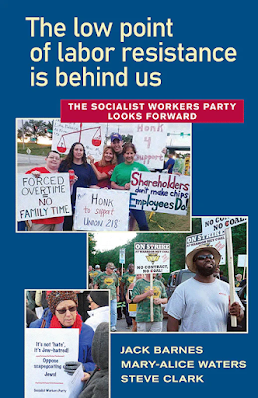
Authored by Jack Barnes, Mary-Alice Waters and Steve Clark, The low point of labor resistance is behind us is the political report adopted by the 49th Constitutional Convention of the Socialist Workers Party (SWP), held on December 12th, 2022. The authors (whom I've dubbed the "Troika") are the long-time (going on five decades now) leaders of the Party. Comrades Barnes and Waters are over 80, while comrade Clark is about 70.

The premise is that the union movement has reached bottom, and because of economic misery workers are becoming more militant and more likely to organize and rebel. This, if true, will reverse a decades long trend that began in the 1970s.

Except I don't think it's true. Just today, in an editorial, the WSJ writes

Union members made up only 10.1% of the workforce last year, down from 10.3% in 2021, according to data released recently by the Labor Department. For a long time the prototypical union shop hasn’t been a private steel plant but a public school, yet the unionized share of government employees also fell.

Though the annual changes look small, they add up: The workforce in 2012 was 11.3% unionized, and in 2002 it was 13.3%. Organized labor hasn’t been able to stop the trend, despite frantic unionization drives, including many aimed at nontraditional members, such as the university graduate students who march under the United Auto Workers banner. Private workers are 6% unionized, down from 8.6% two decades ago. For public workers, it’s 33.1%, down from 37.3%.

Last week ZeroHedge reported similar statistics, along with this rather depressing gem:

The most unionized occupations are public safety (34.6%) and education (33.7%). The lowest are sales (3.0%) and computer and math jobs (3.3%). 

Bad news for Trotskyists, who don't consider cops to be part of the working class.

The Troika might concede that union membership hasn't yet recovered, but they'd insist that the trajectory has changed. Unions, they'd claim, are becoming more militant and better organized, which will be reflected in the overall statistics soon enough. They provide no data for that belief, but are concentrating their efforts in two unions: the bakery workers (BCTGM) and the rail workers. Among the bakery workers, 160 of them have gone on strike in recent months (120 at Ingredion, 40 at Corn Nuts). Both strikes have been settled. This does not auger a surge in labor activism.

The fact is that unions are increasingly irrelevant. There is a serious labor shortage for workers in blue collar professions, and those employees are getting raises. For example, Walmart recently raised starting salaries across the board from $12 to $14 per hour. That's a near 17% raise, for which no strike was required. They're doing this because they need the workers.

The Report consists of 27 sections, ranging in length from a paragraph to a page or two, organized within four chapters. The whole document (not counting prefatory material or illustrations) is about 60 pages long, or approximately 15,000 words. I read it in about three hours.

The first chapter is entitled Opposing US rulers' assaults on freedoms protected by the Constitution and their use of the political police. It describes in detail the unconstitutional persecution of Donald Trump and so-called "MAGA Republicans" by "the government's political police, first and foremost the FBI." It must be noted that the Party has had its own run-ins with the FBI before, notably the COINTELPRO lawsuit in which the Party won $264,000 in damages. Opposing the FBI is consistent with Party history, as the Report discusses at some length.

More, the Party notes that a majority of blue collar workers voted for Trump in 2016 and in 2020. Trump earned the vote of record numbers of Hispanics and Blacks (though the latter was still a small percentage). Therefore supporting civil rights in this case is in solidarity with the people whom they hope to represent. They cast themselves as being on the side of the "deplorables" and the "bitter clingers."

In their defense, the Report cites Leon Trotsky himself:

"Under conditions of the bourgeois regime, all suppressions of political rights and freedom, no matter whom they are directed against in the beginning, in the end inevitably bear down upon the working class, particularly its most advanced elements."

They are also very clear about who their opponents are.

Democrats, liberals, the "left," and "woke," so-called social justice warriors--not rightist or other reactionary forces--have led the assault against constitutional protections and freedoms in recent decades.

Trotskyists have always opposed the Democratic Party and all it stands for. The Report strongly reiterates that position.

While standing up for civil rights, the Report does not explicitly make clear their opposition to Trump and the Republican Party as agents of the bourgeoisie. Trump's name is mentioned in the Report only in passing, and the Republicans are not mentioned at all. This may lead to some confusion as to whether the Party still is part of the Left. I think they unambiguously are, but the Report would be better if they made that case explicitly.

The second chapter is entitled Capitalism's erosion of the family and the working-class road to women's emancipation. This includes some standard boilerplate:

Central to any communist program is a union-led fight for employment, with wage rates, work schedules, and job conditions necessary for families to live. ...

Jobs, not dependence on welfare programs, open a road forward. ...

Class-conscious workers call for a shorter workweek with no cut in pay, with regular hours.

So they're in favor of full employment, but then, after all that, they come out in favor of a comprehensive welfare program: "What is needed is a floor for all families--an income that's sufficient for workers..." to pay for all the bennies. The standard label for such a policy is universal basic income, and was championed by Andrew Yang in 2020.

The weirdest part of the Report concerns abortion. They claim that (boldface mine)

...we fight for women's right to reproductive and maternal health care, sex education (not gender indoctrination), as well as access to the safest and most reliable contraceptive methods and safe and legal abortion.

There is then a long section on how they supported Roe v Wade back in the 1970s, but have now come to regret that choice. The argument isn't entirely convincing. Summarizing in my own words, Roe v Wade short-circuited a national debate on abortion, depriving the working class of an opportunity to come to a decision on their own.

What the current Supreme Court has done, in the Dobbs v Jackson ruling, is simply return decisions about abortion to people in the individual states. They didn't rule on abortion one way or the other. The Party supports this move, and assumes that abortion will eventually be legal everywhere.

But now comes the truly mysterious part (in section 15; boldface mine):

The Socialist Workers Party unconditionally supports the decriminalization of abortion and joins others in fighting for it.

Decriminalization? Why that instead of legalization, as suggested in the prior quote? There is a difference, I suppose, but we're never told what it is.

A hint might be this:

...our communist program has nothing in common with bourgeois and middle-class forces--whether feminists, or campaigners for population control--who in fact advocate abortion as a means of contraception. We reject the pseudoscientific views of those who deny that the issue of human life, a profound moral question for all working people, is always involved in abortion decisions and procedures.

That second sentence is a bit hard to follow because of the double negative (...reject...deny...). It could be more simply written, but I think the mealy-mouthedness is on purpose.

I interpret the Party's position as pro-natalist, i.e., they want workers to have more babies. I think they're right--I describe myself using that word (and not just for workers). It's hard to square pro-natalism with unequivocal support for birth control and abortion. Therefore they equivocate.

The third chapter is entitled The Cuban socialist revolution and our communist continuity. It's much shorter than the first two, and in my opinion is completely wrong. Indeed, I think the Party's whole international analysis is wrong--I'll refer readers to books by Peter Zeihan for a clearer understanding. I'm going to skip over that here.

The fourth chapter--shortest of all--is Forging a proletarian party and educating its cadre. They claim, with no evidence whatsoever, that

The SWP is forging a proletarian party in the United States--a revolutionary political instrument of the working class, whose purpose, as our constitution asserts...is "to educate and organize the working class in order to establish a workers and farmers government, which will abolish capitalism in the United States and join in the worldwide struggle for socialism."

That's a tall order for a Party of about a hundred souls, with an average age in the 60s. The majority of comrades are at or nearing retirement age. Their current leading spokeswoman is Ilona Gersh, who is in her mid-seventies. The leaders are a pair of octogenarians.

What I am most disappointed with is that the Party has not brought in new, younger leadership. While I don't support the Party's goal of revolution and socialism, I have no fear of that ever happening even in my grandchildren's lifetime. But I'm sentimentally attached to my former comrades, and I want the Party to continue to exist. Having the same leadership for 50 years is not healthy. Presuming that the organization will have a meaningful voice when lead by octogenarians is fanciful.

I don't think Jack Barnes, Mary-Alice Waters, or Steve Clark are serious about the World Revolution. They're just concerned for their own sinecures--and what happens after that let the devil take the hindmost.

I enjoyed reading the Report. It's well written, entertaining, and not too long. The illustrations are silly--they're mostly pictures of people standing around holding placards, such as shown on the front cover. But the book is professionally produced. I didn't find any typos--if there are some in what I've quoted here, they are mine. Apologies in advance.


Further Reading:


Monday, June 28, 2021

Book Review: I See Satan Fall Like Lightning

What is the significance of the Passion of Jesus Christ for today?

Nothing! will answer most readers of this blog. The event is merely an ancient myth. Science shall eventually prevail and put religion out of business.

The author of I See Satan Fall Like Lightning, RenĂ© Girard (1923-2015), doesn't entirely disagree, for the Passion is indeed very much myth-like, differing only in one very important way.

Mr. Girard, an anthropologist, was born and educated in France, though he eventually received his PhD in the US, after which his academic career was entirely in America. He retired from Stanford in 1995. His important works are all written in French--the current tome is translated by James G. Williams, who also pens a useful foreword.

Mr. Girard's anthropological interest was the study of primitive and pagan religions and myths. It is only late in life that he converted to Roman Catholicism, and began writing religious books, such as I See Satan..., published in 1999. It may be described as a work of Christian apologetics.

There are two parts to this religion thing: God and Man. Belief in the former requires faith, and can't be derived from reason alone. Mr. Girard makes no effort to "prove the unprovable," and accordingly God is barely mentioned in this book. The latter subject, Man, reduces to anthropology--or at least it has to get the anthropology right. This, of course, is Mr. Girard's wheelhouse--he tells us a lot about Christian anthropology.

A key to understanding the Bible--both Old Testament and New--lies in the tenth commandment:

You shall not covet your neighbor’s house; you shall not covet your neighbor’s wife or his male servant or his female servant or his ox or his donkey or anything that belongs to your neighbor.

Covetousness is the way Satan enters the world--I'll provide a modern example. Consider the rivalry between Donald Trump and Jeff Bezos,

  • Donald envies Jeff for his great wealth, perhaps a hundred-fold greater than what Donald possesses.
  • Jeff envies Donald for his charm, charisma and power.
Each envies the other for what he doesn't have. Ultimately, they both want the same thing--to be the richest man in the world who is also president of the United States. In other words, they become like twins--they share the same goals and are in intense competition with each other.

Mr. Girard calls this mimetic rivalry, and pagan myths are replete with brothers, often twins, fighting to the death to successfully imitate the other. Cain murdered his brother Abel. Romulus murdered his twin brother Remus. Joseph was exiled by his jealous brothers (Gen. 37-50). Mr. Girard asserts that such stories are common among primitive peoples around the world--presumably this is documented in his previous anthropology works.

It gets worse. Mimetic rivalry can grow into mimetic contagion, i.e., groups of people competing with other groups. Republicans envy Democrats, and vice versa--which ultimately reduces them both to something twin-like. Tweedledum and Tweedledee is how my Trotskyist friends like to describe them. Mimetic contagion is the source of social conflict, discord, and disorder.

If there is good news here, it's that Satan doesn't really exist--or at least not like a person or an angel. There is not a little devil on your shoulder urging you to do naughty things. What does exist is this inborn, mimetic covetousness that leads us to take sides and hate our neighbors. It is covetousness that results in the other sins described in the ten commandments--murder, adultery, etc.

Satan exists as collective behavior as mimetic contagion--today we'd call him an emergent phenomenon--the product of covetousness.

Yet Satan--described in the Bible as the Prince of this World--has a problem. His power depends on some level of social cohesion. Failing that, everything will end up in nuclear holocaust, and Satan will be dead along with the rest of us. So the disorder and conflict can't get too far out of hand. Satan has to curb his enthusiasm--or as Mr. Girard puts it, loosely quoting the Bible, Satan expels Satan.

How does Satan do that? It's something that Mr. Girard describes as the single victim mechanism, which he again claims is ubiquitous in primitive and pagan practice. We might recognize it as human sacrifice. The archetype example presented by Mr. Girard is the story of Appolonius of Tyana upon his visit to Ephesus. He found the city suffering from a severe "epidemic," though not of a biological kind. Instead it was riven by feuds and discord caused by mimetic contagion. (Spoiler alert--the full story quoted in I See Satan... is much more horrifying than my abbreviated account.)

Appolonius perceives a solution, and fingers a poor beggar as the culprit. "See," he says. "That man there is the cause of your troubles. He should be stoned." He does eventually convince somebody to throw the first stone--after which the stones fall fast and heavy. The beggar is murdered, but because the mob truly believes that he really was the guilty party, the "epidemic" quickly fades away, eventually to be replaced by renewed mimetic contagion. The beggar is a scapegoat.

The mimetic conflicts are all laid upon a single victim--inevitably somebody who has no friends or relatives to defend him or her: beggar, leper, widow, foreigner, etc. They're all ritually killed, one by one, or perhaps several at a time--and as long as the mob believes, it works. Social solidarity is temporarily restored. Satan has expelled Satan.

Sometimes the effect--civic restoration--is so sudden and beneficial that the citizens are deeply grateful to the victim. He or she is posthumously deified, and occasionally even resurrected. Mr. Williams, in the foreword, explains that pagan gods (such as those of Greek mythology) are usually just deified,  resurrected victims.

The Hebrew Bible understood that at least some victims weren't guilty--they were innocent. Joseph--a victim not murdered but instead exiled--was not guilty. Job is set upon from all directions--yet the Bible proclaims his innocence. The Jews have through the ages disproportionately served as victims, and according to Mr. Williams the Psalms are poems sung by innocent victims. (This insight has put the Psalms in a whole new light for me.)

But now consider the Passion--which follows the single victim mechanism almost to the letter. Jesus is both a foreigner and a pain in the ass. Jerusalem is beset with conflict and strife. The mob is convinced that Jesus is the source of their problems--and so are Herod and Pontius Pilate. The latter orders him ritually tortured unto death. "Forgive them," Jesus says, "for they know not what they do." They don't, because if they did the single victim mechanism wouldn't work.

But the disciples knew--and they proclaimed it loud and clear upon Jesus' resurrection (another echo of the pagan myth). Now you may not believe in the resurrection, but what you believe is in this matter irrelevant. There is no doubt that the disciples and the apostle Paul believed in the resurrection, and they proclaimed it far and wide. The resurrection was for them also proof of Jesus' innocence. He didn't call himself a scapegoat, but he picked a much better term: lamb of God. What can be more innocent than a lamb?

The Passion has destroyed the single victim mechanism for all time. Post-Passion, it's been impossible to sacrifice human beings (and increasingly, also animals) because it won't work. Since Jesus, people no longer believe the victim is guilty--instead he or she is innocent! Killing an innocent victim is murder--and it will no longer absolve one of one's sins. Satan can no longer expel Satan. 

Satan has lost his power to expel Satan, but he still exists and still sows havoc--the political polarization in US politics is a case in point. But Jesus has taught us that victims are innocent--far from blaming the victim as the pagans used to do, we now compete to become the most victimized of all victims. Even white males are today becoming victims because of "reverse racism," or "critical race theory." Our world is full of victims, all trying to imitate each other to become the victim to end all victims. "The first shall be last, and the last shall be first." We're in a mimetic competition to be "last."

That is the significance of the Passion for today! I don't think Mr. Girard is wrong.

Further Reading:


Monday, March 8, 2021

Book Review: The Cult of the Smart

This is the book that Jack Barnes wishes he'd written. Mr. Barnes is the long-time leader of the Socialist Workers Party (SWP), who penned a tome entitled Are They Rich Because They're Smart? .

In today's book, The Cult of the Smart, author Frederik deBoer declares

This book is my prayer for the untalented, an attempt to show how badly our society and its people are hurt by the obsessive focus on schooling and smarts.

He does answer Mr. Barnes' question: they are rich because they're smart! This is unjust in two ways:

  1. The emphasis on smart results in a meritocracy, namely a class of people that claim for themselves all the best jobs, and because they've done so well at school, they hold themselves morally superior to folks with low IQ scores. Mr. deBoer claims that most jobs don't require a high IQ, and sorting people by education is largely unjust.
  2. "Smarts," aka intelligence (measured as IQ), is substantially genetically inherited--that is at least 50% of a person's IQ score can be attributed to genes. In this it is very much like musical talent, aptitude for basketball, or good vision, among many other traits. And while those attributes can contribute to a better life, smarts looms vastly larger in future outcomes. Intelligent people earn substantially more than the less intelligent. In Mr. deBoer's world, this is grossly unfair.

    Mr. deBoer imagines himself a Marxist, and accordingly the real villains are the bourgeoisie, otherwise known as the top 1%. But there not very many of them--only 1%--so while their economic importance is indisputable, their cultural influence is much weaker. For this they rely on the upper middle class--the top 20% of the population, and the best-educated people in the country. These are the folks who dominate academia, the media, politics, and the prestigious professions. They are, in a word, the meritocracy. This is also Mr. Barnes' point of view. 

    The claim of the education establishment is that school is the great leveler--it gets everybody up to speed so they can compete in the modern economy. Mr. deBoer disagrees.

    Because education is not a weapon against inequality; it is an engine of inequality. Far from making society more equal, our education system deepens inequality, sorting winners from losers and ensuring even greater financial rewards for the former. Nowhere is this dynamic more prevalent than in college.

    He describes college as the "instrument of inequality." Students are tracked according to their IQ scores--those who are smart get ahead and eventually enroll at Harvard. The less gifted wind up at the local beauty school. It's deeply unfair.

    It's a chicken-and-egg problem. Do students perform badly because they attend bad schools? Or are the schools bad because they enroll poorly performing students? The received wisdom on the Left is the former answer--if we just equalized the schools, or the curriculum, or the funding, then all students would excel equally and educational inequality would disappear. This is termed the blank slate hypothesis--the contention that all children are equally endowed with intelligence, and all can learn calculus if they just try hard enough.

    Mr. deBoer rejects the blank slate hypothesis. Summarizing current literature, he writes,

    The relationship between genes and behavioral traits is neither perfect nor fixed; environment does matter, to a varying degree, and there are interventions that can ameliorate some of the impact of genes. The degree to which genes assert themselves varies over the course of life. Profoundly unequal environments for children can drown out genetic effects. There is also what behavioral geneticists call the "unshared environment," ...--the influence of unpredictable events, random chance, the flux of life. But none of that changes the fact that our genetic heritage deeply influences our behavioral selves, including our academic selves and that we should recognize that individual exceptions are less important than larger trends when we are dealing with broad populations. Like, say, when we're considering educational policy.

    What Mr. deBoer writes about genes and behavioral traits corroborates the book Human Diversity, written by Charles Murray and which I regard as the leading textbook of the discipline. That Mr. deBoer and Mr. Murray mostly agree is something I find very reassuring.

    Mr. deBoer urges his fellow Leftists to reject the Blank Slate dogma--the evidence for genetic influence on personality is too strong. By insisting on a manifestly false principle, the Left discredits itself.

    In one important respect he disagrees with Mr. Murray--Mr. deBoer insists there are no racial or ethnic differences in IQ or other personality traits. He concedes that much is inherited--children tend to be as smart as their parents, who in turn take after their grandparents, and similarly are related to their cousins, nieces and nephews, and the whole clan. But to then claim that an ethnic group that practices endogamous marriage does not share on average a suite of personality traits is unreasonable. Of course they do--and in fact they must, as is amply and overwhelmingly demonstrated in Human Diversity.

    Scott Alexander, in his lengthy review of The Cult of the Smart, argues that this opinion is not just a concession to political correctness, but rather a deeply held belief by Mr. deBoer--which Scott describes as vaguely irrational. But I think I have some insight here, because like Mr. deBoer, I have spent my career as a college professor. And I can tell you that thinking about IQ in racial categories is deeply, deeply destructive.

    I used to teach general chemistry to a class of about 100 students--including a handful of Black students. It is horribly unfair to those students to walk into a classroom with the prejudice that Blacks aren't as smart as whites. For even if that is true on average, the students in my room are not average--they're not even close to average. For that matter, the white students aren't average, either--because anybody who enrolls in a general chemistry class is both smarter and more motivated than anything average. Conflating a half dozen individuals with an average over a large, and in this context irrelevant population is a huge category error. So big, in fact, that it's immoral. Anybody smart enough to read Charles Murray or Frederik deBoer should know better.

    I think Mr. deBoer, with his otherwise irrational rejection of racial similarities, is responding to that immorality--and for that I give him props. But he's still wrong.

    Mr. deBoer offers two lists of reforms--a list to be accomplished in the short-term, like under the Biden administration. And a more utopian list that might have to wait till after the revolution. Surprisingly, I agree with many items. I'll summarize in bullet points:

    • "Provide Universal Childcare and Afterschool Care"-- He rejects the argument that either of these improve educational outcomes, but he supports it...
    As a socialist, my interest lies in expanding the degree to which the community takes responsibility for each of its members, in deepening our societal commitment to ensuring the wellbeing of everyone.

    Needless to say, I don't support this objective.

    • "Lowering the Legal Dropout Age to 12"-- If the less-intelligent are forced to stay in school, then the obligation to graduate them requires the school to dramatically lower standards. Mr. deBoer documents this phenomenon at length. Among other things, it renders the high school diploma meaningless.

      I support this--our children spend waaaay too much time in school. An unmentioned corollary is that we need to let teenagers participate in the paid labor force--otherwise you have unsupervised kids out looking for trouble.

    • "Eliminating Charter Schools"-- Why? I mostly accept Mr. deBoer's argument that charter schools yield no net positive educational benefit, but that misses the point for two reasons. First, while not changing the statistical average, charter schools may be of significant benefit to individuals. It's very much like the Black students in my gen-chem class--the average is irrelevant. All that matters are the individuals. Why not let students choose the school where they will be most successful?

      The second reason--even if there is no educational benefit--there are surely other benefits. There are, for example, advantages to children wearing uniforms--it likely saves the parents money. Scott mentions that kids can escape bullies by moving to a charter school. For many kids and parents, they're just more fun. Besides, they're cheaper than the public schools. I see no benefit in banning them.

    • "Loosening Standards"-- I strongly agree with this one. We should abolish the absurd standards left over from the early 20th Century. My pet peeve--which Mr. deBoer also addresses--is the high school algebra requirement. Many kids will never pass it. Many more will pass it, but only at great cost in terms of time and misery. And to what end? If anything is less useful than high school algebra, I can't imagine what it is. Probably fewer than 1% of jobs in this country will require any facility in algebra, and computers can do it better than you can. The only people who should take algebra are people who are interested in mathematics for its own sake, or people who know they're headed for certain STEM careers.

      I feel the same way about long division. When was the last time any reader of this blog used long division? Likely not since the fourth grade. Waste of time.

    • "College is Unnecessary for Living a Satisfying Life"-- Amen, brother! In college we have something called a general education program that's designed to turn you into an educated man or woman. In this day of unlimited bandwidth and instant access to any information you want, it's completely unnecessary. Anybody can go on YouTube and learn about anything from introductory electrical engineering to the Bible as literature, and everything else in between. The notion that you have to study all that at age 18 (when, frankly, most people are not interested) is almost as silly as learning algebra.

      If we canned the gen-ed programs, college could be shortened by a whole year, saving everybody a lot of time and money.

      I disagree with Mr. deBoer's claim that general education is mostly about racial bigotry.

      He spends most of the chapter discussing the salary benefits that accrue to college graduates. He rightly points out that it's mostly about native aptitude, not anything learned in school.

      My view is that college is useful for those people who enjoy school and are good at it. Everybody else should stay away. The worst thing you can do for your career is to go to college and then not graduate. That's a black mark that will follow you for the rest of your life. Better not to go to college at all.
    The final chapter of the book lays out his idealistic perspective. It's complicated and I won't cover it here. Let me just pick out a snippet. 

    The modern meritocracy doesn't judge itself by its material well-being, but instead ranks itself by status symbols: where you went to school, where and how intensively you've traveled, how Woke you are, how much you feign concern for the environment, etc. Mr. Barnes cites a similar list.

    Mr. deBoer writes,

    The old version of middle-class success--a two-car garage, a well-mowed lawn, and a big-ass television--seems simpler and more accessible, as it placed far less emphasis on success in a scarce number of fields ... But of course the heyday of this type of success was riven by racial and gender exclusion...

    Like too many Leftists, Mr. deBoer grossly exaggerates the effects of racism. The problem was never racism as much as poverty--solve the poverty problem (which we've substantially done), and the "racism" mostly goes away.

    And so those old middle-class ambitions have made a comeback--now expressed as Make America Great Again. The Left, of course, interprets it as "racism", but then they interpret everything that way. It's not racism. It is instead a plea to return to middle-class, bourgeois values that are much more democratic than those of our current meritocracy.

    Mr. deBoer has written an excellent, very worthwhile book. Jack Barnes really needs to read it. 

    Further Reading:


    Tuesday, January 5, 2021

    Book Review: The Future of Higher Education

    Because the topic is so close to my heart, this post is very long.

    The book, Sustainable, Resilient, Free: The Future of Higher Education,  by John Warner, is a joy to read. Mr. Warner, an untenured affiliate professor of English at the College of Charleston, can definitely practice what he teaches--he knows how to write. Whatever else you think about this book, you won't be bored.

    I thank Mr. Warner for agreeing to send me a review copy. His generosity is not the important part, but rather the attitude his gift implies. For he knows that I will be critical of his thesis (as indeed I am), yet still thought I should read it. I call this charity in the sense that Abraham Lincoln meant it: with malice toward none, with charity for all. 

    That is, I doubt Mr. Warner expects me to agree with him, but perhaps he does hope that I will understand him. It's not that we should bury our differences in some kumbaya moment--our disagreements are too profound for that. It's likely there will never be a meeting of the minds. But if we can understand each other, give credit to each other for acting in good faith, and engage in civil discourse--then surely the world is a better place and our democracy that much stronger. (This blog is founded on the principle of civil discourse.)

    Right-wing though I may be, I can't stand Sean Hannity and Laura Ingraham--or Rachel Maddow and much of the PBS News Hour. Those are all propaganda shows, and I have no use for propaganda.

    Mr. Warner's book is not propaganda, but he does fall down a bit in the charity department. In the first chapter he calls Republicans "evil", and accuses us of "sabotage." Mocking Betsy DeVos is given as an example of how "someone has benefited from their college education." This is not charitable language, and fortunately it's not typical of the book as a whole.

    The major thesis of the book is that nearly all public higher education expenses should be borne by the federal government, and no tuition should be paid by students. There are at least two problems with this:

    1. The federal government is (by definition) a political animal, and with every change in administration the goals set for higher ed will change. Remember that Republicans will be in power approximately half the time--for every Arne Duncan there will follow a Betsy DeVos. Is putting all your eggs in that one basket really a sustainable way to run higher ed? Probably not.
    2. As Mr. Warner repeatedly points out, students need to be in charge of their own education. That means at very least they must have a right to exit--that is, when they leave they can take their money with them. If they put no money on the table, they ultimately lose any authority to change anything. They will always be at the mercy of Betsy and Arne in the Education Department.
    Case in point: the feds already allocate substantial funds to higher ed (both public and private) and use the accruing authority to regulate students' romantic relationships down to the most intimate details. There is a case for colleges acting in loco parentis, but to defer this responsibility to Betsy and Arne strikes me as a path toward totalitarianism. The solution is to reduce federal investment in higher ed, and thereby minimize their power.

    Germany is a cautionary tale. German universities are tuition-free (and prior to 2014 they charged only nominal tuition)--and they're terrible. It takes the typical student nearly a decade to complete their education, the classrooms are massively overcrowded, grades are assigned exclusively by final exams, and the faculty are completely unaccountable to anybody (they can't even be fired for financial exigency). Entrance criteria rely overwhelmingly on a nationwide test, and admitted students are assigned by the government to any university in the country. Is this the model Mr. Warner wishes to emulate?

    Another wonderful example of "free education" is K-12 in this country, where, apart from a few charter schools, students have lost the right to exit. It's a complete disaster. Indeed, the more money spent per student, the worse it gets. Why does Mr. Warner think federalizing higher ed will somehow have a different outcome?

    According to Statista, in 2017 the US spent 2.6% of GDP on higher education, second on a list of 42 countries (including, I believe, all OECD countries) behind only Chile (2.7%). (The complete list is behind a registration wall.) Of that fraction, 1.7% of GDP was spent at private institutions (I suspect largely on their research mission), while 0.9% was spent at public institutions. By comparison, Germany spent a mere 0.2% on private schools, but 1% on public schools.

    Perhaps Mr. Warner can tell us: What fraction of GDP is optimally spent on higher education? Who should make that decision? And who is going to be accountable for the results? His book doesn't say. I think students should have a significant voice in these decisions, and that means they have to put money on the table and be able to vote with their feet.

    Mr. Warner's major complaint about the current system is it forces colleges to compete against each other. In his opinion this is bad--and he does have a point. On first pass, competition reduces to simple-minded comparisons, such as the execrable US News and World Report rankings--that are apropos nothing in particular. But that's only on first pass--anybody who's serious about going to college will be looking under the hood. Think about the campus tours, the open houses, the relentless efforts of admissions offices to generate people to fill the seats. None of that would happen if students weren't concerned about more than magazine ratings.

    Here's some news for you, Mr. Warner: prospective students know more about your college than either Mr. Duncan or Ms. DeVos. Please let students decide where to spend their money and time--not some corruptocrat up in Washington. It's the job of your institution--from the admissions office on down--to provide them with as much information as possible. And precisely because they are paying you, it is also your responsibility to live up to whatever promises you make to them. Your advertising can't be bullshit.

    Which means Mr. Warner presents a false dichotomy. He quotes Carol Christ, chancellor at UC Berkeley: 
    Colleges and universities are fundamentally in the business of enrolling students for tuition dollars.
    And of course that's true, but it's only half the truth. For in order to enroll students, the institution must deliver a good product--otherwise no students will enroll. Without money one can't provide a good education, and without providing a good education, one can't possibly earn the money. Does Mr. Warner work for his paycheck? Or does the paycheck enable him to do his work? The answer is both--so when he claims that competition detracts from the goal of a good education, he's just plain wrong. It's possible--indeed, essential--to do good teaching and earn tuition dollars at the same time.

    Mr. Warner's plan will require only a minor modification to Ms. Christ's statement:
    Colleges and universities are fundamentally in the business of enrolling students for tax dollars.

    In other words, students will lose their vote. 

    Mr. Warner rightly notes that the magazine rankings are a zero-sum game--for every college that moves up a notch, another must move down. It is then ironic that he champions social mobility as a goal for higher education. He writes
    Data compiled by Harvard economist Raj Chetty shows that colleges are largely stratified by socioeconomic class in terms of students they admit. Only a few institutions in the country achieve a high "mobility rate," moving students from the bottom 40 percent of income to the top 40 percent.

    And perhaps it's good--to move students into the top 40%. But of course it is mathematically impossible to move 80% of students into the top 40%--by definition only 40% of students can be in the top 40%. That means that for every student that moves up, another must move down. So just like the magazine rankings, social mobility is a zero-sum game. It is ironic that Mr. Warner is imposing on students precisely the zero-sum game from which he wants to hold colleges exempt.

    Who are these downwardly mobile? Consider the seven rich kids--white, college graduates, well-travelled, progeny of upper-middle-class parents, ranging in age from 20 to 30--who are members of the New Afrikan Black Panther Party [transgressive "k" in original] and got themselves arrested for rioting and smashing store windows during the recent "George Floyd" protests.

    Why did they do that? I don't know, but here's an educated guess: elite educations and wealthy parents notwithstanding, these folks have only menial and/or low wage jobs to look forward to. Their futures look bleak, an upper-middle-class lifestyle is increasingly out of reach. In other words, college didn't prepare them for anything--they're on the downhill slide, and they know it. Of course they're pissed.

    Social mobility is great for the folks moving up, and traumatic for those on the other side. There is no net benefit to society as a whole. Increasing social mobility should not be a goal for either the government or the university, and it is no reason to federalize higher education.

    Unlike social status, wealth is not a zero-sum game. A rising economic tide lifts all boats--rich and poor alike. The goal is to lift the boat, not merely to rearrange the deck chairs. Taking money from the rich and giving to the poor works only if it also grows the size of the pie. In most real cases, however, it actually shrinks the pie and on average makes everybody poorer. For example, forgiving student loans will have precisely that effect: it is a benefit to rich people attending medical school, paid for mostly by people who never went to college. The primary beneficiaries will be unproductive rent collectors, namely the med school cartel.

    Speaking of rent collecting, tenure is a lifelong pass to collect rents paid for by 19 year-olds. By "rent," I mean an income stream that depends only on a person's position or status, and not on their labor or ability. (Rent in the real estate sense doesn't mean the same thing.) A bribe paid to a bureaucrat is a form of rent. Licensing enables rent collection--people with licenses can charge extra for their services despite not doing any more work than people without licenses. (Milton Friedman argued convincingly that all occupational licenses should be abolished except for nurses.)

    Rents are a dead-weight loss to the economy--and certainly that's true for tenured professors. "I just got tenure" is a synonym for "screw students."

    Contingent faculty receive no rents, and therefore are likely paid at the market rate. Mr. Warner has a long chapter explaining how he wants to lower salaries for tenured faculty (i.e., deprive them of their rent), and raise the salaries of adjuncts. The former is not likely (no way are the tenured gonna give up their rents), and the latter is not desirable. What Mr. Warner is really suggesting is that adjuncts should also be entitled to rents.

    Suppose adjuncts are paid at the market rate. Then the reason salaries are so low for contingent English faculty is because of competition from the gazillion English PhDs out there looking for any kind of professional employment. The benefit to students is maximized when as many of them are hired as possible--and the market rate does that. Paying below market will cause fewer adjuncts to seek positions, harming students. Paying above market will, because of financial constraints, reduce the number of adjuncts that colleges can afford. So the market rate maximizes the number of adjuncts--which is certainly good for students, and probably on net best for adjuncts as well. Mr. Warner's rent collection scheme means there will be more unemployed English PhDs--imagine the misery of those folks as they glide down the status escalator.

    What is the purpose of going to college? According to Mr. Warner, it is most importantly a certain je ne sais quoi--an ill-defined, vaguely religious mission of self-discovery and enlightenment, the value of which will only become apparent years after completion. This, along with "critical thinking skills" (whatever those are--don't get me started) is what justifies taxpayer support for higher education.

    I think if you ask students why they go to college, you'll likely get some list like this: career preparation, finding a spouse, partying, making life-long friends, having sex, discovering new things, getting drunk, playing sports, joining a fraternity/sorority, smoking weed...  Those are mostly good reasons, though few of them have much to do with academics. I don't know what on that list maps onto Mr. Warner's je ne sais quoi, nor do I see anything that justifies a huge government subsidy--except maybe it gets the kids off the street for a few years.

    For adults returning to school, the list shrinks almost exclusively to career preparation.

    Mr. Warner makes two implicit assumptions that I think are incorrect. First, he seems to believe that there is a shortage of educational opportunity in this country. I strongly disagree. In my view we are already hugely over-invested in higher ed, much of what we spend on it is wasted, and the economy will do better if we redirect resources elsewhere. The last thing this country needs is more seat-time in college classrooms.

    We're really scraping the bottom of the barrel. Mr. Warner writes about a survey conducted during the pandemic disruption, which found that
    44 percent of two-year college students and 38 percent of four-year college students experienced food insecurity. Eleven percent of two-year students and 15 percent of four-year students lacked a stable place to live.

    Admittedly, the pandemic is an extraordinary time which has greatly exacerbated these statistics--and perhaps some short term response is in order. But even before the pandemic, SUNY campuses (my employer before I retired) had made food pantries and housing solutions a priority.

    I'm not against feeding the hungry or housing the homeless, but this is NOT a responsibility for higher ed. Our job is to educate all qualified students--qualified being a term Mr. Warner uses. Somebody whose life is in such disarray as to be homeless and/or hungry has urgent problems that preclude them from being qualified. By enrolling them, colleges are artificially inflating their enrollments and therefore receiving more subsidies--it's a grossly unethical tax-grab.

    Mr. Warner writes that 

    Another reason why elite private institutions are irrelevant in terms of reshaping the higher education ecosystem as an engine for broad-based prosperity is that these schools overwhelmingly serve students who are already prosperous. The Raj Chetty data on economic mobility reveals that the median annual family income for students at Ivy League institutions is between $150,000 and $200,000. Two thirds of their students come from the top 20 percent in terms of income. While graduates of Ivy League colleges who started in the bottom 20 percent income bracket have a better than even chance of moving up to the top 20 percent bracket, fewer than 4  percent of Ivy League students come from the bottom 20 percent to begin with.

    This means that fewer than 900 individuals per year are put on track to move from the bottom to the top of the income ladder by graduating from an Ivy League institution. 

    Elite colleges (including the Ivy League) may not be leaders in social mobility, but they definitely excel in overall wealth creation. Bill Gates, Mark Zuckerberg, the Google Guys, and many more attended elite schools. Eight of the nine sitting supreme court justices attended law school at either Harvard or Yale--Amy Coney Barrett (Notre Dame) being the lone outlier. Bill Clinton got his law degree from Yale, Barack Obama is J.D., Harvard. Donald Trump graduated from Penn. George Bush must've read a book or two while studying at Yale, and eventually completing an MBA from Harvard Business School. Odds are that the corruptocrat who works for Betsy and Arne is an Ivy Leaguer.

    For better or worse, these people are key for "broad-based prosperity." People in the top few percent of  the IQ distribution, regardless of where they went to college, are responsible for the overwhelming majority of new science, technology, and social/political movements. Without them we'd all be as poor as church mice. 

    Apples usually don't fall far from the tree. Children born into the top quintile are more likely to be: smart, healthy, beautiful, do well in school, come from intact families, excel at standardized exams, attend church, compete in science fair projects, and marry other people from the top quintile.

    Children born into the bottom quintile are more likely to: fail in school, be unhealthy and perhaps obese, have substance abuse issues, come from single parent households, suffer from homelessness and hunger, get involved in crime, watch too much TV, and never get married. None of these problems will be fixed by going to college.

    Seen this way, it is quite astonishing that Ivy League institutions can find 900 qualified students per year from the bottom 20%. They must work really hard at this--and even though I'm not necessarily a fan of social mobility, the fact that so many kids can be pulled out of poverty into the elite is inspiring. We should celebrate this, not deride it as a lack of educational opportunity. It is precisely not that.

    Mr. Warner's second implicit assumption is that the interests of faculty and students largely coincide--that faculty invariably have students' welfare at heart. I don't blame him for thinking that way, for until I entered the administration I would've agreed with him.

    I call it the lowest common denominator effect.

    I used to teach general chemistry, a task I shared with three or four other people in my department. We agonized over textbooks, teaching methods, exams, etc. We worked hard to do right by our students, and I can say without hesitation that everybody on that team cared deeply for our pupils. Likewise, Mr. Warner and his colleagues are similarly passionate about English composition--and I'm sure they work just as hard.

    But were Mr. Warner to ask me what textbook he should use, I'd have no clue. Similarly, I don't even really know what their pedagogical objective is: is it how to follow the MLA style manual? Or how to write a coherent paragraph? Or how to construct a grammatically correct sentence? Or merely an opportunity to get students to express ideas on paper, regardless of skillset? Even given the objective, I'd have no idea how to execute it in practice. Meanwhile, Mr. Warner is expert on all those issues--even though he probably couldn't do a simple titration if I put the equipment in front of him.

    As a former dean of science & engineering, I was shocked to learn how differently the math department thought about instruction than did the chemistry faculty. Meanwhile, the geologists are fixated on problems posed by long camping trips, e.g., to the Grand Canyon, that our English colleagues might think of as junkets. I had some interaction with the fine arts faculty, and honestly, they live on a completely different planet.

    Each of those faculties care deeply about what they do and work very hard at it. On that level, student interest and faculty interest largely correspond (though even there not completely). But when the professors get together--say at a general faculty meeting or as part of a union--what do they talk about?

    How are we all gonna keep our jobs? Are we really gonna get the promised 2% raise this year? What constitutes a full time teaching load? Why do I have to work so hard? This is the lowest common denominator--it's the only stuff we're all concerned about.

    It has nothing to do with students or teaching. The more faculty there are in a room, the less important the topics of discussion become. It justifies the old saw: nothing is less important than the agenda of a general faculty meeting.

    Let me cite one especially egregious example. The college's general education (GE) requirements are subject to review and revision every ten years or so, and this is the responsibility of the faculty as a whole. The whole thing is a travesty, because the GE program is designed specifically to satisfy the lowest common denominator demands of the faculty. While lots of suggestions come forth that might actually benefit students, what comes out at the end is a turd.

    Many years ago the college instituted a foreign language requirement--students were all obligated to take two years (four semesters) of foreign language instruction. Perhaps that made sense thirty years ago, but it's crazy today. Now we have cheap software (e.g., Rosetta Stone), cheap airfares (less than the cost of tuition), and Google Translate (for the incorrigibles who refuse to learn a language). Plus English is far and away the world's second language--it is surely the international language of tourism.

    So while I think foreign languages are important, college classroom instruction in a language is no longer very useful--especially since students are rarely fluent even after four semesters (my impression is that many can't speak it at all). So the requirement really should be abolished!

    I was not alone in my opinion, but doing that required laying off the folks who teach the classes, and this the lowest common denominator faculty refused to do. Admittedly, the language teachers would have had a very hard time finding another job (which says something about the importance of said instruction), and the proper solution is hard-hearted. So the language requirement persists to this very day--students' best interest be damned. They're still forced to waste their tuition money, and worse, their time. (My motto as dean became Never waste a student's time.)

    As individuals, faculty are generous, idealistic, hardworking people. Collectively they're a bunch of selfish jerks. I learned that as dean, and my goal in that job was to push back against lowest common denominator policies. Needless to say, I wasn't very successful.

    I could go on about Mr. Warner's book, but I won't. Let me close on a happier note.

    For as much as I disagree with his book, I deeply admire him as a person. First, unlike us tenured sorts, he's earned an honest living, surviving only because he's very good at his job.

    Second, his dedication is amazing. He could surely have chosen a higher-paying career, and yet he loves to teach. The world needs more people like that. If I were dean, I'd hire him in a heartbeat!

    Finally, he really is a good writer. For as much as I wanted to throw my shoe through the TV set, I happily kept reading his book. It's very clear, passionate, occasionally funny, brutally honest--and completely wrong.

    But read it anyway. It's worth your time. I went with the Kindle edition, which worked fine. As you'd expect from Mr. Warner, I didn't find a single typo.


    Further Reading:
    Thursday, August 20, 2020

    Book Review: Bronze Age Mindset

    The book is Bronze Age Mindset, written by somebody who self-identifies as Bronze Age Pervert. Published in 2018, it has become a cult classic, and perhaps the defining text for the alt-right. I’m in debt to Michael Anton, whose comprehensive and excellent review of the book got me interested.

    I hesitated reading Mindset, partly because Mr. Anton’s review led me to think my college education in Greek classics (45 years ago) left me unprepared, and then also because I was afraid I might actually agree with the book.

    I was wrong on both counts. No doubt Mr. Pervert definitely knows his Herodotus, Thucydides and Plato, and much else besides. But he imposes little on his readers--you don’t need to know anything to read his book. If you can read my blog, you’re educated enough to enjoy Mindset.

    I have come to three counter-intuitive conclusions about Mr. Pervert--speculations, really--that I’ll explain in due course.

    As you might expect, the book is proudly racist, sexist, homophobic and illiberal. A typical excerpt:

    Should the tyranny that has descended on our age ever gain the power it seeks and then be challenged enough to feel itself in danger, the mass annihilations that will be carried out by homosexual, transsexual, and especially lesbian commissars will exceed in scale and cruelty anything that has yet happened in known history. Imagine lesbian mulatta commissars with young Martin Sheen face and haircut manning the future Bergen-Belsens, installations that will span tens of miles.

    It’s in-your-face political incorrectness, and many will be angered by it. Definitely written to prick your nose. A more over-the-top, entertaining, funny, put-down of gay people is hard to imagine. And it contains just enough truth that the gullible, Superman sorts are bound to swallow the whole yarn.

    I found Mr. Anton’s review frustrating because he never explained Mindset’s hierarchy. Who, for example, are the oppressors in charge of the tyranny? Who are the oppressed? Who are the men--young, beautiful men, whom I dub supermen--who are tasked with rescuing us?

    It turns out Mr. Anton’s confusion stems from the original text. Even after reading Mindset I don’t understand the sociology.

    Start with the tyrants--all we’re really told about them is that they remain hidden. “I don’t think we can ever know who these individuals are, but I suspect they walk among us like average men.” It’s possible they’re not even people: the tyranny could be an emergent phenomenon arising from modern complexity.

    Whoever they are, they’re not the obvious suspects.

    Please remember that these small people like Bill Gates, Zuckerface, and Bezos are entirely dependent men. They can’t really do with their wealth what you think they can...for example, they could never just kill a man and take his wife, but even the ruler of the smallest African country has this power, this is true wealth. (ellipses in original)

    So both the tyrants and the tyranny remain hidden (this is one doozy of a conspiracy theory--nearly schizophrenia-worthy). Even the victims--he calls us bugmen--are mostly blissfully unaware. Here I’m living happily in retirement not yet realizing that I’m really a slave to Leviathan (the term Mr. Pervert sometimes uses).

    Yet cracks do appear in the edifice revealing the depths of our slavery. Those slits of light show through in places where polite society falls apart. Mr. Pervert knows about this, because true to his name he’s spent much time in the fleshpots of Southeast Asia. He’s familiar with the drug-dealing prostitute, the vicious bar bouncer, the filth of the yeast-like city.

    He knows all about feminine homosexuals--the poorest, most miserable victims of the tyrant. They--uniquely--see through all the playground games of their male school chums, and realize how useless and empty they are. For, according to Mindset biology, the goal of life is to occupy space. Yeast, for example, grow until the petri dish is full, and then they’ll start growing on top of each other.

    Men, also, want to occupy space, and when space is full, they try to steal it from others. This is the goal of schoolyard antics--boys try to steal each other’s space. It’s just a game, but a serious game.

    But the feminine homosexual realizes the futility, for the tyrants already own all the space. No matter how much you practice conquest, you’re doomed. All you’ll get are the left-over dregs. Most of us bugmen imagine we’re satisfied with a house and lot, and even Mr. Bezos thinks he’s a member of the ruling class! But we’re all bamboozled by the tyranny.

    The feminine homosexual sees through the scam. He knows he can never resist, so he gives up. He retreats into a yeast-like existence--the most miserable form of life for a man. He becomes gay, or ghey, as Mindset often spells it.

    How different this is from what you’d expect from the alt-right. Instead of being the scum of the earth, they are instead the tyranny’s chief victims. We’re supposed to feel sorry for them.

    Speculation #1: Mr. Pervert is gay, maybe even ghey. His very name suggests as much.

    Yeast deserve further attention. Women and Chinese have one thing in common--they are both yeast-like. There are two forms of life in Mindset’s framework: yeast and higher life. Yeast are all the same--they just grow and grow until they occupy all the space. Higher beings, on the other hand, specialize, and evolve different skills for different purposes. Some are soldiers, others peasants, more are slaves, and a few are tyrants. None of this variation happens among the yeast.

    Women are yeast-like because all they usefully do is drop babies. (Mr. Pervert discounts the latter-day entry of women into the professions.) Above all women are ill-equipped to do what in Mr. Pervert’s Mindset is most important--kill people, steal their wives, and grow their space.

    China is a yeast-like culture, demonstrated by its unchanging character--it’s maintained the same society for 5000 years. There’s neither progress nor regress in China.

    Places of higher culture (e.g., medieval towns in northern Italy, Switzerland and Germany) can give birth to Superman. That’s Nietzsche’s term that I’ll use, which Mr. Pervert only uses twice and then not as a general category. But they’re the elect group that will eventually defeat the tyranny. It is to that potential elect that Mr. Perverse addresses his treatise--he calls it “an exhortation.”

    The task of the Supermen is to save us from the tyranny by installing either an absolute monarchy or a military dictatorship. To what end? You might reasonably ask, and here the story of the Jews is revealing.

    The problem with the Jews--according to Mindset--is they’ve become nerds. They’re too obsessed with logic and rationality for their own good. Preoccupied by numbers and money, they don’t understand that they’re slaves to the tyranny. It wasn’t always this way:

    Spinoza explains the corruption of the Jewish people in just this way: the Hebrew “Republic” was in fact a military regime of the type I say here, a rule of the captains. But the priests took this power away and corrupted the nation to weakness.

    They’ve let themselves go. They’ve become obese and ugly. Unaesthetic.

    This, actually, is the extent of Mr. Pervert’s antisemitism--the Jews are ugly and out of shape. They’ve let themselves become nerds in service of the tyranny. Like the feminine homosexual, they are a people to be pitied.

    How far is this from the Global Jewish Conspiracy? Whatever happened to the Protocols of the Elders of Zion? Indeed, neither “Zion” nor “Zionism” are ever mentioned in the book. Nothing about BDS. Assuming the above Bergen-Belsen quote is any indication, Mr. Pervert isn't even a holocaust denier. If this be antisemitism, it’s as pale a version as I’ve ever encountered. Sheesh--I have Trotskyist friends who are more antisemitic than this--they support Hamas!

    Speculation #2: Mr. Pervert is Jewish.

    The story of the Jews reveals the true nature of the cosmic conflict. It is this: the tyranny is ugly, and Superman’s task is to restore beauty. Superman is to fight and win great battles, to be a hero, and to die a glorious death. He is above all supposed to be physically beautiful--physically fit, sculpted, strong--like a Greek god. Mindset raises the young, beautiful king, Conradin, beheaded at age 16, as an example.

    This book is all about aesthetics--and that’s all it’s about. Reason and rationality are dismissed. For example, 

    Could it be, as some have said, that the Jews are actually themselves a recent invention, a sect of Arabs in Cordoba, and that this group made up parts of Plato or of Aristotle…?

    Or,

    I’ve heard other less strange, though still wild theories: that the New Testament was written by a Jewish woman, as a parody of Greek tragedy. It was an effort to overturn Roman life and power.

    He even doubts geography.

    I believe it needs to be investigated, for example, if Mexico City is not in fact the same as Bangkok, and the so-called Baja peninsula not the same as Malay. …

    I’ve heard rumors that as you go inland from Port-au-Prince you start to see the lights of Manila, and that the Caribbean islands are no different from the Philippines.

    And you thought 9/11 trutherism was wacky? So you condemn his political theory as kookiness--for that is what it is. It makes no sense at all. But that just misses the point. The point isn’t reason--it’s beauty. Mindset is a book about aesthetics.

    And that’s just it. Mr. Pervert has written a marvelously beautiful book. It’s an absolute joy to read. Very literate, very erudite, definitely not boring (as Mr. Anton says). I recommend it highly. It’s just crazy as hell--and possibly dangerous, too.

    The book is addressed to teenage boys, perhaps not least because they’re the objects of Mr. Pervert’s lust. The following tells give it away.

    First, Mindset purports to be secret knowledge, reserved for the elite few. By reading it you enter into the kingdom.

    Second, while he claims to address an elite--the rare Superman--he rarely uses that term. In practice the book is offered to any boy who is inspired. So it makes you feel special while reading it, without in any way being exclusive. (Though you won’t like it if you’re a girl. Mr. Pervert isn’t interested in girls.)

    Third, the book is transgressive. The pugnacious political incorrectness is certainly that. Then Mr. Pervert distorts grammar (he dislikes articles) and spelling, which along with violating the rules, gives it a fresh rhythm. Your lady grammar teacher will hate it.

    Fourth, you don’t need to know anything to join the club. History and geography are obviously not necessary. So on the one hand you’re reading a very learned book, but also a book that denigrates learning. Weird.

    But you do need to be literate. Mr. Pervert showcases his learning--and it is considerable and impressive. You won’t get through this with a sixth grade reading level. That limits his audience among teenagers, but attracts readers like Mr. Anton and me.

    At the end Mindset offers advice to these teenage, future supermen. I’ll summarize in bullet points:
    • Be physically fit. Spend as much time in the gym as possible.
    • If you can, join the military. Prepare for war. But don’t argue with the “eunuch brass”--the time is not ripe. Just suck it up and follow instructions like a good little superman.
    • Make sure you have good friends--ones with whom you can conspire. Ultimately it’s the band of brothers that will rule.
    • Outside of your friend circle, hold off on the racist rhetoric. That will just get the “normies” upset and cause the tyranny to turn on you. The time is not yet ripe.
    • Speaking of successful people, such as Sebastian Kurz in Austria, he says “You don’t see these people marching around in hotel bellboy’s uniforms with a Sonnenrad and talking about the “Jewish Question” and this other kind of role-play.” In other words, quit the silly cult stuff.
    It’s all pretty tame--even lame. Beyond being part of the elect and joining the secret band of brothers, this resistance against the tyranny is consequence-free. It’s a charade.

    Which leads to Speculation #3: the book is a hoax. We're being pwned just as Sokal did with Social Text.

    So you’re a Jewish faggot--wonderfully literate, very widely read, hopelessly imaginative--and you want to make some serious money. Best thing to do is to write a bestseller. But how do you that when your expertise is Greek history and philosophy? Mr. Pervert figured to fake it as a phony fascist--and the ruse is working.

    Whatever its provenance, it’s a beautiful book. Read it. Enjoy it. It will become a classic, much like Atlas Shrugged.

    Just don’t give it to your teenage son.

    Further Reading:

    Sunday, August 2, 2020

    Forthcoming Book: Sustainable. Resilient. Free. The Future of Public Higher Education

    The book is by John Warner and it hasn't been published yet. Which means I haven't read it and therefore don't presume to review it. But Mr. Warner, a regular columnist over at InsideHigherEd, uses the platform to advertise his impending tome. The title's adjectives refer to colleges and universities--he calls them "aspirational". He writes:
    If you share this vision and would like to play a part in bringing it further into the mainstream so we can have a conversation about the future of higher ed that goes beyond “Let them eat pixels,” please consider preordering directly from the publisher, Belt Publishing. Belt is an independent outfit located in the Midwest (Cleveland), and ordering directly from them has an outsize positive effect on their bottom line. 
    If you don’t share this vision, please consider preordering directly from the publisher, Belt Publishing, so you can be prepared to tell the world what a fool I am.
    If you go to the link you'll discover the book costs $16.95! Wow! That's a lot of money for a book that may only be 200 pages long. The webpage gives no vital statistics, so I don't know how long the book actually is. I also don't know what format it comes in: paperback or hardcover? In other words, I'm asked to buy a pig in a poke. I do know it's not available on Kindle since it's not being sold on Amazon at all.

    Trotsky's First Law of academic literature is that the value of the product is inversely proportional to the price. My most recent book purchase was $0.99 for a 438 page, very readable account of medieval German history, Kindle edition--a much better bargain.

    I don't understand why Mr. Warner's book costs any money at all. He does, after all, say that a college education should be free. Indeed, he claims that free college "will have genuine, broad-based macroeconomic benefits." But doesn't the same hold true for his book? Why should college be free, while his book costs an exorbitant $16.95? Note that part of the purchase price is charity for the publisher, who is too selfish to forego his bottom line.

    Then he touts "sustainability" as a virtue, which surely should apply to his book as much as any college. Not having read his book, I'm not exactly sure what he means by "sustainable," but let's suppose it's environmental as opposed to financial. (Colleges are obviously not financially sustainable.)

    In which case the book should be distributed solely in an electronic format. Paper consumes trees, subjecting them to chemical processing. Physical books have to be shipped in diesel-burning, fume-spewing trucks! Mr. Warner, by countenancing only dead-tree editions of his book, is certainly not acting sustainably.

    Here, at least, Mr. Warner is consistent. Obviously the most sustainable medium for college instruction is on-line. No more commuters, buildings, parking lots, traffic--on-line is as carbon-neutral as you'll ever get. Yet for some reason Mr. Warner is against on-line. I haven't read the book so I don't know why, but it seems at odds with his demand that colleges be "sustainable."

    Then there's "resilient." Again, I can't tell what Mr. Warner means by the word, but to me it sounds very much like a synonym for "fossilized." Faculty should never, ever be laid off--not even when they're 90 years old and teach accounting the way it was done in 1925. Even rapidly changing subjects--e.g., computer science--have to keep the superannuated sorts on staff, despite the fact that they know nothing about any relevant technology. All because of "macroeconomics," or whatever.

    Old age isn't the only reason to fossilize the faculty. The history department, for example, only graduates 12 majors per year--out of a class of 553. Of course that means that all 22 faculty members have to remain employed forever--never mind that they outnumber the students.

    A "resilient" book perhaps is one you'd like to reread 5 or 15 years from now. Those are books that might justify the dead-tree price--they deserve shelf space in your study. Does Mr. Warner's book rise to the occasion? I think not--rather than "resilient", it's likely journalism. Read it once, and then use it to line the bird cage. I'm not against journalism, but it should be distributed electronically.

    Mr. Warner writes: "A good portion of the book will cover how students became customers and some of what it will take to undo this problem." One often hears this complaint from academics--whatever else students are, they shouldn't be customers.

    What should they be instead? How about rats in a rat race? Academics today is not much more than a huge bureaucracy: check this box, write that paper, regurgitate the opinions of your teacher, pay money in that office, unless it's for this expense in which case you have to pay it in another office. Jump through all the hoops and you'll end up with a diploma--a result achieved by only 33% of public college and university students.

    Or perhaps students are suckers? After all, they're easily scammed into taking out ruinous loans from which at least 67% will never derive any benefit at all. This all supposedly for the good of "macroeconomics." That doesn't count the time and opportunity cost to students in not getting a diploma.

    Mr. Warner's solution to the student loan problem is to have taxpayers pay for it. What this ultimately reduces to is that people who don't go to college should subsidize the people who do go to college. Or, to phrase it more colorfully, minimum wage Walmart employees are paying for the education of highly-paid engineers at Google. I hope Mr. Warner's book explains the justice in this arrangement.

    Much fairer would be a rule where the colleges themselves have to reimburse the government for defaulted student loans (at least in significant portion). Or better yet, abolish the student loan program altogether, which would force colleges to lower their price.

    Or maybe students are a blank canvas upon which faculty can paint their egos. Conservatives frequently complain that the overwhelmingly progressive faculty are brainwashing students to be radical Lefties. I think the case is overstated, but it remains true that if you want to graduate you have to pretend to agree with the teacher--no matter how ridiculous she is. Fortunately, upon graduating (or flunking out) most people come to their senses and make up their own minds. But this does not count as an education.

    Among the many "macroeconomic" benefits of universities are the army of grad students and freshly-minted PhDs, most of whom are under- or unemployed. Often they work for sub-minimum wages as teaching assistants or adjuncts. Collectively they're a true lumpen proletariat. Or put another way, they're the ultimate victims of the college scam--spending years sucking up to the faculty after which they graduate with a useless diploma and no viable career path.

    Seriously, I'm happy to read Mr. Warner's book. I'll try hard to give it a respectful and honest review. This means I'm spending my most precious commodity--time--on it. But there's no way I'm paying $16.95 for the privilege!

    Further Reading:

    Wednesday, May 13, 2020

    Book Review: The Decadent Society

    The author is Ross Douthat and the complete title is The Decadent Society: How We Became the Victims of Own Success. I very much enjoyed reading this book, and I might even agree with its conclusion--but in the end I think the argument fails.

    Decadence, in Mr. Douthat's usage, does not imply a moral or bacchanal degeneration. Instead it means stagnation, complacency, lack of vigor. Unlike crisis, decadence doesn't auger imminent doom, but is rather a kind of purgatory--a changeless state that can last indefinitely. Decadence ends either because renewed vigor that moves society up and away, or because catastrophe brings stasis to a close.

    Among the indicators of decadence is the slow-growth economy. The global economy began to slow down in the mid-1970s, and specifically productivity took a dive. That means technology wasn't advancing as fast as it had in the past. Apart from a decade-long productivity-growth-spurt beginning in 1995 (likely due to the PC), global productivity growth remains tepid.

    Drawing on Robert Gordon's superb book, The Rise and Fall of American Growth (my review here), Mr. Douthat doubts any resurgence in productivity. Gordon's book describes the miracle century, from 1870 to 1970. Beginning with the electric light, inventions included the telephone, the internal combustion engine, automobiles, municipal water and sewer systems, and much more besides. While everybody acknowledges that the Internet, Google, streaming, mobile phones, GPS, and Wikipedia are wonderful, they've done little to improve productivity statistics. The low-hanging fruit has already been harvested. No comparably important technology will be forthcoming.

    So it is odd that Mr. Douthat never mentions fracking--arguably the most important new technology of our current century. Perhaps it won't dramatically change consumers' lives, but it definitely alters geopolitics--the US is now an energy exporter. See Peter Zeihan's book The Absent Superpower for more on that. Much of what Mr. Douthat describes as the end of neoliberalism is, in fact, because of fracking. In terms of geopolitics, fracking changes everything.

    Another symptom of decadence is sterility. Apart from Africa and South Asia, birthrates around the world have been in steady decline. In the developed world fertility rates are now below replacement, i.e., fewer than 2.1 children per woman. Fertility in Japan, for example, is only 1.43. The US is at 1.84.

    Mr. Douthat is right to be concerned. A country without children is a country without economic growth, without cultural or technical innovation, and ultimately a country without a future. For some countries (perhaps Japan) the disease might be terminal. But I doubt it generally is. I'm old enough to recall the 1970s when expert opinion was predicting a population explosion--we were doomed to Malthusian disaster.

    The experts were wrong. That problem corrected itself. And I'll suggest the experts will be wrong again. The current trend is self-limiting--people will start having babies again. Linear extrapolation rarely works.

    In a chapter entitled Sclerosis, Mr. Douthat remarks that governance decays
    ...as popular programs become part of an informal social contract that makes them impossible to reform; as the administrative state gets barnacled by interest groups that can buy off and bludgeon would be reformers;...
    Why are the "barnacles" today so much stickier than they were fifty years ago? I'll hazard a guess: social media. The book that Mr. Douthat really needs to read is by Martin Gurri, entitled The Revolt of the Public. Social media allows interest groups to proliferate. Back in the 70s people celebrated Earth Day. From that a population hived off to Save the Whales. Today there is undoubtedly a Facebook page about saving specifically blue whales. The moral is that mass movements get fragmented. Social media allows people with very specific interests to find each other and form a "public" for a cause. It's not that the barnacles are stickier. It's just that there are a whole lot more barnacles than there used to be.

    If there is one silver lining in this whole COVID-19 fiasco, it's that it might crash higher education. A more sclerotic, decadent institution cannot be imagined. Perhaps the pandemic crisis can break up the higher ed cartel. Here's hoping.

    Among reasons to think our decadence might endure is because we're comfortable. Most Americans live in suburban homes--a chicken in every pot and two cars in the driveway. We vacation in Cancun or Disneyworld, and get 500 channels on the telly. Plus we're getting older.

    What more do you want? Not much, apparently--decadence works just fine.

    Similarly, we're addicted. Mr. Douthat cites porn as an example. Many thought that porn would inspire harassment or rape or worse. It turns out it does the opposite--men addicted to porn are perfectly happy to sit in their mothers' basements and take care of themselves. Instead of incentivizing sex, porn deadens the urge.

    Similarly, Grand Theft Auto does not teach adolescent boys how to steal cars--it makes them less likely to steal real cars.

    Then government encourages decadence. The myth of cradle-to-grave security saps ambition--why bother? Today's argument concerns the extent government will insure all citizens from the effects of the virus. The pro-decadent party (Democrats) support major bailouts, while the (slightly) anti-decadent party desires instead to reopen the economy as quickly as possible.

    Most irritating to me is that Mr. Douthat grossly misunderstands President Trump. He dismisses him as an incompetent, accidental figure who was never anything more than a Reality TV host. I think this is unfair.

    So Mr. Trump a) won the Republican nomination; b) won the 2016 election; c) nominated and had confirmed 193 judges to the federal judiciary; d) changed public opinion by 180 degrees about our relationship with China; e) stopped the caravans from coming across the border; f) defeated the Russia, Russia, Russia hoax; g) survived impeachment.

    Now you may or may not like his successes, but it surely isn't fair to call him "incompetent" or "accidental." That doesn't fit at all.

    Likewise, on a planet where the majority get their news from social media, isn't Mr. Trump's background as a reality TV host just the perfect talent? Love him or hate him, you gotta admit he's using the skill set to the max.

    Finally, Mr. Douthat suggests that Trump's MAGA promises are just hot air. For example, he faults
    A conservatism with no vision of how to revitalize itself and, therefore, no defense except a wall, the moat, the rampart.
    This is not a fair description of Trumpism. The wall by itself will not revitalize America--but surely it's an essential first step. A country without borders isn't a country. Add to the border: a repatriation of manufacturing to the US; an emphasis on personal responsibility for economic outcomes; the strengthening of the military; an effort to diminish the role of the federal government in people's lives; admitting immigrants "who love us" and who can provide for themselves, rather than just those who scramble over the fence; a resurgence of patriotism.

    This is not an empty list. Indeed, it's a very ambitious agenda--not at all clear that Trump can achieve it. But lack of success and lack of vision are two different things. Mr. Douthat is wrong when he claims Trump has no vision.

    The Decadent Society is a beautiful, entertaining book. Perhaps we are decadent, but nowhere near as much a Mr. Douthat claims.

    Further Reading:


    Tuesday, April 21, 2020

    Book Review: Disunited Nations

    I have a love/hate relationship with Peter Zeihan's new book, Disunited Nations: The Scramble for Power in a Disunited World.

    Let's start with the bad news first.

    Apart from editorial asides by the author, the book has no footnotes. The bibliography only includes five titles. There is no reference to historical models of geopolitics. Facts are offered without citations. Now I'm not a great fan of scholarship--academic monographs are not just boring, but useless. Reading through a forest of footnotes is tedious.

    But without any context I have no way to know how trustworthy Mr. Zeihan's sources are. Is he just cherry-picking factoids to fit his story? Is he really such a genius that he can develop a whole geopolitical theory de novo out of thin air?

    Is the man a serious thinker?--or merely a huckster trolling for consulting dollars? Yes, and yes.

    I loved this book!

    For clarity and concision it is unmatched. He tells a simple (too simple by half) story of the globe's future for the next generation. Story is the operative word--the book reads like a well-plotted novel. That makes me suspicious (is life really that straightforward?), but it's very readable. I think he's wrong in big ways, as I'll explain below. But the basic story seems true enough.

    It goes like this:

    After WWII, the Soviet Union, despite its intrinsic weaknesses, represented an existential threat to the United States. Our ingenious counter was to mobilize the world to our side. This was not done by brute force, nor by appeal to humanitarian principles. For the most part we bribed other countries to be our allies. The bribe consisted of three parts:
    1. The US will guarantee your current borders. You do not need to defend yourself against your neighbors.
    2. The US will guarantee your trade routes. Our navy will patrol the world and keep the seas free of pirates and military foes. Not merely was transit through the Panama and Suez canals open to all, but also through the Malacca, Hormuz, and even the Bosporus Straits.
    3. The US market was open to your produce nearly without restriction. Whether German cars, Japanese electronics, Bengali textiles, or Chinese toys--anybody could sell anything in the USA tariff-free.
    It worked like a charm. Apart from the US and the Soviet Union, military spending decreased around the globe. The NATO allies, for example, couldn't rouse themselves to even spend 2% of their GDP on defense. Piracy and privateering on the high seas, along with toll-collecting at choke points disappeared. Countries as diverse as Germany, South Korea and China got rich selling into US market.

    The world got rich, including the United States. Mr. Zeihan refers to this era--from 1945 to nearly the present day--as the post-war Order. But now the Order is breaking down, again for three reasons.
    1. The Soviet Union is no more. The empire collapsed in 1991, and the successor state, Russia, is itself in terminal, demographic decline (so claims Zeihan).
    2. Fracking changes everything. North America is now energy independent, and indeed, we're a net energy exporter. The result is we have little cause to police the Middle East anymore, and certainly not the Persian Gulf or the Straits of Hormuz.
    3. While in 1950 the US produced about 50% of global gdp, today the number is only 25%. That's certainly not because the US is poorer, but rather because the Order hugely increased wealth globally. Thus we can no longer serve as a market of last resort, nor can we cover the world's defense costs.
    As said, it's too simple by half. While the Soviets inspired NATO, it seems unlikely that they were the only reason for the Order. Surely American business understood the virtue of global markets, even in 1945. There were strong economic reasons for the Order. Accordingly, the collapse of the Soviets did not presage the imminent demise of the Order--it's hung on for nigh 30 years--again for its economic benefits.

    Mr. Zeihan's tale leaves out some important trends. New technology spread around the world--the rise in global wealth is as much due to that as the American policeman. The Order’s decline may be due to a sharp drop in global productivity beginning in the mid '70s as much as anything else. Indeed, Mr. Zeihan’s story depends too heavily on geography and demographics--important topics to be sure, but not necessarily more important than technology, history, culture, or even genetics.

    Still, I think he's mostly right, and the Order's inevitable demise may lead to the consequences he foretells. I think he's right about China. I think he's wrong about Germany.

    China has five existential problems, and while it might survive one or two of them, solving all five of them simultaneously is impossible. The Chinese economy will crash, and Zeihan predicts the country will not survive as a unitary state. The five issues are:

    1. While Americans do farming, the Chinese do gardening. This is because they had a surplus of agricultural labor, and gardening is more productive per acre than farming. By shipping labor off to the cities, China was forced into mechanized farming, which hasn't worked too well. Despite the huge capital investment, agricultural productivity has not grown proportionately. Mr. Zeihan predicts famine in China's near future.
    2. China has over-invested in housing. Housing is the primary investment tool for middle-class Chinese, including many second- and vacation- homes, similar to what the stock market is in the US. By building too many houses, there will inevitably be a crash in prices, wiping out the wealth of much of the population.
    3. Chinese demography is terrible. Unlike the US (with our large Millennial Generation), Chinese baby boomers were limited to one child each. Thus China is older than the United States, and it's labor force is actually shrinking. It's very difficult to grow an economy when your labor force is shrinking and the bulk of your population is retiring.
    4. China has insufficient natural resources. It produces very little of its own energy, importing most from the Persian Gulf (to which, absent the US Navy, access is not guaranteed). It can't produce enough food to feed itself, and also must import the fertilizers and other inputs for its agriculture. Given the shortage of labor, the reversion to labor-intensive gardening looks unlikely. 
    5. China is too big to be an export power. Economic success depends on a sharp increase in domestic consumption. But consumers are in the ages 30-50 demographic, i.e., the generation that doesn't exist in sufficient numbers in China. And they're not having any children, either. The result is Chinese consumption is purchased only by government debt, i.e., the government buying all kinds of products that citizens can no longer consume. Every financial institution in the country is insolvent. It will end badly.
    Moral: Don't invest money in China!

    Now for Germany: Mr. Zeihan takes the Marxist saw too literally: history repeats itself, first as tragedy, and then as farce. The "Germans" invaded Russia first in 1914, and then again in 1940. Contrary to Marx, Mr. Zeihan thinks they'll do it a third time. I believe he's ignoring history.

    There were three "German" empires (Reich). The First Reich was under Charlemagne, founded in the Eighth Century, and that really was a German empire (without scare quotes). The capital was in Aachen, in the Rhineland. The Second Reich was founded by Bismarck in 1871, with it's capital in Berlin. But it wasn't really a German Empire, but rather a Prussian one.

    The Prussians are originally a Baltic people--Old Prussian, spoken until the 18th Century, is related to Lithuanian. Ancestral Prussians lived in what became known as East Prussia, today parts of Lithuania and northeast Poland. They were first conquered by one of Charlemagne's heirs, and took to German language and culture with some enthusiasm. But they are not ethnic Germans--neither then nor now. They're Prussian. Mr. Zeihan seems to think they're just another species of "German."

    Bismarck was very aware of this--his goal was a Prussian empire, not a German one. Indeed, he wanted the Kaiser to be dubbed the Emperor of the Germans rather than the German Emperor (it is only by accident that he didn't get his wish). He treated Germany proper (the Rhineland, Baden-Wurttemburg, Bavaria and Austria, along with Alsace and Lorraine--i.e., Catholic or Roman Germany) as colonies to be exploited. (This was especially true in Alsace and Lorraine.)

    And even though Hitler was an ethnic German, the Third Reich was also a Prussian empire, not a German one. It's the Prussians who had an issue with Russia. The Drang nach Osten was never a German emotion, but solely a Prussian one.

    In the meantime, Prussia has been completely destroyed. They've been ethnically cleansed from their native homeland. Today they live mostly in the former East Germany--a geography that has long been a Prussian satrapy. Berlin is the capital of Prussia, not Germany.

    The Germans, properly understood, have no cause to pick a fight with Russia. And I doubt the Prussians have the resources to even think about it. More likely is Germany will re-divide into two states along the former iron curtain: proper Germany to the West, and a rump Prussia in the East.

    I don't think Mr. Zeihan's story about Germany makes much sense, for this and other reasons. But his book is a lot of fun and well worth reading.

    Further Reading: