Showing posts with label New York. Show all posts

Friday, September 6, 2024

Whiners & Complainers

(Source)

Tatiana Cozzarelli must really hate her job! She writes

Another school year is starting at the City University of New York (CUNY).  We’ll arrive on campuses that are dilapidated and falling apart. Broken elevators and escalators plague campuses across the city. Some departments are in a last-minute scramble to hire adjuncts for classes. It’s an affront to us as workers and to our students who deserve a quality education. 

Even though I’ve spent all week preparing for the semester, adjuncts and many others don’t get paid until two weeks into the semester. I have $30 in my bank account and I have to borrow money from friends again. Some adjuncts are on food stamps. Adjunct wages — and wages for most CUNY faculty and staff — are just not enough. We’ve been working with an expired contract for a year and a half, which means a year and a half without raises despite skyrocketing inflation and cost of living in New York City. 

Such is the start of the school year at CUNY. 

Those are the lede paragraphs from an article in Left Voice entitled CUNY Workers and Students Will Write A New Chapter of Class Struggle This Semester. While I never worked for CUNY, I am retired after long service at SUNY, New York's other public college & university system. Like CUNY, SUNY suffers from many of the same problems: declining enrollments, too many faculty & staff for the existing population, an aging infrastructure, and fewer jobs for graduates. Left Voice has covered some of those problems.

I'll take issue with one of Ms. Cozzarelli's claims--from my experience I think she exaggerates CUNY's state of disrepair. On the other matters she is likely correct. Adjuncts and grad students are poorly paid. Of course the reason for the stingy salaries is not because of evil administrators. It's because there are way more adjuncts and grad students available than there are classes for them to teach. Salaries are low to spread the money around as far as possible.

So if it's that bad, why does Ms. Cozzarelli still work there? She really should quit her job. She'd make more money doing almost anything else, eg, driving an Uber car. She identifies herself as a PhD student in "urban education," and she'd probably qualify as a teacher in New York state (and almost any other state). That job would definitely pay better than being an adjunct at CUNY. Why doesn't she do that?

No good reason, I fear. I suppose she wants to be a tenured professor somewhere. I don't know how many professorships there are in "urban education," but it can't be very many. So I think she has unreasonable expectations. Meanwhile, she is being supported in some part by CUNY students' tuition, but mostly by tax dollars from New York State and City taxpayers. In a word, she's on the public dole--aka welfare. If she went and got a real job she'd save us all a lot of money, and also lead a happier life.

Go back and read the above quoted paragraphs again, for what immediately follows is probably the biggest non sequitur of the year.

As I realize that none of the outlets in my windowless classroom work, it’s hard not to think about the billions of dollars being sent to kill Palestinians. There are no universities left in Gaza.

So there you have it. Not only does CUNY have to fix all the outlets and escalators, and pay the adjuncts and grad students more, but CUNY also has to settle the war in Gaza. She probably needs to take that up with her department chair, or if she's serious, even the Dean!

Is Ms. Cozzarelli really so foolish as to believe that some administrator at CUNY is gonna solve the war in Gaza? And why just Gaza? What about the war in Ukraine? Not to mention the starving children of Darfur. She should talk to her Dean about those problems as well.

She's not serious. But wait--Maybe she is? It's "billions" of dollars being wasted in Gaza, and Ms. Cozzarelli has her eyes on that prize. Apparently all of those billions (ALL of them) should be spent on CUNY to fix all the outlets and to give her a big fat raise. What should her salary be? $100K? $300K? Hell, let's go for it--Ms. Cozzarelli should demand at least a million, what with all the moral virtue on her side.

Left Voice author Maryam Alaniz, the daughter of Iranian immigrants, takes her antisemitism anti-Zionism seriously. She really believes that every Zionist in the world should be murdered. As such, she's a strong supporter of Hamas, an outfit she dubs "pro-Palestinian." Hamas is no more "pro-Palestinian" than the Khmer Rouge was pro-Cambodian. Hamas--if given the power--will not just murder all Zionists, but probably the major portion of the Palestinian population as well. It is a death cult, pure and simple.

Ms. Alaniz believes that Israel is exclusively responsible for all civilian war deaths in Gaza. She's wrong. Hamas bears at least half the responsibility--in any war it takes two to tango. The political benefits of dead women and children accrue entirely to Hamas--and discredit Israel. Accordingly, Hamas has worked hard to put as many women and children in harm's way as possible.

She pens an article in Left Voice entitled As Classes Start, Universities Begin a New Wave of Repression Against the Palestine Movement. She writes,

The administrative bureaucracies of the U.S. academy have played a key role since the start of the movement for Palestine to discourage and repress students and staff speaking out against the genocide. In that sense, the university presidents and bureaucracy are strategically linked to maintaining the interests of the bipartisan regime as well as the material interests that many of these universities have with the state of Israel.

There are two obvious errors in these paragraphs.

  1. There is no genocide happening in Gaza. The war has gone on for nearly a year now, and Israel has come nowhere close to killing all 2.3 million Gazans. Even if you believe Hamas' inflated figures of about 40,000 dead (not all of whom were civilians), the war has hardly made a dent in the overall population. If Israel were intent on genocide, surely they would have eliminated most Gazans by now. It's not like they don't have the weaponry to do so. Use of the word "genocide" in this context is blatantly dishonest.
  2. It is not true that "administrative bureaucracies of the U.S. academy have played a key role ...  to discourage and repress students and staff speaking out against the genocide." Nobody is being discouraged from speaking out. However vile, supporting Hamas and the murder of all Zionists is still protected speech in this country. What is NOT protected is camping out on university property, harassing and threatening other students, disturbing the peace at all hours of the day & night, and committing various acts of vandalism. Universities have an obligation to punish those violent protests.

    As an aside, I will add that demanding the murder of all Zionists should disqualify one from a professorship at any American university. There is no constitutional right to a job.
So, apart from her irrational antisemitism anti-Zionism, why does Ms. Alaniz even care? She, too, is a PhD student in NYC, studying who-knows-what (obviously nothing useful), and like her colleague she ardently believes her paycheck welfare check isn't high enough. She writes,
Clearly, the struggle against Zionism within universities has shown the way that these institutions act like businesses and landlords under capitalism, always looking out for their bottom line and afraid to upset their donors. The encampments encouraged us to think of a new kind of university: one that is free, open to the public, run by faculty, staff, and students for the working class and oppressed.

Ms. Alaniz, living as she does off the public dole, is not part of the working class, and she's not oppressed. She's a parasite mooching off other people's tax dollars. What she wants is even more of those tax dollars. She is asking for a blank check, where only the people who spend the money get to allocate it, while the people who pay the money should have no say. 

The third complainer falls into a completely different category. Left Voice author Pola Posen actually has a real job providing real goods and services to consumers around the world. She works at an Amazon warehouse, and writes to complain about how she was mistreated during the Prime Day promotion. The article is entitled “The Myth of Our Disposability”: Reflections from an Amazon Warehouse Worker on Prime Day. The article has one big virtue: the word "genocide" doesn't appear even once.

I can't argue with her. I have never worked at an Amazon warehouse. It is obviously a very demanding job, and many people don't like it. Though I think some people do, but Ms.Posen is certainly entitled to her opinion. 

Ms. Posen writes,

Amazon created Prime Day, its own commercial holiday, in 2015. The holiday reflects Amazon’s global ascendency and the increasing centrality of the logistics industry in the United States. Other companies, like Walmart, Target, and Temu, have been forced to create their own sales in July to compete with Prime Day. In the United States, there are about 170 million Amazon Prime members, or about half of the country’s population. Amazon Prime is enormously popular, but our warehouse labor is invisibilized—the hours, stress, and life force that this mammoth industry extracts from us and relies on to feed its own rise.

The company made $14.2 billion in profits during Prime this year, an 11 percent increase from last year. That same week, I earned $900 for working a mandatory 60 hours.

At least one correction: Amazon didn't earn $14.2 billion in profits from Prime Day--that was its total revenue. Profit only made up a small fraction of that--probably in the low single digit percent. The rest went to pay utilities, debt service, taxes, and--getting the largest share--labor. Ms. Posen's salary came out of that $14.2 billion. The 11% increase in revenue from last year benefits the workers more than the capitalists.

Then the capitalists don't pay Ms. Posen's salary. It's the 170 million Amazon Prime members who pay her salary (along with the profits, however big or small they are). The video she links to says it all--Ms. Posen, along with her colleagues, provide customers with all those myriad goods and services, and add so much convenience and joy to the world that we should be forever grateful.

I know I am. I use Amazon Prime once or twice per week. In my old age going to the store isn't as easy as it used to be. I pay the $140 annual fee along with for all the goods that are delivered. Some of that payment accrues to Ms. Polen--and she deserves every penny! I don't begrudge her a cent.

If her pay is too low, don't blame Mr. Bezos. Blame people like me. We consumers, we're fickle. A small price increase will send us to Walmart or some other competitor. Amazon's revenue will go down, and take Ms. Posen's salary down with it.

Ms. Posen, who works very hard at an honest job, has a right to complain. I'll consider paying more for the dish detergent I buy.


Further Reading:

Thursday, May 6, 2021

Elise Stefanik

Elise Stefanik is one of New York's own, and as such I'm partial to her. She represents my adopted state.

She grew up in suburban Albany, where her parents run a lumber supply business. She graduated from Harvard College, i.e., she's among the smartest people on the planet. Following graduation she went to work in the Bush White House doing foreign policy stuff. After Obama's election, she returned to Albany to help run her parents' business. When in 2014 Democrat Bill Owens decided not to run for re-election for Congress from New York's 21st district, she bought a house in Willsboro (Essex County) and ran for the seat. She won, and has won every re-election since by convincing margins. She was the youngest congressman (30) when first elected. She since got married and lives in Schuylerville (Saratoga County).

She's now running for House Republican Conference Chair to succeed the politically tarnished Liz Cheney. Her credentials are political backslapping, prodigious fund raising (I think she's among the dollar leaders), and, unlike Liz, her vocal and unwavering support for Trump during both his impeachment hearings. That has earned her strong support from DJT, and also from Steve Scalise, the House minority whip. Kevin McCarthy doesn't seem to like her very much, though he's decided not to oppose her.

But a lot of people (incl. the Club for Growth) have come out against, calling her too liberal. They do have a point:
  • She is a squish on abortion. While she consistently opposes any taxpayer funding for the procedure, she's against making it illegal.
  • She opposed Trump's withdrawal from the Paris Accords. She's trying to stake out middle ground in climate issues.
  • She opposed Trump's troop withdrawal from Syria, and I assume she opposes our pending withdrawal from Afghanistan.
  • Like the entire NY delegation, she opposed removing the SALT deduction.
  • She opposed reallocating DoD funds to pay for the border wall (though I don't think this was because of opposition to the wall).
  • She supported the LGBTQ rights bill.
In other words, say her detractors, she's no better than Liz Cheney.

Despite her support for the president, she clearly is not a Trump Republican. She isn't even a Reagan Republican. I think one has to go back to Calvin Coolidge to find a good analogue.

Calvin was born in Plymouth Center, Vermont, barely 75 miles from where Elise now lives. He attended college at Amherst in Northampton, MA. In those days Amherst was a legit good school for men, cultivating the rock-ribbed, Republican attitudes for which New Englanders were famous. Following college he apprenticed himself to a law firm (he was the last lawyer president not to have attended law school), and then lived in Northampton for the rest of his life, except for the time that he spent in the Governor's mansion in Boston or in the White House in DC. I'm informed by the excellent biography by Amity Shlaes.

Cal ran as vice-president under Warren Harding. The latter was a gregarious, happy, intelligent man whose campaign slogan was "Back to Normal." By that he meant undoing the near dictatorship of Woodrow Wilson, inspired by WWI. Wilson was as close to a fascist president as America has ever had, and surrounded himself by a coterie of like-minded people, e.g., Henry Ford and Charles Lindbergh. He curtailed both civil liberties and economic freedoms, and Harding's campaign promised to undo all of that. Harding won easily.

Unfortunately, Harding had one great flaw: he couldn't say NO. The result was people walked all over him and his administration became grossly corrupt, topped off by the Teapot Dome scandal. I think Harding would eventually have been impeached, but fortunately for the country he died first, and in 1923 the vastly more competent Silent Cal took over. Coolidge stuck to the same principles--shrinking government, counting every penny in the government fisc, and undoing all the civil liberties restrictions. The result was the roaring economy for which the '20s are famous.

So what is this Rock-Ribbed Republicanism so ably represented by Coolidge?
  • Pragmatism. Rock-Ribbed Republicans do not go for Grand Eternal Schemes. Just solve today's problems as they come along.
  • Moderation. No radical proposals. Put together viable coalitions.
  • Thrift, bordering on asceticism, in both government and personal budgets.
  • "City on a Hill." The USA is an exceptional country and therefore has exceptional responsibilities. We can't just abandon the rest of the world. We must live up to our high standards.
  • High moral principles. For Coolidge that meant personal virtues; for modern politicians it's more likely to mean social justice virtues, such as LBGTQ rights,
Obviously, Elise isn't the same as Calvin Coolidge--we live in different times, and she's a different person, not least female. But if history doesn't repeat, it's easy to see the rhyme. She holds pragmatic, moderate positions--ones likely to piss off the extremes, such as Club for Growth. I'll bet she's a believer in balanced budgets--were she in charge we'd have no $2 trillion spending bills. She lives modestly, and there's no hint of corruption in her background.

Elise obviously has political ambitions beyond Congress. She aspires to statewide and/or national offices, and rumor has it she's considering a run for governor in 2022. I don't think the presidency is off her radar screen--she certainly has the smarts to pull it off. Let's consider her options.
  • Her biggest hurdle for statewide office is not that she's a Republican, but rather that she is from Upstate. Her district is in the far northern reaches of New York, surrounding the Adirondack Park. Its population is nearly 60% rural. Her constituents are as far removed from the problems of New York City as it is possible to be. Needless to say, all postwar governors have built their political careers Downstate, in or near the City. The northernmost recent governor--George Pataki--hailed from Peekskill, in Westchester County. Beating a Downstate Democrat for statewide office will be a stretch, no matter how smart she is.
  • On the other hand, her gender and pragmatic moderation make her the suburban woman's ideal candidate. Upstate notwithstanding, she's gonna poll well on Long Island and in Westchester County. Will that be enough to put her over the top? It will take a miracle, but it could happen.
  • On the third hand, by his very brashness Trump was able to appeal to Black and (esp.) Hispanic voters. Elise's district, by contrast, is 90% white, and only 3% African-American. New England and Upstate New York is a part of the country uniquely inhospitable to Black folks. Cal never had to worry about that--but Elise does. Most New England politicians have the same problem, e.g., Elizabeth Warren and Bernie Sanders.
I think the Republican Party needs to be a bigger tent than narrow Trumpism, and a champion for Rock-Ribbed Republicanism is a good thing. My biggest beef with her is the climate change shtick, which I think is mostly fake news. But I trust her enough to believe she's not gonna do anything really stupid, like ban airplanes or prohibit fracking. I admire her for standing up for Trump during the impeachment witch hunts--Coolidge-style loyalty counts for something.

To win a nationwide contest she'll have to expand her coalition beyond New York/New England. That's a big hurdle--Yankees aren't popular in much of the country. Just ask Liz Warren or Bernie about that.

So even though I'm more in the Trump camp, I still support her bid for Conference Chair. I will happily vote for her against any Democrat, though I won't promise to support her in a primary. You Go, Girl!

Further Reading:

Tuesday, November 17, 2020

Austerity Comes to Campus

This post derives from two articles in Left Voice: one authored by Scott Cooper, and entitled What's Next: Stimulus or Austerity?  The second, by Olivia Wood, is New York Postpones Raises for Public Employees; CUNY Workers Push for a Strike. As Left Voice's core is a collective of New York City college professors, they know their subject matter, and as a retired professor myself the topic is of considerable interest. The integrity and competence of both authors is beyond question and the articles are worth your time. 

Here is Mr. Cooper's lede idea:

The cuts are everywhere, thanks mostly to plunging tax revenues. States rely on taxes to fund their budgets that come, overwhelmingly, from two sources: income taxes, which don’t get paid if people don’t have jobs; and sales taxes, which are not forthcoming if people have little or no money to spend. …

His solution is to tax the rich, and he documents in some detail how the rich are frequently taxed at a lower rate than the middle class.

Unless it prints new money, federal government funds — and those of state and local governments, for that matter — are overwhelmingly what has been collected from the vast majority of people, the working class. As New York Times columnist David Leonhardt has pointed out by the numbers, the wealthiest pay taxes at much lower rates than the rest of us. And we don’t enjoy any of the numerous loopholes that have been established to help them get away with paying less and less and sometimes even zero.

And true enough, and in fact it's even worse than Mr. Cooper imagines. The very poor, i.e., those receiving welfare benefits, are often taxed at rates exceeding 100% (e.g., they lose food stamp benefits if they're $1 above the cutoff). There is obviously something wrong with welfare, leading many to propose getting rid of all the individual benefits entirely and replacing them with a negative income tax or a universal basic income.

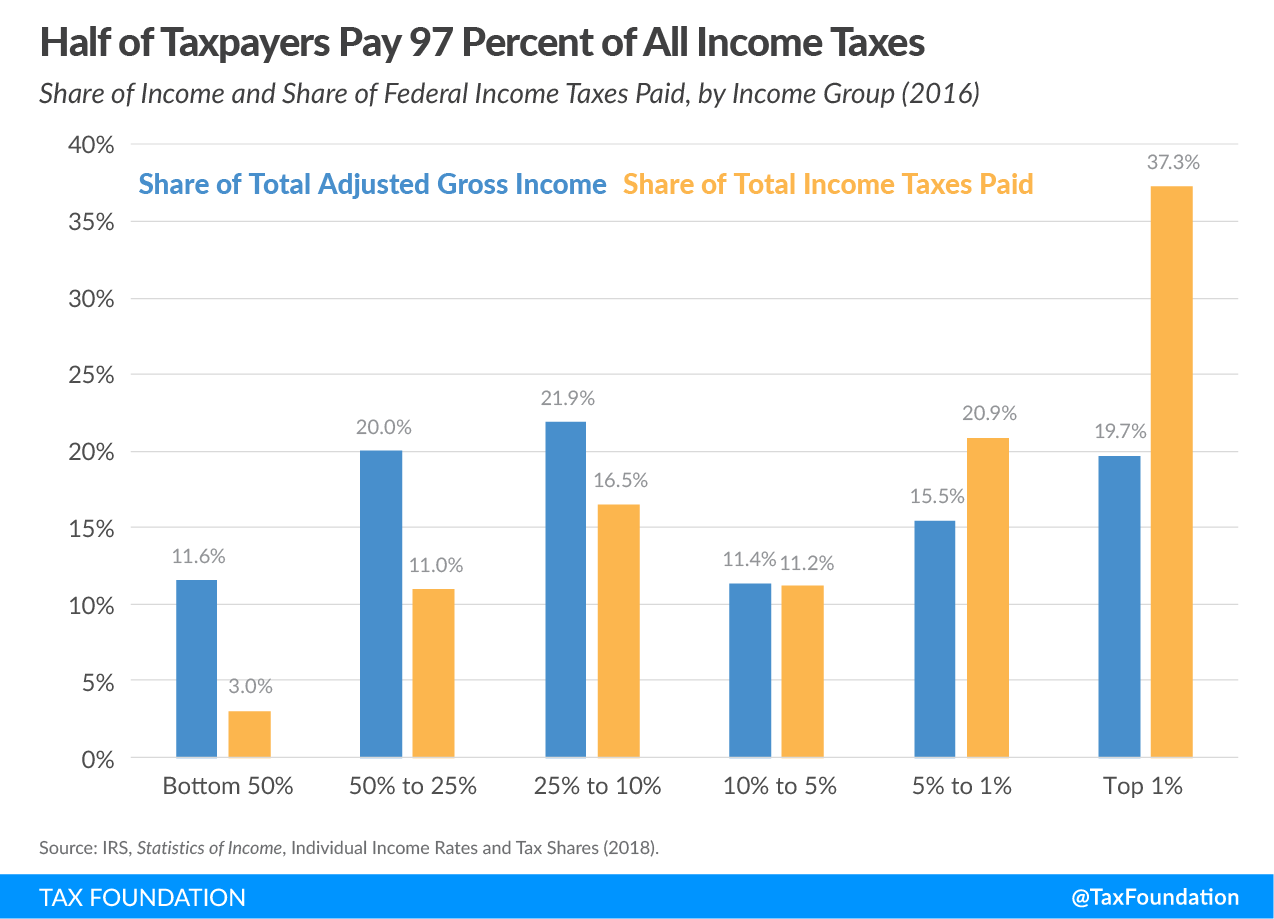
But at the end of the day, it's all irrelevant. Because the big issue isn't the rate at which income is taxed, but rather the total amount received in taxes. And by this measure income taxes are highly progressive, as this chart shows.

Source

That's for federal taxes, nearly 70% of which are paid by the top 10% income earners. Relevant here are New York State and City income taxes, which are even more progressive than the Feds. As shown below, over 50% of New York state tax receipts come from the top 1%, and nearly 80% comes from the top 10%.

Source

Of course income taxes are not the whole story. There are payroll taxes, overwhelmingly paid by the middle class, for whom the primary beneficiaries are also the middle class. This does not seem unfair. Then there are sales and property taxes, which are undoubtedly regressive.

In light of this, raising taxes on the rich doesn't make too much sense. If they're already paying 70% of the tax haul, government is already dependent on the whims of only a few people. These people are the most mobile folks on the planet, and can easily move out of state or even out of the country. Indeed, the NY Post reports that nearly 300,000 people fled the state in the eight months ending Oct. 31st. These are upper income folks who are taking a big slice of AGI with them.

I'll suggest that tax rates are already adjusted to maximize revenue. Adjust the rates either up or down, and actual tax receipts will decline--the former because rich people can move, and the latter because you're just leaving money on the table.

If Mr. Cooper is worried about the revenue stream, Ms. Wood cares more about how the money should be spent. The meat of her argument is summarized in the last paragraph.

New York City, New York State, and CUNY have all been looking to Washington for some kind of relief. They say these cuts and budget shortfalls are temporary, and federal funds from a Biden administration will save us. But workers should not hold our breath. Instead, we must organize, within our unions, across unions, and with the un-unionized, to demand relief that benefits the workers, not the governments and the capitalists. This includes preparing our unions to take citywide strike actions to fight the wave of further austerity that is sure to come.

Are the budget shortfalls temporary? Probably not, and for several reasons. First, as said above taxpayers are leaving the state and taking their AGI with them. Second, and more important, the economy is recovering, but to a different economy.

“We’re recovering, but to a different economy,” [Fed chair Jerome] Powell said during a virtual panel discussion at the European Central Bank’s Forum on Central Banking.

The pandemic has accelerated existing trends in the economy and society, including the increasing use of technology, telework and automation, he said. This will have lasting effects on how people live and work. 

So what are the effects on higher education? I can count a few.

  • More students are learning online. Some of them will prefer it and will not go back to the classroom. Online education got a permanent boost.
  • Students expect online education to be cheaper and are less willing to pay high tuition. Beyond which, online students have no need for dorm rooms, cafeteria food or athletic facilities--all of which are major revenue sources for colleges.
  • Working from home reduces the need for office space, managers, and overhead. Ultimately, it reduces the benefits of a college degree. For that and other reasons, including automation, the demand for college grads likely decreases over time.
  • Likewise, working from home expands the labor pool available to the employer. Their candidates can live in Topeka as easily as in Manhattan. Wages will accordingly trend lower.
  • Not pandemic related, but still important, is the demographic cliff--the cohort of high school grads will be much smaller in coming years.
Bottom line: fewer kids will go to college, fewer of them will attend a residential college, and those kids will all be spending less money at college.

So what's Ms. Wood's suggested solution?

This week, rank and file organizers at CUNY are bringing a Cross-Campus Resolution for a Strike Authorization Campaign and Vote to the floor of the PSC’s Delegate Assembly.

Who are they going to strike against? Surely not against the CUNY administration, because at the end of the day they don't control the purse strings. And also not against the state or city government--for not only can they not control the purse strings, but they've got all kinds of other social services they need to fund.

The faculty probably intend to strike against the millionaires and billionaires, who generally don't give a rat's patoot about CUNY. Why should they? Certainly the ones who have already left town have washed their hands of the whole problem.

So ultimately our faculty friends are striking against their own students--the ones who are at least paying a fraction of the bills. This seems perverse--and deeply counterproductive.

The whole higher education edifice is overbuilt and needs to shrink. We need fewer colleges, fewer professors, and a whole lot fewer grad students. One hopes it can happen gradually so that people could adjust their lives over time. But the world is never like that. As Hemingway put it

“How did you go bankrupt?" 

"Two ways. Gradually, then suddenly.”

 Further Reading:

Thursday, May 21, 2020

Trotskyists on Reopening

Reopening?

Generally they're against it.

The case is succinctly made by Socialist Action in a piece by Steve Johnson entitled Reopening schools: A dangerous threat to children and teachers. The lede paragraph:
Plans to reopen schools are being questioned by the international working class as the novel coronavirus COVID-19 continues to spread across the world. These plans are part of the mad rush of capitalist nations to re-open their economies, disregarding the health of the children and the working class of their respective societies.
Absent perfect safety and the once-and-for-all defeat of the virus, nothing should be allowed to reopen. Anything less than that "demonstrates the lack of scientific planning these nations possess in tackling the pandemic."

Despite claiming to represent the "international working class," not even the teachers' union (AFT) agrees with Mr. Johnson.
AFT president Randi Weingarten announced the union’s “Plan to Safely Reopen America’s Schools and Communities” wherein the AFT linked the re-opening of the economy to the re-opening of schools. The AFT’s proposal repeated the false notion that “To gradually reopen, we need to maintain physical distancing until the number of new cases declines for at least 14 consecutive days.” ...
The AFT’s criteria, essentially matched by the Trump administration’s and major U.S. corporations, for “gradually re-opening” public schools and businesses more generally, would undoubtedly place teachers, other school workers, and students in unimaginable danger.
I think the AFT understands that closed schools mean unemployed teachers, and most teachers are willing to take some risk to go back to work. (It's not like by staying home they're necessarily at lower risk.)

Socialist Resurgence (SR) holds a similar position. Author Andy Barns comes down hard on Elon Musk for opening the Tesla plant in Fremont, CA. In the process he defends such august, bourgeois institutions as the Alameda County health department--presumably because they're "scientists." But Mr. Musk opened up anyway, daring the petty fascists to come and arrest him. Needless to say they backed down.

To which Mr. Barns responds:
Supervisor Haggerty seems confused. That Musk is actively endangering 10,000 people during a pandemic should present cooler heads with the obligation to arrest Mr. Musk! And this should be easy since he is literally breaking the law!
Mr. Musk didn't endanger anybody--no Tesla employee was forced to return to work, and some undoubtedly stayed home. But like teachers, most autoworkers need jobs and want to go to work. It's bizarre that a supposed tribune of the working class is so keen on enforcing bourgeois law against them.

SR's Adam Ritscher is the only comrade on my Beat who's done some actual reporting. In a post entitled COVID-19: Farmers slaughter hogs as pork-processing plants close down he tells us how the meatpacking supply chain actually works. I learned something--the article is well worth reading. He points out that meatpacking facilities have gotten much bigger as the process has been relentlessly optimized. Obviously that benefits consumers in normal times.

But these times are not normal. If one link breaks then lots of other things go haywire as well. "And many processing plants are so huge that they alone process a couple of percentage points of the nation’s pork. So when just one of these plants closes down, it has a huge impact." For all its efficiency, the supply chain has become increasingly brittle.

And he does have a point. But his closing paragraph makes no sense.
Today’s industry was designed around the sole goal of maximizing profits. What we need is an industry that is designed for human needs, and that takes the environment into account. Let’s use this horrible crisis to redouble our efforts to help make such a more just and rational society a reality!
Wrong! The industry's goal of "maximizing profits" also includes getting as much meat into consumer's mouths as quickly and as cheaply as possible. That's meeting human needs! "Redoubling our efforts" to solve hopelessly vague, hypothetical, and very expensive problems will simply keep people hungry.

Better is the solution at the Smithfield Pork plant (also reported by Mr. Ritscher), which offered $500 bonuses to employees willing and able to come to work.

Shifting gears a bit, Socialist Viewpoint reproduces an article by James Dennis Hoff, entitled Get Militant or Die: Labor unions in the age of crisis. The piece originally appeared in something called Left Voice, published by a collective of New York City college professors virtue-signalling their revolutionary socialism.

While Mr. Hoff's article was published on April 3rd--too soon to pass judgement on any reopening--he was staunchly in favor of the shutdown.
However, it is most important, in the short term at least, that unions fight to protect the immediate health of working people by demanding that all non-essential production be halted and that productive resources be repurposed in order to face the crisis, ...
So much for the lower-middle class--waitresses, retail employees, beauticians, hotel maids and flight attendants should all be thrown out of work because they're "non-essential." But no fear--they can all be "repurposed," just like recycled garbage.

Meanwhile, college professors--e.g., Mr. Hoff--who have never been laid off because they're apparently "essential", should now urge their unions to be more militant. No more playing footsie with Mr. Cuomo--the professoriate should demand "adequate funding for public services," even to the point of going on strike.

"Adequate funding," in Mr. Hoff's view, requires taxing the rich.
Meanwhile the Governor has made it clear that he has zero intention of raising taxes and has repeatedly argued that any new taxes on the wealthy or on Wall Street would lead to capital flight, a claim that doesn’t seem to be supported by any actual evidence, but which nonetheless shows where the governor’s priorities are and just how much political power capital wields in Albany when compared to working people.
There is plenty of evidence of capital flight. New York state lost more than 180,000 people to net domestic migration in 2019. Those weren't poor people--those were middle and upper middle class folks who don't want to pay New York taxes.

Because of the virus, the billionaires have already fled Manhattan for their second and third homes in Florida. Will they ever return as New York residents? Maybe not--there's no income tax in Florida. If the billionaires leave, then the millionaires leave, too. Indeed, many of them are already working from home in New Jersey. Will they return to Manhattan so they can pay more taxes? Probably not. And when the millionaires leave, so do the restaurateurs and the Uber drivers--people who need to work near their customers.

The only people left in Manhattan will be college professors, the welfare crowd and homeless people. All fine people, to be sure, but none of them pay taxes. Piss poor future that will be. But go for it, Mr. Hoff. Have fun on your strike--just don't count on having a job when it's over.

I'll close with an official statement from the Socialist Workers Party (SWP) entitled Fight for gov’t-funded public works program to create jobs. They have two demands: one (apropos nothing in particular) is for full amnesty for undocumented workers. The second (relevant to jobs) is
A massive government-funded public works program to put millions to work at union-scale wages to build the hospitals, schools, affordable housing and all the other things we sorely need. We need to get workers back to work to strengthen our class consciousness and fighting capacity.
We have more than enough hospitals--they weren't even full during the height of the pandemic. We surely don't need any more schools--birthrates continue to decline, along with school enrollments. There's plenty of affordable housing--just not in places like Manhattan or San Francisco. The solution is to move more jobs and people to the suburbs. (For an interesting take see this article by John Sanphilippo.)

I'm all for getting workers back to work! But why can't they do useful things instead of stupid, make-work projects? What's wrong with restaurants, hotels, airlines, churches, beauty salons, meatpacking plants--hell, even college campuses? Why is it that Democrats and Socialists alike are so much against people being allowed to earn an honest living?

Down With Poverty!

Further Reading:


Wednesday, March 27, 2019

Amazon HQ2


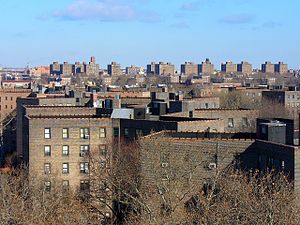
Queensbridge Houses.jpg
Queensbridge Houses (Wikipedia)
Kudos to Marty Goodman, Socialist Action's (SA) reporter on the Amazon HQ debacle in Long Island City. SA is rare on my beat in covering the situation at all--there is nothing in The Militant, nor has Solidarity said anything. Neither has Louis Proyect. Mr. Goodman's two articles are entitled New York Democrats shower Amazon with $billions and Protests bust up New York's Amazon deal.

It's a pity, then, that Mr. Goodman misunderstands almost everything. His confusion is so typical of my Trotskyist friends that it's worth a post to clarify.

The lede paragraphs from the first article:
On Nov. 13, after long secret negotiations, two New York “progressive” Democrats, Governor Andrew Cuomo and New York City Mayor Bill de Blasio, jointly announced that Amazon will place one of two new corporate “headquarters” in New York City and the other in Arlington, Va. 
Virtually kissing the feet of Jeff Bezos, Amazon’s CEO, whose personal wealth is $166 billion, both Democrats have bestowed upon Amazon about $3 billion in tax breaks and construction grants, which include even a nifty helipad for its owner.  ...
New York State offered $1.525 billion and the city is giving $1.28 billion to locate in Long Island City, in rapidly gentrifying Queens, a short train ride from Manhattan. The Wall Street Journal reports a “condo gold rush” in Queens.
This data can all be checked by simple Google searches. At today's price one share of AMZN costs $1759. There are 500 million shares outstanding, so multiplication yields total capitalization at $880 billion. Mr. Bezos owns about 79 million shares, worth $138 billion. He has a few other assets (e.g., Blue Origin), but his net worth likely isn't much more than $140 billion at today's market price.

Mr. Goodman should note how hypothetical that all is. It assumes that Mr. Bezos could sell all of his shares at today's market price. Of course he can't--putting that many shares on the market would crash the price. Further, we can suppose Mr. Goodman wants to confiscate his wealth. But if he did he'd end up only with a pile of worthless stock certificates--nobody will buy stock in a company whose assets are routinely confiscated.

Mr. Goodman will claim he doesn't care about the certificates, but instead only wants the physical assets: warehouses, offices, computers, etc. And yes, he could confiscate those, and perhaps those would have some residual value above zero. But the company Amazon is a whole lot more than the physical assets--it is a business that depends crucially on its management, specifically on Mr. Bezos. Take Mr. Bezos out of the picture and Amazon is reduced to a pile of trash.

Mr. Goodman is correct that the handouts offered to Amazon are tax breaks. Those bennies are contingent on Amazon upholding its part of the agreement, e.g., hiring the promised number of employees, and are payable many years in the future. Of the $3 billion in handouts, very little of it is money in the bank that can be reallocated to schools, housing, welfare, etc. As Tyler Cowen puts it,
There is no $3 billion that NYC gets to keep if Amazon does not show up. That “money” was a pledged reduction in Amazon’s future tax burden at the state and local level.
By comparison, the annual NY State budget is about $150 billion, while the City budget is roughly $89 billion. The (mostly virtual) gifts to Amazon are small change--Mr. Goodman blows the whole issue way out of proportion.

Mr. Goodman's fixation on "handouts" is a red herring.

Then Mr. Goodman is against the "gentrification" of Queens. Why? Is he against new housing? Does he prefer that construction workers be unemployed? Does he really think that everybody should be forced to live in the low-quality, slum-like conditions present in public housing? Is he opposed to new restaurants, shops, and grocery stores, all of which employ people? Should the subway not be rehabilitated?

Those questions are not rhetorical. The honest answer to all of them is "yes." Mr. Goodman is very much Pro-Poverty!

The best argument he can muster for more poverty is this:
For its part, Amazon promises 25,000 new jobs in New York City, with an average salary of $150,000, far above the average salary of the nearby Queensbridge Houses, the largest housing project in the U.S., where the poverty rate is near 50% and the average income is below $20,000. Amazon says it will spend $5 million in training. ...
Raymond Normandeau, a resident of Queensbridge Houses since 1973, told the on-line Gothamist, “It’s pure bullshit. They’re never going to hire us for these jobs. Only a country bumpkin like de Blasio or Cuomo would believe this shit.”
Because of Queensbridge, nobody else should be allowed to earn any money.

My brief encounter with housing projects leads me to believe that most residents are old, disabled, and/or sick. So obviously they're not candidates for high-stress jobs at Amazon. Beyond which, residents of the Houses, even if not debilitated, do not have the skill set necessary for such employment. Because if they did they'd already have high-paying jobs and wouldn't be living in the projects. It's not like there is a surplus of skilled labor in the country.

The Queensbridge residents live almost entirely on taxpayer largesse, and occupy some of the most valuable real estate in the world. Nevertheless, they won't be displaced no matter what company moves to Queens--"gentrification" is not a problem for them.

Quite the contrary, their self-interest is that more people should earn enough to pay taxes. Of all people, they should support Amazon. An employee earning $150K will pay about $10K in state and city income taxes, for an annual haul of $250 million. That's just income tax--it doesn't include sales or property taxes, nor does it include taxes paid by construction workers, suppliers, and vendors who support Amazon and its employees.

It is truly bizarre that a few Queensbridge residents, along with Mr. Goodman, are so blinded by envy and ideology that they can't see the huge, indirect benefit that Amazon potentially provides for poor people in the Queensbridge Houses.

A bunch of Democrats (stupid ones), as pro-poverty as Mr. Goodman, pushed Amazon away, depriving the state and city of tens of billions of dollars in real revenue (as opposed to the hypothetical "handouts"). Progressive heroine Alexandra Ocasio-Cortez led the charge. She may win plaudits in her district, but her future in state and national politics is now foreclosed.

Most people are against poverty. Mr. Goodman is a rare exception.

Further Reading:

Friday, July 17, 2015

Book Review: Grover Cleveland

An Honest President, a biography by H. Paul Jeffers, is sadly out of print. It deserves to be re-issued.

Grover Cleveland is probably the best president you never heard of. His obscurity is due in part to his name. These days, Grover is a Sesame Street character--nobody with that name could possibly do anything important or significant. Today he's known for factoids: as the only president to serve non-consecutive terms, and also to get married in the White House. The newly minted First Lady, 21-year old Frances, proved to be a popular political asset.

It didn't have to be that way. Born Stephen Grover Cleveland, he was the fifth of nine children of a Presbyterian minister. Distant ancestors lent their name to the city in Ohio. The family moved around as the father changed pulpits, but Stephen (as he was known then) mostly grew up outside of Syracuse, NY. Untalented academically (and also lacking money) he didn't go to college, but instead at age 18 moved to Buffalo and apprenticed himself to a law firm.

A tall, gregarious, friendly man, he enjoyed free time playing cards, drinking beer, and eating sausages at the city's many German pubs. And so he came by his trademark girth, earning the nickname "Big Steve." Only when he decided to enter politics--around age 30--did he start using his middle name. Big mistake.

Beyond his native friendliness, two other traits characterized Cleveland: uncompromising integrity, and a formidable work ethic. These together, along with the good fortune that accompanies any political rise, greased his way to the top. He started as an assistant district attorney for Erie County. His first elective office was Erie County Sheriff, where he served for several years. And then in rapid succession he became Mayor of Buffalo, Governor of New York, and finally President of the United States, elected in 1884. While he won the popular vote in 1888, he lost the electoral college to Benjamin Harrison, before famously reclaiming the White House again in 1892.

Cleveland was the first Democrat president since James Buchanan, who lost to Lincoln in 1860. The Republicans, despite having won the Civil War and abolishing slavery, had squandered their reputation through grotesque corruption. Not that the Democrats were any better--they ran urban machines such as Tammany Hall.

Both parties contained reformist elements that opposed the spoils system. Republican reformists were known as the Mugwumps, led by the youthful Teddy Roosevelt. The Democratic reformers included Grover Cleveland, twenty years Roosevelt's senior. And so Roosevelt and Cleveland became unlikely political allies, beginning in New York while Cleveland was governor and Roosevelt a leader in the state Assembly. It's probably an overstatement to say that Cleveland was Roosevelt's mentor, but they maintained a lifelong alliance and mutual respect, if not always friendship.

Among the prominent causes they both supported was a true civil service. When Cleveland took office the federal government employed about 125,000 employees. Almost all of those served at the discretion of the president. The Democrats--out of office since 1860--wanted to fire all the Republicans and replace them with Democrats. Cleveland was besieged with office seekers--it took up most of his time. He vowed to hire the most competent people for the jobs, regardless of party. Since he was not beholden to the Tammany Hall machine, he could get away with that.

Roosevelt was appointed as a commissioner of civil service under the Harrison administration. When Cleveland returned to the White House, he kept Roosevelt on in that position. At the end of his second term he vetoed the Tenure in Office bill--legislation intended to save the jobs of patronage employees when a new president came in office. As he left office, civil service was well established.

Cleveland strongly opposed the free silver movement, supporting instead a strict gold standard. Free silver granted citizens the right to mint silver coins, and required the government to redeem them for gold coins at below market rates. The effect would have been to empty the US Treasury of gold reserves, and create massive inflation. Farmers liked it because it would have given them more money, which they confused with more wealth. Cleveland understood the true economics, leading a newspaper critic to dub him the "elephantine economist."

Cleveland lobbied for lower tariffs and (relatively) free trade. Tariffs in those days were a major revenue source for the federal government, and couldn't be completely eliminated (as they mostly are today). But Cleveland understood that restricting trade hurt American consumers and American exporters. The gains from additional trade more than outweighed the harm to some companies. This is a battle we are still fighting today.

At the end of his second term, he was confronted by Eugene V. Debs and the Pullman strike. Cleveland was supportive of unions, and felt that workers should be paid more. But he was aghast that the Pullman workers were members of the railway workers union, when in fact they weren't really railway workers. When a relatively small and solvable dispute turned into a massive strike that crippled the entire economy, Cleveland had no choice but to call in the army--the first time since the Civil War. It raised economic and constitutional issues, but at the end his move was very popular with the public.

My Trotskyist friends are correct that (in those days) the proletariat had its hand on the throat of the economy. The advantage of industrial unions was precisely that they maximized that leverage. But the counter-argument is that they made it impossible for the government to compromise. The only option left was to break the union. That's what Cleveland did, not necessarily because he wanted to, but because he had to.

On these four issues--civil service, free silver, tariffs, and strikes--Grover Cleveland was on the side of angels. Or at least that's how it looks to my modern eyes. But hidden in that reservoir of pragmatic, common sense loomed a big problem which Cleveland never imagined. Because the advent of good government, midwifed by Cleveland, led gradually but ineluctably toward a demand for big government.

Cleveland's acolyte, TR, began the charge, starting innocuously enough by rigorously enforcing blue laws as a New York City police commissioner. And then the camel's nose gets under the tent with the otherwise laudable National Park Service. But the real villain--the man who turned Grover's good deeds into a monster--was Teddy's cousin, Franklin Delano Roosevelt.

Today's Progressive movement is as much a child of Teddy and Franklin as it is of Karl Marx. Good government has begat big government--something that Mr. Cleveland would never have countenanced. I like Mr. Cleveland, but even for him the law of unintended consequences reigns supreme.

I really enjoyed Mr. Jeffers' book. The salacious details of Cleveland's personal life are alone worth the read. But it has one postmodern quirk that strikes me as strange. For some reason Mr. Jeffers never reports his subject's birthdate. Never mind--Wikipedia to the rescue: March 18th, 1837.

Further Reading:

Friday, August 1, 2014

Subway Values

Referring to break-dancing teenagers, sermonizing preachers, and homeless beggars, Louis Proyect writes
There’s probably nobody more opposed to being a captive audience on the subways than me. I have been riding NYC subways since they cost 15 cents a ride. When they were this cheap, they lacked air conditioning and were as noisy as hell, but you could at least be assured that you would never be forced to watch a musical performance, begged for spare change, or listen to a sermon.
And then follows a several thousand word essay about how efforts to stop this behavior is unjustified. Specifically, he is against the broken window theory or the tactics of the street crimes unit. Those efforts, initiated by past and present police commissioner William Bratton, ruthlessly pursue petty crime (e.g., break dancing on the subway) because it deters more serious crime. These efforts have evolved into the much maligned stop & frisk policy. Mayor DeBlasio campaigned on ending that, but has so far reneged on that promise.

Mr. Proyect opposes any variant of stop & frisk for three reasons:

  • It targets Blacks and Latinos, and therefore is racist.
  • Beyond this, the police are racist and target Blacks and Latinos just because they enjoy it. There are numerous incidents where people have been killed, most recently the imbecilic gentle giant, Eric Garner, who died in a choke-hold for illegally selling cigarettes.
  • Because of the decline in manufacturing jobs, there are no opportunities for young vagabonds other than to be beggars, hustlers and thieves.
For all that, Mr. Proyect doesn't claim that stop & frisk fails. It does work. The subway is a much more civilized experience now than it was 20 years ago. Today most subway fellow passengers are like Mr. Proyect or me--they are possessed of bourgeois values.

That is not a racial statement. I don't ride the subway as much as Mr. Proyect (maybe once a month or so). Most of my subway riding begins and ends in Queens, specifically Jackson Heights and Long Island City. I am frequently the only Caucasian male in the car--my companions are Chinese, Filipino, Colombian, Dominican, South Asian, and God knows who else. They speak different languages, eat different food, and sometimes smell funny. But they are all civilized people, and none of them are routinely rousted by the cops.

So what are the bourgeois values that make for a good subway rider? It's actually a simple concept--a person with bourgeois values has a positive net worth. That means they save and invest at least a small fraction of their income. People who invest in their children have bourgeois values. People who don't run up huge credit card debts have bourgeois values. People who take care of their apartment have bourgeois values.

I don't know where Mr. Proyect lives, but for the sake of illustration let's suppose he lives in a rent-controlled apartment. Now I'm against rent control as much as the next Republican, but that's not the issue. Our assumption is that Mr. Proyect plays by the rules as they exist, has lived in his apartment for a long time, and accordingly pays rent substantially below the market rate.

I will argue that he has an equity stake in his apartment. It's not the same as if he actually owned it as a condo, but the fact that the landlord can neither evict him nor substantially raise the rent is worth money. It's likely worth as much as my tenured professorship. Mr. Proyect (in our imagination) has acquired that stake by being diligent about paying his rent and following all the rules.

Predictably, he behaves in a way that preserves his investment. For example, I doubt he would pee in the elevator. Nor would he spray graffiti over the mailboxes in the foyer. He expects his fellow tenants to behave similarly--if they didn't the value of his investment would decline dramatically. Mr. Proyect, because he has positive net worth, is possessed of bourgeois values. I'll posit that the most anti-social thing he ever did on the subway was to turn on his laptop.

Yet in the housing projects (at least by reputation--I've never been there myself) some residents do pee in the elevator, and spray the whole place with graffiti. Unlike Mr. Proyect or my fellow subway riders, these people do not have bourgeois values. They have no equity stake, and hence no positive net worth. If you are willing to piss in your own bed, then how respectful will you be of public conveyances, e.g., the subway?

It is not a racial thing. I spent a year living in Kampala, and my Ugandan neighbors most definitely exhibited bourgeois values. Cleanliness was a national pastime. On the other hand, plenty of Whites can't cut it--see this article about Owsley County, KY. But New York is the richest city in the world precisely because the vast majority of its residents are civilized.

Some years back I attended a conference in D.C., and stayed in a hotel in Alexandria. My daily commute took me past a small park surrounded by many apartment buildings. It was the neighborhood park for thousands of people. But the residents were completely deprived of its use by the few dozen homeless men who used the place as their campground. The community's sympathy for the homeless had gotten the better of them, and hence they no longer had a community park.

So it is with Mr. Proyect and his vagabonds. He feels sorry for them, and thus is willing to overlook their brigandage. Perhaps he's right to feel sorry, but depriving the millions of civilized citizens the proper use of the subway they pay for is not the solution. So I'm down with the cops--it is their job to let civilized people (the vast majority of New Yorkers) live in a civilized world. The vagabonds need to be rousted out. Thank goodness Mr. DeBlasio understands that.

Unfortunately, the uncivilized minority are disproportionately Black and Latino. Now that's just a fact. It's an unhappy fact, and it clearly inspires racism, but stating facts is not in and of itself racist. One can argue why this is true, but it is true.

So--to quote the musical--are "they depraved because they're deprived"? Mr. Proyect thinks so--it's the lack of manufacturing jobs that's led to the decline of bourgeois values. Never mind that my co-riders from Queens remain civilized despite the same lack. Why can't the vagabonds be held to the same standard?

Still, while I'll let the cops (mostly) off the hook, there is much to blame on city government. They prohibit lots of honest professions that hurt nobody. Why, for example, are poor people not allowed to use their own cars as cabs? (The only reason is to protect the medallion owners.) Why is it illegal to sell food on the street without a license from the utterly obnoxious and useless Department of Health? (The only reason is to protect incumbent restaurateurs.) Why is it illegal to braid hair without a beautician's license? (So to protect the cartel.) Why is it illegal to open a daycare center without a special permit? (Because the teachers' unions want ALL the money.) For that matter, why is it illegal to sell individual cigarettes on the street? (Because crooked politicians want tax dollars from poor people.)

So there is no doubt that New York's government destroys economic opportunity and deprives poor people of a chance to earn an honest living. Economic liberty (which New York sorely lacks) makes people richer.

But I don't think poverty causes people to be uncivilized. Were that true, my Kampala neighbors would be the most uncivilized of all, as they were clearly not. People with bourgeois values retain that mindset in even the most desperate circumstances.

Mr. Proyect's vagabonds may deserve our sympathy. But they don't deserve the subway.

Further Reading:

Sunday, February 16, 2014

Affirmative Action, IQ & Liberals

This post is a riff on a Slate piece by Tanner Colby entitled The Massive Liberal Failure On Race (Part I and Part II). In Mr. Colby's view, the Republicans are unequivocally the Evil Party--racist, greedy, selfish. The Stupid Party is the Democrats, and not just in the trivial sense of needlessly throwing elections. He accuses his own party of almost criminal negligence in the cause of affirmative action. They confused integration with desegregation, and suppressed the Black community's desire for agency over their own kids' education by busing Black students to white schools merely to meet statistical quotas. The whole busing thing wasted billions of dollars with no positive effect whatsoever on either educational outcomes or racial harmony.

After the 1967 race riots in Detroit and elsewhere, some bargain had to be made with Black America for the sake of public order. While Mr. Colby tendentiously attributes the terms to President Nixon's racism, his description of the bargain is generally accurate.

  • The government instituted affirmative action programs for Blacks in public employment. This led to the dramatic increase in African-Americans working in the military, the post office, police and fire departments, and to lesser extent, in public schools and universities. Millions of Blacks were pulled into the middle class by these programs.
  • On the other hand, the high crime rate had to be lowered. Crimes (then and now) were disproportionately committed by Black teenagers. Between draconian drug laws and much more aggressive policing (or some other reason), crime was brought under control. The cost was the high incarceration rate, especially for Black men.
The result has been generally successful. Black people are richer and more integrated into the American economic mainstream. Everybody (whites and, especially, Blacks) are safer--the crime rate continues its descent from the 1970s high. These days people (mostly Republicans) are beginning to discuss lowering the incarceration rate.

The problem is that this grand bargain is breaking down. Even liberals such as Mr. Colby understand that affirmative action can't work anymore, and Republicans realize you can't just lock everybody up.

Back in 1994 Charles Murray and Richard Herrnstein published the controversial book The Bell Curve. I read it many years ago, but recall it as an excellent book, probably still well worth reading. But as with many other readers, some things bothered me. Notably, they never gave a very good definition of IQ.

Whatever IQ is, Murray and Herrnstein show that it correlates very strongly with income. Indeed, some claim (not necessarily convincingly) that if you correct for IQ then education makes essentially no difference in economic outcomes. You can read that whole debate on your own--I'll just point you to a game-changing article by Ron Unz. He quotes another to emphasize his main contention: 
Allow me to repeat the concluding sentence of the Abstract of this peer-reviewed academic article: 'These observations suggest a causal direction from GDP and education to IQ.'
So that leads me to this definition of IQ: IQ measures those mental traits that were most useful in the late 20th Century economy. Then by definition there is a correlation between income and IQ, but who knows which way the causal arrow goes?

So African-Americans are relatively poor, and thus do poorly on IQ tests. Affirmative Action managed to fudge that outcome by increasing their income by fiat. But this doesn't mean Blacks are stupid--it just means their skills aren't easily monetized. Or more precisely, their cultural talent is mostly in winner-take-all professions. I'm listening to Art Tatum as I write this--I think he died a poor man. But the richer sorts--Oscar Peterson, Count Basie, Duke Ellington--all worked in winner-take-all markets where wealth was not widely distributed. Similarly for sports. Likewise, African-Americans have played a hugely disproportionate role in our political life, on all sides of the spectrum from W.E.B. DuBois to Martin Luther King to Herman Cain to Ray Nagin.

My definition suggests that IQ may become less important in the 21st Century, and I do indeed think that will happen. White people have not been proportionately as successful as musicians, preachers, entertainers, or even politicians. Instead they've concentrated on more mathematical, analytical pursuits--endeavors that have been much more lucrative for more people. Their median income has been correspondingly higher.

But here's the rub. Computers will steal white jobs long before they get to Black jobs. Computers can do math better than you can. Math skills will always be important, but they will increasingly lead to winner-take-all jobs. The very best computer programmers will be millionaires, the average will be shlubs, and the below average unemployed. And similarly for most other, white-dominated STEM professions.

The jobs of the future will be jobs that computers can't do, e.g., entertainment, preaching, politics, and music. Computers will raise the relative value of Black culture in the labor market. And none too soon, as the traditional sources of Black employment are drying up. The post office is increasingly automated, and shrinking in any case. The military no longer needs grunt manpower. And the government sector is (thankfully) getting ever so slightly smaller.

Here is an example of the jobs of the future: the street entertainers in New York City. Those guys (almost all Black) are very, very good, and are a major tourist attraction. Once, on a small side street in Lower Manhattan (undoubtedly chosen for its acoustic properties), I spent almost an hour listening to an a capella quartet singing old rock songs. They had a huge crowd around them and were making money like nobody's business. No microphone, no overhead, no instruments--just absolute, raw, undiluted talent. No computer can ever reproduce the human-to-human immediacy of serendipitous, live music. And likewise for preaching, politics, and athletic skill (street-side gymnasts are another NYC draw).

I think Blacks will do relatively better in the 21st Century. And new, updated IQ scores will eventually reflect that.

Blacks do need to get their propensity for crime under control. They're not deprived, nor are they depraved. But there clearly is something wrong, and unless they get it fixed the mass incarceration strategy looks set to continue.

Further Reading:

Saturday, December 14, 2013

Why New York Is Different

Joel Kotkin and his colleagues over at New Geography have invested many millions of pixels making the case that the suburbs are not dead. Their argument is solid: the so-called back to the city movement is very small scale, Millennials show every sign of wanting to live in single-family, detached houses, and the most thriving locations are suburban-like places, such as Houston, Dallas, or Oklahoma City. New technology looks to strengthen the suburban trend, as telecommuting and driverless cars reduce the pain and expense of commuting.

I totally agree with New Geography on the general trend. The effort to force people into higher density housing is doomed to fail. More mass transit is mostly a waste of money (the Second Avenue subway line being a rare exception). But within that larger trend, there are eddies and countercurrents that flow backwards. The larger movement to the suburbs notwithstanding, there are a handful of cities that will do very well as traditional cities. They are the obvious suspects: San Francisco, Boston, Washington, possibly Chicago. Maybe a few more.

And within that handful, New York City will excel. Unlike as is sometimes implied over at New Geography, New York is a lot more than just a "luxury city." Instead, it has a unique niche in both America and the world that no other city can fill. 

My argument has three parts: The beginning of New York in the 17th Century, the people who live in New York today, and the uniquely incredible value New York adds to the economy.

The Dutch founded New York in 1624. Unlike the British, French, and Spanish, the Dutch had no desire to extract resources from the land. Not for them was taming the wilderness, mining for gold, or raising cattle. Unlike other colonists, the Dutch settled accounts with the Indians as quickly as possible, in legend buying Manhattan for $24. A few of their number got as far up the Hudson as Albany, but beyond that, early Dutch influence on American settlement was negligible.

Unlike any other colony in the Americas, New York was founded from Day One as a commercial center. Think of it as a 17th Century version of Hong Kong. Lower Manhattan--even in 1624--was a shipping, trading, and financial center. It was never a farming or manufacturing town.

That legacy holds to the present day. Colin Woodard has published a now famous map showing the eleven nations of North America. By far the smallest geographically, but unmistakably distinctive, is New Netherlands, a region that doesn't even include all of New York's modern suburbs. How can this be? The Dutch lost their colony to the Brits in 1664--they were only there for 40 years. A negligible fraction of New York's current residents are descended from those original Dutch settlers. And yet that crucial heritage persists.

Today New York is known for having the largest Jewish population outside of Israel. Most of these people came over through Ellis Island, along with a much larger number of other immigrants from other places. Those other folks didn't stick around long--the Swedes headed for Minnesota, the Irish moved to Chicago, and so on. The Jews stayed in New York, and not just because they're lazy. The Jews have been a commercial people since Medieval times, and it made sense for them to settle in a place founded on commerce. The Dutch had built them a congenial home.

The other prominent commercial class in the US are the overseas Chinese. These settled first in California, where today they are disproportionately dominant in Silicon Valley. But by far the largest Chinese community in the Americas is in New York--initially along East Canal Street. Today there are multiple Chinatowns throughout the metropolitan area, nine in the City alone. They deal in everything from rags to restaurants. The formerly slum-like Lower East Side is now a suburb of Chinatown, full of back-office businesses, run by an increasingly wealthy population.

Jews and Chinese--these are Peter Stuyvesant's descendants. They compete with each other. The diamond trade has long been a Jewish business, but recently Chinese traders are gaining market share.

Other cities have ethnic commercial classes. I've mentioned the Chinese in Silicon Valley. Hollywood's studio moguls tend to be Jewish. Mormons play that role in thriving Salt Lake City. But as far as I know, New York is the only city in the country (and likely the world) that has two, large immigrant communities that both bring substantial commercial expertise. Of course there are Jews and Chinese in places like Los Angeles and Houston, but the numbers are vastly smaller, both in absolute terms and as a fraction of the population. Indeed, it is surprising how few Chinese live in Los Angeles.

So why are these ethnic communities so valuable to the cities in which they settle? In particular, the Jews bring an attribute uniquely relevant to Mr. Kotkin's thesis. Observant Jews are not allowed to drive or take the bus to synagogue on the Sabbath--they have to walk. That means they all have to live within walking distance of each other. This enforced close living, augmented by shared religious practice and intermarriage, breeds trust and very high levels of social capital. Trust is a marketable commodity--people will do business with banks where the employees are trustworthy.

Famously, among New York's diamond traders, million dollar deals are sealed with a handshake. So is it any wonder that the money center banks are all headquartered in New York? You can move the buildings and the computer services to North Carolina or South Dakota or wherever. But you can't move the community. Ultimately, banking is about trust, and that is something that close-knit, ethnic communities have in spades.

There are other industries where New York has a lock. The rag trade is one. Perhaps partly because Jews have to walk, New York is a densely settled, very walkable city. The women (and men) are out in public, showing off their duds. Because they're on the street, in public, going about they're daily business, fashion trends happen in New York. Accordingly, New York hosts thousands of blogs like this one. That's how people dress in New York City.

There are three fashion capitals in the world--New York, Paris, and Tokyo. New York and Paris are beautiful cities, adding a marvelous backdrop to any photo shoot. Tokyo, while not beautiful, is nevertheless glamorous. All three cities are built for walking and public transport--it's one big fashion show. Compare that to Houston, where stylish people drive around in cars with tinted windows. How can you model clothes in a car? Houston will never be a fashion center--and neither will Los Angeles, Chicago, or Sioux Falls.

A second industry is food. Yes, they grow the goods in Kansas, package it in Illinois, and eat it around the world. But where do they invent the stuff?

Tyler Cowen says that the best ethnic food is found in suburban strip malls. I think he's probably right. But that's not the food that most people eat most of the time. What most people eat is some creative combination of ethnic and comfort food, tasty and cleverly made. Few are going to eat the oddball dishes they serve at Cantonese restaurants. 

But lots of people patronize a New York fast food chain called Happy Taco. Forget Tex-Mex; think Mexiasian. Or JapoItalian. Or Peruvithai. Or whatever combinations of cuisines you can think of. People like ethnic food, but they like it modified, synthesized, palatable, and recognizable. Creating this nouvelle cuisine requires business acumen, lots of fresh ingredients, educated consumers willing to try, and a labor force with sufficient expertise. And ideally, all the restaurants are within walking distance of each other.

I've just described New York City. What you'll eat at Applebee's tomorrow, they're cooking up in New York City today.

Further Reading:

Wednesday, March 20, 2013

Luddites Against Fracking

I have a dream.

I have a dream that someday soon--from the Midtown skyscrapers to the Rockaway bungalows, from the brownstones to the bodegas, from the Brooklyn walk-ups to the Bronx projects--I have a dream that electricity in New York City will cost three cents per kilowatt-hour.

At 3 cents Google starts moving server farms from Washington State to Queens. Indeed, Google moves it's entire operation to Manhattan.

At 3 cents, New York City becomes the hub for additive manufacturing, otherwise known as 3D-printing. The cost of entry is cheap--just think about all the entrepreneurial energy that clever, well-connected New Yorkers can bring to that task.

At 3 cents, electric cars become viable, at least for niche applications. I'm thinking taxicabs and city buses can run off electricity--clean, quiet, cheap. Of course with Google right next door, the dawn of fully automated taxicabs is nigh. Cab fares will become much cheaper.

Mix cheap cabs, cheap electricity, cheap lighting, a fully-employed population, and just imagine what happens to Times Square. You think it's bright and cheerful now? Just you wait. Those poor folks in Las Vegas won't know what hit them. New York will again become the entertainment capital of the world.

So how do we get from today's 13 cents/kwh to 3 cents? You need three things: 1) cheap, clean fuel; 2) cold water; 3) a smart grid and infrastructure. Dallas might have cheap fuel, but it doesn't have cold water. Seattle has cold water, but it lacks fuel. Anchorage has both fuel and cold water, but it's too isolated to have a smart infrastructure. Los Angeles doesn't have squat.

New York City has it all.

The cheap fuel comes from natural gas--shale gas from Pennsylvania and (eventually) New York. Unlike coal, gas can be piped to where it's needed--no noisy, dirty, diesel trucks required.

New York has lots of cold water--it's on islands surrounded by the sea. Cold water is needed as a heat sink--thermodynamics says that the energy you get from any power plant depends on the temperature difference between the boiler and the cold temperature reservoir. A boiler by itself will not generate electricity.

The smart infrastructure is necessary to engage the highly creative, well educated, totally connected population. But more than that, it is cheapest to generate electricity near where it is used--a lot of power is lost in transmission. I foresee several dozen small power plants along New York's extensive waterfront, each connected by pipelines to a fuel source, and informed by a smart grid to dial out just the right amount of power. Today New York gets power from Quebec and Niagara, necessitating long, ugly, wasteful and expensive high tension wires over long distances. This will not be necessary in a 3 cent/kwh world.

So how do we get to my dream (or something like it) from our current reality? I admit, it will take a lot of really smart engineers working overtime to get the price down to 3 cents/kwh, but that's not the hard part. What we really need is a new crew of politicians. The so-called "public servants" we're now stuck with are all card-carrying members of the pro-poverty crowd. I'm looking at you, Mr. Obama, Mr. Cuomo, and Mr. Bloomberg.

  • They think poor people are better for the environment than rich people. They're wrong.
  • They prefer to tax electricity and use it to pay welfare benefits, rather than dispensing with the necessity for welfare by making electricity cheap.
  • They worry more about long-term, hypothetical problems (like global warming), about which they can do nothing except purely symbolic and very expensive stuff.
  • They're afraid somebody besides them might actually have some good ideas.
This blog's beat is to cover papers like The Militant and Socialist Action (SA). This post is inspired by an article in SA. It's one of those that I've read so that you don't have to, but if you're a masochist and want to follow along, here it is. I'd like to say that the ravings of a radical socialist grouplet are irrelevant to political discourse, but sadly that's not true. The points made in the SA article are only slightly more extreme than those expressed by the pro-poverty politicians.

SA has never met an environmental horror story that it doesn't believe. Fracking, per SA, pollutes well water, turns tap water into a flammable substance, creates a "chemical cocktail of radioactivity," causes something called "vibro-acoustic disease," is responsible for subsidence, which in turn leads to volatile organic compounds, and it requires sand quarrying, which leads to tailings and water pollution. Etc. That's not to mention the earthquakes. Oh, and it kills songbirds.

Much of this list is just plain nonsense, and all of it grossly exaggerates reality. Fracking is a $200 billion business today, and growing fast. We've been doing it for 20+ years. People know how to do it right. Everything in life is a tradeoff, and fracking is no exception. There are hazards, but containing and minimizing those hazards is just not that hard or expensive. Properly constructing the wellhead will minimize leaks into the ground water. Correct preparation of the fracking fluid will save money and preserve the environment. And so forth. Fracking is less dangerous or destructive than most other mining activities.. SA hopes to win the argument by making utterly incredible claims that no knowledgeable person can believe. This tactic won't be successful.

But here is the real problem: while SA hugely exaggerates the cost of fracking, they all but ignore any of the benefits. From the article, the ONLY benefit of fracking is to enrich the oil and gas companies. And apparently not even that: "Much of the investment is only on paper, with one-quarter of the reserve growth coming through mergers and acquisitions and massive share repurchases by the majors, giving the illusion of profitability. In other words, the industry is thriving on fake growth, much like the financial markets." How can something in which no real money is being invested be so disruptive of the environment? And are the gas companies really so dumb to put money down a rat hole, for no reason other than to make the Greenies mad? No--it's silly all the way round.

Of course the main beneficiaries are not the gas companies. The main beneficiaries--if I get my way--will be the eight million people living in New York City. All of those people will have cheaper electricity, better jobs, and a higher standard of living because of fracking.

Let my people go and get rich. Down with poverty.