Showing posts with label Piketty. Show all posts

Monday, August 26, 2019

Useful Marxist Economics: Michael Roberts

Socialist Action does us an excellent turn by reprinting an article by Micheal Roberts. The piece is taken from his blog, which I have now added to my regular Beat (see sidebar).

Mr. Roberts is an excellent writer who explains things very clearly. It appears that good Marxist economists (certainly including Mr. Roberts) are economists first and Marxists only second. Accordingly, his writing is not diminished by meaningless, obfuscating Marxist terminology, such as surplus value, neoliberalism, or working class--words that don't appear at all.

There is no point in my summarizing Mr. Roberts' article--you can read it for yourself, and I recommend you do. Nor will I argue with him--what he says is mostly correct as far as I can see. But I do think he misses an important part of the story, and that's what I contribute here. Think of this more as an addendum than a criticism.

It is commonly noted that US productivity has declined since the 1970s. In The Great Stagnation, author Tyler Cowen suggests we've already picked technology's low-hanging fruit--electricity, the internal combustion engine, etc.--and future technological progress will be much harder to come by. Robert Gordon wrote an excellent, scholarly book explaining the same phenomenon (my review here). Peter Thiel is the most pessimistic about future growth, suggesting that AI and driverless cars, for example, are mostly just hype. (See here, and links therein.) He thinks we live in a nearly zero-growth world.

The chart below illustrates the problem, namely clearly diminished productivity growth after 1978. If this chart and the pundits above are correct, then we are in for a long stretch of slow to zero growth.
(Source)
Slow productivity growth means that the standard of living also rises very slowly. There is abundant evidence that is true: median real wages have barely budged since the 1970s.

But people are reluctant to give up hope for higher living standards, and the result is they tend to borrow more. The expectation is that times will get better soon and then they can repay the loans. But times have not gotten better and the world is deeper in debt. Growth is now further constrained by the necessary debt service, and the result is a downward spiral.

Given this background, let's use Mr. Robert's paper as a guide to see what the future holds.

He writes:
Many of the academic papers presented to the central bankers at Jackson Hole were laced with pessimism. One argued that bankers needed to coordinate monetary policy around a global ‘natural rate of interest’ for all. The problem was that “there is considerable uncertainty about where the neutral rate really lies” in each country, let alone globally. As one speaker put it: “I am cautious about using this impossible-to-measure concept to estimate the degree of policy divergence around the world (or even just the G4)”. So much for the basis of most central bank monetary policy for the last ten years.
If there is little new technology then there is little cause for new capital investment. One can't buy new computers if the new computers haven't been invented yet. The result is that the so-called "savings glut," is really an "investment drought." There are few good places to invest money. Thus it is easy to determine the natural rate of interest: it is precisely zero. At which value monetary policy has no effect at all. Corporations--never one to pass up a good deal--borrow heavily at near-zero percent interest, using the proceeds to buy back shares (a shift from equity financing to cheaper debt financing).

If monetary policy doesn't work, what about fiscal policy? Per Mr. Roberts, that's Larry Summers' suggestion. The goal, by excess government spending, is to increase aggregate demand until the economy returns to health. Governments spend all this excess cash on useless roads and bridges (Japan, China), on the military (USA; not useless, but not a productive investment), or on ever more generous entitlements (Europe, esp. southern Europe).

But more money in the back pocket doesn't necessarily increase demand. It could increase inflation, which central banks have guarded against by paying interest on reserves, thus eventually sucking back up the extra cash. While it might increase employment, in the USA (at least) that is already maxed out. And given demographic stagnation (if not decline), then there are fewer people out there to spend the money, even if you do get it into their pockets.

The result is that fiscal stimulus doesn't stimulate. We just end up with more corporate debt and more people working at low wages. Given low productivity growth, it can't be otherwise.

I mentioned above that folks are still in denial about low productivity and near zero growth. To maintain their standard of living they borrow more, unrealistically expecting to pay it back later. We've already mentioned the ways government can borrow money: by printing it or by selling treasury bonds. Otherwise known as monetary or fiscal stimulus, respectively.

In addition, folks can borrow their own money. This has certainly happened as the 2008 mortgage crisis proved. Today we have high levels of student loan, auto loan, and credit card debt.

Student loans are especially pernicious, and not just because they aren't dischargeable in bankruptcy. It's because in a near zero-growth world there are diminishing returns to education. Kids who expect to graduate into a dynamic, high-opportunity economy will be sorely disappointed when they end up as burger-flippers and dog-walkers. But absent new technology, there won't be many high-tech jobs for them to fill.

In my view, student loans are a dead-weight loss to the economy and the whole program should simply be abolished. Beyond which they destroy many people's lives.

Marxists think this is all a crisis. Mr. Roberts doesn't say that explicitly, but he seems to imply it. It could be a crisis. If, for example, central banks stop paying interest on reserves, then hyperinflation is just around the corner. In the United States that would be a civilization-ending event. I'm not predicting it, but for those who want to lie awake at night worrying about stuff, it surely is a much more likely life-ending outcome than catastrophic global warming.

Near zero growth is really bad news. It means that the next generation will not be richer than the current generation. It is stagnation, which is the opposite of a crisis. Indeed, nothing here even predicts a recession--merely steady as she goes. (It doesn't preclude one, either.)

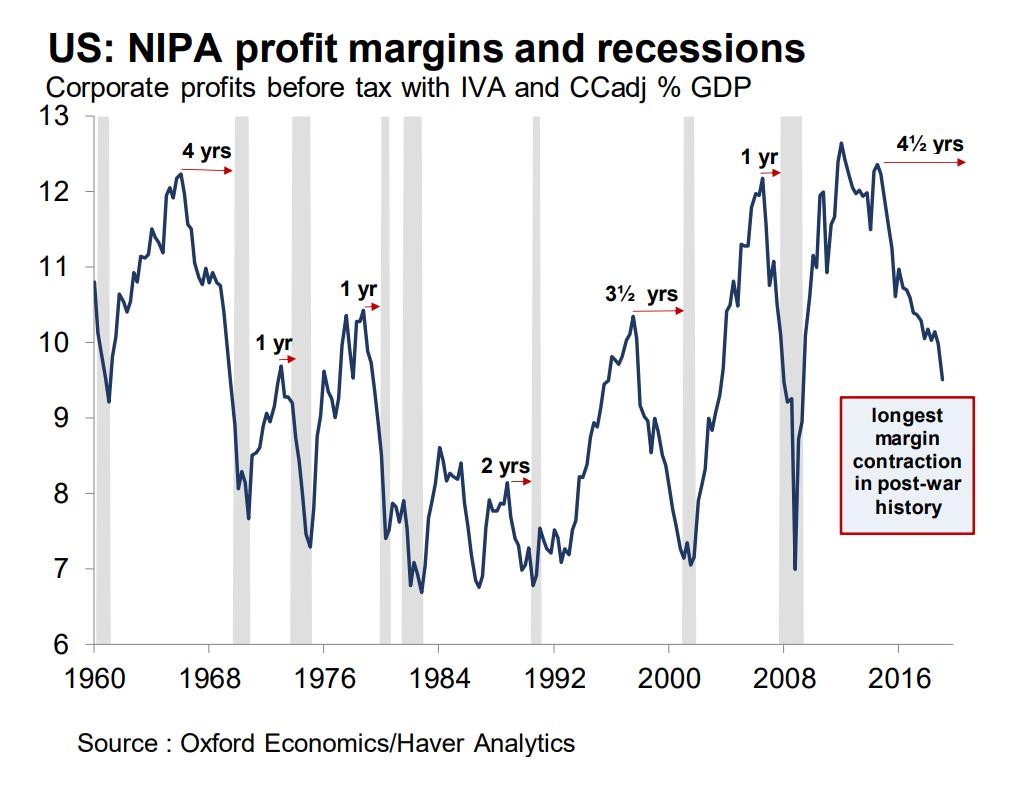
Mr. Roberts does give us one piece of good news. He points out that in recent years profits, as a percent of gdp, have been declining.
(Source: https://thenextrecession.files.wordpress.com/2019/08/pear-2.jpg)
If the returns to capital as a fraction of gdp are declining, that means the returns to labor are increasing! Even I can't see why that is a bad thing. It contradicts the claim of Thomas Piketty, who argues that capital will always get an ever larger share.

Take your good news while you can. The world is going to be increasingly short of it.

Further Reading:

Wednesday, January 6, 2016

Economic Predictions for the Coming Period

Our economic future will be determined by the Double-Ds: Deflation and Debt.

Or, put another way, Main Street is doing just fine, but Wall Street has some serious problems. Unfortunately the two are interlinked.

We are experiencing deflation (not disinflation) and have been for some years now. I base this opinion on these facts:
  • Commodity prices (especially gold and energy) have fallen dramatically. 
  • Our major trading partners (China, Brazil, and probably Canada) are exporting deflation.
  • The cost of labor is going down. Yes, there has been some increase in individual wages, but there is a decline in labor force participation, meaning that total wages are likely declining. And, as Thomas Piketty famously claimed, the fraction of GDP going to labor is getting smaller.
  • Technology is making stuff cheaper.
  • My anecdotal opinion is that the prices of things I buy are declining, or failing that the quality of what I get is increasing.
  • Nominal interest rates have remained very low for a very long time. This is not because of Fed manipulation
I understand that government statistics indicate merely disinflation, but I think they're wrong. First, I doubt they can properly correct for quality issues. Dinner at a decent restaurant still costs $17, but you get a much better meal today than you did a few years ago. Health care, admittedly more expensive, is also much improved over the past. (Higher education, on the other hand, is increasingly just a dead-weight loss.)

And second, deflation is bad for governments, and especially for the Fed. The latter is trying to raise inflation by changing expectations, that is, trying to convince the public that it's just around the corner. But I think that's propaganda. There is no inflation on the horizon.

Many pundits, along with my friends over at ZeroHedge, argue that there was massive monetary stimulus during the Great Recession bailouts, along with the subsequent quantitative easing (QE). But George Selgin argues convincingly (here and here) that this isn't true. The base money supply has remained mostly constant over the last decade. For example, QE was accompanied by paying interest on reserves. The former added liquidity, while the latter took it away again. The net money supply remained unchanged. Mr. Selgin describes the entire decade as a process of removing liquidity from solvent enterprises and transferring it to insolvent enterprises.

Not good. But also not something that will lead to inflation.

So is deflation good or bad? To answer that question we need to invoke Scott Sumner's dictum: Never reason from a price change. For deflation can have two causes: demand side or supply side.

Demand-side deflation happens when consumers get poorer and can no longer buy as much. This occurred during the Great Depression, and also what might be happening in China today. Because there is less demand prices must fall. Demand-side deflation is unambiguously bad, and to the extent we have that the Fed is absolutely right to resist it.

Supply-side deflation happens when producers get better, either through new technology or because of cheaper inputs. Widgets used to cost $10 to make, but because of new technology now they only cost $2. Thus the cost of widgets goes down dramatically. This kind of deflation, while often disruptive, is a very good thing. Our standard of living goes up, not because of higher wages, but rather because of cheaper prices.

I argue that our current deflation is mostly supply-side. The big new technology is fracking, which has reduced the cost of energy by 50% or more. Computer-aided improvements in logistics (see, e.g., Amazon) have reduced the costs of retailing--not even Walmart can make money anymore. And then other countries are exporting deflation, which from a US standpoint simply means lower costs for similar or better products--i.e., supply-side deflation.

Of course there are some demand-side issues as well, slowing population growth being key among them. But the fact is that at least in the US deflation is mostly supply-side. That means American consumers are getting richer because they're paying lower prices for the things they want to buy. I argued as much in a post a couple of years ago, here.

So if the goal of an economy is to make consumers (i.e., everybody) richer, then we are undoubtedly succeeding. Or speaking metaphorically, Main Street is on a roll.

Financially, however, things are not so rosy.

The other big D is debt. "Debt is cheap," or so they say, what with interest rates at "historic" lows. And people sure have piled it on: student loan debt is over a trillion dollars, and auto loan debt is not far behind. Many cognoscenti (e.g., Paul Krugman) argue that we should massively invest in infrastructure--finance has never cost less.

Even on the Right pundits agree: the Fed, so they maintain, has arbitrarily kept interest rates low making it cheap to borrow, with the collateral damage of screwing grandma out of her savings.

But I think both the cognoscenti and the pundits are wrong. Real interest rates are precisely not cheap--indeed, they're quite high. Suppose, optimistically, that we have 2% deflation, which mean Americans are getting richer at 2% annually even without a pay raise. Then the 10-year Treasury, nominally at 2.2%, is actually paying a real rate of 4.2%. That's not cheap! Grandma is doing just fine.

So who is hurt by deflation? Anybody in debt. If you owe money on a student loan (nominally at 4.29%) you are paying real interest at 6.29%. There is no way that's a good deal, and only the very top students will make enough to earn that back. A car loan these days (if you have good credit) costs 2.6%. In real terms that's 4.6%, again hardly a bargain. Fortunately for homeowners, a lot of the housing debt was liquidated during the last recession.

So who is the biggest debtor today? Governments, both in the US and abroad. China, for example, has borrowed billions to build useless infrastructure, including whole ghost cities. Japan has splurged on bridges to nowhere in a futile attempt to "jumpstart" its economy. Puerto Rico is in default. Illinois stiffed its lottery winners (giving the IOUs, since redeemed), and is bankrupt in everything except name. National and sub-national entities around the globe are hopelessly in debt.

The State of New York, for example, owes an amount equal to 23.6% of state gross product, or approximately $370 Billion. Of this, $140 Billion is owed by the state, while $230 Billion are owed by local governments. It comes out to $18,600 in debt per person, even for every newborn baby. Remember that upstate New York (where a lot of these local governments are located) is losing population and has a declining economy.

This won't end well, and it will end suddenly.

One of these days creditors will refuse to lend money to New York to roll over its bonds. This may be because of something that happens in New York, or more likely it may be because of a credit crisis in China or Japan or Portugal or wherever. However it happens, it means that New York will default--suddenly, dramatically, catastrophically. There will be no warning. One day life is normal. The next day retired state employees won't receive their pensions.

Deflation brings the day of reckoning closer. States, especially Blue states like New York, are losing their tax base, both by population loss and by declining prices. I don't know if New York is one recession away from default, or if it will take two or three. But I certainly wouldn't want to be part of the public employee retirement system right now. (I'm not, thank God, despite my status as a state college professor.)

So we have too much debt. Private debt has been (slightly) paid down since the last recession, but government debt has grown. The most dangerous sort is owed by municipalities and school districts. Many of them are doomed.

The Great Liquidation is still in front of us. It will happen eventually. I don't know when, but deflation brings it closer. It will wipe a huge amount of wealth off the table.

So here's my advice to you young-uns out there: Worry less about your salary and more about your savings. Stay out of debt. Don't buy real estate in New York.

Further Reading:

Friday, April 25, 2014

More on Piketty

Back in January I posted about Thomas Piketty's new book Capitalism in the 21st Century here. I confessed to not having read the book, understandable since it hadn't appeared in English yet. But I still haven't read it, and now I don't plan on doing so. I have read many reviews, most of which have been negative. As an amateur economist I can read whatever I want to read, and I don't feel like reading Piketty's book.

Much of today's post is based on Kevin Hassett's very nice talk and accompanying slides, here.

My previous description of Piketty's work seems to be reasonably accurate, if simple-minded. Let me just briefly summarize. Piketty defines two quantities. r is the rate of return on capital, roughly equivalent to the interest rate or to the inverse of the price-earnings ratio. g is the global economic growth rate, usually expressed as a percentage of GDP. Piketty's claim is that if r is bigger than g (r > g), then an ever larger percentage of global income will accrue to capital. Contrary, if r < g, then the income will instead accrue disproportionately to labor.

Piketty, who has done an extensive study of historical economic data since the French revolution (for which he is universally credited), contends that r < g for much of the 20th Century, up until 1970 or so. Accordingly, this was the heyday of labor, with the rise of unions, the growth of the middle class, and indeed, the increase of all the good things we associate with capitalism. But in the 19th Century, and then again since 1970, r > g, which favors capital. As capital is mostly owned by rich people, the rich get richer and the poor get (relatively) poorer, leading to wider inequality. That, indeed, is what we have seen in selected wealthy countries.

Piketty goes on to claim that r will be greater than g for the indefinite future, and hence the outlook for capitalism is bleak.

The reviews I have read criticize this in three ways. First, they doubt that r will always be greater than g. If global growth declines (which seems likely), then the return on capital must per force decline with it, at least in the longer term. And even in the shorter term r can't remain high. As capital accumulates, then more capital is chasing ever fewer opportunities, leading to declining returns, i.e., smaller r. Indeed, we find evidence for this trend in current data--low interest rates and the record cash hordes accumulated by corporations indicate that there is a glut of capital. Unlike Piketty's claim that r is generally around 5%, today it's closer to 1%.

Apparently there is a loophole in this logic that Mr. Piketty could squeeze through. r can remain permanently greater than g if the elasticity of capital substitution is larger than one. Now I'm not professional enough to really tell you what that means, but roughly it says if capital can completely replace a worker, then capital will grow at the expense of wages. For example, a hamburger-flipping robot might completely replace a hamburger-flipping person. The elasticity of substitution is very high, though perhaps not greater than one. While the flipping person is redundant, the hamburger-flipping-robot-repairman is still on call. So even in this case the elasticity is likely less than one.

Mr. Hassett reports that 40% of capital is invested in buildings and real estate. This investment replaces no labor at all--the elasticity is zero. (We think Mr. Hassett is joking when he argues that buildings replace people holding umbrellas.) He suggests that the economy-wide elasticity is on the order of 0.4 or 0.5--far less than what Piketty's theory requires.

Then Piketty is dinged on factual grounds. While his study of inequality seems beyond reproach, he may not be looking at it the right way in doing comparisons. Within the US, for example, it is certainly true that income has gone disproportionately to the rich since 1970. We say that the Gini coefficient (a measure of inequality) has increased. But two other ways of looking at it give you a different result. First, mostly because of the dramatic rise in living standards in China, the global Gini coefficient has decreased, i.e., there has been a global trend toward greater equality. This contradicts Mr. Piketty's thesis.

Second, the appropriate measure of poverty is not necessarily gross income, but rather gross consumption. The poor are only poorer if they can't buy what they used to buy. But the Gini coefficient for consumption has remained remarkably constant in the US since 1970. Mr. Hassett explains that, though the rich received large investment returns, government transfer funds have increased in tandem. Measured by consumption, the poor are not poorer.

Finally, Mr. Piketty completely ignores human capital, i.e., any investment in education and skills. Many, such as the economist Gary Becker, believe that the majority of capital is, in fact, the human sort. Mr. Piketty apparently ignores it because it can't be bought or sold like a factory. You can't sell your education. Capital is only invested in stuff you can sell.

The counter argument is that lots of things are illiquid, and yet they're regarded as capital. In the 1990s the post office invested heavily in mail sorting machines, expecting a continued increase in first class mail. That, of course, didn't happen, and presumably those machines lost most of their value. Why should they be counted as capital, but education not? The only reason, so it seems to me, is to avoid a measurement problem, for no doubt the value of human capital is much harder to quantify. But it's still capital.

If you account for human capital, then a good deal of money accounted as wages is instead a return on capital. In that case a much larger fraction of the population will benefit from capital substitution--the phrase don't work harder, but work smarter will hold in spades. Piketty apparently admits as much, suggesting that about 50% of the population will benefit from the trend toward capital.

I find these counter arguments compelling. That, of course, is no reason not to read Mr. Piketty's book. But I find I'm just no longer interested.

Note: Blogging has been very light recently. Partly I am busy with my day job--it's nearing the end of the semester. And then I'm working on my new Jobs book. You can read a draft excerpt here.

Further Reading: