Showing posts with label Tyler Cowen. Show all posts

Monday, August 26, 2019

Useful Marxist Economics: Michael Roberts

Socialist Action does us an excellent turn by reprinting an article by Micheal Roberts. The piece is taken from his blog, which I have now added to my regular Beat (see sidebar).

Mr. Roberts is an excellent writer who explains things very clearly. It appears that good Marxist economists (certainly including Mr. Roberts) are economists first and Marxists only second. Accordingly, his writing is not diminished by meaningless, obfuscating Marxist terminology, such as surplus value, neoliberalism, or working class--words that don't appear at all.

There is no point in my summarizing Mr. Roberts' article--you can read it for yourself, and I recommend you do. Nor will I argue with him--what he says is mostly correct as far as I can see. But I do think he misses an important part of the story, and that's what I contribute here. Think of this more as an addendum than a criticism.

It is commonly noted that US productivity has declined since the 1970s. In The Great Stagnation, author Tyler Cowen suggests we've already picked technology's low-hanging fruit--electricity, the internal combustion engine, etc.--and future technological progress will be much harder to come by. Robert Gordon wrote an excellent, scholarly book explaining the same phenomenon (my review here). Peter Thiel is the most pessimistic about future growth, suggesting that AI and driverless cars, for example, are mostly just hype. (See here, and links therein.) He thinks we live in a nearly zero-growth world.

The chart below illustrates the problem, namely clearly diminished productivity growth after 1978. If this chart and the pundits above are correct, then we are in for a long stretch of slow to zero growth.
(Source)
Slow productivity growth means that the standard of living also rises very slowly. There is abundant evidence that is true: median real wages have barely budged since the 1970s.

But people are reluctant to give up hope for higher living standards, and the result is they tend to borrow more. The expectation is that times will get better soon and then they can repay the loans. But times have not gotten better and the world is deeper in debt. Growth is now further constrained by the necessary debt service, and the result is a downward spiral.

Given this background, let's use Mr. Robert's paper as a guide to see what the future holds.

He writes:
Many of the academic papers presented to the central bankers at Jackson Hole were laced with pessimism. One argued that bankers needed to coordinate monetary policy around a global ‘natural rate of interest’ for all. The problem was that “there is considerable uncertainty about where the neutral rate really lies” in each country, let alone globally. As one speaker put it: “I am cautious about using this impossible-to-measure concept to estimate the degree of policy divergence around the world (or even just the G4)”. So much for the basis of most central bank monetary policy for the last ten years.
If there is little new technology then there is little cause for new capital investment. One can't buy new computers if the new computers haven't been invented yet. The result is that the so-called "savings glut," is really an "investment drought." There are few good places to invest money. Thus it is easy to determine the natural rate of interest: it is precisely zero. At which value monetary policy has no effect at all. Corporations--never one to pass up a good deal--borrow heavily at near-zero percent interest, using the proceeds to buy back shares (a shift from equity financing to cheaper debt financing).

If monetary policy doesn't work, what about fiscal policy? Per Mr. Roberts, that's Larry Summers' suggestion. The goal, by excess government spending, is to increase aggregate demand until the economy returns to health. Governments spend all this excess cash on useless roads and bridges (Japan, China), on the military (USA; not useless, but not a productive investment), or on ever more generous entitlements (Europe, esp. southern Europe).

But more money in the back pocket doesn't necessarily increase demand. It could increase inflation, which central banks have guarded against by paying interest on reserves, thus eventually sucking back up the extra cash. While it might increase employment, in the USA (at least) that is already maxed out. And given demographic stagnation (if not decline), then there are fewer people out there to spend the money, even if you do get it into their pockets.

The result is that fiscal stimulus doesn't stimulate. We just end up with more corporate debt and more people working at low wages. Given low productivity growth, it can't be otherwise.

I mentioned above that folks are still in denial about low productivity and near zero growth. To maintain their standard of living they borrow more, unrealistically expecting to pay it back later. We've already mentioned the ways government can borrow money: by printing it or by selling treasury bonds. Otherwise known as monetary or fiscal stimulus, respectively.

In addition, folks can borrow their own money. This has certainly happened as the 2008 mortgage crisis proved. Today we have high levels of student loan, auto loan, and credit card debt.

Student loans are especially pernicious, and not just because they aren't dischargeable in bankruptcy. It's because in a near zero-growth world there are diminishing returns to education. Kids who expect to graduate into a dynamic, high-opportunity economy will be sorely disappointed when they end up as burger-flippers and dog-walkers. But absent new technology, there won't be many high-tech jobs for them to fill.

In my view, student loans are a dead-weight loss to the economy and the whole program should simply be abolished. Beyond which they destroy many people's lives.

Marxists think this is all a crisis. Mr. Roberts doesn't say that explicitly, but he seems to imply it. It could be a crisis. If, for example, central banks stop paying interest on reserves, then hyperinflation is just around the corner. In the United States that would be a civilization-ending event. I'm not predicting it, but for those who want to lie awake at night worrying about stuff, it surely is a much more likely life-ending outcome than catastrophic global warming.

Near zero growth is really bad news. It means that the next generation will not be richer than the current generation. It is stagnation, which is the opposite of a crisis. Indeed, nothing here even predicts a recession--merely steady as she goes. (It doesn't preclude one, either.)

Mr. Roberts does give us one piece of good news. He points out that in recent years profits, as a percent of gdp, have been declining.
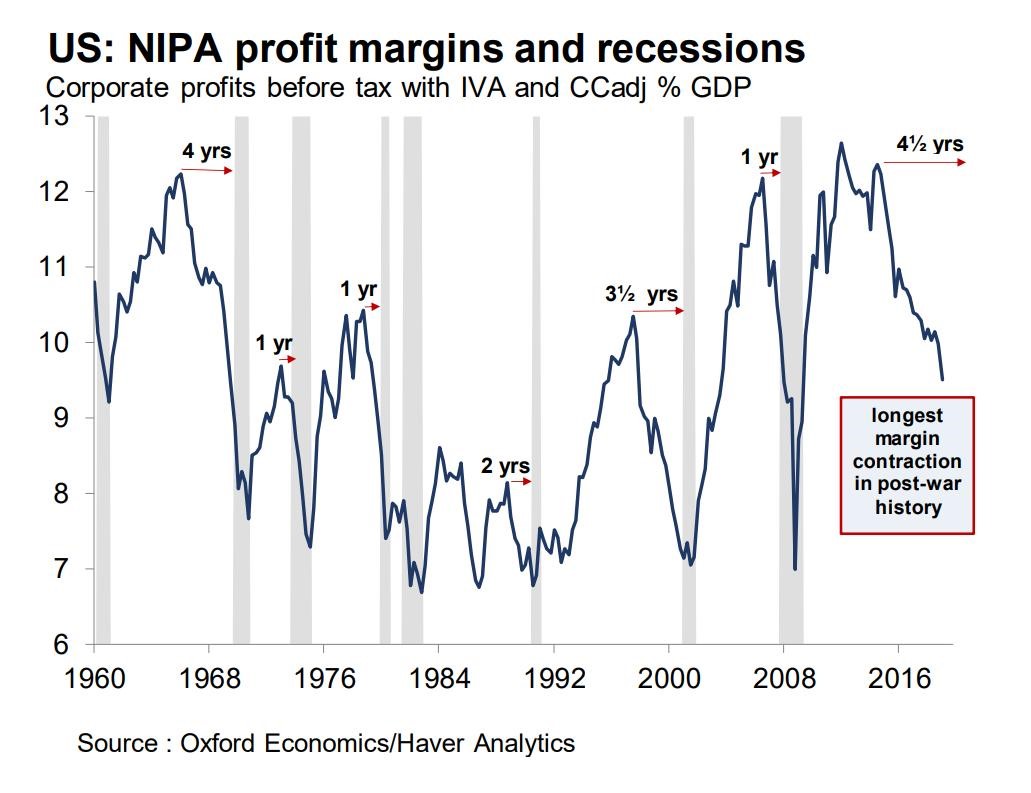
(Source: https://thenextrecession.files.wordpress.com/2019/08/pear-2.jpg)
If the returns to capital as a fraction of gdp are declining, that means the returns to labor are increasing! Even I can't see why that is a bad thing. It contradicts the claim of Thomas Piketty, who argues that capital will always get an ever larger share.

Take your good news while you can. The world is going to be increasingly short of it.

Further Reading:

Wednesday, March 27, 2019

Amazon HQ2


Queensbridge Houses.jpg
Queensbridge Houses (Wikipedia)
Kudos to Marty Goodman, Socialist Action's (SA) reporter on the Amazon HQ debacle in Long Island City. SA is rare on my beat in covering the situation at all--there is nothing in The Militant, nor has Solidarity said anything. Neither has Louis Proyect. Mr. Goodman's two articles are entitled New York Democrats shower Amazon with $billions and Protests bust up New York's Amazon deal.

It's a pity, then, that Mr. Goodman misunderstands almost everything. His confusion is so typical of my Trotskyist friends that it's worth a post to clarify.

The lede paragraphs from the first article:
On Nov. 13, after long secret negotiations, two New York “progressive” Democrats, Governor Andrew Cuomo and New York City Mayor Bill de Blasio, jointly announced that Amazon will place one of two new corporate “headquarters” in New York City and the other in Arlington, Va. 
Virtually kissing the feet of Jeff Bezos, Amazon’s CEO, whose personal wealth is $166 billion, both Democrats have bestowed upon Amazon about $3 billion in tax breaks and construction grants, which include even a nifty helipad for its owner.  ...
New York State offered $1.525 billion and the city is giving $1.28 billion to locate in Long Island City, in rapidly gentrifying Queens, a short train ride from Manhattan. The Wall Street Journal reports a “condo gold rush” in Queens.
This data can all be checked by simple Google searches. At today's price one share of AMZN costs $1759. There are 500 million shares outstanding, so multiplication yields total capitalization at $880 billion. Mr. Bezos owns about 79 million shares, worth $138 billion. He has a few other assets (e.g., Blue Origin), but his net worth likely isn't much more than $140 billion at today's market price.

Mr. Goodman should note how hypothetical that all is. It assumes that Mr. Bezos could sell all of his shares at today's market price. Of course he can't--putting that many shares on the market would crash the price. Further, we can suppose Mr. Goodman wants to confiscate his wealth. But if he did he'd end up only with a pile of worthless stock certificates--nobody will buy stock in a company whose assets are routinely confiscated.

Mr. Goodman will claim he doesn't care about the certificates, but instead only wants the physical assets: warehouses, offices, computers, etc. And yes, he could confiscate those, and perhaps those would have some residual value above zero. But the company Amazon is a whole lot more than the physical assets--it is a business that depends crucially on its management, specifically on Mr. Bezos. Take Mr. Bezos out of the picture and Amazon is reduced to a pile of trash.

Mr. Goodman is correct that the handouts offered to Amazon are tax breaks. Those bennies are contingent on Amazon upholding its part of the agreement, e.g., hiring the promised number of employees, and are payable many years in the future. Of the $3 billion in handouts, very little of it is money in the bank that can be reallocated to schools, housing, welfare, etc. As Tyler Cowen puts it,
There is no $3 billion that NYC gets to keep if Amazon does not show up. That “money” was a pledged reduction in Amazon’s future tax burden at the state and local level.
By comparison, the annual NY State budget is about $150 billion, while the City budget is roughly $89 billion. The (mostly virtual) gifts to Amazon are small change--Mr. Goodman blows the whole issue way out of proportion.

Mr. Goodman's fixation on "handouts" is a red herring.

Then Mr. Goodman is against the "gentrification" of Queens. Why? Is he against new housing? Does he prefer that construction workers be unemployed? Does he really think that everybody should be forced to live in the low-quality, slum-like conditions present in public housing? Is he opposed to new restaurants, shops, and grocery stores, all of which employ people? Should the subway not be rehabilitated?

Those questions are not rhetorical. The honest answer to all of them is "yes." Mr. Goodman is very much Pro-Poverty!

The best argument he can muster for more poverty is this:
For its part, Amazon promises 25,000 new jobs in New York City, with an average salary of $150,000, far above the average salary of the nearby Queensbridge Houses, the largest housing project in the U.S., where the poverty rate is near 50% and the average income is below $20,000. Amazon says it will spend $5 million in training. ...
Raymond Normandeau, a resident of Queensbridge Houses since 1973, told the on-line Gothamist, “It’s pure bullshit. They’re never going to hire us for these jobs. Only a country bumpkin like de Blasio or Cuomo would believe this shit.”
Because of Queensbridge, nobody else should be allowed to earn any money.

My brief encounter with housing projects leads me to believe that most residents are old, disabled, and/or sick. So obviously they're not candidates for high-stress jobs at Amazon. Beyond which, residents of the Houses, even if not debilitated, do not have the skill set necessary for such employment. Because if they did they'd already have high-paying jobs and wouldn't be living in the projects. It's not like there is a surplus of skilled labor in the country.

The Queensbridge residents live almost entirely on taxpayer largesse, and occupy some of the most valuable real estate in the world. Nevertheless, they won't be displaced no matter what company moves to Queens--"gentrification" is not a problem for them.

Quite the contrary, their self-interest is that more people should earn enough to pay taxes. Of all people, they should support Amazon. An employee earning $150K will pay about $10K in state and city income taxes, for an annual haul of $250 million. That's just income tax--it doesn't include sales or property taxes, nor does it include taxes paid by construction workers, suppliers, and vendors who support Amazon and its employees.

It is truly bizarre that a few Queensbridge residents, along with Mr. Goodman, are so blinded by envy and ideology that they can't see the huge, indirect benefit that Amazon potentially provides for poor people in the Queensbridge Houses.

A bunch of Democrats (stupid ones), as pro-poverty as Mr. Goodman, pushed Amazon away, depriving the state and city of tens of billions of dollars in real revenue (as opposed to the hypothetical "handouts"). Progressive heroine Alexandra Ocasio-Cortez led the charge. She may win plaudits in her district, but her future in state and national politics is now foreclosed.

Most people are against poverty. Mr. Goodman is a rare exception.

Further Reading:

Wednesday, May 31, 2017

Book Review: The Complacent Class

Don't get me wrong--I thoroughly enjoyed reading Tyler Cowen's recent book, The Complacent Class. It's full of facts, figures, recent trends, and conversation that is all food for thought, presented in a lively and entertaining style. As usual, Mr. Cowen takes a relatively pessimistic view of our current circumstance, but unlike with some of his previous books, I am more willing to accept it.

Still, I got issues, the first being the title. The word class (especially coming from an economist) implies some kind of socioeconomic status, or perhaps one of the poles in a dialectical struggle. David Brooks, in his classic Bobos in Paradise, describes just such a group, bourgeois bohemians, whom he could have dubbed complacent if he'd wanted to.

But not so in Mr. Cowen's book. Never does he define who belongs to this class, nor do we meet any doughty dynamicists who stand in opposition. We're all more or less happy with the status quo, regardless of social position. It's not so much a class that he's talking about, but more an era or a zeitgeist. I'll happily concede that The Complacent Zeitgeist doesn't trip off the tongue, so I don't totally blame Mr. Cowen for his moniker. But let's be clear: it's a literary conceit, and not a term or category to be taken seriously.

Another (unwieldy) title Mr. Cowen could have chosen is The Herrnstein Centrifuge Goes Into Overdrive. For his book describes more or less precisely what Richard Herrnstein and Charles Murray predicted back in 1994 in The Bell Curve. Mr. Herrnstein forecast that people with high IQs would marry other people with high IQs, they would have really smart children and then segregate themselves into neighborhoods with other people with really smart children. This is what has happened, as documented by Mr. Cowen, and also by Charles Murray himself in Coming Apart.

Arguably The Bell Curve oversimplified things a bit by emphasizing only IQ. In reality, social segregation depends on lots of personality traits, not just IQ. As Mr. Cowen says,
For instance, intelligence, ambition, conscientiousness, and some personality traits all seem to possess some degree of heritability or at least intergenerational transmission. We have perhaps the best estimates for intelligence, and there the degree of heritability seems to run in the range of 40 to 60 percent, depending on which studies you consult.
Mr. Cowen takes Herrnstein's idea and generalizes it into what he calls matching. The Internet allows us much greater choice, not just in marriage partners, but in all sorts of other things--where to live, schools, restaurant choices, even pets. The net result is that people are more segregated than ever, with ever more power to select their friends, neighbors, and lifestyles--the centrifuge on steroids.

He has some new (to me) things to say about matching. It is well known that measured total factor productivity has declined markedly since 1970. Why? Mr. Cowen treats matching not just as a social phenomenon, but also as an economic one. He cites the usual litany of improvements in our lives that the statistics may not capture, e.g., the ready availability of free search engines. But then he suggests that the ability to match is much more important than anything on that usual list. If there really is an improvement in productivity, it likely shows up in better matching as much as anyplace else.

I think this is an important point. Thus a very important new aspect to our lives--arguably the most important new aspect to our lives--contributes nothing to GDP. So economic statistics don't catch the important consequences of the IT revolution.

But perhaps Mr. Cowen doesn't take his insight as far as he could. For example, Google-Waze technology has noticeably improved my life by sparing me many hours sitting in traffic jams. I pay (nearly) nothing for this service. But by participating in Waze, my data is used to to help other people match their travel to available roadways--I'm trading my information (my location and speed in traffic) for their information (fastest possible route to my destination). So this is in effect a direct consumer to consumer exchange, albeit with no money changing hands. It is a form of barter.

Similar statements can be made about Yelp, TripAdvisor, and even Match.com. All of these are direct economic trades from one consumer to another, unmediated by money. We pay only a small amount to support the platform, which is the only bit that shows up in the statistics. The value of these trades must be enormous, which implies that productivity statistics are woefully short of the mark.

I'm not sure complacent is the appropriate adjective for this. Revolutionary might be a better description. I'm grateful to Mr. Cowen for the insight.

Mr. Cowen maintains that however much we may enjoy good matches as individuals, there is net harm to society as a whole in the form of Herrnstein's centrifuge. Call this a market failure. No doubt there are winners and losers from the centrifuge. The poor are losers precisely because they get centrifuged out. But then the poor can't buy Mercedes-Benz cars either, and nobody calls that a market failure. I'm not at all convinced that society as a whole is worse off. Matching makes (most) people both happier and richer, and less reason for the government to come in and regulate it. (Which is no reason not to help the poor.)

The weakest chapter in the book is “Why Americans Stopped Rioting and Legalized Marijuana.” The obvious problem is that the word marijuana is never mentioned in the chapter at all besides the title. So it doesn’t deliver. I would have enjoyed learning about Mr. Cowen’s take on the opioid epidemic--surely as complacent a drug as can be imagined.

Then he attributes the stunning decline in the crime rate since 1970 to "complacency," suggesting that other explanations (incarceration, better policing, eliminating lead from the consumer environment, etc.) can’t explain the phenomenon. I’m not sure I believe him--I don’t know how one can measure the magnitude of a hypothetical with any precision. Then later in the book he refutes his own argument, suggesting that crime isn’t down as much as it has changed. Today we’re afflicted with cybercrime instead of street crime.

Another point he could have made is that street crime is less lucrative today--neither people nor stores carry as much cash as they used to. I think in this chapter he carries his complacency theme a bit too far.

The most compelling section of the book comes at the end, on the topic of global affairs. I’ll rephrase his point in my own words:

We, being complacent and rich, have absolutely no desire to go to war. After all we have the most to lose. North Korea has nearly nothing to lose--it would be hard to knock out their non-existent electricity system. So psychopath Kim Jong-un is using that asymmetry to blackmail us, knowing full well that all-out war will hurt us far more than it would hurt him (assuming he can save his own skin).

Our very complacency is leading us (nearly) inevitably toward war.

Nothing I say here should deter you from reading Mr. Cowen’s book. It’s a wonderful read, you’ll learn a lot, and you’ll probably reach different conclusions from me. Enjoy.

Further Reading:


Friday, February 21, 2014

Book Review: Arnold Kling's Macroeconomics Book

Psst! The Wizard is powerless!

So claims Arnold Kling in his deeply subversive little book formally entitled Memoirs of a Would-be Macroeconomist, but known in Mr. Kling's blog simply as "my macroeconomics book."

He should know, of course. He worked for the Fed from 1980 to 1986 during the reign of Paul Volcker. He was a worker bee in a very busy office, collecting data, analyzing reports, coding FORTRAN, and doing other things staff economists do. He was close enough to the Wizard to know what was going on, and yet apparently had no position of any power. It's what I'd call the perfect fly-on-the-wall appointment.

So with all that effort, the Wizard stood behind his curtain, tweaking the carefully calibrated dials, turning knobs, pulling on levers and pushing buttons. The monetary machinery creaked and groaned, serviced by the army of economists including Mr. Kling, who oiled it for greater transparency and efficiency. Yet still, despite their best efforts, great clouds of irrational obfuscation issued forth.

Mr. Volcker is widely credited for ending the inflation of the 1970s, but Mr. Kling doesn't give him much credit. He writes
I might argue that it was not Volcker who made the difference [in inflation]. ...What I am suggesting is that the high inflation of the late 1970s may have been self-correcting. It resulted in weakness in the stock market and in housing, which then created severe recessions--remember, the unemployment rate climbed over 10 percent in the second half of 1982. Yes, most economists say that was due to monetary tightening, but I am suggesting that it was due to financial dynamics that were playing out regardless of what the Fed was doing.
Contrary to mainstream thinking, Mr. Kling argues that (short of the full Zimbabwe), inflation is not very susceptible to either monetary or fiscal policy. Expectations control inflation more than most economists acknowledge--as the money supply is increased, the market automatically corrects by reducing the velocity, and vice versa.  Mr. Kling's opinion is that QE, tapering, and Fed-speak are mostly if not entirely irrelevant.

That differentiates him from the folks (charlatans?) over at ZeroHedge or Occupy, who believe that the Fed is actively malign. But powerlessness implies an inability to do evil as much as good. Besides, Mr. Kling has a great deal of respect for his former bosses--he credits them with good intentions, and even for a few good deeds. In his list of economists who have led "interesting lives," (that he himself might like to have lived) Mr. Bernanke comes in for special praise, but mostly for his research rather than his chairmanship.

Mr. Kling's alternative to standard macroeconomics is something called patterns of sustainable specialization and trade (PSST). He describes it nicely in his book. For a more scholarly account you can download a pdf here. I will summarize it in two sentences:
Entrepreneurs, mostly by trial and error, will look for ways to maximize value from existing resources. In response to change, new economic patterns will evolve over time that optimize the consumer surplus.
As Mr. Kling generally rejects mathematical models as unrealistically simple, mainstream economists obviously dislike his view. He's basically telling them that they've wasted their professional lives for the past thirty years.

There is a view that is more charitable to the mainstreamers. One can accuse PSST of being untestable and unhelpful. In discarding econometric models, Mr. Kling essentially throws up his hands in despair and asks us to abandon all hope of messing constructively with the economy. This is a rather depressing conclusion that people of good will prefer to reject.

But I think PSST allows for some predictions. In particular, I think it renders the two recent books by Tyler Cowen (the world's most overrated economist?) wrong. In The Great Stagnation Mr. Cowen argues that technological change has come to a (temporary) halt, and we've already consumed the benefits from electrification, the IC engine, etc. Thus economic growth is in decline, and this accounts for the declining wages, unemployment, etc.

But this doesn't square with PSST. Absent technological change, the economy should be stagnant. That means that the optimal patterns of specialization and trade would already be in place, with consumer surplus maximized. Thus, rather than there being unused resources, all resources would be used to maximum extent. Of course the "boom" wouldn't really exist--consumer surplus would never grow. Indeed, it might gradually shrink, and despite the full employment we would all be getting steadily poorer. (Think of it as an economy with no additional labor-saving devices.)

That doesn't describe our current economy. Instead of stagnation we have crisis. That means there is rapid change occurring that renders existing patterns non-optimal. I think that change is fairly obviously technological, so the great stagnation theory is wrong.

Mr. Cowen's second book, Average is Over, contradicts the stagnation thesis, arguing that rapid technological change in the form of computer automation will put huge numbers of people out of work. He suggests that, despite marvelous new technology, up to 80% of us will be in absolute terms poorer than we are today. (You can't win with this guy--technology or no, we're all gonna get poorer no matter what.) But PSST says this can't be true, at least not in the long term. Entrepreneurs are not going to leave 80% of human capital sitting on the table collecting no return--that is clearly not an optimal pattern. So while almost everybody agrees that in the short term new technology will be highly disruptive, in the longer term new patterns will evolve that utilize the existing human resources. New technology will eventually show up as added consumer surplus.

My claim is that Mr. Kling's book is subversive. Of course it undermines mainstream economics. It also diminishes the Austrians, Austerians, NGDP, DSGE, neo-Keynsians, and the doomsters over at ZeroHedge. I like PSST because I think it correctly predicts that new technology will make us richer. I've argued along similar lines in my post here.

The second way Mr. Kling is subversive is his status in the profession--he has none. He occupies no faculty chair, nor has he ever served as a policy maker in government. Following his fly-on-the-wall stint at the Fed, he held a similar position at Freddie Mac. He then went on to start an Internet company, which made him financially independent. I understand that his day job now is teaching high school, undoubtedly done as a labor of love. (Lucky students!) The title of his memoir gives it away: Memoirs of a Would-be Macroeconomist.

Third, Mr. Kling writes a professional memoir rather than a scholarly article. That makes it much more interesting to read, and it also lets him draw on his extensive and relevant experience. But this is not the typical way that academic research proceeds. Rather than just the in-crowd, Mr. Kling is addressing readers like me--interested laymen curious about economics. (I'm a rank amateur, with no formal economics education whatsoever.) Of course I prefer that approach, but apparently the cognoscenti do not. The book has not been widely reviewed. I don't believe the book is mentioned on Tyler Cowen's blog at all. This is discouraging.

Finally, and related to the third point, Mr. Kling obeys Trotsky's First Law, which states that the value of a scholarly article is inversely proportional to the height of the paywall, that judged not just by the subscription fee, but also the time and effort required to read it. Mr. Kling accordingly values his work very highly--it is an enjoyable (if not always easy) read, only 120 pages long, and is available for FREE.

Psst! I think Mr. Kling has written a very important book. Pass it along.

Further Reading:

Saturday, January 25, 2014

Book Review: The Second Machine Age

The Second Machine Age, by Erik Brynjolfsson and Andrew McAfee (Erik & Andy, as they call themselves) is a sequel to the equally entertaining, self-published e-book, Race Against the Machine. The more recent book is a longer, more detailed account of the same thesis.

The argument begins with Moore's Law, which posits a doubling of computing power every 18 months. If one chooses the date that the US Government defined the economic category information technology as Year 1, then the year 2006 brings us to 32 doublings. That means computers (along with software, data communication, etc.) were 4.3 billion times more powerful than they were in 1958.

Pocket change, claim Erik & Andy. Despite the dramatic increase in computation over 48 years, computers were still something of a sideshow. Well into the aughts one could claim that the only source of economic growth was in information technology--the rest of the world still plugged along as it always had.

But now things are different. Now we have arrived at the second half of the chess board (from the story where a king promises his faithful servant grains of wheat, the amount to double on every square). For most of the first half of the chessboard, computational gains are modest if not nugatory. But as one goes from the 32nd doubling to the 64th doubling, computer power begins to take over the entire economy. Erik & Andy predict massive changes in how we will live.

So I agree with Erik & Andy. Indeed, I wrote a post last Summer (Getting Richer While Feeling Poorer) which actually serves as a pretty good description of the first half of their book. The claim (in both my post and their book) is that computation will lead to rapid automation, which will dramatically change the nature of the labor force. We both argue that traditional economic statistics, such as GDP, are no longer very useful for describing the new normal. Erik & Andy, however, include a lot more data and information in their much longer text.

Erik & Andy's thesis can be distinguished from Tyler Cowen's The Great Stagnation. Mr. Cowen argues that the world has run out of innovation--that we've consumed all the benefits of electrification, mass education, modern manufacturing, etc. Thus growth rates will inevitably decline, at least until the next big thing comes along. Erik & Andy (& me) argue that the next big thing is already here in the form of mass automation. For us, boom times are just ahead, if not here already.

Mr. Cowen recently published another book, Average is Over, in which he implicitly repudiates the stagnation thesis. He argues that indeed, computers will automate lots of jobs, but only the cognitive elite will benefit. The rest of us shlubs (80%) will be under- or unemployed and have a net lower standard of living. (His claim reduces to the argument that massive economic growth will lead to widespread poverty--a ridiculous conclusion.)

Eric & Andy specifically address the Average is Over thesis comparing Bounty and Spread. Bounty refers to the huge amount of wealth created by computer power. Spread refers to the distance between rich and poor--the greater the spread, the more the inequality. Will the bounty be distributed broadly enough to minimize the spread? They offer no definite answer, but my reading leads me to be optimistic.

It is not just the so-called cognitive elite that will benefit from computers. Indeed, a lot of doctors and college professors are going to be put out of a job, while home health care aides will have thriving careers. Erik & Andy borrow a 2 x 2 matrix to describe the result, with routine and non-routine jobs in the columns, and manual and cognitive jobs along the rows. They conclude that routine jobs, whether manual or cognitive, will tend to disappear. Assembly line work in factories (very routine) is already mostly eliminated. Increasingly, routine cognitive work (including entry-level lawyer jobs) is going the same way.

I agree with that, but I'd add some other ideas. For example, any job that requires a prodigious memory is likely to be (partially) computerized. Thus medical jobs (especially diagnosis) will rely heavily on computers and will displace a lot of humans. What is happening to lawyers today will be happening with doctors in the near future, and for much the same reason. I've posted a longer piece about the impact of automation on STEM careers here. The STEM careers that show the most promise are the skilled trades, i.e., the equipment and instrument repairmen. To use an example from Erik & Andy, the guy who can fix Baxter will make a good living.

I disagree most with Erik & Andy on their policy prescriptions. A college education, while excellent preparation for work in the 20th Century, is less well suited for the 21st Century. In particular, I think graduate work is a waste of time for all but the very top students--graduate enrollments in all disciplines should shrink by 90%. I think the baccalaureate program is too long in most cases--a two or three year college career is long enough. I think general education--such as a Great Books program--no longer makes much sense. That is something that can be pursued by the adult learner on-line as part of life-long learning.

Finally, I think math is useless for almost everybody. I took a poll in my gen ed science class (mostly art and business majors) asking how many knew how to do long division. Every hand went up. Now this is the most useless skill imaginable, yet we're still teaching it in school. Likewise, factoring quadratic equations, graphing non-linear inequalities, studying trigonometry--none of this is useful for more than 1% of the working population. Computers can do math better than you can--why are we still putting everybody through this?

Conversely, art, music, writing, performance, public speaking, cooking, dance, counseling--computers can't do any of that. Those are the subjects that should be taught in school. Save the math and science for those students who are interested in it for its own sake. There will be very few jobs in those fields.

Otherwise I really like Erik & Andy's book. Highly recommended.

Further Reading:

Thursday, January 16, 2014

Thomas Piketty & The Marxist Meme

The Marxist meme, for those of you new to this blog, claims that we're poor because the rich people stole all the money. It is an idea that slides easily into the mind, quickly learned but very hard to unlearn, despite making no economic sense. Economically uneducated people (such as my Trotskyist friends) are enchanted by it.

But even brilliant geniuses can fall victim to the meme, a case in point being the young, French economist, Thomas Piketty. His new book, Capitalism in the 21st Century, (h/t Tyler Cowen) will be released in English in March. Needless to say, I haven't read it yet. I may never read it--it's 900 pages long, albeit apparently very well written. I have read Milanovic's excellent review, here (pdf).

Piketty's model starts out with accounting identities. These are facts that are true by definition, such as in a balance sheet liabilities must always equal assets. It doesn't matter if the firm is a stock market star or nearing bankruptcy, if the balance sheet isn't balanced it's time to fire the accountant. There are macroeconomic identities as well. For example (oversimplifying), global expenditures must equal global incomes, since whatever I spend is necessarily somebody else's income.

So accounting identities can be manipulated mathematically while still remaining necessarily true, and this is what Mr. Piketty does. His first law is simply rewriting some known identities.

First among these is that income is allocated between capital and labor. Income from capital is known as return on capital, while income from labor is called wages. The total income is the sum of the return on capital and wages. So it could be, for example, that 30% of total income is awarded to capital, while 70% is awarded to wages. The fraction of total income that's awarded to capital is called alpha.

The second identity is a relationship between the average global return on capital (let's designate that by r), and the rate of growth of the global economy (let's call that g). Piketty shows that if r > g, then alpha must get bigger over time. That is, a larger and larger fraction of the global wealth will accrue to capital, with an ever smaller fraction going to wages.

Conversely, if r < g, then the reverse is true--wages will grow relative to capital.

In the former case, r > g, reasonably assuming that rich people own most of the capital, then more and more wealth will accrue to the 1%. The rich will get richer, and the poor, while perhaps not getting poorer, will certainly be getting richer a lot slower. In the latter case, r < g, the premium goes to wages, and so wealth is more evenly distributed across society.

So which is it? The relative values of r and g depend on empirical fact rather than accounting identities. And here Mr. Piketty apparently excels--he has collected extensive data from most of the capitalist world from before the French Revolution to the present. He has found that for most of the last 200-300 years that r > g. The exception has been the period from 1913 to 1970--during that time r < g. His conclusion is that r > g is the normal state of capitalism, while r < g was an aberration that will likely never be repeated.

Today global growth is in the 2-3% range, while the average return on capital is roughly 4-5%. Thus r > g, and accordingly an ever increasing fraction of wealth is accruing to the top 1%. This is certainly true in the US, evidenced by high unemployment, declining labor force participation, and stagnant wages. Piketty argues that global growth can't get much higher. It depends predominantly on two things: population growth (stagnant), and improvements in technology (yielding approximately 1.5%). Growth is as high as it is because of China, but as it becomes fully integrated into the capitalist system its growth rate will slow, taking global growth down with it.

The return on capital has averaged 4-5% over the past two centuries, and barring exceptional circumstances is unlikely to change significantly. So Mr. Piketty forecasts r > g for as far as the eye can see.

The exceptional period from 1913 to 1970 was due to the World Wars (echoing my Trotskyist friends). By destroying so much capital, the return on capital was greatly reduced (perhaps even negative in some years). Further, rebuilding Europe and Asia enabled very strong growth. So, with r < g, this was the heyday of labor, when workers could claim an ever larger share of the pie. Unfortunately, economists coming of age during that time thought that was normal, and that capitalism would inevitably lead to a richer and more equitable society. Mr. Piketty says that's wrong.

Piketty's view is very pessimistic, essentially condemning a large fraction of the population to relative poverty. He suggests that 50% of the population will generally benefit from the trend toward capital, but that the bottom 50% will be losers. This, at least, is better than the robber baron age when it really was only the top 1% who were able to capture the largest share of income.

Among Piketty's solutions is to reduce the rate of return on capital through higher taxes. He supports (in some cases) a return to the 90% tax bracket--not to raise revenue (it won't) but rather to lower r. Instead of a war, let's just destroy capital through taxes. This is where the Marxist meme comes through most obviously.

So I am reminded of three things. First, many years ago I saw a TV interview with some futurologist. In a thought experiment he imagined a world where robots did all the work, and people simply lived off interest on the capital. Everybody would be a member of the leisure class, and labor would collect no wage whatsoever. We'd all own our bit of a robot.

Second, I frequently buy my morning coffee at a convenience store that is part of a state-wide chain. They pay minimum wage and are always trying to recruit employees. One of the perks they offer is stock in the company. In light of Mr. Piketty's argument, the company's stock may, in fact, turn out to be much more valuable than the wage. It's always been important to save for retirement, but if Mr. Piketty is correct, then accumulating capital at an early age becomes even more crucial.

Finally, Mr. Piketty criticizes Gary Becker's theory of human capital, i.e., that the investment made in education, etc., is a form of capital. In Piketty's opinion this just muddies waters that don't need to be muddied, namely the distinction between labor and capital. (Or as my Trotskyist friends would put it, don't cross the class line.) Mr. Piketty likely disagrees with the thesis I've put forward elsewhere that we're all petty bourgeois now. But whether or not human capital is really capital, there is no doubt that people who conserve human capital will also be able to accumulate real capital.

Human nature being what it is, some government redistribution of wealth will always be necessary. But perhaps we should redistribute capital rather than income.

Note (April 25th, 2014): I have written a follow-up post on Piketty's book here.

Further Reading:


Thursday, October 31, 2013

Those Nattering Nabobs of Negativism

I am an optimist. 

My secretary once nicknamed me "Pollyanna," and not entirely as a compliment. It's a personality disorder I share with people like Matt Ridley.

My optimism was dented a few years back when my career took a tumble. Then I fell in with the ZeroHedge (ZH) crowd and folks like Marc Faber. In response I bought a few hundred shares of GLD, managing to time the very top of the market. That's what pessimism will get you. I've since recovered and am back to my old self--see here, for example.

It is possible to be pessimistic in the short term while being a long-term optimist. Trotskyists are like that, though for them the short term extends indefinitely into the future. They believe that capitalism will eventually self-destruct, and until then will be a time of wars, crises, and poverty. But long term (assuming there is a revolutionary Party with the precisely correct political perspective) future generations will live happily ever after. Idealistic young people (i.e., 18-year-olds who think they will live forever) became Trotskyists precisely because of this naive optimism. 

For true pessimism you need to turn to Mark Steyn. He forecasts the demographic and intellectual decline of civilization as we know it, assuming a) that civilized people will never have enough babies, and b) that people who have lots of babies will never be civilized. I think he's probably wrong on both counts, but there is no denying that demographic decline will have a major effect on the economy. That, along with persistent deflation, are probably the signal trends of our age.

A more insidious pessimism--because it is more reasonable--is propounded by Tyler Cowen in his books The Great Stagnation and Average is Over. I've commented extensively on his opinions here and here.

So that brings us to a recent paper by Brink Lindsey entitled Why Growth Is Getting Harder (pdf). He is almost apologetic about his pessimism, practically inviting readers to respond tell me it ain't so. I'll oblige: Mr. Lindsey is too pessimistic by half (but only by half).

His argument is that the four major drivers of GDP growth are all showing signs of long-term, secular decline. Each of them has declined in the past, but this is the first time in the last century that all four have gone down simultaneously. The four components are labor force participation, labor force skill level, capital appreciation, and "total factor productivity," otherwise sort of known as innovation.

The first item largely echoes Mr. Steyn's arguments--we baby boomers didn't have enough babies, and as we retire the labor force is going to shrink. This is happening full force in places like Japan and Italy, and is gathering pace in the US as well. Put more colloquially, the Millennial generation is getting screwed. Unfortunately, I can't argue with this prognosis.

His second point is that we've extended education to point of diminishing returns. In the 20th Century there were huge productivity gains achieved by dramatically increasing the number of people who went to college. There will be no similar gains in the future. Beyond that, I argue that we've passed the point of diminishing returns, and instead today's marginal investment in education is a dead weight loss.

So there is hope on the horizon. Our current college system is hopelessly inefficient and ripe for change. It will become much cheaper in the future--indeed, even trending toward free. One of the ways it gets cheaper is by becoming shorter--there is now a growing trend toward three-year bachelors degrees. Many students can productively use the senior year of high school taking on-line college classes, possibly shortening the time to degree even more. Yes, kids will still want to live on campus in dorms, but for a shorter time than they do today. Beyond this, graduate programs are a complete and total waste of time & money for almost everybody. In particular, the PhD is a recipe for a lifetime of underemployment.

Mr. Lindsey's third point is that less capital is being accumulated and invested. His modest claim is that at very least it does not auger for strong economic growth. And true enough, but I will argue that the point is largely irrelevant. Stuff is just cheaper these days. It requires little up-front investment to launch an international ad campaign on Google. A desktop, 3D printer can be had for a few thousand dollars. Arts & crafts people can set up shop on eBay in a jiffy. Frankly, it just doesn't take a lot of capital to start a business. The days of huge automobile factories is coming to a close. Therefore I suggest there isn't a strong correlation between capital investment and economic growth.

The last factor on Mr. Lindsey's list is innovation. There are reasons to think that the rate of innovation is increasing. Not only are capital and labor both cheaper than they ever have been, less labor and capital are needed to bring an idea to market. More people can start more companies with less money--the cost of innovation has declined dramatically. Individuals can start colleges. People can publish their own books on Kindle for free. 3D printing will allow all sorts of small time entrepreneurs to get into business making stuff. And so on. Of course most of these efforts will fail, but throw the dice enough and you'll get lucky. Resources are so cheap that we'll be throwing the dice a lot more often than we used to.

So I'm not as pessimistic as Mr. Lindsey. I admit his point about the declining labor force, but I don't see any commensurate increase in salaries. So this can't be harming the economy. I acknowledge that our education system is dysfunctional, but that presents an opportunity for growth. Lack of capital investment may be a problem, but with interest rates so low it's hard to see how it makes much difference. And finally, the cost of innovation is dramatically cheaper than it ever has been. We should be getting more of it.

So Mr. Lindsey is wrong. The glass is half full!

Note: The title is borrowed from a speech written by William Safire for Spiro Agnew. Does anybody remember Spiro Agnew?

Further Reading:

Thursday, October 24, 2013

Food Network & The New Normal

Over the past couple of months I've taken to watching three shows on The Food Network: Diners, Drive-ins, and Dives (3D), Restaurant Impossible, and especially, Chopped.

These are not about food. Television is a poor medium for taste and smell, and in LED facsimile even color doesn't work to well. For me, at least, Pavlov's response is not triggered; the shows don't make me hungry.

Instead the programs are about restaurants: the people who work in them, the people who eat at them, the kinds of destinations they make, and what their business model is. Themes run the gamut, from a reality-show episode exposing a family torn asunder by their restaurant, to a sober account of how the front of the house should be managed. Food and recipes also appear, but are mostly relegated to the webpage.

When I was growing up, my parents had a friend--moneyed beyond his professor's salary--who fancied himself a connoisseur--fine art, classical music, good wine, elegant furniture, and excellent food. As a divorcee he did most of his own cooking, to Mozart accompaniment, but it was not his passionate avocation. His kitchen possessed a repertoire of tasteful, clever, well-engineered gadgets that supposedly made the job easier.

His facility was nothing compared to those I discovered in the pages of Architectural Digest. The kitchens of the 1% (a few of which I've actually seen in person) are vast, barn-like structures with every appliance imaginable, decorated with granite counter tops, built-in freezers, and possessed of mountain/ocean/city vistas. These are kitchens as a competitive sport--read David Brooks' funny account of the phenomenon in Bobos In Paradise.

So you will understand that for most of my life I thought of haute cuisine as the preserve of the well-to-do. My more humble family ate good food, but it was simple fare. In my college town there was exactly one Chinese restaurant, and otherwise one could choose between diners, the occasional steakhouse, or maybe a sandwich shop. McDonalds came of age during my youth. Needless to say, we didn't eat out often.

Imagine my surprise, then, when I saw the chefs on Chopped--tattooed, overweight, scraggly, working-class folks. Far from the kitchens of Architectural Digest, the Chopped contestants are the sons and daughters of truck drivers, plumbers, and maids. They're not listening to Mozart. The runner-up on today's episode was a ghetto kid who spent part of his life homeless, and then got a job as a dishwasher, feeding himself from the leftovers on people's plates. From that he worked his way up to chef--no formal education. The winner had a more stable life growing up in poor, East Los Angeles. Both of them are highly skilled, incredibly practiced cooks.

And likewise with the other programs. The chefs on 3D are one step removed from the short order cook at Dennys. And the owners profiled in Restaurant Impossible are former garbage handlers and postal employees. These are not people my parents' professor friend would associate with, nor did they grow up in an elite kitchen.

So what's changed? How has cooking gone from a hobby of the elite to a skill for the dispossessed?

I'll suggest three things. First on the list is WalMart. While a luxury kitchen is still a luxury, a perfectly functional kitchen can be had at everyday low prices. Even poor kids can obtain a blender, buy some decent knives and teflon pans, and have access to a stove, fridge and freezer. That's different from my youth, where much on that list were middle class appliances.

Second, improvements in transport and agriculture means that quality, fresh food can be had at almost any grocery store. Yes, there's a marginal benefit to Whole Foods or some other elite store, but those are no longer necessary. As Robert Irvine of Restaurant Impossible never tires of pointing out, fresh food is both cheaper and better than the frozen or canned variety. You don't need to be rich to buy it anymore.

And finally, as the above implies, we're all richer now. In contrast to where I grew up, the college town I live in now has three sushi bars, along with other places serving Thai, Indian, Chinese, Japanese, Italian, and American cuisine. All for a town of about 30,000 people! But food in my town is downright expensive compared to New York City, where you can eat like a king for under $15.

So why is this important? My Trotskyist friends will take these lower class chefs and lump them in with the proletariat--a term they consider complimentary. But it's really deeply insulting because it dismisses the hours and hours and hours of practice and hard work these people invested in their trade. Like the rest of us, the Chopped contestants all aspire to the petty bourgeoisie, i.e., they hope to bring some unique, marketable skill to the table. The proletariat has power and significance only in the abstract mass--the attributes of an individual don't matter much. Thus Trotskyists are championing the fast food strike, trying to extort higher wages for people whose jobs are already at risk of automation.

More serious is the opinion of Tyler Cowen in his book Average Is Over. He argues that while there will be more millionaires and billionaires than ever before, the largest part of the American population--85%--will be left behind. Those that succeed will have the cognitive chops to compete and cooperate with computers. But he's wrong.

The Chopped champs may be smart, but they've got a different kind of chops. Unlike any computer they can chop vegetables, reduce a broth, taste a sauce, and judge the color of meat. Very few of them will be millionaires, but most of them will earn a living. And unlike what Mr. Cowen claims, they'll do better than just feeding the Architectural Digest crowd (though they'll be doing that, too).

Everybody wants good food. All the food in my town is putting the old-fashioned diners out of business. The restaurants that specialize in prepackaged microwave food (e.g., Olive Garden) are probably next in line. Fast food places will be automated and their employees laid off.

People--even poor people--are going to be eating much better food in the future. The former fast food workers will find employment as servers and busboys in gourmet restaurants, run by Chopped champions who really know what they're doing. Their customers will be you and me--we'll get quality, fresh ingredients, combined in complex, tasty recipes, cooked by expert chefs, served by trained staff--and all for under $10.

Mr. Cowen is wrong. Automation will eliminate lots of jobs. But it will make better jobs just as quick, and it will make us all richer in the process. Yeah--McDonald's and (maybe) Starbucks will be automated, but their former employees won't be sitting around collecting welfare. They'll be creating yet more value added that improves the lives of everybody.

Is this a great country, or what?

Further Reading:

Tuesday, October 15, 2013

Book Review: Average Is Over

Tyler Cowen's recent book, Average Is Over, is a deeply pessimistic and fundamentally mistaken look at America's future. He's got the ingredients right--computerization, globalization, a skills misfit--but he puts them together in a way that doesn't make any sense.

No doubt we are beginning an era of rapid technological change, one probably as dramatic as the industrial revolution or electrification. The computer revolution has grown up, is leaving the IT ghetto behind, and now is moving into the world of Real Stuff, radically changing the way we will live. Many, many jobs will be automated out of existence, or at least changed into something unrecognizable today. This will involve a new way of working, putting a premium on different sets of work skills.

Mr. Cowen's book catalogs some of those changes, using, among other items, the interesting example of freestyle chess as a guide. Unlike the traditional mano a mano chess tournaments of yore, freestyle chess lets the players use whatever tools are available, including powerful computers (that Mr. Cowen dubs genius machines). The combination of man and machine is more effective than either alone, and the best freestyle chess teams can beat any human or computer opponent out there. Freestyle teams include computer geeks and chess nerds--but not the best of either. Instead, the teams put a premium on computer/human teamwork, and must decide when to trust the computer, or instead go with human instinct. This is a different skill set than either the traditional grandmaster or computer nerd possesses.

His discussion of chess occupies a goodly portion of the book, but two other examples add to the flavor. He spends most of a chapter on String Theory, an esoteric field of physics primarily of interest to hobbyists. Finally we come (sort of) down to earth with an account of the digestive tract in starfish.

So there you have it. You take these examples, add them together, and you get--I dunno--maybe $5-6 million in global annual revenue if you're lucky. Enough to keep Bill Gates in the pink for a couple of weeks, but this is not the stuff that economies are made of. While he does mention other topics of somewhat more practical importance, the book radiates unreality. There is very little about how people in the future will actually earn a living.

Indeed, in one large part of our economy he argues that the dashing young men and their genius machines will have almost no impact at all. By virtue of demographics, he predicts that health care costs will continue to grow faster than inflation indefinitely. I find this incredible. At most demographics suggests a growing job market for home health care aids (a low wage job), but surely the genius machines are going to displace large numbers of doctors and technicians. Watson (it of Jeopardy fame) was designed to do medical diagnoses--no human doctor will be able to compete with that. Radiologists, pathologists, oncologists, etc., are all looking at the unemployment line.

Indeed, I think Mr. Cowen gets the trend all wrong. He says that middle-wage workers (bookkeepers, travel agents, stock clerks) will suffer most, while the "cognitive elite" will benefit. But he's wrong. Computers are putting lots of lawyers out of work right now. College professors are on the bubble. Doctors are not too far behind. The cost savings is maximized when you eliminate the most expensive people. The home health care aid, nurse practitioner, and physical therapist are more likely to stay employed than most doctors. Those middle-income, skilled trades will survive and thrive--they're the eyes, hands and feet for the computers.

It is surely odd that Mr. Cowen has not addressed topics more central to the way people actually make money. Important topics such as agriculture, oil & gas, and manufacturing are almost unmentioned. And this leads to the fundamental flaw of the book.

He posits that the future will lead to a radically inegalitarian society, with a few very wealthy millionaires and billionaires, and the rest of us left over as shlubs. This seems indisputable, and inequality doesn't bother me particularly. But he further claims that a large fraction of our population will be poorer in an absolute sense, not just relatively. They will live in more isolated areas, have less access to health care, eat lower quality food, and live in smaller and less comfortable houses. I find this unbelievable. As I say, his is a very pessimistic view of the future. I also don't think it's true.

You can see why Mr. Cowen thinks so. Given that his examples are all of the pocket change variety, no wonder he thinks we'll all be poor. But then why are we undergoing this huge technological revolution just to save a few pennies at the margin? Mr. Cowen's (implicit) answer to that is very disturbing.

His view of America's future is similar to Latin America's present--a wealthy elite lording it over the miserable peasants. But America isn't built that way. Unlike Latin America, our economy is not structured around crony capitalism (despite the best efforts of Democrats to move us in that direction). Rich people in the US can't just collect rents in the manner of Carlos Slim, Pemex, the Mexican teachers' unions, or the drug gangsters. Instead, American billionaires become rich only because they provide goods and services to consumers at prices people can afford.

Yes, we have a few, rent-collecting scoundrels--maybe Goldman Sachs falls into that category. But folks like Malcom McLean, Sam Walton, Steve Jobs, and George Mitchell all did something that made everybody richer. Mr. Cowen describes a scene--two billionaires having lunch--that shows he fails to appreciate this fact. Those two billionaires earned their billions by improving the lives of us shlubs--not by diminishing them.

There is no good way to interpret the message of Average is Over. Perhaps Mr. Cowen thinks we're going to evolve into a crony economy such as they have in Mexico, Brazil and Argentina? That is surely a very depressing thought, and one the Tea Party is actively resisting. If that's true then we really will become poorer, but it won't be because of technological change or the computer revolution.

Or perhaps Mr. Cowen thinks that billionaires can become rich without selling anything to anybody? In Average is Over, apparently the only things the peasants can buy is cheap entertainment. That's it--an economy based on Grand Theft Auto and internet porn. No wonder Mr. Cowen picks examples of no financial significance.

In reality, billionaires become rich because they sell things to people at a price we can afford. Us shlubs buy the stuff because it makes our lives better. Of course there will be winners and losers in any technological revolution--just ask lawyers, college professors and doctors about that. But Mr. Cowen's dire prediction of mass impoverishment will not come to pass.

My post entitled Getting Richer While Feeling Poorer is a much clearer vision of the future than Average is Over. Mr. Cowen exaggerates the problem of inequality, which I address in a post entitled Are Rich People Rich? Finally, some thoughts on the future of the labor market in STEM fields are here.

I've read a lot of books by Tyler Cowen and Alex Tabarrok. I have enjoyed them all, including this one. But within that set, the current tome is well below average.

Further Reading: