Showing posts with label Louis Proyect. Show all posts

Wednesday, September 1, 2021

Louis Proyect: January 26, 1945 -- August 28, 2021

Louis Proyect died last Saturday. An announcement is posted on his webpage, which I didn't see until today.

I'm not the person to eulogize him. I never met him personally, and am not familiar with the details of his life. But even from afar, I found him in many ways to be an admirable man.

He had no academic rank, and as far as I know never attended grad school. The man earned an honest living. Yet he was a master historian--mostly self-taught. His lack of academic standing freed him from the corrupting constraints of tenure committees, funding agencies and journal reviewers. He was free to tell the truth as he saw it. He was very knowledgeable about Syria, disagreeing with many of his Leftist friends. I considered him the go-to source for factual information on that conflict.

His blog was wonderful. Very few people can turn a personal blog into an important success--but Mr. Proyect did so, without in any way sullying his reputation by trying to monetize it. He was early to the web, and among its most resourceful users. 

He was an excellent writer. Given the quantity of output it must have come easy to him. His work was always clear and entertaining.

Obviously, I did not share his Leftist/Socialist sympathies. I especially objected to his opinions on environmental issues, about which I thought him ill-informed.

As a polemicist, I often thought his arguments were too ad hominem. Instead of addressing issues, he simply lobbed insults at his interlocutors. Entertaining? Yes. Helpful? No.

Had I known he was dying I likely would not have published my most recent essay--very discourteous but written tongue-in-cheek. Though I don't feel too bad--Mr. Proyect sure could dish it out. I assume he could take it as well.

I will miss Mr. Proyect. His blog was always food for thought, and often fodder for a blog post as well. The world is poorer without him.

Further Reading:

Tuesday, July 27, 2021

Louis Proyect Denies Being a White Supremacist

Does Louis Proyect deny being a white supremacist?

Not explicitly, of course, because if you say you're not a white supremacist, then you probably are a white supremacist. That's all because of white fragility and systemic racism--the very people who deny being subject to it are, in fact, the leading carriers of the disease.

Yet we do have good cause to suspect Mr. Proyect of being a white supremacist. For starters he's white. There's no getting around that--he doesn't even try to deny it. And if white supremacy is indeed a condition that afflicts white people--a problematic population--then there's no reason to exclude Mr. Proyect from the category.

Beyond that, he's Jewish. We all know that Jews profited immensely from the slave trade. Indeed, Mr. Proyect used to work for Goldman-Sachs, a Jewish-led institution if there ever was one, and one that supposedly acquired its riches mostly if not exclusively from slave dealing. Besides, Jews wrote the Hebrew Bible (and the New Testament), admitting that they owned slaves almost from the very beginning, starting with Exodus. (I have an edge on Mr. Proyect here. I'm only half Jewish, so by that genetic quantum I'm less of a white supremacist than he is.)

Mr. Proyect tries mightily to atone for this original sin by allying himself with the most antisemitic organizations possible--notably Hamas (that explicitly wants to kill all the Jews) and BDS (which cancels people for the crime of being Jewish). Sadly, the stain of white supremacy is not so easily discarded.

So he kowtows to the BIPOCs in most humiliating ways. BIPOC is how we're supposed to refer to Black people these days--at least according to the Fac-Staff email list on my campus. It stands for Black & Indigenous People of Color. Though weirdly, the loudest representatives of BIPOCs on my campus aren't much differently colored from me. He's keen on using dehumanizing terms like Latinx (I think it rhymes with minx)--a degendered dysphemism for Hispanic, a people so reduced that they have no purpose in life other than to be oppressed by white supremacists. 

He insists on using the phrase Native American instead of Indian, despite the fact that the people themselves prefer the latter term. Like other white supremacists, Mr. Proyect wants to eliminate all traces of Indian culture from American life. Not just by renaming all the sports teams, but likely by eventually replacing evocative place names like Chattanooga and Kalamazoo. Those represent the evil legacy of white supremacist cultural appropriation.

Unfortunately, in my 50 years following American Trotskyism and 40 years as an academic, I have yet to encounter a succinct definition of "white supremacy." Mr. Proyect is no help here, but he does offer an example of a white supremacist--an archetype if you will.

The poor fellow's name is Matthew Karp, a professor of history at Princeton. Mr. Proyect's account of Professor Karp's sins is an article entitled How Harper’s Magazine Undermines the Struggle Against White Supremacy, which appeared in Counterpunch. The teaser to the article on Mr. Proyect's blog sports a picture of John "Rick" MacArthur, the editor of Harpers who has been "orchestrating this shift to the right." It's probably more accurate to say that he's been orchestrating a shift to common sense.

Mr. Karp's error is that he had the unforgivable temerity to criticize Nikole Hannah-Jones' 1619 project. Mr. Proyect writes,

[Mr. Karp's] article argues that it is futile to dwell on the racist history of the USA and to instead look forward to breakthroughs like the Civil War, the civil rights movement, etc. Essentially, Karp aligns himself with the cadre of historians that complained bitterly about all the falsehoods they supposedly saw in the 1619 Project. Among them, his Princeton colleague Sean Wilentz barked the loudest at Hannah-Jones. Mostly, the complaints were about her introductory article that stated that the colonists fought for independence in order to maintain slavery and that racism was in America’s DNA.

Now Mr. Proyect is an ace historian--a really good one--and he surely knows more about history than I do. And to his credit, he refuses to say that Mr. Karp's criticism is actually wrong. But in his desperate attempt to suck up to Ms. Hannah-Jones, he can only argue by association--i.e., that Mr. Karp keeps bad company. Here is the rest of the above-quoted paragraph:

Except for Wilentz, the historians took their case to the World Socialist Website (WSWS), an outlet distinguished by its hysterical Henny-Penny warnings that WWIII was always about to break out and that Socialist Workers Party leader Joe Hansen was a GPU agent.

That is, because Mr. Karp agrees with somebody who at some other time said something stupid on a completely unrelated topic, therefore Mr. Karp's criticism is wrong. OK, so it isn't wrong--Mr. Proyect never says it's wrong--but apparently one shouldn't utter it in public.

The fact is--as surely Mr. Proyect knows--that maintaining slavery was important to some American revolutionaries, especially in Georgia and the Carolinas. They were afraid that Britain was going to ban the institution--as indeed Britain did in 1833. But the bulk of the Continental Army--led by George Washington--came from Yankee states: New England and Upstate New York. Those Yankees were abolitionists more likely than not, and in any case were not fighting for "white supremacy."

Obviously the relationship between race and the American Revolution is vastly more complicated than Ms. Hannah-Jones would have us believe. Mr. Proyect is so in hock to bullies like her, who claim the power to exonerate one from being a white supremacist, that he can't even call a simple spade a spade. This is humiliating.

He makes other statements for which he really ought to know better. He channels his inner Democrat, claiming "Republican state governments were working overtime to pass Jim Crow type voting laws." I always thought Mr. Proyect hated the Democratic Party, but here he is echoing a completely over-the-top talking point. The voting laws in states such as Georgia are nothing even close to being like Jim Crow. There will likely be no racially disparate impact at all from that legislation. Like Democrats, Mr. Proyect apparently believes that Black people are too stupid to get a driver's license. I told you he was a white supremacist.

Mr. Proyect writes

This rather obscure observation is supposed to remind us, according to Karp, that history is neither all good or all bad. I am not sure it is necessary to cite Foucault to understand what most children learn in the 8th grade. What they are not learning, however, is how White households ended up with 6.9 times as much wealth as Blacks’.

I think it's obvious that school children are learning about white/Black wealth discrepancies (that may be all they're learning). Mr. Proyect will attribute the problem to "white supremacy." This fails for two reasons:

  • Neither he nor anybody else can define "white supremacy" with sufficient precision to make it measurable.
  • He attributes all social ills to that one meaningless phrase. Surely Mr. Proyect is smart enough to know that history and sociology are much more complicated than that.
Finally, referring to the fact that Ms. Hannah-Jones was denied tenure by the Board of Trustees at U of North Carolina, he writes "Somehow, he [Mr. Karp] had not noticed the UNC’s egregious attack on Hannah-Jones’s right to tenure."

Nobody has a "right" to tenure, which is guaranteed by neither the Constitution nor by any reasonable definition of academic freedom. Tenure is an employment contract promising the holder a lifetime job. In this case, tenure meant that Ms. Hannah-Jones would receive a paycheck from the U. of North Carolina for decades to come. Obviously taxpayers in that state have a right to deny her that privilege, and it is the obligation of the Board of Trustees to represent the taxpayers. Which they did until they wimped out, but fortunately for North Carolinians the lady went elsewhere.

I think Ms. Hannah-Jones is a propagandist faking it as a scholar. She's a fraud who should never have been hired in the first place.

I'll admit to being facetious in this post. I don't really think that Mr. Proyect is a white supremacist. Indeed, I don't think he's any more a white supremacist than I am, and I am definitely not a white supremacist.

Further Reading:

Thursday, January 14, 2021

Louis Proyect and "Degrowth"

I have often accused Louis Proyect of being pro-poverty (e.g., here, here, and here).

I did expect pushback at some point--how can a Marxist be in favor of poverty? Surely, I thought, Mr. Proyect would deny my charge and argue that he was indeed for human well-being.

What I didn't expect was a confession--Mr. Proyect explicitly admits to being pro-poverty! He concedes as much in an article entitled A reply to John Molyneux and Michael Lowy on degrowth. (Molyneux's paper is here; Lowy's can be found here.) "Degrowth" is a synonym for "we all need to take a big cut in our standard of living." He offers a succinct definition here:

Degrowth is completely focused on the question of how humanity can not only survive into the 22nd century but how can civilization continue until the planet dies due to astrophysical realities. It poses solutions based on the needs of a modest life-style that while giving up on SUV’s and all the other crap can allow the full development of the human being, who might have to work 10 hours a week while painting landscapes or growing orchids the rest of the time. That means addressing the population question that people like Molyneux recoils from.

The argument is that Joe, by not driving an SUV today, will measurably enhance the well-being of whatever civilization exists a billion years from now. This is ridiculous on its face!

At bottom, Mr. Proyect's philosophy is a death cult.

He makes two assumptions: first, he fails to discount the future--i.e., the comforts of his great-great-great grandchildren two hundred years from now are as, or even more important than our comforts today. This is ironic because I don't believe that Mr. Proyect even has any grandchildren, which renders the whole issue hypothetical. Since part of the proposed solution is reducing the birth rate, putative future generations won't exist at all. How's that for a wonderful life?

Second, he supposes he can predict the future. He knows with unseemly confidence that Joe's SUV is gonna ruin the climate--not just now, but literally for all time! I think he's almost certainly (99.999%) wrong about climate change--whatever that is, it isn't an existential threat, and future generations (much less distant civilizations) will not remember us for our carbon profligacy.

I can't possibly go through all the bullshit in his correspondents' two papers. Lowy's piece is so far detached from reality that it establishes him firmly among the 99% of academics that give the remaining 1% a bad name.

Our authors completely ignore capitalism's benefit to consumers. Capitalism produces the goods and services that we want to buy and which greatly prolong and enhance our lives. Claiming that capitalism's sole benefit is profit for the capitalist is simply not true.

They all maintain that democratic decision making will make for a better environment, arguing that somehow the majority will elevate the interests of future civilizations billions of years from now over those of their own children (or themselves) today. There is no evidence for that. Joe with his SUV gets to vote just as much as Mr. Proyect.

Their claim that capitalism wastes resources is not true. A capitalist wants to cut costs, which means using as few resources as possible. Now there are issues that arise from "the tragedy of the commons," i.e., people passing environmental costs on to their neighbors. This is where government has to step in and why we need an EPA (the purpose of which is not to preserve the environment for the next billion years). But for the most part, capitalism wastes as little as possible, and is therefore much cleaner than rival societies, such as socialist ones.

Most regrettably, our friends want to limit people to working 10 hours per week--they can spend the rest of their time "painting landscapes or growing orchids." But they're not allowed to earn any extra money! They can't start a business--not even a lemonade stand--because somebody a billion years from now might object.

Trading goods and services is a uniquely human trait--no other animal does that. Mr. Proyect calls it "working," and we're now supposed to be forbidden from doing it. This is like being in prison--where they sit around all day painting landscapes.

Somehow Mr. Proyect concocts a wood shortage--mysteriously there is now a dearth of trees. Capitalism is "[s]o efficient at reducing forests to toothpicks." He writes,

Molyneux proceeds to define some of the norms we can expect under world ecosocialism. This one stuck out for me: “The extensive retrofitting of homes”. I am not sure what this means exactly but it would point to the banning of any house or apartment over 3,000 square feet for a family of four. I’m definitely for that but within such an advanced new way of sheltering, how do we create the furniture that people need for a modicum of comfort? We certainly need chairs, tables, beds, desks, and bookshelves, don’t we? Can we have a socialist Ikea that supplies such basics?

In this new ecosocialist utopia, some bureaucrat is gonna tell you "you can't have that end table. We need to save the wood for the folks living a billion years from now."

Some people would prefer to have fine furniture to painting landscapes. Who are these ecosocialist creeps to tell them they can't do that?

One thing I really don't understand about ecosocialists is their fixation on "mass transit." Somehow they imagine that a technology from the early 1900s is the ultimate solution to problems faced by civilizations a billion years from now. I don't get it.

So how do people get to work? In 2019 (before the pandemic), 1.4% of American commuters took mass transit, while 5.3% worked from home. (These are median numbers from a list of 110 US metropolitan areas.) Since then transit's share has collapsed. Ridership in the New York metro is down as much as 90%, while the work from home share has skyrocketed. As of September, 2020, 33% of all employees worked exclusively from home, while another 25% worked from home for part of the week. Only 42% of American workers still go to the office or factory every day.

This trend may partially reverse post-pandemic, but it will never go back to where it was. The number of people working in Lower Manhattan or Chicago's Loop is now permanently reduced.

Please, Mr. Proyect--tell us why you think we need more buses and subways? (And let's forget about streetcars, which average speed is only 19 mph!)

The whole mass transit thing is an anachronism. And the whole ecosocialism thing is a vile religious movement that is very bad for children and other living men and women.

Further Reading:


Sunday, July 19, 2020

Louis Proyect vs. Steven Pinker

Louis Proyect is the master of ad hominem argument. In a post pretentiously titled Pecksniff and the Harper’s Open Letter, he'd refuse to sign the Harper's Open Letter because he wouldn't want to join the disreputable crowd of hypocritical, prominent signatories. He never claims to oppose the letter's actual content, which champions free speech, open inquiry, and some minimal respect for persons who disagree. These are bourgeois values which I believe Mr. Proyect holds in low esteem--he is, after all, a totalitarian Marxist.

Certainly respect for persons who disagree is low on Mr. Proyect's list. This is what he says about Mark Lilla.
Mark Lilla—Another Columbia professor. His claim to fame is writing a book urging the Democrats to dump “identity politics”. Katherine Franke, a Columbia law professor compared Lilla to David Duke and charged him with “underwriting the whitening of American nationalism, and the re-centering of white lives as the lives that matter most in the U.S.” Maybe he signed the letter because she “canceled” him.
So apparently any skepticism about "identity politics" is the same as David Duke, who, we may extrapolate further, is just one short step away from H*tl*r. And that's the problem--anybody who disagrees with Mr. Proyect is ultimately associated with the H-man. This is supposed to pass for discourse.

He saves his worst bile for Steven Pinker.
Steven Pinker—Pinker is arguably the worst person who signed the letter. My interest in him was focused on his reactionary sociobiological theories that I described as a mixture of Hobbes and Pangloss. I also recommend a new Jacobin article titled “It’s Official — Steven Pinker Is Full of Shit”. I guess Jacobin was guilty of cancel culture.
I've read both Mr Proyect's post (entitled Steven Pinker = Hobbes + Pangloss, posted in 2011, which in turn links to a post from 2009) and the Jacobin piece. It appears that Mr. Proyect has never actually read any of Pinker's books, so on this I have an edge. I read The Blank Slate shortly after it was published in 2003. I have never read The Better Angels of our Nature--the book that really gets Mr. Proyect's goat.

Sociobiology (aka evolutionary psychology) asserts two premises--the veracity of which are to be proven empirically.

1) That human evolution occurs much more rapidly than was believed in the 20th century.
2) That genetic evolution happens not just in response to changes in the natural environment, but also to changes in the social environment. This leads to the concept of gene-culture co-evolution. (For more about this, see Joseph Henrich.)

The first premise is now demonstrated beyond any reasonable doubt. Detectable evolution can happen in historical time--certainly within a few thousand years, and likely within one thousand years. Indeed, it can happen almost immediately, as when a small band of people separates from a much larger group, and by crossing a mountain range loses genetic contact with their ancestors. They will be genetically distinct almost from the git-go--even if they represented a random sample before they crossed the mountain range.

Analysis of the human genome (first sequenced in 2003) has become cheap and ubiquitous. Coupled with massive data processing power, it is now possible for commercial companies (e.g., 23&me) to distinguish ethnic groups by genomic analysis alone.

The second premise is harder to definitively establish, but it can be said with confidence that genes correlate with personality traits, which collectively contribute to culture. Correlation obviously does not prove causation, and because genetic influences are extremely complicated and subtle, proving causation will be difficult to impossible except in a few cases (e.g., lactose tolerance). But correlation certainly suggests causation, and in many cases it probably results from causation.

In the 2009 post Mr. Proyect attributes the following statements to Pinker.
  • Males have a stronger tolerance for physical risk and a stronger drive for anonymous sex. 
  • Women have stronger emotions and are better at reading emotions on the faces of others. 
  • Pinker states “A variety of sexual motives, including taste in men, vary with the menstrual cycle.” 
  • He also states that “in a sample of mathematically talented students, boys outnumbered girls by 13 to one” but that women maintain more eye-contact, and smile and laugh more often. 
  • Humans are hard-wired to think in stereotypes and to prefer kin. 
  • Some people, most of them men, are born with criminal tendencies. 
  • Turning to the big questions of social transformation that have vexed Great Thinkers for the millennium, we learn from Pinker that “Biological facts are beginning to box in plausible political philosophies.” Communism may work for insects, but humans are programmed for economic exchange and “reciprocal altruism.” (Is that the reason I used to climb across the ceilings and consume a pound of sugar at a time when I was in the Trotskyist movement, I wonder?)
Apart from the last bullet, there is abundant empirical evidence--genetic, neurological, anatomical, behavioral, and anthropological--to support all these claims. The best, recent source for this is Charles Murray's 2019 book entitled Human Diversity (my review here). The author compiles huge datasets (sample sizes in the millions) to support the assertions listed above (and much more besides).

I know, I know. I genuinely wish that somebody else besides Mr. Murray had written the book, and failing that I wish he'd written it under a pseudonym. But it is really important here to separate the subject from the author. Mr. Murray has written a textbook instead of a monograph. He has not done the research himself, but has put together the data from the scientific literature compiled by other people. One common criticism of Mr. Murray's book is that he's published no peer reviewed papers. I don't know if that's true, but it's irrelevant--textbook authors are not typically researchers themselves.

The other common criticism is that he's "cherry-picked" the data. This is both cheap and irrefutable. Any author--even a textbook author--has to pick and choose what to include and what to leave out. So of course the contents are "cherry-picked" in that trivial sense. The implication, however, is that he's hiding some crucial bit of data that disproves his thesis--presumably because he's dishonest, racist, and his name is Charles Murray. I find this incredible. While the book can certainly be criticized, it won't be easily dismissed because of some magic, missing data point.

The Blank Slate, published in 2003, did not have access to the voluminous data at Murray's fingertips. It is necessarily more speculative, and has been criticized for telling just so stories. But Murray's subsequent data have largely confirmed Pinker's hypotheses.

In the 2009 post Mr. Proyect writes about Pinker:
For all of Pinker’s animosity to radicalism and Marxism in particular, there is very little evidence that he understands how historical materialism deals with the question of human nature. While it is beyond the scope of this article to trace its development through the years, suffice it to say that Marxism views the nature-nurture relationship dialectically.
It does not really challenge the existence of biologically determined traits, but simply places the whole question of equality, justice and freedom in a materialist context. In other words, revolutionary socialism strives to create the conditions in which all human beings can reach their full potential. Within the context of such a challenge, Pinker’s “Blank Slate,” with its discussions about the difference between the appearance of male and female brains (according to Pinker, they are “nearly as distinct as their bodies”) seems little more than “Men Are From Mars, Women Are From Venus” geared to readers of the New York Review of Books.
It turns out that the pop-culture Mars/Venus stories are not that far off the mark. Most people understand that men and women are different in the ways one expects. (Only woke people on college campuses have forgotten how to do that.) But Murray's data is much more rigorous: first, it's actual data with sample sizes in the millions rather than mere anecdotes; second, it can quantify the differences, and also the similarities between men and women; and finally, it can at very least correlate those differences with differences with genomic and neurological data. In some cases it can establish causation.

Opponents of sociobiology will not get very far by firing shots at Charles Murray. First, he's just the messenger, and second, his book is very thorough. What they need to do instead is write a competing textbook. If Marxist dialectics are indeed the key to the nature-nurture debate, then by all means write the textbook that makes that case. But it must take the data seriously--you can't just philosophize in the abstract about "equality, justice and freedom," along with empty words like "dialectically," and expect to get away with it.

Materialism, if it means anything at all, certainly means arguing from empirical data.

One last point: nobody is arguing for genetic determinism. The environment plays a large role--both for individual outcomes, and certainly for cultural outcomes. I hope there's even room for old curmudgeons like me who still believe free will has at least a small remit.

But what is now undeniably true is that genes play a significant role in explaining variation between individuals, and also between ethnic groups. While genetic determinism is wrong, it is equally impossible to ignore genetics when thinking about human health, psychology, and culture.

Mr. Murray makes that point. He argues that, within the next ten years, academic papers in the social sciences will all include genetic data as a matter of course, and will be unpublishable otherwise. This is already true in biology, medicine, and psychology, and will spread to sociology and economics--even in the face of political correctness.

So the window of opportunity for our Marxist friends to write their textbook is closing fast. Mr. Proyect needs to get busy.

Further Reading:

Monday, April 27, 2020

The Militant & Louis Proyect Argue About the Virus

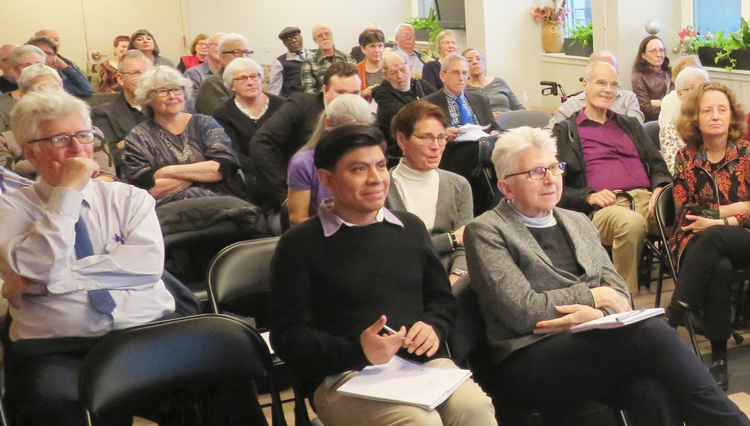
Louis Proyect (h/t commenter John B) suggests a (perhaps literally) fatal flaw in Socialist Workers Party (SWP) strategy and tactics. Consider the picture below, published in an article by Maggie Trowe in the April 6th edition of The Militant.

Audience at March 15th memorial meeting celebrating the life of Larry Quinn (Source: The Militant/Roy Landerson)
Mr. Proyect notes in his lede:
In this photograph, dated March 15, 2020, you will see a group of mostly senior citizens defying the call for social distancing. Who could they be? Rightwing Christian evangelists? Libertarians standing up for liberty? 
Nope. Instead, you are looking at members of the Socialist Workers Party at a memorial meeting for one of their members who died last month. The Militant newspaper reported that more than sixty people were in attendance. That’s probably about half the membership, ...
The meeting was held in Albany, NY on March 15th. In our comrades' defense, New York's Stay-At-Home order was not issued until March 22nd--a week later. Broadway theaters were closed on March 12th. It's hard for me to go back in time and recover how transgressive such a gathering was perceived back then, but Mr. Proyect obviously conflates attitudes on April 10th (when his article was published) with those on March 15th (when the meeting took place). Likewise, the door-to-door canvassing depicted in this article probably did not violate Indiana's stay-at-home order (not sure).

Mr. Proyect exaggerates the kookiness of the SWP--there is no way this meeting can be interpreted as libertarian civil disobedience. Though in retrospect it was foolish--especially for the senior citizen crowd. I'm glad I didn't attend. (Apparently the Party's top leadership--Jack Barnes, Mary-Alice Waters, or Steve Clark--also didn't attend. Make of that what you will.) [Update: Ms. Waters did attend the meeting and is sitting in the second row.]

Weirder is The Militant's vigorous defense of Alcoholics Anonymous (AA) meetings. In the April 13th issue Roger Calero writes
Essential needs like 12-step program meetings — the regular, face-to-face peer gatherings key to recovery for alcoholics and addicts, as well as their spouses and families — have been forced to close by shelter-in-place and lockdown edicts, and bans on even small gatherings, here and elsewhere.
This was almost certainly written after lockdown orders went into effect, so the context is very different from Larry Quinn's memorial.

Mr. Proyect's take is this:
If you want to see an explicit call, however, you can turn to a bizarre Militant article titled “Morality of capitalist rulers reflected in shutdown of AA.” It defended the right of alcoholics to attend weekly meetings even if it cost their lives from COVID-19 rather than cirrhosis of the liver.
Mr. Proyect himself can't decide whether Covid or alcoholism is the greater threat, and his uncertainty somehow renders the SWP "bizarre." But surely it's a fair question--the lockdown inevitably produces some trade-offs. Is it unreasonable to let individuals decide for themselves which risk is greater? Apparently not according to Mr. Proyect--he thinks that Mr. Cuomo should make such decisions for everybody, unilaterally.

To me, the "weird" part is The Militant's uncharacteristic support for a religious movement. In AA's 12 steps, "God" or "higher power" is explicitly mentioned in six of them. Belief in God is core to AA's success. That a supposedly Trotskyist organization is touting such virtues is astonishing.

In our politically polarized society, it's not surprising that people gravitate toward extreme positions. Our Marxist and pseudo-Marxist friends, such as Misters Proyect and Cuomo, take literally Marx's dictum  "from each according to his ability, and to each according to his needs."

Supporters of capitalism--especially Libertarians--will rephrase this.
From each an opportunity to apply his ability toward maximum economic benefit, both for himself and society, and to each according to his wants.
Only the free market allocates and organizes abilities efficiently. No other system works nearly as well--not state capitalism (aka fascism) such as practiced in China, and certainly not socialism, e.g., Cuba or Venezuela.

More important for the discussion here is the second clause--the contrast between needs and wants. Marxists (pseudo and otherwise) claim to know the difference. This leads to the distinction between essential workers and non-essential workers. Mr. Cuomo--acting now very much like a Marxist--believes that essential workers tend to people's needs, while the non-essential sort are only about wants. Misters Proyect and Cuomo claim to be smart enough to tell them apart.

Of course the governor is self-dealing. People who deliver groceries to the upper-middle class (e.g., Cuomo's political base, Mr. Proyect, and me) are deemed essential, while the waitress at the working-class diner is somehow a non-essential luxury. Supposedly waitresses spread disease, but grocery deliverers somehow don't.

To supporters of a free market the distinction is completely nonsensical. The other night on Fox News, Shannon Bream interviewed two small business owners from Atlanta--now legally allowed to reopen. One lady owned a beauty parlor--hair styling, facials, manicures, etc.--the owner herself did eyebrows. For her own safety she chose not to reopen, despite running up a big debt on her credit card.

The other lady owned a cross-fit gym, and armed with blue tape to mark out socially-distanced workstations, along with liberal quantities of sanitizer, she is back in business.

The only thing these two businesses have in common is that some stupid governor deemed them non-essential (as if nobody ever needed a haircut). But they're obviously completely different from each other, and the one-size-fits-all, essential category is silly.

People, including the president, criticized Georgia's Governor Kemp for reopening too soon. That would be a proper criticism if he'd required businesses to reopen. But as the Fox clip shows, both these ladies are very smart and know their businesses. They choose different strategies. The moral is Let Capitalism Reign. Businesses, their employees, and their customers will work out optimal solutions.

The Militant gives a good example of how this happens.
On March 26 an assistant manager at a sizable Walmart in the northern New Jersey area told Tetri Boodhoo that she had to take off the mask she had decided to wear, saying it was against company policy. The boss said she and any other workers not happy with this could take leave without any penalty — and without any pay. 
... After rejecting their demands, the boss consulted with higher-ups and backed down. Many workers — and customers too — considered this a victory. “You see, when we speak out together we can win,”
... Walmart bosses nationally have now reversed their position. They told the press March 31 that they intend to make available “high-quality masks” for any employee who wishes to wear them.
While this is more confrontational than seems necessary, it didn't take long for a meeting of minds between bosses, employees and customers--to the benefit of all concerned. Yet Mr. Proyect puts all his hopes in the supposedly unfailing wisdom of Mr. Cuomo, who thinks the only good business is a closed business.

Just to rant a little bit:

Aren't non-essential workers some vaguely sub-human folks who can't serve people's needs instead of merely their wants? That's what Mr. Cuomo implied when he told "protesters" to get "essential" jobs. So the lady, whose life savings and entire career are invested in the beauty business, should now go and deliver groceries to Mr. Proyect's house?

Or--aren't non-essential workers approximately the same as the deplorables? Admittedly the correspondence isn't exact, but surely close enough. Do people like Mr. Proyect really have it in for the lower middle class?

Perhaps Mr. Proyect is correct? Maybe the SWP isn't Marxist anymore? But at least they know who their customers are. The Militant's masthead proclaims "published in the interests of working people."

Seems right to me.

Further Reading:

Thursday, April 2, 2020

Trotskyists on the Pandemic

My Trotskyist friends have all opined on the coronavirus crisis. And well they should, because finally they have something that might actually rise to the level of a "crisis," unlike all the other mythological "crises" they have previously invented (climate, education, decline in living standards, etc.).

Never let a good crisis go to waste.

Here is a brief review of relevant articles. Let's begin with the Statement By Socialist Resurgence  (SR), which sums up everything wrong with Trotskyist economics.
Slowing down the initial spread of COVID would have meant paying for massive testing campaigns in every country as soon as the virus was identified in China. In itself, this act would have meant large payments for doctors and equipment, not to mention the inevitable slowdowns in production as workers test positive and choose to self-quarantine. A rational response to the virus means workers and their dependents must not engage in productive activity while also being sustained in all of the necessities of life.
Consider the last sentence: workers and dependents must not engage in productive activity. Presumably "workers and dependents" include people employed by grocery stores, pharmacies, delivery services, not to mention farmers, tractor mechanics, grain haulers, meat packers, etc. None of those people can go to work. Yet everybody is gonna get free food? How?

Further, doctors (who presumably are also banned from working) are now supposed to provide "free" healthcare. I assume that means they're supposed to work for free, like they do in Cuba. At very best they'll get paid in little green pieces of paper--with which they'll be able to buy nothing at all because nobody else will be producing anything.

The ridiculous assumption is that the "bourgeoisie" have some huge stash of food held in reserve that they can now personally distribute to the working class. Imagine Bill Gates riding a bicycle delivering pizzas.

This is the free unicorn theory of economics. It makes no sense.

SR can't help but resurrect old eco-wheezes, blaming the virus on: deforestation and forest fires; global trade, especially with more remote areas; industry reaching deep into hitherto untouched forest uncovering disease-ridden animals ready to transmit to humans (a silly thesis); the stock market. Ultimately, they blame civilization--we should all return to some primitive hunter-gatherer existence when everybody was happy and life expectancy was 32 years.

The truth is that Covid-19 originated in a live-animal market in Wuhan. Or, for the more conspiracy-minded, it was caused (probably inadvertently) by an escaped virus from a nearby research lab. None of this has anything to do with forest fires.

James Fortin, in an article in Socialist Action (SA), is absolutely obsessed with Donald J. Trump. In his imagination the spread of the virus was caused by: Trump refusing to implement the Defense Production Act; Trump suggesting that "WE CANNOT LET THE CURE BE WORSE THAN THE PROBLEM ITSELF" (caps in Fortin's original); Trump disobeying his own medical advisers; Trump personally responsible for denying masks and PPE to healthcare workers; Trump originally underestimating the seriousness of the disease; and last but not least, Trump wanting the stock market to go up.

If only Hillary had been elected president! The world would just be so much better!!

Like SR’s piece, an article by Roy Landerson in The Militant concentrates on economic issues, albeit much more intelligently. Mr. Landerson (who I believe is a pseudonym for Brian Williams) is a competent economics reporter. The problem with being competent is that it becomes impossible to issue the radical-sounding but ultimately really stupid demands. Accordingly The Militant comes across as veritably reformist. They're not really--they're just sane.

A key graf:
In the U.S. and around the world, the capitalist rulers are trying to stem the virus tide by shutting down much of the economy and globalized world production and trade, apart from “essential” industries and services. Borders have been closed, lockdowns and curfews imposed in ever more far-reaching fashion. As the social dislocation for hundreds of millions of working people increase, so too will attacks on our rights and political space.
Mr. Landerson's account is much more specific about what has and has not been shut down. Further, he never criticizes the principle behind the closures--namely to prevent the spread of the virus. His final sentence also rings true, albeit he uses weird, SWP language to express it.

Attacks on "our rights and political space" supposedly refers only to the working class, but really it affects everybody--especially academics and journalists. The warning is echoed by many others, including the prominent libertarian, Arnold Kling, who suggests that once governments obtain power, they are reluctant ever to concede it. I'm sympathetic to Mr. Kling's and The Militant's concern.

Mr. Landerson is alone on my list who mentions the other principle reason for economic distress.
An additional external shock, in the midst of this crisis, is the collapse of the crude oil production quotas and price fixing deal between the rulers of Saudi Arabia and Russia. This caused a glut amid falling demand and already plummeting prices. Low prices will hit highly indebted U.S. shale oil producers hard as well as the budgets of governments dependent on oil exports like Venezuela, Nigeria and Iran.
The US used to be a net energy importer, which means that falling oil prices were an unalloyed blessing to our economy. But now we're a net exporter and the shoe is on the other foot. The benefit to the American consumer (which given the lockdown they can't avail themselves of) are outweighed by the collapse in energy sector employment.

The Militant's sober analysis of the crisis leads to a sober list of demands, most of which have already been met by the government.
  • They demand "emergency relief for the working class" and others, such as farmers and shop owners. The $1200 checks issued to each adult meets this request.
  • They ask that the government build emergency hospitals--now being done in New York at the Javits Center and in Central Park, along with a hospital ship. Similar efforts are underway elsewhere.
  • They request "weekly unemployment relief that working people can depend on — not just a one-time check in the mail that falls far short of what is needed." Indeed, unemployment benefits have been juiced by $600/week, and extended to 39 weeks.
  • They want a "government-funded public works program to put millions to work at union-scale wages." In government they call that an "infrastructure bill," and it does look like it's coming. I oppose it because I think it's mostly wasteful pork.
  • Finally, they want "a crash government program to greatly expand the resources to produce a coronavirus vaccine." I think that's happening. The problem with vaccines is they have to be proven both safe and effective, which takes time. No amount of money will make that time any shorter.
Two of the SWP's demands are out of sync with the public's. First, they want emergency and unemployment benefits to be extended to illegal immigrants. This is a political nonstarter. 

And second, they want the Federal government to take over the production and distribution of essential supplies. For some reason they think that the government will be better at logistics than Walmart or Amazon!? The government--which ordered hospitals to use virus tests that didn't work; that couldn't get the Obamacare webpages to work; which allows the military to buy hammers at a thousand dollars each; which can't get the 737-Max plane back in the air--that government is now supposed to be given a monopoly on essential medical supplies.

No thank you!

Finally, let me link to a wonderful article by Louis Proyect. It's not really political, but instead is a beautifully written memoir of what it's like to be a septuagenarian in New York City during a pandemic.

Further Reading:

Thursday, January 23, 2020

Louis Proyect and the More-Poverty Solution

Louis Proyect worries a lot.

There is climate change--a boogeyman that's supposed to destroy civilization within the next 12 years (I guess since the New Year it's now only 11 years). All this because of modest increases in CO2, which despite being only 0.04% of the atmosphere is nevertheless supposed to heat up the world's oceans lickety-split. Recall that the oceans represent 99.9% of global heat capacity--many orders of magnitude more than atmospheric CO2.

Rumors of our imminent demise from climate change are exaggerated way beyond any credible belief.

Then he frets over GMOs, or genetically modified plants that manufacture their own insecticide and thus don't need to be sprayed. While in principle just an improved method for breeding agricultural plants as has been done for millennia, the specific technique has been used since 1983. It saves farmers huge amounts of money in pesticides, along with greatly reducing the quantity of pesticide in the environment from any source. Despite trillions of GMO meals having been served, there is absolutely no evidence of any threat to human or ecological health as a result.

Mr. Proyect's aversion to GMOs is less rational than the fear some people have of measles vaccines. That is, completely irrational.

He worries about fracking. Here he is on more solid ground since the industry clearly has some environmental costs, though they are increasingly under control. But the benefits of fracking are huge, reducing fuel expenses across the entire society. Natural gas just fell below $2/Mbtu. The cost of gas to heat my 1800 sqft house was only $88 this past December, a nearly trivial expense. If you're against poverty and want poor people to be able to heat their homes, then this is really a good thing.

But Mr. Proyect probably agrees with President Obama: that we'd all be better off if all fuels cost three or four times more in the future. What a guy!

Mr. Proyect doesn't like nuclear power, either. He writes 
In his letter urging Bernie Sanders to embrace nuclear power, Phillips assured him that the human costs of Chernobyl were exaggerated. Even though there were likely 4,000 people who would die eventually because of exposure, it was a lot less than Greenpeace and other groups alleged.
The implication is that today's small, completely redesigned, Generation IV, nuclear power plants are just like Chernobyl. Which is like saying a modern Prius is the same as a Model T. With Gen IV, the residual radioactive waste decays in a few hundred years rather than a few billion. Unlike, say, coal ash waste, the volume of generated nuclear waste is very much smaller. It could all be stored in Yucca Mountain with plenty of room to spare. And it emits no CO2 (if that's important to you) or other atmospheric pollutants.

He worries about tourism--especially "mass tourism." He approvingly quotes Richard Smith
Take just one: Cruise ships are the fastest growing sector of mass tourism on the planet. But they are by far the most polluting tourist indulgence ever invented: Large ships can burn more than 150 tons of the filthiest diesel bunker fuel per day, spewing out more fumes—and far more toxic fumes—than 5 million cars, polluting entire regions, the whole of southern Europe – and all this to ferry a few thousand boozy passengers about bashing coral reefs. There is just no way this industry can be made sustainable.
This, presumably, is in addition to AOC's effort to ban airplanes--in Mr. Proyect's perfect world nobody will be allowed to travel at all. At least not unless you're exceptionally Woke. Only really Woke, pre-approved, certified people could get a passport. The rest of us will have to make do with three hots and a cot (aka free food and housing).

All for the sake of saving the planet.

Tens of millions (perhaps even hundreds of millions) of people depend on tourism, directly or indirectly, for their livelihood. Of those, some millions earn a living specifically from cruise ships. Mr. Proyect will throw all of these people into abject poverty.

Tourism is one of the most efficient ways of transferring money directly from rich people to poor people. And Mr. Proyect has, as a first order of business, a desire to stop it. What a guy!

Then, of course, he and Mr. Smith have their facts all wrong. Modern cruise ships don't run on oil at all, but instead on liquefied natural gas (cheaper, cleaner, and doesn't spill into the ocean). More, eco-cruises are growing faster than the industry as a whole--e.g., to the Galapagos and Antarctica. These ships, along with their customers, have a strong self-interest in protecting the resource they want tourists to see. If there was ever a lobby to protect the environment, the cruise industry is it.

Finally, Mr. Proyect writes off the people who live along Bangladesh's coast.
Huber certainly feels sorry for some Bangladeshi farmer or fisherman whose life will be destroyed by rising ocean levels but has to question how such struggles could ever have the social power capable of taking on a capitalist class that is responsible for the dispossession and pollution in the first place.  ... For a Yanomami or a Bangladesh farmer or fisherman, the stakes are very high. For a machinist working at Boeing or a Verizon lineman in suburban New Jersey, there are worries about climate change but it doesn’t have the same immediacy as living in a village near the Indian Ocean.
Rich people are able to take care of their environment--that's why America is much cleaner today than it was 50 or 100 years ago--and why the average New Jerseyan doesn't care. Poor people don't have that luxury. Mr. Proyect's solution is to make the rich people poor, which is truly perverse. The best solution is to make the poor people rich.

Perhaps Mr. Proyect has never heard of the Sundarbans, the largest mangrove swamp in the world, located in Bangladesh. Wouldn't part of a realistic solution be to attract more tourists to visit it? People who would buy fish from local fishermen, tours from local guides, handicrafts from local women, and food from local farmers. Plus they'd leave tips. Plus the travel company will have a strong vested interest in preserving the ecosystem.

Nah! That's much too practical. Mr. Proyect is against that. He thinks Bangladeshis should just remain poor forever so that some kooky folks on the Upper East Side can power-trip by banning air travel and cruise ships. What a guy!

I agree with Mr. Proyect that human civilization will come to an end some day--nothing lasts forever. We've been around (as a civilized species) for some 7000 years now, and perhaps we've got a few thousand more to go. I don't know how it ends, but I do know that we're not gonna run out of environment in the next eleven years. Not even in the next millennium. Mr. Proyect needs to get more sleep at night, and stop worrying about silly things.

Down With Poverty!

Further Reading:


Note: Due to health issues, blogging may be light for the next few months.

Thursday, March 21, 2019

Louis Proyect and Peter Thiel

Peter Thiel and Louis Proyect will both be astonished to learn that they agree with each other. Neither of them is enthusiastic about the process of "creative destruction," albeit for very different reasons. Mr. Thiel expresses his opinion in a fascinating Youtube video of a conversation between him and Cornel West (along with another unidentified gentleman) in a Harvard University classroom. (It's nearly two hours long. I watched it yesterday and do not have a transcript. My comments are based entirely on memory.)

Mr. Proyect's thoughts are recorded in a post entitled The Boeing 737 Max 8: a case-study in uncreative destruction. The lede paragraph:
On October 29, 2018, a Boeing 737 Max 8 belonging to Lion Air in Indonesia crashed into the Java Sea 12 minutes after take-off. All 189 passengers and crew members were killed instantly. It is extremely unusual for planes to suffer such accidents in clear weather after having reached their cruising altitude. Flight experts concluded that the pilots were not adequately trained in the Maneuvering Characteristics Augmentation System (MCAS), a robotics technology that lowers the nose of a plane to prevent a stall. Although there is no definitive judgement on exactly what happened, it appears to be a combination of inadequate training for the pilots and a malfunctioning MCAS.
His larger argument is that flying has become deskilled, and therefore pilots less competent. Similarly, he bemoans the rise of driverless cars. Noting that pedestrians have been killed by such vehicles, he writes,
Despite such incidents (there have been 4 fatalities already), the bourgeoisie is determined to push ahead since the savings in labor costs will make up for the collateral damage of dead pedestrians. While I am skeptical that completely driverless cars will ever become the norm for Uber or Lyft, I can see people with little driving experience being paid minimum wage just to be a back-up to the computer system—as long as they don’t watch TV on the job. (Fat chance with such a boring job.)
Mr. Thiel agrees with him--the dead pedestrians are a problem. Indeed, Thiel goes further and suggests that driverless cars are mostly propaganda and won't happen for decades, if ever. The reason--we have become way too risk averse. He mentions that two dozen people died from polio vaccines when they first came out--there was a lot of uncertainty about the correct dosage. Had that happened today the whole vaccine effort would have been put on ice--the FDA would never approve a polio vaccine today.

Mr. Thiel's larger point is that we can no longer organize large-scale collective effort. That's readily apparent in public works: the NYC subway, public schools, NASA, Obamacare, etc. But Thiel argues that the rot is spreading into the private sector. The 737 scandal is not simple error or corruption on the part of some individuals--it is instead because the US can no longer manufacture aircraft. It's too complicated and we're increasingly incompetent.

I always thought Mr. Proyect was a pessimistic Luddite, but when it comes to pessimism Mr. Thiel has him beat by a mile. Don't watch the video if you're in need of cheering up.

Mr. Proyect's anti-technology bias does show through big-time, however. He bemoans automation on the flight deck, suggesting it deskills pilots. And it is true: nearly the entire commercial flight is by wire: from accelerating down the runway until landing, the pilots do nothing but oversee the computers. They are still in charge of landing the plane--the last hundred feet descent to the runway still requires human control.

They retain responsibility for when something goes wrong. Most dramatically that happened in 2009 when "Sully" Sullenberger successfully landed an Airbus 320 in the Hudson river after bird strikes had knocked out both engines, saving all lives on board. Mr. Sullenberger was 1) a skilled pilot with military experience; 2) had spent countless hours in a simulator rehearsing emergency procedures; and 3) had a genius IQ. Lucky passengers!

Somebody in the video says "no human should be condemned to do work that a machine can do better." A computer can do straight and level flight much better than a human being. It's not a hard job (even I, a novice flight student, can do that), but it requires unflagging attention. People aren't good at that--certainly not on 14 hour trans-Pacific flights. Computers are much better.

I think Mr. Proyect believes we should go back to digging ditches with picks and shovels. Let's return to the days when men did real work!

Mr. Proyect thinks that we're on the cusp of pilotless planes. I think he's wrong--no computer will ever be able to deal with an emergency. Driverless trucks, if they run into problems, can simply pull over to the side of the road and wait for human assistance. An airplane can't do that; it has to land, one way or the other. For any circumstances outside the training of AI, a human being will have to be on board. Perhaps we'll reduce the number of pilots in the cockpit, but we'll never eliminate them.

I'm more optimistic than Mr. Thiel. I do think driverless trucks on the interstate are on the near horizon. Driverless taxis will be possible in simpler environments--say in small and mid-sized towns. Though it will be a long time before they're feasible in complex places like Manhattan or Mumbai.

Mr. Thiel does not bemoan creative destruction. It is a symptom of technological progress, and at the end of the day any durable improvement in our standard of living is because of new technology. The fact that (in his opinion) technology has come to a standstill means that per capita economic growth is now zero. There is not too much creative destruction, but rather too little. Or maybe none at all.

I'll observe that our current circumstance--full employment at low wages--supports Mr. Thiel's point of view. Technological change implies a lot of churn in the labor market, and that's what pundits keep predicting. (It's even what I predicted in my book on careers.) But perhaps there is no technological change. Perhaps, instead of churn, the problem is stasis. Then everybody works as hard as they can just to stay in the same place. No creativity, and also no destruction.

The worst outcome is zero growth, which is where Mr. Thiel believes is where we're at. Then everything becomes a zero-sum game. In a zero-growth world there is no room for charity.

I hope he's wrong.

Further Reading:

Wednesday, August 29, 2018

Louis Proyect on "Radical Professors"

Louis Proyect pens a piece entitled Radical professors and the hazards of social media that cites four examples of leftist academics who have gotten themselves in trouble by intemperate tweeting: Steven Salaita, George Cicciarello-Maher, Johnny Eric Williams, and James Livingston.

The most egregious case is that of George C-M, a former professor at Drexel University, who was somehow inspired to tweet "All I Want for Christmas is White Genocide." Mr. Proyect offers some background. The tweet was
...prompted by the racist backlash against State Farm Insurance for purportedly advancing “white genocide” through a commercial featuring an interracial couple. This trope of “white genocide” is ubiquitous to the alt-right, including the business about white farmers in South Africa being killed off. After the fuckwit Tucker Carlson claimed that this was taking place, Trump followed up with a tweet even though it had no factual basis. Unlike the University of Illinois, Drexel University defended his free speech rights but George resigned eventually because the death threats and other forms of harassment became intolerable. Like Salaita, he was guilty of nothing except using Swiftian satire that might have been acceptable among leftists but not to Fox News’s audience.
Mr. Proyect claims some context of which I was unaware, e.g., that State Farm Insurance somehow advocated "white genocide" in a commercial. I find this hard to believe. He further maintains that we rightists are somehow fixated on said supposed genocide--I, for one, live in no fear of such an event, however disturbing recent events in South Africa might be.

The upshot of this is that we're supposed to excuse George's tweet as "Swiftian satire," i.e., just harmless fun that only a dedicated right-winger could take out of context.

Of course tweets come without context--almost by definition--and if George is foolish enough to proclaim his ardent desire for "white genocide" via that medium, then who am I to disbelieve him? Even after reading Mr. Proyect's explanation, I can't understand the tweet in any way besides literally.

I don't fear "white genocide," but at the same time I don't believe anybody who advocates it deserves to work as a professor. George has, whether purposely or foolishly, disqualified himself from the academic profession.

As an aside, if some right-wing professor (there are a few) had posted a similar tweet about African-Americans or LGBTQ people, the "Swiftian satire" excuse wouldn't have passed the laugh test. Such a person would have been fired before sundown--and rightly so.

As a second aside, the tweet can possibly be interpreted as a threat, in which case it is not protected speech. Of the four cases Mr. Proyect cites, this is the only one where I'm not sure First Amendment rights apply.

Now lets turn to the sorry case of Mr. Salaita, who opined that "At this point, if Netanyahu appeared on TV with a necklace made from the teeth of Palestinian children, would anybody be surprised?" among many other things. Mr. Salaita had been offered a tenured professorship at the University of Illinois, but because of antisemitic tweeting the offer was withdrawn before he could start work. Mr. Proyect writes "It should have been obvious that this was Swiftian satire but the board preferred to placate wealthy Jewish donors rather than uphold academic freedom."

For the life of me I can't see anything satirical in Mr. Salaita's tweets, Swiftian or otherwise. I have no trouble calling him an anti-Semite. That said, he does not directly threaten or libel anybody, so despite being hate speech it is clearly protected under the First Amendment. But he does not have a right to work at the University of Illinois as a professor, and the school was right to rescind the offer.

Mr. Proyect blames "wealthy Jewish donors" for the outcome. I don't know if that's true, but let's suppose it is. The University of Illinois--faculty and students alike--are dependent on donations, especially in Illinois where state funding has been cut to the bone. Mr. Proyect will put that all at risk just so that some clueless little twerp can run off at the mouth with his vile hate speech. Hiring Mr. Salaita would have severely damaged the institution, and the Board had no choice but to let him go.

So why do these people post such career-ending tweets? Are they really that stupid? Well, yes they are, but there is also a larger story to tell. They are all academics and as such they live in an echo chamber. Status in academia is achieved by loudly touting one's anti-racist, anti-homophobic, anti-misogynist, anti-Israel (Jewish) credentials. It's an arms race--the more and better your virtue-signalling, the higher your status within the community (and the more likely you are to get published, funding, tenure, etc.).

We recently endured such an episode on my campus. A long-time political science professor--often interviewed by The Economist and the New York Times--made the rather obvious observation that the Republican John Faso will likely win the congressional seat over the Democrat Antonio Delgado. He also had the temerity to criticize hip-hop music, leading to a faculty piling-on that lasted for several weeks, ended only by the offending professor's abject apology, though he had said nothing he needed to apologize for.

It's nothing but virtue-signalling all the way down. And sometimes this internecine, academic competition escapes its bounds, leading to tweets that, to people in the real world, are correctly interpreted as hate speech.

That brings us to the sad case of James Livingston, who tweeted
OK, officially, I now hate white people. I am a white people, for God’s sake, but can we keep them — us — us out of my neighborhood? I just went to Harlem Shake on 124 and Lenox for a Classic burger to go, that would my dinner, and the place is overrun with little Caucasian assholes who know their parents will approve of anything they do. Slide around on the floor, you little shithead, sing loudly you unlikely moron. Do what you want, nobody here is gonna restrict your right to be white.
I hereby resign from my race. Fuck these people. Yeah, I know it's about access to my dinner. Fuck you too. 
As Mr. Proyect points out, this isn't even political. It definitely is protected, and further, it's not hate speech, even though it sounds that way. There is no way that Mr. Livingston should lose his job at Rutgers University because of it.

But it is pathetic. This guy is so insecure about his own moral virtue that he has to condemn other restaurant patrons for their lack of "woke-ness." Most people visit restaurants for the food--not to demonstrate their political bonafides. Harlem Shake gets pretty good reviews on Yelp. How would the management and employees feel if all of a sudden white customers stayed away because they weren't "woke" enough?

He's definitely got a chip on his shoulder. Maybe he needs to visit a psychiatrist?

I'll take issue with Mr. Proyect's description of these professors as "radical." A radical implies somebody of independent thought. These people, far from being radical, simply can't control themselves, be it from some psychological defect or too much academic peer pressure. Instead, they are the slaves of a virtue-signalling mob.

Further Reading:


Sunday, June 24, 2018

Affirmative Action

This article is inspired in part by a piece by Louis Proyect, here. We reach the same conclusion, but his reasoning seems illogical to me.

I've never been a huge fan of affirmative action. True, I never strongly objected to a racial preference for African-Americans. At least in that case one could justify the policy as a remedy for past discrimination. My problems begin mainly when it extends well beyond African-Americans to include other minorities and--especially--women. Hispanics, for example, were never enslaved or put-upon any more than any other ethnic group--e.g., the Irish. Women are completely undeserving of the benefit.

On net, I think affirmative action is harmful at non-elite institutions like mine. The resulting feminization of college life diminishes the institution. (Note that at elite institutions the gender balance is rigorously kept at 50/50.) And partly because of affirmative action, identity politics now dominates campus life to a destructive degree.

So now an organization called Students for Fair Admissions is suing Harvard University for discriminating against Asian-Americans. And discrimination it certainly is. Based on test scores only, Asians should make up 43% of Harvard's freshman class, yet they're only granted 19% of the spots. By contrast, African-Americans get 10%, vs. only 1% in a test-only world.

Looks damning, doesn't it? It is often compared to the similar discrimination against Jews in the 1920s and 1930s, in that case giving a strong preference to gentile white students. Yet I don't think Harvard was antisemitic back in the 1930s, and I don't think they're anti-Asian today. In both cases I believe they acted for perfectly valid, honest reasons.

Harvard--and all other elite institutions--strives for a meritocracy. As The Hill points out,
Imagine a world where every student has their SAT score emblazoned on their forehead. Imagine one where a person’s worth is determined by their ACT score.
Indeed, merit based solely on test scores would be a very desiccated, narrow standard. No real college or university will want to use such a system (Cal Tech perhaps being an exception). Unsurprisingly, they come up with a lot of other relevant criteria--legacy students, athletics, special circumstances, and, sotto voce, ethnicity. Which leads to a conversation--just what is merit, anyway? And how is it supposed to be judged?

I can tell you how Harvard judges merit: by estimating how a student will enhance Harvard's brand. At very least Harvard depends on alumni contributions; I've read that Asian alums are relatively chintzy (don't know if that's true). Yankee blue bloods from New England are a safer bet.

And more, the College wants to maximize its influence on the larger culture--Asians, only 6% of the population, will never contribute 43% of the influence, no matter what the test scores say. Blacks, meanwhile, despite being only 12% of the population, have a disproportionate effect on our political, musical and cultural life.

That last paragraph suggests that Harvard wants a student body that roughly mirrors the nation--that's not affirmative-action-speak, but instead brass-tacks reality for a school that wants to lead American society. Of course they're inconsistent: they ignore the Scots-Irish, have relatively little use for Catholics, and frankly, disproportionately preference Asians. But over all, the goals of Harvard and affirmative action are roughly aligned.

I have no problem with Harvard's admissions policy. Indeed, I agree with the headline in The Hill:
Every college — even Harvard — has a right to build its own community.
This, of course, is simply an assertion of the First Amendment right to free association.

And that brings us to Barry Goldwater justifying his vote against the 1964 Civil Rights bill.
I wish to make myself perfectly clear. The two portions of this bill to which I have constantly and consistently voiced objections, and which are of such overriding significance that they are determinative of my vote on the entire measure, are those which would embark the Federal Government on a regulatory course of action in the area of so-called "public accommodations" and in the area of employment--to be precise, Titles II and VII of the bill. I find no constitutional basis for the exercise of Federal regulatory authority in either of these areas.
Mr. Goldwater was among very few Republicans to vote against the measure, and of course he was indelibly tarred as a racist because of that, despite making himself "perfectly clear." And let's face it--the times were against him. Jim Crow was such an egregious offense against the Constitution that no fair-minded American could oppose either fair accommodations or fair employment provisions.

And yet, Mr. Goldwater turns out to be right. Today institutions--and not just Harvard--are denied freedom of association, and are forced into all kinds of legal contortions to accomplish their perfectly reasonable (and non-racist) goals. The irony is that Harvard is trying to benefit--for its own reasons, and not out of charity--the very people whom the civil rights movement sought to protect.

Ideally, the Civil Rights Act of 1964 will be repealed (at least the offending sections) and First Amendment Rights will be restored. Fat chance.

There are plenty of other government agencies, that like the Civil Rights Act were a good idea at the time, have long since outlived their usefulness. A good example is the USDA inspection regime. At the turn of the last Century, meat sold in stores was of abysmal quality. Refrigeration was rare and expensive, so much of it was rotten. Then it was often adulterated with chalk--adding to the weight without adding to the nutrition. Finally, the meat processing plants were filthy, as documented by Upton Sinclair's novel, The Jungle.

No wonder government regulators stepped in.

But today they should step out again--the whole inspection regime is ridiculous. Refrigeration is today both cheap and ubiquitous--no consumer will buy meat improperly kept. Beyond which social media keeps an hourly watch on any grocery or restaurant selling meat--the slightest offense, or even rumor of an offense, will bring instant retribution. The annual USDA inspection adds nothing to consumer safety while contributing significantly to costly bureaucracy.

I feel the same about municipal restaurant inspectors. Again, social media does a much better job at enforcing restaurant cleanliness than any semi-annual inspection regime. All the latter does is prevent poor people from selling street food, and provide many opportunities for corrupt income to the bureaucrats involved. I suggest getting rid of the entire enterprise.

Harvard's goals can in no way be considered racist--their very self-interest prevents that. There are perhaps 100,000 students in the USA in a given year who can benefit from a Harvard education. These can be identified by test scores by rendering applicants below a certain minimum ineligible. Beyond that minimum, I doubt a specific test score makes much difference. Given that Harvard only admits 2,000 students, surely they can find enough qualified members from any ethnic minority they want. Unlike the implicit premise of the Students for Fair Admissions, Harvard isn't accepting any unqualified students.

So I generally oppose Affirmative Action. I even oppose the Civil Rights Act of 1964! But I do support Harvard's legitimate claim to freedom of association, and believe they should be allowed to admit whomever they want for whatever reason they want. I hope the courts reject the claims of Students for Fair Admissions.

Further Reading:


Monday, March 5, 2018

Strikes, Janus, & Amazon

The West Virginia teachers' strike headlines the news at both The Militant and Socialist Action. The latter's star reporter, Bill Onasch, probably gives the best overview of the situation. The lede paragraph:
West Virginia “Wildcats”—Technically, public sector collective bargaining is illegal in West Virginia. But practically, governors have negotiated in the past with teachers—and school service employees including bus drivers, cafeteria, clerical, and maintenance workers—for salary and benefit packages passed by the legislature. While perhaps better than nothing, the teachers have been falling behind.
He tells us that 20,000 teachers and 15,000 support personnel are off the job, that they haven't gotten a raise in four years, and that West Virginia teachers' salaries rank 48th in the nation. Further, rising health care premiums are a big issue, and that initially caused the rank & file to turn down a 5% raise from the state.

The Militant's Mary Imo-Stike (never heard of her before--may be a pseudonym) reports from Charleston, interviewing actual teachers. She captures the anger and frustration that many of them feel--medical premiums have been rising faster than wages.

As of yesterday afternoon there has been no settlement--the strike now enters its second week. The governor has conceded on the 5% raise but Republicans in the legislature balk, offering only 4%. I have no recent information on the medical issue.

A few thoughts:

  • The union's lack of legal status is important. It can't enforce a closed shop, nor can it negotiate a real contract. All it can do is get a widely publicized agreement from the state. That is actually an appropriate role for a union. I support this kind of "union" activity.
  • Labor militancy goes up as the economy gets better. With today's low unemployment the teachers are in a very strong position to ask for a raise. Looks like they're gonna get it, too. Bully for them.
  • West Virginia seems to be unusual in that teachers' salaries are negotiated state-wide, and not district by district. That gives the union more power.
  • Pensions are apparently not on the table. That undoubtedly stems from this being a "voluntary" union. "Real" unions have been lying to their members for decades, promising pensions that can never be delivered. That's been especially true with the United Mine Workers in West Virginia, as discussed here previously. Once burned--twice learned. The teachers are not negotiating for pie in the sky.
So if the only difference between the state's offer and the union demand is 4% vs. 5%, then this really should be pretty easy to settle. (Again, I don't know what's happened to the medical issue.) The governor is asking the state senate to do just that.

I don't think the roadblock is money. Instead, I'll suggest that there's a large constituency that wants the strike to last for a long time. I'm thinking of people like me--retired and no longer having kids in the school system--who resent paying taxes for "overpaid" school teachers. I think that sentiment must be strong in West Virginia, which is among the oldest states in the union, and where private-sector salaries are lower than what teachers already get. Beyond which, education is historically a low priority for the Scots-Irish who live in Appalachia. If the teachers want to go on a two-month, unpaid holiday, it's fine by them. The longer the better.

The other big labor news is the case now before the Supreme Court: Janus vs AFSCME. An Illinois public employee, Mark Janus, sued AFSCME for using his agency fees for political purposes, expounding positions with which Mr. Janus disagreed. A similar case reached the high court previously, but shortly after Justice Scalia's death the court couldn't produce a decisive majority. So they're revisiting the issue.

Oddly, neither The Militant nor Socialist Action has covered this issue at all. But Louis Proyect has.

In as post entitled Mark Janus vs. AFSCME and the need for a real trade union movement, Mr. Proyect suggests that unions that don't have a guaranteed income source are more likely to be radical. Guaranteed incomes make for complacency, and why upset the apple cart with a strike or something? Mr. Proyect quotes Illinois' solicitor general, who argues for the maintenance of agency fees.
“When unions are deprived of agency fees, they tend to become more militant, more confrontational. They go out in search of short-term gains that they can bring back to their members and say, ‘Stick with us.’”
 An interesting idea--not sure if it's true. On the one hand, the West Virginia strike lends credence--the "non-union" has no guaranteed income whatsoever and they're perfectly happy to lead a strike. On the other hand, the Wisconsin Education Association Council--once flush with cash--has, thanks to Scott Walker, been cut off. They're a mere shadow of their former selves--hardly in a position to be more radical.

Those are two anecdotes--the truth of Mr. Proyect's suggestion is an empirical question. I think the jury is out.

For what it's worth, highly regarded, conservative legal scholar Eugene Volokh has filed a friend of the court brief siding with AFSCME. The money quote:
I don't think there's any First Amendment problem with compelled payments of union agency fees at all. The government can constitutionally require people to pay money to the government (in taxes), money that the government can then use for ideological purposes (e.g., supporting a war, opposing racism, promoting environmentalism, and so on). Likewise, the government can constitutionally require people to pay money to unions, money that the unions can then use for ideological purposes.
 We'll see what the Supreme Court decides; I have no clue.

Finally, let me take issue with an article by The Militant's Brian Williams, Trotskyism's only competent economics reporter. But he falls down on the job in this piece about Walmart and Amazon. The lede paragraph:
Walmart and Amazon bosses have been battling for domination in market share and profits. The Walton family owners of Walmart have been winning, as Amazon has proven unable to launch any serious challenge to their utter domination of the brick-and-mortar store market.
But I think he's too much in love with his thesis and fails to report some significant facts. First, Amazon is not really in direct competition with Walmart. Walmart's customer is in the bottom 50% of the income demographic, while Amazon's customer is in the top 50%. Yeah, there's more overlap than that suggests, but there is definitely room in the market for both companies. Neither is going out of business anytime soon.

Second, he fails to note that Walmart has been trying to step up its on-line game, having purchased Jet.com. However in the recent quarter it has performed well below expectations, and the stock dropped substantially.

Third, it's a stretch to say that Amazon failed in launching brick-and-mortar stores. They only recently bought Whole Foods (which, by the way, doesn't compete against Walmart at all), and have not yet had time to assimilate the experience. They haven't failed--they're still experimenting.

The Amazon Go store--one without cashiers which is in beta-testing in Seattle--is a big experiment, as Mr. Williams notes. It potentially puts millions of cashiers out of a job. That's bad, but it's good for consumers who will save both time and money. Trotskyists, including Mr. Williams, are Luddites. Does Mr. Williams think we should ban cars so that unemployed blacksmiths can be put back to work?

So it is not clear that there is a battle royale to the death between these two companies, nor is it true that Walmart is winning.

Further Reading: