Showing posts with label Lynn Henderson. Show all posts

Monday, September 23, 2019

Jeff Mackler on Trump, Trade, and China

Jeff Mackler pens an article in Socialist Action (SA) entitled Trump, trade, and China: A Marxist assessment. While this blog has often mocked Mr. Mackler's pathetic performance as a presidential candidate, I take seriously his ability as a writer and thinker. The article is worth reading.

Though I think it's all wrong, and in a few places incoherent. To fit everything into a Marxist story he oversimplifies.

Mr. Mackler starts with the Sept/Oct issue of Foreign Affairs (FA) headlined "How a global trading system dies." (Those articles look interesting, but unfortunately they're paywalled.) He credits FA with being a voice of the "ruling class," and I suppose in some sense that's true. But in this case it appears they're writing mostly on their own account. FA readers (and writers) are overwhelmingly employed by the State Department, intelligence services, other related government agencies, and academia. A Trumpian foreign policy--if it survives Trump--renders this collective expertise as obsolete as Kremlinologists were upon the collapse of the Soviet Union. Indeed, whole PhD programs will go extinct.

So no wonder they hate Trump--you can think of them as the "deep state." Their cry of pain does not reflect any consensus among the "ruling class," to the extent such exists. When all opinion has to be categorized as either "ruling class" or "proletarian," then meaningful distinctions are lost. Simplicity becomes the enemy of truth.

More telling is that among politicians the China tariffs are relatively uncontroversial. It is pretty much a given on both sides of the aisle that our previous policy toward China is not tenable, and a new relationship has to be worked out. You can't trade with somebody you can't trust, and China has proven itself untrustworthy.

Mr. Mackler says China is a capitalist country--recall that SA's position is all countries are capitalist except for Cuba, which is a worker's state. This terminology is useless, and again elides meaningful differences between the US and China.

It is far more accurate to say that China is mercantilist, which means they don't care if they make a profit. Instead the only issue is positive cash flow--as long as an exporter brings in US dollars it's good to go. It doesn't matter if it loses money in Renminbi (RMB) terms--the Chinese government can fudge that at will. (They can print money, absolve debts, steal fortunes, eliminate people, or do whatever else they need to do. But they can't print dollars.)

Why does China need US dollars? In Mr. Mackler's opinion they don't:
...Trump’s public complaints about the U.S. trade deficit with China, wherein Chinese imports to the U.S. exceeded U.S. exports to China by $419 billion in 2018, fail to take into account that the U.S. corporations pay for these imports with increasingly inflated dollars, printed with abandon by the U.S. Treasury in the form of paper money or the issuance of computer-generated federal bonds and/or related promises to pay. Again, any government that prints money with no regard to its material basis in commodity production risks disaster. The U.S. “coin of the world realm” is, in this writer’s view, in deep trouble.
This is all wrong. Dollar inflation is definitely not a problem, remaining well below the Fed's 2% target. The Fed's massive money printing is something of a myth. Yes, they printed money, but they also started paying interest on reserves, which soaks up the cash as fast as it's printed. The result is a huge bump in the Fed's balance sheet, which may someday lead to inflation, but not soon. More, the issue isn't inflation per se, but rather differences in inflation between currencies. The rate of dollar-inflation is lower than RMB inflation.

The fact is that the dollar is the only possible reserve currency around. The euro is politically unstable. The yen, like the Swiss franc, is from too small a country. The RMB is not freely tradable, and is subject to arbitrary confiscation by the Chinese government. Bitcoin doesn't have the necessary capitalization yet (and may never get there). The fraction of world trade (pdf) settled in RMB in 2017 was 1.61%.

China needs dollars because it is resource poor and has to buy food and energy on the world market. The US is the world’s granary, and a long-term boycott of American agricultural products is not a tenable strategy. Today, because of a devastating swine flu epidemic, China is forced to buy American pork, that being their primary protein source.

Likewise, China depends on the Persian Gulf for oil, and by extension they depend on the US Navy to keep the supply route open. Given that North America is now energy-independent, our Navy is gradually withdrawing that service. Indeed, I’ll go further and suggest that the strong sanctions against Iran are directed more toward China than against Iran.

China is much richer today than it was in 1980. Even Mr. Mackler acknowledges that:
The question therefore inevitably arises of how China made the transition from a relatively poor nation, largely bereft of modern technology, to a world-class player on international markets? The answer lies in how China made the transition over the past 40 years from a deformed workers’ state that essentially banned capitalist private property, established a planned economy that focused more on addressing human needs—including providing free health care and education to all its citizens—than capitalist profits, to a leading capitalist and imperialist nation with trillion-dollar infrastructure investments in China and, increasingly around the world...
 His answer to the question is utterly bizarre.
A serious approach to answering this critical question, a complex matter to be sure, begins with China’s adoption of the key features of the BRICS nations—Brazil, Russia, China, India and South Africa. In all these relatively underdeveloped nations, the ruling elite focused on a massive transfer of wealth from the poor to the rich that they expected to result in the emergence of a relatively well-off layer of perhaps 20 to 25 percent of the population, consisting of “middle class” and working-class sectors, who would be capable of purchasing a broad range of nationally produced consumer commodities typical of their counterparts in advanced nations. This massive transfer, of course, was to be at the expense of the vast majority of their respective populations, who were in turn driven into abject poverty.
In other words, Deng Xiao Ping literally stole money from poor Chinese peasants in order to provide 400 million other people with a middle class income comparable to those in the West. This is ridiculous! The median income of a Chinese peasant was $2/day, or about $700/year. All that bought was a Mao suit and a couple copies of the Little Red Book. There was nothing to steal!

No--the bump in income is entirely due to global trade. The Chinese sold us toys, telephones, computers, clothes--in a word, just about everything you can buy at Walmart. Through Walmart, China raised the standard of living of every American. In return, the Chinese got food, jumbo jets, business services, and access to global resources (e.g., oil). I detail this in my two posts responding to Lynn Henderson (here and here).

Indeed, thanks to Sam Walton and Deng Xiao Ping, every Chinese citizen is vastly richer than they were in 1980. They didn't get that way just by stealing from each other. Mr. Mackler's theory is as silly as his presidential campaign.
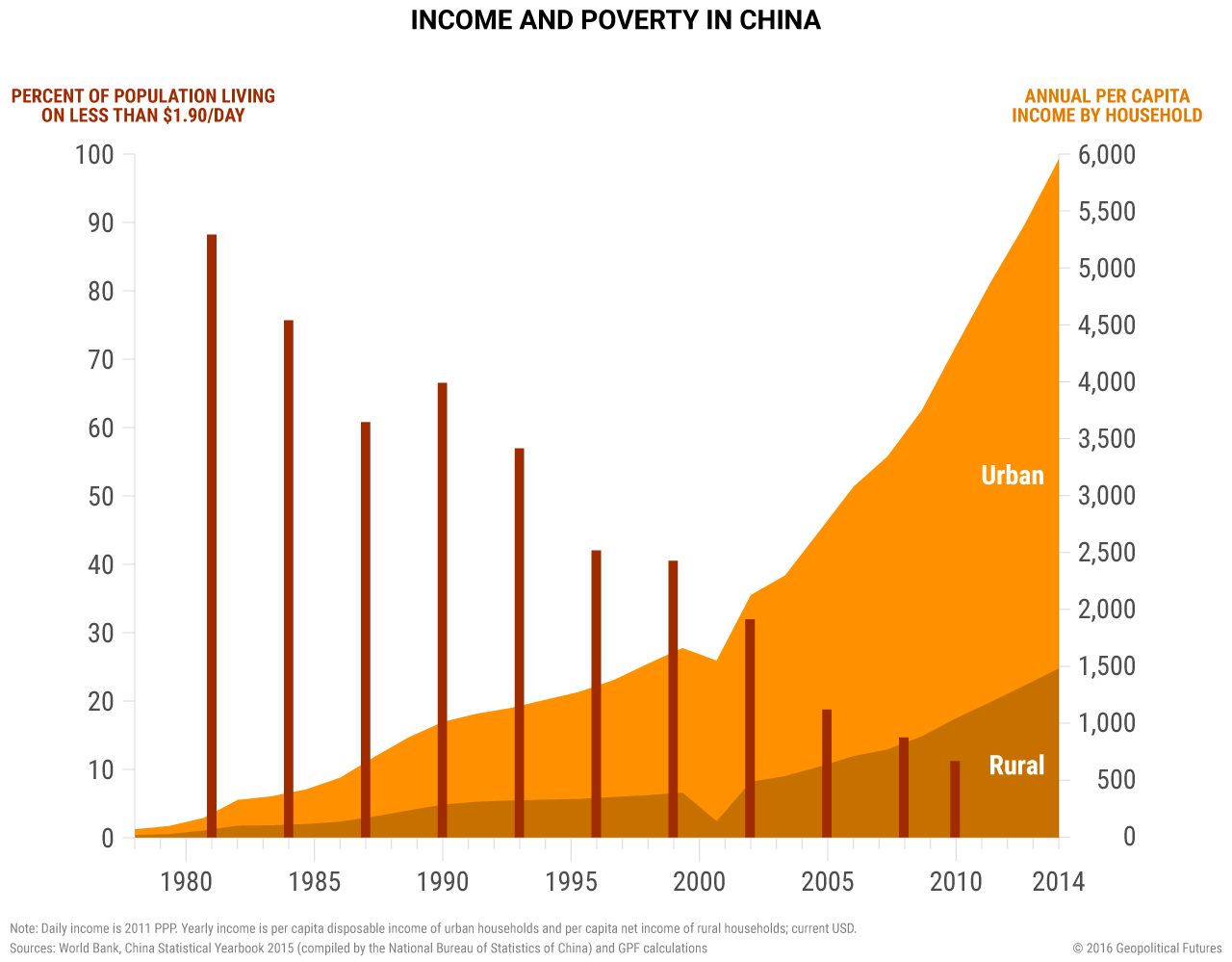
china-household-income
Increase in wealth in Chinese households, both urban and rural. (source)
Further Reading:

Wednesday, December 13, 2017

China & the United States

There are two extreme but commonly held opinions about China. The China Bulls, typified by NYT columnist Thomas Friedman (e.g., here), believe that China will leap from strength to strength, eventually far surpassing the United States in both wealth and power.

The China Bears, meanwhile (represented ably by Peter Zeihan, whose work I have reviewed here, here and here), think China is approaching a precipice beyond which lies disastrous decline. Mr. Zeihan, for example, thinks the country is unstable as a unitary state.

Lynn Henderson (who often writes for Socialist Viewpoint) sent an Open Letter to Dave Gilbert, kindly including me on the copy list. The full text of the letter is posted at Louis Proyect's site, here. Despite its length, it is cogent, well-written, and very much worth the read.

Mr. Henderson did not title his piece. Mr. Proyect headlines it as Trump, Russia vs China and China Industrialization. Fair enough, but I'd prefer another: China's Threat to American Capitalist Hegemony. That reveals him as a China Bull, and further, he subscribes to the common corollary: that the United States is in secular decline (a view shared by Mr. Friedman).

Mr. Henderson tells a history of Chinese-American relations that doesn't make much sense to me. The 1949 revolution threw the imperialists out of China, but then in 1980 Deng Xiaoping invited them back in as foreign direct investment*. My take is that China wasted 30 years murdering tens of millions of its own people before they finally got their economic act together. Somehow Mr. Henderson sees the "revolution" as an advantage.

He attributes too much credit to Nixon and Kissinger--figures who were bit players in the whole drama. The real stars were people like Malcom McLean and Sam Walton. The former "invented" the shipping container, reducing the cost of freight transport by 90%--a technology that came to full fruition by 1970. The latter (who in 1970 owned a few stores in NW Arkansas) took advantage of that savings, along with cheap labor availability in China, to build the world's largest retail chain.

Mr. Henderson gets that last point. A key paragraph is this.
Handed down from the pre-revolutionary past, the new China possessed a gigantic peasantry numbering in the hundreds of millions accustomed to a very low standard of living and hard manual labor. This peasantry served as the source for an industrial proletariat willing to put up with a much higher rate of surplus value than the workers of North—and even Latin—America, Western Europe or modern Japan. Huge amounts of foreign investment, especially U.S. investment flowed into China. What the United States—or rather the United States capitalists—wanted most of all from China was the lion’s share of the surplus value produced by the Chinese working class. Russian workers produce very little surplus value compared to what the U.S. capitalists could appropriate from Chinese workers in the form of profit, interest and dividends.
Let's ignore the unnecessary term "surplus value" and acknowledge that trade with China was hugely profitable--for both Americans and Chinese. We got everything from toys to hand tools to smartphones at sharply reduced prices. Indeed, though Mr. Henderson credits Paul Volcker with ending inflation, it's just as likely that cheap imports from China did the trick. China, initially through Walmart, dramatically raised the standard of living of every American, especially poorer ones.

In return 400 million Chinese were pulled out of poverty and became part of the global middle class. They used the proceeds of their labor to buy grain (there's no more starvation in China), airplanes (jumbo jets fly hourly schedules between Shanghai and Beijing), and the construction of superhighways and bullet trains (Tom Friedman's favorite toys), among many other things.

Though somehow Mr. Henderson thinks this is a problem.
The problem from the viewpoint of the U.S. capitalist class and its political representatives—the Party of Order of both Democrats and Republicans and the emerging Trump America First gang—is that the U.S. capitalists in squeezing huge amounts of surplus value out of the Chinese have been forced to develop China’s productive forces at the same time.
Mysteriously, he thinks we'd be better off if China remained poor. Just how are those poor, starving Chinese supposed to buy grain, airplanes, and everything else from the USA? They have to sell something to us first--as I said in a previous post, it's all about trade. The USA can't trade with countries that have nothing to sell. Fortunately for all of us, Sam Walton enabled China to sell lots of stuff to Americans.

Mr. Henderson buttresses his argument with one big factual error. He claims that because production increased in China, US industrial production has been declining.
In order to make the empire last for even 70 years—a very short period historically—the U.S. had to give up much of its domestic industrial production.
But this is manifestly not true--US industrial production has more than doubled since 1980! Don't believe me? Then listen to that Marxist economist of (deserved) renown, Kim Moody (my review here):
The problem with trade-based explanations [for the decline in manufacturing employment--ed] is that manufacturing output hadn’t shown a decline, but had grown in real terms by 131% from 1982 to 2007 just before the Great Recession reduced output. At an annual average of 5% this is only slightly less than the 6% annual growth of the 1960s.
So both China and the USA were successful from 1980 through 2010. But the world moves on; this is how Mr. Henderson sees the future.
China on the other hand, as the world’s most rapidly expanding manufacturing power, is now its strongest proponent for globalization, “free trade”, open markets and multinational trade agreements. Under China’s “One Belt, One Road” initiative, which is aimed at creating a modern version of the Silk Road, a network of trading routes from China to Africa and Europe, it has launched a massive economic outreach dwarfing even the Marshall Plan of U.S. imperialism following WWII.
Let's take this apart.
  • China is not "the world's most rapidly expanding manufacturing power." The United States is, by far. Robots and AI have reduced the value of low-wage labor, and sharply increased the advantage of cheap electricity. Thanks to fracking, the US has by a good margin among the cheapest electricity prices of any country in the world.
  • OBOR ain't gonna work--see my previous post. The only advantage is it gives China a back door to Persian Gulf oil. Though shipping oil over the top of the world won't be cheap.
  • Yes--China is a strong proponent of globalization and free trade, for obvious reasons. But see my reviews of Peter Zeihan's books for more about that.
I tend to be a China Bear, though not as pessimistic as Mr. Zeihan. Here are some of the important problems China faces.
  • Chinese population growth is slowing, and the size of its labor force is actually shrinking. Since labor force growth is the biggest component in overall economic growth, this will severely limit the Chinese economy going forward.
  • The economy is too big to be primarily export-oriented. Global markets simply can't absorb all that stuff. Exports will have to decline as a fraction of GDP.
  • China is dependent on foreign oil, which will put it at a significant disadvantage to the US.
  • Increasing personal consumption--and therefore income--is absolutely crucial to sustain the economy. That means Chinese citizens have to get a lot richer, which means productivity has to increase--dramatically. I'm not sure they can do that.
  • China has a huge debt burden, which is a drag on future growth.
So I think the best case scenario for China is growth at global rates, i.e., around 2%. Personally, I'm skeptical if they can sustain that. Then it becomes an issue of whether or not the country remains politically stable.


*Not sure I buy the "foreign investment" argument. I don't believe the US ever ran a trade surplus with China, which means net foreign investment must have flowed toward the US, not toward China.

Further Reading:


Thursday, December 7, 2017

What Marxists Don't Understand About Economics

This post is inspired by, but not directly in response to, an Open Letter by Lynn Henderson and Cindy Burke (H&B), posted on Louis Proyect's website. Their misconceptions are so common on my Beat that I think a post pointing them out is useful.

Growth

In 1956 Robert Solow and Trevor Swan published a model for economic growth that is both simple and fits real world data fairly well. Economic growth is the sum of three terms: 1) growth in the skills-adjusted labor supply; 2) growth in capital invested; and 3) growth in productivity due to technological advancement.

In today's world (unlike the future world of robots), the availability of skilled labor is the most important factor. A proxy for that is population growth, especially of the working-age population. In the US our population growth is less than 1%. During the first 60 years of the last century it was closer to 2 or 3%. Obviously fewer workers will result in a lower GDP, so it should be no surprise that our growth rates have declined from 3-4% historically to about 2% today. Absent a new baby boom or a sharp increase in immigration, our economy will not grow as fast as it did before.

Japan's workforce has been in absolute decline for several decades. So it should be no shock that their economy is barely growing at all. This has nothing to do with a "crisis" of capitalism or malfeasance by Mr. Abe, but is a matter of simple demographics.

Note that we Trumpkins will be disappointed with our president's stated immigration policy. Economically we are much better off with more immigrants rather than fewer.

Capital behaves differently, obeying the law of diminishing returns. When a company with 1000 employees buys their first computer, there is a huge jump in productivity. But after they buy the 1000th computer, productivity will barely budge. That is, initial investment in a new technology is highly profitable, but as more and more money is invested the returns diminish. Eventually the maintenance and upkeep on all those computers costs more than any profit, at which point the firm is fully capitalized. There is no point in investing more money in more computers.

It's roughly the same for national economies. In my opinion the United States is fully capitalized--there are relatively few places where investing new money makes sense. That means we have a savings glut, which implies that interest rates are low and will remain low for a very long time. This is why asset prices are being bid up--houses, art, antique cars, bitcoin, stocks & bonds, etc.--as there are no other good places to put money.

Note that we Trumpkins will be disappointed with tax reform. The stated goal is to repatriate trillions of offshore dollars and thus recapitalize and dramatically grow our economy. Sorry--it won't work. We've already got too much capital sloshing around. But it will secure very low interest rates for even longer, and people who own real estate or bitcoin will do very well. (I am generally in favor of the tax reform proposals, but not for that reason.)

Finally, productivity growth is the implementation of new technology, e.g., replacing the horse with the internal combustion engine, or the abacus with a computer. For whatever reason (there's no agreement on why) productivity growth has declined since about 1970. Robert Gordon wrote a whole book on that subject, which I reviewed here.

That our economy is growing faster than demographics is likely due entirely to productivity growth.

Trade

Money is earned only by trade and in no other way. I can buy something from you only if I have money. And the only way I can get money is by selling something to you or somebody else. Or put another way, only people with something to sell are able to buy the things I sell. A homeless, unemployed bum has no marketable skill or product to sell, and therefore has no money to buy anything from me or anybody else.

It's the same with countries. We buy toys from China, paying them in dollars. That only works if China can buy airplanes from us, also paid for in dollars. If we didn't manufacture airplanes then China would not sell us their toys since we'd have no money. (A trade deficit just means China doesn't need an airplane today, but will buy one in the future. Meanwhile it keeps its dollars invested in US Treasury bills.)

China is America's largest trading partner. That means China manufactures things that we want to buy, which perforce means that we manufacture things that they want to buy (today or in the future). So Marxists are wrong (and specifically H&B are wrong): we do not benefit from manufacturing all products in the United States. We should only manufacture those items for which we have a comparative advantage. Everything else we should buy from other countries.

This explains why our biggest trading partners are mostly rich countries. Rich countries produce things we want to buy, which means they have money to buy the things we have to sell. A country with nothing to sell also can't buy anything, and therefore is not a market for our products. Our trade with Haiti is next to zero--they've got nothing to sell to us. So Marxists have it precisely wrong: we do not want to impoverish the world. Quite the opposite--we only trade with countries that can produce valuable goods and so can afford our products.

The Marshall Plan and OBOR

The Marshall Plan was a program of loans to war-ravaged Europe after World War II. The purpose was to rebuild the European economy so that Europeans could sell into the US market, enabling them to buy things from the United States. That trade was hugely profitable to both sides of the Atlantic, generating way more than enough to pay back all the loans.

Had the Plan been a failure then US taxpayers would have been on the hook for all the loan defaults, and Europe would never have become a major trading partner to the US. As it is our total trade to European Union countries combined is larger than our trade with China.

OBOR (One Belt, One Road) is--according to H&B--a Chinese version of the Marshall Plan. That means China is lending to other countries in the hopes that they can produce something that China wants to buy, which will enable those countries to pay back the loans. So compare and contrast: during the Marshall Plan we lent money to Germany, Holland, the UK, France, etc. China is lending money to Kyrgyzstan, Uzbekistan, Azerbaijan, Greece, and Venezuela. Let me know how promising you think Chinese investments are likely to be. Hint: they've already written off Venezuela.

There are certainly geopolitical calculations in China's OBOR project, but as an economic effort it's doomed to fail. H&B, for example, point to the Greek port of Piraeus, which they claim is now the largest port in the Eastern Mediterranean. But it's a lost cause--Piraeus has no industrial or agricultural hinterland, and transport to/from the more productive parts of Europe is hopelessly difficult and expensive.

China

Henderson & Burke's letter is mostly about China. I will have more to say about that in a future post.

Further Reading:


Monday, February 20, 2017

Lynn Henderson on Donald Trump

My former comrade, Lynn Henderson, posts a long article at Socialist Action entitled A watershed election for U.S. imperialism. Despite being a well-written, worthwhile read, the piece is a mess.

He posits at least two conspiracy theories. First, he assumes that U.S. Imperialism is actually a thing. It literally sits around and makes conscious decisions about how best to screw the working class. While Mr. Henderson doesn't identify "imperialism" with Jews, it's precisely the same sort of conspiracy supposedly documented in The Protocols of the Elders of Zion. Perhaps the "imperialists" meet in secret organizations such as the Trilateral Commission? Or is it the Bilderberg Group? Or maybe they cavort around naked in the woods at Bohemian Grove in Northern California while plotting their nefarious schemes?

Mr. Henderson never tells us how this conspiracy supposedly transpires, but apparently everybody from George Soros to the Koch brothers to Larry Page to Charlie Hamm are all on the same page about what to do next. Note to Mr. Henderson: these people don't even talk to each other much less agree on how the world should run.

The second conspiracy theory concerns Obama's strategy in Syria. Here Mr. Henderson must have access to information that nobody else possesses. Was he a fly on the wall in the White House situation room? He claims to have the chronology of events in Syria absolutely down flat, without the shadow of any doubt. Here's how it supposedly all transpired:
  • Obama really wanted to go to war in Syria.
  • He used chemical weapons as an excuse, making his infamous "red line" remark.
  • But the British--unreliable bastards that they are--refused to go along with Obama's war. (Apparently British imperialism is not on the same wavelength as US imperialism. Mr. Henderson doesn't explain why.)
  • Because the Brits didn't like it, Congress might not have approved war authorization.
  • Therefore John Kerry made an agreement with the Russians.
I find this incredible. Unsurprisingly Mr. Henderson offers no evidence for his theory at all. A much simpler (and widely accepted) explanation is that Mr. Obama (who never had any intention of getting involved in Syria) was trying to push Assad into making a settlement and the latter called his bluff. The result was another couple hundred thousand dead people.

Mr. Henderson relates a very strange story about the growth of the American middle class. In his telling it's all because of World War II. Apparently the massive destruction of Europe and East Asia enabled US imperialism to conquer the world (at least temporarily) and extract enough wealth to enrich US workers as well.

People earn money by trading goods and services with each other, and capitalism maximizes those trading opportunities. It's really hard to trade with people whose houses and factories have all been destroyed. The US lent Europe money to rebuild it's infrastructure, which fortunately happened successfully. For otherwise American taxpayers would have been on the hook and lost their investment. We'd all have been much poorer.

The real reasons for the development of the American middle class (along with similar populations in Europe, Japan, Korea, and elsewhere) is because of new technology. It's described in great detail in Robert Gordon's book The Rise & Fall of American Growth (which I reviewed here). Here's the list: the electric light bulb, the internal combustion engine, antiseptics, canned food, indoor plumbing, clean running water, air conditioning, airplanes, the department store, interstate highways, modern finance, and more. Mr. Henderson mentions none of this--he nonsensically attributes our modern living standard to WWII.

Finally we get to Mr. Trump, who presumably is the topic of the article. At least Mr. Henderson is smart enough not to call Mr. Trump a fascist, which he manifestly is not. But otherwise he throws the book at him:
... the Republican Party is captured by an extreme right wing, rogue billionaire, an open racist, who brags about his successful sexual assaults on women, banning individuals from entering the country on the basis of their religious affiliation, and among other things, promises to launch a global-wide trade war. The ruling class itself sees Trump as a loose cannon, dangerous and unstable—the kind of president that in this threatening new era for U.S. capitalism, demonstrates every potential for making things dramatically worse.
Much on this list is either false or a gross exaggeration. Trump is definitely not "extreme right wing." Most of the Republican establishment (which includes a significant Libertarian constituency) disowned him. They're in favor of free trade and (relatively) open borders--see Marco Rubio as a clear example. Also Paul Ryan, Mitch McConnell, Jeb Bush, etc. Trump's positions on trade, industrial policy, and even unions, are much closer to the Democrats, which is why he won over blue-collar voters who voted for Obama in 2012. Even on health care he's a Democrat--whatever else Trump-care does, it's not gonna water down Obamacare. Trump agrees with Bernie Sanders on foreign policy, condemning our recent wars with almost as much vitriol as Socialist Action.

Second, he certainly isn't an "open racist." He's been actively courting the Black community since before the election, including most recently touting historically Black colleges. Scott Alexander (a superb post!) describes Trump as not being any more racist than the average 70-year-old white guy. Two acts of "racism" are held against him: his birther campaign against Obama, and that he proclaimed "I love Latinos" while eating a taco bowl in Trump Tower. The former was stupid, not racist. And the latter may not have been politically correct, but hardly qualifies him as a racist. An "open racist" would have said "I hate Latinos." Trump has never said that nor anything remotely similar.

Trump undoubtedly acknowledges the continued existence of racism. But he also maintains (correctly in my view) is that racism is not the central problem in our society. The problem with the police is not that they're racist (though some are), but mostly that they're not preventing crime in Black communities. Thus his promise to crack down on crime is as much a bid for African-American support as it is anything else. Likewise with his championing of school choice.

Trump got more Black votes than either McCain or Romney. And his vote among Hispanics equaled that which Republicans typically get. There is no evidence that he is viewed in those communities as unusually, or "openly" racist.

Third, Trump bragged about assaulting women in a media clip from a decade ago. Mr. Henderson should use the past tense--"bragged." Trump is certainly not bragging about sexual assault today. This sloppy use of language discredits Mr. Henderson's argument.

Trump does not threaten a global-wide trade war. And the US, like any other country, has a right to control who crosses our borders. Mr. Trump has long since backed off barring all Muslims, but he is certainly right that terrorism tends to come from Muslim countries. Again, exaggeration is not Mr. Henderson's friend.

I think accusations that Trump is an unstable, undisciplined loose cannon, while perhaps arguable, are mostly incorrect. His campaign turns out to have been spectacularly well organized. Which is fairly obvious since he won the election while spending only a fraction of the money Hillary wasted. While he certainly has made mistakes, accusing him of stupidity, mental illness, or lack of self-discipline I think are charges very far of the mark.

Further Reading:

Saturday, December 29, 2012

Is The SWP A Cult?

This is the second article inspired by Louis Proyect’s post entitled Cult Leaders Reward Themselves Handsomely. The title refers to the modern Socialist Workers Party (SWP), under the leadership of Jack Barnes. I think the SWP is frequently characterized as a cult--see also this article by Lynn Henderson  in Socialist Viewpoint, which even contains a section entitled On Cultism. In Socialist Action’s obituary for Gerry Foley, one finds the sentence, “[h]is departure from the SWP, which expelled Gerry retroactively, stemmed from his opposition to the bureaucratic and cult-like practices of SWP National Secretary Jack Barnes...” Finally, Mr. Proyect and others contributed to this discussion thread.

The word is used sloppily and one shouldn’t take it too seriously. Still, the question presents itself: Is the SWP a cult? And if not, then what is it?

When I think of “cult,” I think of Jonestown (Guyana), or the Branch Davidians, or perhaps Charles Manson-style wackiness. The Socialist Workers Party definitely does not fit that mold. My former Comrades are surely needy and I feel sorry for them, but they’re not certifiably insane.

According to Wikipedia:

The word cult in current popular usage usually refers to a new religious movement or other group whose beliefs or practices are considered abnormal or bizarre.

This description doesn’t fit the Party, either.

Because of the Pope, some Protestants refer to the Catholic Church as a cult. By this standard any organization under a single, all-powerful leader will qualify. Thus the examples above are cults, and if Jack Barnes is an “all-powerful leader,” then the SWP is also a cult. That appears to be Lynn Henderson’s argument.

But the Pope is not an all-powerful leader, infallibility notwithstanding. He is bound by Biblical teaching, along with the long history of the Church. He has no more power to ordain women than I do, nor can he single handedly change Church teachings on homosexuality. Such big decisions are reserved for Ecumenical Councils, such as Vatican II--these meet approximately every hundred years. The old saw--”the Church thinks in centuries”--is largely true. The Pope can’t lead it off a cliff, and hence in no way is it a cult.

Likewise, the Mormon church is frequently described as a cult. Certainly that was true in its early days--polygamy was an “abnormal or bizarre” practice. Founder Joseph Smith was arguably a cult figure, as was the church’s greatest leader, Brigham Young. But in abandoning polygamy in order to secure statehood for Utah, the Mormons sacrificed their cult. Today they have a system of governance that is at least as convoluted as the Catholic Church, and similarly bound by both text and tradition. No one person can inspire collective suicide.

These examples show that “cult” and “crackpot” are not synonyms. One can be the latter without belonging to the former.

So, in addition to “abnormal or bizarre” practices, we have a second criterion for a cult--namely the presence of a charismatic, all-powerful leader, who can lead the group off the rails if he so chooses. The SWP fails the “abnormal or bizarre” test. And I think it fails the “charismatic leader” test as well.

By jettisoning Trotskyism, the Party gave Jack more flexibility than he used to have. But Trotskyism, vague to begin with, isn’t much of an anchor anyway. Socialist Action, for example, seems to interpret it very flexibly. And despite partially rejecting its founding dogma, the Party is severely constrained by history. After all, The Militant has been published since 1928, and the Party can no more disown that than Catholics can the Bible.

This distinguishes Jack Barnes from real cult leaders, like Lyndon Larouche or Bob Avakian. Those grouplets report to no authority beyond their leader. Jack certainly has disproportionate influence, but more in the style of Gus Hall or the Pope, rather than like David Koresh.

So the SWP is not a cult. Then what is it?

The important answer to that question is old. The median age of Comrades must now be close to sixty. Jack himself is 72. This fact alone explains most of the changes that have happened in the Party. For 2012, the search term “Young Socialists” yields only four hits from The Militant website. Long gone are YS conventions and manifestos. Also vanished are the YS leaders. Samantha Kern left the group in about 2000. Jack Willey disappeared under mysterious circumstances in 2002. The staff writers for The Militant are mostly people I remember from my youth (including my former roommate).

Jack depends on regular, sustainer income. He can’t afford defections, but at the same time he needs a loyal, homogeneous organization (hence the expulsions). On the one hand Comrades need to feel that they are an Elite Group, members of the Anointed Vanguard Party, part of a continuous tradition that dates back to Leon Trotsky.

At the same time, this has to be very low-impact, feel-good socialism. No hard effort is demanded. Sub drives only require 3,000 subs--easy work for 400 Comrades. Gone are the days of arduous fraction work--retired folks won’t be getting union jobs in factories anyway. Pay your sustainer and sell a few subs, and you, too, can take credit for the Great Events Of Human History.

The religious analogy is the feel-good mega-churches, such as Rick Warren’s Saddleback Church, Bobby Shuler’s Crystal Cathedral (Hour of Power), or Oral Roberts’ Expect A Miracle. Like the SWP, these crusades promise free unicorns for everybody in the sweet bye & bye, without imposing any real sacrifices in the here and now. All glory--no cross. Or, all vanguard party feel good stuff--no Trotsky.

Even if its not a cult, the Party isn’t a political organization anymore, either. It has effectively forfeited any claim to power. What it really is is a church--a feel-good church where Comrades go for fellowship and “prayer.” Prayer, in this context, means a ritual (the branch meeting) that connects the “parishioner” with the meaning and purpose of life.

The Party recently opened a new branch in Lincoln, Nebraska. This seems mysterious, especially since the word “meatpacking” isn’t even mentioned in the announcing article. But it is entirely consistent with the Party as a feel-good church for old people. Lincoln is a smallish city with a low cost of living and a low crime rate. It’s a great place for retired Comrades living on social security, who will then still have some pennies left over for a sustainer.

The “church’s” Bishop, Jack Barnes, issues his biannual sermons in the form of political documents, such as Capitalism’s Long Hot Winter Has Begun. I’ve read some of these books, including that one. They are well-written, entertaining, sentimental, and flattering--Rick Warren couldn’t do better. They emphasize the importance of the current moment--how close we are to a pre-revolutionary situation--though he’s always careful to say that future timing can’t be predicted. Comrades, with their deep, proletarian understanding of Marxist principles, will soon be thrust into powerful, leadership roles. The Rapture is near at hand. In the meantime, nobody really needs to do very much--just make sure the printing presses are well-oiled and the Party is well funded.

Amen, Comrade. Amen.


Further Reading: