Saturday, December 19, 2015

Politics & Evolution

In which I claim that Dr. Ben Carson and Mr. Louis Proyect hold similar beliefs.

My Trotskyist friends claim to accept the theory of evolution while also denying it. In this they are typical of the Left. And also of the Right.

Louis Proyect is a good example. I reviewed his extensive criticism of Napoleon Chagnon in a post entitled Marxism & Evopsych, which includes a critique of the Marxist view on evolution. I won't repeat that here except to say that contrary to their claim, Marxists deny the theory of evolution, at least as it applies to human beings.

Since writing that review I have read and reviewed two books on the subject: one by Jonathan Haidt (The Righteous Mind), and the other by Nicholas Wade (A Troublesome Inheritance). These render my Marxism & Evopsych remarks somewhat incomplete, and I confess probably lend some credence to Mr. Proyect's complaints against modern Darwinism.

The latter book is particularly troublesome, as the name implies. It argues that ethnic differences are indeed more than skin deep, and also include variations in personality. In particular, the circle of trust appears to be under significant genetic control. People who have lived in urban areas for many generations, for example, will tend to be more trusting of strangers than folks who've spent the last millennium out in the bush. 

Other people (not Mr. Wade) argue that things like IQ is significantly heritable, and that ethnic groups differ in average IQ, often by a significant margin. Indeed, a recent book by Garett Jones (The Hive Mind) argues that the wealth of nations depends crucially on the average IQ of its population. (He speculates that it may depend more strongly on the IQ of the top 5%, though that's unproven.)

Such ideas have a long and disreputable heritage, as Mr. Proyect will be quick to point out. This chart is easily found by searching for "iq by nation". 


It's been reposted by such worthies as Stormfront (I won't honor them with a link) and FreeRepublic. Nevertheless, the data in this chart seem mostly reproducible and correct, as Mr. Jones discusses in detail. (The causes of the phenomenon are a matter of considerable controversy.)

So actually I don't blame Mr. Proyect for denying evolution's application to human beings. It paints a grim picture of our species. Our prognosis is not good. Mr. Proyect aspires to a better world, and in doing so he is forced to deny science.

Another politico who sides with Mr. Proyect is the presidential candidate, Dr. Ben Carson. Dr. Carson is a retired neurosurgeon, serving as the Director of Pediatric Neurosurgery at Johns Hopkins for nearly 30 years. As such he must know something about evolution, and it is unlikely that he rejects it altogether. Even though he says "I don't believe in evolution... I simply don't have enough faith to believe that something as complex as our ability to rationalize, think, and plan, and have a moral sense of what's right and wrong, just appeared." [All Carson quotes from Wikipedia.]

Further,
In October 2015, Carson stated that he does accept the idea of natural selection, but there is only evidence for microevolution (changes in allele frequencies that occur over time within a species), which he believes was the result of "a wise creator who gave his creatures the ability to adapt to their environment so that he wouldn't have to start over every 50 years", whereas "there's never been one species that's turned into another species, that can be proved." 
But then, with respect to using fetal tissue for research, he said "to not use the tissue that is in a tissue bank, regardless of where it comes from, would be foolish. Why would anybody not do that?"

So like Mr. Proyect, Dr. Carson is inconsistent on evolution. When it comes to his professional life he has at least implicitly accepted it. But in his religious and political world he adamantly rejects it. In this he is like most people--they reject evolution on Sunday when they go to church, but rely on it on Monday when they visit the doctor. Surely this ability to compartmentalize is an evolved, human trait.

It's very difficult to be consistent on evolution. Maybe some devoutly religious people qualify--like those Christian Scientists who reject any and all medical care, or perhaps some of the faculty at Bob Jones University. But such folks are few and far between.

Then there are people who raise evolution to the status of religion: I'd put Stormfront or FreeRepublic in that category. They consider the above IQ chart to be divinely inspired. Leave aside, for the moment, that they don't know what they're talking about.

Also consistent on evolution is Boko Haram. I don't mean in an intellectual sense--I doubt the Bokos know anything about science. But in the way they live their lives they obey evolution's core principles:
  1. The ultimate measure of evolutionary success can be measured by the fertility rate of one's children and grandchildren.
  2. Evolution cares not a whit for the happiness of the individual organism.
So consider the 250+ schoolgirls from Chibok kidnapped by Boko, and then sold off as wives and concubines.
  1. The lifetime fertility of these girls is likely to be very high--at least for those who survive. Four or five children apiece, subsequently yielding 20+ grandchildren is a reasonable guess. Further, the reproductive success of the kidnappers is virtually assured--how many of the girls are already pregnant?
  2. Yet prospects for happiness for the girls is dire. Or, as an evolutionist might put it, who cares.
Compare the Bokos' fertility with that of aging ex-Trotskyists. I don't believe Mr. Proyect has any offspring (or at least none mentioned on his blog). I have two, but not yet any grandchildren. How many unrelated ex-Trotskyists would you have to put in a room before they could cumulatively match the reproductive success of one Boko platoon leader?

There is no doubt, at least compared to Trotskyists, that the Bokos have a better understanding of evolution.

And yet any member of civilized society--among whom I'd count myself and both Dr. Carson and Mr. Proyect--will object. While we might state it differently, our creed maintains We hold these truths to be self-evident, that all men are created equal, that they are endowed by their Creator with certain unalienable Rights, that among these are Life, Liberty and the pursuit of Happiness.

Of course evolution denies all of this: the Truths are not only not self-evident, they're not even true. We weren't endowed by any creator, and we don't have any unalienable rights. And for Happiness? Just ask the organisms from Chibok about that!

So I sympathize with Misters Proyect & Carson. Their selective denial of evolution is a mark of civilization, not scientific ignorance (though in the case of Mr. Proyect it is that, too). Despite my own passionate defense of the science of evolution, I have no use for those who raise it to moral principle. Accordingly I would never vote for any ultra-rationalist candidate--not Richard Dawkins or Daniel Dennett or Christopher Hitchens. Nor would I vote for Barack Obama.

Still, I think Dr. Carson gets the better of any debate. He has three children, and one presumes also some grandchildren. Religious people are more able to successfully reproduce, despite denying evolution, than us more secular sorts. This is civilized religion's great advantage: it potentially answers the question of our age: how can we successfully reproduce in an environment that contains birth control and still remain civilized?

I would never vote for Dr. Carson for biology teacher of the year. For other reasons I probably won't vote for him as president. But on the issue of evolution he's probably closest to getting it right.

Evolution is a science. That's all it is. It tells you something about the human species, but it cannot be the moral lodestar or a religious foundation. As Katherine Hepburn famously said, “Nature, Mr. Allnut, is what we are put in this world to rise above.”

Further Reading:

Sunday, November 29, 2015

Book Review: 'Trotsky'

Paul Le Blanc's Trotsky is primarily an account of Leon Trotsky's last dozen years in exile.

Mr. Le Blanc describes Trotsky's passion in religious terms.
With a grand philosophical sweep that comprehends reality as an evolving and dynamic interplay of matter and energy, Marxism projects reality as a vibrant totality in which amazing qualitites of humanity (creative labor, community, the quest for freedom) have generated technological advances, economic surpluses and consequent inequalities that - in turn - generate struggles against oppression.
Trotsky engaged in those struggles beginning as a teenager and never wavered from the faith. Socialism was, for him, the preordained solution to all of humanity's problems, rather like the Second Coming.

So the fulfillment of Trotsky's socialist dream came in October, 1917, when at the last minute he allied himself with Lenin's Bolshevik party. A famed orator, he delivered his initial speech to his new comrades, rousing them to paroxysms of revolutionary fervor and closing with this peroration:
Let this vote of yours be your vow - with all your strength and at any sacrifice to support the Soviet that has taken on itself the glorious burden of bringing to a conclusion the victory of the revolution and of giving land, bread and peace!
Of course it was a complete lie. The peasants never got any land. Instead they were wiped out. As for bread, the Russian living standard declined from Day One of the revolution and never, ever caught up to that of the capitalist West.

And peace? Trotsky himself became the Secretary of War leading the Red Army to eventual victory, but at enormous cost. Gone was the heroic language. Instead he used threats typical of a psychopath.
I give warning that if any unit retreats without orders, the first to be shot down will be the commissar [Communist political director] of the unit, and next the [military] commander.
Perhaps because he lacked political support Trotsky pursued the war with utmost brutality, as Mr. Le Blanc describes.
In the name of defending the Revolution, a terrible violence was justified, which included the brutal repression of the peasants who were simply defending their crops from confiscation, and of the angry sailors and workers who revolted at the Kronstadt naval base outside Petrograd, traditionally a centre of pro-Bolshevik strength.
 Lenin, no fan of political violence, was taken aback.
...Trotsky particularly, as the supreme commander of the Red Army, developed a style that even Lenin - quite capable of pitiless authoritarian rhetoric - concluded was excessively 'administrative'.
"Administrative" is an odd euphemism for mass murder. But Trotsky ran with it. Subsequently his primary accusation against the Stalinist regime was that they were "bureaucratic", as if the slaughter of 40 million people could be justified if only there'd been less paperwork involved.

However unintentionally, Mr. Le Blanc depicts his subject as a womanizing psychopath. (You'll have to read between the lines to deduce the womanizing, but I'll stand by the claim.) Only when he was cast into exile, beginning in 1928, did he adopt the persona of the cuddly pig from George Orwell's Animal Farm.

While in exile Trotsky worked on three major projects. The first was his magisterial trilogy, The History of the Russian Revolution, which will be read for many generations to come. (I read the one-volume edition back when I was in college, 40 years ago.) The man was a literary genius.

The second project was an analysis of the Stalinist "degeneration" of the Soviet Union. Loathe to call the 1917 Revolution a failure, Trotsky insisted to the end that something fundamental had changed. However deformed and "bureaucratized", in the USSR workers owned the means of production, representing a major leap forward for humanity. I believe the Socialist Workers Party still subscribes to this theory, even today.

The reasons Trotsky gives for the degeneration of the USSR make no sense, and it's hard to take them seriously. Mr. Le Blanc describes them succinctly.
'When there is enough goods in a store, the purchasers can come whenever they want to. When there is little goods, the purchasers are compelled to stand in line,' Trotsky explained. This led to the next link. 'When the lines are very long, it is necessary to appoint a policeman to keep order.' This simple example, he argued, 'is the starting point of the power of the Soviet bureaucracy. It "knows" who is to get something and who has to wait.'
Unlike in backward Russia, Trotsky maintained, in Germany, England, and America there are no shortages and therefore no policeman is necessary. That's why "bureaucracy" uniquely took hold in Russia.

But this makes not even simple-minded economic sense. There is no country on earth--not even the United States--where there are no shortages. There aren't enough Mercedes Benz to go around. Even the most casual acquaintance with Adam Smith reveals how market prices clear when supply meets demand. The "bureaucracy" arises because central planners stick themselves between suppliers and consumers, destroying the market and creating huge inefficiencies and distortions. It has nothing to do with the relative poverty of Russia.

Trotsky obviously knew nothing about economics. There is no evidence that he had even heard of his great contemporary, John Maynard Keynes. He completely misunderstood the Great Depression and the causes of World War II, leading (as Mr. Le Blanc points out) to totally wrong predictions about the postwar era.

Trotsky's third project was the establishment of the Fourth International. The First International was founded by Marx & Engels; the Second International, known for social democracy, was led by the great German socialist, Karl Kautsky. Lenin established the revolutionary Third International. The Trotskyist, Fourth International arose in response to Stalin.

The project has been an abysmal failure. At no time and in no place has Trotskyism succeeded as a viable political movement. In consequence the International has splintered. Indeed, we could number the various iterations like they do software versions: International numbers, 4.1, 4.2, 4.2.1, 4.2.1a, etc. It's a farce.

So Trotsky kept the dream alive, surrounded by his groupies (disproportionately female) in his hideout in Mexico. But it takes a psychopath to know one, and Stalin couldn't sleep at night knowing that his charismatic, intelligent, ruthless rival was still alive. Live by the sword; die by the ice-pick.

I think Leon Trotsky failed at his life's ambition. He only got to spend a few years as a mass murderer--his true calling. His efforts to denigrate his rival come across as self-serving and incredible. The Fourth International is a joke. Only his History will survive as an enduring legacy.

But even that will pale. Trotsky thought that the Russian Revolution was the turning point in World history, rather like the birth of Christ. And for a few years it seemed that way. But now, a quarter Century after the demise of the USSR, the event looks more like a bad dream. Russia has been ruined by 1917: its culture, literature, population, and economy irreparably destroyed. If people recall 1917 today it will be as what not to do.

Goodbye Trotsky.

Mr. Le Blanc's book is well-written, nicely edited, and appropriately priced. The designers of the Kindle edition deserve especial praise (even though a few of the pictures are missing). If despite my advice you're still interested in Leon Trotsky, then this book is highly recommended.

Further Reading:


Sunday, November 15, 2015

The Demise of the Democratic Party

The demise of the Democratic Party? The claim is ambitious and I claim no certainty. Of course the Republican Party then has to change, too.

The symptoms of such a change are apparent. Political correctness--proudly inaugurated by we Trotskyists back in the early 70s--entered the American mainstream by the 1980s. But recently it has descended into parody, as illustrated by Mizzou and Yale, and also by the "rape culture" witch-hunt. Further, the environmental movement has gone off the rails, advocating ever more extreme policies that, if enacted, will impoverish billions of people. These are not positions of a thriving political movement.

Our argument starts with Arnold Kling's book describing the three axes of politics, which I reviewed and summarized here. Briefly, he claims that political discourse is organized around three poles: Progressives see the world as a tension between oppressor and oppressed; Conservatives defend civilization against barbarism, while Libertarians support freedom over coercion. In the current political alignment, Progressives are all Democrats, while Conservatives and Libertarians are uncomfortably joined in the Republican Party.

But it need not always be that way. To see why, note that Mr. Kling's label Progressive is misleading. Progressives look forward to a better world. They are building a future where there is no inequality, racism has been conquered, poverty is but a memory, and electric power comes from magical unicorns that leave no environmental footprint. Only the 1%, or perhaps the people with white male privilege, or the big corporations stand between us and a more humane world.

But there is another way to reach the same conclusion. Instead of a utopian future, what we really need to do is recover some golden age past. Do you remember those days when a guy with a high school education could get a good job at the factory? When there were uplifting shows on TV like Leave it to Beaver, or Father Knows Best. When the biggest decision in life was the choice between Ford and Chevy. Those were the days, my friend, and but for the 1%,  or the big corporations, or disruptive technology, or free trade with foreigners, we could go back to those halcyon days when we all lived happily ever after.

Believers in that last dream are commonly called conservatives (though they differ somewhat from Mr. Kling's description of Conservative), but the only real difference between them and Progressives is which direction they're looking. Progressives look forward to the future, while conservatives look back at the past. But at the end of the day they're both looking at the same thing, and regard the same people as enemies. Especially if you ditch the political correctness meme (which is happening in real time right before our eyes), then progressive and conservative close cousins under the skin.

The current exemplar of the conservative movement is Donald Trump. And lo and behold he's a long-time Democrat, a former close ally of that progressive, Hillary Clinton. So it is not written in stone that conservatives will always be allied with Libertarians. Quite the contrary, one sees a split in the Republican Party, with Trump, Cruz, and Carson on one side, and Paul, Bush, and Rubio on the other.

So I foresee a Janus-faced political party combining backward-looking conservatives on one side with forward-looking progressives on the other. There is tension between them, to be sure, but they both share the same enemies. Let's call them the Traditionalists. Traditionalists oppose free trade, are skeptical of immigration, support unions, support subsidies to important American firms such as GM and the Post Office, don't like Silicon Valley, and tend to be nativist. In addition to the above list, their ranks include Pat Buchanan (arguably the founder of the movement), Hillary Clinton, Bernie Sanders, Rick Santorum, Mike Huckabee, Matt Drudge, and Rush Limbaugh. Their constituency will be Blacks, Appalachians, and working-class whites. The coin of their realm will be a deep-seated grievance against the 1%, globalization, disruptive technology, and the New Normal.

Opposing the Traditionalists will be a Party I'll dub the Liberals, so named because they'll count among their members classical liberals such as Arnold Kling and me. But not just us. Other members will include Larry Summers, Paul Krugman, Bill McKibben, Bryan Caplan, and John Kerry. The Liberals will believe in free trade and open borders, along with the rule of law. They'll welcome new technology. Unlike the Traditionalists, they'll see the modern era as the best of times. Maybe it will get better in the future, but only if we stay the course.

Liberals will also be a coalition. While all of us will subscribe to capitalism and globalization, the Party will contain both Keynesians and Hayekians. Against the Traditionalists those differences are modest. Likewise, people who worry about global problems (e.g., Bill McKibben) will sign up as Liberals. The Liberals' constituency will include Silicon Valley, the professional class, new immigrants (e.g., most Hispanics and Asians), young people, and people who enjoy travel and interesting restaurants.

So lets consider specifically the fate of two subgroups: academics and Trotskyists.

Academics will split, though not evenly. The top of the profession--e.g., Larry Summers and Paul Krugman--will be Liberals. That's because they're winners in the winner-take-all competition, and they benefit directly from global marketplace for their ideas. I expect the famous people at the Ivies to be Liberals pretty much regardless of their current political affiliations. The internecine fight within the Liberal Party will be intense, but again, compared to the Traditionalists all differences will pale.

Most Academics--e.g., my colleagues at the local state college--will become Traditionalists. Their top priorities will be to preserve funding, tenure, and the prestige that comes from the title professor. All of these are at risk in the New Normal, threatened by both technology and globalization. 

Those faculty who staffed the barricades at Mizzou are part of the Traditionalist brigade, though they don't realize it yet. Everybody at the barricades--the faculty, the Black students, the white students--have a vested interest in the survival of the university as an institution. They will need allies in its defense. Their natural allies are other people in the same predicament, i.e., people whose jobs are being automated or globalized, and whose salaries are declining. To win those allies my faculty colleagues are going to have to abandon political correctness. I think you will see that happen very quickly now.

My Trotskyist friends are in worse shape. Note that socialism will not be on the agenda for either Party. Some Trotskyist talking points will still have traction, e.g., the higher minimum wage, a growth of the union movement, and a dig at the 1%. But the blanket condemnation of individual property and freedom will be a non-starter. Further, most of the Trotskyist movement has aligned itself with radical environmentalism, which will put them at odds with most Traditionalists.

I think Trotskyism will fade into irrelevance. (Actually, I've thought that for a long time.)

A possible exception is the Socialist Workers Party (SWP). The masthead of the The Militant proclaims it's "published in interests of working people." Working people have to have jobs, and so the SWP has wisely distanced itself from the job-killing Greenies. Likewise, they're taking more "conservative" stands regarding Jihadism, Israel, and national defense. They are gradually turning themselves into a Traditionalist grouping. They might survive as such (though they won't be recognizably Trotskyist anymore).

Traditionalist Parties have long existed in Europe, including the National Front in France, UKIP in Britain, and Alternativ fuer Deutschland in Germany. Perhaps Syriza could now be put under that umbrella. In all cases they are becoming simultaneously less socialist and less fascist, and thereby more palatable to a mainstream audience.

So Donald Trump, rather than being an outlier, is a foretaste of politics in the New Normal.

Further Reading:

Thursday, November 12, 2015

Trotsky's Common Sense Diet

The conceit is that Americans have unhealthy diets. I don't think that's is true--we eat better food than anybody ever has in the history of humanity. We can eat poorly if we so choose, but for the most part the modern American diet is perfectly fine. The main problem is we eat too much.

The typical adult male needs about 2000 Calories per day, split between carbohydrates, fats, and proteins. While the precise proportion of those nutrients is probably not that important, it is essential that you get a sufficient quantity of each. For that reason I am not a fan of the extremist low-fat or low-carb diets. Common sense should rule.

Carbs (aka, sugars) are something of a special case. Unlike fats and proteins, these need to be metabolized right away. The body cannot easily store carbs for future use. Eating too many carbs at one time pegs out the system. And especially as one gets older this can lead to diabetes (something I have recently become familiar with).

So while carbs are a necessary nutrient, we should consume them in complex, slowly-digestible forms. Refined sugars should be avoided, and high-fructose corn syrup should not be eaten at all. If possible, one should eat whole grains--healthier mainly because it takes the body longer to digest them.

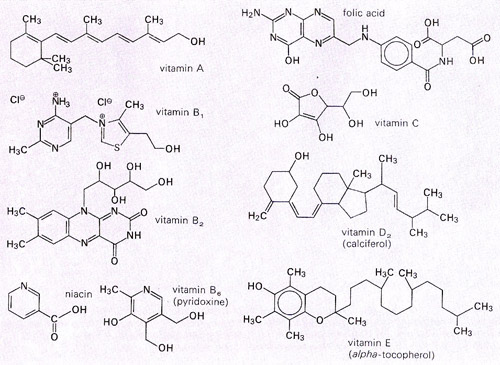
In addition to the nutrients, there are selected chemicals that the body needs in order to function properly. Your body can't make those so they have to come in your food. They include things like retinol, niacinamide, pyridoxine, cyanocobalamin, and ascorbic acid. Collectively they are known as vitamins, and the common names for the ones I've listed are A, B3, B6, B12, and C. These are all small molecules that can be readily manufactured in a chemistry lab. You can consume them in a pill.
The structure of some vitamins
       (taken from http://www.daviddarling.info/encyclopedia/V/vitamin.html)

Here are some common myths about the American diet:
  • People who worry a lot about their diet are healthier.
Many religions, e.g., Judaism, have dietary laws. I do not believe these confer any health benefits. Indeed, my anecdotal impression is that orthodox Jews are disproportionately obese and unhealthy. Whether that's because of kosher or despite kosher I don't know, but obviously kosher isn't helping any.

Even worse off are the vegans. The vegan students I've encountered have pasty, unhealthy complexions, seem to be frequently sick, and look terrible. This is not a good diet, certainly lacking in fats and proteins, and probably missing some vitamins as well.

Likewise, the Atkins diet is low-carb extremist. I tried it at one point and found it completely unworkable. Reducing carbs is fine, but an ideological crusade to eliminate them is nuts.
  •  Some essential ingredient is missing from your diet.
Just take the magic pill--so the story goes--and you'll be much healthier. That's what they tell you in the nutrition shops or on late-night TV. Not true. As long as you get your vitamins you're fine. There is no magic ingredient missing from the food you eat.

As I've already said, our biggest problem is that we eat too much. It is simply not true that despite all that food we're all on the verge of malnutrition because we lack some essential nutraceutical. It's nonsense. I never visit those "nutrition" shops.
  • Fast food is unhealthy food.
A Big Mac has about 550 Calories. If you ate three of them a day you'd get all the carbs, fats, and proteins you need, along with 1650 Cal. If the remaining Calories were consumed as fresh fruits and vegetables you'd have a perfectly balanced diet. Nobody on the Big Mac diet will die of malnutrition.

Of course that diet is boring. So people augment it with fries, a soft drink, and an apple pie. Then you've got too many Calories and way too many carbs. But there is nothing intrinsically wrong with fast food. All it is is good food served quickly.

  • Pesticides and food additives are bad for you.
Pesticides are clearly non-toxic to humans. Were it otherwise we'd have long since been killed off--they've been used ubiquitously for decades if not centuries. To the contrary, pesticides make food better by keeping insects out of it. I live right next to an apple orchard, and if the farmer didn't use pesticides the apples wouldn't be near as good.

I used to buy bread that didn't contain preservatives. Of course it goes stale and moldy within a few days. I always ended up throwing half the loaf away. There is no measurable damage to human health from preservatives. Indeed, there is enormous cost savings because much less food has to be discarded.

Likewise, food additives add taste and texture to food. The alternative is a lot more sugar or a lot more fat. Food shouldn't just be healthy, but also tasty and attractive. Food additives allow that to happen cheaply and with no significant ill effects.
  • "Health food" is healthy.
My daughter buys something called "almond milk" in lieu of the real thing--she thinks it's healthier. But it's just sugar water with a little almond extract and a few vitamins mixed in. It's overpriced, carb-loaded crap. Much better to buy real milk, which comes not only with vitamins and proteins, but necessary fatty acids. (My wife is lactose-intolerant, so that is not an option for her.)

Likewise, I see no advantage to so-called "organic" food. It confers no health benefits that I can see. But the Madison Avenue guys have y'all bamboozled into buying the stuff at inflated prices. I never touch it.

So that's Trotsky's common sense diet. Eat recognizable foods. Don't worry about additives or pesticides. Avoid excess carbohydrates. Control your calorie intake. As Aristotle said, all things in moderation. Enjoy your food. Don't let the Greenies, the ad men, the fanatics, or the scolds get to you.

Bon Appetit!

Thursday, October 15, 2015

Sam King Defends Lenin's Imperialism

Sam King (no relation to my pseudonym) throws the word "monopoly" around like it actually meant something.

Mr. King is the author of a long, interesting article entitled Lenin's Theory of Imperialism: A Defense of its Relevance in the 21st Century (h/t Socialist Action). It suffers from the flaw common to most Marxist theory: it's principally concerned with a rabbinical exegesis on some ancient text. In this case the text is Lenin's Imperialism: The Highest Stage of Capitalism, published in 1900. His major claim is summarized in the final paragraph.
Far from having become antiquated, the framework provided by Lenin’s Imperialism: the Highest Stage of Capitalism is still able to cast light on even the most modern developments in world political economy – as I have tried to show in relation to China. If this article provokes even a handful of serious people to go back and study or re-study Lenin’s thesis, then it has done its job.
I think this is nutty--a study of modern economics starting from a political polemic written more than a century ago by somebody inexpert in the discipline is not worthwhile. But before Mr. King can analyze the modern economy, he has to dispense with some modern-day Marxists who have apparently lost their way. Specifically, he takes on the deceased Chris Harmon, late of the International Socialist Tendency (IST).

For example, he attributes the following to Mr. Harmon (footnotes deleted for clarity).
Harman argued, “Most of the Third World, including nearly all of Africa and much of Latin America outside Brazil and Mexico, is of diminishing economic importance for the dynamic of the system as a whole. Profits and interest payments from such regions are the lettering on the icing on the cake for world capital, not even a slice of the cake itself”, while “the major sources of surplus value in the world are in the advanced countries”. Lenin is evoked in support of this position.
Mr. Harmon's opinion seems right to me--a proper description of the modern world. Mr. King almost admits as much, but no matter.
Whatever the truth of Harman’s position on the unimportance of exploitation of the poor countries for imperialism, it cannot be said to have anything in common with Lenin.
In other words, reality sucks. Facts that don't conform to Lenin's theory, however creatively interpreted, must be studiously ignored. And so Mr. King spends the rest of the article strenuously pounding square pegs into round holes, trying to fit the modern world into Lenin's theory.

Like Biblical exegesis, the Marxist sort also has moral consequences. Mr. King does not fail to point out the long reach of class collaboration (emphasis mine).
Leaving aside that Harman is arguing here not what Lenin said, but what his “phraseology” seemed to suggest, it is easy to find categorical refutation. Lenin called it a “petty bourgeois reformist point of view” to believe it “possible, under capitalism to separate” out “‘productively’ invested capital (industrial and commercial undertakings) and ‘speculatively’ invested capital (in Stock Exchange and financial operations)”.
Lenin's theory of imperialism revolves around two concepts: monopoly and unequal exchange. The latter depends on the uniquely Marxist understanding of value. There is the market price of labor, aka the wage, which is easily measured on the market. Then there is the value of labor, which is some kind of spiritual quantity that depends on what a worker's time is actually "worth." The difference between the value and the price represents unequal exchange, i.e., the degree of exploitation of the proletariat. Since labor's value cannot be measured, these numbers are just made up and estimated. This is why Marxist polemics never contain any actual data.

Mr. King gives numerous examples of where, in his opinion, value and wage substantially diverge. Consider, for example,
...your computer. One study gives a breakdown of revenues for iPods sold in the US for $300. US-based retailers got $75. Apple secured $80. Chinese workers and bosses got $2.61 between them. How would it be possible to imagine the workers who did most of the work are exploited, not by the capitalists who get most of the profits, but only by some middlemen and subcontractors?
Of course the factory workers did not do most of the work (as Mr. King admits later in the article). The vast majority of the effort was done by designers, engineers, entrepreneurs, salesmen, and brand managers in the United States, Taiwan, and Israel. Chinese factory workers probably contributed about 1% of the value. So this is no example of unequal exchange.

Capitalists can capitalize on unequal exchange only if they have a monopoly. Otherwise (as Mr. King does not mention) the benefits go entirely to the consumer. Mr. King describes two kinds of monopolies. The first is held by multi-national corporations, of which Nike and Apple are two examples. And these do have a monopoly of sorts. While sneakers are a commodity product (i.e., no monopoly), branded Nike sneakers are a monopoly of Nike. Indeed, as any sophomore microeconomics student learns, brands create "artificial" monopolies--Crest toothpaste, McDonald's hamburgers, Nike sneakers, etc.
Where do Nike’s profits come from? Nike does not produce anything; it outsources all its production. Are Nike’s profits then produced by Tiger Woods, Shane Warne and its small group of advertising, design, sales and financial staff in their offices in the US? The Marxist answer is “no”: production workers create the value realised as profits.
Actually, yes, Tiger Woods, et al., contributed significant value to the brand. As did the designers, stylists, and advertisers in the US. It is simply not true that production workers created all the value. Only a small bit of it.

The other monopoly is "financial capital." Despite spending seven years as a card-carrying Commie, and an additional thirty as a student of economics, I still have no idea what that term means. It's a boogeyman, like neoliberalism. So I can't do Mr. King's argument justice, but he seems to claim that "financial capital" is increasingly monopolized. Really? Today we have not just banks, but commercial and investment banks, hedge funds, venture capital, mutual funds, pension funds, exchange-traded funds, shadow-banking systems, all kinds of derivatives, along with many financial instruments I've never even heard of.

I don't understand the half of it. And neither does Mr. King. For that matter, neither does anybody else. The whole thing is so complicated and so interlocked that nobody has a clue what will happen when something goes wrong. But one thing is certain: it is definitely not a monopoly! So on that Lenin is just wrong.

One more claim by Mr. King is worth examining.
Indonesian textile workers receive wages around one-thirtieth of the Australian minimum wage. They must work a full work day to earn what an Australian worker gets in the first minutes of a shift.
A similar discrepancy occurs on the US-Mexican border. Workers can increase their wages by a factor of 10 just by moving from Juarez to El Paso. Why? It is not, as Mr. King rightly states, because American textile technology is so superior. Indeed, he remarks that such low-tech manufacture is comparably productive around the world. And it's not that Americans are more skillful--the Mexican gets the pay raise on his first day in the USA.

Instead it has to do with good institutions. I count the following advantages of El Paso over Juarez.

  • Low crime. Crime adds a significant cost, and the crime difference between El Paso and Juarez is significant.
  • Secure property rights. Factory owners in El Paso have secure title to the land going back several centuries. There is no doubt who owns it. The government is (generally) not able to simply expropriate it. Nobody will invest very much if property rights are not secure.
  • Rule of law. American courts and the American legal system have a long tradition in both common law and constitutional law. They will get it right most of the time. That's not true in Mexico: the common law tradition does not exist, and the constitution is not awarded the same authority. Legal outcomes are much less predictable.
  • Economic freedom. Entrepreneurs in the USA are free to fail. Nobody goes to jail for going bankrupt (unlike, e.g., China). Conversely, American businesses can keep the proceeds of their efforts, even if in a narrow sense it's unfair. The biggest correlate for a country's standard of living is the measure of economic freedom.
Lenin understood none of this, though in 1900 perhaps we can't blame him. Sam King, on the other hand, really should know better.

Further Reading:

Tuesday, October 13, 2015

Book Review: Popper's Bitcoin Book

Nathaniel Popper is the author of Digital Gold, an account of the short history of bitcoin. Bitcoin is a digital currency invented by "Satoshi Nakamoto," and released to the world in 2009.

The book is advertised as a business book, and no doubt some legitimate fortunes have been made and lost. A few of the characters are, indeed, entrepreneurs in the spirit of Sam Walton, Steve Jobs, or Aubrey McClendon. The name Wences Casares, the Patagonian founder of Xapo, comes to mind, though (apart from Satoshi himself) no bitcoiners rise to the rank of genius that one associates with those other giants of industry.

But two other less creditable strands are prominent, especially in the early years. First is a kind of crackpot libertarianism--a cross between Ron Paul and Occupy Wall Street. It's a paranoid world view that posits some grand conspiracy theory between the government, big business, and the Federal Reserve, among others. These are people for whom the dollar bill is an infringement on liberty, and the main object of activism is to protect one's privacy from the prying eye of government. Roger Ver, a longtime champion of bitcoin, who served time for illegally selling explosives and has renounced his US citizenship, is representative.

The second strand is outright criminality. The biggest use for bitcoin, even today, is buying and selling illegal drugs. The founder of the trade was a poor fellow named Ross Ulbricht, aka Dread Pirate Roberts. Along with belonging to the kooky Libertarian club, he also grew mushrooms in his basement and wanted to sell them. Apart from hawking them on a street corner, a bitcoin-enabled internet storefront looked to be a golden opportunity. And so Silk Road was born--the internet marketplace run along the principles of Amazon.com, but that used bitcoin as a cheap, relatively anonymous way to transfer money.

For this Mr. Ulbricht is now serving a life sentence without parole, a punishment which many (perhaps including me) think is excessive.

Other people got caught up in Silk Road, including an early bitcoin entrepreneur named Charlie Shrem. A born salesman and a natural champion for the new technology, he ran the first currency exchange facilitating bitcoin purchases. While great at raising capital, he wasn't a particularly good manager and had no interest at all in regulations surrounding financial transactions. So, despite likely having no criminal intent, he is now spending two years in the federal pen--a sentence that is surely unduly harsh.

And then there is Mark Karpeles, the French dude who bought Tokyo-based Mt. Gox, building it into the premier trading platform for bitcoin. Unfortunately his bookkeeping was not up to the challenge, and in 2014 Mr. Karpeles revealed that somehow the company had "lost" 750,000 bitcoins, worth as much as $500 million. That story is complicated (I don't think it is completely told in Mr. Popper's book), and some of the money has been recovered. Nevertheless, Mr. Karpeles is now charged with embezzlement.

Despite this, surprisingly bitcoin is still around. There are four reasons for its continued existence. First, successors to Silk Road have proliferated, and the technology remains today the best way to buy and sell contraband. This remains the biggest use for the currency and guarantees a market. Second, honest, non-ideological entrepreneurs have entered the market, of which Wences Casares is a preeminent example. He is looking for legitimate markets, and indeed, bitcoin is now popular in places where banks are unreliable, e.g., Mr. Casares' native Argentina.

Third, the dreaded establishment has latched on to bitcoin. Every major bank now has a research program on the technology. The blockchain (bitcoin) algorithm can be used to trade any number of things cheaply, e.g., stocks, bonds, and real estate. Blythe Masters, the lady wunderkind working for JP Morgan, actively disowns bitcoin currency, but is using the blockchain to trade derivatives. (Ms. Masters does not appear in Mr. Popper's book, but she is the first woman to play a significant role in any of the business books I have read.)

And finally, even the evil government is beginning to take notice. Much to the Libertarians' dismay, the gnomes at the Fed and the IRS have realized that bitcoin is not like cash. The latter is truly anonymous and can be used to evade taxes, among other things. Bitcoin is precisely not anonymous, but merely pseudonymous. Indeed, all transactions are a public record, just waiting for the police to figure out who hides behind the pseudonyms. That's how Mr. Ulbricht got caught.

So now some paranoid people are suggesting that the Fed wants to eliminate cash altogether and replace it with bitcoin or some similar system.

So what do Trotskyists think about bitcoin? I have absolutely no clue. My guess is that few of the papers on my Beat would know the difference between a blockchain and a cement block. If you're stuck in a 19th Century timewarp, then new technology becomes a mystery.

As for me, I'm cautiously optimistic about bitcoin. I took Mr. Casares' advice, which I paraphrase from memory here:  
Buy four bitcoins, which today costs about $1000. There's a good chance that you'll lose all your money--that the price of bitcoin will fall to zero. But there's also a chance that bitcoin will eventually be worth $1 million.
Paypal has about 200 million users in the world, and everybody acknowledges that Paypal is a success. But you need a credit card to use it, and only one billion of the world's population has a credit card. Bitcoin, on the other hand, only requires having a cell phone. Six billion people have a cell phone. So bitcoin has a much larger potential market than Paypal.
Today bitcoin has 13 million users. When it has 200 million (like Paypal) it will be a success. 
I bought the bitcoin lottery ticket. The most I can lose is a grand. But I might also become rich.

Further Reading:

Sunday, October 4, 2015

Trotskyists on Economics

Here is a roundup of recent Trotskyist opinion on economics, broadly interpreted.

Consider first Socialist Action's article headlined Scientists Say: End Fossil Fuel Use Now. I guess that means I won't be able to heat my house this winter. And I should probably forget about going to work on Monday, as that entails driving a car. Oh, and I'm not allowed to use a thorium reactor, either.

So maybe I shouldn't take author Christine Frank so literally? Perhaps she'd be willing to give me thirty days to wean myself off of hydrocarbons? Maybe even a year, though who knows, all of Antarctica might melt before then.

As it turns out, Ms. Frank's solution ignores her imaginary deadline.
The only way to stop further environmental devastation by a greedy capitalist class that refuses to give up its fossil-fuel-based economy is to nationalize the entire energy industry and put it under democratic workers’ control. At the same time, we must ensure a just transition with retraining, union wages, and full benefits for all workers making the shift from the production of dirty fuels to clean, renewable energy.
Even if you could accomplish all of this before the End Of The World, it's not clear to me that democratically empowered workers are going to vote for collective suicide, e.g., freezing to death in the winter. But then Ms. Frank never had much of a brain for practicalities.

Socialist Action is obviously not serious about convincing anybody who doesn't already agree with them. Their website is principally dedicated to the psychological amusement of their own comrades.

Equally ridiculous is the article by Socialist Action's Marty Goodman entitled Syriza Wins, Greek Workers Lose, about Alexis Tsipras' reelection as Greek prime minister following his abrupt turnabout on the memorandum. The correct path for Greek workers, according to Mr. Goodman, is to support the Trotskyists in the ANTARSYA coalition--you know, the ones that got 0.85% of the vote. (Mr. Goodman hilariously mentions that this is an improvement over last time!)

The Left breakaway from Syriza that supported Grexit did much better, getting somewhat less than the 3% necessary to enter parliament. Such a smashing success, per Mr. Goodman, is attributable to their supposedly bourgeois insistence on continued capitalist rule.

The fact is that the overwhelming majority of Greeks want to stay in the Euro. And no wonder, as the alternative is instant poverty. When Tsipras' negotiation failed to produce the expected free unicorns, Greek voters--sadly but predictably--settled for the only remaining option. Mr. Goodman's thesis that the election was somehow unrepresentative is delusional.

I try to take my Trotskyist friends seriously, but these Socialist Action articles are just stupid--there's no other word for it.

The folks over at Solidarity hold the same opinion as Ms. Frank, but they are better informed and more honest about what it entails. Reprinting a piece from the Bureau of the Fourth International (whatever that is), they lay out the unvarnished truth.
To save the climate: 1) 4/5ths of known reserves of fossil fuels must remain underground; 2) the energy system based on these fossil sources (and on nuclear power) must be destroyed as quickly as possible, without compensation; 3) production which is harmful, unnecessary, or based on planned obsolescence must be abandoned, in order to reduce the consumption of energy and other resources; 4) the despotic and unequal productivist/consumerist system must be replaced by a renewable system, one that is efficient, decentralized, social and democratic.
This requires nothing less than the disemployment and mass impoverishment of the majority of the world's population. Of course if that's what's necessary to Save the Planet, then certainly we should all go along--even democratically elected workers must agree.

The Militant's masthead includes the slogan "published in the interests of working people." Socialist Action and Solidarity will both claim similar sentiments. But their relentless insistence on mass poverty will never win the support from anybody who actually has to work for a living.

More serious is an article in Solidarity by Kevin Lin, entitled Chinese Strikes in Manufacturing: From Offensive to Defensive? Mr. Lin obviously knows something, and that right there makes the piece worth reading. He describes strikes at manufacturing companies in China, including at a footwear factory and a clothing & leather company. Some were successful and others not so much.

His thesis (and I simplify it here) is that in the previous decade strikes have been for higher wages and better working conditions--demands that Mr. Lin terms "offensive." More recently, however, unrest has been caused by company closures, severance packages, and demands for workers to relocate. These are "defensive" because while they protect workers, they don't improve standards of living.

Mr. Lin claims that because of the weakness in the Chinese economy, defensive struggles will now prevail. I think he's right.

The Militant also reports on labor unrest, this time in the US. As usual, they're the best reporters on my Beat. Alyson Kennedy files from East Chicago about the contract negotiations between the United Steelworkers and ArcelorMittal. After describing the weakness in the global steel market, she writes,
“We are in for a long fight,” Darrell Reed, a member of Local 1010’s grievance committee, told the Militant. “I’m not optimistic that the latest negotiations will get us something we can live with. Both active and retired members have to stand together. Health care is a major issue, especially for retirees. For some of them the company’s offer means not having enough money for food after paying for health care.”
Mr. Reed has it right. Margins in the steel industry are razor-thin, and companies have no ability to raise prices. Further, even as the workforce shrinks, the number of retirees continues to grow. And contrary to Marxist opinion, benefits for retirees do not come from the capitalists' margins, but instead are paid out of the salaries of the employees. That's why it's going to be so hard to keep active and retired members on the same page--they're both competing for the same pot of money.

Actually, it's all of a piece--the unrest in China, the dispute in the steel industry, and even the demand for $15/hour. For higher wages for Walmart employees means that savings have to come from elsewhere--either by hiring fewer workers in America, or by pinching suppliers. But the suppliers are Chinese workers, who end up footing the bill. That's why their strikes are increasingly defensive, and also increasingly unwinnable.

The only winners are American consumers, who will get cheaper prices. All the workers--whether in the US or China--are really on strike against the consumer. And it's a battle the unions will never win.

The Militant, at least, does not always demand Instant Poverty Now.

Further Reading: