Tuesday, April 12, 2022

What's Happened Since I've Been Gone

I guess I need to explain my absence. My cancer came back and I've spent the last four months undergoing chemotherapy. The first few weeks were truly debilitating and I couldn't have blogged even if I wanted to. But after that--I just didn't want to. I was getting bored with my own posts. So with chemo as the excuse I took a break from blogging.

The good news is that the chemo worked--I am now in complete remission. In celebration my wife and I will be taking a vacation, including 12 days on a Caribbean cruise. I've never done that before--it's definitely an old man's holiday. So regular blogging won't resume until early May when we get home, but I'm chomping at the bit to get started again.

I've been gratified to see that even in the absence of new material, this blog has attracted 20 - 30 legit hits per day--pretty good for an amateur covering a very niche topic.

So if I've been sick, then my friends over at Socialist Action (SA) have been going stir-crazy. They managed to post exactly one (1) article during the month of March. I sure am glad I haven't paid for a subscription to the print newspaper--it must be mostly blank pages by now.

The reason for the silence is obvious. SA is unapologetically pro-Putin. To summarize their position in my own words, while they acknowledge that Russia is a capitalist/imperialist state, the country is nevertheless an objective force for progress because it necessarily must oppose the much stronger American imperialism. The real cause of the Ukraine war, in this view, is not anything that Putin or the Ukrainian people have done, but instead it's entirely the fault of "US imperialism"--that largely mythical boogeyman upon which all evil can be blamed.

On April 11th SA's chief honcho and failed presidential candidate Jeff Mackler finally posted a long article explaining at great length the position I've just described. The supposed sins of the USA are catalogued in detail. For example:

  • Ukraine is dominated by US-funded fascists, such as the Azov Battalion.
  • Fascist snipers shot 100 innocent civilian on Maidan Square in 2014.
  • Fascists overthrew the duly elected president, Viktor Yanukovych--forcing him to flee to Russia.
  • The US installed (somehow, mysteriously) the fascist prime minister Arseniy Yatsenyuk. 
And so on. He cites no references for any of this--neither as links nor in a bibliography. His only source for the fascist snipers are unspecified remarks by Victoria Nuland--he provides neither the date nor venue for her speech. It's impossible to track this down. His only other source is a booklet authored by--Jeff Mackler--of all people.

In other words, Mr. Mackler just makes stuff up. You can't believe a word he says.

SA's call to action is to demonstrate against the US government for forcing Putin to invade Ukraine--as summarized by their key demand: US Out Now! Hands off Ukraine! Needless to say this is crazy-talk, and will attract no support from anybody on the American political spectrum.

One last thing: I can't let Mr. Mackler's antisemitism go unchecked. The fact that current president Volodymyr Zelenskyy is Jewish apparently sticks in his craw. The only mention of the man's name is this: "We note with contempt Ukrainian President Volodymyr Zelensky’s recently-proclaimed affinity for Zionist Israel’s model of a militarized state aimed at the subjugation of oppressed people."

If Mr. Mackler is nutty, then our comrades in Solidarity are perfectly sane. A long editorial, dated March 2nd, is posted by the "National Committee." The piece is well worth reading, and I recommend you do so. 

I think the article is mostly correct. They unambiguously condemn Russia for the invasion and are not making excuses for Putin. But at the same time they write:
NATO’s expansion into post-Soviet Eastern Europe, up to Russia’s borders, was all the more dangerous because it was not only a power grab, but also ideologically driven by the U.S. establishment’s assumption, after the Soviet Union’s collapse and the crushing U.S. victory over Iraq in the 1990-91 Kuwait war, that its rule was uncontested. It violated assurances that U.S. diplomats at the highest level had made to Soviet leader Gorbachev, and was already called by George Kennan in the 1990s a “tragic mistake” that Russia ultimately would never accept.
This is absolutely correct. NATO should never have expanded east of the Oder/Neisse line (today Germany's eastern border). The extension into eastern Europe has to be seen by Russia as a threat. The Biden administration's biggest mistake was to insist that Ukraine have a hypothetical right to join NATO. Indeed, I think that was the proximate cause of the war to begin with.

Unlike Solidarity, I do not believe NATO should be abolished--I do think it needs to retreat from Russia's borders. The editorial also states that "...NATO and particularly U.S. imperialism are at least equally aggressive and as dangerous as Russian annexationism." I do not agree with the adjective equally here--Putin is by far most at fault.

Contra Jeff Mackler, they write:

It is painful to see how much of the U.S. peace movement swallowed the simplistic story that the events of 2014 in Ukraine, when a spectacularly corrupt pro-Russian government was deposed under pressure of a mass movement (over whether to join a European trade bloc or a Russian-led Eurasian one), were a “fascist coup” and a “genocide” of Russian-speaking regions.

In these claims, some kernels of reality are wrapped inside layers of twisted falsehoods that could (and do) come straight from the Kremlin – as if, for example, violent ultra-nationalist forces, which do exist in Ukraine, are more powerful there than they are in Russia!

I couldn't have put it better myself!

On a completely different topic, news comes that Socialist Resurgence (SR) will unite with a grouplet called Workers' Voice (WV), with the new group adopting that latter name. They write:

We are in agreement about the necessity for principled regroupment of revolutionary groups. The two groups carried out common discussions and practical work for two years and have come to a shared perspective on the fundamental situation facing the working class and oppressed today. On this basis, a congress was held on March 19-20, 2022, in which WV and SR voted to merge as Workers’ Voice. Our congress included observers from the International Workers League, Revolutionary Socialist Organizing Project, Tempest Collective, Corriente Obrera, and affiliates of the Revolutionary Socialist Network. 

As a fused organization, Workers’ Voice brings together two historic traditions of world Trotskyism into a common revolutionary party.

The "two historic divisions" represent two versions of the Fourth International (FI): that of the United Secretariat, which purports to be the original FI, and the International Workers' League-Fourth International  (IWL-FI), which claims a mission to "reconstruct" the original FI. (A more useless mission is hard to imagine.)

The Workers' League existed back in my day (1970s), then led by a fellow named Tim Wohlforth. In a play on his name, our derogatory name for them was the Woolies. I did not know them well--there weren't many Woolies in the cities where I lived. I say more about this in one of my earliest posts, here.

The IWL-FI writes a history of their movement--it reads like an endlessly tedious soap opera. I couldn't make much sense of it. Mr. Wohlforth is not mentioned at all--I think he was forced out in disgrace. More useful than the text itself are the footnotes. They're explanatory and can be read independently--and serve as a useful summary.

I've since googled around and discovered that Mr. Wohlforth died in 2019 at age 86. He spent the last decade of his life in Ashland, OR, where he was a member of the Society of Friends Meeting--a tradition he picked up from his childhood. He wrote mystery novels (with some success) and mentored others in that craft. Here is his obituary, and here is a reminiscence. Neither mentions his Workers' League years, but his Wikipedia page does. He is survived by a wife, a son, two grandchildren, and many friends. In other words, he was a successful and accomplished man.

I do wish the new Workers' Voice success. Certainly not in making a world revolution--heaven forbid--but in producing an interesting and useful web page from which I may learn something, and from which I can draw inspiration.

Further Reading:


Sunday, November 14, 2021

Elections, 2021--Race & Transgender

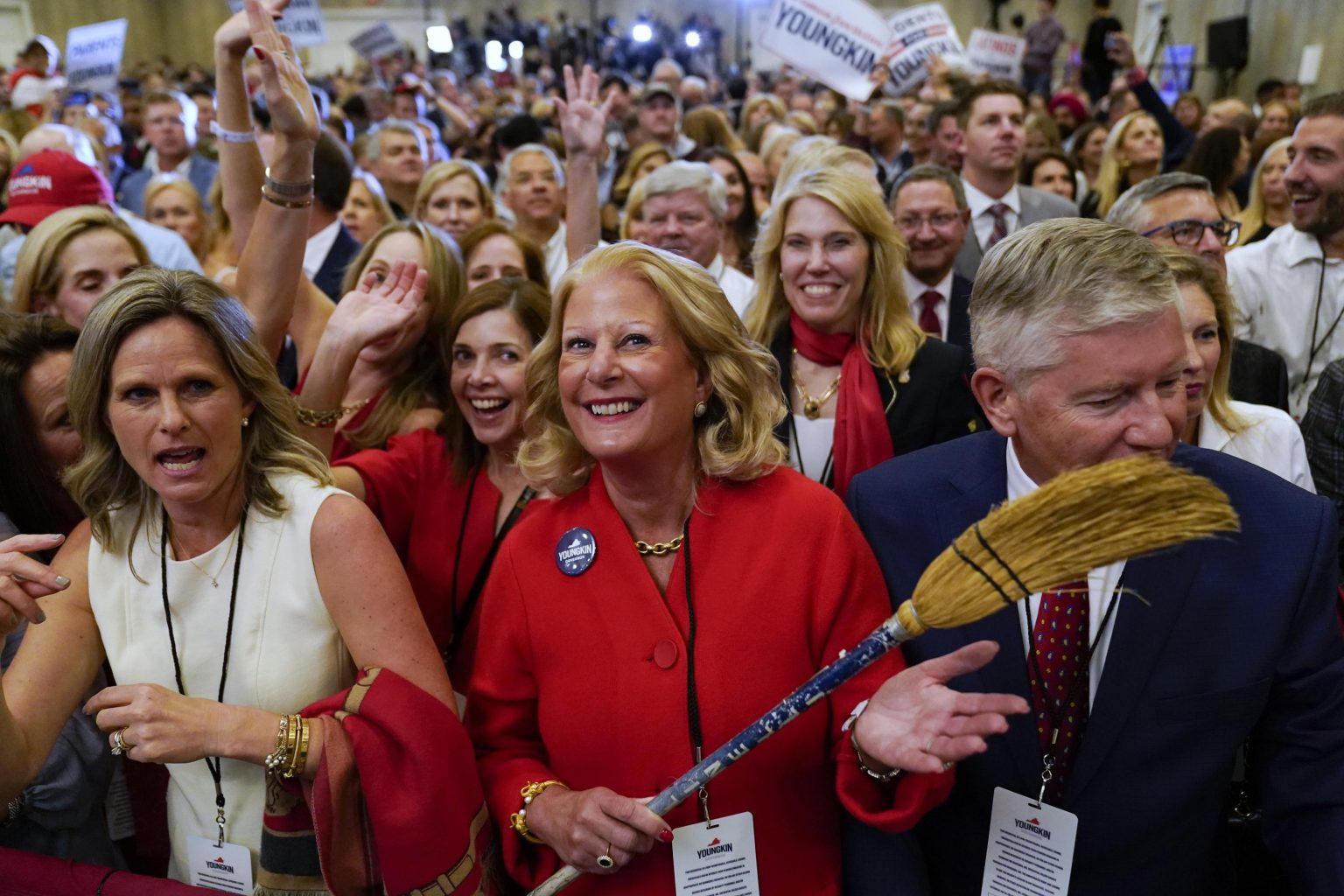
Source: Andrew Harnik/AP, as published in Left Voice

Ezra Brain, a regular columnist for Left Voice, is a smart and interesting guy. His election night summary is excellent, and dated Nov. 3 is entitled  Election Night 2021: The Right Strikes Back. Another well written post from Left Voice author Tatiana Cozzarelli is dubbed Teachers Unions Must Fight the Attacks on Critical Race Theory and on Trans Kids. We'll also take a look at Terry Evans' piece from Nov. 22nd Militant headlined What do the 2021 election results mean for the US working class?

I don't have a big problem with Mr. Brain's Election night summary. The article is very well written and definitely informative--but there is nothing in it that is especially Marxist, much less Trotskyist. It is mostly a well-phrased rehash of Democratic Party talking points. The accompanying picture (shown above) is most revealing of Mr. Brain's biases: it shows a bunch of smiling white people, who have deceptively traded in a white hood for a red blazer, and who must all be racists because they're white, and you know they're white because they are so unWoke that there are no Black faces in the picture, and whenever white people get together for any reason, it's because they're racists. And did I mention that they are all white!

The problem for the progressive left is that one can't win people's votes by constantly accusing them of being racists. Surely reporters like Mr. Brain have to make some effort to understand what people are really thinking rather than just assuming they're all hopelessly obsessed with race and can't think about anything else. The best way to understand what people actually believe is to listen to what they say and to take them seriously--and then not assume you know more about their motives than they do themselves.

For example, Mr. Brain writes 

"Jack Ciattarelli, the Republican, also ran against critical race theory in schools. Ciattarelli essentially argued against the teaching of the terrible history of racism in the U.S."

I don't think CRT was the primary issue in New Jersey, and nobody is saying that racism and its history shouldn't be taught in schools. That's just a red herring. The real issue in New Jersey was exemplified by Governor Murphy's gaffe, when he said “If taxes are your issue, then New Jersey’s probably not your state.” A vote for Ciattarelli was a vote for lower taxes--not a vote for "racism."

Ms. Cozzarelli apparently imagines that on those rare occasions when us white folks aren't thinking about race, then we're thinking about sex. She writes.

Attacks on trans kids in schools take many forms, from the right to bathrooms to the right to play on sports teams. Eight anti-trans sports bans have passed in the past few months in Arkansas, Alabama, Tennessee, Mississippi, Montana, West Virginia, and Texas. These laws ban trans kids from playing sports on teams that correspond to their gender. Texas’s law  was publicly litigated, and trans kids came in to plead their case. 8 year old Sunny Bryant told the Texas State Legislature: “My first visit to the Capitol should have been on a school field trip, not defending my right to exist, but if I don’t show up, you won’t see the real stories. Kids like me whose futures will be crushed, opportunities taken away even before I’m given a chance to try.” Her powerful testimony didn’t stop the bill—it passed in Texas, and others like it passed in multiple states across the country.

I confess I find the problem trans people pose to be intractable. I do know a couple trans women quite well, and both have undergone a strenuous and debilitating medical procedure to make the transition. They are smart, honorable people who have overcome serious odds. I honestly wish them the very best, I hope others treat them courteously and respectfully, and I strongly oppose any infringement on their Constitutional rights. I have no problem with them using the women's washroom--and I can't see why anybody else should have an issue with that, either.

But...

I do have a problem when a junior high or high school boy wakes up one morning, puts on a dress, changes his pronoun, and then claims he's a girl--asserting for himself the right to use the girl's toilet and play on girl's sports teams. Perhaps he's legit--i.e., he really does think he was born in the wrong body and will eventually undergo the medical procedure. Or maybe he's just pwning us, or just trying to get on a varsity sports team, or something less honorable than that. Either way, he devalues the travails of real transgender people, such as the two women of my acquaintance.

My basic disagreement with the Woke left is that I don't believe gender roles are fluid. For almost all of us sex and gender are fixed at birth. For a very few (<1%), something goes wrong (or at least different) and they really are transgender. But the notion that some kid can switch genders at will--which seems to be the dogma of most Trotskyists these days--is simply wacko. I can't take that seriously, and therefore I can't take the Woke notion of "trans rights" seriously.

Men and women, boys and girls, are different--even from birth. Their bodies and brains are constructed differently. Boys are bigger and stronger; girls have a thicker corpus callosum that connects the two halves of the brain. Boys excel in visuo-spatial skills, i.e. they can throw a ball further and aim it more accurately. Conversely, girls excel in verbal skills. Etc. 

Letting boys play on girls' sports teams is just unfair, and therefore trans people are going to be left out. I'm sorry--as I said, the problem is intractable. But bathroom rules can be very simple: if you have a penis, you need to use the boys' bathroom. If you don't have a penis--either you weren't born with one or you've had surgery--then you may use the girls' bathroom.

I think a large majority of the world's population agrees with me, and the Woke effort to radically remake gender roles is doomed to failure.

If Mr. Brain and Ms. Cozzarelli articulately represent the Democratic Left, then the The Militant's Terry Evans is similarly adept at arguing for the Republican Right. It's odd that they both identify as "Trotskyists," at least in some loose sense of the term. They both agree on what the end outcome should be: we need a mass labor party independent of the Democrats and Republicans, and the working class eventually needs to take state power.

Mr. Evans insists that blue collar white people are members of the working class. Our friends from Left Voice suggest that white folks can be workers only if they're grad students or somehow otherwise associated with the academic left. You need a graduate degree to not be a racist.

Mr. Evans' lede paragraph, in my opinion, represents an accurate description of Left Voice's authors.

The 2021 elections registered a sharp rejection of the anti-working-class politics of the liberal and middle-class socialist wing of the Democratic Party by workers and farmers across the country. From “defund the cops” referendums in Minneapolis and Seattle to the election results nationwide, candidates reflecting these views went down to defeat, taking other Democrats with them.

Regarding defunding the police, Mr. Evans quotes a fellow comrade this way: 

“What is of great concern to workers, however, is anti-social violence within working-class communities. In addition to the immediate consequences for those affected, it saps workers’ confidence and tears at social solidarity,” Nelson said. “The rulers’ cops and courts are aimed against us, but it is far better to live under their rule of law than without it, where warlords, gangs and vigilantes fill the gap. ..."

I've expressed a similar point of view, and still assert that our Left Voice friends unwittingly want to deny Black citizens access to the 911 emergency system. This is a shameful position.

The true home for working class Americans of all races--as opposed to the top 10% and the lumpen intelligentsia--is the Republican Party.

Further Reading:

Wednesday, October 20, 2021

Louisville, Cincinnati, Havana

Maggie Trowe, at podium, Socialist Workers Party candidate for mayor of Louisville, Kentucky, and Anthony Dutrow, right, member of the SWP National Committee, talk about political opportunities ahead as SWP members move to Cincinnati, at Oct. 2 Militant Labor Forum.
(Photo & caption source: Amy Husk/Militant)

The October 25th issue of The Militant (published by the Socialist Workers Party--SWP) brings us tidings from Louisville, Kentucky. But not for long--because the whole branch is moving a hundred miles up the road to Cincinnati.

The announcement was made in the weirdest possible way. Maggie Trowe is running for mayor of Louisville, and has actually gotten a bit of media attention, including a nice write-up in the Courier-Journal. (See also here and here.) But it seems to no avail, for apparently the campaign is too hot for her, so she and her comrades are hightailing it to Cincinnati.

Eighteen people attended the forum "including four workers from two Walmart stores where members of the SWP had worked. A young woman, who met party members earlier that day at an action to defend a woman’s right to choose an abortion, brought a friend."

Leave it to the Party's mayoral candidate to invite special guests and possible new recruits only to announce that she's decided to cut and run. This rises to Macklerian levels of unseriousness.

The reason for the move is the usual grass is greener elsewhere boilerplate.

“We think in Cincinnati we’ll have greater opportunities to join in union battles and at the same time build a branch of the SWP in a city with a long tradition of class struggle, an industrial center in the Midwest,” Dutrow said. “And where there have been important struggles against racist oppression and police brutality, like those we’ve been part of in Louisville.”

Though timing and manner of the announcement notwithstanding, the move does make sense. The population of metro Cincinnati (2,256,884 from 2020 census), is the 30th largest city in the country, and the largest in Ohio. It's almost double the population of metro Louisville (1,285,439), the 45th biggest city in the nation. So Ohio's Queen City is a bigger sandbox.

I've been to both cities, but know Cincinnati better. My first visit there must have been in the late 80s, when I was living in Buffalo, NY. I went to visit a friend of mine from grad school, by then engaged at the Univ. of Cincinnati. He was a foreign student from Taiwan named Mr. Wong. I've sadly lost touch with him--and it's impossible to locate a Chinese guy named Wong, when a) he's almost certainly moved back to Taiwan, and b) the English spelling does not specify which Chinese character he uses for his name.

Anyway, my friend from Taiwan gave me the grand tour of Cincinnati. The first thing I did was learn how to spell the place. Then we had to eat some chili--I liked it. He drove me to Kentucky just so I could say I'd been there. Of course we spent time at his lab at the University, and then we walked around town. He knew nothing about baseball, but he did point out the P&G buildings downtown.

I wish Ms. Trowe luck in her campaign for mayor of Cincinnati--assuming she stays there long enough to make it happen.

Moving on to Havana: The Militant scored an interview with a foreign dignitary. The conversation is described in an article entitled ‘Cuban Revolution: a challenge to US imperialism’, by Martín Koppel, Mary-Alice Waters and Róger Calero. The lede paragraph:

Carlos Fernández de Cossío, head of the Cuban foreign ministry’s department for U.S. affairs, was in New York at the end of September for the opening session of the United Nations General Assembly. As part of his busy schedule, he made time to sit down and talk with the Militant. He spoke about the intensified assault the world’s strongest imperialist power is today mounting against the men and women who made and continue to defend Cuba’s socialist revolution.

(Source: Cuba Escena reprinted in The Militant)

The best way to parse this is by looking at the pictures included in the article, such as the one above. The Militant's caption reads

Artists bring theater and music to El Salvador, a rural town in Cuba’s Guantánamo province Jan. 28, 2019. Socialist revolution expanded access to culture and education to millions in countryside and city.

This reminds me of rural Uganda when I lived there in the 1990s: no electricity, no telephones, no internet, no television, mostly illiterate, and only limited radio. The performers have no stage, no microphones, no props, no makeup, and no lighting. Apparently that's also how rural Cubans still live--a world of deep and desperate poverty. 

Compare with the average American, who, when they tire of the 50 channels on TV, can stream almost any content they wish from anywhere. My wife and I have been watching a Chinese soap opera called Chef Hua on YouTube. Even poorer countries are better off than Cubans--rural Filipinos at least have access to the Internet and telephones.

The "socialist revolution," far from expanding "access to culture and education," has instead vastly reduced and impoverished said culture. It's very sad.

Or consider this image

(Source: GRANMA/MIGUEL FEBLES HERNÁNDEZ, reprinted in The Militant)

The Militant's caption reads

Havana, February 2021. Medical students go door to door, making sure anyone with COVID symptoms gets needed care. For more than 60 years black Cubans have been a leading force in the socialist revolution, fighting to consolidate social and political gains of working people of all skin colors while uprooting legacy of discrimination against Cubans who are black. 

These are very strange medical students--they carry no supplies, no thermometer or stethoscopes, or any other tools. All they've got are white shirts and clipboards. Perhaps they're not medical students (or not just medical students), but rather agents from the Committees for the Defense of the Revolution--the Stasi-like secret police that hires neighbors to snitch on neighbors. The lady at the door doesn't look too happy to see them--can't say I blame her.

In the past the SWP extended "critical support" to the Castro regime, offering an occasional criticism. For example, they once dinged the Cuban government for their homophobia. But there is nothing even remotely critical in The Militant's account of Fernández de Cossío's interview. Indeed, a more credulous audience our visiting diplomat has likely never had. Surely no audience in Cuba would grant him such authority.

Here's the deal: all government officials lie. Trump lied. Biden lies. Boris Johnson lies, etc. Mr. Fernández de Cossío represents the Cuban government, and there is no way he is telling the truth. Surely any journalist with half a brain will treat his comments with some skepticism.

But not Martín Koppel, Mary-Alice Waters and Róger Calero. Their obsequiousness is embarrassing, and it discredits The Militant as a serious newspaper.

Further Reading:


Monday, October 18, 2021

The China Beat

This post is in response to three recent articles from the Trotskyist press--one by Jeff Mackler, another by Michael Roberts, and a short piece by Roy Landersen.

Mr. Mackler's piece is entitled The Myth of a New “Cold War” Between the U.S. and China/Russia. He's addicted to the word imperialism--the word fragment imperial- shows up 28 times in the article. This despite the fact that he has no clue what the word means. He's not alone--nobody else knows what it means either.

What I think he thinks it means is something like unequal exchange. That is, on the one hand US capitalists will exploit Chinese workers who manufacture cheap products for American consumers by paying them "near slave wages." On the other hand, the US will export expensive, overpriced products back to China. Thus the capitalist realizes excess profits on both legs of the round trip. The problem is it doesn't work that way. Why would China volunteer their citizens for slavery? And why would they agree to buy overpriced products when the same can be had for cheaper from other countries?

Mr. Mackler actually admits that the imperialism model doesn't fit. He writes,

In the 20 years since China was admitted to the WTO, China went from operating as one of the world’s lowest technology nations to today, when Chinese technology rivals or exceeds almost all other nations on earth. In the past 20-plus years China was transformed from providing “internal migrant” teenage girls from the countryside, producing garments in prison-like foreign-owned dormitory factories at six cents per hour and seven days a week, to a nation with some of the most modern Chinese-owned factories in the world, producing world-class industrial tools and machinery and state-of-the-art 5G (fifth generation) electronics and telecommunication products.

So--in a mere 20 years those migrant slave girls went from being ruthlessly exploited to becoming middle class citizens of an increasingly wealthy country. There is still a lot of poverty in China, but the collaboration between Walmart, on the one hand, and Chinese entrepreneurs on the other has lifted 400,000,000 people into the global middle class--an achievement unprecedented in human history. Mr. Mackler needs to explain how "imperialism" wrought such a change, and if so, then why is "imperialism" such a bad thing?

It's not like American consumers suffered. Walmart reduced prices across the board, sharply lowering the cost of living, especially in rural areas. More, Walmart kept its operating margins at 3%, thereby passing nearly all the benefits of the China trade on to American consumers. Sam Walton only got a small slice.

The problem with Mr. Mackler's version of Marxism is that he sees trade as being a zero-sum game. He thinks anybody who trades with the USA is getting ripped off. Other people postulate the reverse: the US is getting ripped off by foreigners selling cheap products to Americans (I put Barry Sheppard into this category here). Though Mr. Mackler is inconsistent: he also believes Cuba's suffering is due to the US trade embargo, i.e., Cuba can't trade with the US.

There are social and geopolitical reasons why the US needs to curtail its trade with China--but we will pay an economic price by doing so.

Michael Roberts' article, entitled China at a turning point?, is much better--not least because the word imperialism isn't mentioned even once. More, Mr. Roberts actually knows something and is careful about terminology--nothing he says can be dismissed out of hand.

The article is inspired by the collapse of the giant real estate developer, Evergrande. I think Mr. Roberts' analysis of the near-term consequences is accurate. It is not a financial collapse on the order of Lehman Brothers, nor will it bankrupt the entire Chinese economy. But it will lower the standard of living by a misallocation of resources. Mr. Roberts suggests that China is creating "zombie companies" such as exist in many capitalist countries. He writes,

The real problem is that in the last ten years (and even before) the Chinese leaders have allowed a massive expansion of unproductive and speculative investment by the capitalist sector of the economy.  In the drive to build enough houses and infrastructure for the sharply rising urban population, the central and local governments left the job to private developers.  Instead of building houses for rent, they opted for the ‘free market’ solution of private developers building for sale.  Evergrande-like development in China wasn’t just capitalism doing its thing. It was capitalism facilitated by government officials for their own purposes. Beijing wanted houses and local officials wanted revenue. The housing projects helped deliver both. The result was a huge rise in house prices in the major cities and a massive expansion of debt.  Indeed, the real estate sector has now reached over 20% of China’s GDP. 

I think this diagnosis is largely correct, except I wouldn't blame the free market, but instead government intervention in the market. "Beijing wanted houses and local officials wanted revenue" has nothing to do with free market capitalism.

The Chinese problem is in a sense the opposite of that of the USA. In our country we subsidize housing demand: Section 8 vouchers, eviction moratoria, generous tax benefits, subsidized mortgages, concerted government efforts to extend home sales to poor people, etc. At the same time, housing supply is sharply limited, mostly by local zoning and environmental regulations. Many Greenies want to ban single family housing altogether. The result, of course, is sharply higher housing costs as subsidized demand outstrips constrained supply.

In China it's the other way round. Both the local and national governments want more houses--and boy, have they built houses! Whole ghost cities full of them. Supply is hugely subsidized, leading to falling prices. But the government can't have falling prices since that would destroy middle class savings. The result is a bankrupt Evergrande that is building houses that nobody really wants to pay for anymore.

My take on this is government regulation--on either the demand side or the supply side--screws things up. It's not capitalism anymore, but rather government cronyism, which eventually morphs into fascism/socialism.

Mr. Roberts' solution is to prohibit consumers from buying what they want. In the US consumers by a large majority want to live in single family homes in the suburbs. Chinese consumers want to own their own apartment and drive a car. But Mr. Roberts and his fellow socialists are against that--they think they know what the people want more than the people themselves. His penultimate paragraph makes precisely that point.

What is needed is not a further expansion of consumer sectors by opening them up to ‘free markets’, but instead state-led investment into technology to boost productivity growth.  And that state sector investment can be directed towards environmental goals and away from uncontrolled expansion in carbon-emitting fossil fuel industries.  As Richard Smith has put it: “The Chinese don’t need a higher standard of living based on endless consumerism. They need a better mode of life: clean unpolluted air, water and soil, safe and nutritious food, comprehensive public health care, safe, quality housing, a public transportation system centred on urban bicycles and public transit instead of cars and ring roads.” Rising personal consumption and wage growth will follow such investment, as it always does.

Somehow I doubt Chinese consumers prefer to ride around on bicycles instead of owning a car.

Mr. Landersen, writing for The Militant, pens a piece entitled Embracing Mao, Chinese rulers continue assault on working people. The premise is much the same as Mr. Mackler's--Chinese workers were exploited and oppressed by their Stalinist masters (which makes me wonder why The Militant offered the Maoists critical support for all those years). That oppression continues near unabated to this very day--the dramatic rise in China's material well-being is barely mentioned.

China's travails are contrasted with Cuba's virtues:

This is the opposite of the working-class trajectory of the Marxist leadership of Cuba’s socialist revolution. Under Fidel Castro and the July 26 Movement, workers and farmers were led to take political power into their own hands and to take on ever-greater control over all aspects of economic and social life, transforming themselves in the process. Working people became conscious actors in history, extending their hand to anti-imperialist struggles around the world.

Yet China has manifestly been more successful than Cuba! Cities like Shanghai and Beijing look a lot more like New York than Havana. There are good restaurants, excellent public transportation, and nice stores. As mentioned China has a sizeable middle class.

None of that exists in Cuba. Smart and ambitious Cubans have all been exiled. Those still living in Cuba are hungry, live in housing so dilapidated that they're functionally homeless, and survive without electricity for much of the day.

China has a lot of problems--but there is no way that Cuba compares favorably with China.

Further Reading:

Monday, October 4, 2021

The Eurodollar

The Eurodollar is the world's reserve currency.

Most people think the US dollar serves that role, and that's not entirely wrong. But it is misleading.

So just what is a Eurodollar?  A Eurodollar is created when a US dollar is deposited in a foreign bank account, e.g., in Switzerland. Many foreign banks will let you open up dollar accounts where you can deposit dollars and keep them as dollars without having to convert them to the local currency. Historically those dollar accounts were typically in Europe--Switzerland, London, Frankfurt, etc.--hence the misleading prefix Euro-. Today dollar accounts exist in banks around the world: Toronto, Tokyo, Bermuda, Hong Kong, etc. These are collectively known as off-shore banks, and Eurodollars can be found in nearly every country on earth--not just Europe.

The advantage of a Eurodollar account is that foreign banks are not regulated by the US Federal Reserve Bank (Fed). For example, there is no reserve requirement. Domestic banks need to place reserve money at the Fed to protect citizen depositors from a bank run--the amount is equal to 10% of total deposits. Off-shore banks don't need to do that.

In addition domestic banks can borrow or lend money to the Fed, which gives the Fed power to determine short-term interest rates (and indirectly long-term interest rates). Off-shore banks are under no such constraints, and in fact interest on Eurodollar accounts is typically higher than at domestic banks. Further, off-shore banks pay no taxes to the US government. And finally, off-shore banks are exempt from all the myriad rules and regulations (such as the very complex Dodd-Frank rules) that constrain domestic banks.

The Eurodollar system evolved by accident--it wasn't designed by anybody. Likewise, it exists more or less independently of any central authority. Accordingly, it's difficult to determine how many Eurodollars are in circulation, though a 2016 estimate cites nearly $14 trillion. It is precisely this unregulated free market that has pushed the Eurodollar to the fore as the exchange medium for foreign trade.

The Bretton Woods agreement, signed in 1944, envisioned a structure where most currencies would be pegged to the US dollar, and the dollar would in turn be pegged to gold at $35/oz. In 1960 Robert Triffin realized that this was impossible--gold production was not sufficient to maintain the price at $35/oz, and soon the US Treasury's gold reserves would be completely drained. A variety of kludges were invented to keep the system operational, by which the dollar was effectively pegged to fictional gold. It is out of this confusion that the Eurodollar evolved--the term was first used in the early 60s. In 1971 President Nixon called it quits on the gold standard and formally ended the Bretton Woods system.

Eurodollars, while exempt from US regulations, are governed by the rules where the off-shore bank is located. So, for example, a Eurodollar in a Shanghai bank is governed by Chinese rules, and is in some sense is "owned" by China. Thus, even though a Eurodollar is a US dollar, the national sovereignty of China is preserved. This is what makes Eurodollars so valuable to foreigners compared to US dollars in a US bank.

So how are Eurodollars created? A small number arise from retired Americans living abroad, e.g., in Costa Rica. They deposit their social security checks in a dollar account at a Costa Rican bank--and pronto, Eurodollars are born. They remain Eurodollars until they're repatriated back into the US banking system.

The much more important source of Eurodollars is the US trade deficit. The US exports some products to foreign countries, and imports other products from foreigners. When the dollar value of imports exceeds that of exports, then a trade deficit occurs and net dollars are being paid to foreign countries. Those dollars get deposited in foreign banks, thereby becoming Eurodollars.

The US has run a trade deficit every year since 1974 (pdf). That's all money deposited in foreign banks, growing the total stock of Eurodollars. Indeed, the sum of all those annual deficits since 1974 results in about $13 trillion, comparable to the estimate above. In short, the overwhelming bulk of Eurodollars in circulation comes from the US trade deficit.

So now the bottom line: what makes Eurodollars so useful? They are the currency of foreign trade. Suppose a company in Thailand wants to buy goods made in Uganda. Ugandans have no great need for Thai Baht, nor do the Thais have excess reserves of Ugandan Shillings. So without a common and trusted currency by which to finance the trade, it wouldn't happen.

In the old days such trade might have been mediated using gold or silver. That doesn't work very well today--the transaction costs are too high. So instead Eurodollars are used. Because Thailand has a trade surplus with the US, it has a supply of Eurodollars which it can use to buy Ugandan products. Uganda, meanwhile, may not have a positive trade balance with the US, but instead sells products to other countries, e.g., Thailand, and acquires Eurodollars that way.

In order to engage in foreign trade, every country on Earth needs Eurodollars. Otherwise they're essentially reduced to barter with a few of the nearest neighbors. They have no globally accepted money.

Peter Zeihan suggests that the US trade deficits were purposeful, with the intent of buying allies against the Soviet Union. By allowing any country to sell into the US market, America financed the postwar trade boom, massively increasing globalization and raising living standards around the world, most notably in China. For much of the postwar era the Eurodollar system benefited the United States, but of course it had some costs. Today the costs begin to outweigh the benefits.

An obvious cost is the hit American workers have taken as manufacturing has moved off-shore. We imported cars first from Europe, then Japan, and now Korea. We can't run a trade deficit if we don't import manufactured products, and as a result the wages of US factory workers are depressed. Donald Trump won the election in 2016 in part because of this problem. He initiated tariffs on China and Europe--which persist to this day.

Then, in relative terms, the US economy has shrunk compared to the global economy. In 1960 we made up 40% of global GDP. Today we're merely 22%. It's important to emphasize the word relative. In absolute terms the US economy is much richer today than in 1960, but the rest of the world has grown even faster. Given our smaller relative size, it becomes increasingly expensive for us to finance global trade. Hence there are recurring Eurodollar shortages.

Ludwig von Mises (The Theory of Money and Credit) distinguishes between two types of money (among other distinctions): fiat and commodity money. Commodity money begins with the direct exchange of a monetary commodity, e.g., gold coins of known weight and fineness. This evolves into paper certificates that can be exchanged for the equivalent amount of gold, and in the meantime used as money. Often there isn't enough gold to redeem all the certificates (as happened with the dollar under Bretton Woods) in which case the commodity fix is partly imaginary.

The opposite of commodity money is fiat money, or reliance on currency printed up by the government, no longer redeemable for gold even in theory. The US transitioned to a pure fiat regime in 1971 when President Nixon finally dropped the gold peg. The problem with fiat money is the government's continuing temptation to print ever more paper dollars and thereby devalue the currency through inflation.

While the US dollar is pure fiat money, the Eurodollar is not. The Fed can print as many US dollars as it wants, but the Fed cannot print Eurodollars. Eurodollars are created only when American consumers buy products from other countries. The limitation on the creation of Eurodollars depends on the ability and willingness of American consumers to pay for imports, not on how many US dollars the Fed prints.

Indeed, the Eurodollar is much closer to being commodity money than fiat money. It doesn't depend on gold or silver, but instead on the economic wherewithal of the American consumer. This is a real economic datum--a hard number if you will--and not just an imaginary notation in the Fed's accounts. For the reasons described above--protectionism to benefit American workers and the smaller relative size of the US economy--the ability of American consumers to buy from foreigners is marginally smaller than it has been historically. Accordingly, since 2008 (and I don't know why specifically that year), there have been recurring Eurodollar shortages.

Jeffrey Snider, in a long series of videos, has documented this effect. He records four or five Eurodollar shortages since 2008. The first one began in 2008, with the great recession. Subsequent shortages began in 2012, 2014 and 2018. The fifth, possibly now underway, perhaps began in November, 2020. During these shortages the number of Eurodollars in global circulation stopped growing and/or shrank. Data presented in the slide deck here illustrate the point, though note there is no direct measure of Eurodollars in circulation.

So how can there be a Eurodollar shortage? Two ways: supply and/or demand. The supply of Eurodollars depends on the whims of American consumers, and clearly during recessions they tend to hold back. The demand for Eurodollars depends on the volume of global foreign trade (not just with the US). If that grows faster than the US trade deficit, then a Eurodollar shortage will ensue. Today, for example, China needs to buy oil from the Persian Gulf, and because of bad weather they currently need to import food. Both of these purchases require Eurodollars, and given the Covid recession in the US, those may not be readily available. Hence the current shortage (if that's what it turns out to be).

For Americans a Eurodollar shortage is deflationary. As Milton Friedman said, “Inflation is always and everywhere a monetary phenomenon in the sense that it is and can be produced only by a more rapid increase in the quantity of money than in output.” Deflation is the opposite: if the quantity of money is shrinking, then prices have to go down. Since Eurodollars constitute the money supply for global trade, a Eurodollar shortage makes imports into the US cheaper.

Mr. Snider seems to think (I'm not sure) that the Eurodollar is effectively the "real money" that drives the US economy, and therefore US domestic inflation is determined not so much by US dollars, but instead by Eurodollars. I'm not sure I accept that, for according to the World Bank, the "United States exports of goods and services as percentage of GDP is 11.73% and imports of goods and services as percentage of GDP is 14.58%." Wikipedia has a list of countries by trade-to-gdp ratio which shows that the US depends less on foreign trade (as percent of GDP) than almost any country in the world. Further, we're the only country in the world that doesn't need Eurodollars--we can import products using our very own US dollars (which then become Eurodollars).

Nevertheless, Mr. Snider does show that since 2008 there is a close relationship between US recessions and Eurodollar shortages. But correlation is not causation, and what the cause-effect interaction is is anybody's guess.

One last point: Some countries, notably Germany, Japan, South Korea and until recently China, have run large trade surpluses with the United States, hence collecting a large horde of Eurodollars. There is no point in letting all this money sit idly in their domestic banks, so instead they use them to buy US Treasury bills and bonds, and sometimes US equities. The dollars thus flow back into the US banking system, but the foreigners hold a claim on US debt. Since Treasurys are very liquid, they can easily sell the Treasurys and reclaim the dollars as Eurodollars. So effectively US debt held by foreigners is part of the world's Eurodollar supply.

Foreigners will tend to cash in their Treasurys--and/or not buy more of them--when there is a Eurodollar shortage. As that may be happening now, it may be the cause of the very recent rise in interest rates.

Further Reading:


Sunday, September 19, 2021

American Brezhnevism Today

Jeff Mackler, in his piece entitled Afghanistan: The Defeat of U.S. Imperialism and the Road Aheadpublished in Socialist Action (SA), gets at least one thing right: The US needlessly surrendered Afghanistan to the Taliban, departing in the most humiliating and disgraceful way possible. Everything else in Mr. Mackler's article is wrong. A typical paragraph:

After 20 years and $2.6 trillion in Pentagon spending, after deploying more than 120,000 U.S. troops at the highpoint of the war – half of them U.S.-financed via Blackwater and other privatized mercenary and war crimes committing forces accountable to no one – after more than 470,000 direct and indirect civilians killed and 2,442 U.S. troops dead and another 20,666 wounded – Afghanistan, among the poorest nations on earth, is once again free of foreign invaders – a critical first victory that blasts open the imperialist-sealed door to the potential for future social progress.

Mr. Mackler attributes every war casualty in Afghanistan to the American forces. Apparently the Taliban never killed anybody. And he ignores the Afghan civil war that started before the Americans arrived and will continue with renewed brutality now that we're gone.

You can't believe Mr. Mackler's numbers. Recall he's the guy who claimed that "between 15 million and 26 million people" showed up for the George Floyd protests--a manifestly ridiculous assertion that not even his own followers believe.

The current article contains at least a few howlers, e.g.,

[Belgian King] Leopold, however, was compelled to grant American robber barons, J.P. Morgan and the Rockefeller billionaires, (today the J.P. Morgan/Chase $trillion mega conglomerate) the mining rights to that nation, rights that they retain to this day.

JP Morgan has a market cap of $470 billion--nowhere close to the trillions that Mr. Mackler claims. This number is easily checked. Further, what mining rights does JP Morgan still have? Certainly no copper mines. The cobalt mines are now owned mostly by China. Unlike me, Mr. Mackler cites no references--I think he just makes stuff up. And how did an article about Afghanistan wind up documenting King Leopold's sins from the 19th Century? This is argument by irrelevancy.

I've already opined about Afghanistan here--no need to repeat any of that. Instead, this post is about American Brezhnevism, which is the way I describe the politics of Socialist Action and its leader, Jeff Mackler.

For those too young to remember, Leonid Brezhnev (1906 - 1982) was, second to Joseph Stalin, the longest-serving general secretary of the Soviet Union, holding office from 1964 until his death. He was a renowned bureaucrat, expert in the internal politics of the Kremlin, and largely immune from any outside criticism. He led his country through the Age of Stagnation (1973 - 1982) during which the Soviet economy shrank relative to the United States (and depending on which numbers you believe, also in absolute terms).

Brezhnev suffered from ill-health beginning already in the mid-70s. By the end he was largely incapacitated, acting a puppet serving the interests of the Politburo. After a short interregnum, he was succeeded by Mikhail Gorbachev, whose attempts at reform led to the demise of the Soviet Empire.

Brezhnev's politics were pragmatic and unprincipled. He viewed the United States as a great power competitor, not as a capitalist/imperialist evil. Accordingly, he allied himself with anybody who opposed the USA, regardless of their opinions on anything else.

The modern variation on Brezhnevism is today known as campism. This is succinctly defined in Socialist Forum this way:

Campism is a longstanding tendency in the international and U.S. left. It approaches world politics from the standpoint that the main axis of conflict is between two hostile geopolitical camps: the “imperialist camp,” today made up of the United States, Western Europe, Saudi Arabia, and Israel (or some such combination) on one hand and the “anti-imperialist camp” of Russia, China, North Korea, Syria, Iran, Venezuela, Cuba, and other less-industrialized nations on the other.

Campism, like Brezhnevism, is utterly unprincipled. There are no red lines, green lines, demilitarized lines--and certainly no class lines. There is only the USA and its close allies on one side, and everybody else on the other. The truest and best exemplar of campism on the American Left is, indeed, Socialist Action, represented ably by its chief bureaucrat, Jeff Mackler. Indeed, Mr. Mackler supports all of the above listed regimes, at least vis a vis the United States.

Socialist Action has begrudgingly admitted that Russia and China are capitalist. But they still support those countries against the USA. More egregiously, they excuse the gross human rights abuses in North Korea and Iran only because the US opposes them. Mr. Mackler has been a staunch supporter of the vile Assad regime in Syria.

(As an aside, I mention that the Socialist Workers Party (SWP) also still supports the North Korean regime. Assistant Chief Honcho Steve Clark sent a letter to Pyongyang:

“We stand in solidarity with the Korean people’s struggle to reunify the country and restore Korea’s national sovereignty,” Steve Clark wrote for the Socialist Workers Party in a Sept. 9 letter to the North Korean government on the 73rd anniversary of the founding of the Democratic People’s Republic of Korea.

So regards the Norks the SWP is similarly guilty. But they're not campist because they never supported the Assad regime, and no longer support the Ayatollahs in Iran.)

What it boils down to is that Socialist Action lets Donald Trump determine their politics for them. They simply do the opposite of whatever Trump says.

So is it really any surprise that Mr. Mackler wants to lend critical support to the Taliban? No--of course it isn't.

We begin with the proposition that the U.S. defeat in Afghanistan is a victory for all humanity... In inflicting this defeat the Afghan people, regardless of the reactionary ideology and practice of the landlord capitalist Taliban leadership, exercised the right of poor and oppressed peoples and nations to self-determination, that is, to be free from imperialist domination and rule.

Despite being "reactionary," the Taliban have struck a blow for freedom and liberty worldwide. I hope Mr. Mackler can go on a speaking tour in Kabul and tell that to a crowd of schoolgirls.

He's willing to give the Taliban the benefit of the doubt.

The Taliban have issued statements indicating that they will not repeat their policies of excluding women and girls from receiving public education and from working more generally. They have indicated that the most reactionary aspects of Shariah law may be modified. No doubt all these statements and proclamations, as well as their initial dealings with the governments of world capitalism, are aimed at demonstrating a semblance of tolerance and stability following two decades of unmitigated chaos under U.S. rule.

No--I don't think it "remains to be seen." Of course the Taliban are going to enforce a strict interpretation of Shariah law. It only depends on how carefully they hide their brutality. And note how Mr. Mackler will now blame the US if the Taliban so much as lays a finger on a schoolgirl.

The other odd thing about the just-quoted paragraph is that it could've been written by Joe Biden (or at least by his ghostwriters). Jen Psaki has said much the same thing. This looks to prove my claim that Mr. Mackler is just a Democrat in thin disguise--serving a role much the same as the CPUSA did when Brezhnev was in power.

Socialist Action is a bunch of unprincipled, Brezhnevist Democrats all the way down.


Further Reading:


Wednesday, September 1, 2021

Louis Proyect: January 26, 1945 -- August 28, 2021

Louis Proyect died last Saturday. An announcement is posted on his webpage, which I didn't see until today.

I'm not the person to eulogize him. I never met him personally, and am not familiar with the details of his life. But even from afar, I found him in many ways to be an admirable man.

He had no academic rank, and as far as I know never attended grad school. The man earned an honest living. Yet he was a master historian--mostly self-taught. His lack of academic standing freed him from the corrupting constraints of tenure committees, funding agencies and journal reviewers. He was free to tell the truth as he saw it. He was very knowledgeable about Syria, disagreeing with many of his Leftist friends. I considered him the go-to source for factual information on that conflict.

His blog was wonderful. Very few people can turn a personal blog into an important success--but Mr. Proyect did so, without in any way sullying his reputation by trying to monetize it. He was early to the web, and among its most resourceful users. 

He was an excellent writer. Given the quantity of output it must have come easy to him. His work was always clear and entertaining.

Obviously, I did not share his Leftist/Socialist sympathies. I especially objected to his opinions on environmental issues, about which I thought him ill-informed.

As a polemicist, I often thought his arguments were too ad hominem. Instead of addressing issues, he simply lobbed insults at his interlocutors. Entertaining? Yes. Helpful? No.

Had I known he was dying I likely would not have published my most recent essay--very discourteous but written tongue-in-cheek. Though I don't feel too bad--Mr. Proyect sure could dish it out. I assume he could take it as well.

I will miss Mr. Proyect. His blog was always food for thought, and often fodder for a blog post as well. The world is poorer without him.

Further Reading: