Monday, August 26, 2019

Useful Marxist Economics: Michael Roberts

Socialist Action does us an excellent turn by reprinting an article by Micheal Roberts. The piece is taken from his blog, which I have now added to my regular Beat (see sidebar).

Mr. Roberts is an excellent writer who explains things very clearly. It appears that good Marxist economists (certainly including Mr. Roberts) are economists first and Marxists only second. Accordingly, his writing is not diminished by meaningless, obfuscating Marxist terminology, such as surplus value, neoliberalism, or working class--words that don't appear at all.

There is no point in my summarizing Mr. Roberts' article--you can read it for yourself, and I recommend you do. Nor will I argue with him--what he says is mostly correct as far as I can see. But I do think he misses an important part of the story, and that's what I contribute here. Think of this more as an addendum than a criticism.

It is commonly noted that US productivity has declined since the 1970s. In The Great Stagnation, author Tyler Cowen suggests we've already picked technology's low-hanging fruit--electricity, the internal combustion engine, etc.--and future technological progress will be much harder to come by. Robert Gordon wrote an excellent, scholarly book explaining the same phenomenon (my review here). Peter Thiel is the most pessimistic about future growth, suggesting that AI and driverless cars, for example, are mostly just hype. (See here, and links therein.) He thinks we live in a nearly zero-growth world.

The chart below illustrates the problem, namely clearly diminished productivity growth after 1978. If this chart and the pundits above are correct, then we are in for a long stretch of slow to zero growth.
(Source)
Slow productivity growth means that the standard of living also rises very slowly. There is abundant evidence that is true: median real wages have barely budged since the 1970s.

But people are reluctant to give up hope for higher living standards, and the result is they tend to borrow more. The expectation is that times will get better soon and then they can repay the loans. But times have not gotten better and the world is deeper in debt. Growth is now further constrained by the necessary debt service, and the result is a downward spiral.

Given this background, let's use Mr. Robert's paper as a guide to see what the future holds.

He writes:
Many of the academic papers presented to the central bankers at Jackson Hole were laced with pessimism. One argued that bankers needed to coordinate monetary policy around a global ‘natural rate of interest’ for all. The problem was that “there is considerable uncertainty about where the neutral rate really lies” in each country, let alone globally. As one speaker put it: “I am cautious about using this impossible-to-measure concept to estimate the degree of policy divergence around the world (or even just the G4)”. So much for the basis of most central bank monetary policy for the last ten years.
If there is little new technology then there is little cause for new capital investment. One can't buy new computers if the new computers haven't been invented yet. The result is that the so-called "savings glut," is really an "investment drought." There are few good places to invest money. Thus it is easy to determine the natural rate of interest: it is precisely zero. At which value monetary policy has no effect at all. Corporations--never one to pass up a good deal--borrow heavily at near-zero percent interest, using the proceeds to buy back shares (a shift from equity financing to cheaper debt financing).

If monetary policy doesn't work, what about fiscal policy? Per Mr. Roberts, that's Larry Summers' suggestion. The goal, by excess government spending, is to increase aggregate demand until the economy returns to health. Governments spend all this excess cash on useless roads and bridges (Japan, China), on the military (USA; not useless, but not a productive investment), or on ever more generous entitlements (Europe, esp. southern Europe).

But more money in the back pocket doesn't necessarily increase demand. It could increase inflation, which central banks have guarded against by paying interest on reserves, thus eventually sucking back up the extra cash. While it might increase employment, in the USA (at least) that is already maxed out. And given demographic stagnation (if not decline), then there are fewer people out there to spend the money, even if you do get it into their pockets.

The result is that fiscal stimulus doesn't stimulate. We just end up with more corporate debt and more people working at low wages. Given low productivity growth, it can't be otherwise.

I mentioned above that folks are still in denial about low productivity and near zero growth. To maintain their standard of living they borrow more, unrealistically expecting to pay it back later. We've already mentioned the ways government can borrow money: by printing it or by selling treasury bonds. Otherwise known as monetary or fiscal stimulus, respectively.

In addition, folks can borrow their own money. This has certainly happened as the 2008 mortgage crisis proved. Today we have high levels of student loan, auto loan, and credit card debt.

Student loans are especially pernicious, and not just because they aren't dischargeable in bankruptcy. It's because in a near zero-growth world there are diminishing returns to education. Kids who expect to graduate into a dynamic, high-opportunity economy will be sorely disappointed when they end up as burger-flippers and dog-walkers. But absent new technology, there won't be many high-tech jobs for them to fill.

In my view, student loans are a dead-weight loss to the economy and the whole program should simply be abolished. Beyond which they destroy many people's lives.

Marxists think this is all a crisis. Mr. Roberts doesn't say that explicitly, but he seems to imply it. It could be a crisis. If, for example, central banks stop paying interest on reserves, then hyperinflation is just around the corner. In the United States that would be a civilization-ending event. I'm not predicting it, but for those who want to lie awake at night worrying about stuff, it surely is a much more likely life-ending outcome than catastrophic global warming.

Near zero growth is really bad news. It means that the next generation will not be richer than the current generation. It is stagnation, which is the opposite of a crisis. Indeed, nothing here even predicts a recession--merely steady as she goes. (It doesn't preclude one, either.)

Mr. Roberts does give us one piece of good news. He points out that in recent years profits, as a percent of gdp, have been declining.
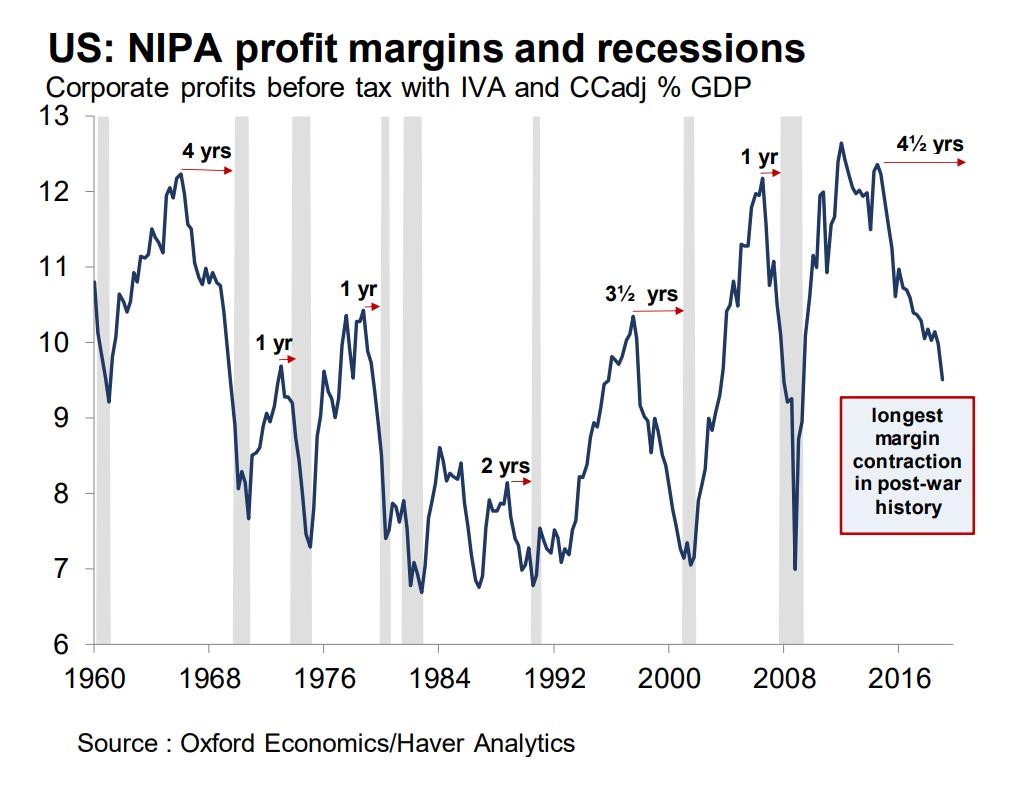
(Source: https://thenextrecession.files.wordpress.com/2019/08/pear-2.jpg)
If the returns to capital as a fraction of gdp are declining, that means the returns to labor are increasing! Even I can't see why that is a bad thing. It contradicts the claim of Thomas Piketty, who argues that capital will always get an ever larger share.

Take your good news while you can. The world is going to be increasingly short of it.

Further Reading:

Saturday, August 17, 2019

Unionizing Hotels?

Ernie Gotta and Erwin Fried post a useful article in Socialist Action (SA) entitled Shifting the balance of power in hotels. It concerns the unionization of Sheraton and Hilton hotels in Stamford, CT.

I'm sympathetic. Hotel maids work very hard for low wages. The ladies (and a few gentlemen) who get up at 4am to serve breakfast (free to guests) are heroes in my book. I depend on them whenever I travel, and I make sure I leave them all a tip. They deserve it.

So if a union is being formed to demand higher wages, I'd tend to favor it. After all, I'm as much against poverty as Misters Gotta and Fried, and if it's at all practicable to raise the salaries of hotel maids, surely that's a no-brainer.

But raising salaries is not what this union local in Stamford has in mind. Instead their goal is simply to reduce productivity. To wit:
  • Employees should be allowed to talk on their cell phones during work hours and get paid for it.
  • Cooks, who are paid more because they bring essential skills, should spend valuable time doing work that servers can do more efficiently and cheaper.
  • Managers should be forbidden from helping out--they can't clean a room or assist with service. 
None of this actually helps the maids. Yes, she can now talk on her cell phone instead of working, but how this substantially improves her life is beyond me. And worse: why should I leave a tip to a maid who takes twice as long to clean my room because she's yakking on the phone?

Consider:
At the Sheraton, workers are now fighting for their first contract, but before voting to join Local 217 workers were often made to staff positions other than their own, regularly taking on two or more different jobs in the same shift. This allowed the bosses to hire fewer people and cut hours for positions like the café. By keeping a skeleton staff that is worked to the bone, they save a lot of money on labor costs, but at the same time the hotel cannot maintain a high level of customer service. Management proves again and again that they prioritize profits over guest satisfaction.
This is perverse. Surely an employee who can flexibly do several jobs as needed is more likely to be working full time than one who can only make beds (but not vacuum floors). It's hard to see why a guest should have to wait for the unionized vacuum operator to come along before the room is cleaned.

All it does is featherbed the workforce. The hotel will have to hire more maids to do the work of the phone talkers--and each of those additional employees will pay additional union dues. It's the union bigshots who come out ahead on this.

On the other hand, if instead of featherbedding all the maids just got a raise, the union's additional take would at most be a trivial percentage. This is a classic example where the interests of the union diverge from that of the employees.

Misters Gotta & Fried, being Marxists, claim that capital deserves no return--all proceeds should go to the employees. The net profit margin (as percent of operating costs) for Hilton Worldwide in June, 2019, is 8.71%. In another article, Mr. Gotta writes "Right now, hotels in Stamford, Conn., the second largest market in New England, are bringing in big profits for the owners. They can afford to pay their workers a living wage, but they’re too greedy to concede a few bucks."

So let's play that out. Suppose Hilton sacrificed their entire 8.71% margin. The employees all get a raise by that amount. Presumably suppliers receive a similar bump--they'd have to give their own employees an 8.71% raise. Of course not just workers, but managers also get a raise. Most front-line managers are not paid much more than the hourly workers.

So what happens then? Hilton's profit margin has just gone to zero.

  • The stock price also falls to zero. Anybody with a 401K or pension plan invested in Hilton is just plum outta luck.
  • The board of directors all resign. Why bother managing a company that can't earn a dime? It's a lot of work to manage a company!
  • Most of the C-suite execs also quit. Their pay is mostly in stock options--now worthless. The reservations system crashes.
  • Suppliers no longer trust the company to pay their debts. After all, with a stock price of zero Hilton has no collateral anymore. So all transactions are cash only.
  • Travel agents no longer book rooms at Hilton. There's no guarantee that the customer will actually get the room she paid for. Even today something occasionally goes wrong and the room fee needs to be refunded. Hilton can no longer be trusted to make those refunds.
  • Homeless people move into the lobby.
  • The city confiscates the hotel property for back taxes.
If you want to see what a profit-free hotel looks like, just check out housing in Cuba, or the NYC public housing projects. Nobody wants to live like that, much less pay $250/night for the privilege. All that for a once-off, 8.71% raise? Fortunately most hotel workers are smart enough to know that money doesn't grow on trees, something that Misters Gotta and Fried apparently haven't learned yet.

My Trotskyist comrades see themselves as uncompromising radicals, and they urge nothing less on their fellow workers.
A worker’s strength also does not exist in the formal relationship between the union and the boss. ...Strength comes from shop floor militancy. What workers have on their side is the ability to apply pressure on management through delegations, workplace actions, shop-floor campaigns like button ups, or a strike.
In other words, employees should, as a first resort, sabotage the workplace.

This strategy will fail. Most large hotel chains often do not own the real estate. They simply lease it for a period of years, or occasionally operate the hotel on a commission basis. The benefit is that companies like Hilton can just walk away from the property at little cost. The employees know this, and sabotage will be rewarded with everybody losing their jobs.

A hotel--like any business, no matter who owns it--has to be profitable to stay in business. Sabotage certainly doesn't help. What's the point of having a union if you're not going to avail yourself of the grievance procedure?

It's worth noting that once the union is in place, it wants all employees to behave so that it can extract its dues from them as efficiently as possible. Union leaders are smart enough to know that money can't be squeezed out of a bankrupt hotel.

I think the union drive is just a big scam designed to transfer money from hotel maids to union bureaucrats. It's a scandal.

Further Reading:


Wednesday, August 14, 2019

Book Review: The Fall of Rome

The book, The Fall of Rome: And the End of Civilization is by Bryan Ward-Perkins, today an Oxford don, but born and raised in Rome, the son of an archaeologist.

It's a wonderful little book--less than 200 pages of actual text--that delivers just what the title promises, written with concision and clarity. Perhaps it's not an easy read, but it certainly isn't a boring one. I picked the Kindle edition, which was a mistake. The book contains lots of maps and figures that don't reproduce all that well. I'd recommend a dead-tree version.

History, it turns out, often depends on the present as much as on the past. Immediately following the Second World War, French scholars portrayed the invading Germanic tribes as barbarians, who "had achieved the remarkable feat of living for centuries on Rome's frontiers 'without becoming civilized.'" The fall of the Roman empire was uncannily similar to the fall of the French Republic in 1940.

A few years later, as Germany was being tamed to bring about the EU, historians in North America and northern Europe played down the event. Rome didn't "fall" as much as it gradually "transitioned" into a medieval culture. The tribes cease being "invaders" and gradually just become migrants. Late Antiquity (as the era from 400 - 800 AD is called) was not a dark age, but rather a passage to another way of life.

Further, there is a reluctance to use the word civilization, implying that Romans were somehow morally superior to the barbarians. While Mr. Ward-Perkins rejects any moral superiority, he asserts that a civilized society is both richer and far more sophisticated than the more primitive sort.

Mr. Ward-Perkins mostly condemns this modern point of view as being not true. He documents the catastrophic decline in living standards across the empire, with many peoples reduced to an iron-age existence. It was many centuries (until the dawn of the Renaissance, or even longer) before wealth in the West exceeded that of Roman times.

He draws heavily on archaeological evidence, notably pottery. Roman pottery is found practically everywhere, even in homes of very modest circumstance. It was certainly not restricted to the wealthy. It came as tableware, cooking pots, and was used in transport. For example, olive oil, a staple Roman commodity, was shipped in amphorae.
Amphorae stacking.jpg
Amphorae used in shipping (Wikipedia)

While pottery vessels can break, the shards are nearly indestructible. "It is a reasonable supposition that, somewhere in the soil, almost all the pottery vessels ever made survive in fragments, waiting to be excavated and studied."

There is a huge wealth of information: the chemical composition tells where it was made; the design says when; the shape suggests what it was used for; and the location says something about who used it. Further, it often comes with inscriptions which inform about who made and traded it, and also the extent of literacy.

Pottery was an industrial art and produced in high quality on a massive scale. Amphorae carried grain from North Africa (the empire's granary) and olive oil from Spain to the farthest reaches of the empire: Hadrian's Wall in Britain, and the banks of the Rhine and Danube. There it provided for the soldiers who defended the empire, who in turn spent their income in local communities on the frontier. The result was Pax Romana.

This is something akin to today's globalization. Just as we can buy cheap, high quality clothing made in Bangladesh, Romans acquired fine goods and foods from hundreds if not thousands of miles away.

The Vandals sacked the city of Rome in 410, and went on to conquer the Iberian Peninsula and most of Roman Africa. The rest of the Roman empire was divided among various Gothic and Frankish tribes. Anglo-Saxons and Celts ruled previously Roman England.

Despite the occasional sacking, pillaging and looting, the tribes did not want to destroy Rome, but instead they wanted to share in its wealth. They were quite conscientious about this, retaining Roman nobility as administrators. They gradually even converted to the Roman religion.

The problem was not their intent. The problem was by divvying up the empire into so many competing principalities, it made trade impossible. This was especially painful at the frontier, which no longer had access to quality pottery from abroad. Instead they had to make do with hand-formed (not wheel-thrown) pots, made from crumbly, substandard material. Plus they had to grow their own food, since that trade, too, had disappeared. No more olive oil for you!

The result, by 450 AD, was a reversion to an iron-age economy.

Mr. Ward-Perkins traces the same history not only in pottery, but in building materials and even in the size of farm animals! He suggests that human populations dramatically declined during the 5th Century (though he can't prove that).

Trade allows for specialization: specialized potters, builders, writers, soldiers, farmers, etc. Without trade, each household has to do all those things on their own--that's the very definition of an iron-age world. Our modern society is so rich precisely because we have hugely sophisticated global trading networks and therefore highly specialized job titles. But lots of people are--to one degree or another--against trade. President Trump apparently sees it as a zero-sum game, which it isn't. 

Our most celebrated congresswoman, Alexandria Ocasio-Cortez suggests we should abolish airplanes (to protect the climate). This would immediately put tens of millions of people out of work. But worse, it would destroy tourism. Think of all the countries that depend on tourism for a large part of their income. Without tourists they lose access to the world market and can't buy anything but what they produce themselves. Which likely will not include things like electricity, computers or pharmaceuticals.

Ms. Ocasio-Cortez's supposed solution to climate change will condemn hundreds of millions of people to a miserable existence--assuming they survive at all.

Many people look into the abyss, and somehow they see utopia down there. If you want to find out how people of good intentions and good will can destroy the world, then please read Mr. Ward-Perkins' book.

Further Reading:

Wednesday, July 31, 2019

What Determines Political Opinion?

The conceit of this blog is that my arguments are so compelling and my writing of such spectacular quality that the scales shall inevitably fall from my former comrades' eyes and they'll all become Republican Trump supporters.

Of course that almost never happens. People rarely change their political opinions because of argument, spectacular or otherwise.

So what determines people's political opinions? There are several points of view.

The first may be called Marxian. It maintains that politics derives from economics, and a person's political opinions will roughly follow their economic status. In the narrowly Marxist sense this reduces to bourgeois, petty-bourgeois, and proletarian sympathies. As this blog has relentlessly pointed out, that taxonomy no longer fits the modern world very well.

The larger Marxian premise is alive and well, however. It's shows up in simple-minded form in the MSM as blue-collar voters elected Trump. A more sophisticated, Marxian perspective is proposed by Joel Kotkin, author of the recently released The New Class Conflict (which I have not yet read). It is summarized in an important article here.

In Kotkin's view, US society exists in four classes: the Oligarchy, the Clerisy, the Yeomanry, and the Serfs. The oligarchs are the top 0.1% of our society--roughly equivalent to the bourgeoisie. The clerisy are "made up of academics, the media and well-paid professionals — represent[ing] some 15 percent of the American workforce." The yeomanry represent "small business and property owners." I'd suggest it constitutes most Americans with a positive net worth. Bringing up the rear are the serfs--people who are too poor to accumulate any wealth at all, or who have smothered themselves  debt that they'll never be able to pay off.

That all sounds very clear, and it has considerable explanatory power. But it falls apart when I try to apply it to myself, my family, friends and colleagues. Am I a member of the clerisy? After all, I retired as a professor at full rank, making me an academic in good standing. But I retired from Two-Bit State College--not Harvard. How far down in the academic pecking order can one get and still be a cleric in good standing?

Unlike most of my colleagues, I retired on a 401K rather than with a state pension. That means I have a lot more money than they do--if I can't rise to clerical status I'm definitely a yeoman. My retired colleagues, while they have much less money, do get a state pension--which politically isn't much different from a welfare check. Are they clerics, yeomen, or serfs? (Or are retired folks declassed altogether, as a traditional Marxist might maintain?)

And so on. It all dissolves into ambiguity. And none of this predicts my vote or that of anybody in my family. Maybe we're just special--but I don't think so.

A second explanation for political opinion is that it is a personality trait. A leading exponent of this model is Arnold Kling, author of The Three Languages of Politics. My review (here) briefly summarizes the thesis:
Kling suggests that there are three political ideologies in America, which he roughly labels as Progressive, Conservative and Libertarian. These three groups use different languages--that Kling calls heuristics--and from this he derives a three-axis model. Progressives organize ideas around an oppressor/oppressed axis. Hence they are primarily interested in social justice, and in righting historical wrongs. Conservatives think in terms of a civilization/barbarism axis. Accordingly they emphasize stable institutions (church, family, law), and tend to resist sudden changes. Finally, Libertarians orient according to a freedom/coercion axis. They're worried about big government, too much taxation, gun control, and too much environmental regulation.
How one aligns along the three axes (I'm halfway between the conservative and libertarian) is personality trait. Given that the adult personality is roughly 50% genetic and 50% random chance, a person's political opinions are substantially inherited and in any case unchangeable in adulthood--at least in terms of basic priors as summarized by the three-axes model.

This, of course, contradicts Kotkin's Marxian view--neither clerics nor yeomen share a common set of personality genes. It also means that political conversation is mostly a waste of time--we'll always be talking past each other no matter what we do.

The third model is group affiliation. A core human desire is to be part of a group, to have a reliable set of kin and friends who will stand with each other through thick and thin. People thus go to great lengths to demonstrate their allegiance to the group. Religious practice is a common example. The devout parishioner visibly demonstrates his loyalty to the group, proving that he can be trusted no matter what.

Some groups demand not a religious faith, but rather a shared set of political principles. The academy is an obvious example. To be a member in good standing of the academic club you have to hold reliably Progressive opinions. It doesn't matter what your genotype is, nor is any randomness in your background a factor. Absent vocal progressivism your chances at getting an academic job, much less acquiring funding and tenure, shrink dramatically. Accordingly academics are ostentatiously Woke and aggressively Green.

A lot of this is self-selection. People who aren't Woke or Green often shy away from academic careers. Though some of my colleagues are nowhere near as committed to those principles in private as they are in public. In many cases they're just not interested in politics at all and only go through the PC motions. Others (like me) are actual Conservatives, and mostly we just keep our mouths shut.

Nevertheless, group affiliation explains why the academy is so relentlessly Leftist. To a lesser degree the same is true of school teachers and civil servants. On the other side, some religions also impose a political dogma on their adherents--they will often be Conservative.

The fourth and last possible determinant of political opinion is identity politics. It maintains that people of a given ethnicity share common genes, culture and/or experiences, and thus will share common politics. The Progressive version of this story has become cartoonish, but I have succumbed to it myself. Since reading Albion's Seed, I have been seeing Yankee, Quaker, and Scots-Irish influences everywhere. (See my review of Colin Woodard's book here.)

While Progressives say they subscribe to Identity politics, what they really mean is a form of group affiliation. The latter easily explains why academics vote 90% for Democrats. African-Americans also vote overwhelmingly Democratic. Progressives claim this is because of their unique genetic/cultural heritage, i.e., their identity. Though it is a stretch to think that African-Americans are so uniform in genotype and culture. Of course they're not, but voting Democratic has become a cultural touchstone--you're not genuinely African-American if you can't toe the line.

Congresswoman Ayanna Pressley recently put it very well. She said "we don't need Black faces that don't wanna be a Black voice." She's not playing identity politics, but rather trying to enforce group affiliation.

It won't work. Unlike academics, Blacks are not self-selected. They were born into an ethnic culture. That culture is much more heterogeneous than Ms. Pressley will have us believe. I think the days when Democrats can simply take the African-American vote for granted are coming to an end.

None of these models are mutually exclusive, and all of them describe some aspects of reality. Surely people respond to economic stimuli. For example, teachers vote to pass school budgets. But to suggest that blue collar workers voted for Trump for economic reasons stretches credulity. For that phenomenon group affiliation is a better predictor. Likewise, identity politics might have some merit--there really are many Americans of Scots-Irish descent, and they often vote similarly. But to think they'll vote as a solid block is to overstate the case.

While I'll give much credit to all of these models, I still think they're incomplete. It's a quaint thought, but I do believe people have free will. Its remit is pretty small, but it's still there. It means that ornery, unpredictable, thoughtful people still can change their minds independently of money, genes, or culture.

So there is reason for me to write my blog after all.

Further Reading:

Wednesday, July 24, 2019

Book Review: Donald J. Trump

The full title of this biography by Conrad Black is Donald J. Trump: A President Like No Other. Mr. Black--Canadian-born, one-time newspaper mogul and a former US prison inmate recently pardoned by President Trump--is a spectacularly talented writer, despite his discursive, complex, literate style. Among my friends I call him "my favorite Canadian," and I read his columns religiously.

Obviously this isn't the definitive biography of Trump--the man is still in mid career. We'll have to wait a decade or two before that comes out. Equally clear, it isn't a hit piece--Mr. Black is upfront about his pro-Trump sympathies. 

Nor is it a hagiography, perhaps best described by Edmund Morris (Theodore Roosevelt's biographer) who says you can't fall in love with your subject. Mr. Black avoids (maybe just barely) falling in love, and is sufficiently honest and clear-eyed to find fault.

What you will find here is first-class journalism. It's a background piece on today's top story, and apart from it's length it could appear in any newspaper or magazine.

Trump comes by his hucksterism honestly. His grandfather, Friedrich Drumpf, arrived in the US in 1885 at age 16. Mr. Black surmises that he took the name Fred Trump at the port of entry. He first traveled west to Seattle, and then on to the Canadian Yukon, where he "operated restaurants, bars, and hotels, catering to prospectors." But "most accounts allege that he was in fact operating whorehouses and clip joints, sometimes with no lease or title to the land." Eventually he settled in the Bronx, marrying his childhood sweetheart from Germany.

Donald Trump was an ingenious businessman, but borrowing to the limit, played very close to the edge. When the economy tanked in the early 1990s, bankruptcy seemed inevitable. He took full advantage that neither banks nor bondholders wanted that outcome. The lenders didn't know how to run a casino, nor did they have the celebrity to promote it. Both knew that only he could maintain the value of the property. Trump leveraged this to the max, renegotiating the loans at very favorable terms, saving his personal fortune.

I previously believed that Trump became a politician by accident--that the campaign was initially a PR stunt designed to promote his business. Indeed, Trump obviously didn't think he was going to win--not even at the last minute. But Mr. Black makes a convincing case that Trump planned a presidential campaign far in advance of the event. He was long interested in politics, especially as his business turned from buildings/casinos into licensing his own name as a brand. Trump's long shot bet on a campaign is risk-taking typical of the man, and does not indicate lack of seriousness.

Trump's political tactics revolve around two principles. The first is never back down or apologize. He broke this rule at least once: following the release of the Billy Bush tapes, where Trump said he "can get away with women, including grabbing them 'by the pussy.'" This was made public a few days before the second debate with Hillary Clinton. Trump's first response was to apologize, saying "Anyone who knows me knows these words do not reflect who I am. I said it, I was wrong, and I apologize." It made him sound like any two-bit political loser.

But then he fought back: he held a press conference with three women who accused Bill Clinton of sexual assault, and a fourth woman--a victim of an actual rape--whose assailant had Hillary Clinton as a lawyer and was acquitted on a technicality. Oddly not mentioned by Mr. Black, Trump invited these ladies to sit in the front row during the debate.

Far from backing down, Trump "flipped the script", accusing Mrs. Clinton of precisely what she had accused him of. It worked. I read recently that the Trump campaign thinks this maneuver saved the election for them.

The second tactic is truthful hyperbole, including obvious exaggerations, such as requiring press secretary Sean Spicer to say that his inauguration was "the largest audience to ever witness an inauguration, both in person and around the globe." That one probably didn't help him any. But Mr. Black also writes that
Trump, the grand impresario, had entered "an environment that was ripe for bombastic, inflammatory outrageous statements without having to suffer the consequences," where extreme partisanship, public cynicism, general disregard for traditional expertise, and accumulated public anger did not discourage his natural tendencies toward hyperbole and did not really punish lapses into fabrication.
Mr. Black, writing a biography, sticks close to Trump's own truthful hyperbole formulation. But I will go further and claim that Trump is a teller of tall tales.

A tall tale differs from a lie in that nobody is expected to believe the tale. Indeed, Trump is a master story teller--that's how he can keep an audience spellbound for over an hour. Stories must have a plot, and that requires exaggeration and simplification. The "alternative facts" have to fit the story--not reality.

The most famous tall tale (which Mr. Black doesn't mention) is the tag phrase "...and Mexico will pay for it." Nobody ever believed it--it was just an applause line--and that's why he suffers no political damage upon not being able to deliver. His critics--who invariably accuse him of "lying"--miss the point completely and make themselves look like fools in the process.

As Salena Zito famously wrote, "the press takes him literally, but not seriously; his supporters take him seriously, but not literally."

Trump is neither an intellectual nor an analytical thinker. He traffics in metaphors and parables. He doesn't have a "program" in the way Hillary or Elizabeth Warren do. His slogans are all evocative, emotional, and vague--easily misunderstood.

For example Nancy Pelosi thinks his slogan Make America Great Again, really means Make America White Again. I find that completely implausible, but I'd be hard pressed to find a specific quote where Mr. Trump explicitly denies it.

Likewise, I think Trump is pro-immigration, but he insists that it be legal. We should admit people "who love us." But others (both critics and supporters) interpret his rhetoric as trying to shut the door, or that we should only admit white people. I think they're wrong, and my post Good Trump, Bad Trump makes that case.

The amorphous nature of Trump's appeal makes him hard to pin him down. Some people think he's a "racist"; others, like me, think he's rebelling against political correctness. Some people think he's ignorant about "climate change." Others, like me, believe he's not gonna throw good money after a non-existent problem.

Those three issues (or at least my interpretation of them)--immigration, political correctness, and "climate change"--are what inspire my support for the man. Plus he's such a great storyteller.

Let me give Mr. Black the last word, who compares Mr. Trump to his predecessors.
In international relations, Richard Nixon was a chess player and Ronald Reagan a poker player, and both were very successful. Trump seems more of a pool shark, but it seems likely he will do well too.
"Pool shark" is a good word in many contexts--not just in international relations. It's part of Donald J. Trump's genius, as beautifully described by Conrad Black.

Further Reading:

Monday, July 15, 2019

Does The Militant Support Smaller Government?

The Militant (publication of the Socialist Workers Party (SWP)) prints two articles of interest. The first, by Roy Landerson, is entitled 2020 election debates show crisis of bosses twin parties, while the second, by Brian Williams, is Almost half of all US workers live ‘paycheck to paycheck’.

The first article is a critique of the Green New Deal, championed by the irrepressible Alexandria Ocasio-Cortez (AOC). Mr. Landerson asserts the following:
Millions of working people distrust both capitalist parties and want to discuss an alternative to the anti-working-class course of successive Democratic and Republican administrations.
In the face of this, the liberals work feverishly to corral working people back into the rulers’ two-party shell game, to convince us we absolutely have to back the “lesser-evil” among the bosses’ parties or disaster beckons.
There are so many things wrong here, beginning with the word millions. 95% of voters cast ballots for either Democrats or Republicans, and most of the remainder plump for the Libertarians. The fraction who subscribe to the distrust that Mr. Landerson describes is tiny--likely less than 1%.

So it is a stretch to suggest that "liberals have to work feverishly" to corral working people back into the shell game. Very few sheep have gone astray--and those that have are mostly voting for Trump. The clamor for an independent labor party of socialist stripe is minuscule.

Yet corralling is precisely the motivation that's attributed to AOC. She's not entitled to any honest opinion--hers is solely a mission of bait-and-switch deception. I think this is grossly unfair. However much I disagree with AOC, I'm certain she really believes her own bullshit. She is truly convinced that "climate change" is the crucial issue of our age, and that mass poverty is the only solution.

It's nonsense on stilts. Unfortunately, it's nonsense that claims the allegiance of a large part of the electorate--much larger than those demanding a labor party. The Green Party, for example, was founded on such a program. Most grouplets on the Left have enthusiastically signed on to climate-catastrophism, e.g., Socialist Action, even if they refuse to support the Democratic Party.

The Militant, to its great credit, understands the "nonsense" part, though Mr. Landerson unfairly imputes dishonest motives to AOC.
The hook Ocasio-Cortez advances to try and convince workers to back her call for a bigger, stronger capitalist state is fear of climate-change-generated disaster. Hysterical — and unscientific — claims of impending catastrophe are supposed to make you happy to turn your life over to the government.
Then comes the really strange part:
President Trump says he has “cut more regulations … than any other administration,” part of the Republicans’ claims to be partisans of “small government.” ... 
The Democratic aspirants all claim they want ever more regulations and government agencies to place the “smart” meritocrats in every government nook and cranny to do “good” for the downtrodden, who’ve proven too dangerous to make decisions for themselves. ...
Trump says all socialists like big government. But if you look at the real continuity of the revolutionary working-class movement — from Karl Marx and Frederick Engels to the Bolshevik Revolution in Russia to Fidel Castro and the Cuban Revolution to the program of the SWP today — you see the opposite is true. Writing in 1871, Marx explained that the Paris Commune, the first time that the working class held power, “made that catchword of bourgeois revolutions — cheap government — a reality by destroying the two greatest sources of expenditure: the standing army and state functionarism.”
So apparently The Militant claims to support small government, in solidarity with workers who support Trump. They agree with the premise that regulations and the administrative state are the enemies of freedom.

But then comes the ludicrous claim that Marxists are NOT for big government! Tell that to the Cubans, whose very livelihoods are stifled by myriad rules and red tape. The former USSR was no slouch in the regulatory department, either. But apparently Revolutionary America is going to cut all defense spending and government functionaries.

And it is on that very weird promise that workers are supposed to vote SWP in 2019 and 2020.

The second article, by Mr. Williams, claims that
Four in 10 U.S. workers struggle to pay their bills, a recent UBS bank survey showed, and would confront a crisis if faced with a $400 emergency expense. One quarter of U.S. residents skipped necessary medical care in 2018 because they couldn’t afford the cost.
And more:
After adjusting for inflation, 50 percent of U.S. households have less income today than they did 30 years ago, the Federal Reserve Bank reports. While more jobs are available today, increasing numbers of workers are forced to work two or even three jobs to make ends meet. Wages are less than $18.58 an hour for half of all U.S. jobs, and more than a third pay less than $15. Some 4.3 million workers seeking full-time jobs are forced to accept part-time hours, the government admits.
Mr. Williams never explains, but one assumes that his cure for this will be higher taxes and more regulations--all in a futile effort to raise people's standard of living by fiat. Of course that will fail in a major way--see Venezuela for a recent example.

But if that's Mr. Williams' view, then it openly contradicts that of Mr. Landerson, who (correctly) argues that government regulations are the problem rather than a solution. This is very funny for unintentional reasons: "Landerson" is likely a pseudonym--the name does not appear on The Militant's masthead. I'm reasonably certain that the person behind the name is Mr. Williams himself. So he's schizophrenic--in one article he tells the truth (that regulations make people poorer), while in the second he suggests the opposite (that we can, by magic regulations, make people richer by fiat).

A couple additional points:

Debt Explosion: Mr. Williams complains that workers are too far in debt. Of course that's true--and not just workers. Practically everybody wants to spend beyond their means, and merchants are happy to extend credit. Ray Dalio has an excellent video on that topic here. But what is Mr. Williams gonna do about it? Prohibit people from taking on debt? Talk about a nanny state infringement on freedom.

Speed Up: Mr. Williams is exercised about automation, which he terms speed up. The example he picks is Amazon, which now uses robots that "that swarm around the 2,500-worker Amazon warehouse on Staten Island in New York bring goods for pickers to pack at breakneck speed, raising the rate from 100 items an hour to between 300 to 400."

And this is bad? Surely using machines to augment human labor is a good thing. Indeed, increases in productivity are the only real way people can actually get richer. But like all his socialist brethren, Mr. Williams is a true Luddite.

Brian Williams is a smart guy. Back in the day we nicknamed him Brainy--it still fits. But his ideology traps him in contradictions.

Further Reading:


Sunday, July 14, 2019

Trump Calls Out the Squad

So Trump just told the Sqaud (AOC, Omar, Pressley, Tlaib) that if they don't like the USA they should go back to their own, miserable, misbegotten countries.

Some thoughts:

1) The comment is over the top. Only Omar was born abroad, in Somalia. For some reason Somalis have come here expressly to become an aggrieved minority. So in her case, the request to go home and fix Somalia first before she tries to fix us may not be too far fetched. The rest were born in the US. AOC is of Puerto Rican ancestry, in which case she's an American back many generations.

2) The comment is not racist. It is a criticism of four individuals. It may be stupid, over the top, uncivil, etc., but it does not apply to any large group of citizens on the basis of race. There's nothing there that even remotely implies that all Blacks should go back to Africa, or some such.

3) It's a Godsend to the Squad. AOC must be overjoyed--it puts her squarely in the national spotlight. Their professed indignation is purely for show.

4) It won't hurt Trump at all. In a recent poll I read that AOC has a national approval rating of 13%--far below Trump's 46%. I have no data on Omar (who really is a racist), but I doubt she'd clear the single digits. The Squad is wildly unpopular, and widely perceived as representing what's wrong with America.

5) The real target of the attack is Nancy Pelosi, who is now between a rock and a hard place. She has been trying to diminish and isolate the Squad as nothing more than four votes in Congress. In return they've tarred her as racist (which she doesn't deserve any more than Trump). But now she's forced to stick up for them, and further, after a call-out from the President they're no longer just four irrelevant votes. Then Trump is claiming to support Pelosi--which is as embarrassing as it will be hard to disown.

6) Pelosi's predicament will make it much harder to keep control of the House in 2020. Swing-seat voters hate the Squad--and if Pelosi goes all squaddy they won't vote for Dems.

7) The 20 little dwarfs (Dem candidates) are similarly challenged--they either go all-in, Squad-crazy, or they end up siding with Trump. Liz has already picked the Squad--which will likely doom her presidential campaign. (Unless she can somehow credibly disown them later.) 

So as silly and over-the-top as it sounds, Trumps tweets are a stroke of political genius. Now all he has to do is watch the shit fly as the Dems tear each other apart.

Further Reading: