Thursday, October 24, 2019

Socialist Action Splits!

A couple of days ago Socialist Action published a long post entitled Anatomy of the Recent Split in Socialist Action. It contains a short introduction by Jeff Mackler, followed by the Political Resolution Adopted by the Socialist Action National Committee Plenum, October 6, 2019, detailing the political differences that resulted in divorce. It comes to nearly 11,000 words.

The bottom line is that 29 comrades have left the organization, including the former editor of their newspaper (whom I believe is Michael Schreiber). It's a bit under a third of the total membership. They are referred to in the Resolution as the Permanent Revolution Faction (PRF), and I will use that terminology. I will call those remaining in Socialist Action, specifically the authors of the resolution, the Majority. The PRF has since gone on to found a new organization called Socialist Resurgence. I have not yet had time to study their webpage and so do not know their response to the Majority's resolution. I'll get to that in a later post.

The first topic of disagreement is trans liberation. Here is what the Majority claim:
We begin with our stance of full support to and respect for transgender people’s fundamental right to self-identify and for the full, unequivocal inclusion of trans people in every aspect of society. Gender is a social construct, which is formed by economic, cultural, historical, biological, and class factors. In matters of gender identity, as with sexual orientation, an individual knows best what is right for them. We reject any assertion that their identity is in any way inauthentic or invalid. Trans women are women. Trans men are men. 
That trans people should be assured the civil and human rights is incontrovertible--even I support that! But then they go off the rails. The "social construct" theory is just factually wrong, touted only by ideologues in academic women's studies departments. Nobody who has ever raised children can take it seriously. The final claims--e.g., "trans women are women,"--are also false. If they said trans women are women with an asterisk, where the size and content of that asterisk varies considerably by individual, they'd be a whole lot closer to the truth.

An effort toward radical clarity leads them to oversimplify the whole issue--the trans phenomenon is not so easily dealt with. People with an interest in truth as opposed to mere revolutionary chic will not be able to take the Majority's position seriously. Beyond which, one wonders why the trans issue is so important, concerning, as it does, less than 1% of the population.

The Majority's position on Syria is similarly simplistic and counterfactual. The essential problem supposedly is "U.S. imperialism."
With few, if any exceptions these “rebels” have almost from the beginning been armed, trained, promoted and supported by U.S. imperialism and its NATO and Gulf State monarchy “coalition” as well as the Turkish government.
It's a real stretch to claim that the rebels have been significantly financed by the US, and certainly not since Trump took office. Further,
In Idlib today, the remaining “rebels,” who regularly launch missiles into Syria’s cities, exist only because of the support of the U.S., its NATO imperialist allies, and Turkey. These “rebels,” significantly, but decreasingly, control and dominate, via terror, the population of Idlib.
There are 3 million people in Idlib, including 1.1 million displaced from elsewhere in Syria. They are all Sunnis who potentially face slaughter at the hands of Assad's army. Beyond which, Assad, with Russian assistance, is barrel-bombing Idlib hospitals in the hope of driving the population out of the country. The Majority doesn't tell that side of the story, and the side it does tell isn't accurate.

The Majority presents a hypothetical:
In the course of this monstrous U.S. imperialist war, SA tragically finds itself divided. In Syria, we have explained, we would be on the side of the Syrian government. In Syria, the minority explains, they would be on the side of the nondescript “Syrian masses.”
This is very funny. If the Majority and PRF were both Sunni, then they'd all be refugees somewhere. If they were both Alawite then they'd all support the Syrian government. The notion that some theoretical distinction about "U.S. imperialism" might make any difference is absurd.

Apparently the PRF aren't the only people who speak for the masses. The Majority claims
The only way for serious revolutionaries to win the hearts and minds of the Syrian masses is to be in the front lines of the battle against imperialist intervention and invasion. [emphasis mine]  
In Syria there are no "masses." There are Sunnis, Alawites, Christians, Palestinians, Druze, Assyrians, Kurds, and others--all fighting just for survival. The country--always artificial--hangs together now only by force of arms.

The Majority's error is again to oversimplify things to the point of complete falsehood. Surely Syria is more complicated than some kooky story about "U.S. imperialism." Whatever the PRF's opinions, there is at least some recognition of reality.

As a final example, the Majority's position on Venezuela is similarly reality-deprived. They write
The U.S. imperialist beast has sanctioned and embargoed Venezuela, the nation with the largest oil reserves in the world, since the Obama administration and before. These sanctions have led to mass starvation and the death of some 50,000 Venezuelans.
This is simply not true. It is correct that some US sanctions have been in place since 2008 (pdf).
In 2008, the Treasury Department imposed financial sanctions on two individuals and two travel agencies in Venezuela for providing financial support to the radical Lebanon-based Islamic Shiite group Hezbollah.
Two individuals do not an economy destroy. Subsequent sanctions were similarly narrow, in 2014 levying penalties on 89 people. It was only under Trump beginning in 2018 that economy-wide sanctions were imposed. By that time the Venezuelan economy had already imploded.

It's really easy to break stuff. The de-civilization of Venezuela began in 2006 when Hugo Chavez took money from the PDVSA (the state-owned oil company) and used it to buy services for the poor. The NY Times wrote
Critics see the spending as a reckless exercise in populist decadence intended to burnish Chávez's image while embarrassing the Bush administration, his principal obsession since American officials gave tacit support to a failed coup against him in 2002.
It was worse than "populist decadence." Essential maintenance on the oil infrastructure was not performed, and today it will require billions in new capital to repair the damage. In a word, Chavez killed the golden-egg-laying goose. It will be generations (if ever) before Venezuela recovers its previous living standard.

The PRF's sin apparently is pointing out the obvious fact that Maduro is substantially responsible for the disaster. The reward for truth-telling is expulsion.

Socialist Action had about one hundred comrades--now they're down to seventy. This because the so-called Vanguard Party, the sole inheritors of Revolutionary Truth, are unable to say anything truthful or coherent about the major issues of the day. It's not clear to me why I should continue writing about them--it could be they fall off the radar screen in a few months.

It seems they've fallen off their own radar screen. The supposedly important Jeff Mackler for President campaign hosted ZERO events in October, and has absolutely nothing scheduled for November. The idiots can't even ride down an escalator.

Further Reading:

Sunday, October 20, 2019

Talking Tulsi

I think I understand Tulsi Gabbard.

Enlightenment came from Scott Adams (695) who suggested her appeal is partly sexual, proposing that a lot of men (disproportionately Republicans) are "in love" with Tulsi. At age 38, she is by far the most attractive candidate, and a lot of guys just want to see more of Tulsi on TV. I can relate to that, and I was rooting for her.

So I was disappointed by her performance during the October debate. She got very little air time, and while she tried to land a punch, she never connected. Pete Buttigieg argued her to a draw during their exchange, not least because her description of Syria as a "regime-change war" isn't accurate.

So now comes Hillary Clinton who said
I'm not making any predictions, but I think they've got their eye on somebody who is currently in the Democratic primary and are grooming her to be the third-party candidate. She's the favorite of the Russians. [...]

They have a bunch of sites and bots and other ways of supporting her so far. And that's assuming [Green Party politician] Jill Stein will give it up, which she might not because she's also a Russian asset. She's a Russian asset, I mean, totally. They know they can't win without a third party candidate.
Tulsi--who obviously is at least as smart as she looks--didn't miss the opportunity:
Great! Thank you @HillaryClinton. You, the queen of warmongers, embodiment of corruption, and personification of the rot that has sickened the Democratic Party for so long, have finally come out from behind the curtain. From the day I announced my candidacy, there has been a ...
... concerted campaign to destroy my reputation. We wondered who was behind it and why. Now we know — it was always you, through your proxies and ...
... powerful allies in the corporate media and war machine, afraid of the threat I pose. It’s now clear that this primary is between you and me. Don’t cowardly hide behind your proxies. Join the race directly.
It's a wonderful set of tweets. Look how she reduces the campaign to a race between her and Hillary--between a person of integrity and the "personification of rot". Between the real voice of the Democratic Party and the sick, warmongering pretenders. Note how she indirectly tars the other candidates with the sick, warmonger label, among whom Hillary is the leader.

Mr. Adams thinks Hillary is just stupid (698), which seems to be the consensus opinion. And that could be true. But Hillary might not be as dumb as she sounds--it's possible she has a strategy.

It's a given that she really wants to be president, which means she has to win the Democratic nomination. The odds are long no matter what she does, but steady-as-she-goes is definitely not gonna work. So she has to shake the box (as Mr. Adams would put it). Her comments do that--they're way over the top, and they've definitely gotten attention. She's borrowed the Trumpian tactic that there's no such thing as bad publicity--there is only publicity.

Ms. Clinton's comments are provocative in exactly the same way that Mr. Trump's Muslim ban was. It was never realistic, but it definitely got everybody talking.

Then follows an astute analysis of the campaign. Biden is on his way out--he has no chance. Bernie's support is self-limiting, and will gradually shrink over time. He's not a serious candidate. But if Bernie's voters migrate over to Liz Warren, then she becomes nearly unstoppable.

So the trick is to draw the Sanders' brigade over to Tulsi. There are at least three reasons to think that might happen. First, Tulsi endorsed Bernie in 2016, so there's a link there. Second, Tulsi's campaign has that radical, transgressive flavor that attracted people to Bernie in the first place.

And third, Bernie's Bros are obviously men. They're disinclined to support an aging harridan like Liz anyway, and if given half a reason will readily plump for sexy Tulsi. Like us Republicans, they'll "fall in love."

The other candidates are easily dismissed: Kamala is a loser; Mayor Pete is the windbag mayor of the fourth largest city in Indiana; Castro has a tin ear; Corey is a nice guy who finishes last, etc. So by turning Bernie's Bros into Tulsi's Toys, Hillary splits the Left Lane three ways. By locking down the middle lane for herself, she has as good a chance as any of winning the nomination.

It's a long shot, but it's all she's got. That Tulsi invited Hillary to join the campaign is an added bonus.

Further Reading:


Saturday, October 12, 2019

Our President is a Pacifist

A few days ago President Trump suddenly pulled all US forces out of Syria, resulting in a Turkish offensive against the Kurds.

This evening on the NewsHour's Shields and Brooks, David Brooks opines
It's complete incoherence. I think Donald Trump — the logical thing is, Donald Trump spoke to somebody on the phone, he made a decision. It was a terrible decision, an immoral decision, and just bad for our foreign policy. I mean, who's going to fight ISIS, or I.S., if we're out?
Who's going to guard the 10,000 prisoners who the Kurds — we have been relying on the Kurds to guard? And the Kurds are going to turn to Russia or Iran or somebody. And so it will further strengthen Russia and Iran. So it's a terrible decision.
And then they get a little bad publicity, the administration does, and so then Mnuchin and various other people in the administration come out and say, oh, this is terrible. 
And so it's not a foreign policy. It's a foreign policy by what Donald Trump's latest emotion is.
This is bizarre. Mr. Trump campaigned on pulling US forces out of the Middle East, specifically Syria. His former defense secretary, Jim Mattis, resigned on precisely that issue. John Bolton left his job over similar concerns. The president has been considering this move for at least four years now--nobody can seriously claim it comes as an "incoherent" surprise except in the narrowest, tactical sense.

In Mr. Trump's mind, the original sin was the invasions of Afghanistan and Iraq, embroiling us in a series of "endless wars." President Obama partially corrected the error with his precipitous withdrawal from Iraq. Arguably that was a huge mistake, leading to the rise of ISIS and the Syrian civil war. Our departure likely permitted more than half a million deaths and many millions more refugees. Mr. Obama has definitely not lived up to the hopes of the Nobel Committee!

Mr. Trump apparently doesn't believe in "tripwire" tactics. We only had a thousand troops in Syria--not an intimidating force. But behind those troops stood the full faith and credit of the US military--namely a promise that we'd bring in the cavalry if so much as a hair on the head of one US soldier be harmed. Our presence in Syria was effectively a promise of US protection.

Mr. Trump has long said he doesn't want to extend that promise, especially in a country where the stakes for the US are so low. Much better to retract it now than wait for a crisis later on. Of course there are humanitarian consequences--take away the policemen and disorder will ensue. Though it is unlikely that Mr. Trump's withdrawal will be as catastrophic as Mr. Obama's.

Of course the war party is up in arms about this. "War party" is Mr. Trump's pejorative name for advocates for the Iraq war, for the preservation of our force in Iraq, and now for the continued presence of a tripwire in Syria. These people are mostly Republicans--though I think the war in Iraq was more bipartisan than people now let on. Apart from defending their own reputations, they believe strongly in the traditional tools of American power and diplomacy: strong alliances, an international perspective, and credibility.

I'm sympathetic to the war party. I supported the war in Iraq at the time, and I deeply opposed Obama's withdrawal in 2009 (still do). At the same time, I'm skeptical of high-sounding verbiage like "strong alliances." I increasingly agree with Trump that "alliances" are a means and not an end. Without a definite purpose, what's the point of an alliance? (NATO no longer has much of a purpose.)

Ultimately, once you scrape away all the highfalutin language, the war party's argument is humanitarian. For just as Obama's decision led to the complete destruction of two whole countries, so too will Trump's move destroy the Kurds (or at least force them into other alliances). It's heartrending! Why can't the US be a policeman--especially since the cost (a thousand troops) is so cheap?

But it's not cheap, if only because we have too many tripwires. There's the famous one in Korea--Trump has promised to bring those troops home. Then we still have 30,000 troops in Germany--there to ensure Europe's internal borders. They're coming home, too (and no, they aren't moving to Poland). Every tripwire is like writing an insurance policy--and some day we'll have to pay a claim. That likely involves us in a major war, and inevitably that will eventually happen. Think World War I.

But we need to answer Mr. Brooks' questions.

  • Who is going to fight ISIS?  Everybody and nobody. ISIS used to be a caliphate that controlled extensive territory, including the city of Mosul. Driving them out of that territory was a military objective--and one that Trump accomplished in short order. The caliphate is now gone, and ISIS is reduced to being a loose ideology connecting adherents around the world. Confronting them now is a matter for the police and other civil authorities. They are not a military target. The thousand troops in Syria weren't protecting us against ISIS, but instead they were protecting the Kurds against Turkey. In the unlikely event the caliphate ever resuscitates itself, then we can send the Marines back in. 
  • Who is going to guard the 10,000 prisoners? Probably nobody. As I understand it, a large fraction of those prisoners are European nationals. The Europeans have not repatriated them, leaving them for the Kurds, and indirectly, for the Americans to guard. The Americans have no dog in the fight--this is between the Europeans and the Kurds. The former are incapable, and the latter have more serious problems. My prediction is the prisoners will be killed, if not by the Kurds, then by the Turks or the Iranians or Russians. Or somebody.
President Trump has turned down many opportunities to go to war. His retaliation against Syria (for chemical weapons violations) was destroying an empty "research facility" in the middle of the night. When Iran shot down a drone, it turned out that he didn't want to kill any Iranians. He rejected John Bolton's desperate pleas to invade Venezuela. He wants to pull our troops out of Afghanistan. He has studiously ignored all the provocations coming from Pyongyang.

The man, of German ancestry (who, reputation notwithstanding, tend toward pacifism), studied at Fordham and Penn (two institutions in the larger Quaker tradition). He attended the New York Military Academy in high school, and apparently enjoyed the military lifestyle. But he never joined the military.

The man is a pacifist. It's that simple.

Further Reading:


Monday, September 30, 2019

The Pro-Poverty Crowd

"You have stolen my dreams and my childhood with your empty words."
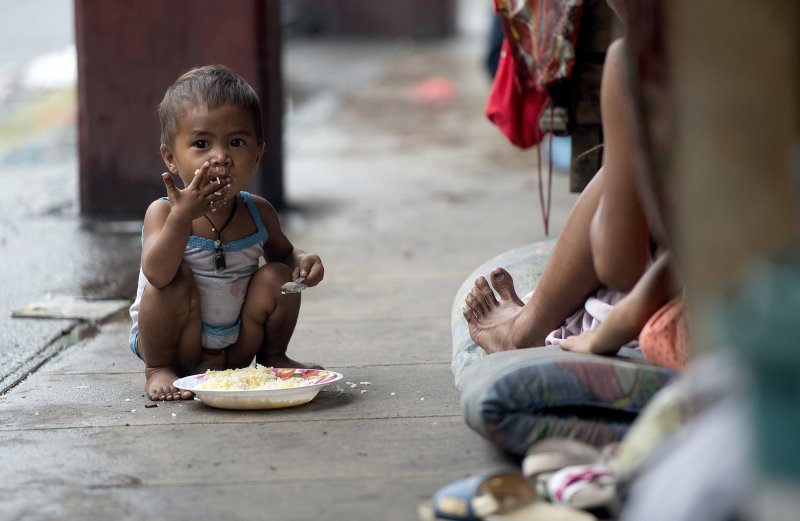
Picture credit; Caption credit
I should talk.

Last February my wife and I visited the Philippines. We flew business class on Japan Airlines and stayed in 4-star hotels. We hired cars to travel around Manila, foregoing public transportation. We dined in nice restaurants, some expensive even by New York standards. A low-cost, eco-friendly, carbon-neutral vacation this was not.

Surely some wiseguy could have published a photo of me sleeping on my lie-flat, business-class seat, paired with street urchins sleeping on sidewalk mats along Mabini street in Manila. The injustice of it all! How could I?
A homeless child in the streets of Manila in 2014.
A homeless child in the streets of Manila in 2014 (Source)
I have no guilty conscience whatsoever.

I don't begrudge Greta Thunberg her first-class train ticket (or so it looks to me). Nor am I offended by her vegan(?) lunch--downright spartan compared to mine in Manila. I'm not bothered by her air travel to the U.N. meeting in New York, even though she probably flew business class (or even first class). That her audience all made similar arrangements to attend her talk is also not an important concern.

What disturbs is not the facts themselves, but rather the hypocrisy of it all. Terry Evans, in a feature article in The Militant, understands that much.
Almost all the proposals bandied about amounted to one thing — working people have to sacrifice to save the world. Give up your car, no more air travel, only plant-based food at McDonald’s, and the like.
[UN General Secretary] Guterres demanded no new coal plants be built worldwide after 2020. Another U.N. official told countries in Africa “not to get into coal.”
Calls to restrict which kinds of energy sources can be built by governments in the semicolonial world, countries whose development was stunted and distorted by colonial exploitation, amount to a demand that the 840 million people who live without electricity continue to go without. Close to 600 million of those live in rural Africa.
Ms. Thunberg, who with a straight face demands of her audience that they impose draconian restrictions on the rest of us--to reduce our carbon footprint by more than 50%--somehow holds herself exempt from those rules. Unlike me--merely on a luxurious, recreational trip to Manila--she is among the Chosen Elect tasked to Save the Planet. Not only is she Chosen, but so is her audience, made up of diplomats and potentates from around the world.

They may think they're Chosen, but to me it looks like Greta Thunberg and her audience don't really believe their own climate bullshit. I think it's hypocrisy all the way down.

Apart from The Militant, my Trotskyist friends agree with Ms. Thunberg. Here are excerpts from a manifesto issued by the Solidarity Ecosocialist Working Group.
While the forests in the Amazon and Congo are in flames, while extreme weather demolishes island countries from the Caribbean to Southeast Asia, while the Great Lakes suffer from both flooding and the spread of algae, politicians and corporations fail to address the climate crisis. So youth around the globe are taking a stand, demanding that we break with the fossil-fuel economy. On September 20 youth are striking for climate justice. We stand with them! ...
We need a “just transition,” one that retools and repurposes manufacturing, replaces the inadequate system of food production and builds communities where people have the right to good, healthy and meaningful work. In short, youth are demanding a future for themselves and for the planet!
The magnitude of the problem is grossly exaggerated; the difficulty of the proposed solution is vastly understated. Though at least Trotskyists are not flying around the world in business class.

But this post isn't about climate change. It's about poverty.

My former comrades--including The Militant--all make the same mistake. And not just them: most Democrats share in the error.

It is this. They believe that if people like me didn't take luxurious vacations, then homeless children could live in a better world. The money I (or Greta Thunberg) spend is in their view "wasted," and instead should be used "to meet human needs."

My business class round trip NYC to Manila cost about $4,000. Economy tickets can be had for around a grand.

Consider this:

  • Without business class service, about half of all flight attendants would be laid off.
  • Economy tickets are partially subsidized by business class passengers, and would be more expensive without them.
  • Skilled chefs prepare meals for business class customers (who are willing to pay for them). Absent the premium fare they'd be unemployed.
Our hotel cost about $200/night, about 25% of which was taxes. We stayed for 14 nights.
  • We paid for maid, laundry, and front-desk services.
  • We got a "free" breakfast (a good one), providing a salary to servers, cooks, and cleaners.
  • The hotel had electricity and potable water--I'm sure we paid a premium for those services, subsidizing Manila residents.
  • The taxes paid for infrastructure throughout the city.
And beyond that:
  • We hired a car and driver nearly every day, paying as much as $200. That pays for the car, the driver, repairs and fuel. In addition to a fuel tax, we paid tolls.
  • We ate in restaurants, paying chefs, waitresses, busboys, food and rent.
  • My wife did some shopping, buying mostly local products.
  • We even patronized a few street vendors.
It's hard to estimate, but I'll hazard that 70% of the $13,000 we spent on the trip was paid out as wages, mostly to Filipinos. The rest went for resources (food, fuel) and profit (maybe 5%). As mentioned, the taxes we paid subsidized the municipal infrastructure, including electricity.

So tell me--would those homeless children be better off if we'd instead stayed home? Of course not! Without tourism the Philippines would be a much poorer place.

And tell me again--would those homeless children be better off if we'd flown coach, stayed in cheap, budget hotels, and lived off street food? Again, no!

There is the old saw:
Give a man a fish, and he eats for a day; teach him how to fish, and he eats for the rest of his life.
We didn't teach anybody fishing, but we did something nearly as good. By our custom we helped sustain a viable economy. I estimate we contributed approximately $6,000 toward labor costs in Manila. The median annual household income in the country is about $5,300--we supported a whole family for a year!

I don't expect an award. I did, after all, have an extremely pleasant vacation in the Philippines. But please don't tell me that I don't care about the children.

Suppose, for example, somebody like President Elizabeth Warren or President Jeff Mackler or President Greta Thunberg comes along and says I don't deserve all my money. It becomes impossible for me to travel to the Philippines--and certainly not in business class. Will that make the homeless children of Manila any richer?

Of course it won't. Making rich people poor does not make poor people rich. And that's what all the pro-poverty politicians--especially including my Trotskyist friends--don't understand.

Down with Poverty!

Further Reading:


Monday, September 23, 2019

Jeff Mackler on Trump, Trade, and China

Jeff Mackler pens an article in Socialist Action (SA) entitled Trump, trade, and China: A Marxist assessment. While this blog has often mocked Mr. Mackler's pathetic performance as a presidential candidate, I take seriously his ability as a writer and thinker. The article is worth reading.

Though I think it's all wrong, and in a few places incoherent. To fit everything into a Marxist story he oversimplifies.

Mr. Mackler starts with the Sept/Oct issue of Foreign Affairs (FA) headlined "How a global trading system dies." (Those articles look interesting, but unfortunately they're paywalled.) He credits FA with being a voice of the "ruling class," and I suppose in some sense that's true. But in this case it appears they're writing mostly on their own account. FA readers (and writers) are overwhelmingly employed by the State Department, intelligence services, other related government agencies, and academia. A Trumpian foreign policy--if it survives Trump--renders this collective expertise as obsolete as Kremlinologists were upon the collapse of the Soviet Union. Indeed, whole PhD programs will go extinct.

So no wonder they hate Trump--you can think of them as the "deep state." Their cry of pain does not reflect any consensus among the "ruling class," to the extent such exists. When all opinion has to be categorized as either "ruling class" or "proletarian," then meaningful distinctions are lost. Simplicity becomes the enemy of truth.

More telling is that among politicians the China tariffs are relatively uncontroversial. It is pretty much a given on both sides of the aisle that our previous policy toward China is not tenable, and a new relationship has to be worked out. You can't trade with somebody you can't trust, and China has proven itself untrustworthy.

Mr. Mackler says China is a capitalist country--recall that SA's position is all countries are capitalist except for Cuba, which is a worker's state. This terminology is useless, and again elides meaningful differences between the US and China.

It is far more accurate to say that China is mercantilist, which means they don't care if they make a profit. Instead the only issue is positive cash flow--as long as an exporter brings in US dollars it's good to go. It doesn't matter if it loses money in Renminbi (RMB) terms--the Chinese government can fudge that at will. (They can print money, absolve debts, steal fortunes, eliminate people, or do whatever else they need to do. But they can't print dollars.)

Why does China need US dollars? In Mr. Mackler's opinion they don't:
...Trump’s public complaints about the U.S. trade deficit with China, wherein Chinese imports to the U.S. exceeded U.S. exports to China by $419 billion in 2018, fail to take into account that the U.S. corporations pay for these imports with increasingly inflated dollars, printed with abandon by the U.S. Treasury in the form of paper money or the issuance of computer-generated federal bonds and/or related promises to pay. Again, any government that prints money with no regard to its material basis in commodity production risks disaster. The U.S. “coin of the world realm” is, in this writer’s view, in deep trouble.
This is all wrong. Dollar inflation is definitely not a problem, remaining well below the Fed's 2% target. The Fed's massive money printing is something of a myth. Yes, they printed money, but they also started paying interest on reserves, which soaks up the cash as fast as it's printed. The result is a huge bump in the Fed's balance sheet, which may someday lead to inflation, but not soon. More, the issue isn't inflation per se, but rather differences in inflation between currencies. The rate of dollar-inflation is lower than RMB inflation.

The fact is that the dollar is the only possible reserve currency around. The euro is politically unstable. The yen, like the Swiss franc, is from too small a country. The RMB is not freely tradable, and is subject to arbitrary confiscation by the Chinese government. Bitcoin doesn't have the necessary capitalization yet (and may never get there). The fraction of world trade (pdf) settled in RMB in 2017 was 1.61%.

China needs dollars because it is resource poor and has to buy food and energy on the world market. The US is the world’s granary, and a long-term boycott of American agricultural products is not a tenable strategy. Today, because of a devastating swine flu epidemic, China is forced to buy American pork, that being their primary protein source.

Likewise, China depends on the Persian Gulf for oil, and by extension they depend on the US Navy to keep the supply route open. Given that North America is now energy-independent, our Navy is gradually withdrawing that service. Indeed, I’ll go further and suggest that the strong sanctions against Iran are directed more toward China than against Iran.

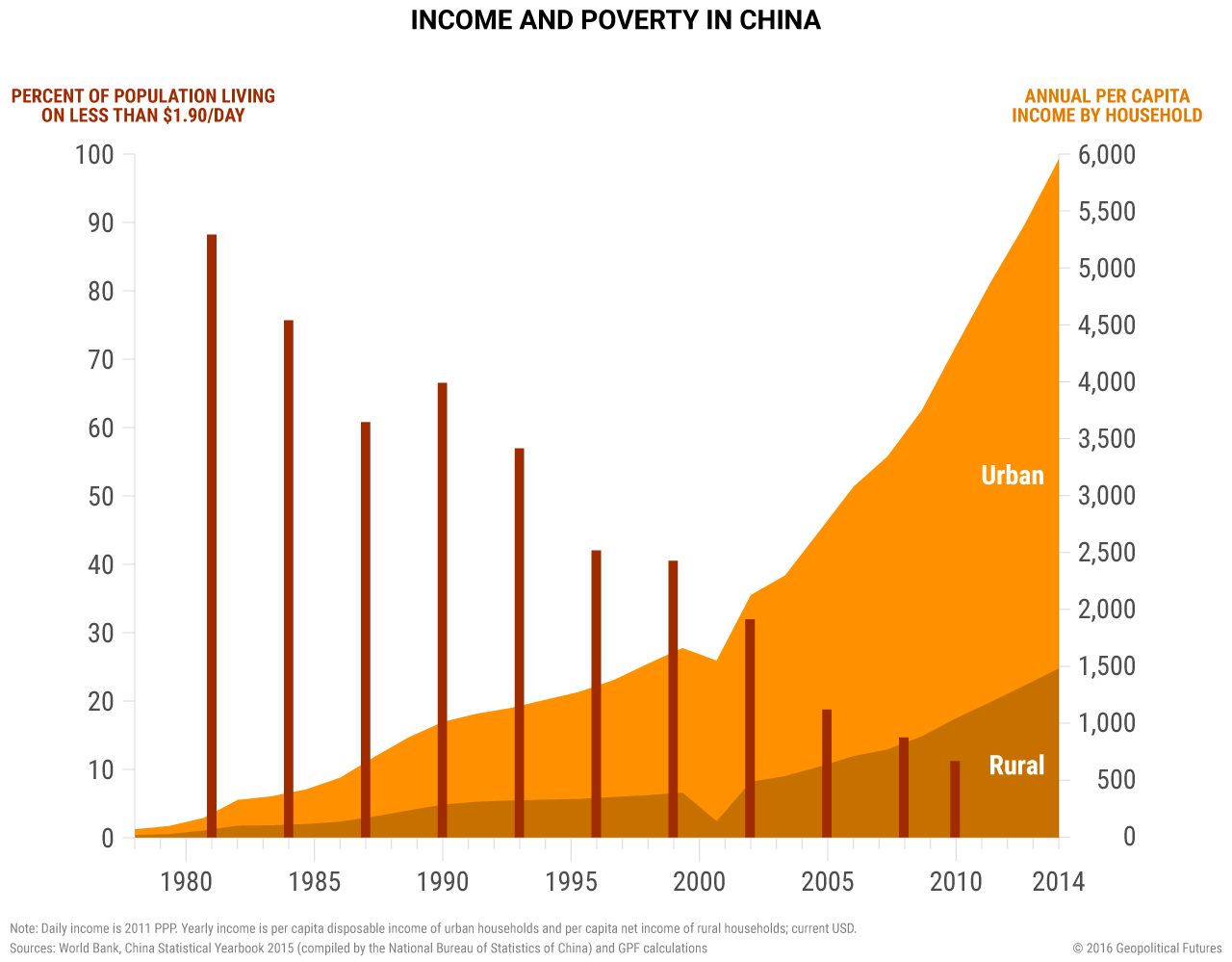
China is much richer today than it was in 1980. Even Mr. Mackler acknowledges that:
The question therefore inevitably arises of how China made the transition from a relatively poor nation, largely bereft of modern technology, to a world-class player on international markets? The answer lies in how China made the transition over the past 40 years from a deformed workers’ state that essentially banned capitalist private property, established a planned economy that focused more on addressing human needs—including providing free health care and education to all its citizens—than capitalist profits, to a leading capitalist and imperialist nation with trillion-dollar infrastructure investments in China and, increasingly around the world...
 His answer to the question is utterly bizarre.
A serious approach to answering this critical question, a complex matter to be sure, begins with China’s adoption of the key features of the BRICS nations—Brazil, Russia, China, India and South Africa. In all these relatively underdeveloped nations, the ruling elite focused on a massive transfer of wealth from the poor to the rich that they expected to result in the emergence of a relatively well-off layer of perhaps 20 to 25 percent of the population, consisting of “middle class” and working-class sectors, who would be capable of purchasing a broad range of nationally produced consumer commodities typical of their counterparts in advanced nations. This massive transfer, of course, was to be at the expense of the vast majority of their respective populations, who were in turn driven into abject poverty.
In other words, Deng Xiao Ping literally stole money from poor Chinese peasants in order to provide 400 million other people with a middle class income comparable to those in the West. This is ridiculous! The median income of a Chinese peasant was $2/day, or about $700/year. All that bought was a Mao suit and a couple copies of the Little Red Book. There was nothing to steal!

No--the bump in income is entirely due to global trade. The Chinese sold us toys, telephones, computers, clothes--in a word, just about everything you can buy at Walmart. Through Walmart, China raised the standard of living of every American. In return, the Chinese got food, jumbo jets, business services, and access to global resources (e.g., oil). I detail this in my two posts responding to Lynn Henderson (here and here).

Indeed, thanks to Sam Walton and Deng Xiao Ping, every Chinese citizen is vastly richer than they were in 1980. They didn't get that way just by stealing from each other. Mr. Mackler's theory is as silly as his presidential campaign.
china-household-income
Increase in wealth in Chinese households, both urban and rural. (source)
Further Reading:

Friday, September 13, 2019

Kim Moody on "Persistent Inequalities"

Why aren't wages equal across the economy? Why, for example, does a warehouse worker receive only half the pay of an auto assembly worker? Why are women and minorities paid less than white men?

The book is by Howard Botwinick and is entitled Persistent Inequalities: Wage Disparity Under Capitalist Competition. I have not read that book (though I probably should and maybe I will). Instead I respond to a lengthy review by Kim Moody, published in Against the Current. The principle inquiry of the book is to explain the persistent inequality in the wages of women and minorities when compared to white males.

Mr. Moody is a very capable economist who regards Mr. Botwinick's book (first published in 1993, and newly reprinted) highly. The latter is a recently retired economics professor at SUNY Cortland. Both claim to offer a Marxist perspective on their topic.

One common Marxist prediction is that industries will tend to be dominated by monopolies. Counter-intuitively (but correctly) Mr. Moody argues that monopolies will tend to pay higher wages, since as monopolies they can raise prices to cover the difference. But that doesn't appear to be happening. Retail, for example, is dominated by two behemoths: Amazon and Walmart. But they're in such intense competition with each other (and with smaller companies in the same space) that they're forced to lower prices--which means they have to reduce their labor costs.

(Some of my Trotskyist friends may confuse monopoly with monopsony. The former is when there is only one seller who monopolizes the market. The latter is when there is only one buyer, such as in a company town. Folks can only work for that company, or not at all, in which case the company can keep wages arbitrarily low. Mr. Moody does not consider the company town, monopsony phenomenon.)

A possible reason warehouse employees (at Amazon or Walmart) are paid less than auto workers is because Amazon and Walmart are in competition with each other, and not with General Motors. Therefore the wages at GM don't correlate with those at Walmart. This is a "persistent inequality."

Another possible reason for the wage differential is differences in productivity. If auto workers are more productive than warehouse employees, then of course they should be paid more. But Mr. Moody cites some statistics that warehouse productivity has increased faster than auto assembly productivity. (I'm not sure why that's relevant. The issue isn't about changes in productivity, but rather comparing existing values.)

The assumption is that auto assemblers and warehouse workers are comparably skilled, and therefore in a fair world should be payed equally. So I've never worked in either an auto plant or in a warehouse. I'll suppose that warehouse work is something similar to the people at Walmart who restock the shelves (or go around and shop for people who've ordered their groceries by phone). And I'll assume that autoworkers do jobs similar to what I see in a TV clip, where they're installing dashboards into SUVs.

The auto worker is using expensive equipment to do very precise work. The dash has to fit within a millimeter. A mistake can ruin a $40,000 vehicle. This has got to be a high stress job that requires continuous concentration. You can't tell me this is at the same skill level as the restocker at Walmart. The auto worker deserves her higher wage!

This, I think, is the fundamental flaw in the argument. Workplace skills can't be classed into a few boxes, e.g., people with a high school diploma. There is instead a huge variation within that category, and it depends not only on training but also very much on personality. The autoworker must be a more careful and conscientious person than the warehouse worker. The Marxist notion that we're all interchangeable proletons is wrong.

There lurks a deeper economic truth here. As Adam Smith pointed out, wealth derives from specialization. Using Smith's example, a skilled craftsman who makes pins might manufacture a couple dozen in a day. But if the labor is divided so that one person cuts the metal, and another sharpens the point, and yet a third fashions the pinhead, etc., then production increases thousand-fold.

This works only if there is a market for thousands of pins. Therefore large markets foster specialization, which makes everybody within that market richer. In our day markets are global, which means jobs are very, very specialized. Which implies that there are no large groups of people with similar skills. Individual talents and predispositions become very important.

Nevertheless, our Marxist friends carry on and locate three key dynamics accounting for "wage differentials among workers with similar skills." The first is "The ongoing processes of capitalist competition and technical change that create different conditions of production..." This describes the comparison between Walmart and autoworkers.

Second: "The continuing regeneration of a reserve army of unemployed workers." The very word "army" illustrates the error. There is no "army" of unemployed autoworkers. The people who can do that job have bespoke skills that are not readily transferable. The laid-off workers from the  Lordstown, Ohio, assembly plant may or may not have the skill set necessary to assume jobs in South Carolina's much newer BMW plant.

Mr. Moody cites large numbers of men who have withdrawn from the labor force as being part of this "army." But this seems unlikely--most of those people are on disability, or have various mental/substance abuse problems that render them unsuitable for auto manufacturing (or warehouse work).

Finally, there is "the uneven efforts of workers to raise wages." This represents unionization, and Mr. Moody suggests that workers who are more militant (i.e., willing to sabotage their workplace) will on average receive higher wages. Count me skeptical.

So how do Misters Moody and Botwinick explain gender and racial differences in employment?
The origins of racism and sexism precede the development of industrial capitalism in patriarchy and slavery, but it is the rise of capitalist competition that provides the new and changing unequal forms of wage labor that workers compete to fill.
In this model, capitalism "creates" low-wage employment just so it has a place to dispose of women and minorities. The implication (as I understand it) is that if there were no more sexism and racism then low-wage work would no longer exist. This is not credible.

Women, by Mr. Botwinick's theory, are simply another set of proletons that need to be accommodated in the workplace. Of course they're not: women are obviously and significantly different from men in both physical and psychological respects. Men and women have had different job descriptions since time immemorial--as the words hunter and gatherer suggest. Robert Gordon says that (prior to the industrial era) men's work was dirty and dangerous, while women's work was unending drudgery. It is only latter-day feminists who implausibly insist that gender differences should be radically abolished. That will never happen.

Indeed, the modern workplace seems to favor women, what with its emphasis on customer service and care. Machines disproportionately displace men by doing the backbreaking, muscular labor for them. Mr. Moody illustrates the problem, mentioning the "growing numbers of prime-age males, in particular, who have dropped out of the work force."

There is no cause to think that women are being needlessly relegated to low-wage work as surplus proletons. The "persistent inequality" doesn't exist--at least not for that reason.

Mr. Moody's article, and likely also Mr. Botwinick's book, are worth the read. But the thesis is unconvincing.

Further Reading:

Thursday, September 5, 2019

George Novack: Then and Now

Back in the day (early 1970s) George Novack (1905-1992) was touted as the world's foremost Marxist philosopher.

My girlfriend at the time--also a comrade--had studied philosophy in college. "I don't like George Novack," she said. A heretical thought, for George and his wife, Evelyn Reed, had God-like status within the Movement.

I looked at her, shocked. In a parallel universe such a comment could've gotten her shot.

Nevertheless, since I had no prior opinion about Mr. Novack one way or the other, the remark has forever biased me against him. After all, she, better educated than me, should know a philosopher when she saw one.

Mr. Novack's name hasn't crossed my radar screen for decades, so it was with sentiment that I read the excerpt republished in The Militant, entitled "Socialist revolution is ‘historical mission of modern proletariat’" The entire piece is an introduction to Frederick Engels' classic work, Socialism: Utopian and Scientific. That book was first published in 1880, while Mr. Novack made his contribution in 1972. With a bit of fiddling you can likely read the whole introduction using Amazon's Look Inside feature, which is what I did.

My girlfriend was correct--Mr. Novack is not a philosopher. But he is a lucid exponent of Marxist thought. The piece is worth reading for that reason.

Like all Marxists, Mr. Novack understands nothing about economics.
The material source of the conflict between capital and labor is their ceaseless struggle over the division of the social surplus product in the form of the new value that is added to the total wealth produced by the laboring population. The profits of the capitalist stand in inverse ratio to the wages of the workers.
This is manifestly not true, as evidenced by the dramatic rise in global living standards since 1880. The "conflict" between workers and capitalists is not the zero-sum game that Novack and Engels imply.

"Utopian socialism" was the sort practiced by, among others, Robert Owen in New Harmony, Indiana, where a group of like-minded souls got together and tried to live under socialist principles. Of course it failed, surviving only for two years, from 1825 to 1827.

"Scientific socialism," proposed by Marx and Engels, was the root-and-branch social transformation into a socialist society. It was "scientific" because it depended on "social forces," and "material conditions," rather than some idealistic dream. Mr. Novack gives us a summary statement of how this transformation is supposed to occur.

The workers--also known as the proletariat--trying to recover their rightful share of "surplus value," will form trade unions. These will fight around narrow, workplace issues, such as wages and working hours.

When this doesn't satisfy them, they will expand their fight to the political realm. This leads to the formation of a labor party, distinguished from capitalist parties by being beholden only to proletarian interests.

Since the capitalists cannot relinquish their hold on profits and still stay in business, not even a labor party will satisfy the workers. Hence they shall be inspired toward revolution, implementing the dictatorship of the proletariat, and ultimately communism.
Only the triumphant proletarian revolution can clear the road to a classless society. Then, at last, long-suffering humanity will be the master of nature and its own social organization, and its full creative capacities will be released to beautify a bountiful world. This will mark “the ascent of man from the kingdom of necessity to the kingdom of freedom.”
It's a silly model, yet Mr. Novack claims some success. He notes that when Engels wrote his book, it was
...no more than a prophecy. History had yet to demonstrate whether his prediction of things to come was solidly based or an aberrant hypothesis of social development. Now a century later, the act of emancipation he anticipated has been effected in fourteen countries, beginning with Russia in 1917 and extending to Yugoslavia, China, Vietnam and Cuba after the Second World War.
While it's hard to think of Stalinist Russia, Maoist China, or Castroist Cuba as being in any sense "emancipated," it is nevertheless true that (apart from Cuba) there is nothing "socialist" about them now. Mr. Novack was premature in his claim of success and Engels' prophecies are just flat-out wrong.

Yet the dying embers of the Marxist dream are kept alive by my Trotskyist friends, who still insist that Engels' template can be turned into reality. But they're stuck on Square One, still championing the union movement. Socialist Action (SA), for example, touts hotel unions--service workers who Engels probably didn't have in mind when he wrote his book. Indeed, it is unlikely that hotel workers--even collectively--hold the keys to civilization.

The Socialist Workers Party (SWP) is even more out on a limb urging the unionization of Uber drivers. This is a nigh impossibility--the closest they could come would be to quit their jobs, which if the proceeds from driving Uber ever fell below the market rate is precisely what they would do.

The union movement is fading, not just in the US but globally. There are many reasons for that, including: automation has supplanted the majority of industrial workers; workplaces are smaller and harder to organize; supply chains are longer and therefore redundant, meaning strikers have less leverage; management has been flattened, which means employment is much more sensitive to the marketplace than previously; and most employees are now service workers who directly interact with customers. I think this trend is irreversible.

So Trotskyists have made no progress on Engels' step one.

Step Two is the formation of a labor party, and both groups are striving. SA has gone the furthest with this--they are now engaged in Jeff Mackler's quixotic and deeply unserious presidential campaign. The core platform is Build an Independent Labor Party, which, of course, is copied straight from Engels.

But it is more complicated today. SA believes in "catastrophic climate change," and par for the course they're on the radical extreme of that movement, claiming the world will end in ten years. Their solution to this imminent disaster is to Build an Independent Labor Party. I, for one, wonder how such a labor party is gonna prevent catastrophe at all, much less within ten years--especially since it's so far from becoming reality.

Engels would be flummoxed, as I suspect George Novack would be as well.

The SWP has dropped the "climate change" nonsense, which puts them back in the real world. And further, they've gone all-in on the blue-collar billionaire, supporting President Donald J. Trump.

OK--that last sentence is an overstatement. They don't endorse Mr. Trump, but they do sympathize with his supporters. An attack on Mr. Trump--or so they perceive--is an attack on the workers who are his fans. The SWP adamantly (and in my view correctly) rejects the charges of treason and racism so often and casually thrown at the president's constituents.

It's a fine line: defending Trump's supporters against completely spurious charges--without supporting Trump. Many on the Left accuse them of actually supporting Trump. The case is stronger because the SWP has rejected the antisemitism otherwise so rampant on the far Left.

Nevertheless, I think they are very much on the Left: they strongly support the Cuban "revolution"; they defend North Korea as a workers' state ("emancipated"?); they generally oppose Trump's crackdown on immigration; and above all, they aspire to Build an Independent Labor Party.

So I predict they'll again run candidates for president and vice-president in 2020, just have they done since 1948. The campaign will be just as quixotic as Socialist Action's, though less incoherent.

Still, I can't help but hope that at least a few comrades, in the privacy of the ballot box, will join me in voting for Donald J. Trump.

Either way, George Novack is spinning in his grave.

Further Reading: