Sunday, August 16, 2020

Is Jeff Mackler a Racist?

Jeff Mackler writes a long article (3000+ words) published in the July print edition of Socialist Action, entitled U.S. Fight Against Racism and Repression Reaches New Heights (pdf). Despite Mr. Mackler being a talented writer, it's one of those that I've read so that you don't have to. Frankly, it's boring.

Setting the tone, in the lead paragraph he writes,

Unprecedented, multi-racial, daily mobilizations against the ingrained institutional racism that permeates every aspect U.S. society have exploded in scope and intensity. Recent surveys estimate that 15 million to 26 million Americans have taken part in the widespread demonstrations over the murder of George Floyd. They continue to this day.

The exaggerations are stunning. Taking the obvious first--that 15 to 26 million people have participated in the protests--my back-of-the envelope calculation comes to about 600,000 demonstrators. Perhaps that's a low estimate--multiply by two or three if you want--but Mr. Mackler's is 25 times bigger--in other words, just way out of line.

Then he says the demonstrations were over the murder of George Floyd. That's rather like protesting child abuse--everybody is against it. Everybody from across the political spectrum--from Steve Bannon to Jeff Mackler--agrees that Mr. Floyd was murdered, and that his killer should be brought to justice. Even the police unions--who almost always stand up for cops no matter what they do--agree that he was murdered! So I don't know who the demonstrators are protesting against.

Even Mr. Mackler indirectly admits that the fuss was not about George Floyd's murder, which by all accounts was a once-off crime committed by a rogue cop. But in his view it is symptomatic of "ingrained institutional racism that permeates every aspect [of] US society." He offers some statistics revealing the depth of the problem.

About 63 percent of those shot and killed by police in Minneapolis between 2000 and 2017 – 19 people – were Black, while only 17 percent – 5 people – were white.

So--to fill in the missing data--over a 17 year period 30 people were shot and killed by police in Minneapolis. That's less than two per year--police shootings are not a major cause of death in Minneapolis or the country. Most of those shootings were justified in the sense that the police's mandate to protect public safety sometimes requires them to use force.

On the basis of this small, statistically meaningless dataset, Mr. Mackler infers a giant racist conspiracy. He offers no other evidence.

Though it is true that Blacks are stopped, arrested and prosecuted at a rate exceeding their fraction of the population. Mr. Mackler will attribute that to "racism." Like most Republicans, I think it's because of higher crime in Black communities, as illustrated here.

(Source: Wikipedia)

Though the reasons for higher crime might in part be racism, surely the actual causes are far more complicated than that. Racism is likely only a minor contributor.

Which is not to say there aren't any problems with the police. The police department in Ferguson, MO, for example, was running an extortion racket. The Black residents of that city had every right to be upset--though burning down stores in your own neighborhood is not an especially helpful tactic. Likewise, a Black woman from Minneapolis interviewed on Fox News was all in favor of the police, but she wished they better represented the neighborhood. According to her most cops didn't even live in Minneapolis, and no matter how good their intentions they didn't really understand what was going on.

While there is certainly room for improvement, polls show that Black people do not support defunding the police. This recent Gallup poll  reports that 81% of Black citizens want the police present in their community. This makes sense--like the rest of us, Black people are civilized and want to live in a civilized world.

Here is what Mr. Mackler proposes instead of the police:

The right of Black, Brown and Native American people to control and govern their own lives and communities, free from white racist police brutality and corporate exploitation, can only begin with a fundamental change in relations of power. The struggle to disarm, defund, and disband the racist institutions of police power begins with the emergence of new organs of democratic control of the communities of the oppressed themselves.

Civil order requires a "well-regulated militia" (as the 2nd Amendment puts it). Today we call that the police department, and it has a monopoly on violence in civil settings. Well-regulated means subject to civilian and ultimately democratic authority, for otherwise it becomes just another street gang (which is always a threat, see, e.g., Ferguson).

Absent the police, chaos ensues. Nature abhors a vacuum, and in the absence of a well-regulated police department, one gets only street gangs. We can call this the Mogadishu solution, in honor of the city which, for the past several decades, has been unable to field a well-regulated militia.

Mr. Mackler definitely has "Trump" on the brain. Indeed, I think The Donald has built a golf course inside his head. The president is mentioned 19 times in the article. Some examples:

"...the posturing, chin up egomaniac President Trump..."
"...the racist bigot President Trump..."
"...fearful, bragging bigot Trump and his family..."

One concludes that Mr. Mackler doesn't like Trump very much, but aside from name-calling he presents no evidence that the man is especially racist. By comparison, George Floyd only earns four mentions.

Nevertheless, let's take Mr. Mackler seriously and take an example of what he would call "racism." Let's consider Chicago--a city I know well, and where my son currently lives. Chicago is really two cities in one--on the North Side it is a wealthy, global, cosmopolitan place--a slightly smaller version of Manhattan or San Francisco. On the South and West Sides it's a mostly Black, very poor, third world city.

My son is part of the global city. He earns six figures working in IT for a major financial institution. His salary is so high because people with his skill set are scarce as hen's teeth and there's a bidding war for his services. The man is entirely self-taught--he never got any formal education in IT--in fact he never attended college at all. Instead he worked toward certifications demonstrating the necessary technical skills. Anybody can do that--there are no admission's criteria, no interviews, nobody cares what race you are, nobody cares where you live or how old you are. Indeed, the certifying companies are often not located in the US.

Get one of these certificates and you will almost certainly get a job--the market is that tight. You'll have to start at the bottom, earning only $80K annually, but after a couple years experience you too will be in the top 10%.

Of course easier said than done. My son worked hard studying for the exams, and then often didn't pass the first time he took them (or even the second time).

So why can't people on the South Side of Chicago do the same? I admit--this is a variant of Hillary's advice to coal miners--that they should all learn to code. And certainly only a minority of South Siders could do what my son did, who is himself only among a small minority of his high school classmates. That said, the number of South Siders working in high-skilled IT professions for major financial institutions borders on zero. Why?

It certainly isn't Trump's fault. Even if the man were a racist, the problem is long-standing and predates him by decades. It's also not the banks' fault--they'd love to hire skilled African-Americans. I actually don't think it's any individual's fault, but if I were to blame one person, that would be Jeff Mackler.

Because my son had the advantage of an at least decent public high school education (nothing fancy--he grew up in small-town Indiana). The Chicago Public Schools, meanwhile, are execrable--basically glorified babysitting clubs. This is substantially the fault of the teachers' unions--who run the schools primarily for the convenience of the teachers and not for the students.

Jeff Mackler is a retired teachers' union hack. So if you gotta blame somebody, he's as good a fall guy as anybody--much better than Trump.

The unions blame parents and the community for their pupils' poor performance. They perennially claim they don't have enough money, despite the fact that Illinois spends $14,000 per student per year. Effectively, the unions believe that South Side children are ineducable. In other words, the unions--including Mr. Mackler--are racist.

You can't get any IT certifications if you're illiterate and innumerate, thus excluding most graduates of the Chicago Public School system.

The looters--who Mr. Mackler claims were only a "small percentage" of the protesters--destroyed Walmart stores, including those at 83rd St. just off the Dan Ryan Expressway, and in Austin on the West Side. Walmart--as an act of charity--promises to reopen the unprofitable stores. People do, after all, need to get their groceries and medicines. The city committed to help.

Ensuring competent police protection seems like the least they could do.

Further Reading:

Saturday, August 8, 2020

The New Aristocrats

Note: It's astonishing in this age of plague and turmoil that my Trotskyist friends write nothing that interests me. So I offer this piece instead, which is mostly fiction based on a shred of reality.

My neighborhood is very diverse. Of the 150 odd homes in the subdivision, perhaps 50 are occupied by white Americans. The rest are from all over the world. There are at least a half dozen Filipino families, probably similar numbers of Chinese and Koreans, and a smattering of South Asians. 

But by far the largest demographic are folks from the West Indies and West Africa. Not all are new immigrants--I think many are second generation. But I believe the African-American population--narrowly defined as descendants of slaves brought here during colonial times--is small. One of my occasional walking buddies--I walk around the neighborhood every day--is from The Gambia. Indeed, he has several friends (perhaps relatives) living here--there are at least three houses full of Gambians. Other neighbors--acquaintances from work--are from Jamaica. I often hear Jamaican brogues while wandering around.

Occasionally I see a truly elegant couple on the street. I've never spoken to them and I don't know which house they live in. I'm pretty sure--from appearance--that they're from West Africa, of which Nigeria is the most populous country. Searching the web for common Nigerian names, I'll name the standout pair Musa and Aisha.

Musa is very tall--at least 6'5"--a full head taller than me. He's very athletic--I see him holding impromptu fitness classes on the street for neighbors. Not one to smile often, he has a proudly erect, regal bearing. Clean-shaven, he looks to be in his early 40s.

Aisha is not as tall, nor as slender, but still taller than I am--perhaps 6'. She's incredibly beautiful--buxom and full-bodied, but not at all fat. Rather, she's pure muscle--very strong and just as much in to fitness as her husband. I typically see her clad in skin-tight sweats--and it flatters. Perfect posture, proportions, features.

If people with straight backs ruled the world, Musa and Aisha would be king and queen. I'm quite intimidated by them--which is why I haven't introduced myself.

I don't know if Musa and Aisha have any children--but it would be a damn shame if they didn't. Let's award them two, and name them Prince and Princess--just to keep the genders straight. Perhaps grandma tends to them during their parents' walks.

Musa and Aisha clearly got some good genes. (Nobody in my family ever grew to 6'5", and we're definitely not known for athleticism.) That said, the pair have made the most of their endowment. Had they chosen instead a diet of french fries and ice cream coupled with a couch-potato lifestyle, perhaps Musa would still be over six feet tall. But he'd have a slouch and a pot-belly, and nobody would take him seriously as a fitness instructor. Aisha, rather than strong, would just be fat. She'd look like a pig.

These people work hard. They know they have a gift, and they haven't squandered it. In addition to physique, they're endowed with self-discipline.

Houses in my neighborhood sell for about $300K. That's well below the median cost of housing in the New York City metro region, but then we're a 90 minute commute to Manhattan. (Pre-Covid, my Gambian friend made that trip every day. Now he gets to work from home.) On the other hand, our neighborhood is more expensive than the surrounding town--partly because the houses are newer, and also because of our superb location.

So poor people don't live here. And neither do aristocrats.

To live here, Musa and Aisha need middle class jobs. Perhaps, like my Gambian friend, they work on Wall Street. To get such work they must have some education--whether learned in Nigeria or here, they have a marketable skill. For which self-discipline certainly helps, but there has to be some level of smarts besides.

I think they're relatively new to the neighborhood--I've seen them around only recently. Likely they've skimped and saved to put together the down payment. As immigrants they needed to establish a credit rating from scratch. All of which is evidence of self-discipline, smarts, and a serious work ethic.

Now imagine the lives of Prince and Princess. Children get their genes from mom and dad, and it's hard to see how this pair goes wrong either way. Something bad could've happened--birth defect, disease, accident--but most likely the kids will be like their parents: tall, dark, and exceedingly handsome. With luck the children will inherit the self-discipline trait--but even if not, they'll be taught it from an early age. I doubt slouching is tolerated in the Musa/Aishi household!

The schools around here aren't very good, but I'm not worried for Prince or Princess. Mama will certainly teach them how to read, and daddy will school them in arithmetic. Many other things they'll pick up on their own. What they'll learn from school will not be taught by teachers, but rather by their classmates. They'll learn how to earn the respect of their peers. It will be a class in Aristocrat 101.

Prince and Princess will have more advantages. Instead of growing up relatively poor in Nigeria, they'll come of age in middle class America, with all the opportunities that offers. And not being slouches they'll take advantage of them. They'll probably go to college (or whatever replaces college), and they'll likely inherit some money. If nothing else, Musa and Aisha will have paid off the house for them.

Will Prince or Princess become true aristocrats? Probably not yet. Likely it will take another generation of wealth-building before that status is reached. If they marry well--not necessarily into other Nigerian families, though that's certainly a good option--Musa and Aishi's grandchildren may well aspire to the aristocracy. By which I mean they will have the wealth, authority and wisdom to decide the fates of others.

Fortunately, America does not have a formal, hereditary aristocracy, complete with titles. But we do have aristocratic families, e.g.,

[Kenneth] Arrow was a brother to the economist Anita Summers, uncle to economist and former Treasury Secretary and Harvard President Larry Summers, and brother-in-law of the late economists Robert Summers and Paul Samuelson. In 1947, he married Selma Schweitzer, graduate in economics at the University of Chicago and psychotherapist, who died in 2015. (Wikipedia)

Unlike in bygone eras, the path to aristocracy includes more than just military talent. Today one can be a family of academics, artists, businessmen, politicians, sports stars, etc. Whatever the field, the talents required to be a leader of men and women are in significant part hereditary, which is why aristocratic rank follows from parents to children.

And so here we are. In Trump's America, a family of West African immigrants are founding a new aristocratic dynasty.

My story is mostly fiction. But I hope it's true.

Further Reading:

Sunday, August 2, 2020

Forthcoming Book: Sustainable. Resilient. Free. The Future of Public Higher Education

The book is by John Warner and it hasn't been published yet. Which means I haven't read it and therefore don't presume to review it. But Mr. Warner, a regular columnist over at InsideHigherEd, uses the platform to advertise his impending tome. The title's adjectives refer to colleges and universities--he calls them "aspirational". He writes:
If you share this vision and would like to play a part in bringing it further into the mainstream so we can have a conversation about the future of higher ed that goes beyond “Let them eat pixels,” please consider preordering directly from the publisher, Belt Publishing. Belt is an independent outfit located in the Midwest (Cleveland), and ordering directly from them has an outsize positive effect on their bottom line. 
If you don’t share this vision, please consider preordering directly from the publisher, Belt Publishing, so you can be prepared to tell the world what a fool I am.
If you go to the link you'll discover the book costs $16.95! Wow! That's a lot of money for a book that may only be 200 pages long. The webpage gives no vital statistics, so I don't know how long the book actually is. I also don't know what format it comes in: paperback or hardcover? In other words, I'm asked to buy a pig in a poke. I do know it's not available on Kindle since it's not being sold on Amazon at all.

Trotsky's First Law of academic literature is that the value of the product is inversely proportional to the price. My most recent book purchase was $0.99 for a 438 page, very readable account of medieval German history, Kindle edition--a much better bargain.

I don't understand why Mr. Warner's book costs any money at all. He does, after all, say that a college education should be free. Indeed, he claims that free college "will have genuine, broad-based macroeconomic benefits." But doesn't the same hold true for his book? Why should college be free, while his book costs an exorbitant $16.95? Note that part of the purchase price is charity for the publisher, who is too selfish to forego his bottom line.

Then he touts "sustainability" as a virtue, which surely should apply to his book as much as any college. Not having read his book, I'm not exactly sure what he means by "sustainable," but let's suppose it's environmental as opposed to financial. (Colleges are obviously not financially sustainable.)

In which case the book should be distributed solely in an electronic format. Paper consumes trees, subjecting them to chemical processing. Physical books have to be shipped in diesel-burning, fume-spewing trucks! Mr. Warner, by countenancing only dead-tree editions of his book, is certainly not acting sustainably.

Here, at least, Mr. Warner is consistent. Obviously the most sustainable medium for college instruction is on-line. No more commuters, buildings, parking lots, traffic--on-line is as carbon-neutral as you'll ever get. Yet for some reason Mr. Warner is against on-line. I haven't read the book so I don't know why, but it seems at odds with his demand that colleges be "sustainable."

Then there's "resilient." Again, I can't tell what Mr. Warner means by the word, but to me it sounds very much like a synonym for "fossilized." Faculty should never, ever be laid off--not even when they're 90 years old and teach accounting the way it was done in 1925. Even rapidly changing subjects--e.g., computer science--have to keep the superannuated sorts on staff, despite the fact that they know nothing about any relevant technology. All because of "macroeconomics," or whatever.

Old age isn't the only reason to fossilize the faculty. The history department, for example, only graduates 12 majors per year--out of a class of 553. Of course that means that all 22 faculty members have to remain employed forever--never mind that they outnumber the students.

A "resilient" book perhaps is one you'd like to reread 5 or 15 years from now. Those are books that might justify the dead-tree price--they deserve shelf space in your study. Does Mr. Warner's book rise to the occasion? I think not--rather than "resilient", it's likely journalism. Read it once, and then use it to line the bird cage. I'm not against journalism, but it should be distributed electronically.

Mr. Warner writes: "A good portion of the book will cover how students became customers and some of what it will take to undo this problem." One often hears this complaint from academics--whatever else students are, they shouldn't be customers.

What should they be instead? How about rats in a rat race? Academics today is not much more than a huge bureaucracy: check this box, write that paper, regurgitate the opinions of your teacher, pay money in that office, unless it's for this expense in which case you have to pay it in another office. Jump through all the hoops and you'll end up with a diploma--a result achieved by only 33% of public college and university students.

Or perhaps students are suckers? After all, they're easily scammed into taking out ruinous loans from which at least 67% will never derive any benefit at all. This all supposedly for the good of "macroeconomics." That doesn't count the time and opportunity cost to students in not getting a diploma.

Mr. Warner's solution to the student loan problem is to have taxpayers pay for it. What this ultimately reduces to is that people who don't go to college should subsidize the people who do go to college. Or, to phrase it more colorfully, minimum wage Walmart employees are paying for the education of highly-paid engineers at Google. I hope Mr. Warner's book explains the justice in this arrangement.

Much fairer would be a rule where the colleges themselves have to reimburse the government for defaulted student loans (at least in significant portion). Or better yet, abolish the student loan program altogether, which would force colleges to lower their price.

Or maybe students are a blank canvas upon which faculty can paint their egos. Conservatives frequently complain that the overwhelmingly progressive faculty are brainwashing students to be radical Lefties. I think the case is overstated, but it remains true that if you want to graduate you have to pretend to agree with the teacher--no matter how ridiculous she is. Fortunately, upon graduating (or flunking out) most people come to their senses and make up their own minds. But this does not count as an education.

Among the many "macroeconomic" benefits of universities are the army of grad students and freshly-minted PhDs, most of whom are under- or unemployed. Often they work for sub-minimum wages as teaching assistants or adjuncts. Collectively they're a true lumpen proletariat. Or put another way, they're the ultimate victims of the college scam--spending years sucking up to the faculty after which they graduate with a useless diploma and no viable career path.

Seriously, I'm happy to read Mr. Warner's book. I'll try hard to give it a respectful and honest review. This means I'm spending my most precious commodity--time--on it. But there's no way I'm paying $16.95 for the privilege!

Further Reading:

Sunday, July 19, 2020

Louis Proyect vs. Steven Pinker

Louis Proyect is the master of ad hominem argument. In a post pretentiously titled Pecksniff and the Harper’s Open Letter, he'd refuse to sign the Harper's Open Letter because he wouldn't want to join the disreputable crowd of hypocritical, prominent signatories. He never claims to oppose the letter's actual content, which champions free speech, open inquiry, and some minimal respect for persons who disagree. These are bourgeois values which I believe Mr. Proyect holds in low esteem--he is, after all, a totalitarian Marxist.

Certainly respect for persons who disagree is low on Mr. Proyect's list. This is what he says about Mark Lilla.
Mark Lilla—Another Columbia professor. His claim to fame is writing a book urging the Democrats to dump “identity politics”. Katherine Franke, a Columbia law professor compared Lilla to David Duke and charged him with “underwriting the whitening of American nationalism, and the re-centering of white lives as the lives that matter most in the U.S.” Maybe he signed the letter because she “canceled” him.
So apparently any skepticism about "identity politics" is the same as David Duke, who, we may extrapolate further, is just one short step away from H*tl*r. And that's the problem--anybody who disagrees with Mr. Proyect is ultimately associated with the H-man. This is supposed to pass for discourse.

He saves his worst bile for Steven Pinker.
Steven Pinker—Pinker is arguably the worst person who signed the letter. My interest in him was focused on his reactionary sociobiological theories that I described as a mixture of Hobbes and Pangloss. I also recommend a new Jacobin article titled “It’s Official — Steven Pinker Is Full of Shit”. I guess Jacobin was guilty of cancel culture.
I've read both Mr Proyect's post (entitled Steven Pinker = Hobbes + Pangloss, posted in 2011, which in turn links to a post from 2009) and the Jacobin piece. It appears that Mr. Proyect has never actually read any of Pinker's books, so on this I have an edge. I read The Blank Slate shortly after it was published in 2003. I have never read The Better Angels of our Nature--the book that really gets Mr. Proyect's goat.

Sociobiology (aka evolutionary psychology) asserts two premises--the veracity of which are to be proven empirically.

1) That human evolution occurs much more rapidly than was believed in the 20th century.
2) That genetic evolution happens not just in response to changes in the natural environment, but also to changes in the social environment. This leads to the concept of gene-culture co-evolution. (For more about this, see Joseph Henrich.)

The first premise is now demonstrated beyond any reasonable doubt. Detectable evolution can happen in historical time--certainly within a few thousand years, and likely within one thousand years. Indeed, it can happen almost immediately, as when a small band of people separates from a much larger group, and by crossing a mountain range loses genetic contact with their ancestors. They will be genetically distinct almost from the git-go--even if they represented a random sample before they crossed the mountain range.

Analysis of the human genome (first sequenced in 2003) has become cheap and ubiquitous. Coupled with massive data processing power, it is now possible for commercial companies (e.g., 23&me) to distinguish ethnic groups by genomic analysis alone.

The second premise is harder to definitively establish, but it can be said with confidence that genes correlate with personality traits, which collectively contribute to culture. Correlation obviously does not prove causation, and because genetic influences are extremely complicated and subtle, proving causation will be difficult to impossible except in a few cases (e.g., lactose tolerance). But correlation certainly suggests causation, and in many cases it probably results from causation.

In the 2009 post Mr. Proyect attributes the following statements to Pinker.
  • Males have a stronger tolerance for physical risk and a stronger drive for anonymous sex. 
  • Women have stronger emotions and are better at reading emotions on the faces of others. 
  • Pinker states “A variety of sexual motives, including taste in men, vary with the menstrual cycle.” 
  • He also states that “in a sample of mathematically talented students, boys outnumbered girls by 13 to one” but that women maintain more eye-contact, and smile and laugh more often. 
  • Humans are hard-wired to think in stereotypes and to prefer kin. 
  • Some people, most of them men, are born with criminal tendencies. 
  • Turning to the big questions of social transformation that have vexed Great Thinkers for the millennium, we learn from Pinker that “Biological facts are beginning to box in plausible political philosophies.” Communism may work for insects, but humans are programmed for economic exchange and “reciprocal altruism.” (Is that the reason I used to climb across the ceilings and consume a pound of sugar at a time when I was in the Trotskyist movement, I wonder?)
Apart from the last bullet, there is abundant empirical evidence--genetic, neurological, anatomical, behavioral, and anthropological--to support all these claims. The best, recent source for this is Charles Murray's 2019 book entitled Human Diversity (my review here). The author compiles huge datasets (sample sizes in the millions) to support the assertions listed above (and much more besides).

I know, I know. I genuinely wish that somebody else besides Mr. Murray had written the book, and failing that I wish he'd written it under a pseudonym. But it is really important here to separate the subject from the author. Mr. Murray has written a textbook instead of a monograph. He has not done the research himself, but has put together the data from the scientific literature compiled by other people. One common criticism of Mr. Murray's book is that he's published no peer reviewed papers. I don't know if that's true, but it's irrelevant--textbook authors are not typically researchers themselves.

The other common criticism is that he's "cherry-picked" the data. This is both cheap and irrefutable. Any author--even a textbook author--has to pick and choose what to include and what to leave out. So of course the contents are "cherry-picked" in that trivial sense. The implication, however, is that he's hiding some crucial bit of data that disproves his thesis--presumably because he's dishonest, racist, and his name is Charles Murray. I find this incredible. While the book can certainly be criticized, it won't be easily dismissed because of some magic, missing data point.

The Blank Slate, published in 2003, did not have access to the voluminous data at Murray's fingertips. It is necessarily more speculative, and has been criticized for telling just so stories. But Murray's subsequent data have largely confirmed Pinker's hypotheses.

In the 2009 post Mr. Proyect writes about Pinker:
For all of Pinker’s animosity to radicalism and Marxism in particular, there is very little evidence that he understands how historical materialism deals with the question of human nature. While it is beyond the scope of this article to trace its development through the years, suffice it to say that Marxism views the nature-nurture relationship dialectically.
It does not really challenge the existence of biologically determined traits, but simply places the whole question of equality, justice and freedom in a materialist context. In other words, revolutionary socialism strives to create the conditions in which all human beings can reach their full potential. Within the context of such a challenge, Pinker’s “Blank Slate,” with its discussions about the difference between the appearance of male and female brains (according to Pinker, they are “nearly as distinct as their bodies”) seems little more than “Men Are From Mars, Women Are From Venus” geared to readers of the New York Review of Books.
It turns out that the pop-culture Mars/Venus stories are not that far off the mark. Most people understand that men and women are different in the ways one expects. (Only woke people on college campuses have forgotten how to do that.) But Murray's data is much more rigorous: first, it's actual data with sample sizes in the millions rather than mere anecdotes; second, it can quantify the differences, and also the similarities between men and women; and finally, it can at very least correlate those differences with differences with genomic and neurological data. In some cases it can establish causation.

Opponents of sociobiology will not get very far by firing shots at Charles Murray. First, he's just the messenger, and second, his book is very thorough. What they need to do instead is write a competing textbook. If Marxist dialectics are indeed the key to the nature-nurture debate, then by all means write the textbook that makes that case. But it must take the data seriously--you can't just philosophize in the abstract about "equality, justice and freedom," along with empty words like "dialectically," and expect to get away with it.

Materialism, if it means anything at all, certainly means arguing from empirical data.

One last point: nobody is arguing for genetic determinism. The environment plays a large role--both for individual outcomes, and certainly for cultural outcomes. I hope there's even room for old curmudgeons like me who still believe free will has at least a small remit.

But what is now undeniably true is that genes play a significant role in explaining variation between individuals, and also between ethnic groups. While genetic determinism is wrong, it is equally impossible to ignore genetics when thinking about human health, psychology, and culture.

Mr. Murray makes that point. He argues that, within the next ten years, academic papers in the social sciences will all include genetic data as a matter of course, and will be unpublishable otherwise. This is already true in biology, medicine, and psychology, and will spread to sociology and economics--even in the face of political correctness.

So the window of opportunity for our Marxist friends to write their textbook is closing fast. Mr. Proyect needs to get busy.

Further Reading:

Tuesday, July 14, 2020

Robots and AI

Andy Barns, over at Socialist Resurgence, does us a good turn with an article entitled Robots can help humanity, but rarely under capitalism. He's among the few of my Trotskyist friends to comment on technology at all.

Unfortunately, his Marxist premises lead him astray. The opening lede:
Humans are making rapid strides in robotics and artificial intelligence (AI). Both have the potential to reduce working hours, make jobs safer, increase energy efficiency, etc. But there are many potential problems—chief among them being unemployment and the use of AI to control human destiny in ways we may not want.
He's forgotten one huge beneficiary: the consumer. Automation lowers prices which raises the standard of living for all consumers. An economic analysis that doesn't account for the cost of consumption is woefully incomplete.

The relevant word is productivity. As Mr. Barns notes, new technology raises productivity--i.e., the amount that can be produced by person-hour of work. The higher the productivity, the higher our standard of living. It is only by increases in productivity that our standard of living improves at all.

Mr. Barns assumes that all productivity improvements go straight to capitalist's back pocket in the form of profits. His example illustrates the point.
For example, a single industrial forklift can perform the same amount of work with one laborer that once took 20 or more laborers in the same time. Time is how labor is measured under capitalism and how the majority of workers are paid. If one worker can be as efficient as 20 used to be, then that will be more profitable, and thus, capitalists will gravitate towards technological development....
In our forklift example, the displacement of 19 workers means the one now has to do the same work as 20, whereas the 19 others now have no work. The total workload could be reduced for all persons while still offering meaningful employment to all. Again hypothetically, the forklift should reduce a 10-hour day of labor for 20 persons, into a three-hour day for 20 persons.
In this hypothetical, rather than the capitalists capturing all the benefits of new technology, instead the workers would. The price for consumers would remain constant, and thus our standard of living is not improved. Even the workers don't really benefit--their pay is capped because they are forced to work fewer hours.

The real world doesn't look like that. In a competitive marketplace all manufacturers will have to lower their prices to compete. While the remaining forklift drivers will get paid more than the original laborers (because of higher skill level), the total wages paid by capitalists will go down. The proceeds will not go to the capitalist, but instead to consumers as a result of lower prices.

Even a monopolist will lower prices in response to improved technology--just not as much. To maximize total revenue the monopolist will lower prices until the increase in the number of customers (more money) compensates for the reduced price (less money).

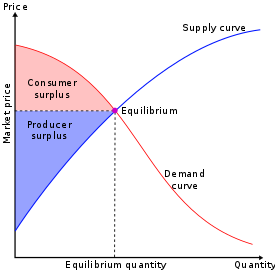
Consider this diagram taken from Wikipedia.
Graph illustrating consumer (red) and producer (blue) surpluses on a supply and demand chart
(Source)
The producer surplus represents the price over the cost of production--and that amount is what is fought over by worker and capitalist. The consumer surplus represents savings by consumers, giving them more money to spend elsewhere.

The effect of new technology is to lower the cost of production. The supply curve will move down, and the point labeled equilibrium will move down and right along the demand curve. The producer surplus will likely (not necessarily) shrink, reducing benefits to capitalists and workers alike. But the consumer surplus will necessarily increase, effectively raising consumers' standard of living.

Since we're all consumers, we're all better off if technology makes things cheaper. Marxists (including Mr. Barns) somehow don't understand this.

Mr. Barns realizes that not all the former laborers will be unemployed. He writes,
While there is a certain truth to the notion that technological development creates more jobs, since new industries (or branches of industry) offer new labor needs, the interim between employment and re-employment in a capitalist system is dehumanizing. All human needs are marketized under capitalism, and if you don’t have the money then you are going to starve (or otherwise be deprived of needs like housing, health care, entertainment, a car to get to work, etc). Meanwhile, the unemployed part of the population serves as a pressure on employed workers to accept lower standards of work and compensation. Unless there is a revolution, the same cycle of needless unemployment will repeat itself.
I don't think he realizes that new technology always creates new jobs, and for two reasons. First is supporting the new technology: forklift repair and maintenance, fuel, forklift manufacturing. But this isn't most important. More crucial is that consumers have a whole lot of money left over that they'll want to spend elsewhere: movies, video games, restaurant meals, personal grooming, travel, etc. Eyebrow plucking is now a job description! Who would've thunk?

Which brings us to Mr. Barns' important point--that the job market is dehumanizing. Of course he's right--and it is inevitably so. People will only pay for goods and services they want, for which they won't pay a penny more than they have to. Some people (not me) want to have their eyebrows plucked (God knows why), and that leads to (what I think is) a dehumanizing profession. Though better than being unemployed.

Consider Mr. Barns' alternative: all job categories are frozen in stone. Any improvement in productivity has to be taken as a reduction in working hours. Nobody is ever allowed to earn any more money. Capital allocations are made politically (i.e., by the mob), rather than by maximizing benefit to consumers (i.e., the same as maximizing profits). This is a recipe for poverty, as experienced in the former Soviet Union and Maoist China, and in Cuba today. I'd rather live in our "dehumanizing" world.

Indeed, contra Mr. Barns, our problem is not too much productivity, but rather too little. Productivity growth has slowed considerably since the mid 1970s, and nobody really knows why. The result is our standard of living is not growing, and the world is becoming a much more zero-sum game. See books/podcasts by Robert Gordon, Tyler Cowen, and Peter Thiel, among others.

Mr. Barns (uniquely among Trotskyists) discusses artificial intelligence (AI). Today AI is simply a tool--one that makes the robot cheaper and more efficient. I think Mr. Barns' concern over advertising is misplaced. For example, how much money would Trump have to spend in advertising before Mr. Barns would vote for him? Billions? Trillions? A whole lot, for sure. That shows how much good advertising does--humans are ornery and they make their own decisions. (See George Gilder's book Life After Google, my review here).

There is much discussion about AI as an existential threat to humanity--i.e., killer robots who will do us in. Nick Bostrom and Gwern write about this. I have not followed this literature at all, and somehow can't take it seriously--sort of like climate change.

Mr. Barns writes about commuting and mass transit. It's interesting stuff, but it will have to wait for another post.

Further Reading:

Monday, July 6, 2020

Men are Men and Women are Women

Men are men and women are women. So claims The Militant. Sort of. Somehow.

A feature article in this week's paper written by the Editors, entitled A working-class road to expand rights for all the oppressed, leads with this paragraph (link and emphasis mine).
An article in last week’s issue of the Militant — under the headline “Supreme Court: Job Discrimination for Being Gay, Transgender Is Illegal. Ruling Includes ‘Poison Pill’ Against Women’s Rights Fight” — was wrong. It erroneously implied that the June 15 court decision, though flawed, should be welcomed by the working class and others fighting to eradicate prejudice, bigotry and discrimination in employment and other areas.
"Implied" really is a weasel word--apparently the offending article, by Emma Johnson, never actually said anything wrong. Indeed, after reading both articles, wrong seems much too strong a word. At worst it's slightly unclear. Surely no reason for Ms. Johnson to be rendered an unperson.

The articles concern the recent 6-3 Supreme Court ruling stating that “an employer who fires an individual merely for being gay or transgender defies the law.” The decision--authored by Justice Gorsuch--was based on an interpretation of Title VII of the 1964 Civil Rights Act. The surprising ruling has drawn much conservative ire.

The Militant isn't precisely against the outcome, as the second paragraph of the Editors' article makes clear.
The stakes for the working class and our allies in opposing each of the three separate firings at issue in the court case are indisputable. The bosses themselves readily acknowledged they had fired the workers only upon learning they were gay or transsexual, without the pretense of any work-related reason. If employers get away with arbitrarily singling out a worker for firing or other penalties, then any fighting capacity of the workforce and unions for unity in protecting one another is set back, irreparably so if not combated and reversed.
The problem isn't the decision, but rather the way it was reached. Gay and transgender rights are to be won by working class activism following a debate within the working class itself. Instead the rights were awarded on a silver platter, offered up rather arbitrarily by the Supreme Court.

The analogy Ms. Johnson offers is Roe v. Wade, which preempted any discussion of abortion in this country. In her telling, American workers would have reached a consensus guaranteeing a woman's right to choose, and instead of it being hopelessly controversial, abortion would have been widely available. The result of Roe v. Wade is paradoxically not more abortion, but rather less as the working class can't speak with one voice on the issue.

The Editors, meanwhile, cite the 1979 Weber case, where a white worker sued on grounds that an affirmative action program resulted in "reverse discrimination." The Supreme Court ruled against Mr. Weber, which the Editors claim was "a victory for working people."
That is the kind of working-class action needed to defeat arbitrary and discriminatory hiring, firing or promotion practices of any kind by private or government employers. Changing attitudes about countless forms of discrimination and bigotry are not the product of either legislation or court rulings but of unity forged in struggle by working people, the oppressed, and our class organizations.
So let's try to figure this out.
  • The Gorsuch decision, while nominally correct in guaranteeing gay rights, nevertheless preempted working class action. Both Ms. Johnson and the Editors agree with that.
  • Roe v. Wade, mentioned by Ms. Johnson, and also nominally correct, has also preempted working class action, paradoxically making abortion less available.
  • The Weber case, cited by the Editors, is still nominally correct, but in this case it is a reflection of working class sentiment rather than an arbitrary Court ruling.
Huh?

Honestly, I'm stumped. I can't make head or tail of this. Where did Ms. Johnson go wrong?

The problem isn't really anything that Ms. Johnson says. It's rather that she's succumbed to reactionary petty bourgeois thinking--nothing that a good dose of humiliation self-criticism won't solve.

Because--while the outcome of Gorsuch's ruling is correct--the reasoning is straight from the reactionary, petty bourgeois Left. The Editors write:
The court’s contorted ruling as to what constitutes discrimination based on “race, color, religion, sex or national origin” is a blow to working people and the oppressed. It lends credence to the utterly anti-scientific notion promoted by many who consider themselves enlightened, progressive, that human beings (unlike almost all other animal species) are not born as either female or male. ...
Those holding this unscientific view demand that “gender” — solely a grammatical term until only several decades ago — instead be left open at birth, to be “chosen” by the individual sometime later in life from literally dozens of possible options. Anyone can supposedly be a woman or a man, or virtually any variant in between, merely by declaring themselves so.
And true enough--men are men and women are women. Vive la différence! The Editors accurately mock the ridiculous opinion common in academic circles. It's easy to do--we conservatives do it all the time. That Ms. Johnson fell for the academic BS shows her lack of proletarian sensibilities.

But wait! Turns out she's just as sensible as the Editors, perhaps even more so. She writes,
But the fact is, the court’s way of handling the case assures that years of litigation will follow. Reactionary forces that advance a gender-over-sex agenda will weaken the fight for women’s emancipation. They will seek to use the ruling to demand admittance to women’s bathrooms, sports competitions, locker rooms and other sex-separate spaces, and to attack freedom of speech and health care.
So I count Ms. Johnson not guilty. Her article is actually a clearer statement of what I (sort of) understand to be The Militant's true position. She does not deserve her walk of shame.

So why does The Militant retract an article that doesn't need to be retracted? This is like Tweedledum retracting a piece written by Tweedledee. It makes no sense.

So I count three possible reasons:

  1. Ms. Johnson is about to be expelled from the Party.
  2. There is some very subtle point that I missed, but which nevertheless is of profound importance. In which case they need a third article to tell us what it is.
  3. It's just clickbait. It did, after all, inspire me to write this post.
I vote for option three. I should probably retract this post--but I won't.

Further Reading:

Monday, June 29, 2020

Let Them Eat Little Bits of Green Paper

From The Militant
People live well when they have enough money to buy the consumer goods they want and need.

People are poor when they either don't have enough money, or when consumer goods are not available at an affordable price. In Keynesian parlance, the former case is known as a demand side shock, while the latter is a supply side shock. (Without getting into any argument about the relevance of Keynesian economics, the nomenclature is helpful.)

The Great Recession of 2008 was a classic demand side shock. Housing prices collapsed, the stock market went down, and trillions of dollars of wealth were destroyed. The result was a sharp drop in the money supply, greatly reduced demand, after which followed bankruptcies, factory closures and unemployment. Everything spiraled downhill from there.

The Keynesian solution to a demand-side shock is for government to pump money into the economy by deficit spending, thereby putting people back to work again and so increasing natural demand until the economy recovers. This is called stimulus, and the federal government under Bush and Obama did approximately that. The economy has since recovered. At least that's the simple story--one can argue about how true it is.

The problem today is precisely the opposite--we have a supply-side shock. To illustrate, in January people used to eat in restaurants. By April, because of the virus, restaurants were deemed unable to serve food safely, and therefore nobody ate in restaurants. All of a sudden the supply of restaurant meals collapsed to zero--despite the fact that consumers had plenty of money to spend in restaurants.

A similar story can be told for airlines, hotels, and Uber rides. The problem was never lack of money, but rather the lack of safe supply of said services. Workers in those industries were laid off, unemployment ensued, rent and mortgages went unpaid, and it spiraled downhill from there.

Demand-side and supply-side shocks both end up in roughly the same place, but they get there by two different routes. The solutions have to be different. As mentioned, for the demand-side shock the government needs to provide stimulus. But for a supply-side shock that is precisely the wrong medicine.

The best solution for a supply-side shock is for the Fed to wave a magic wand and get all the restaurants to reopen again. (They'd also have to re-establish consumer confidence in restaurant safety. As said, it's a magic wand.) Then all the restaurant employees will be back at work and people will happily spend the money in restaurants buying the meals they planned on buying anyway.

But if the restaurants are all closed, more stimulus will not help. No amount of money will convince consumers to eat in a closed, unsafe restaurant. Instead of enabling consumers to eat in restaurants, all the stimulus did was pass out little bits of green paper. Consumers can't eat bits of green paper, nor will restaurant employees get their jobs back. This is the opposite of living well--I can't buy what I want, and the waitress can't earn a living. Stimulus doesn't change anything for either of us.

So instead of spending their stimulus checks, many people just put the money in the bank. That's what I did--because I'm retired my income has remained unchanged. Because of lack of supply (i.e., my wife & I can no longer go out to eat) and also because of the government's stimulus check, my bank balance has increased since the pandemic began. This drives up asset prices, such as the stock market. My experience is similar to others who haven't lost their job or otherwise been able to maintain their income. But for "non-essential" workers such as restaurant employees the outcome is very different. Their income has just gone to zero. 

Of course I don't have to save all my stimulus money. While I can't spend it on restaurant meals, I can spend it on something else. In my case home repairs took up a big slice. Others have spent it on used cars--the used car market is quite hot right now. There are a lot of people looking to buy a house, though inventory is very low. And, of course, especially since we can't eat in restaurants anymore, we will have to spend more money in grocery stores.

The result is more money (stimulus plus foregone restaurant meals) chasing fewer goods that remain in supply (cars and groceries). It's a classic recipe for dramatic inflation. Unless bits of green paper suddenly become edible, more stimulus will just make things worse and increase inflation even more.

An article in The Militant entitled Joblessness soars worldwide, spurs working-class resistance by Roy Landersen (likely a pseudonym for the competent Brian Williams) demonstrates this. The graph above reveals the sharp inflation in grocery prices that have resulted from both added stimulus dollars, plus the disruption in the supply chain. Grocery prices have gone up by 2.6%.

Disruptions in the supply chain include this: while restaurants all closed down, grocery stores got more business. The problem is that food for restaurants is not the same thing as food that's sold in grocery stores. For example, many people enjoy eating in Chinese restaurants, but only a few people cook Chinese food at home. So there's now a huge surplus of Chinese ingredients that used to be bought by restaurants but can't now be sold in grocery stores.

The result of all of this is higher prices.

At some level Mr. Landersen understands this; after all, he did compile the graph above. But his proposed solutions are wrong--they amount to Let them eat little bits of green paper. He condemns "paltry government handouts" as being woefully insufficient.
In the U.S., individuals have been forced to skip more than 100 million payments on student loans, auto loans and other forms of debt. A wave of apartment and home evictions loom, threatening millions with homelessness.
He has a point--all these defaults will lead to bank failures, and then we're all toast. So some short-term help for unemployed restaurant workers is appropriate. And that's been done--though it remains to be seen if it's enough. But it shouldn't be called stimulus, and to the extent it adds to the money supply it's inflationary.

Sending an extra "stimulus" check to somebody like me--who has suffered no income loss--is completely counterproductive.

His second suggestion is gonzo:
The Socialist Workers Party calls for workers and their unions to fight for a government-funded public works program to provide jobs at union-scale pay, building things working people need — hospitals, housing, day care centers, schools, and to repair the crumbling infrastructure.
Why build more hospitals when a) we have enough, and b) we don't have the extra doctors and nurses to staff them? Those professions are already in short supply, and jacking up the salaries of doctors and nurses won't help restaurant employees at all. This really is a Let them eat little bits of green paper strategy. It would be massively inflationary.

I want to eat in a restaurant, but Mr. Landersen will force me to buy a new hospital instead. How silly is that?

The solution--the only solution--is to find a way to reopen restaurants, airlines, hotels, and tourism and travel generally. Little green pieces of paper are useful only if there is something consumers want to buy with them.

Further Reading: