Showing posts with label Environment. Show all posts

Sunday, June 6, 2021

Electric Cars

So I really liked the article entitled Electric cars: On the road to a ‘green’ future?, authored by Cooper Bard and published in Socialist Resurgence. It has a lot of very useful information, specifically about lithium and lithium mining. Lithium is used in lithium-ion batteries that are the power source for electric cars. The cited references are especially useful. So I recommend it highly.

Lithium is the lightest metal on the periodic table, and therefore ideal for low-weight batteries. It is a common element in the earth's crust, but is widely distributed, existing in most places in only trace amounts. Concentrated ores are rare, found disproportionately in South America (esp. Chile and Bolivia), Australia and China. Accordingly, economically viable mines are in short supply, and there is no reason to think the world's lithium supply will grow rapidly.

As one of Mr. Bard's references points out,

If we would like to have a North American standard of living for everyone in the world – say, 1 car for every 2 people – then we would need about 3.4 billion Nissan Leafs. This would use 32% of the identified resources (all known lithium in the world), or 82% of the reserves (all lithium that is currently economic to produce). Even with widespread recycling, that seems like an unsustainable prospect.

And that's just lithium. Mr. Bard mentions cobalt and nickel. Cobalt is mined mostly in DR Congo, with smaller amounts coming from Canada. Nickel is more widely dispersed:

More than 2.5 million tonnes (t) of nickel per year are estimated to be mined worldwide, with Indonesia (760,000 t), the Philippines (320,000 t), Russia (280,000 t), New Caledonia (200,000 t), Australia (170,000 t) and Canada (150,000 t) being the largest producers as of 2020.

For whatever reason, Mr. Bard doesn't mention copper, which electric motors require in large quantities. Indeed, the best response to governments mandating electric cars is to buy copper futures or copper mining stocks, which have doubled in price over the past 18 months. "Chile was the top producer of copper with at least one-third of the world share followed by the United States, Indonesia and Peru."

The common method of mining lithium involves the selective precipitation of various salts in brine pools. At first the ore is dissolved in a large pool, and as the water evaporates the salts crystallize and precipitate out. One then has a mixture of lithium, manganese and boron salts. These are then dissolved in another brine pool, and are again selectively precipitated out (by varying the pH), enabling the isolation of sufficiently pure lithium salts. Turning lithium salts into metallic lithium requires copious amounts of electricity, in a manner similar to aluminum production. Any general chemistry student who did qualitative analysis in a lab will understand the basic principles.

Even if you didn't follow all of that, the bottom line is that mining lithium requires lots of water, and is a process that takes months or even years to complete. The waste products include sulfuric and hydrochloric acid, along with heavy metal byproducts. None of this is good for the local groundwater.

So Mr. Bard is quite right: lithium mining is not good for the environment. And more--there is not enough lithium out there to electrify our transportation system. Similar issues arise in mining the other necessary metals. Copper, for example, is extracted in huge, open pit mines, leaving enormous tailings in their wake. Fracking is a much cleaner, cheaper and less destructive way of producing energy.

I'll take issue with Mr. Bard's description of the Thacker Pass mine in Nevada. He writes,

Clay dug up from what is essentially an exploded mountain is mixed with 5800 tons sulfuric acid a day. The process will require over 3200 gallons of water every minute. The site, operated by Lithium Americas, will generate over 350 cubic yards of mining waste laced with the sulfuric acid [1]. Groundwater may also be contaminated with toxic materials. Anyone who declares this an environmentally safe solution has an odd perspective on environmentalism!

I won't argue with the last sentence, but the rest is misleading. The water is not required by the minute, but rather while setting up the brine pools, i.e., every few months. And similarly for sulfuric acid. Further, there is no groundwater at Thacker Pass--if you've traveled in Nevada you know the place is dry as a bone.

He also writes,

[The Thacker Pass] mine has received the ire both of local ranchers, who have filed lawsuits, and the Fort McDermitt Paiute and Shoshone Tribes, who have delivered petitions and protested the site, as well as organized a 273-mile-long prayer run to promote awareness.

The Ft. McDermitt reservation has 341 inhabitants, and is located about 50 road miles away from the mine. It is not clear to me how the mine will in any way affect the tribe. I also don't see why that small population should have veto power over an enterprise of national significance.

But I agree with Mr. Bard that electrifying our transportation system is not a solution to any environmental crisis. I'll suggest that fossil fuels are much better, cheaper and cleaner.

Instead of fossil fuels, Mr. Bard's suggestion is that we revert to "mass transit," i.e., a 19th century solution to a 21st century problem. He writes,

One bus—whether diesel, hybrid, or electric—can efficiently transport 50 people. A train or tram connected to a renewable city electric grid will provide clean transit to thousands of people over the course of a year. Mass transit has the dual advantage of being both more accessible (and more equitable) and more efficient. Pound for pound, trains, trams, and buses require less and do more.

Which is weird, because the buses in my hometown rarely carry more than half a dozen passengers at a time. Often I see them driving around completely empty. Trams famously travel at 19 miles per hour. On current ridership, there is no way that so-called "mass transit" is more energy efficient than private cars.

More, it's really hard to get to work on mass transit. Randall O'Toole writes,

It doesn’t reach many jobs: The University of Minnesota’s Accessibility Observatory estimates that a typical resident of the nation’s 50 largest urban areas can reach more than twice as many jobs in a 20-minute auto drive than a 60-minute transit ride. Auto users can reach 12 times as many jobs in 60 minutes up to 67 times as many jobs in 10 minutes as transit users.

Mr. Bard implicitly recognizes that--he phrases transit's advantage as "pound for pound." But surely, "minute for minute" is a much better comparison, and on that "mass transit" loses big time. Mr. Bard apparently assigns no value to people's time.

I believe Larry Ellison dinged rail travel something like this:

A train starts from a place you don't want to start from, leaving at a time you don't want to go, and takes you to a place you don't want to be at, arriving at a time when you don't want to get there. And after all of that you have to get into a car to drive to your destination.

Mass transit works in densely populated cities, e.g., New York. But most Americans don't live that way, and don't want to live that way. Mass transit doesn't work for suburban or rural areas.

Just imagine if the indigenous tribe Mr. Bard otherwise so champions were all forced to wait around for buses. They wouldn't be happy. 

Further Reading:


Saturday, March 20, 2021

Socialist Action Believes American Children Should Freeze to Death

James Fortin, a journalist for Socialist Action (SA), pens an article entitled The Capitalist Criminality of (Un)Natural Fracked Gas. It is complete nonsense, buttressing SA's reputation as a pro-poverty grouplet. Indeed, the logical conclusion is that American houses should not be heated, and children should be allowed to freeze to death. It's the socialist way.

The rot starts at the top:

Exxon Mobil, fifty years ago, was the first to obscure and lie about the dangers that fossil fuels pose to the climate. But such criminal “traditions” carries on to this day. Pittsburgh EQT, the largest supplier of U.S. gas, pumping about 4 billion cubic feet a day, says on its website as of this writing: “Clean burning natural gas is an important part of our country’s energy mix, and we are proud to be a major producer of natural gas and even prouder to produce it in an environmentally responsible manner.”  Whatever the claim, the record on natural gas says otherwise, overwhelmingly.

If anybody is lying about fossil fuels, it's SA. Solar and wind (S&W) combined produce less than 4% of America's energy, while fossil fuels are responsible for 80% (nuclear, biofuels and hydroelectric make up most of the difference). It is literally impossible for S&W contribute much more than 10% of total electricity production. Germany has gone the farthest with this, with S&W comprising 11.9% of total electric power, but they have the costliest electricity in the world, at 38.1 cents/kwh. Compare that with Oklahoma's 8.8 cents/kwh.

Unlike what Mr. Fortin claims, cheap electricity does not just benefit Exxon Mobil. How many children would freeze to death if Mr. Fortin turned off gas supply? How many people would lose their jobs if factories had to pay double or triple their current electric bill?

Mr. Fortin admits that gas has ended most coal consumption in the US, and also that it is a much cleaner fuel. As a result, US CO2 emissions have declined steadily since 2005.

(Source)
He also points out that cheap gas made investment in S&W uneconomic. Of course--why invest in something that's more expensive, and therefore wastes more resources and is likely worse for the environment? Raw materials needed for S&W manufacture include silicon, copper, aluminum, cadmium, manganese, molybdenum, and zinc, along with rare earth metals. These are expensive to mine and leave a lot of heavy metal waste in their wake. It is not clear that S&W is a green technology.

While understating the potential costs of S&W, Mr. Fortin hugely exaggerates the dangers of fracking. He writes,

Fracking operators have avoided disclosure of the chemicals used in their extraction process. Numerous studies though have confirmed evidence of cancer-causing chemicals such as benzene, toluene, ethylbenzene, and xylene contaminating groundwater in the area of the wells, and populations in the vicinity of wells experiencing disproportionate occurrences of respiratory, nervous, and immune system problems. A wide assortment of lesser impacts such as headaches, eye irritation, and dizziness have been found as well.

Mr. Fortin provides no source for this data. While the precise components of fracking fluid are kept as trade secrets, the major components are well-known: sand and soap. There is this:

Fracking fluids fall within such cryptic catagories as carrier/basefluid, biocides, scale inhibitors, solvents, friction reducers, additives, corrosion inhibitors, and non-ionic surfactants – which is a catch-all category for dozens of fluids like Naphthenic Acidethoxylate or Poly (Oxy-1,2-Ethanediyl), Alpha-(4-Nonylphenyl)- Omega-Hydroxy-, Branched.

While it sounds scary, most of these are just "soap." Indeed, the term surfactant is a generalization on the "soap" idea. "Solvents" is likely just a synonym for water. According to The Frackers (my review here), the industry has become very sensitive about being green, and tries to source all fracking fluid ingredients from consumer products. It is highly unlikely that anything very toxic is found in fracking fluid--certainly not as hazardous as the waste from S&W manufacturing.

The chemicals that Mr. Fortin lists are very unlikely fracking ingredients and are almost certainly not used. Benzene is a strong carcinogen and is banned from most industrial processes (and from undergraduate chemistry laboratories). Mr. Fortin, as usual, provides no reference nor context for his data. Similarly, his list of ailments is so vague and so common that it is unlikely that they're caused by fracking.

He also writes,

In one Texas location a study performed between 2012 and 2015 demonstrated that babies born to mothers who lived within 5 miles of natural gas flaring during that time frame were 50 percent more likely to be premature. In other areas excessive nausea, fatigue and cancer have been attributed to exposure to radioactive materials extracted from the fracked bedrock together with the natural gas.

Natural gas flaring comes from oil wells, not gas wells. The purpose of a gas well is to capture the gas, not to burn it off. So this is a silly charge. He may be correct that gas wells bring radioactive substances to the surface, but this has to be a minor effect. Is there any evidence of higher radioactivity around gas wells? I doubt it, and again, Mr. Fortin cites no reference. Here as well, the list of ailments is too vague and other possible causes too widespread for anything to be attributed to gas wells.

I'll cite just one more paragraph, full of hyperbolic claims. My responses are in red.

The attack on public health is part and parcel of the assault on the environment. With the development of fracking technology came the exploitation of shale geological formations where 75 percent of U.S. gas now originates, now found throughout the continental U.S. Obviously any resource extraction has some environmental impact. But fracking is less dangerous than coal mining, than the traditional way of procuring gas, and likely less destructive than the manufacture of S&W technology. A poisonous mix of patently secret  chemicals and massive amounts of water, under enormous pressure, are blasted into the fissures created thousands of feet below the surface. The list of chemicals is not secret, and they're not especially poisonous. The deadly concoction – presently with each well consuming over 14.3 million gallons of water on average – is pumped out and stored for treatment and further use. Fracking in total uses about as much water as American golf courses. Much of the water comes from deep underground, way below well-water aquifers, and is too saline for human/agricultural consumption. That the water is reused is a benefit. The fracked gas now being produced releases into the atmosphere carbon dioxide, nitrous oxide, carbon monoxide and methane, a greenhouse gas 80 times more potent than carbon dioxide, alone. Methane is natural gas, and is the product the frackers wish to sell. They obviously try to prevent its escape into the atmosphere. Unlike CO2, methane decomposes quickly in air. Side effects (have that read “cost of doing business”) include earthquakes, billions of gallons of water poisoned beyond repair, and despoilment of grasslands and forest. The earthquakes are a problem, but increasingly understood and perhaps avoidable. As said, the water is already saline before the frackers use it, and "despoilment" is a lot less than open-pit mining, as is done to obtain copper and other metals for solar panels and electric cars.

Not only is Mr. Fortin against fracking, he's also against pipelines. Indeed, he's against any kind of industrial infrastructure at all. He apparently believes that electric power and home heating will appear miraculously from the tooth fairy and free unicorns.

The man literally believes that letting children freeze to death is a price worth paying in order to prevent "climate change." Mr. Fortin and SA have their priorities all mixed up. They're subscribe to pro-poverty politics.

Unlike Mr. Fortin, I'm against poverty, and I hope it can be eliminated.

Further Reading:

Thursday, January 14, 2021

Louis Proyect and "Degrowth"

I have often accused Louis Proyect of being pro-poverty (e.g., here, here, and here).

I did expect pushback at some point--how can a Marxist be in favor of poverty? Surely, I thought, Mr. Proyect would deny my charge and argue that he was indeed for human well-being.

What I didn't expect was a confession--Mr. Proyect explicitly admits to being pro-poverty! He concedes as much in an article entitled A reply to John Molyneux and Michael Lowy on degrowth. (Molyneux's paper is here; Lowy's can be found here.) "Degrowth" is a synonym for "we all need to take a big cut in our standard of living." He offers a succinct definition here:

Degrowth is completely focused on the question of how humanity can not only survive into the 22nd century but how can civilization continue until the planet dies due to astrophysical realities. It poses solutions based on the needs of a modest life-style that while giving up on SUV’s and all the other crap can allow the full development of the human being, who might have to work 10 hours a week while painting landscapes or growing orchids the rest of the time. That means addressing the population question that people like Molyneux recoils from.

The argument is that Joe, by not driving an SUV today, will measurably enhance the well-being of whatever civilization exists a billion years from now. This is ridiculous on its face!

At bottom, Mr. Proyect's philosophy is a death cult.

He makes two assumptions: first, he fails to discount the future--i.e., the comforts of his great-great-great grandchildren two hundred years from now are as, or even more important than our comforts today. This is ironic because I don't believe that Mr. Proyect even has any grandchildren, which renders the whole issue hypothetical. Since part of the proposed solution is reducing the birth rate, putative future generations won't exist at all. How's that for a wonderful life?

Second, he supposes he can predict the future. He knows with unseemly confidence that Joe's SUV is gonna ruin the climate--not just now, but literally for all time! I think he's almost certainly (99.999%) wrong about climate change--whatever that is, it isn't an existential threat, and future generations (much less distant civilizations) will not remember us for our carbon profligacy.

I can't possibly go through all the bullshit in his correspondents' two papers. Lowy's piece is so far detached from reality that it establishes him firmly among the 99% of academics that give the remaining 1% a bad name.

Our authors completely ignore capitalism's benefit to consumers. Capitalism produces the goods and services that we want to buy and which greatly prolong and enhance our lives. Claiming that capitalism's sole benefit is profit for the capitalist is simply not true.

They all maintain that democratic decision making will make for a better environment, arguing that somehow the majority will elevate the interests of future civilizations billions of years from now over those of their own children (or themselves) today. There is no evidence for that. Joe with his SUV gets to vote just as much as Mr. Proyect.

Their claim that capitalism wastes resources is not true. A capitalist wants to cut costs, which means using as few resources as possible. Now there are issues that arise from "the tragedy of the commons," i.e., people passing environmental costs on to their neighbors. This is where government has to step in and why we need an EPA (the purpose of which is not to preserve the environment for the next billion years). But for the most part, capitalism wastes as little as possible, and is therefore much cleaner than rival societies, such as socialist ones.

Most regrettably, our friends want to limit people to working 10 hours per week--they can spend the rest of their time "painting landscapes or growing orchids." But they're not allowed to earn any extra money! They can't start a business--not even a lemonade stand--because somebody a billion years from now might object.

Trading goods and services is a uniquely human trait--no other animal does that. Mr. Proyect calls it "working," and we're now supposed to be forbidden from doing it. This is like being in prison--where they sit around all day painting landscapes.

Somehow Mr. Proyect concocts a wood shortage--mysteriously there is now a dearth of trees. Capitalism is "[s]o efficient at reducing forests to toothpicks." He writes,

Molyneux proceeds to define some of the norms we can expect under world ecosocialism. This one stuck out for me: “The extensive retrofitting of homes”. I am not sure what this means exactly but it would point to the banning of any house or apartment over 3,000 square feet for a family of four. I’m definitely for that but within such an advanced new way of sheltering, how do we create the furniture that people need for a modicum of comfort? We certainly need chairs, tables, beds, desks, and bookshelves, don’t we? Can we have a socialist Ikea that supplies such basics?

In this new ecosocialist utopia, some bureaucrat is gonna tell you "you can't have that end table. We need to save the wood for the folks living a billion years from now."

Some people would prefer to have fine furniture to painting landscapes. Who are these ecosocialist creeps to tell them they can't do that?

One thing I really don't understand about ecosocialists is their fixation on "mass transit." Somehow they imagine that a technology from the early 1900s is the ultimate solution to problems faced by civilizations a billion years from now. I don't get it.

So how do people get to work? In 2019 (before the pandemic), 1.4% of American commuters took mass transit, while 5.3% worked from home. (These are median numbers from a list of 110 US metropolitan areas.) Since then transit's share has collapsed. Ridership in the New York metro is down as much as 90%, while the work from home share has skyrocketed. As of September, 2020, 33% of all employees worked exclusively from home, while another 25% worked from home for part of the week. Only 42% of American workers still go to the office or factory every day.

This trend may partially reverse post-pandemic, but it will never go back to where it was. The number of people working in Lower Manhattan or Chicago's Loop is now permanently reduced.

Please, Mr. Proyect--tell us why you think we need more buses and subways? (And let's forget about streetcars, which average speed is only 19 mph!)

The whole mass transit thing is an anachronism. And the whole ecosocialism thing is a vile religious movement that is very bad for children and other living men and women.

Further Reading:


Thursday, January 23, 2020

Louis Proyect and the More-Poverty Solution

Louis Proyect worries a lot.

There is climate change--a boogeyman that's supposed to destroy civilization within the next 12 years (I guess since the New Year it's now only 11 years). All this because of modest increases in CO2, which despite being only 0.04% of the atmosphere is nevertheless supposed to heat up the world's oceans lickety-split. Recall that the oceans represent 99.9% of global heat capacity--many orders of magnitude more than atmospheric CO2.

Rumors of our imminent demise from climate change are exaggerated way beyond any credible belief.

Then he frets over GMOs, or genetically modified plants that manufacture their own insecticide and thus don't need to be sprayed. While in principle just an improved method for breeding agricultural plants as has been done for millennia, the specific technique has been used since 1983. It saves farmers huge amounts of money in pesticides, along with greatly reducing the quantity of pesticide in the environment from any source. Despite trillions of GMO meals having been served, there is absolutely no evidence of any threat to human or ecological health as a result.

Mr. Proyect's aversion to GMOs is less rational than the fear some people have of measles vaccines. That is, completely irrational.

He worries about fracking. Here he is on more solid ground since the industry clearly has some environmental costs, though they are increasingly under control. But the benefits of fracking are huge, reducing fuel expenses across the entire society. Natural gas just fell below $2/Mbtu. The cost of gas to heat my 1800 sqft house was only $88 this past December, a nearly trivial expense. If you're against poverty and want poor people to be able to heat their homes, then this is really a good thing.

But Mr. Proyect probably agrees with President Obama: that we'd all be better off if all fuels cost three or four times more in the future. What a guy!

Mr. Proyect doesn't like nuclear power, either. He writes 
In his letter urging Bernie Sanders to embrace nuclear power, Phillips assured him that the human costs of Chernobyl were exaggerated. Even though there were likely 4,000 people who would die eventually because of exposure, it was a lot less than Greenpeace and other groups alleged.
The implication is that today's small, completely redesigned, Generation IV, nuclear power plants are just like Chernobyl. Which is like saying a modern Prius is the same as a Model T. With Gen IV, the residual radioactive waste decays in a few hundred years rather than a few billion. Unlike, say, coal ash waste, the volume of generated nuclear waste is very much smaller. It could all be stored in Yucca Mountain with plenty of room to spare. And it emits no CO2 (if that's important to you) or other atmospheric pollutants.

He worries about tourism--especially "mass tourism." He approvingly quotes Richard Smith
Take just one: Cruise ships are the fastest growing sector of mass tourism on the planet. But they are by far the most polluting tourist indulgence ever invented: Large ships can burn more than 150 tons of the filthiest diesel bunker fuel per day, spewing out more fumes—and far more toxic fumes—than 5 million cars, polluting entire regions, the whole of southern Europe – and all this to ferry a few thousand boozy passengers about bashing coral reefs. There is just no way this industry can be made sustainable.
This, presumably, is in addition to AOC's effort to ban airplanes--in Mr. Proyect's perfect world nobody will be allowed to travel at all. At least not unless you're exceptionally Woke. Only really Woke, pre-approved, certified people could get a passport. The rest of us will have to make do with three hots and a cot (aka free food and housing).

All for the sake of saving the planet.

Tens of millions (perhaps even hundreds of millions) of people depend on tourism, directly or indirectly, for their livelihood. Of those, some millions earn a living specifically from cruise ships. Mr. Proyect will throw all of these people into abject poverty.

Tourism is one of the most efficient ways of transferring money directly from rich people to poor people. And Mr. Proyect has, as a first order of business, a desire to stop it. What a guy!

Then, of course, he and Mr. Smith have their facts all wrong. Modern cruise ships don't run on oil at all, but instead on liquefied natural gas (cheaper, cleaner, and doesn't spill into the ocean). More, eco-cruises are growing faster than the industry as a whole--e.g., to the Galapagos and Antarctica. These ships, along with their customers, have a strong self-interest in protecting the resource they want tourists to see. If there was ever a lobby to protect the environment, the cruise industry is it.

Finally, Mr. Proyect writes off the people who live along Bangladesh's coast.
Huber certainly feels sorry for some Bangladeshi farmer or fisherman whose life will be destroyed by rising ocean levels but has to question how such struggles could ever have the social power capable of taking on a capitalist class that is responsible for the dispossession and pollution in the first place.  ... For a Yanomami or a Bangladesh farmer or fisherman, the stakes are very high. For a machinist working at Boeing or a Verizon lineman in suburban New Jersey, there are worries about climate change but it doesn’t have the same immediacy as living in a village near the Indian Ocean.
Rich people are able to take care of their environment--that's why America is much cleaner today than it was 50 or 100 years ago--and why the average New Jerseyan doesn't care. Poor people don't have that luxury. Mr. Proyect's solution is to make the rich people poor, which is truly perverse. The best solution is to make the poor people rich.

Perhaps Mr. Proyect has never heard of the Sundarbans, the largest mangrove swamp in the world, located in Bangladesh. Wouldn't part of a realistic solution be to attract more tourists to visit it? People who would buy fish from local fishermen, tours from local guides, handicrafts from local women, and food from local farmers. Plus they'd leave tips. Plus the travel company will have a strong vested interest in preserving the ecosystem.

Nah! That's much too practical. Mr. Proyect is against that. He thinks Bangladeshis should just remain poor forever so that some kooky folks on the Upper East Side can power-trip by banning air travel and cruise ships. What a guy!

I agree with Mr. Proyect that human civilization will come to an end some day--nothing lasts forever. We've been around (as a civilized species) for some 7000 years now, and perhaps we've got a few thousand more to go. I don't know how it ends, but I do know that we're not gonna run out of environment in the next eleven years. Not even in the next millennium. Mr. Proyect needs to get more sleep at night, and stop worrying about silly things.

Down With Poverty!

Further Reading:


Note: Due to health issues, blogging may be light for the next few months.

Monday, September 30, 2019

The Pro-Poverty Crowd

"You have stolen my dreams and my childhood with your empty words."
Picture credit; Caption credit
I should talk.

Last February my wife and I visited the Philippines. We flew business class on Japan Airlines and stayed in 4-star hotels. We hired cars to travel around Manila, foregoing public transportation. We dined in nice restaurants, some expensive even by New York standards. A low-cost, eco-friendly, carbon-neutral vacation this was not.

Surely some wiseguy could have published a photo of me sleeping on my lie-flat, business-class seat, paired with street urchins sleeping on sidewalk mats along Mabini street in Manila. The injustice of it all! How could I?
A homeless child in the streets of Manila in 2014.
A homeless child in the streets of Manila in 2014 (Source)
I have no guilty conscience whatsoever.

I don't begrudge Greta Thunberg her first-class train ticket (or so it looks to me). Nor am I offended by her vegan(?) lunch--downright spartan compared to mine in Manila. I'm not bothered by her air travel to the U.N. meeting in New York, even though she probably flew business class (or even first class). That her audience all made similar arrangements to attend her talk is also not an important concern.

What disturbs is not the facts themselves, but rather the hypocrisy of it all. Terry Evans, in a feature article in The Militant, understands that much.
Almost all the proposals bandied about amounted to one thing — working people have to sacrifice to save the world. Give up your car, no more air travel, only plant-based food at McDonald’s, and the like.
[UN General Secretary] Guterres demanded no new coal plants be built worldwide after 2020. Another U.N. official told countries in Africa “not to get into coal.”
Calls to restrict which kinds of energy sources can be built by governments in the semicolonial world, countries whose development was stunted and distorted by colonial exploitation, amount to a demand that the 840 million people who live without electricity continue to go without. Close to 600 million of those live in rural Africa.
Ms. Thunberg, who with a straight face demands of her audience that they impose draconian restrictions on the rest of us--to reduce our carbon footprint by more than 50%--somehow holds herself exempt from those rules. Unlike me--merely on a luxurious, recreational trip to Manila--she is among the Chosen Elect tasked to Save the Planet. Not only is she Chosen, but so is her audience, made up of diplomats and potentates from around the world.

They may think they're Chosen, but to me it looks like Greta Thunberg and her audience don't really believe their own climate bullshit. I think it's hypocrisy all the way down.

Apart from The Militant, my Trotskyist friends agree with Ms. Thunberg. Here are excerpts from a manifesto issued by the Solidarity Ecosocialist Working Group.
While the forests in the Amazon and Congo are in flames, while extreme weather demolishes island countries from the Caribbean to Southeast Asia, while the Great Lakes suffer from both flooding and the spread of algae, politicians and corporations fail to address the climate crisis. So youth around the globe are taking a stand, demanding that we break with the fossil-fuel economy. On September 20 youth are striking for climate justice. We stand with them! ...
We need a “just transition,” one that retools and repurposes manufacturing, replaces the inadequate system of food production and builds communities where people have the right to good, healthy and meaningful work. In short, youth are demanding a future for themselves and for the planet!
The magnitude of the problem is grossly exaggerated; the difficulty of the proposed solution is vastly understated. Though at least Trotskyists are not flying around the world in business class.

But this post isn't about climate change. It's about poverty.

My former comrades--including The Militant--all make the same mistake. And not just them: most Democrats share in the error.

It is this. They believe that if people like me didn't take luxurious vacations, then homeless children could live in a better world. The money I (or Greta Thunberg) spend is in their view "wasted," and instead should be used "to meet human needs."

My business class round trip NYC to Manila cost about $4,000. Economy tickets can be had for around a grand.

Consider this:

  • Without business class service, about half of all flight attendants would be laid off.
  • Economy tickets are partially subsidized by business class passengers, and would be more expensive without them.
  • Skilled chefs prepare meals for business class customers (who are willing to pay for them). Absent the premium fare they'd be unemployed.
Our hotel cost about $200/night, about 25% of which was taxes. We stayed for 14 nights.
  • We paid for maid, laundry, and front-desk services.
  • We got a "free" breakfast (a good one), providing a salary to servers, cooks, and cleaners.
  • The hotel had electricity and potable water--I'm sure we paid a premium for those services, subsidizing Manila residents.
  • The taxes paid for infrastructure throughout the city.
And beyond that:
  • We hired a car and driver nearly every day, paying as much as $200. That pays for the car, the driver, repairs and fuel. In addition to a fuel tax, we paid tolls.
  • We ate in restaurants, paying chefs, waitresses, busboys, food and rent.
  • My wife did some shopping, buying mostly local products.
  • We even patronized a few street vendors.
It's hard to estimate, but I'll hazard that 70% of the $13,000 we spent on the trip was paid out as wages, mostly to Filipinos. The rest went for resources (food, fuel) and profit (maybe 5%). As mentioned, the taxes we paid subsidized the municipal infrastructure, including electricity.

So tell me--would those homeless children be better off if we'd instead stayed home? Of course not! Without tourism the Philippines would be a much poorer place.

And tell me again--would those homeless children be better off if we'd flown coach, stayed in cheap, budget hotels, and lived off street food? Again, no!

There is the old saw:
Give a man a fish, and he eats for a day; teach him how to fish, and he eats for the rest of his life.
We didn't teach anybody fishing, but we did something nearly as good. By our custom we helped sustain a viable economy. I estimate we contributed approximately $6,000 toward labor costs in Manila. The median annual household income in the country is about $5,300--we supported a whole family for a year!

I don't expect an award. I did, after all, have an extremely pleasant vacation in the Philippines. But please don't tell me that I don't care about the children.

Suppose, for example, somebody like President Elizabeth Warren or President Jeff Mackler or President Greta Thunberg comes along and says I don't deserve all my money. It becomes impossible for me to travel to the Philippines--and certainly not in business class. Will that make the homeless children of Manila any richer?

Of course it won't. Making rich people poor does not make poor people rich. And that's what all the pro-poverty politicians--especially including my Trotskyist friends--don't understand.

Down with Poverty!

Further Reading:


Saturday, December 8, 2018

Socialist Action Goes AWOL

The very first post on this blog was commentary on Socialist Action's (SA) 2012 convention. It's a rather dense dissection of SA's understanding of economics. Everything was new back then--I took great pleasure in the argument.

Two years later I blogged about the 2014 conclave. This covers much the same ground as the 2012 piece. The convention concluded poverty was increasing in Europe--I put that exaggerated claim into perspective.

Then I commented on the 2016 convention, criticizing them for the seeming disconnect between the enormous economic crisis supposedly engulfing the world proletariat, compared to the pathetic response of the Party. The imminent destruction of the planet/immiseration of the working class/irremediable crisis of capitalism--all those challenges were to be met by increased sales of their print newspaper, a $25,000 fundraiser, and the sorriest presidential campaign ever launched in American history.

Finally, in February, 2017, I responded to the Declaration of a Faction Fight within the Fourth International, where SA proclaimed its heroic stand defending a proletarian outlook. I accused SA of setting "the bar for success very low." Definitely an understatement. We have, by the way, heard nothing about the faction fight since.

So now we come to 2018. At some point in October, SA announced that their paper would be taking a short break to allow for a convention later that month. The announcement is no longer on the web, but to the best of my memory the convention was held in the 3rd or 4th week of October. For most previous conventions the event was reported at length within a week or two after the meeting.

This year? Crickets. Not a word so far.

Now maybe it will still come--if so, I'm happy to eat my words--I'd love to find out what SA has planned for the coming period. Nevertheless, I'm getting worried. I'm afraid the Party is crawling into a hole and hiding from the limelight. Why?

One possible reason is that SA has become increasingly incoherent. That certainly seems to be the trend from 2012 to 2016. They've lost their Marxist bearings. They have no unique perspective on world politics. They're lost at sea when it comes to both strategy and tactics--and they're ashamed of themselves.

Or it could be there is a big faction fight in the organization and they haven't figured out what to write yet. I doubt that.

Or they just don't like criticism--not that they get very much of it. As far as I know I'm the only blogger who pays them any attention at all. My reach is pretty small, so it seems a stretch to think they're afraid of me. Yet they surely have gotten very secretive of late--they no longer publish locations or phone numbers of their branches, nor have they said anything about attendance at any of their conventions, and now they don't even want to say what they talked about at their meeting. It looks downright paranoid.

A pair of recent issues indicates the confusion. For starters, there has so far been no analysis of the Yellow Vest protests in France. SA is not alone--so far on my Beat only The Militant has covered the protests (here and here). Part of that is the Trotskyist news cycle is very slow. But I think the Yellow Vest movement must be especially embarrassing for Socialist Action.

The Yellow Vests put paid to the idea of a "Vanguard Party." The movement has no leadership--it is an entirely organic creation of social media. It's not organized around any coherent platform, much less the uniquely correct program sanctified by The Revolutionary Party. As far as I know, no Trotskyist organization of any denomination has played any role in the movement whatsoever. All SA can do is kibbutz from the sidelines.

Then the movement is a "weird" coalition between Left and Right--supported by both the National Front and far-left movements. I say "weird" because it's only weird from a Marxist perspective. Us normal folks see a confluence of interests between far Left and far Right--you both support more government intervention in the economy. In France they call that dirigisme. It's the very opposite of Trumpism.

Finally, and most disturbing for SA, is the movement's anti-environmentalism. The proximate cause of the riots was the imposition of a carbon tax (The Militant calls it a gas tax), ostensibly imposed to prevent global warming. Apparently French workers will have none of this global warming nonsense, especially since "fighting" it involves a severe hit to their standard of living. Can't say as I blame them.

SA, meanwhile, has gone whole hog for the most crackpot version of environmentalism. For example, in a recent article by Marc Rome on the role of the electric utility PG&E in "causing" the wildfires in California. The company is now subject to potentially bankrupting lawsuits from fraudster lawyers trying to make a killing.

SA apparently thinks those lawyers are heroes. After all, forcing the electric company out of business will certainly save on emissions--everybody will be cutting back when their power is turned off. And California has a warm climate, so what do all those people need electricity for anyway? Especially given the catastrophic threat imminent global warming poses.

Like the lawyers, SA is convinced the PG&E caused the fires. Now it may be true that the company caused the spark that lit the fires, but that's hardly the big story. According to Mr. Rome, the real cause is "climate change," that ill-defined, protean boogeyman that's about to destroy us all. SA apparently thinks PG&E singlehandedly caused "climate change," and therefore should pay the full bill.

So let's double or triple everybody's electricity rates. That seems to be SA's solution. Because somebody has to pay all those lawyers, and that somebody is gonna be rate payers. Or taxpayers, which is the government's solution. Mr. Rome's article is entitled California governor signs legislation to bail out utility that sparked deadly fires.

Actually, it's not PG&E that's getting bailed out. It's the shyster lawyers. SA is taking the side of lawyers--that's not very revolutionary of them. Here I thought they were supposed to be defending the interests of the working class?

Further Reading:

Wednesday, November 15, 2017

Schreiber on Bonn Climate Talks

Socialist Action's Michael Schreiber reports on the COP23 UN-sponsored climate talks held in Bonn, Germany. The topic has not made the news on any other medium I pay attention to (and I'm a news junkie), so I was unaware that the talks were even happening. That's how far climate change has fallen off the radar in the United States--you have to read papers from Trotskyist grouplets to find out what's going on.

Whatever the status of the scientific debate, the climateers have lost the political battle. People are not willing to take a catastrophic hit to their standard of living now in order to prevent some hypothetical (and improbable) disaster one hundred years from now.

My own posts on climate change are among the least read of any, which is par for the course--nobody is interested in the topic anymore. But Mr. Schreiber's article is such a hodge-podge of silly ideas that I can't resist trying to set him straight (a lost cause, I know). I will make clear at the outset that I don't believe Mr. Schreiber speaks for actual "climate scientists." They are a more sober group of people who are less willing to throw factoids around as propaganda points. For in the long run such hyperbole diminishes their credibility and hurts their cause.

Here are a few of the factoids:
  • "As the conference opened, the World Meteorological Organization released data showing that 2017 is apparently the hottest non-Niño year on record, and is expected to join the two previous years as the three hottest in modern history." What is left unsaid is that the record is only since the beginning of the satellite era, i.e., about 40 years ago. This is not a long enough timeframe from which to draw major inferences about the climate.
  • "The amount of CO2 in the atmosphere (over 400 ppm) is at a concentration unsurpassed in the last three million years, when global temperatures and sea level were significantly higher than today—and the concentration is still rising."  The 400 ppm is true. The "three million years" is irrelevant. 
  • "The report predicted heat waves becoming common, an increase in forest fires in the American West, and drastically reduced water resources with possible chronic drought in the United States by the end of the 21st century. Worldwide sea levels could continue to rise for centuries to come, as the ice sheets and glaciers melt." Rising temperatures will mean more water vapor in the atmosphere, which is inconsistent with a prediction of more droughts. And rising sea levels are not caused by melting glaciers, but rather by the thermal expansion of the world's oceans.
  • "The report presented a grim prognosis for the future, in which the Atlantic coast of the United States could be swamped by rising seas and regularly battered by heavy storms."  'Heavy storms' is inconsistent with extreme drought. And it's not clear climate science suggests there will be more storms, which depend not on the absolute temperature, but rather the temperature difference between the poles and the equator. So far that difference seems to be diminishing rather than increasing.
The conference chose an odd spokesman: the Prime Minister of Fiji, Mr. Frank Bainimarama. He claims to represent “ 'one of the most climate-vulnerable regions on earth' and called on the delegates to 'make the Paris Accord work.' ” If you're trying to convince American workers to make huge sacrifices to prevent climate change, then touting him as the principal beneficiary hardly seems like a winning strategy.

Mr. Bainimarama doubles down on the disaster by claiming “ 'The need for urgency is obvious,' he said, referring to the tremendous hurricanes, floods, droughts, and forest fires of the last year and more. 'Our world is in distress from the extreme weather events caused by climate change.' ” A prediction that predicts everything is a forecast that can't be taken very seriously.

More surprising to me is that Mr. Schreiber, a Trotskyist in good standing, even takes the Paris accords seriously. He echoes the complaints of poor countries that the developed countries are not keeping their word to contribute the promised $100 billion in climate aid.
The Bonn conference is entrusted with creating a mechanism to achieve the objectives of the Paris Accord, while leaving space for those goals to be raised higher. But success, even on limited terms, is not assured. On the first day of the conference, less developed countries, led by India, questioned whether the wealthier countries could be trusted, since they had failed to meet many of their pledges to reduce carbon emissions made at earlier COPs.
India's prime minister, Narendra Modi, has been very forthright in stating that his country is not going to take an economic hit because of hypothetical climate predictions. He has adamantly refused to scale back fossil fuel use. So the hypocrisy is stunning: India still wants money from American taxpayers (among others) to fund its nonexistent efforts in fighting climate change.

Mr. Schreiber seems to believe (though he does not say explicitly) that the Paris accords are a good first step, i.e., a reformist position. Though I will ask: if the Accords were implemented in full, how much cooler would the planet be 100 years from now? How is the implementation (or lack thereof) of the Paris accords reflected in the computer models that supposedly predict the climate?

In the extraordinarily unlikely possibility that Mr. Schreiber gets his way, this is what it would mean for American workers:

  • They will pay much higher electric bills, by multiples of 10, or even 100 times more.
  • Transport will become vastly more expensive, and much less convenient. Travel in the US will be as difficult as it is in today's Cuba.
  • Solar power, when scaled up, will have enormous environmental impacts, from the large heavy-metal waste from their manufacture, to the large amounts of land required for their use, to the toxic and expensive materials used in batteries to store the generated power.
  • Electric cars will put even larger demands on the power network, leading to much higher prices and lower reliability.
It is no wonder that the climate issue has disappeared from American politics. Trump's withdrawal from Paris was very popular, and not even progressive Democrats are advocating that we reenlist. The Accords were never meaningful, regardless of whether the US is a signatory or not.

Further Reading:

Wednesday, June 8, 2016

Canada's NDP Rejects Suicide

Barry Weisleder was a candidate for president of Canada's New Democratic Party (NDP), and he authors Socialist Action's (SA) report on the recent NDP convention in Edmonton. It is very hard to take him seriously, but we will try.

The problems begin in the lede:
Will the left seize this golden opportunity to fight for an anti-capitalist agenda and make North America’s only mass, union-based political party a weapon in the fight against austerity and climate catastrophe?
"Austerity" presumably refers to the supposed increase in poverty across Canada (mostly a myth, I'd argue, but that's a topic for another day), the solution of which is to give more people jobs at higher wages to raise their standard of living. Ultimately, Mr. Weisleder claims he wants to reduce poverty.

"Climate catastrophe" is the dire prediction, maintained by the far Left, that we're all doomed--and it's all the fault of the fossil fuel industry. There is very little evidence that "climate catastrophe" is a likely outcome of whatever climate change is occurring. The best argument one can make is to invest in some insurance against the possibility. But Mr. Weisleder and his comrades are so certain of imminent disaster that any compromise or common sense solution is for them impossible.

Mr. Weisleder must surely understand that Canada's is a natural resource based economy. Most recently its fortunes have been tied to oil--the Loonie's value has closely tracked the price of crude. More generally, Canada depends on an array of resources: mining (gold, nickel), lumber, agriculture, and hydroelectric power. Canada (along with Australia) is unique in the world in that it has managed to build a first-world economy from natural resources--compare it with, for example, Russia, Saudi Arabia, or Congo.

Even an 80% decline in oil prices has not doomed Canadians to poverty, unlike, e.g., Venezuela.

But Mr. Weisleder wants to put an end to all that. He wants to shut down the fossil fuel industry altogether and replace it with some ill-defined (and non-existent) "green energy." Presumably he means mostly solar and wind power, neither of which will ever play more than a niche role in meeting the world's energy needs. But leaving that impracticality aside, consider the consequences.

Among the more egregious failings of Marxist economics (and not just Marxists, but also Donald Trump) is that they don't recognize the importance of trade. A Canadian gold miner earns a living only because he can trade gold for food, gas, cars, and plane tickets, etc. But if nobody wanted gold, then all he'd have is a hunk of yellow rock. The value of gold depends solely on its ability to be traded for other things. Economics is not about wealth or value. It is all about trade. Political parties (and candidates) who think we will get richer by restricting trade are just flat-out wrong.

And that's the rub. Even if solar energy were practical, and even if hundreds of square kilometers of the Canadian arctic were covered with solar panels, the power is not readily exportable. That is, unlike Alberta oil, solar energy can't be traded and will produce no income. Without exports there will be no imports. And then Canada becomes as poor as Venezuela.

So when Mr. Weisleder claims that "green energy" is good for the economy, he is simply wrong. Please, sir, tell us what Canada's exports will be? How will your country earn money to buy fruits and vegetables from warmer climes?

Do Canadians really want to reduce their standard of living to that of the 19th Century?

Indeed, Mr. Weisleder is against anybody being able to earn a living. Miners, oil workers, hydroelectric workers, and likely many more are to be put out of an income-producing job. Instead Mr. Weisleder wants to revert to "local agriculture" (aka subsistence farming) and, bizarrely, high-speed rail.

High speed rail? How does that make sense in a huge country with perhaps the lowest population density in the world? From what income stream (i.e., exports) is this supposed to be paid for? It's a completely wacko idea, though personally I'd love to ride the express train from Chicoutimi to Chilliwack. At a billion dollars per passenger it'd be a marvelous ride--comparable to a trip to the moon.

Mr. Weisleder's goals are contradictory. On the one hand his green agenda will drive everybody into deep poverty, Venezuela style, by denying Canadians any right to earn an honest living. On the other hand, his solution to poverty is to waste money--to create make-work projects on a grand scale, and then invest in things (e.g., high-speed rail) for which there is no hope of any economic payoff.

Mr. Weisleder represents a faction in the NDP called the Socialist Caucus (SC), loosely allied with another faction, Momentum. Depressingly, he boasts that the SC recruited 70 new members, out of 1700 people attending the convention. Also,
Jointly with Momentum, the SC ran 16 candidates for party executive and federal council posts. Vote results, ranging from 5.2% to 15%, revealed a significant hard-core radical left base. It also indicated that, while the broad membership wants change, it is not yet convinced of the need for a Marxist programme. But the SC will continue to make the case for revolutionary change.
So within the already left wing NDP, the SC has had only modest success.

Similarly bothersome, "[d]elegates also voted about 60 per cent in favour of conducting a grassroots discussion of the environmental and social justice proposals in the Leap Manifesto." The latter is a completely ridiculous proposal, doubling down on Mr. Weisleder's contradictory program. The subtitles give it away:
A Call for a Canada Based on Caring for the Earth and One Another

We start from the premise that Canada is facing the deepest crisis in recent memory
The Call is petty-bourgeois, hippie sentimentality, and the premise is completely wrong.

Fortunately most of the NDP doesn't go along with this silliness. The Premier of Alberta, Rachel Notley, is the only NDP member who occupies an office of any consequence. Surely she represents, among others, all the hardworking men and women of Fort McMurray--that burned out, far-north town in the middle of Alberta's oil patch. Abolishing fossil fuels is certainly not going to help them any.

Fort McMurray is best served by building the Keystone Pipeline, giving them direct access to US markets, and via the Gulf of Mexico to the broader world. But Mr. Weisleder's comrades in the US have sabotaged that project, forcing Canadians to come up with alternative options. During the 2015 election campaign Tom Mulcair, leader of the party in the federal parliament, advocated building a pipeline from Alberta to Thunder Bay on Lake Superior. From there oil could be shipped out via the St. Lawrence. This is known as Pipeline East.

An alternative proposal is to build west from Alberta to Prince Rupert on the British Columbia coast--Pipeline West. Ms. Notley--honestly speaking for her constituents--is calling for a pipeline from west to east, presumably including both of the above.

But the best solution for everybody is the Keystone Pipeline. If Mr. Weisleder were sincere about reducing poverty in Alberta (and Canada) he'd enthusiastically support it. He should demand that his comrades in the US stop hurting Canada by denying them access to markets. Instead, Mr. Weisleder thinks Canadians should count on the free unicorns and magic windmills described in the Leap Manifesto.

I'm glad that saner voices prevail--even in the Leftist NDP.

Down With Poverty!

Further Reading:

Thursday, November 12, 2015

Trotsky's Common Sense Diet

The conceit is that Americans have unhealthy diets. I don't think that's is true--we eat better food than anybody ever has in the history of humanity. We can eat poorly if we so choose, but for the most part the modern American diet is perfectly fine. The main problem is we eat too much.

The typical adult male needs about 2000 Calories per day, split between carbohydrates, fats, and proteins. While the precise proportion of those nutrients is probably not that important, it is essential that you get a sufficient quantity of each. For that reason I am not a fan of the extremist low-fat or low-carb diets. Common sense should rule.

Carbs (aka, sugars) are something of a special case. Unlike fats and proteins, these need to be metabolized right away. The body cannot easily store carbs for future use. Eating too many carbs at one time pegs out the system. And especially as one gets older this can lead to diabetes (something I have recently become familiar with).

So while carbs are a necessary nutrient, we should consume them in complex, slowly-digestible forms. Refined sugars should be avoided, and high-fructose corn syrup should not be eaten at all. If possible, one should eat whole grains--healthier mainly because it takes the body longer to digest them.

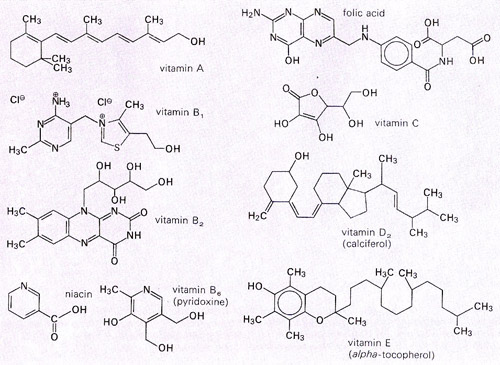
In addition to the nutrients, there are selected chemicals that the body needs in order to function properly. Your body can't make those so they have to come in your food. They include things like retinol, niacinamide, pyridoxine, cyanocobalamin, and ascorbic acid. Collectively they are known as vitamins, and the common names for the ones I've listed are A, B3, B6, B12, and C. These are all small molecules that can be readily manufactured in a chemistry lab. You can consume them in a pill.
The structure of some vitamins
       (taken from http://www.daviddarling.info/encyclopedia/V/vitamin.html)

Here are some common myths about the American diet:
  • People who worry a lot about their diet are healthier.
Many religions, e.g., Judaism, have dietary laws. I do not believe these confer any health benefits. Indeed, my anecdotal impression is that orthodox Jews are disproportionately obese and unhealthy. Whether that's because of kosher or despite kosher I don't know, but obviously kosher isn't helping any.

Even worse off are the vegans. The vegan students I've encountered have pasty, unhealthy complexions, seem to be frequently sick, and look terrible. This is not a good diet, certainly lacking in fats and proteins, and probably missing some vitamins as well.

Likewise, the Atkins diet is low-carb extremist. I tried it at one point and found it completely unworkable. Reducing carbs is fine, but an ideological crusade to eliminate them is nuts.
  •  Some essential ingredient is missing from your diet.
Just take the magic pill--so the story goes--and you'll be much healthier. That's what they tell you in the nutrition shops or on late-night TV. Not true. As long as you get your vitamins you're fine. There is no magic ingredient missing from the food you eat.

As I've already said, our biggest problem is that we eat too much. It is simply not true that despite all that food we're all on the verge of malnutrition because we lack some essential nutraceutical. It's nonsense. I never visit those "nutrition" shops.
  • Fast food is unhealthy food.
A Big Mac has about 550 Calories. If you ate three of them a day you'd get all the carbs, fats, and proteins you need, along with 1650 Cal. If the remaining Calories were consumed as fresh fruits and vegetables you'd have a perfectly balanced diet. Nobody on the Big Mac diet will die of malnutrition.

Of course that diet is boring. So people augment it with fries, a soft drink, and an apple pie. Then you've got too many Calories and way too many carbs. But there is nothing intrinsically wrong with fast food. All it is is good food served quickly.

  • Pesticides and food additives are bad for you.
Pesticides are clearly non-toxic to humans. Were it otherwise we'd have long since been killed off--they've been used ubiquitously for decades if not centuries. To the contrary, pesticides make food better by keeping insects out of it. I live right next to an apple orchard, and if the farmer didn't use pesticides the apples wouldn't be near as good.

I used to buy bread that didn't contain preservatives. Of course it goes stale and moldy within a few days. I always ended up throwing half the loaf away. There is no measurable damage to human health from preservatives. Indeed, there is enormous cost savings because much less food has to be discarded.

Likewise, food additives add taste and texture to food. The alternative is a lot more sugar or a lot more fat. Food shouldn't just be healthy, but also tasty and attractive. Food additives allow that to happen cheaply and with no significant ill effects.
  • "Health food" is healthy.
My daughter buys something called "almond milk" in lieu of the real thing--she thinks it's healthier. But it's just sugar water with a little almond extract and a few vitamins mixed in. It's overpriced, carb-loaded crap. Much better to buy real milk, which comes not only with vitamins and proteins, but necessary fatty acids. (My wife is lactose-intolerant, so that is not an option for her.)

Likewise, I see no advantage to so-called "organic" food. It confers no health benefits that I can see. But the Madison Avenue guys have y'all bamboozled into buying the stuff at inflated prices. I never touch it.

So that's Trotsky's common sense diet. Eat recognizable foods. Don't worry about additives or pesticides. Avoid excess carbohydrates. Control your calorie intake. As Aristotle said, all things in moderation. Enjoy your food. Don't let the Greenies, the ad men, the fanatics, or the scolds get to you.

Bon Appetit!

Sunday, May 3, 2015

Book Review: The Frackers

I really enjoyed this book.

The Frackers, by Gregory Zuckerman, is an excellent account of the short history of fracking. It's a spellbinding description of the over-sized personalities that have made the phenomenon happen.

Unlike Silicon Valley, fracking is not the preserve of youth. Indeed, most leaders were older people. The modern founder of the art was a fellow named George Mitchell (not to be confused with the clown politician from Maine), who started work on the idea in his sixties back in the 1980s. He kept doggedly at it until his dying day--at age 94 in 2013.

Mr. Mitchell was born to Greek immigrant parents. His father's name was Savvas Paraskevopoulos, whose first job in America was working on the railroad. The Irish paymaster could neither pronounce nor spell his name, declaring from now on your name is the same as mine: Mike Mitchell. Son George married another Greek immigrant, siring ten children of his own, and settling in Galveston, Texas.

He went on to build Mitchell Energy & Development, turning it into a Fortune 500 company. The development part included Houston's planned community of The Woodlands, a successful suburb. But the money came from oil and gas. For most of his career he was a classic wildcatter.

Perhaps as a retirement activity, Mr. Mitchell became obsessed with the Barnett shale, a geologic feature that underlies Dallas. It was long known that there was natural gas in shale rock, but nobody besides Mr. Mitchell thought it could be profitably extracted. In the beginning he was a minority of one, but already being a billionaire he had some cash to invest in the hobby.

There are three ingredients to fracking's success. First was the use of explosives to crack open an oil well and get the oil flowing. Mr. Zuckerman tells us this practice began during the civil war. Second, in order to successfully remove gas from tight shale, fracking fluid had to be used to open up cracks in the rock, and then to prop them open so that the gas would continue to flow. Mr. Mitchell was the man who put these two concepts together, so we can rightly consider him the father of the industry.

The third key to fracking's success, which Mr. Mitchell did not initiate, was horizontal drilling. This is a practice where a well is drilled down to the gas-bearing layer, and then horizontally drilled along the layer. Mr. Zuckerman reports that this practice originated in a government lab, probably the only positive contribution of the federal government to the industry. It was later refined to a high art by Harold Hamm, founder of Continental Resources.

A second difference between fracking and Silicon Valley is that, in the latter, most of the participants graduated or attended elite schools, Stanford and Harvard being the most prominent. That's much less evident with the frackers. Mr. Mitchell's alma mater was Texas A&M; another common choice was the University of Oklahoma.

Still, generalizations are made to be broken. Aubrey McClendon graduated from Duke University, co-founding Chesapeake Energy at age 28. He comes from a distinguished family, sharing his heritage with a former Oklahoma governor, and the founders of the Kerr-McGee Corporation. Still, as his mother often pointed out, illustriousness didn't translate into a trust fund--Mr. McClendon would have to earn his own way in the world. Despite lacking for money, he did inherit blinding charisma, capacious intelligence, and single-minded drive. He's since made and lost a fortune, and made it again. Today he's a billionaire--again.

His partner was a fellow named Tom Ward, one of 13 children of an alcoholic, hardscrabble farmer from rural Northwestern Oklahoma. He grew up in Grapes of Wrath country. Interested in oil from the beginning, he majored in petroleum land management at the University of Oklahoma. No famous pedigree there, but Mr. Ward also came with a high IQ and a prodigious work ethic.

Chesapeake Energy (founded by McClendon & Ward in 1989) was named for Mr. McClendon's pleasant vacations along Chesapeake Bay--it was always an Oklahoma company. They added horizontal drilling to the tools inherited from Mr. Mitchell. Instead of the Barnett Shale, the company branched out to other fields such as the Austin Chalk and the Bakken. Mr. McClendon raised money and leased drilling-rights acreage. It was left to Mr. Ward to turn those assets into a revenue stream by producing natural gas.

They were successful beyond their wildest dreams--too successful in fact. Mr. McClendon, suave and charming, was an ace on Wall Street and brought in money by the bucket. He used that to buy up drilling rights in odd places where nobody else expected there'd be natural gas. He got it cheap. Through the 1980s people assumed that the US was running out of oil and gas. Through the 1970s gas prices had slowly risen, reaching $2.71 in 1984 (worth $6.28 today). Mr. McClendon assumed he'd make a killing selling gas, which he did.

But Mr. Ward (along with others) was too successful. Fracking was so productive that by the late 1980s gas prices began to go down. By 2012 they reached a low of $1.89. Fracking was no longer profitable, but Mr. McClendon couldn't stop. He kept buying drilling rights and going deeper in debt. Mr. Ward, who didn't like the debt, quit. And eventually Mr. McClendon got fired (only to come back again in a different company).

A third difference between the frackers and Silicon Valley is that no women are involved. Silicon Valley supposedly excludes women, but at least there they make up 10-15% of the leadership--most famously Sheryl Sandburg. But amongst the frackers there are zero women. The men are all highly driven, single-minded, workaholic, and extraordinarily intelligent. In many respects they are all very far out on the bell curve--not just in terms of intelligence. Few women are to be found amongst those very unusual people.

Silicon Valley was and remains an important driver of technological progress. But so far in the 21st Century fracking is the most important new technology. Government played only a very small positive role (along with a somewhat larger negative one). The major oil companies (ExxonMobil, et al.) also ignored the business until it was too late--they remain bit players. This was an industry founded by wildcatters, using their own money and following their own dreams. It is a true, American success story.

Mr. Zuckerman gives a balanced and (I believe) correct account of the environmental hazards. The industry has mostly underplayed those (Mr. Mitchell being a notable exception), an attitude that now hurts them. The environmental critics, on the other hand, have hugely exaggerated the risks involved. Fracking is much better for the environment than any alternatives, especially coal. I'd argue it's cleaner than solar power given the current state of that technology.

Panic-mongering aside, fracking is here to stay. And eventually the technology will spread around the globe. The world is not running out of fossil fuels any time soon.

Further Reading:


Friday, April 24, 2015

How to Change the Climate

Back in 2005, in the aftermath of the disastrous, Indian Ocean tsunami, The Militant coined a phrase that shouldn't need to be said: "Geology indisputably played a role." As though anybody argued with that. But The Militant thought geology played a rather small role, as the rest of the paragraph makes clear.
The staggering loss of life produced by the tsunami’s wrath, though, was largely due to the absence of any warning system—including in places such as India where the waves struck the shores four hours after the quake. Resources on hand—from communications, to roads, transportation, electrical grids, medical care, and food supplies—have also been scarce to respond to the disaster in its immediate aftermath. These are the products of the plunder of the region’s resources and labor over decades by the wealthy imperialist states—whose governments are now tripping over each other to paint themselves as generous benefactors—aided and abetted by the local capitalist regimes.
The claim--that capitalism bears most of the fault for the disaster--is silly. I argued as much in this blog's past incarnation, here. Still, at least The Militant granted some role for geology, or more generically, for acts of God. Not every problem can be laid at the feet of capitalism.

Not so with Socialist Action. They have gone from the plausible hypothesis that human activity has some influence on the climate, directly to the claim that the climate is completely within human control. It is only because of the greed of the bankers and capitalists that we have bad weather at all. The opening sentence of Andrew Pollack's article on Hurricane Sandy makes the point. "By now the scientific consensus is clear: the fury of Hurricane Sandy was greatly magnified by human-caused climate change." No room left for natural causes.

Far from being a scientific consensus, the sentence is a crackpot idea, arrived at by taking literally the most exaggerated fever dreams of extremist climateers. But our task here is not to argue with them, but rather to take the statement as a given. Assume, therefore, that the future climate (and not the distant future, either) depends sensitively on how we as a society organize our means of production.

The relevant question then becomes How do we change the climate?

That brings us to the speech by the South African activist, Patrick Bond, delivered in Tunis in March (reprinted in Socialist Action). The event was an organizing meeting in preparation for the COP21 United Nations shindig to be held later this year in Paris. Mr. Bond discussed different strategies that the Left might pursue. Socialist Action makes it clear they don't agree with either of his alternatives, and instead in a lengthy preface propose a third.

The first option (which I'll dub the reformist strategy) is to work "inside." That means collaborating with governments and NGOs to find practical solutions to curb CO2 and methane emissions, ideas such as carbon taxes, carbon capture, or more nuclear power.

Both Mr. Bond and Socialist Action reject the reformist strategy. First, it in no way rises to the urgent challenge of rescuing the planet from imminent disaster. Minor fiddling with CO2 output is drastically insufficient. Second, reformists will inevitably get bought off, making deals with the capitalists for small (albeit lucrative) favors that don't benefit the climate. Trotskyists have always opposed reformism as being class-collaborationist, which in their view always fails. (No doubt in terms of making revolutions it always does fail, but then so does Trotskyism.)

Mr. Bond supports the second alternative, that I'll dub the ultraleft approach. It can be summarized as shut the mother down. The template is the protests in Seattle around the WTO conference in 1999. Those did manage to short circuit the WTO meetings, but otherwise seemed to have rather little impact. It is not clear how similar events in Paris are going to modify the climate. Throwing a temper tantrum is rarely a constructive solution.

Socialist Action poses a third solution, which I'll call the mass movement strategy. This is always Trotskyists' favorite solution, since ultimately organizing the masses is the only way to effect revolutionary change. Their model is the People's Climate March in New York, last Fall, in which 400,000 people marched for--just what exactly? Socialist Action raises the slogan System change; Not climate change, which presumably is the modern analog of the Vietnam war era slogan, Out Now.

But the slogan is completely empty. First, system change is much more ambitious that simply changing the climate (though that seems hard enough). It requires a root and branch change in the very way we organize everything. Climate activists--i.e., people who are actually seriously interested in problems related to climate change--will be unwilling to make their task oh so much harder and more complicated. Rather than simplifying the problem for them, Socialist Action's slogan makes it sound impossible.

Second, system change is not obviously connected to climate change. What guarantee is there that changing the system will improve the climate? Certainly it didn't work in the former Soviet Union or Maoist China. The only evidence that it will work in the future are vague promises from Andrew Pollack, Bill Onasch, and Carl Sack. And activists are supposed to stake their cause on that? Not likely.

And finally, system change is completely disconnected from any individual effort. This, too, is a Trotskyist theme, because they maintain that all social problems are because of capitalism, not because of any individual cupidity.

So, for example, Socialist Action never asks how Patrick Bond got from Durban to Tunis. Presumably he took an airplane, which is not very environmentally conscious of him. Socialist Action will claim that this is irrelevant, because until we change the system, nothing Mr. Bond can personally do will change the climate. But after system change, then the airplane ride will be OK. Because--don't you know--pilots working for the working class pollute much less than pilots flying planes for capitalists. Go figure.

The problem with Socialist Action is they moralize everything. The climate is a moral issue, capitalism is immoral, and therefore capitalism must be bad for the climate. The argument doesn't even work as a syllogism even if you're willing to grant the premises. It's completely nutty, as I suspect the folks at Socialist Action realize. Their involvement in the climate fight is merely tactical--to recruit members to their cause--rather than any heartfelt seriousness about the urgency of climate change.

The climate movement is ultimately doomed. First, the catastrophe predicted by the likes of Socialist Action is unlikely to come true. So facts will eventually prove them wrong. But more importantly, solving the climate problem ultimately means forcing everybody into poverty. The marchers in New York believe themselves exempt from that fate. They are all part of the rich world, comfortably middle class, even by American standards. They can afford to ask other people to forfeit their comforts and livelihoods.

But poor people--people in China, India, Bangladesh--depend much more directly on world trade and fossil fuels for what little prosperity they have. The climateers--unwittingly to be sure--are condemning billions of people to utter destitution, forced back to scratching out a living as subsistence farmers. Poor people are smart enough to realize that the climate movement does not have their back.

That's why India, for example, is simply rejecting the whole movement. PM Narendra Modi speaks for the vast majority of his countrymen when he refuses to accept poverty as an outcome. I agree with him.

Down with poverty!

Further Reading: