Showing posts with label Science. Show all posts

Monday, March 17, 2025

Cosmetics, Cuba & Mary-Alice Waters

From left, Esther Pérez, Mary-Alice Waters and Martín Koppel at the podium in Havana
(Source: Militant/Jonathan Silberman)

Contrary to my prediction, octogenarian Mary-Alice Waters really did make another trip to Cuba in February--and took a whole bevy of comrades with her (as best as I can determine, including Martín Koppel, Jonathan Silberman, Rachele Fruit and Philippe Tessier). Ms. Waters is second in command of the Socialist Workers Party (SWP) and longtime consort to chief honcho and similarly aged Jack Barnes. 

The occasion was the Havana Book Fair, and the topic of Mary-Alice's speech was a new edition (2024) of Cosmetics, Fashion and the Exploitation of Women, recently translated into Spanish by a Cuban, Esther Pérez.  The original authors were Joseph Hansen and Evelyn Reed, while the new edition includes contributions by Ms. Waters.  Her speech is reprinted in The Militant under the title ‘Fight for women’s equality is part of battle on world scale to settle which class will rule’A companion article, by Rachele Fruit and Philippe Tessier, is headed Lively exchange at Havana book launch.

There are at least two things weird about the above photo. First are the microphones on the table. Authors Fruit and Tessier tell us that about 30 people attended the session. It hardly seems necessary to have a sound system, especially since Cuba is busy liberating itself from electricity use. After last Saturday's additional power failure, a reasonable estimate is that only 10% of demand is satisfied. It seems unlikely that the microphones even work. Why are they even there?

The second weird thing--recall this is a talk nominally about cosmetics and how evil capitalists have bamboozled women into buying them--is that octogenarian Mary-Alice has obviously dyed her hair! Compare her hair color with that of Esther Pérez--a woman likely younger than Ms. Waters, but who, living in Cuba, doesn't even have access to cheap hair dye.

In my prior article (Mary-Alice on Cosmetics & Fashion) I challenged Ms. Waters:

As a test, Ms. Waters should go to the dollar store and buy a bunch of cheap cosmetics that she can take with her next time she goes to Cuba (if she ever goes to Cuba again). She can pass them out to local women, whom I hazard will be overjoyed to receive them, without any encouragement from the bourgeoisie. Just a little bit of beauty to brighten their otherwise dark, dreary, boring days.

At very least she could've brought along some hair dye to share with her loyal translator. It would seem like the right thing to do.

The gist of Mary-Alice's speech was that women are oppressed, not just by men, but mostly by "capitalism" (whatever that is--Mary-Alice has no clue). The depths of their oppression is illustrated by the fact that they are hoodwinked into buying cosmetics that (according to Mary-Alice) they 1) don't need, 2) are dangerous, and 3) are similar to addictive drugs, such as fentanyl.

To which my responses are: 1) maybe women don't need cosmetics (who is Ms. Waters to tell women what they need?), but surely they enjoy having them. Cuban women probably have bigger problems than a lack of cosmetics (eg, adjusting to no electricity), but I still think had Mary-Alice taken my advice, she would've brightened the day of a few Cuban ladies. Cheapskate!

2) Ms. Waters mentions a few edge cases where cosmetics--broadly understood--might be dangerous. Her examples are mostly around cosmetic surgery, which I agree is perhaps taking the passion too far. But L'Oreal is the biggest cosmetics company in the world, and I don't think she can reasonably claim that any of their products are dangerous. 

3) They're addicting--which is true, but so is everything else that's pleasurable. I take great joy in being able to turn on electric lights in the evening. Does that mean that I'm addicted to electricity? Are her Cuban comrades better off being free of such an addiction?

Ms. Waters summarizes her talk at the end by asking and answering two questions.

The first question is: Are the issues addressed in a debate about cosmetics and fashion many decades ago still relevant? Haven’t “we” moved beyond that?

Second: Hasn’t knowledge of the earliest human societies moved far beyond what was known in the early 1950s? Isn’t Evelyn Reed’s article on “Anthropology: Marxist or Bourgeois?” outdated for that reason?

This is her answer to question one:

More than three centuries after the birth of industrial capitalism, we can say that the resources devoted by capitalist enterprises to advertising and the creation of markets — that is, creating “needs” that don’t naturally exist — have expanded astronomically, and continue to expand. 

Which demonstrates that she knows nothing about capitalism. To me, the most succinct definition of capitalism is an economic order designed to maximize consumption. Capitalists want you to shop till you drop.

Contrast that with socialism, where consumer wants are to be rationed by the government. Under socialism you can buy cosmetics only if the State approves the sale of cosmetics. Mary-Alice is convinced that nobody (except her) needs cosmetics, and therefore you should be prohibited from buying them. Apparently in Cuba they've decided that nobody needs electricity, either.

Sure--you can complain about overconsumption or even wasteful spending. But I think those are minor problems compared with the problem that afflicts most of the world, namely under-consumption, aka poverty. The problem in Cuba has nothing to do with who owns the means of production or who gets to distribute the proceeds. The problem is poverty. That's all it is. Cubans aren't allowed to buy what they want to buy.

Ms, Waters responds to the second question merely by asking another: Who needs any stinkin' research anyway? Some 60+ years ago she read a book entitled The Origin of the Family, Private Property and the State, by Friedrich Engels, first published in 1884. That book is the absolute truth when it comes to anthropology. Why? Because it's "materialist," whatever that means.

In the intervening six decades Mary-Alice has refused to read anything new in the human sciences. Whenever confronted by novelty she sticks her fingers in her ears and sings loudly "LA LA LA LA..." to drown out any contrary information.

She's never heard of evolutionary psychology. Indeed, it appears she denies the theory of evolution altogether. She doesn't know what the human genome is, much less the astounding discoveries made over the past couple of decades. She's unfamiliar with radiocarbon dating. She's resoundingly ignorant of basic economics. Amazingly, she denies that humans are a sexually dimorphic species. Hell, she probably hasn't even read Sigmund Freud (who is, at very least, a pleasurable read).

She's a complete ignoramus, and we can safely ignore her opinions. Whether in English or Spanish, Cosmetics... is not a serious book.

Further Reading:


Friday, January 27, 2023

ChatGPT and Artificial Intelligence

                                    (2100 words long. I have borrowed many ideas from Arnold Kling's substack.)

I've been doing a lot of thinking and reading about ChatGPT (GPT). For those of you living under a rock, GPT represents a major milestone in so-called artificial intelligence (AI). It's free for public use here, though you will need to register with a legit email address. I urge you to try it.

While GPT is the talk of the town on college campuses these days, its intersection with Trotskyism is minimal. For example, I asked GPT to

Give a brief biography of the SWP's Jack Barnes.

It replied

Jack Barnes is a political figure and a longtime leader of the Socialist Workers Party (SWP) in the United States. He joined the SWP in the 1960s and has been a central leader of the party since the 1970s. Barnes has written extensively on a wide range of political and theoretical topics, and has been a central figure in the SWP's efforts to build a revolutionary socialist movement in the United States. He has also been involved in various international socialist organizations and campaigns. Despite some controversies, Barnes is widely respected within the socialist movement for his commitment to building a revolutionary party and his contributions to socialist theory. 

I learned nothing from this--it's boilerplate bordering on balderdash. I got a better answer when I substituted in "Mary-Alice Waters" for Jack Barnes. I will note that you will likely get a different answer every time you enter a prompt.

Of the blogs on my Beat, the comrades over at Left Voice will probably care the most about GPT. That's because they're mostly college professors or aspire to become so. GPT threatens to upend their business model and their career plans, so I suspect they won't like it. But they most need to take my advice and learn how to use it. Consider this a brief tutorial.

So what is GPT?

Perhaps most important, GPT is not actually "intelligent", artificial or otherwise. It has no consciousness, it isn't creative, and it can only reorganize and spit out what one feeds in to it. It won't, for example, ever replace a journalist's job as it can't interview anybody, or observe what's happening in real time. At the end of the day it's just a large linear algebra processor, in many ways very similar to Google.

So what is different about GPT? I suggest it is analogous to a new graphical user interface (GUI). Point & click is a much easier way to navigate a webpage than typing in text in response to a ">" prompt. Now the point & click computer is not really any more intelligent than the ">" computer (though it probably does have more RAM and a better graphics card), but it really is a whole lot easier to use. Its construction required a whole new way of thinking about software--and so object-oriented programming was born.

A Google search is the analogue to the ">" prompt. You will get a list of links--perhaps thousands of them--and it will be up to you to find the ones most suited for your purpose. Google uses a linear algebra solver based on counting the number of links to any given webpage. So Google scours the web 24/365 to look and see which pages link to what other pages.

On the other hand, if you type a query into GPT (the "point & click" analogue), the computer doesn't do that. Yes, it still has a database of all the world's webpages (or soon will have that database), but it is no longer looking for links. Instead it is searching for words and phrases. Words and phrases that happen more frequently rise to the top, while those of less frequency sink to the bottom. Eg, "the red barn" will occur more often than "the red epistemology," and thus when asked to illustrate "red", GPT will cite "barn" rather than "epistemology." (Example borrowed from somewhere.) It's still a linear algebra machine, but it's now described as a "neural network" and supposedly is "artificial intelligence." Instead, it's just extremely clever software, just as object-oriented was extremely clever software.

But there is an additional twist. GPT can borrow phrases from across the web, and can put them together to make a coherent sentence and paragraph. That is, it has been taught the rules of English grammar, syntax and (to some extent) style. This is natural language processing, and I'm not sure how the computer learns how to do that. But it's not really saying anything original--it is merely piecing together bits of language that it's cribbed off the web.

In the Google world, you got a list of links, hopefully in order of declining relevance. In the GPT world, you get a list of words and phrases put together in paragraph form, constructed by a natural language processor. There is no fundamental difference--GPT isn't any more intelligent than Google and draws from the same dataset. But it organizes the data differently and allows for free form queries, and presents the results in a different format (written paragraphs), just as a GUI alters the input/output of graphical data.

Needless to say, the business most disrupted by GPT is Google, and my impression is that company is now sweating bricks. GPT was designed by OpenAI, which has received $billions in investment from Microsoft, which now proposes to invest billions more. In the search world this gives Microsoft a new killer app--or perhaps it's a Google-killer. Google is responding by accelerating its own investment in AI (an acronym that should be in scare quotes).

So could GPT have written this essay? Right now, No. That's because GPT is, as far as I know, trained only on data current thru 2021. The data I'm drawing from is much more recent than that, so therefore GPT has no access to my sources. But that's a short-term limitation; surely within the next few weeks or months there will be AI that searches the entire web. In that case GPT and I have access to exactly the same information. Or actually, not--for I have only accessed a dozen or so pages, while GPT has looked at billions. GPT knows way more than I do.

So why can't GPT write my essay better than I can? Because my essay reflects my personality just as much as it is about web pages. I come with a prejudice against AI--that is, I don't think it's intelligent, and I doubt it ever will be. Then, as will be apparent later, I have a bias against higher education. These biases (among others) reflect inputs into my essay that GPT will never have access to--and therefore it can't write my essay. It never will be able to. (If I were famous perhaps it could get closer. I can ask GPT to write an essay about inflation in the style of Paul Krugman, and what I'd get will be an imitation of Paul Krugman. Though were I to ask the real Paul Krugman for such an essay, it would likely be very different. But I'm not famous enough for GPT to imitate me.)

It appears that GPT can pass both the Medical Boards and the Bar Exam. Of course a person using Google could also pass those exams, but it would take them a lot longer. By searching for words and phrases rather than links, GPT greatly expedites the search process. It is not because GPT is more intelligent. Nevertheless, GPT is a very important new step in technology--at least as important as the modern graphical user interface. Mr. Kling suggests that GPT is as important as the founding of Netscape in 1994. That sounds about right to me.

If GPT can pass the Boards and the Bar, then it certainly can do a lot of the work that doctors and lawyers now do. Doctors' jobs are likely safer because they have to talk to, look at, and touch their patients. GPT can't do any of that. But once the doctor (or the nurse or PA) has accumulated a list of symptoms, then GPT can probably narrow down the diagnosis pretty quickly, and then also the recommended treatment. While GPT probably won't outright eliminate jobs, it will become an important medical coworker.

Lawyers, on the other hand, are at greater risk. I'll suggest that the work entry level lawyers do today will increasingly be done by GPT. If a legal practice is simply constructing wills and managing estates, I think they may be substantially out of business rather soon. Or at least have many fewer employees.

I read that GPT is an excellent programmer. Mr. Kling suggests that a million Indians, now working in Bangalore writing routine code, will soon be replaced by GPT.

Higher ed is both behind the eight ball and in the catbird seat. If they were smart they'd own GPT. But they're not smart--which is where the eight ball comes in. From lurking on my campus email, it seems the faculty's first response is just to ban the platform and assume all it's good for is cheating. I suspect that will be the go-to opinion of the Left Voice crowd. First, I'm shocked that they think so poorly of their students. Yes, some of them will cheat, but most of them won't. Second, this is a fool's errand--you will never be able to ban GPT. And I don't know why you'd want to (except perhaps on a few specific assignments). GPT will change the way higher ed works in very dramatic ways. I suggest it will make online education much cheaper and more effective. The benefits of a residential college will decline in relative terms. Since GPT will radically change the workplace, it must perforce change what higher ed teaches.

I believe (and have believed for some time now) that educating students in STEM fields is not useful, and I deplore the huge funds that governments and philanthropies are investing in STEM education. Because computers can already do math better than you can. And now GPT can program computers better than you can. GPT can probably do science and engineering better than you can, and learn to design experimental apparatus or an organic synthesis faster and better than any human. Of course there will always be a need for very high-end scientists and engineers--but much less need for the more mediocre sorts educated at smaller, public institutions like where I worked.

College algebra is a nearly useless subject. Calculus is even less useful. Yes, they're beautiful, and people who are interested in those disciplines for their own sake should be encouraged. But to require hundreds of students to take algebra and calculus because they're useful (when they're not) strikes me as not sensible. Calculus probably needs to go the way of Latin.

The careers of the future will not be in STEM. Instead they'll be in the arts and humanities. The scientist and engineer were careers for the 20th Century. Today they're increasingly automated away. The careers of the 21st Century are the artist, musician, storyteller, preacher, counselor, sex worker, nurse, teacher*, comedian, chef, hotelier, etc., along with the all-important skilled trades. Those are where the jobs will be. And those are the jobs that cannot be done any computer, much less GPT.

So how is higher ed in the catbird seat? That's because nobody really knows how to use GPT yet. How does one use the platform effectively? Ethically? How do you cite GPT sources? This is all very unclear, and it seems to me that the best people to work out some answers to those questions might be college faculty. Or, at least, should be if they weren't such ostriches about it. College faculty need to spend a lot of time using GPT, and need to give their students assignments using it, and play around with what "effective and ethical GPT use" actually means. There will certainly be some false starts, but for the most part I think it would be an adventure.


*By "teacher," I don't mean the college professor type who went to grad school and thinks she's smart enough to ban GPT. I mean something like the Bennington College model where the faculty are practicing artists who take a year-long sabbatical from their careers (art, music, theater, creative writing) to mentor young people who want to learn, only to go back to their careers after a year (or two). 

Further Reading:

Sunday, July 19, 2020

Louis Proyect vs. Steven Pinker

Louis Proyect is the master of ad hominem argument. In a post pretentiously titled Pecksniff and the Harper’s Open Letter, he'd refuse to sign the Harper's Open Letter because he wouldn't want to join the disreputable crowd of hypocritical, prominent signatories. He never claims to oppose the letter's actual content, which champions free speech, open inquiry, and some minimal respect for persons who disagree. These are bourgeois values which I believe Mr. Proyect holds in low esteem--he is, after all, a totalitarian Marxist.

Certainly respect for persons who disagree is low on Mr. Proyect's list. This is what he says about Mark Lilla.
Mark Lilla—Another Columbia professor. His claim to fame is writing a book urging the Democrats to dump “identity politics”. Katherine Franke, a Columbia law professor compared Lilla to David Duke and charged him with “underwriting the whitening of American nationalism, and the re-centering of white lives as the lives that matter most in the U.S.” Maybe he signed the letter because she “canceled” him.
So apparently any skepticism about "identity politics" is the same as David Duke, who, we may extrapolate further, is just one short step away from H*tl*r. And that's the problem--anybody who disagrees with Mr. Proyect is ultimately associated with the H-man. This is supposed to pass for discourse.

He saves his worst bile for Steven Pinker.
Steven Pinker—Pinker is arguably the worst person who signed the letter. My interest in him was focused on his reactionary sociobiological theories that I described as a mixture of Hobbes and Pangloss. I also recommend a new Jacobin article titled “It’s Official — Steven Pinker Is Full of Shit”. I guess Jacobin was guilty of cancel culture.
I've read both Mr Proyect's post (entitled Steven Pinker = Hobbes + Pangloss, posted in 2011, which in turn links to a post from 2009) and the Jacobin piece. It appears that Mr. Proyect has never actually read any of Pinker's books, so on this I have an edge. I read The Blank Slate shortly after it was published in 2003. I have never read The Better Angels of our Nature--the book that really gets Mr. Proyect's goat.

Sociobiology (aka evolutionary psychology) asserts two premises--the veracity of which are to be proven empirically.

1) That human evolution occurs much more rapidly than was believed in the 20th century.
2) That genetic evolution happens not just in response to changes in the natural environment, but also to changes in the social environment. This leads to the concept of gene-culture co-evolution. (For more about this, see Joseph Henrich.)

The first premise is now demonstrated beyond any reasonable doubt. Detectable evolution can happen in historical time--certainly within a few thousand years, and likely within one thousand years. Indeed, it can happen almost immediately, as when a small band of people separates from a much larger group, and by crossing a mountain range loses genetic contact with their ancestors. They will be genetically distinct almost from the git-go--even if they represented a random sample before they crossed the mountain range.

Analysis of the human genome (first sequenced in 2003) has become cheap and ubiquitous. Coupled with massive data processing power, it is now possible for commercial companies (e.g., 23&me) to distinguish ethnic groups by genomic analysis alone.

The second premise is harder to definitively establish, but it can be said with confidence that genes correlate with personality traits, which collectively contribute to culture. Correlation obviously does not prove causation, and because genetic influences are extremely complicated and subtle, proving causation will be difficult to impossible except in a few cases (e.g., lactose tolerance). But correlation certainly suggests causation, and in many cases it probably results from causation.

In the 2009 post Mr. Proyect attributes the following statements to Pinker.
  • Males have a stronger tolerance for physical risk and a stronger drive for anonymous sex. 
  • Women have stronger emotions and are better at reading emotions on the faces of others. 
  • Pinker states “A variety of sexual motives, including taste in men, vary with the menstrual cycle.” 
  • He also states that “in a sample of mathematically talented students, boys outnumbered girls by 13 to one” but that women maintain more eye-contact, and smile and laugh more often. 
  • Humans are hard-wired to think in stereotypes and to prefer kin. 
  • Some people, most of them men, are born with criminal tendencies. 
  • Turning to the big questions of social transformation that have vexed Great Thinkers for the millennium, we learn from Pinker that “Biological facts are beginning to box in plausible political philosophies.” Communism may work for insects, but humans are programmed for economic exchange and “reciprocal altruism.” (Is that the reason I used to climb across the ceilings and consume a pound of sugar at a time when I was in the Trotskyist movement, I wonder?)
Apart from the last bullet, there is abundant empirical evidence--genetic, neurological, anatomical, behavioral, and anthropological--to support all these claims. The best, recent source for this is Charles Murray's 2019 book entitled Human Diversity (my review here). The author compiles huge datasets (sample sizes in the millions) to support the assertions listed above (and much more besides).

I know, I know. I genuinely wish that somebody else besides Mr. Murray had written the book, and failing that I wish he'd written it under a pseudonym. But it is really important here to separate the subject from the author. Mr. Murray has written a textbook instead of a monograph. He has not done the research himself, but has put together the data from the scientific literature compiled by other people. One common criticism of Mr. Murray's book is that he's published no peer reviewed papers. I don't know if that's true, but it's irrelevant--textbook authors are not typically researchers themselves.

The other common criticism is that he's "cherry-picked" the data. This is both cheap and irrefutable. Any author--even a textbook author--has to pick and choose what to include and what to leave out. So of course the contents are "cherry-picked" in that trivial sense. The implication, however, is that he's hiding some crucial bit of data that disproves his thesis--presumably because he's dishonest, racist, and his name is Charles Murray. I find this incredible. While the book can certainly be criticized, it won't be easily dismissed because of some magic, missing data point.

The Blank Slate, published in 2003, did not have access to the voluminous data at Murray's fingertips. It is necessarily more speculative, and has been criticized for telling just so stories. But Murray's subsequent data have largely confirmed Pinker's hypotheses.

In the 2009 post Mr. Proyect writes about Pinker:
For all of Pinker’s animosity to radicalism and Marxism in particular, there is very little evidence that he understands how historical materialism deals with the question of human nature. While it is beyond the scope of this article to trace its development through the years, suffice it to say that Marxism views the nature-nurture relationship dialectically.
It does not really challenge the existence of biologically determined traits, but simply places the whole question of equality, justice and freedom in a materialist context. In other words, revolutionary socialism strives to create the conditions in which all human beings can reach their full potential. Within the context of such a challenge, Pinker’s “Blank Slate,” with its discussions about the difference between the appearance of male and female brains (according to Pinker, they are “nearly as distinct as their bodies”) seems little more than “Men Are From Mars, Women Are From Venus” geared to readers of the New York Review of Books.
It turns out that the pop-culture Mars/Venus stories are not that far off the mark. Most people understand that men and women are different in the ways one expects. (Only woke people on college campuses have forgotten how to do that.) But Murray's data is much more rigorous: first, it's actual data with sample sizes in the millions rather than mere anecdotes; second, it can quantify the differences, and also the similarities between men and women; and finally, it can at very least correlate those differences with differences with genomic and neurological data. In some cases it can establish causation.

Opponents of sociobiology will not get very far by firing shots at Charles Murray. First, he's just the messenger, and second, his book is very thorough. What they need to do instead is write a competing textbook. If Marxist dialectics are indeed the key to the nature-nurture debate, then by all means write the textbook that makes that case. But it must take the data seriously--you can't just philosophize in the abstract about "equality, justice and freedom," along with empty words like "dialectically," and expect to get away with it.

Materialism, if it means anything at all, certainly means arguing from empirical data.

One last point: nobody is arguing for genetic determinism. The environment plays a large role--both for individual outcomes, and certainly for cultural outcomes. I hope there's even room for old curmudgeons like me who still believe free will has at least a small remit.

But what is now undeniably true is that genes play a significant role in explaining variation between individuals, and also between ethnic groups. While genetic determinism is wrong, it is equally impossible to ignore genetics when thinking about human health, psychology, and culture.

Mr. Murray makes that point. He argues that, within the next ten years, academic papers in the social sciences will all include genetic data as a matter of course, and will be unpublishable otherwise. This is already true in biology, medicine, and psychology, and will spread to sociology and economics--even in the face of political correctness.

So the window of opportunity for our Marxist friends to write their textbook is closing fast. Mr. Proyect needs to get busy.

Further Reading:

Wednesday, April 15, 2020

Book Review: Human Diversity

The full title of Charles Murray's recent book is Human Diversity: The Biology of Gender, Race and Class. It's a dense, tightly-reasoned, data-packed, expertly-written tome that will change the world. Or rather, the subject it discusses will change the world.

The major purpose of the book is to bring the educated layman up to date on the science of human genetics. Thanks to spectacular advances since 1980, and especially since the complete mapping of the genome in 2005, it is now possible to shed some serious light on the old nature vs. nurture question. While these results have until now stayed mostly within the specialist, scientific community, it is Mr. Murray's view that before the end of this decade, the consequences of this new knowledge will impact every aspect of our lives.

A short, oversimplified summary of the story goes like this: Back in the old days (before 1980) it was supposed that most human traits were the result of a gene or two, or perhaps maybe half a dozen. In this context we are using the word gene to refer to a bit of DNA that actually codes for a protein. In those days people supposed there were 100,000 or more genes.

This had numerous consequences. First, there was fear of genetically modified babies. If we could just change a specific gene, then we could make children much more intelligent. This possibility was never remotely realistic.

Then people assumed that evolution happened very slowly. Most mutations in actual genes are deleterious--resulting in birth defects or death. Only a very few are beneficial, and even those will need about 2000 generations (40,000 years) to spread from one individual to the entire human population.

Even then, it was understood that the bulk of our DNA was not part of a gene, i.e., didn't code for anything. Folks didn't know what that excess DNA did--it was often called junk DNA. Today we know different. It appears there are only about 20,000 actual genes in the entire genome. By far most DNA is in the non-coding portion. It appears that non-coding DNA regulates gene expression in some complex way.

While mutations in the genes are still usually deleterious, mutations in the non-coding parts of the genome tend to not have much effect. Therefore mutations accumulate there. Many of them spread across the human species: certain mutations that occur in more than 1% of individuals are called single nucleotide polymorphisms, or SNPs (pronounced snips). Wikipedia claims that more than 335 million SNPs have been found in our species, while any given individual will have between four and six million SNPs.

While an individual SNP has little effect, cumulatively the SNPs make a big difference. For example, it is now known that millions of SNPs help determine how tall you will be. With enough data and a big enough computer, one can isolate those SNPs that correlate with height.

So today we understand there isn't a "gene" for height, nor for personality/behavioral traits like intelligence, empathy, honesty, conscientiousness, etc. Yet we know that all these traits are significantly heritable--that is depend on our DNA. But instead of counting genes by the handful, we count SNPs by the thousands. Thus almost all traits (both physical and behavioral) are polygenic, in some cases nearly omnigenic (involving contributions from nearly all your DNA).

It's the SNPs that drive human evolution, and sufficiently fast that evolution can (and does) happen in historical time.

It is possible to count SNPs that enhance a certain trait, such as height or tendency toward schizophrenia. This leads to the polygenic score for that particular trait. Since your SNPs are fixed at birth, one can readily calculate your odds of being schizophrenic later in life. (It will never be 100%--environmental effects alter the odds significantly).

Likewise, there is a polygenic score for IQ. It cannot predict your IQ as an adult--for which the environment contributes about 40% of the variance--but it definitely narrows the field. If your child is born with a high polygenic score for IQ, then it might be worth saving money to send her to Harvard.

There are polygenic scores for things like criminality. The optimist will say that by judicious interventions we can prevent that outcome from occurring. The pessimist will fear that we'll be punishing people in advance of any crime--simply on the basis of their polygenic scores. I think they're both probably right--it is a brave new world coming on.

A second theme in Murray's book is an argument against the socialization theory. This theory--standard groupthink at American colleges--maintains that all differences between genders, races, and classes are merely social constructs, and have no underlying basis in biology. I'll mention that prior to 1980 this was a plausible idea, but since then, and especially since the rise of modern genomics, it becomes completely untenable.

Mr. Murray discusses at length the differences between men and women, who differ by an entire chromosome. There are genetic, physiological and psychometric differences between the sexes, compared to which "socialization" pales into insignificance. That said, it is not a simple switch--there is a continuum between male and female in nearly all traits. Few men have exclusively "male" traits, while few women are exclusively "female."

Murray uses facial features as an example. Consider the kinds of metrics facial recognition software might use: relative length of nose, relative distance between the ears, etc. Suppose there are twenty such metrics. It may be that women have slightly shorter noses (relatively) than men. But the effect is not very large--many women have noses longer than the average man, but most women don't.

So it is with all the other metrics. Women congregate slightly on one side of the spectrum, while men predominate mostly on the other, with a large overlap in the middle. Very few men are "masculine" on all twenty measures, and neither are many women "feminine" on all measures.

And yet it is easy to distinguish male faces from female faces. Even though each effect is small, the accumulated effects are big enough to see the difference. Only in a few cases is it truly ambiguous--I think of Rachel Maddow, for example. Two corollaries: facial recognition software can distinguish between male and female faces most of the time; it takes a skilled artist to draw an obviously female face, since most of the differences are so subtle.

Similarly, racial and ethnic differences show up in polygenic scores. That's how sites like 23&Me work their magic. Those very same polygenic scores imply ethnic differences in disease susceptibilities, physical attributes, and personality traits. Race is not just "skin deep" as the pre-1980 school would have it.

Class differences also depend on polygenic scores.

I'll close with some comments on how I think Murray's book will be received, especially by my former colleagues at Local State College.

First, most of the people who fancy themselves as experts on Race, Class and Gender are committed to the social construct theory and won't change their minds. But science progresses one retirement at a time, and these folks--tenured baby boomers--are not that long for the academic world. I don't think they're being replaced.

Second, those same self-proclaimed experts are typically in English and education departments. They know nothing about statistics. (Yes, I know--education faculty should know some stats, but I don't think they generally do.) One doesn't need a lot of statistics to read Murray's book, but a college-level introduction to the discipline strikes me as a prerequisite. (Sociologists have no excuse here.)

Finally, "Charles Murray" is a dirty word in those quarters. He should have written the book under a pseudonym. As the book has just come out, I can't blame them yet for not having read it, but they won't have read it five years from now, either.

So yes, while it will pass the academy by, I predict there will be a revolution in our understanding of human behavior. I'm not sure it will all be good. Lots of people (e.g., inhabitants of red states) will be classed as vaguely subhuman because of their average polygenic scores, as will many other groups of people.

There are some things this book should never change, concepts of morality, justice, and human worth among them. No polygenic score is an excuse to deny anybody their human rights. As Mr. Murray recently opined, religion becomes more important. Absent some kind of revival, the temptation to equate polygenic scores with human worth becomes irresistible.

You should definitely read Charles Murray's book. But whether you do or not, for better or worse it will definitely change your life.

Further Reading:

Tuesday, February 6, 2018

Arnold Kling's Moonshot

I'm a great Arnold Kling fan--I've favorably reviewed two of his books on this blog (here & here). I follow his blog daily--it's one of my favorite reads. Mostly I agree with him. But I have to take issue with his post from a few days ago, entitled A Moonshot to Overthrow Neoclassical Economics, along with the similarly titled article, here.

A moonshot is the Big Thing that a person wants to accomplish in life. In other contexts it might be called a vision statement, or a passion. Though a moonshot is typically much less practical than those--a goal for striving rather than achieving. Mr. Kling's moonshot is "to be a leader in overthrowing neoclassical economics. A better approach would focus on mental-cultural factors and rapid evolution."

I think he gives neoclassical economics a bum rap.

In his account (and I don't disagree) neoclassics begins with two "essential propositions":
1) Production is a process that employs two primary factors--labor and capital. 
2) The distribution of returns to labor and capital reflects their respective contributions to the production process.
He notes that Marxists disagree with the second axiom--they believe capital steals a disproportionate share of the proceeds--and he acknowledges they might be right. But that, in his view, is quibbling over a detail. Mr. Kling's critique is much more damning--he denies the validity of the first premise.

Instead a third axiom must be included:
[Y]ou have to pay attention to what people believe. What they believe affects what they value, what they think constitutes a good investment, what conduct they believe is appropriate when buying and selling, how they interact in their work environment, and so on.
Mr. Kling says that culture matters. In a slightly different context others insist that institutions matter. And of course they do--does anybody deny that? Indeed, Paul Romer took the idea to the nth degree and attempted to build a city de novo in the Honduran jungle, endowed from the beginning with good institutions. I don't think that worked out very well.

My old professor in general chemistry (Norman Nachtrieb--now deceased) told us that "science is the art of successful approximation." Ideal gas law is valid as long as intermolecular forces are assumed to be negligible. A step in an engine cycle is adiabatic as long as no appreciable heat escapes into the environment. The words "negligible" and "appreciable" are purposely left vague, and depend on how precise an answer one actually needs in the result.

Economists have a similar concept--ceteris paribus--which means all else equal. Put that phrase in front of anything an economist says and you've got the economic equivalent to "negligible" and "appreciable." Of course, what with economics involving humans rather than molecules, the approximations are much rougher and the degree of precision much less. Still, at least in this sense economics is just like chemistry--it is the art of successful approximation.

One common approximation is to limit the timeframe during which a result is expected to hold. At picosecond scales (light-matter interactions) almost everything is adiabatic. For long-lived radioactive decay processes (the uranium half-life is billions of years), nothing is adiabatic. Completely different approximations will apply in the two cases--indeed, they can't even talk to each other.

In that sense economists have it easy--economic timescales don't vary by 30 orders of magnitude--maybe only by four or five (from a few weeks to a few centuries). Still, timescales matter, and this is where Mr. Kling's analysis breaks down.

Implicit in neoclassical economics are those two, essential, prefatory words: ceteris paribus. The axioms are not divine writ, but only hold as long as everything else remains equal. Thus we'd expect the approximation to be successful only for a relatively short period of time. How long is that time? Do many people make economic forecasts beyond a year? Even the Fed doesn't dare estimate anything more than four or five years out--and they're roundly mocked when they do even that. Ten years is beyond anybody's ken--ceteris is no longer paribus (pardon my Latin).

And Mr. Kling knows that. He says that culture changes, and furthermore, evolves. He further claims that it's changing more quickly than before. And therefore the all else equal assumption is invalid at nearly any timescale. Of course that's wrong--it is certainly possible to predict many economic phenomena (interest rates, corporate profits, unemployment) on a quarterly or even annual basis. Those predictions (especially the short term ones) are right more often than not. Culture does not change that fast.

Contrary to Mr. Kling, I think culture changes are on a generational timescale--roughly 30 years. My children grew up in a different part of the country than I did, and their mother (my wife) is Filipina. So obviously they see the world differently from me (though there is also considerable continuity). But now that they're 30 years old (give or take), those attitudes are mostly baked into the cake. For the next 50 years their cultural expectations will not significantly change.

I think Mr. Kling is mistaken in his claim that cultural evolution is speeding up. It's not. We're talking 30-year timescales here, minimum. It may even be longer since life expectancy has gotten longer. Within that timeframe, for the few-years horizon of neoclassical economics the ceteris paribus approximation makes sense.

What is more rapidly changing is technology, often known as structural change. That's the way mainstream economists refer to something not being equal. And like physical scientists they treat it with fudge factors, as a perturbation from the original result. Obviously if the structural change is huge (the engine explodes), that's not a fair approximation. But in the real world structural change happens slowly--driverless cars aren't anticipated to be mainstream for another 30 years.

So, over the two or three year window during ceteris paribus, neoclassical economics is a good approximation. Or, as scientists working at a blackboard might put it, a good first approximation, for which more refined iteration may be indicated. Mr. Kling's criticism is valid, but only over longer timescales when the two axioms no longer hold.

Mr. Kling does have a legitimate complaint. Approximate models will never give you exact results. Calculating theoretical implications out to four significant digits is a waste of time. It's computer gaming. Many econometric models seem to me to fall under this category (though I'm not expert).

But economists are not alone in falling in love with their computers. Scientists suffer from the same disease--in our current day so-called "climate scientists" are extending models far beyond where they can reasonably be expected to hold.

Further Reading:


Saturday, July 8, 2017

Book Review: Everybody Lies--Big Data, New Data...

I did finish the book: Everybody Lies: Big Data, New Data, and What the Internet Reveals About Who We Really Are, by Seth Stephens-Davidowitz. I count myself among the elite, since the author claims that fewer than 10% of readers finish reading economics books. And it speaks to my opinion--I recommend all of you to follow my example and read it to the end.

Seth (the author refers to himself that way, and in the interests of brevity I will follow his lead) is a trained economist who studies Big Data, by which he means millions and even billions of data points. Big Data is distinct from small data, aka survey data, where a researcher polls some relatively small sample of subjects--probably less than a thousand. His primary source is Google. Through Google Trends (and a special relationship with the company for which he once worked) he has access to every search anybody has ever made (suitably anonymized). And not just Google, but also PornHub, one of the largest pornography sites in the US, and Facebook. All of this gets processed and analyzed, turned into statistics and conclusions.

Seth is suitably modest about his endeavor. Most of the book illustrates the virtues of Big Data, but the last chapter discusses the limitations. The major shortcoming is conflating correlation with causation, which one shouldn't do. Big Data is good at the former, but survey data is often essential to uncover causal relationships. The two together offer the most complete picture.

He refers to Google searches as truth serum. People in their darkest hours or horniest moments confide in a Google search bar for help, though as Seth often asks, what answer do they actually expect to receive?

Seth claims that Big Data will turn the social sciences into true sciences, i.e., disciplines with definitive truth statements about human behavior. I think he's wrong here, and some of the flaws in his book illustrate that.

I cite three examples where I think his enthusiasm leads him astray.

First, he completely misunderstands Sigmund Freud. He refers to The Psychopathology of Everyday Life (a book I read as an undergraduate), aka Freudian slips. Those refer to slips of the tongue, e.g., if I inadvertently say sex instead of flex. So, when Google searchers type penistrian instead of pedestrian, Seth (he with the dirty mind) assumed they were making a Freudian slip. And then uses Big Data to prove that they weren't--it's simply a fat fingers effect.

I could have told him that. Freudian slips are always verbal, never written. Freud, of course, never saw a computer, much less a Google search bar, nor do I think he ever used a keyboard. The closest analogy to fat fingers I can think of is when strangers meet each other on the street. They sometimes do a little dance to determine which way to get past each other. Freud concluded that might occasionally reflect something sexual, but most of the time it is simply a miscommunication between two pedestrians. No psychopathology at all.

So Seth has misread Freud, and also draws a conclusion obvious to anybody who has read Freud (even if that was 40 years ago). No Big Data required.

Second, Seth asks an interesting question: "Why do some parts of the country appear to be so much better at churning out America's movers and shakers?" He goes through a list: Madison, WI, Berkeley, CA, etc. They're all college towns. To which he says: "Some of it may well be due to the gene pool: sons and daughters of professors and graduate students tend to be smart...But there is most likely something more going on: early exposure to innovation."

Really? When I think of "innovation," college is the last thing that comes to mind. A more sclerotic, hidebound, conservative, politically-correct institution is hard to imagine. Seth cites new art and music, and while that's outside of my bailiwick my experience leads me to think colleges fail there as well. So I'll posit another reason for the geographic effect our author identifies.

Jews.

Jews, who are very smart, for historical reasons have congregated in college towns. This attracts more Jews, and also more people who prefer living around other smart people. The result is you end up with "movers and shakers." It has nothing to do with the now moribund institution called college, except as the historical cause for the initial effect.

My model predicts that "moving and shaking" will correlate strongly with relatively high Jewish populations. Of course Seth never bothered to check that, so we don't know. What he did check reflects his bias, not necessarily reality, and represents a reason to think the social sciences will never become true sciences.

Seth's biases show most egregiously when it comes to politics. He admits to being one of Bernie's Bro's, though hopefully not part of the brown shirt gang that forced the cancellation of a Trump campaign rally in Chicago. And he, being most uncharitable toward his fellow citizens, looks for any reason he can think of to dub Trump voters "racist." Of course he discovers this on Google (I think if you look hard enough you can discover anything you want on Google). Searches for racist jokes are most common in regions that voted for Trump! QED.

Elsewhere in the book he contradicts his own argument. He says: "Four days after the shooting [in San Bernardino--ed] then president Obama gave a prime-time address to the country...But searches calling Muslims 'terrorists,' 'bad,' 'violent,' and 'evil' doubled during and shortly after the speech...Yet searches for 'kill Muslims' tripled during his speech. In fact, just about every negative search we could think to test regarding Muslims shot up during and after Obama's speech...".

In other words, Obama--however unintentionally--turned his audience into stark, raving Islamophobes.

I understand that completely. Obama's insufferable, patronizing self-righteousness engenders rebellion from any sentient human being. One types in transgressive Google searches just out of spite. (Black Lives Matter and "Check your privilege" partisans have the same effect.) So it's not that the country is unusually racist. It's rather that Obama was a spectacularly talented asshole.

I'll suggest that Trump's more laid-back attitude will reduce anger among the white "racists." Perhaps Seth can check if racist searches have declined since he's been in office?

Causality in society is dense. There is no one reason for anything. The causes Big Data discovers will be the causes the researcher chooses to look for in the first place. It is impossible for it to be otherwise, but it won't result in science.

Seth's book is fascinating and well worth reading. The only thing wrong with it is he doesn't realize that his bias is showing.

Further Reading:

Saturday, April 23, 2016

Invention

Louis Proyect reposts a review he wrote some years ago of a book by Cliff Connor, entitled A People's History of Science (I have not read that book). The review claims that "elite science" is not what it's cracked up to be, but is much more the work of the common man (and woman) than is assumed.

Surprisingly, I actually agree with Mr. Proyect, at least up to a point. He suggests that academic science is often a fraud.
Advanced degrees and professional societies become the norm, as does the tendency to give ethics the short shrift. Scientists become all too happy to produce scientific studies showing that tobacco will not cause cancer or that atomic energy is the safest source of electricity.
And surely this is right, and not just with tobacco or (arguably) nuclear power. Today's climate change fetish is another example, as are the longstanding nutrition guidelines promulgated by the federal government. Modern science is full of fads, fictions, internal politics, and dishonest people--a lot like the human race generally. Academic science is all that and worse.

Mr. Proyect brings our attention to Robert Boyle (1627 - 1691). Modern chemistry students still study Boyle's Law, which states that the volume of a gas is inversely proportional to it's pressure. Mr. Proyect claims that because Boyle was an aristocrat, and because he hired employees and assistants, therefore he is a complete fraud. Of course this is nonsense, and if that's the best example of "elite science" that Mr. Proyect can come up with, then his case is pretty sad.

Perhaps a better example is Antoine Lavoisier (1743 - 1794), the founder of modern chemistry, whose rules for stoichiometry still torment beginning chemistry students to this very day. The man was a first-rate genius, no doubt, and also an unapologetic aristocrat. But the story ends well for Mr. Proyect, whose political ancestors chopped off his head--all for scientific progress we may suppose.

These stories of "elite science" are not typical. Isaac Newton, who Mr. Proyect promotes to "elite," was born in middle class circumstances in Northern England. Today he would be diagnosed as autistic--he had no close friends, no romantic relationships, and was notoriously difficult to get along with. He got promoted as director of the Royal Mint precisely because the job had no real significance and it got him out of the way (or so they hoped). He was hopelessly obsessive-compulsive, keeping voluminous notebooks.

Mr. Newton, his genius notwithstanding, was insane. There is no way he can be described as "elite." For all that, Newton was much more self-aware than Mr. Proyect gives him credit for. The latter writes,
One of the most remarkable of these figures was a Soviet physicist named Boris Hessen, who was responsible for challenging the “Great Men of Science” approach in the same manner that Marxist historians of his time would highlight the efforts of working people and peasants in changing society throughout history. One of the major figures that Hessen reevaluated was Isaac Newton, the author of Principia, or Mathematical Principles of Natural Philosophy, a work that would seem to embody the idea-descending-from-above paradigm.
And yet Newton famously described himself as "standing on the shoulders of giants," by whom he meant people like Brahe and Kepler and Galileo. So even Newton didn't buy the "idea-descending-from-above paradigm."

Still, there is a grain of truth in Mr. Proyect's argument. Science is only rarely done by the "elite." Most of the time great things are accomplished by nut cases, folks more like Newton than Mr. Boyle. An excellent case in point is the Wright brothers.

The Wright brothers owned a bicycle shop in Dayton, Ohio. Their business was successful and the proceeds were reinvested into what was then a top-rate machine shop. Though they had no academic training, they were incredibly smart guys and superb machinists and mechanics. While they couldn't have solved a differential equation if their life depended on it, somehow they understood that an airplane has more in common with a bicycle than with an automobile or a farm tractor.

That hunch, along with the necessary tools of the trade, eventually led to the first flight in Kitty Hawk, North Carolina in 1903. Along the way they also developed the first lightweight, aluminum-cast engine.

They had lots of competition. There were large academic groups working on building an airplane in Boston and in Germany. All they produced are the endlessly entertaining film clips of improbable contraptions collapsing into a pile of rubble. They failed not because they couldn't solve differential equations, but because they lacked the skills of the trade. None of them had decades of experience working with lightweight mechanical devices, nor did they have access to the necessary machine tools. And they didn't understand the Wrights' core insight about bicycles.

So perhaps the airplane would have been invented even if the Wright brothers hadn't come along. That is the Marxist dogma--everything is "inevitable". But it would have taken decades--nobody else was even close. It may be that the rocket ship would have come first. Or perhaps new dirigible technology would have eliminated any immediate need for the airplane.

The point is that history--especially the history of technology--is highly contingent. It depends very much on the specific individuals who invented it. Our modern jet aircraft are heir to the Wright brothers in a very personal way. Inside every 747 lurks the spirit of a bicycle. The Wright brothers did build that!

Of course, like Newton, Orville and Wilbur also stood on the shoulders of giants, specifically Gottlieb Daimler, the inventor of the internal combustion engine. And just as important, the airplane depended crucially on the bicycle market in Dayton, Ohio in the 1890s. Had bicycles not been popular, the Wrights' business wouldn't have been successful, and the fancy machine tools wouldn't have been available. So Mr. Proyect is at least half right--social conditions do matter.

The Wright brothers in no way can be considered "elite scientists." They came out of nowhere. And like Newton, they were completely nuts. Their father was a bishop in this small, paranoid, conspiratorial, very disputatious religious sect--personality traits the brothers inherited. Their pathological secretiveness resulted in the patents being stolen right out from under them. The first commercially successful airplane was not built by Wright Flyers, but instead by Fairchild.

Mr. Proyect shares the received wisdom that scientific and technological progress is on some kind of continuous trajectory. I call this the Magic School Bus approach, which claims that science is an infinite frontier where, if we just dedicate enough NSF funding or more education dollars or inspire more third graders, then new discoveries are bound to happen.

But that's wrong. Most NSF money is completely wasted. Our investment in academic science may not add up to identically zero, but it's uncomfortably close. Putting thousands of people through grad school in biology or chemistry is a horrible waste.

Technological progress, instead, depends on the genius of a very few great men (no women). These people rarely come from the aristocracy, and even more rarely from academia. Instead they're oddballs, kooks, social misfits, nonconformists, who by genius, hard work, and luck happen to stumble on some great idea. Since the dawn of the industrial revolution, there have been perhaps a thousand such men, who are responsible for the vast majority of the wealth we now enjoy.

William Perkin (1838-1907) was 15 when he started working as an assistant for the famous chemist August von Hofmann. One of the experiments went wrong and Mr. Perkin (then 18) found this useless, purple garbage at the bottom of his test tube. He didn't tell his boss about it, but had the presence of mind to take it home with him so he could find out what had happened on his own time.

The result was mauveine, the world's first artificial dye. And so was born the entire modern chemical industry. Mr. Perkin did become wealthy, but the industry soon moved to Germany, where the world's largest chemical industry still resides. The dye and textile industry has since settled in India and Bangladesh, where it employs millions of people to this very day--all from the serendipitous genius of an 18-year-old.

They're all nuts: autistics like Newton, psychopaths like Steve Jobs, devil-may-care risk-addicts like Aubrey McClendon (co-founder of Chesapeake Energy), crackpot control freaks like Henry Ford, conniving thieves like Thomas Edison. None of them are normal people. Many of them went to jail.

Robert Heinlein says it best:
Throughout history, poverty is the normal condition of man. Advances which permit this norm to be exceeded — here and there, now and then — are the work of an extremely small minority, frequently despised, often condemned, and almost always opposed by all right-thinking people. Whenever this tiny minority is kept from creating, or (as sometimes happens) is driven out of a society, the people then slip back into abject poverty. 
This is known as "bad luck.”
 Further Reading:

Saturday, December 19, 2015

Politics & Evolution

In which I claim that Dr. Ben Carson and Mr. Louis Proyect hold similar beliefs.

My Trotskyist friends claim to accept the theory of evolution while also denying it. In this they are typical of the Left. And also of the Right.

Louis Proyect is a good example. I reviewed his extensive criticism of Napoleon Chagnon in a post entitled Marxism & Evopsych, which includes a critique of the Marxist view on evolution. I won't repeat that here except to say that contrary to their claim, Marxists deny the theory of evolution, at least as it applies to human beings.

Since writing that review I have read and reviewed two books on the subject: one by Jonathan Haidt (The Righteous Mind), and the other by Nicholas Wade (A Troublesome Inheritance). These render my Marxism & Evopsych remarks somewhat incomplete, and I confess probably lend some credence to Mr. Proyect's complaints against modern Darwinism.

The latter book is particularly troublesome, as the name implies. It argues that ethnic differences are indeed more than skin deep, and also include variations in personality. In particular, the circle of trust appears to be under significant genetic control. People who have lived in urban areas for many generations, for example, will tend to be more trusting of strangers than folks who've spent the last millennium out in the bush. 

Other people (not Mr. Wade) argue that things like IQ is significantly heritable, and that ethnic groups differ in average IQ, often by a significant margin. Indeed, a recent book by Garett Jones (The Hive Mind) argues that the wealth of nations depends crucially on the average IQ of its population. (He speculates that it may depend more strongly on the IQ of the top 5%, though that's unproven.)

Such ideas have a long and disreputable heritage, as Mr. Proyect will be quick to point out. This chart is easily found by searching for "iq by nation". 


It's been reposted by such worthies as Stormfront (I won't honor them with a link) and FreeRepublic. Nevertheless, the data in this chart seem mostly reproducible and correct, as Mr. Jones discusses in detail. (The causes of the phenomenon are a matter of considerable controversy.)

So actually I don't blame Mr. Proyect for denying evolution's application to human beings. It paints a grim picture of our species. Our prognosis is not good. Mr. Proyect aspires to a better world, and in doing so he is forced to deny science.

Another politico who sides with Mr. Proyect is the presidential candidate, Dr. Ben Carson. Dr. Carson is a retired neurosurgeon, serving as the Director of Pediatric Neurosurgery at Johns Hopkins for nearly 30 years. As such he must know something about evolution, and it is unlikely that he rejects it altogether. Even though he says "I don't believe in evolution... I simply don't have enough faith to believe that something as complex as our ability to rationalize, think, and plan, and have a moral sense of what's right and wrong, just appeared." [All Carson quotes from Wikipedia.]

Further,
In October 2015, Carson stated that he does accept the idea of natural selection, but there is only evidence for microevolution (changes in allele frequencies that occur over time within a species), which he believes was the result of "a wise creator who gave his creatures the ability to adapt to their environment so that he wouldn't have to start over every 50 years", whereas "there's never been one species that's turned into another species, that can be proved." 
But then, with respect to using fetal tissue for research, he said "to not use the tissue that is in a tissue bank, regardless of where it comes from, would be foolish. Why would anybody not do that?"

So like Mr. Proyect, Dr. Carson is inconsistent on evolution. When it comes to his professional life he has at least implicitly accepted it. But in his religious and political world he adamantly rejects it. In this he is like most people--they reject evolution on Sunday when they go to church, but rely on it on Monday when they visit the doctor. Surely this ability to compartmentalize is an evolved, human trait.

It's very difficult to be consistent on evolution. Maybe some devoutly religious people qualify--like those Christian Scientists who reject any and all medical care, or perhaps some of the faculty at Bob Jones University. But such folks are few and far between.

Then there are people who raise evolution to the status of religion: I'd put Stormfront or FreeRepublic in that category. They consider the above IQ chart to be divinely inspired. Leave aside, for the moment, that they don't know what they're talking about.

Also consistent on evolution is Boko Haram. I don't mean in an intellectual sense--I doubt the Bokos know anything about science. But in the way they live their lives they obey evolution's core principles:
  1. The ultimate measure of evolutionary success can be measured by the fertility rate of one's children and grandchildren.
  2. Evolution cares not a whit for the happiness of the individual organism.
So consider the 250+ schoolgirls from Chibok kidnapped by Boko, and then sold off as wives and concubines.
  1. The lifetime fertility of these girls is likely to be very high--at least for those who survive. Four or five children apiece, subsequently yielding 20+ grandchildren is a reasonable guess. Further, the reproductive success of the kidnappers is virtually assured--how many of the girls are already pregnant?
  2. Yet prospects for happiness for the girls is dire. Or, as an evolutionist might put it, who cares.
Compare the Bokos' fertility with that of aging ex-Trotskyists. I don't believe Mr. Proyect has any offspring (or at least none mentioned on his blog). I have two, but not yet any grandchildren. How many unrelated ex-Trotskyists would you have to put in a room before they could cumulatively match the reproductive success of one Boko platoon leader?

There is no doubt, at least compared to Trotskyists, that the Bokos have a better understanding of evolution.

And yet any member of civilized society--among whom I'd count myself and both Dr. Carson and Mr. Proyect--will object. While we might state it differently, our creed maintains We hold these truths to be self-evident, that all men are created equal, that they are endowed by their Creator with certain unalienable Rights, that among these are Life, Liberty and the pursuit of Happiness.

Of course evolution denies all of this: the Truths are not only not self-evident, they're not even true. We weren't endowed by any creator, and we don't have any unalienable rights. And for Happiness? Just ask the organisms from Chibok about that!

So I sympathize with Misters Proyect & Carson. Their selective denial of evolution is a mark of civilization, not scientific ignorance (though in the case of Mr. Proyect it is that, too). Despite my own passionate defense of the science of evolution, I have no use for those who raise it to moral principle. Accordingly I would never vote for any ultra-rationalist candidate--not Richard Dawkins or Daniel Dennett or Christopher Hitchens. Nor would I vote for Barack Obama.

Still, I think Dr. Carson gets the better of any debate. He has three children, and one presumes also some grandchildren. Religious people are more able to successfully reproduce, despite denying evolution, than us more secular sorts. This is civilized religion's great advantage: it potentially answers the question of our age: how can we successfully reproduce in an environment that contains birth control and still remain civilized?

I would never vote for Dr. Carson for biology teacher of the year. For other reasons I probably won't vote for him as president. But on the issue of evolution he's probably closest to getting it right.

Evolution is a science. That's all it is. It tells you something about the human species, but it cannot be the moral lodestar or a religious foundation. As Katherine Hepburn famously said, “Nature, Mr. Allnut, is what we are put in this world to rise above.”

Further Reading:

Thursday, November 12, 2015

Trotsky's Common Sense Diet

The conceit is that Americans have unhealthy diets. I don't think that's is true--we eat better food than anybody ever has in the history of humanity. We can eat poorly if we so choose, but for the most part the modern American diet is perfectly fine. The main problem is we eat too much.

The typical adult male needs about 2000 Calories per day, split between carbohydrates, fats, and proteins. While the precise proportion of those nutrients is probably not that important, it is essential that you get a sufficient quantity of each. For that reason I am not a fan of the extremist low-fat or low-carb diets. Common sense should rule.

Carbs (aka, sugars) are something of a special case. Unlike fats and proteins, these need to be metabolized right away. The body cannot easily store carbs for future use. Eating too many carbs at one time pegs out the system. And especially as one gets older this can lead to diabetes (something I have recently become familiar with).

So while carbs are a necessary nutrient, we should consume them in complex, slowly-digestible forms. Refined sugars should be avoided, and high-fructose corn syrup should not be eaten at all. If possible, one should eat whole grains--healthier mainly because it takes the body longer to digest them.

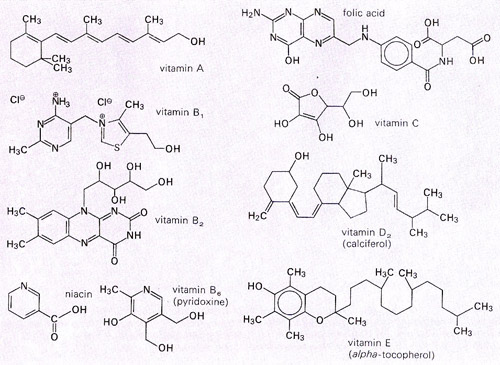
In addition to the nutrients, there are selected chemicals that the body needs in order to function properly. Your body can't make those so they have to come in your food. They include things like retinol, niacinamide, pyridoxine, cyanocobalamin, and ascorbic acid. Collectively they are known as vitamins, and the common names for the ones I've listed are A, B3, B6, B12, and C. These are all small molecules that can be readily manufactured in a chemistry lab. You can consume them in a pill.
The structure of some vitamins
       (taken from http://www.daviddarling.info/encyclopedia/V/vitamin.html)

Here are some common myths about the American diet:
  • People who worry a lot about their diet are healthier.
Many religions, e.g., Judaism, have dietary laws. I do not believe these confer any health benefits. Indeed, my anecdotal impression is that orthodox Jews are disproportionately obese and unhealthy. Whether that's because of kosher or despite kosher I don't know, but obviously kosher isn't helping any.

Even worse off are the vegans. The vegan students I've encountered have pasty, unhealthy complexions, seem to be frequently sick, and look terrible. This is not a good diet, certainly lacking in fats and proteins, and probably missing some vitamins as well.

Likewise, the Atkins diet is low-carb extremist. I tried it at one point and found it completely unworkable. Reducing carbs is fine, but an ideological crusade to eliminate them is nuts.
  •  Some essential ingredient is missing from your diet.
Just take the magic pill--so the story goes--and you'll be much healthier. That's what they tell you in the nutrition shops or on late-night TV. Not true. As long as you get your vitamins you're fine. There is no magic ingredient missing from the food you eat.

As I've already said, our biggest problem is that we eat too much. It is simply not true that despite all that food we're all on the verge of malnutrition because we lack some essential nutraceutical. It's nonsense. I never visit those "nutrition" shops.
  • Fast food is unhealthy food.
A Big Mac has about 550 Calories. If you ate three of them a day you'd get all the carbs, fats, and proteins you need, along with 1650 Cal. If the remaining Calories were consumed as fresh fruits and vegetables you'd have a perfectly balanced diet. Nobody on the Big Mac diet will die of malnutrition.

Of course that diet is boring. So people augment it with fries, a soft drink, and an apple pie. Then you've got too many Calories and way too many carbs. But there is nothing intrinsically wrong with fast food. All it is is good food served quickly.

  • Pesticides and food additives are bad for you.
Pesticides are clearly non-toxic to humans. Were it otherwise we'd have long since been killed off--they've been used ubiquitously for decades if not centuries. To the contrary, pesticides make food better by keeping insects out of it. I live right next to an apple orchard, and if the farmer didn't use pesticides the apples wouldn't be near as good.

I used to buy bread that didn't contain preservatives. Of course it goes stale and moldy within a few days. I always ended up throwing half the loaf away. There is no measurable damage to human health from preservatives. Indeed, there is enormous cost savings because much less food has to be discarded.

Likewise, food additives add taste and texture to food. The alternative is a lot more sugar or a lot more fat. Food shouldn't just be healthy, but also tasty and attractive. Food additives allow that to happen cheaply and with no significant ill effects.
  • "Health food" is healthy.
My daughter buys something called "almond milk" in lieu of the real thing--she thinks it's healthier. But it's just sugar water with a little almond extract and a few vitamins mixed in. It's overpriced, carb-loaded crap. Much better to buy real milk, which comes not only with vitamins and proteins, but necessary fatty acids. (My wife is lactose-intolerant, so that is not an option for her.)

Likewise, I see no advantage to so-called "organic" food. It confers no health benefits that I can see. But the Madison Avenue guys have y'all bamboozled into buying the stuff at inflated prices. I never touch it.

So that's Trotsky's common sense diet. Eat recognizable foods. Don't worry about additives or pesticides. Avoid excess carbohydrates. Control your calorie intake. As Aristotle said, all things in moderation. Enjoy your food. Don't let the Greenies, the ad men, the fanatics, or the scolds get to you.

Bon Appetit!

Monday, January 12, 2015

Beware the Amazons!

I have not read Adrienne Mayor's new book, entitled The Amazons: Lives & Legends of Women Warriors Across the Ancient World. It would never have crossed my radar screen but for an article in Socialist Action.

From the preview at amazon.com it looks to be charmingly written and beautifully researched. Appropriately, it's doing well in the sales rankings and has been widely reviewed elsewhere. I have read two "bourgeois" reviews from The Independent and the Wall Street Journal. There's nothing wrong with the book. It's just that I have lots of other stuff to read first that's more important to me.

Ms. Mayor's opus concerns female warriors from Scythia. That land was in Central Asia, and the warriors (both men and women, as the WSJ points out) were members of nomadic tribes who depended on finding new pastureland and/or booty for survival. Occasionally they attacked Greek communities (unsuccessfully, I gather), inspiring a voluminous and enduring series of myths about Amazon warriors. They caught the Greek imagination.

Ms. Mayor writes
After Heracles, Amazons were the single most popular subjects in Greek vase paintings. Amazons appeared in city murals and monumental civic sculptures in Athens and other Greek cities; tombs and places linked to Amazons were revered in the Greek and Anatolian landscape.
Ms. Mayor's effort is to separate fact from fiction--what was true about the Amazons, and what was myth. It's a book about art, culture, fashion, archaeology, and sex. I think it will be a bestseller.

So why am I writing about a book that I have no plan to read? It's because of the odd, idiosyncratic review provided by Socialist Action's resident feminist, Christine Marie, entitled A challenge to the myth of male dominance. Ms. Marie reads much more into the book than I think is there.

The title of Ms. Marie's review gives the game away. She reduces a complex, romantic tale to a cardboard cutout. Mayor's book is little more than an anecdote to justify some Marxist theory.

Her first claim is that the very existence of female warriors is in doubt. Of course that's not true--we have Amazons even today--the US military is almost completely gender-integrated. Ms. Marie thinks that we males are sent into paroxysms of psychological despair by the mere thought of female warriors. Then how does she explain the idolization of said Amazons in today's video games?

Second, she suggests that the acknowledgement of women soldiers has been the secret knowledge of Marxist anthropologists.
Collections of works by Marxist feminist anthropologists such as Eleanor Burke Leacock are kept in the public eye thanks only to small radical publishing houses. And so, when academic publishers commit to printing a new book that challenges the mainstream on these questions, it should be celebrated.
This ultimately reduces to a conspiracy theory--that well-known academics (almost all of whom are Leftists, and the majority are women) are somehow keeping important knowledge under wraps. How could this happen? And why?

Then comes the bizarre argument that because women died in battle, therefore there is a threat to male dominance. The logic escapes me. I do not see the connection between the title of Ms. Marie's piece and the substance of Ms. Mayor's book. Over 700,000 British soldiers died in World War I, many of them in futile attempts to move the front lines by a few hundred yards. Is that an argument for male dominance? And yet Ms. Marie will have us believe that the discovery of graves of a few hundred female battle victims implies that women were equals way back when.

And then there is the category error. She is taking a tale from history and turning it into a fact of anthropology. Ms. Mayor's book looks to be a rousing good tale, analogous perhaps to the myriad Civil War stories. These are at best anecdotes. And true enough--collect enough anecdotes and eventually you get data. But Ms. Marie has one anecdote and from there she argues for Marxist anthropology. The premise does not justify the conclusion.

Any effort to do anthropology has to take into account evolutionary psychology. From what I've read, there is nothing in Ms. Mayor's book that contradicts evoPsych. Nor as a work of history would one expect it to. But anthropology looks at a much bigger canvas over a much longer timeframe. Marx knew nothing about genes or genetics, nor did he have any ability to track their propagation through human populations. We have that toolkit today, at least in rudimentary form.

I don't expect Ms. Marie to change her mind. A person's political opinions are likely innate, or at least not changeable after age 30 or so. It all depends on what categories you put things in, and what values you consider important. To use Arnold Kling's language, Ms. Marie puts everything in terms of an Oppression/Liberation axis. Women are oppressed, and the political goal is to free them.

I prefer (in this context) the Civilization/Barbarism axis, i.e., that rules of civilized behavior are a crucial ingredient of our modern world. Civilization requires some limits on freedom. Men, for example, are not allowed to form street gangs with the purpose of going out to rape women, Genghis Khan style. Women, on the other hand, need to provide domestic life that keeps families and communities intact. When these institutions break down, we'll all be much worse off.

So Ms. Marie is from Mars and I'm from Venus, or whatever. I relinquish any effort to alter her world view. But I will suggest that she could become better at making her own case if she knew more. And that, of course, applies to me as well. So I'll make a deal with her. If she reads one book that I recommend, then I shall return the favor. The goal is not to change minds (impossible), but rather just to inform.

My recommendation for Ms. Marie is Steven Pinker's The Blank Slate. I don't agree with everything in that book. It's also somewhat dated. Nevertheless, I think it makes the strongest case against Marxist anthropology as historically understood. Now a reformulation of Marxism is possible, but that will require some understanding of evolutionary psychology.

I await Ms. Marie's instructions for what book I am to read. I promise to review it here.

Further Reading: