The North Star has apparently ceased publication. At least their URL (https://thenorthstar.info/) no longer works. Founded in order to reinvigorate Trotskyism by the lights of Bert Cochrane, it sought a non-sectarian Left. If anybody knows if they've moved someplace else, please let me know. Meanwhile, I've removed them from This Blog's Beat.
Further Reading:
Showing posts with label North Star. Show all posts
Showing posts with label North Star. Show all posts
Friday, July 13, 2018

Wednesday, May 16, 2018
"Perspectives for the United States"
It's been a quiet month in Trotsky-land. I've found rather little to write about. Scraping the bottom of the barrel here, not because John Reimann's article is bad, but just that I've covered this territory many times before.
I've borrowed my post's title from Mr. Reimann's piece over at The North Star. The lede paragraph:
The "racism" charge is also mostly phony. As Scott Alexander puts it, Trump is no more racist than the average 70-year-old white guy. So that's more "racist" than Obama, but it hardly qualifies him as a member of the Ku Klux Klan. Unlike previous Republican candidates, he actively campaigned in Black neighborhoods and sought out their votes. And while unsuccessful at the time, Trump is slowly winning support from Black men (see, e.g., Kanye West).
What is true is that Trump is spectacularly uninterested in racial politics or issues, about which he knows nothing and cares less. That's why he has such a tin ear on things like Charlottesville, where the media were able to take his remarks completely out of context. (See my comments on that episode here.)
Then we're told that Trump is in cahoots with the Russian mafia. Mr. Reimann's source for this is something called oaklandsocialist.com, which refers us to the equally obscure site WhoWhatWhy.org. These tout conspiracy theories--that Trump has surreptitious ties with Russian oligarchs that not Robert Mueller, nor the otherwise bloodthirsty media has been able to reproducibly uncover. This is just BS.
Finally we get to real substance: Mr. Reimann asserts that American imperialism is in decline. He separates this into two parts: domestic and foreign. He asserts that Trump's slogan, Make America Great Again, is in fact a promise to reverse this decline--a promise he won't be able to keep.
Mr. Reimann does have a point. As a fraction of global output US GDP has declined: from 37% in 1967 to 25% today. This happened (in major part) because China (a very big country) rejoined the world economy in 1980 and global GDP has expanded considerably as a result. But it is a big mistake to interpret this as the decline of America (though in Mr. Reimann's defense, Trump makes the same error). The US has hugely benefited from the industrialization of China, as I have documented in detail here (in response to an article by Marxist Lynn Henderson).
It is an undeniable fact that almost all Americans at all income levels are far richer than they were in 1980. Today we have the Internet, cell phones, 500 channels on cheap, 72" televisions, access to streaming movies, real-time video games, much safer, more reliable, and better cars, cheaper food and much cheaper clothing. Etc. I find it completely incredible that my Trotskyist friends can still claim that we're all getting poorer with a straight face. That is manifestly not true!
Yes, some things have gone awry: Mr. Reimann cites lower home ownership rates. Even there he's cherry-picked his data point, for the quality of housing has increased dramatically over that past 40 years. Even renters are substantially better off than they used to be.
Speaking of cherry-picking, Mr. Reimann cites At Our Own Peril, a report published by the US Army War College, as if it represented the last word in Pentagon thinking. Rest assured--it does not. DoD is a huge organization and publishes a zillion reports annually. Some of them are certifiably stupid, like the one that suggested that climate change is the most important defense priority for the United States.
At Our Own Peril is not silly, but to take it as the last word on global politics is silly. Yes, in many ways US influence has declined since 1945, most precipitously since the demise of the Soviet Union. A multipolar world is intrinsically more complex than a bipolar one. And ever cheaper technology makes weapons of mass destruction more easily obtainable, even by non-state actors. So in that sense Mr. Reimann is correct.
But the US spends 37% of all global defense expenditures, roughly triple what China spends. We are by far the most powerful nation on the planet, a fact that is not likely to change any time soon. It's not even close. When President Trump promises "fire & fury," he is very much in a position to deliver just that.
In an all-out war with North Korea, we win. Easily and hands down. But Mr. Reimann distorts that prospect. He writes
Mr. Reimann devotes much of his article to the political responses to Mr. Trump. Given his assumption that Trump is some right-wing, Russia-loving, kooky crackpot, no wonder he gets it all wrong. I remind him that Trump won the 2016 election, and he didn't do that by being a bumbling, incompetent, undisciplined idiot. Quite the contrary--the campaign was spectacularly well run. See, for example, here and here (unfortunately I can't now find the best article on this subject).
The truth is Trump is a masterful politician! He has upended politics in precisely the same way Amazon disrupted bookstores, and Uber has trashed taxicabs. The man is not only disciplined--he's a genius! That doesn't mean he's always right on the issues, but he understands the political pulse in America as no other.
Mr. Reimann, writing back in January, claims Trump only had 32% support. Today it's up to about 50%. But none of those numbers matter. Trump may very well be the most unpopular politician in America--except for all the others. I can't think of a single Democrat who has a chance of beating him.
A lot can change between now and 2020. If nothing else, Trump is getting on in years and his health might fail. Still, Trump is far and away the odds on favorite to win reelection in 2020.
Further Reading:
I've borrowed my post's title from Mr. Reimann's piece over at The North Star. The lede paragraph:
The Marxist method is to start by trying to figure out the main processes – the main forces at work – and get some idea of how they will interact and develop. Only then can we figure out our tasks within that general process. Recently a small group of Marxists – the Workers International Network – held a conference in Britain. Here are some thought on the perspectives for the United States that were submitted to that conference:It's a fine thought, but then why is the following sentence so spectacularly wrong?
On November 9, 2016, the world awoke to Americans having elected the most right wing and racist president since before the US Civil War.Surely Presidents Reagan and both Bushes were more "right wing" than Trump, at least if judged against standard Republican principles. They all explicitly tried to shrink the size of government (unsuccessfully), and were eager to use US military force abroad (Grenada, Nicaragua, Kuwait, Iraq). Trump, meanwhile, just signed the biggest deficit-spending bill in history, and apart from two pinprick strikes against Syria has barely used American military force at all.
The "racism" charge is also mostly phony. As Scott Alexander puts it, Trump is no more racist than the average 70-year-old white guy. So that's more "racist" than Obama, but it hardly qualifies him as a member of the Ku Klux Klan. Unlike previous Republican candidates, he actively campaigned in Black neighborhoods and sought out their votes. And while unsuccessful at the time, Trump is slowly winning support from Black men (see, e.g., Kanye West).
What is true is that Trump is spectacularly uninterested in racial politics or issues, about which he knows nothing and cares less. That's why he has such a tin ear on things like Charlottesville, where the media were able to take his remarks completely out of context. (See my comments on that episode here.)
Then we're told that Trump is in cahoots with the Russian mafia. Mr. Reimann's source for this is something called oaklandsocialist.com, which refers us to the equally obscure site WhoWhatWhy.org. These tout conspiracy theories--that Trump has surreptitious ties with Russian oligarchs that not Robert Mueller, nor the otherwise bloodthirsty media has been able to reproducibly uncover. This is just BS.
Finally we get to real substance: Mr. Reimann asserts that American imperialism is in decline. He separates this into two parts: domestic and foreign. He asserts that Trump's slogan, Make America Great Again, is in fact a promise to reverse this decline--a promise he won't be able to keep.
Mr. Reimann does have a point. As a fraction of global output US GDP has declined: from 37% in 1967 to 25% today. This happened (in major part) because China (a very big country) rejoined the world economy in 1980 and global GDP has expanded considerably as a result. But it is a big mistake to interpret this as the decline of America (though in Mr. Reimann's defense, Trump makes the same error). The US has hugely benefited from the industrialization of China, as I have documented in detail here (in response to an article by Marxist Lynn Henderson).
It is an undeniable fact that almost all Americans at all income levels are far richer than they were in 1980. Today we have the Internet, cell phones, 500 channels on cheap, 72" televisions, access to streaming movies, real-time video games, much safer, more reliable, and better cars, cheaper food and much cheaper clothing. Etc. I find it completely incredible that my Trotskyist friends can still claim that we're all getting poorer with a straight face. That is manifestly not true!
Yes, some things have gone awry: Mr. Reimann cites lower home ownership rates. Even there he's cherry-picked his data point, for the quality of housing has increased dramatically over that past 40 years. Even renters are substantially better off than they used to be.
Speaking of cherry-picking, Mr. Reimann cites At Our Own Peril, a report published by the US Army War College, as if it represented the last word in Pentagon thinking. Rest assured--it does not. DoD is a huge organization and publishes a zillion reports annually. Some of them are certifiably stupid, like the one that suggested that climate change is the most important defense priority for the United States.
At Our Own Peril is not silly, but to take it as the last word on global politics is silly. Yes, in many ways US influence has declined since 1945, most precipitously since the demise of the Soviet Union. A multipolar world is intrinsically more complex than a bipolar one. And ever cheaper technology makes weapons of mass destruction more easily obtainable, even by non-state actors. So in that sense Mr. Reimann is correct.
But the US spends 37% of all global defense expenditures, roughly triple what China spends. We are by far the most powerful nation on the planet, a fact that is not likely to change any time soon. It's not even close. When President Trump promises "fire & fury," he is very much in a position to deliver just that.
In an all-out war with North Korea, we win. Easily and hands down. But Mr. Reimann distorts that prospect. He writes
There is the matter of North Korea, for example. Right now, the rhetoric as far as crushing that country seems to have receded. But who knows what’s going on beneath the surface? There have been some reports that some generals are implying they would disobey an order to launch a first strike nuclear attack. But relying on the military, which has always had its crazed Dr. Strangelove wing, is a very weak assurance indeed.Why would the US launch a first strike nuclear attack? We have no need--we can destroy the Nork's nukes with perfectly conventional weapons. Which (I hope) is what we will do if Mr. Kim cannot be persuaded to give them up otherwise.
Mr. Reimann devotes much of his article to the political responses to Mr. Trump. Given his assumption that Trump is some right-wing, Russia-loving, kooky crackpot, no wonder he gets it all wrong. I remind him that Trump won the 2016 election, and he didn't do that by being a bumbling, incompetent, undisciplined idiot. Quite the contrary--the campaign was spectacularly well run. See, for example, here and here (unfortunately I can't now find the best article on this subject).
The truth is Trump is a masterful politician! He has upended politics in precisely the same way Amazon disrupted bookstores, and Uber has trashed taxicabs. The man is not only disciplined--he's a genius! That doesn't mean he's always right on the issues, but he understands the political pulse in America as no other.
Mr. Reimann, writing back in January, claims Trump only had 32% support. Today it's up to about 50%. But none of those numbers matter. Trump may very well be the most unpopular politician in America--except for all the others. I can't think of a single Democrat who has a chance of beating him.
A lot can change between now and 2020. If nothing else, Trump is getting on in years and his health might fail. Still, Trump is far and away the odds on favorite to win reelection in 2020.
Further Reading:
- Summary Statement of US Strategic Goals for the Coming Period
- If Everybody is a Racist, Then Nobody is a Racist
- Book Review: The Accidental Superpower
Saturday, November 4, 2017
100 Years After October Revolution
Three articles have recently appeared celebrating the centennial of the 1917 Russian Revolution. Socialist Viewpoint publishes a piece by Chris Kinder, The North Star highlights an article by Roger Silverman, and finally, Socialist Action posts a feature written by their national leader, Jeff Mackler. Mr. Mackler promises a second installment which I fear may not appear for several more weeks.
He sees Socialist Action as following in the Bolshevik's footsteps (though he's too modest to suggest that he is himself the reincarnation of Lenin).
Assessment
Trotskyists have a problem. Unlike Communist parties, they are not willing to sweep the Stalinist crimes under the rug. They freely admit to the purges and mass murders of the 1930s, though those events are not explicitly mentioned in any of the articles. And contrary to Conservative critics (like me) they are even more adamantly insistent that the Revolution was ultimately a success. After all, why celebrate it otherwise. It is a high wire act to rescue something of enduring value from an event that otherwise appears disastrous.
Mr. Silverman is the most explicit in tabulating accomplishments, citing economic data.
Mr. Kinder recounts some (in his view) admirable Bolshevik policies without commenting on how successful they were. The most radical was the Decree on Land, which forbade landlords from collecting rent or evicting tenants. He tells in loving detail of the political intrigue this dramatic move caused, though nowhere does he say anything about the economic outcome, which we know was awful.
Mr. Mackler also comments on land reform, writing,
The problem with transferring all property rights to the poorest citizens is that they, almost by definition, lack the capital (both human & financial) and the access to markets to be meaningful producers. If the goal is to improve agricultural output, this strategy will inevitably fail, as it always has.
Then Mr. Kinder talks about Soviet housing policy. The paragraph is long and hard to excerpt, but here goes.
Relevance
None of our correspondents are very specific about the relevance of Russia's revolution on today's world, beyond claiming that it's earthshaking and exemplary.
We've quoted Mr. Kinder at the top of this post. Presumably Mr. Mackler will have something to say in his next installment. That leaves Mr. Silverman, who simply asserts that it continues to be important.
My view is that the Russian Revolution has faded into history and has nearly no relevance for the modern world outside of Russia. Within Russia, the Revolution was a cataclysmic event that destroyed their country, culture, and peoples, and from which they will never recover.
Further Reading:
All three articles cover pretty much the same territory, which we can summarize with three questions:
- What was the significance of the Russian Revolution in 1917?
- How can the success or failure of the Revolution be assessed?
- What is the relevance of 1917 to our present day?
Significance
All three authors hold the Russian Revolution in very high regard. Chris Kinder, in his opening paragraph, phrases it in utopian terms.
Long disparaged and denounced as it is, the Russian Revolution of 1917 still demands our attention today. No event in history was quite like the Russian Revolution, because no other event before or since has attempted to change the motive force of history in the fundamental way that this event did. By forming the world’s first and only lasting (if only for a few years) workers’ state, this revolution alone offered the promise of a world without the endless class conflict that defined all previous history: a world based on genuine human cooperation; free of exploitation, war, racism, sexism and national, ethnic and religious oppression. The promise of the Russian Revolution embodied the true goals of the vast majority of humanity then, and yes, of humanity today. The fact that this revolution soon was unraveled, betrayed and eventually destroyed only makes the lessons it holds for us today more important to understand.Mr. Silverman perceives the Revolution as a specter that still haunts the globe.
November 7th, 2017 marks the centenary of an event whose impact still today reverberates throughout the world. The Russian revolution remains a constant spectre at the feast of the rich, its shadow falling across all subsequent history. Since its lessons lie buried in a century of sludge by all those determined to malign its meaning, it is the duty of socialists to unearth them and bring them back to light.
Mr. Mackler credits the Bolshevik Party.
To this day, 100 years after Lenin’s Bolshevik Party led the world’s first socialist revolution, no party has matched its record of social, political, theoretical, organizational, military, cultural, and moral contributions to the advancement of the interests of the working-class masses.
Assessment
Trotskyists have a problem. Unlike Communist parties, they are not willing to sweep the Stalinist crimes under the rug. They freely admit to the purges and mass murders of the 1930s, though those events are not explicitly mentioned in any of the articles. And contrary to Conservative critics (like me) they are even more adamantly insistent that the Revolution was ultimately a success. After all, why celebrate it otherwise. It is a high wire act to rescue something of enduring value from an event that otherwise appears disastrous.
Mr. Silverman is the most explicit in tabulating accomplishments, citing economic data.
It is worth remembering that in earlier days, for all its devastating burdens, the planned economy had boasted miracles of economic transformation. To take a measure of what was then achieved, in the fifty years starting from 1913 (the highest point of the Russian pre-revolutionary economy), Russia’s share of total world industrial output had soared from 3% to 20%, and total industrial output had risen more than 52 times over. (The corresponding figure for the USA was less than six times.) In the same period, industrial productivity of labour had risen by 1,310%, compared to 332% in the USA, and steel production from 4.3 million tons in 1928 (at the start of the first Five Year Plan) to 100 million tons. Life expectancy had more than doubled and child mortality dropped nine times. Soviet Russia in its heyday produced more scientists, technicians and engineers every year than the rest of the world put together.This paragraph illustrates a fundamental problem with Marxist economics, which renders their comparisons irrelevant. That's because they weigh measures of what workers produce much higher than what consumers buy. Producing something (e.g., refrigerators that don't work or cars that break down within 5000 miles or warehouses full of rotting produce) is not important if people don't want or need to buy it. Increasing industrial output by 52 times, or even by a million times, has no value if it serves no need for consumers, i.e., people. That's why sales data is more important than production data.
Mr. Kinder recounts some (in his view) admirable Bolshevik policies without commenting on how successful they were. The most radical was the Decree on Land, which forbade landlords from collecting rent or evicting tenants. He tells in loving detail of the political intrigue this dramatic move caused, though nowhere does he say anything about the economic outcome, which we know was awful.
Mr. Mackler also comments on land reform, writing,
Aside from revolutionary Cuba, no nation since then has implemented a land reform-distribution of that scope. Indeed, today in Latin America every so-called revolutionary or “popular” regime, from Venezuela to Bolivia, Ecuador and Uruguay to Nicaragua and Argentina, has failed to accomplish even a modest land reform. To do so would entail a break with the capitalist system of private property that none of the above dared to contemplate.Beyond Cuba, he fails to consider Zimbabwe, which implemented a land reform at least as catastrophic as the Soviets. And then also China, unless he is revisiting the existence of the Chinese Revolution. Beyond which it beggars imagination to think that Cuba has an effective agricultural industry.
The problem with transferring all property rights to the poorest citizens is that they, almost by definition, lack the capital (both human & financial) and the access to markets to be meaningful producers. If the goal is to improve agricultural output, this strategy will inevitably fail, as it always has.
Then Mr. Kinder talks about Soviet housing policy. The paragraph is long and hard to excerpt, but here goes.
However, to judge by the numerous critiques of Soviet housing that emerged in modern times, one would think that problems such as these were the whole story, as they repeat endless horror stories about inadequate housing in the USSR. Yet, how many homeless people were there in the Soviet Union?....Russians find it odd that Americans call themselves ‘homeowners’ from the day they close on a mortgage loan. For Russians, ownership only begins after all debts are paid off.” How true that was for millions of so-called “homeowners” in the U.S. who lost their homes in the mortgage fraud-induced crash of 2008!There was no homelessness in the Soviet Union because it was illegal to be homeless. The alternative was internment in a mental hospital (or worse). And surely Mr. Kinder will acknowledge that almost all Americans had housing far better than all but the Soviet's nomenklatura.
Relevance
None of our correspondents are very specific about the relevance of Russia's revolution on today's world, beyond claiming that it's earthshaking and exemplary.
We've quoted Mr. Kinder at the top of this post. Presumably Mr. Mackler will have something to say in his next installment. That leaves Mr. Silverman, who simply asserts that it continues to be important.
And now more than ever, another world is necessary. In every continent today, a new generation is waking up to the reality that the only future it faces under capitalism is one of poverty, homelessness, hopelessness, discrimination, environmental destruction and war. Millions of people are in revolt, casting around for alternatives, sometimes seduced by false demagogues, but increasingly determined to find a road to change. Those commentators who used to scoff at the idea of revolution are today falling silent. In a recent Greek opinion poll, 33% called for “revolution”. And last year in the USA, 54% of respondents voted yes to the idea of a “political revolution to redistribute money from the wealthiest Americans”. That included 68% of Afro-Americans, 65% of Hispanics, and 68% of 18-29 year-olds.
It is time to rescue the Russian revolution from the history books and return it to its rightful place as a guide to action.I think if you'd asked those poll respondents "Would you like to live in country like the Soviet Union?" I suspect the answers would have been far different.
My view is that the Russian Revolution has faded into history and has nearly no relevance for the modern world outside of Russia. Within Russia, the Revolution was a cataclysmic event that destroyed their country, culture, and peoples, and from which they will never recover.
Further Reading:
Monday, August 21, 2017
Freedom Socialist Party Reads Marx
The Freedom Socialist Party (FSP) certainly belongs on my Beat! They're professed Trotskyists, having split off from the Socialist Workers Party in 1966. That was before my time, and indeed, these folks come across as frozen in amber. Being early-birds to the web, they've cornered the handle socialism.com.
The FSP started in Seattle, where apparently the entire branch left the SWP. The reasons for the split are here, and don't make too much sense to a modern audience. They disagreed only on fine points related to the civil rights movement, the anti-war movement, and the SWP's attitude toward (then) Maoist China. And typical of all splitters, they accused the SWP leadership of unprincipled, undemocratic behavior that forced the issue. Today these issues are mostly moot.
They also believed the SWP underestimated the importance of the women's movement, and this looks to be the primary distinguishing aspect of the FSP today. The Party briefly became an all-woman organization, but has since charitably admitted men. "Party men today are engaged feminists."
That left the feminist impulse unsatisfied, and so a sisterly organization was established: Radical Women (RW), which does exclude men. I'm not sure how the goals or responsibilities of RW differ from the FSP.
The Party had it's share of scandal. The leading lady of the movement was Clara Fraser (1923-1998). At the founding she was joined by her husband, Richard, who then soon filed for divorce. The spat was very public and led to a split in the Party, likely accentuating its feminist flavor.
In 1984 a disgruntled ex-comrade sued for a refund of contributions he'd made to the Party toward rebuilding their headquarters. The Party was then located at Freeway Hall--today it's at New Freeway Hall. The dispute was again very public and drawn out, with Leonard Boudin serving as the FSP's lawyer. Eventually the Party was vindicated, but not until 1992.
By 1976 the Party had branches in Seattle, Los Angeles, New York, San Francisco, and Portland, which is where they are still located. These are the "billionaire cities"--between them they're probably home to three quarters of the country's billionaires. Of course Seattle wasn't like that in 1970--then it was a decaying rust belt town, famous for the billboard: "Will the last person to leave Seattle please turn out the lights." But then a young man named Bill Gates decided to come home to live closer to his parents.
It is ironic that a supposedly vanguard, working-class Party, even today, can only exist in the richest places on earth.
I'm turned on to the Freedom Socialists by an article in North Star written by an FSP member, Susan Williams, entitled Marx's Capital for the 21st century. It's an intriguing title and could be a good article, but it isn't. Instead it's a poorly written piece composed by somebody who knows nothing about economics. But the author can't be stupid--she identifies as a medical doctor and "doctor's union organizer." So we can forgive her economic ignorance. If I'm ever in Seattle (if that's where she lives) and not feeling very well, I'll look her up and engage her in topics she undoubtedly knows more about.
I'm not going to make fun of Dr. Williams, which would be too easy and not much sport. I will also confess I haven't read Capital, nor do I intend to. In my old age I no longer have the patience for bad writing. So I will assume that Dr. Williams' description of Marx is accurate, at least for the topic I wish to consider. She inadvertently points out a place where the world really has changed, and while Marx may have been correct in the 1850s, he is certainly wrong now.
Dr. Williams writes:
In Marx's time, commodities in that sense did make up the major portion of the economy. Today they are a much smaller percentage.
There's another definition of commodity that I think is more useful: A commodity is a product where competition is entirely on price. Gasoline is a commodity--when I shop around I only compare prices, and only secondarily service, cleanliness, quality of the gasoline, etc. Economy class airline seats are a commodity. Tourists look for the cheapest fares, and beyond that they don't care which airline they fly. Business and first-class travel, on the other hand, does not compete on price. They are not commodities, and Singapore Airlines has established a prominent brand name.
Marx may also have used commodities in this sense. He lived during the industrial revolution, when the major industrial output was textiles. They were certainly commodities in the sense that manufacturers competed mainly on price.
And if competition is only on price, then of course profit margins will get squeezed. Marx's conclusion of a declining rate of profit (as a fraction of operating costs) will certainly be true, and is true today for commodities. Gas stations run on very thin margins, as do airlines, and stores like Walmart.
But unlike in Marx's day, most things we buy are not commodities. Let's use a more general term: consumer products are things that consumers buy. I like to include the qualifier consumer because what the consumer can buy will determine his or her standard of living. The more consumer products, the better we shall live.
In today's world, few consumers purchase raw iron ore, raw textiles not yet cut or sewn into clothes, unroasted coffee beans, bushels of wheat straight off the farm, or crude oil. Those are commodities, but today they aren't consumer products. In Marx's time, however, many more of them might have been consumer products. Families, for example, purchased yards of cloth, and then it was up to the women or the servants to fashion that into clothes. We don't do it that way anymore--we're richer than that.
Even if she's not from Seattle, Dr. Williams has likely heard of Starbucks. Starbucks buys two commodities in bulk: coffee and sugar. These get fashioned into elaborate concoctions, prepared using custom equipment by specially trained personnel, and served in bespoke locations designed specifically for that purpose.
Of course all that comes at a price: Starbucks is not cheap. Starbucks is not selling a commodity, but rather a branded product that consumers choose to spend money on. Indeed, it's a good rule of thumb: branded products are not commodities. Instead they're sold because they add some extra value for the consumer that elevates them above the price war. There are lots of branded products: iPhones, Cadillacs, Cheerios, Harvard University, Singapore Airlines, etc. They're a ubiquitous part of our lives, and none of them are commodities.
The declining rate of profit does not apply to non-commodities. Starbucks charges a premium for the benefits of it's brand, which are quite substantial.
Marx did not live in our world. He may never have encountered a consumer product like what we have today. In his world all one could buy were commodities, and it was up to the household to make something more out of them. He lived in a world of commodities; we live in a world of consumer products.
The rules are different. Marx was right. Now he's wrong.
Further Reading:
That left the feminist impulse unsatisfied, and so a sisterly organization was established: Radical Women (RW), which does exclude men. I'm not sure how the goals or responsibilities of RW differ from the FSP.
The Party had it's share of scandal. The leading lady of the movement was Clara Fraser (1923-1998). At the founding she was joined by her husband, Richard, who then soon filed for divorce. The spat was very public and led to a split in the Party, likely accentuating its feminist flavor.
In 1984 a disgruntled ex-comrade sued for a refund of contributions he'd made to the Party toward rebuilding their headquarters. The Party was then located at Freeway Hall--today it's at New Freeway Hall. The dispute was again very public and drawn out, with Leonard Boudin serving as the FSP's lawyer. Eventually the Party was vindicated, but not until 1992.
By 1976 the Party had branches in Seattle, Los Angeles, New York, San Francisco, and Portland, which is where they are still located. These are the "billionaire cities"--between them they're probably home to three quarters of the country's billionaires. Of course Seattle wasn't like that in 1970--then it was a decaying rust belt town, famous for the billboard: "Will the last person to leave Seattle please turn out the lights." But then a young man named Bill Gates decided to come home to live closer to his parents.
It is ironic that a supposedly vanguard, working-class Party, even today, can only exist in the richest places on earth.
I'm turned on to the Freedom Socialists by an article in North Star written by an FSP member, Susan Williams, entitled Marx's Capital for the 21st century. It's an intriguing title and could be a good article, but it isn't. Instead it's a poorly written piece composed by somebody who knows nothing about economics. But the author can't be stupid--she identifies as a medical doctor and "doctor's union organizer." So we can forgive her economic ignorance. If I'm ever in Seattle (if that's where she lives) and not feeling very well, I'll look her up and engage her in topics she undoubtedly knows more about.
I'm not going to make fun of Dr. Williams, which would be too easy and not much sport. I will also confess I haven't read Capital, nor do I intend to. In my old age I no longer have the patience for bad writing. So I will assume that Dr. Williams' description of Marx is accurate, at least for the topic I wish to consider. She inadvertently points out a place where the world really has changed, and while Marx may have been correct in the 1850s, he is certainly wrong now.
Dr. Williams writes:
Capital begins with the individual cell of the capitalist organism: the commodity (an object made to be sold). Marx explains step by step the process by which human labor-power adds economic value to commodities above and beyond the owner’s costs. And he shows how this process inherently steals from the worker. If you know in your gut that you are being robbed at work even though you get a paycheck, Marx demonstrates logically why you are absolutely correct.
Marx laid out how capitalist economy would unavoidably suffer periodic crises worsening over time while the general rate of profit would slow.Marx may have used the word commodity in just the way she describes, namely as a product to be sold. Today, however, the term is used in a much narrower sense. Sometimes it refers to raw materials, i.e., the stuff that comes from mines, oceans, or farms. Thus oil, copper, and pork bellies are all commodities, and are commonly traded on commodity exchanges.
In Marx's time, commodities in that sense did make up the major portion of the economy. Today they are a much smaller percentage.
There's another definition of commodity that I think is more useful: A commodity is a product where competition is entirely on price. Gasoline is a commodity--when I shop around I only compare prices, and only secondarily service, cleanliness, quality of the gasoline, etc. Economy class airline seats are a commodity. Tourists look for the cheapest fares, and beyond that they don't care which airline they fly. Business and first-class travel, on the other hand, does not compete on price. They are not commodities, and Singapore Airlines has established a prominent brand name.
Marx may also have used commodities in this sense. He lived during the industrial revolution, when the major industrial output was textiles. They were certainly commodities in the sense that manufacturers competed mainly on price.
And if competition is only on price, then of course profit margins will get squeezed. Marx's conclusion of a declining rate of profit (as a fraction of operating costs) will certainly be true, and is true today for commodities. Gas stations run on very thin margins, as do airlines, and stores like Walmart.
But unlike in Marx's day, most things we buy are not commodities. Let's use a more general term: consumer products are things that consumers buy. I like to include the qualifier consumer because what the consumer can buy will determine his or her standard of living. The more consumer products, the better we shall live.
In today's world, few consumers purchase raw iron ore, raw textiles not yet cut or sewn into clothes, unroasted coffee beans, bushels of wheat straight off the farm, or crude oil. Those are commodities, but today they aren't consumer products. In Marx's time, however, many more of them might have been consumer products. Families, for example, purchased yards of cloth, and then it was up to the women or the servants to fashion that into clothes. We don't do it that way anymore--we're richer than that.
Even if she's not from Seattle, Dr. Williams has likely heard of Starbucks. Starbucks buys two commodities in bulk: coffee and sugar. These get fashioned into elaborate concoctions, prepared using custom equipment by specially trained personnel, and served in bespoke locations designed specifically for that purpose.
Of course all that comes at a price: Starbucks is not cheap. Starbucks is not selling a commodity, but rather a branded product that consumers choose to spend money on. Indeed, it's a good rule of thumb: branded products are not commodities. Instead they're sold because they add some extra value for the consumer that elevates them above the price war. There are lots of branded products: iPhones, Cadillacs, Cheerios, Harvard University, Singapore Airlines, etc. They're a ubiquitous part of our lives, and none of them are commodities.
The declining rate of profit does not apply to non-commodities. Starbucks charges a premium for the benefits of it's brand, which are quite substantial.
Marx did not live in our world. He may never have encountered a consumer product like what we have today. In his world all one could buy were commodities, and it was up to the household to make something more out of them. He lived in a world of commodities; we live in a world of consumer products.
The rules are different. Marx was right. Now he's wrong.
Further Reading:
Tuesday, June 21, 2016
Classy
Vincent Kelley writes a useful article entitled Class: Its Core Dimensions and Relationships to Levels of Organization, published in The North Star. It's a superior exercise in Marxist theory as it tries to actually describe reality instead of just rehashing ancient texts. Plus Mr. Kelley is a good writer.
In the end, it fails, and mostly because Mr. Kelley begins with a severely truncated toolkit.
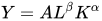
Economists usually begin such discussions with the so-called factors of production. Often three ingredients are required: access to natural resources, labor, and capital. But the resource factor is usually subsumed into the other two, so most economic argument starts with how to allocate labor and capital in order to maximize production. This is enshrined in the well-known Cobb-Douglas production function,
And then he makes some odd distinctions:
In Mr. Kelley's view fundamental laborers, while they might be allied with the proletariat, lack the power to shut the mother down in the way that actual production workers can. They're rather like Russian peasants--in Lenin's view useful allies but ultimately irrelevant.
Mr. Kelley could mention that 80% of the American labor force are in service occupations, and only 12% are in traditional manufacturing. The actual proletariat then is already rather small, and is still shrinking fast. Mr. Kelley blames this on foreign outsourcing, when in fact the biggest culprit by far is automation. The day is not far off when only 1 or 2% of the population is involved in manufacturing, similar to the fraction now working in agriculture.
Further, that 12% in manufacturing are not the interchangeable proletarians of yore, but instead are increasingly highly skilled and well-paid workers. These are not people who have any interest in "shutting the mother down."
Beyond this, I'd take issue with his distinction between service workers and proletarians. We'll all agree that the UAW guy at the River Rouge plant is a worker. But what about the salesman at the local dealership? The salesman is the crucial link in the chain--without him the worker's labor is wasted, as is Henry Ford's capital investment. If the cars don't sell, there's no point in building them. So if anybody has his finger on the pulse of the economy, it's the salesman. I don't think Mr. Kelley understands that.
And then: Are McDonald's employees fundamental laborers trained to respond to customers? Or are they instead workers in a hamburger manufacturing plant? Mr. Kelley needs to answer such questions before he makes such dramatic distinctions.
There are bits of Mr. Kelley's article that I agree with. He writes,
Also,
So Mr. Kelley's goal is to overthrow capital. I have no clue what that means. But I enjoyed reading about how we're supposed to get there.
Further Reading:
In the end, it fails, and mostly because Mr. Kelley begins with a severely truncated toolkit.
Economists usually begin such discussions with the so-called factors of production. Often three ingredients are required: access to natural resources, labor, and capital. But the resource factor is usually subsumed into the other two, so most economic argument starts with how to allocate labor and capital in order to maximize production. This is enshrined in the well-known Cobb-Douglas production function,
Here Y is total output (to be maximized), L is the amount of labor used, and K is the capital invested. The other terms are empirical parameters. In particular, alpha and beta represent the relative importance of capital and labor, respectively.
So a cab driver has to buy a car ($30K in capital investment), and then spend hours driving (a labor investment). The result, he hopes, is a good living. And if the driver does not himself buy the car, then somebody else has to lay out the money, and accordingly will want some return on investment, aka profit.
But Mr. Kelley does not acknowledge capital as a factor of production. For him it is unnecessary for a cab driver to have a car--he could just simply start driving anyway. Or equally absurd, the person (even the driver) who purchases the car is willing to lend it out for free, just as a favor. Mr. Kelley says that there is only one factor of production--only labor counts, and nobody should be reimbursed for capital.
His ideal world, where capital is abolished, is one where there will be no taxis, no factories, no roads and no airplanes. I can't imagine what such a better world might look like--it'd be rather like a world without gravity.
Yet the article has some merits. First, he acknowledges that class is a malleable quality--it depends on the class struggle. Or putting it in my own words, class exists only insofar as the people involved recognize that they're in different classes. Or, in Mr. Kelley's language,
Because class is created through historical class struggle, classes are made and remade over time. For the same reason, they can also be altered and destroyed. Class ideologies can be even more dynamic than classes in economic and political terms since ideology encompasses not only what is but also what was and what could be.I think this is true, though it doesn't sound very materialist, and therefore odd coming from a Marxist.
And then he makes some odd distinctions:
...the outsourcing of manufacturing jobs in the last several decades has pushed many long-term production workers into the service sector, in which they sell their services to clients as opposed to selling their labor-power to capitalists. This shift of many workers from the occupational proletariat to the occupational petite bourgeoisie has formed a large segment of the U.S. petite bourgeoisie whose material conditions are comparable to or even below the proletariat, even though this segment is not in direct contradiction with industrial capital as it used to be. We call members of this lower strata of the petite bourgeoisie fundamental laborers...So our taxi driver (even if he just works for the cab owner) is nevertheless not a member of the proletariat. Instead he is a fundamental laborer (aka, service worker) who is "occupationally" a member of the petite bourgeoisie. The distinction is that the cabbie works for passengers more than for the car owner, and is thus not an employee in the way a true proletarian would be.
In Mr. Kelley's view fundamental laborers, while they might be allied with the proletariat, lack the power to shut the mother down in the way that actual production workers can. They're rather like Russian peasants--in Lenin's view useful allies but ultimately irrelevant.
Mr. Kelley could mention that 80% of the American labor force are in service occupations, and only 12% are in traditional manufacturing. The actual proletariat then is already rather small, and is still shrinking fast. Mr. Kelley blames this on foreign outsourcing, when in fact the biggest culprit by far is automation. The day is not far off when only 1 or 2% of the population is involved in manufacturing, similar to the fraction now working in agriculture.
Further, that 12% in manufacturing are not the interchangeable proletarians of yore, but instead are increasingly highly skilled and well-paid workers. These are not people who have any interest in "shutting the mother down."
Beyond this, I'd take issue with his distinction between service workers and proletarians. We'll all agree that the UAW guy at the River Rouge plant is a worker. But what about the salesman at the local dealership? The salesman is the crucial link in the chain--without him the worker's labor is wasted, as is Henry Ford's capital investment. If the cars don't sell, there's no point in building them. So if anybody has his finger on the pulse of the economy, it's the salesman. I don't think Mr. Kelley understands that.
And then: Are McDonald's employees fundamental laborers trained to respond to customers? Or are they instead workers in a hamburger manufacturing plant? Mr. Kelley needs to answer such questions before he makes such dramatic distinctions.
There are bits of Mr. Kelley's article that I agree with. He writes,
To return to our examples, the Afro-American petite bourgeoisie is a largely reactionary sub-class segment because of its attachment not only to what it has but also to what it could have. Hence we observe the fallacious political line of uplifting all Afro-Americans through the development of an Afro-American (mis)leadership class of race leaders who advocate an individualized politics bolstered by explicit or implicit cultural nationalism. This cultural nationalism has most recently expressed itself through the petite bourgeois leadership of Black Lives Matter, which has co-opted the militant struggle of urban poor and working class Afro-Americans into the cultural nationalist paradigm of Afro-Americans “coming together across class.” Similarly, the racist sub-class elements of the American proletariat establish themselves as a reactionary segment of the working class when they support capitalist politicians like Donald Trump in exchange for a promised populism for whites only.I think this is mostly correct, though (as a Trump supporter myself) I'd be a bit more generous to the Trump people.
Also,
The latter position is a result of the petite bourgeoisie’s tendency to fetishize its own, very real, domination under capitalism and equate this domination with a proletarian class location. This line leads to a disproportionate attention on unionized public sector service workers, such as teachers, postal workers, and graduate students as opposed to the largely non-unionized private sector production workers who most urgently must be organized if the workers’ movement as a whole has any chance of challenging, defeating, and finally destroying capital at its origin.He implies (and I'd agree) that public sector workers are not very useful people (I've used the less polite term parasite). And very few people are more useless than graduate students (a total waste of time and money).
So Mr. Kelley's goal is to overthrow capital. I have no clue what that means. But I enjoyed reading about how we're supposed to get there.
Further Reading:
Sunday, March 15, 2015
Labor Strategy for the Coming Period
This post begins with an article in Socialist Action by Carl Sack, entitled 'Right to Work' Battle in Wisconsin. The scare quotes imply that "right to work" is anything but. Indeed, Mr. Sack claims that "Median wages for workers in states with Right-To-Work laws are almost $6000 a year lower than in states without them."
Of course that's the wrong metric. The true measure of government policy is the relative size of the total payroll--not the pay per worker. Even if the median salary is lower, but many more people are employed growing the total payroll, then both workers and society are better off.
The article (well-written and informative) reports on Wisconsin becoming the 25th state to pass a right-to-work (rtw) law. That means that workers in that state may join a union if they wish, but are not forced to do so if they don't wish. It is a right to disassociate. The so-called "battle" was a bit of a dud. There were a few demonstrations around the state, but the law passed with surprisingly little controversy.
The big brouhaha occurred in 2011 when the newly elected Republican governor and legislature defanged the public employee unions, essentially imposing rtw-light on them. Accordingly, as Mr. Sack reports, this "...has decimated the membership of the state’s public worker unions and the wages and benefits of public workers here."
So that begs the question. If unions are so valuable to workers, why don't they flock to join even without the legal obligation? The reason is pretty obvious--unions are no longer able to deliver benefits to their members commensurate with the union dues. Thus most workers simply choose to stop paying dues. I'm forced to pay dues to the professors' union, even though I don't think I derive any benefit from it.
Mr. Sack suggests that the public employees back in 2011, and private sector unions today, should have called for a general strike rather than fight the changes through the political process. Of course that wouldn't work. Public employees are not popular people these days. (Scott Walker has won three elections in four years, all by substantial margins.) Going on strike would simply have meant they'd all be fired.
The college professors wouldn't even be missed if they went on strike.
An article in North Star (whose new page design is vastly improved) by Ben Smiff is entitled In Search of Workers' Power. This engaging piece is about "deindustrialization," and attempts an analysis about how the labor movement should respond to the phenomenon.
Deindustrialization has two parts: 1) an increasing percentage of labor is working in so-called service industries, and 2) manufacturing has moved to rural places in the Southeast, far from any union influence.
Mr. Smiff recounts the efforts of workers in Minneapolis sandwich chain called Jimmy John's to organize a union. They eventually failed--by narrowly losing an NLRB vote. Why--if a union were such a slam-dunk good thing--would the election even be close? Because there is no money in fast food. The union would never be able to keep its promises. The only "benefit" accruing to the employees is the right to pay union dues.
Mr. Smiff notes that manufacturing remains a major part of the American economy, still employing 9% of the labor force. {Emphasis mine}
Mr. Smiff does us a good turn by citing an important article by Jasper Bernes entitled Logistics, Counterlogistics, and the Communist Prospect. Mr. Bernes is among the few Marxists who actually takes deindustrialization seriously.
Yet, as Mr. Bernes mentions, there are still a few choke points where labor holds the edge. One of these is the huge container ports, through which almost all freight must flow. He (writing in Sept., 2013) cites the Occupy blockade of the Port of Oakland. An even better example is the recently concluded work slowdown at the Port of Los Angeles. There a small group of longshoremen held a knife to the throat of the entire economy, extorting for themselves yet another large salary increase. They can get away with that as long as they don't overplay their hand. (It seems to me they've been very skillful.) For if they raise costs too high, then public pressure will eventually force their ouster, or somehow the Port of Los Angeles will be bypassed.
Mr. Bernes makes two claims--one which I think is factually wrong, and the second which makes me angry.
The first is that the new logistics is centralizing. He implies that it only works for big companies, such as Walmart. While it is true that Sam Walton was a leader in establishing the new logistics, it is not true that only Walmart-sized firms benefit from the technology. Indeed, even Ma & Pa shops use container shipping. Every product is assigned an SKU (store keeping unit), represented by the little barcode on the box. There are on the order of trillions of SKU numbers. Amazon (as best I can determine from the web) stocks 125 million SKUs. Walmart only carries around 300,000 SKUs. So of all the millions and (maybe) billions of different products out there, Walmart only sells a tiny fraction.
Most of the rest are sold by small firms. Amazon is less and less a store, and more a platform for third party vendors. My immigrant wife's employers sell products from the old country via Amazon, imported by container ship. And theirs is a small business indeed. So Mr. Bernes is wrong about how logistics favors big firms.
His second claim is even worse. He writes,
North Korea, Cuba and Venezuela are not poor because of some evil, imperialist plot. No--they are poor by design. Communism can't deal with too many SKUs. Everything has to be filtered through poetry professors. You little shits just need to get with the program.
Or face the firing squad.
Further Reading:
Of course that's the wrong metric. The true measure of government policy is the relative size of the total payroll--not the pay per worker. Even if the median salary is lower, but many more people are employed growing the total payroll, then both workers and society are better off.
The article (well-written and informative) reports on Wisconsin becoming the 25th state to pass a right-to-work (rtw) law. That means that workers in that state may join a union if they wish, but are not forced to do so if they don't wish. It is a right to disassociate. The so-called "battle" was a bit of a dud. There were a few demonstrations around the state, but the law passed with surprisingly little controversy.
The big brouhaha occurred in 2011 when the newly elected Republican governor and legislature defanged the public employee unions, essentially imposing rtw-light on them. Accordingly, as Mr. Sack reports, this "...has decimated the membership of the state’s public worker unions and the wages and benefits of public workers here."
So that begs the question. If unions are so valuable to workers, why don't they flock to join even without the legal obligation? The reason is pretty obvious--unions are no longer able to deliver benefits to their members commensurate with the union dues. Thus most workers simply choose to stop paying dues. I'm forced to pay dues to the professors' union, even though I don't think I derive any benefit from it.
Mr. Sack suggests that the public employees back in 2011, and private sector unions today, should have called for a general strike rather than fight the changes through the political process. Of course that wouldn't work. Public employees are not popular people these days. (Scott Walker has won three elections in four years, all by substantial margins.) Going on strike would simply have meant they'd all be fired.
The college professors wouldn't even be missed if they went on strike.
An article in North Star (whose new page design is vastly improved) by Ben Smiff is entitled In Search of Workers' Power. This engaging piece is about "deindustrialization," and attempts an analysis about how the labor movement should respond to the phenomenon.
Deindustrialization has two parts: 1) an increasing percentage of labor is working in so-called service industries, and 2) manufacturing has moved to rural places in the Southeast, far from any union influence.
Mr. Smiff recounts the efforts of workers in Minneapolis sandwich chain called Jimmy John's to organize a union. They eventually failed--by narrowly losing an NLRB vote. Why--if a union were such a slam-dunk good thing--would the election even be close? Because there is no money in fast food. The union would never be able to keep its promises. The only "benefit" accruing to the employees is the right to pay union dues.
Mr. Smiff notes that manufacturing remains a major part of the American economy, still employing 9% of the labor force. {Emphasis mine}
What’s more, as Kim Moody and Charlie Post point out in a recent article in Socialist Register 2015, despite overall losses in manufacturing jobs over the past several decades, as it stands today, “the United States produces more goods… than ever”: ...
The reason for this, Moody and Post note, relates to “enormous productivity increases since the early 1980s[…].” This stems from unceasing speed-ups imposed upon workers through the introduction of new machinery and, most significantly, through the social reorganization of production along more-efficient lines – so-called “lean production” techniques. {Emphasis mine}Speed-ups is surely the wrong word. Automation, globalization, and above all, logistics, are more accurate descriptors. Manufacturers are able to deliver more products of higher quality to more people at ever cheaper prices. Only a Marxist can complain about that.
Mr. Smiff does us a good turn by citing an important article by Jasper Bernes entitled Logistics, Counterlogistics, and the Communist Prospect. Mr. Bernes is among the few Marxists who actually takes deindustrialization seriously.
Today’s supply chains are distinguished not just by their planetary extension and incredible speed but by their direct integration of manufacture and retail, their harmonisation of the rhythms of production and consumption. Since the 1980s, business writers have touted the value of “lean” and “flexible” production models, in which suppliers maintain the capacity to expand and contract production, as well as change the types of commodities produced, by relying on a network of subcontractors, temporary workers, and mutable organisational structures, adaptations that require precise control over the flow of goods and information between units.Mr. Bernes describes accurately the dense connectivity of the modern economy, which he labels logistics. In such an environment it is almost impossible to go on strike. There exists another plant somewhere on the planet that can replace your output almost instantaneously.
Yet, as Mr. Bernes mentions, there are still a few choke points where labor holds the edge. One of these is the huge container ports, through which almost all freight must flow. He (writing in Sept., 2013) cites the Occupy blockade of the Port of Oakland. An even better example is the recently concluded work slowdown at the Port of Los Angeles. There a small group of longshoremen held a knife to the throat of the entire economy, extorting for themselves yet another large salary increase. They can get away with that as long as they don't overplay their hand. (It seems to me they've been very skillful.) For if they raise costs too high, then public pressure will eventually force their ouster, or somehow the Port of Los Angeles will be bypassed.
Mr. Bernes makes two claims--one which I think is factually wrong, and the second which makes me angry.
The first is that the new logistics is centralizing. He implies that it only works for big companies, such as Walmart. While it is true that Sam Walton was a leader in establishing the new logistics, it is not true that only Walmart-sized firms benefit from the technology. Indeed, even Ma & Pa shops use container shipping. Every product is assigned an SKU (store keeping unit), represented by the little barcode on the box. There are on the order of trillions of SKU numbers. Amazon (as best I can determine from the web) stocks 125 million SKUs. Walmart only carries around 300,000 SKUs. So of all the millions and (maybe) billions of different products out there, Walmart only sells a tiny fraction.
Most of the rest are sold by small firms. Amazon is less and less a store, and more a platform for third party vendors. My immigrant wife's employers sell products from the old country via Amazon, imported by container ship. And theirs is a small business indeed. So Mr. Bernes is wrong about how logistics favors big firms.
His second claim is even worse. He writes,
Much of the machinery of contemporary logistics aims to streamline the circulation of commodities and not use-values, to produce not the things that are necessary or beneficial but those that are profitable: individually packaged boxes of cereal, for instance, whose complex insignia distinguish them from the dozens of varieties of nearly identical cereals (sold and consumed in sizes and types that reflect certain social arrangements, such as the nuclear family).So there it is--Marxism's dedication to poverty is laid bare. You want Cheerios for breakfast? Why you petty bourgeois scumbag! How dare you decide you want to eat something that has no use-value! After all, Jasper Bernes knows much better than you do what you should eat for breakfast. After all, he teaches poetry at UC Berkeley. He is much, much smarter than you are.
North Korea, Cuba and Venezuela are not poor because of some evil, imperialist plot. No--they are poor by design. Communism can't deal with too many SKUs. Everything has to be filtered through poetry professors. You little shits just need to get with the program.
Or face the firing squad.
Further Reading:
Sunday, November 23, 2014
The North Star
I have added a new webpage to This Blog's Beat: The North Star. The title is inspired by the late Peter Camejo's memoir, who in turn borrowed the term from the newspaper published by abolitionist Frederick Douglass. Mr. Camejo chose the title because he didn't want to use Russian symbols (hammer and sickle) for what he thought was a home-grown, American movement.
The name is a poor choice. Googling North Star yields results from astronomy, banking and real estate. The relevant result only shows up only on page two. Further, there is nothing in the title that indicates socialism, radicalism, or workers' rights. The reference to Douglass is too obscure. Beyond this, the aesthetics of the page are atrocious--who ever came up with that design?
I don't know when North Star started--the About page is no help. But articles date back to at least the beginning of 2013. I stumbled across the site most recently through Louis Proyects blog. Indeed, let's consider the congratulatory article Mr. Proyect wrote for the page.
Mr. Proyect, a one-time comrade of mine in the Socialist Workers Party (SWP), has long regretted his participation in a vanguard party. He has been arguing against Leninism in a series of articles (one reviewed by me here). Accordingly, he has championed the thought of Bert Cochran (1913-1984, born Alexander Goldfarb). Mr. Cochran turns out to be a limpid writer, and Mr. Proyect quotes him at length.
In 1954 Mr. Cochran wrote,
Mr. Cochran continues.
Unfortunately, Marxism is wrong. History is, at least in major part, simply a sequence of random events. Not only is there no correct understanding, it is by its very nature incomprehensible. This, of course, leads Marxists to divergent interpretations of current events: some support Assad, others the Syrian rebels; some support a free Ukraine, others the Russian resistance to Western imperialism. These differences are irreconcilable, and if you take history as seriously as Marxists do, then it becomes impossible for sundry groups to work together.
For history is of whole cloth--disagree on one point, and the entire fabric is rent asunder. Marxism is by definition fissiparous.
How long, for example, will Mr. Proyect be able to support both Counterpunch and North Star? What is the difference between these two magazines? However insignificant distinctions seem now, they will grow into an unbridgeable gap. The anti-sectarians will, themselves, become sectarian.
Mr. Cochran's third point (as quoted by Louis Proyect) is similarly problematic.
How refreshing this is compared with the SWP's cynical attitude toward "bourgeois democracy." In the Party's view, democratic rights were to be used and abused by revolutionaries to take state power. They had no intrinsic value of their own. The SWP favors elections only until the Communists win--after that no elections are necessary anymore (see Cuba). Mr. Cochran--to his credit--disagreed with that.
But sadly, socialism, democracy and freedom are incompatible concepts. Socialism precludes people from managing their own economic affairs--we're only allowed to buy things the government thinks we need. Thus socialism and freedom are not simultaneously possible. Democracy only works if the power of government is strictly limited, as our Constitution prescribes. Otherwise majority rule morphs into mob rule, which is the enemy of democracy. Unlimited democracy, for example, allows the majority to deprive a minority of the right to vote.
I don't think North Star will succeed in its political mission. Socialism is simply impossible. While people still want government handouts, a large majority in this country realize that some level of free enterprise is essential to a functioning economy. As a political movement, socialism is a dead letter.
I added North Star to my beat because even today I continue to admire and respect Peter Camejo, whom I knew from my days in the SWP. Especially in honor of Mr. Camejo's honest courtesy and civility, I wish the North Star editors much journalistic and popular success. But their political goal--a socialist "revolution" in America--is impossible and will never happen.
Further Reading:
The name is a poor choice. Googling North Star yields results from astronomy, banking and real estate. The relevant result only shows up only on page two. Further, there is nothing in the title that indicates socialism, radicalism, or workers' rights. The reference to Douglass is too obscure. Beyond this, the aesthetics of the page are atrocious--who ever came up with that design?
I don't know when North Star started--the About page is no help. But articles date back to at least the beginning of 2013. I stumbled across the site most recently through Louis Proyects blog. Indeed, let's consider the congratulatory article Mr. Proyect wrote for the page.
Mr. Proyect, a one-time comrade of mine in the Socialist Workers Party (SWP), has long regretted his participation in a vanguard party. He has been arguing against Leninism in a series of articles (one reviewed by me here). Accordingly, he has championed the thought of Bert Cochran (1913-1984, born Alexander Goldfarb). Mr. Cochran turns out to be a limpid writer, and Mr. Proyect quotes him at length.
In 1954 Mr. Cochran wrote,
If I may be permitted to draw my own design of the consensus that I believe has been achieved, I would state as the first proposition that the day of organizing a radical movement in this country as a branch office of the Russian concern—is over; and thank God! And that is true whether it is a branch office that gets its instructions from Stalin or Khrushchev or Lenin or Trotsky. This country is too big, too diversified, too self-sufficient and self-confident, it has too many people, it has too powerful a tradition of its own to tolerate a radicalism whose source of inspiration or whose hidden allegiances reside abroad.This prescient excerpt inspired not only Mr. Proyect, but also Mr. Camejo. It is undoubtedly true.
Mr. Cochran continues.
The second proposition that I would list on which there has been a significant meeting of many minds is the realization that a new movement cannot be built representing simply one of the existing factions, or revolve around one of the existing factions. The fact is all of these have been trying to build the Left party of the American people for many years, and all of them have failed.Again, this is also true. Abe Denken in another post at North Star puts it very dramatically.
The vanguard.
It’s what American Marxist-Leninists and Trotskyist-Leninists have aspired to become ever since McCarthyism obliterated the Communist Party and its influence over the working class and the union movement. The Socialist Workers Party, the International Socialists, the Revolutionary Communist Party, the Progressive Labor Party, and the Communist Party (Marxist-Leninist) of the 1960-1970s all emerged convinced that they and they alone were America’s Bolsheviks, the nucleus of a future vanguard party, destined to triumph over their (Menshevik) competitors.
All of them were wrong.
Not one of them developed a mass following among working people. Not one of them exerted any influence over the direction or policies of the union movement. And it’s not like they didn’t try.But here we run up against an ineluctable truth of Marxism. Marxists take history very seriously. It needs to be properly understood and interpreted. Vanguardists are people who have studied history and have the correct understanding of the historical relationship of forces. Without that proper understanding, any hope of leading the working class is doomed to failure.
Unfortunately, Marxism is wrong. History is, at least in major part, simply a sequence of random events. Not only is there no correct understanding, it is by its very nature incomprehensible. This, of course, leads Marxists to divergent interpretations of current events: some support Assad, others the Syrian rebels; some support a free Ukraine, others the Russian resistance to Western imperialism. These differences are irreconcilable, and if you take history as seriously as Marxists do, then it becomes impossible for sundry groups to work together.
For history is of whole cloth--disagree on one point, and the entire fabric is rent asunder. Marxism is by definition fissiparous.
How long, for example, will Mr. Proyect be able to support both Counterpunch and North Star? What is the difference between these two magazines? However insignificant distinctions seem now, they will grow into an unbridgeable gap. The anti-sectarians will, themselves, become sectarian.
Mr. Cochran's third point (as quoted by Louis Proyect) is similarly problematic.
The third proposition is that the new movement will have to effect a wedding between radicalism and democracy all over again. It was a fatal error that an estrangement was permitted between the two, and reconciliation will have to be consummated, not as a matter of mutual convenience, but of true love. Socialism can have appeal and attractive power in America again only if it rests on the democratic achievements that have been wrested thus far and seeks to extend them, only if works to realize the American dream one of whose main components is freedom and democracy.Recall this was written as the world began to learn the true meaning of Stalinism. Rather than deny, apologize for, or explain away Stalin, Mr. Cochran suggested that Americans should reject the Russian model altogether. Democracy was simply too much a part of the American tradition, and Leninism-Stalinism wasn't much worth emulating anyway.
How refreshing this is compared with the SWP's cynical attitude toward "bourgeois democracy." In the Party's view, democratic rights were to be used and abused by revolutionaries to take state power. They had no intrinsic value of their own. The SWP favors elections only until the Communists win--after that no elections are necessary anymore (see Cuba). Mr. Cochran--to his credit--disagreed with that.
But sadly, socialism, democracy and freedom are incompatible concepts. Socialism precludes people from managing their own economic affairs--we're only allowed to buy things the government thinks we need. Thus socialism and freedom are not simultaneously possible. Democracy only works if the power of government is strictly limited, as our Constitution prescribes. Otherwise majority rule morphs into mob rule, which is the enemy of democracy. Unlimited democracy, for example, allows the majority to deprive a minority of the right to vote.
I don't think North Star will succeed in its political mission. Socialism is simply impossible. While people still want government handouts, a large majority in this country realize that some level of free enterprise is essential to a functioning economy. As a political movement, socialism is a dead letter.
I added North Star to my beat because even today I continue to admire and respect Peter Camejo, whom I knew from my days in the SWP. Especially in honor of Mr. Camejo's honest courtesy and civility, I wish the North Star editors much journalistic and popular success. But their political goal--a socialist "revolution" in America--is impossible and will never happen.
Further Reading:
Subscribe to:
Posts (Atom)