Showing posts with label Urban Affairs. Show all posts

Wednesday, February 24, 2021

Teachers Can't Teach

Teachers get a bum rap. If Richie can't read and Suzie can't do her sums, it's all the teacher's fault. The failure of our public schools is chalked up to the perfidy of the teachers' unions. Even I have piled on, blaming teachers for the existence of "systemic racism" because they've failed to educate us white folks out of our primordial prejudices.

Of course it's not true--or at least not the whole truth. Richie might be dyslexic, and Suzie maybe isn't very bright. A lot of kids watch too much TV, are obese and unhealthy, have mental health issues, have fallen foul of the law, are smoking too much dope, or, like Suzie, aren't all that smart.

No bespoke third grade curriculum is going to overcome all those handicaps, no matter how good the teacher is.

But I'm still gonna cast some shade on the teachers' unions, because to them it seems it all reduces to not enough money. Teachers aren't getting paid enough--and if only their salaries were doubled or tripled then all the above problems would be solved. Or, as a condition of going back to work after the pandemic, the ventilation system of every school in the country has to be completely rebuilt. Failing that, or perhaps in addition to that, teachers need to be first in line for vaccinations.

If those conditions aren't met, they threaten to go on strike.

Left Voice, a high-quality blog published by a loose collective of New York City college professors and their hangers-on, has the education beat covered. They include this picture of Catholic school students.

(Source)

Alert, physically-fit, neatly attired in bespoke uniforms, hair laboriously primped--these are the kids educated by Catholic schools. The parents have obviously invested lots of money and hours of time into their offspring. The teachers don't do any of this--they don't buy the uniforms, arrange for the extra-curricular dance classes, make sure the kids do their homework, or get them ready for school every morning. The parents do all of that--leaving it to the Catholic schools to take credit for being better than their public counterparts.

And yet it's not enough for Left Voice author Ellie Thomas, who writes about the Catholic school where she works.

In August, my school district gave families the option of either full-time, in-person learning or full-time, remote learning. At my school, more than half of all students returned in person, and in some grades nearly all returned in person. Over the summer, Catholic school teachers in my district were likewise offered the option of teaching in person or remotely, which came as a relief to many teachers who were afraid to contract the virus or spread it to vulnerable family and community members. However, that mandate quickly changed: in the end, all teachers were required to teach both in-person and remote students while in the school building, without any additional compensation for the additional workload. Those who refused were told they could sign a voluntary resignation letter. 

Ms. Thomas seems remarkably ungrateful. With all the obvious sacrifices that parents make to send their children to a Catholic school, it is surely reasonable to expect school employees to reward the effort. We learn later in the article that the school did accommodate the employees with release time, and nowhere in the article does Ms. Thomas claim there was a Covid outbreak--so it's all just one big whine.

Meanwhile, James Dennis Hoff--history professor, union activist, and Left Voice journalist--reports from Chicago (dated 2/11/21)--

After three weeks of fierce negotiating and threatening to strike, the Chicago Teachers Union (CTU) has reached a tentative agreement with the Chicago Public Schools (CPS) administration to reopen all of the city’s more than 600 public schools.

Chicago's schools have been closed since March 17th, 2020 (nearly a year ago) on Governor Pritzker's order. Prior to the governor's edict, Chicago's mayor Lori Lightfoot had vowed to keep the schools open. She was forced backtrack on that. While we right wingers occasionally accuse her of not having much of a backbone, there's no question but the lady has heart. Here's what she said (3/13/20):

“In light of this order, the best place for our students to be is at home,” she said Friday evening. “I’m asking residents to remain in your homes. Of course, I know that’s not possible for everyone. CPS serves thousands of children who’re experiencing homelessness or housing instability.” … 

Lightfoot is calling on the business community to accommodate workers who are CPS parents and may not have access to paid sick leave.

“No parent should be forced to choose between staying home with a child or earning a paycheck. That is why my team is finalizing our contingency plan to meet the needs of our children and families,” Lightfoot said. “In Chicago, we know that schools are more than just places of learning.”

Unlike Mr. Hoff, Mayor Lightfoot realizes that public school students are not always like the well-cared-for, intelligent, carefully groomed pupils in Catholic schools. Some of them are hungry and homeless, more haven't showered in weeks, a few are just plain stupid, and many others hugely unmotivated. There are those who are abused, or who live in foster homes, or who are lonely and abandoned.

These kids don't come to school to be educated--instead they just need a safe place to spend the day. If they're lucky, there's a teacher who can spare them a smile. Lori Lightfoot understands that.

Mr. Hoff doesn't. Instead he argues that schools should remain closed indefinitely.

Though they did not go on strike, the CTU managed to postpone sending most teachers to classrooms until it was safer and until all faculty and staff were vaccinated. In a country where right to work laws have increasingly undercut the power of unions, postponing school reopenings for more than an entire month is a significant victory. This was made possible because the CTU members voted overwhelmingly in January to support a strike if needed to win their demands. That strike threat was made all the more powerful, however, by the fact that the CTU had already shown twice in the last decade that they are willing to do more than make idle threats, and that they are ready to strike and strike big. That strike muscle is strong in the CTU and it is the reason why they were able to remain firm in their negotiations with Lightfoot and eventually win their demands.

So who are the teachers gonna strike against? According to Emma Lee, the foe is the evil Lori Lightfoot herself. Never mind that Ms. Lightfoot has humored the unions for nearly a year, keeping schools closed despite increasing evidence that opening them won't spread the virus. Meanwhile, the rightwing media accuse her of coddling the unions--the lady can't win. At the end of the day, she's just the messenger--she doesn't really control the purse strings.

My friends at Left Voice will say battle is against the millionaires and billionaires who supposedly have endless amounts of money stashed away in some safety deposit box. So let's imagine a selfish billionaire who lives not in Chicago but on the North Shore, and she hears that Chicago's teachers are going on strike. "Great!" she says. "Now the state can save money by not paying those stupid teachers. Hope they stay on strike forever." The teachers' union can't win against that attitude.

Or maybe the strike is against middle class homeowners, liable for property taxes, and who themselves depend on the public schools--if only for the sake of civil order. But they don't have a lot of money. Raising property taxes will reduce their home values, and ultimately force them to move. That's happening in Chicago already--the city is losing population.

In reality, the strike is against poor people--people who don't pay any taxes, who live on food stamps and Section 8, who spend time in jail and are functionally illiterate. The French have a word for them: Les Misérables--The Miserables, Those are the folks who the teachers' union really wants to screw over--with help from Mr. Hoff and his friends over at Left Voice.

A kid can't even get a smile anymore.

Further Reading:


Wednesday, March 27, 2019

Amazon HQ2


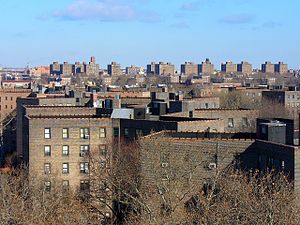
Queensbridge Houses.jpg
Queensbridge Houses (Wikipedia)
Kudos to Marty Goodman, Socialist Action's (SA) reporter on the Amazon HQ debacle in Long Island City. SA is rare on my beat in covering the situation at all--there is nothing in The Militant, nor has Solidarity said anything. Neither has Louis Proyect. Mr. Goodman's two articles are entitled New York Democrats shower Amazon with $billions and Protests bust up New York's Amazon deal.

It's a pity, then, that Mr. Goodman misunderstands almost everything. His confusion is so typical of my Trotskyist friends that it's worth a post to clarify.

The lede paragraphs from the first article:
On Nov. 13, after long secret negotiations, two New York “progressive” Democrats, Governor Andrew Cuomo and New York City Mayor Bill de Blasio, jointly announced that Amazon will place one of two new corporate “headquarters” in New York City and the other in Arlington, Va. 
Virtually kissing the feet of Jeff Bezos, Amazon’s CEO, whose personal wealth is $166 billion, both Democrats have bestowed upon Amazon about $3 billion in tax breaks and construction grants, which include even a nifty helipad for its owner.  ...
New York State offered $1.525 billion and the city is giving $1.28 billion to locate in Long Island City, in rapidly gentrifying Queens, a short train ride from Manhattan. The Wall Street Journal reports a “condo gold rush” in Queens.
This data can all be checked by simple Google searches. At today's price one share of AMZN costs $1759. There are 500 million shares outstanding, so multiplication yields total capitalization at $880 billion. Mr. Bezos owns about 79 million shares, worth $138 billion. He has a few other assets (e.g., Blue Origin), but his net worth likely isn't much more than $140 billion at today's market price.

Mr. Goodman should note how hypothetical that all is. It assumes that Mr. Bezos could sell all of his shares at today's market price. Of course he can't--putting that many shares on the market would crash the price. Further, we can suppose Mr. Goodman wants to confiscate his wealth. But if he did he'd end up only with a pile of worthless stock certificates--nobody will buy stock in a company whose assets are routinely confiscated.

Mr. Goodman will claim he doesn't care about the certificates, but instead only wants the physical assets: warehouses, offices, computers, etc. And yes, he could confiscate those, and perhaps those would have some residual value above zero. But the company Amazon is a whole lot more than the physical assets--it is a business that depends crucially on its management, specifically on Mr. Bezos. Take Mr. Bezos out of the picture and Amazon is reduced to a pile of trash.

Mr. Goodman is correct that the handouts offered to Amazon are tax breaks. Those bennies are contingent on Amazon upholding its part of the agreement, e.g., hiring the promised number of employees, and are payable many years in the future. Of the $3 billion in handouts, very little of it is money in the bank that can be reallocated to schools, housing, welfare, etc. As Tyler Cowen puts it,
There is no $3 billion that NYC gets to keep if Amazon does not show up. That “money” was a pledged reduction in Amazon’s future tax burden at the state and local level.
By comparison, the annual NY State budget is about $150 billion, while the City budget is roughly $89 billion. The (mostly virtual) gifts to Amazon are small change--Mr. Goodman blows the whole issue way out of proportion.

Mr. Goodman's fixation on "handouts" is a red herring.

Then Mr. Goodman is against the "gentrification" of Queens. Why? Is he against new housing? Does he prefer that construction workers be unemployed? Does he really think that everybody should be forced to live in the low-quality, slum-like conditions present in public housing? Is he opposed to new restaurants, shops, and grocery stores, all of which employ people? Should the subway not be rehabilitated?

Those questions are not rhetorical. The honest answer to all of them is "yes." Mr. Goodman is very much Pro-Poverty!

The best argument he can muster for more poverty is this:
For its part, Amazon promises 25,000 new jobs in New York City, with an average salary of $150,000, far above the average salary of the nearby Queensbridge Houses, the largest housing project in the U.S., where the poverty rate is near 50% and the average income is below $20,000. Amazon says it will spend $5 million in training. ...
Raymond Normandeau, a resident of Queensbridge Houses since 1973, told the on-line Gothamist, “It’s pure bullshit. They’re never going to hire us for these jobs. Only a country bumpkin like de Blasio or Cuomo would believe this shit.”
Because of Queensbridge, nobody else should be allowed to earn any money.

My brief encounter with housing projects leads me to believe that most residents are old, disabled, and/or sick. So obviously they're not candidates for high-stress jobs at Amazon. Beyond which, residents of the Houses, even if not debilitated, do not have the skill set necessary for such employment. Because if they did they'd already have high-paying jobs and wouldn't be living in the projects. It's not like there is a surplus of skilled labor in the country.

The Queensbridge residents live almost entirely on taxpayer largesse, and occupy some of the most valuable real estate in the world. Nevertheless, they won't be displaced no matter what company moves to Queens--"gentrification" is not a problem for them.

Quite the contrary, their self-interest is that more people should earn enough to pay taxes. Of all people, they should support Amazon. An employee earning $150K will pay about $10K in state and city income taxes, for an annual haul of $250 million. That's just income tax--it doesn't include sales or property taxes, nor does it include taxes paid by construction workers, suppliers, and vendors who support Amazon and its employees.

It is truly bizarre that a few Queensbridge residents, along with Mr. Goodman, are so blinded by envy and ideology that they can't see the huge, indirect benefit that Amazon potentially provides for poor people in the Queensbridge Houses.

A bunch of Democrats (stupid ones), as pro-poverty as Mr. Goodman, pushed Amazon away, depriving the state and city of tens of billions of dollars in real revenue (as opposed to the hypothetical "handouts"). Progressive heroine Alexandra Ocasio-Cortez led the charge. She may win plaudits in her district, but her future in state and national politics is now foreclosed.

Most people are against poverty. Mr. Goodman is a rare exception.

Further Reading:

Tuesday, April 3, 2018

Black Dispersal from Cities

Glen Ford, executive editor of Black Agenda Report, often has his work reprinted in Socialist Viewpoint. The post that caught my attention today is entitled Great, Bloody Black Dispersal from the Cities. It's typical of Mr. Ford--always one to take the most extreme, radical position possible, facts and logic be damned.

It is true that, since 2000, Blacks are gradually moving away from large cities, reversing a trend from the prior several decades.
The rapidly unfolding dispersal of Blacks from the cities, like the white invasion of the surrounding hinterlands in the previous era, is the result of deliberate state policies, dictated by finance capital. But, this time, the demographic makeover has been effectuated and politically finessed with the active collaboration of a Black misleadership class that, paradoxically, owes its existence to the concentration of Black populations during the Sixties and Seventies.
True to form, Mr. Ford sees it as a giant conspiracy, where some all-powerful racist/capitalist/government yokel has, for mysterious reasons, decided to depopulate America's cities.

He cites no real data, so I'll take data from Chicago, which I have close at hand. According to the Chicago Tribune, the city lost 186,000 Black residents between 2000 and 2010. The same article reports that the Chicagoland area lost 46,000 Black residents since 2010.

Mr. Ford speculates this is due to the destruction of housing projects. He writes
The de-Blackening of urban America is a wrenchingly painful and bloody amputation-in-progress. In a frenzy of demolition, the U.S. has lost a quarter-million units of public housing since the mid-1990s, only a small fraction of which has been replaced with new public housing, according to the Center on Budget and Policy Priorities. Black mayors and heavily Black city councils have, typically, bought into the notion that concentrations of poor Black people are, by definition, vectors of pathology, while concentrations of affluent whites are the indispensable ingredients of urban “renaissance.” It is the logic of apartheid, cloaked in phony economics.
Chicago's Robert Taylor Homes were the infamously inhumane high-rises alongside the Dan Ryan Expressway, containing 4,415 units. They were demolished between 1998 and 2007, replaced by 2,300 low-rise homes and apartments. (Wikipedia) So while Mr. Ford is correct that on net public housing was destroyed, the fraction that was replaced was more than 50%. Not really a "small fraction," especially if you consider that many apartments in the original towers weren't habitable.

Does Mr. Ford really think Chicago's Black citizens were better off living in the Robert Taylor Homes? The crime was building them in the first place--not their destruction.

He claims that Blacks have been forced out of the cities into the suburbs. "No mayor has been more intent on driving Blacks from his city than Chicago’s Rahm Emanuel," he says. But I think he's wrong.

1) Like whites, Black folks are richer than they were 40 years ago--they have more choices. Nobody with any money at all is gonna want to live anywhere close to the Robert Taylor Homes. Much better is a house and yard in the 'burbs. Like whites before them, Blacks want to lead civilized, suburban lives.

2) We're all getting older, and Black demographics are only slightly younger than us white folks. Old people, living on social security, want low prices, low crime, and quiet neighborhoods. One can live in Mississippi or Alabama quite comfortably on social security and a small pension. No wonder folks are leaving Illinois in droves (and not just Blacks).

3) Chicago has the highest sales taxes of any jurisdiction in the nation. And the city is so hard-up for revenue that they've resorted to stupid things, like soda taxes and red-light cameras. Of course these penalize poor people more than rich ones. Again, for people of modest means the suburbs or Mississippi look really good by comparison.

Then Mr. Ford condemns the city for closing 50 public schools. He never tells us about the drop in enrollment, described by the Sun-Times.
Chicago Public Schools on Friday announced another five-figure enrollment drop, counting 371,000 students in the country’s third largest school district. ...
CPS has lost about 21,000 students from its rolls in the last two years and now has just about 26,000 more students than the fourth largest, Miami-Dade County Public Schools in Florida.
Why should schools stay open when the district is losing 10,000+ pupils annually? Mr. Ford gives us a really silly reason.
The result [of school closings--ed] was catastrophic, as students were forced to transit unfamiliar gang turf to attend schools that were often no better than the shuttered ones in the old neighborhoods. Many kids died. “What people don’t understand is that if you are 16 years old and get on a bus, when you get off that bus you are gang-affiliated whether you are gang-affiliated or not,” said activist Jitu Brown.
Mr. Brown is certainly right--we whites don't understand that. I've never been in a gang, nor do I have any friends who have ever been in a gang. Gang membership is just one of those things we white people don't do (mostly). But now Mr. Ford will have the government enforce turf boundaries established by street gangs! Is that supposed to be the job of the school district? Are we taxpayers (people in housing projects don't generally pay taxes) now required to subsidize gang warfare by keeping unnecessary schools open?

Mr. Ford will likely respond by saying that gangs are the result of poverty/racism/capitalism, etc. He's sorta right, but he's got the causal arrow backwards. By coincidence there's an article in The Atlantic about "Brastell Travis, a 21-year-old who lives in the city’s Englewood neighborhood." He did all the things a young man is supposed to do--went to school to learn a trade: welding. But he can't find a job, "...because of where he went to high school, he can’t apply for jobs in certain neighborhoods, because he could become a target of violence if he goes to the wrong areas of town, he said." So in this case gangland crime causes poverty, not the other way round.

Mr. Travis should move to the suburbs. To do that he'd need a car (which he doesn't have) and money for a deposit on an apartment (which he doesn't have). His parents apparently have saved up zero capital to help get him started on life. And that's the real problem--no capital accumulation by Black families. (I'm not talking millions here--a couple thousand dollars would solve a lot of problems.) So he's screwed.

Mr. Ford's real concern is to maintain a majority Black population in large cities, such as St. Louis, where Blacks became a minority this century. He wants to use this majority to enact far-reaching reforms, one of which is the "Right to free education through post-graduate level."

I can't think of a stupider idea. Surely more education is not something that Mr. Travis, for example, actually needs right now. At best it would be a waste of time. And nothing is more a waste of time than "post-graduate" schooling. All it does is postpone becoming an adult until one turns 30. I think we're already waaaay over-invested in education at all levels. But apparently Mr. Ford thinks higher sales taxes and soda taxes are a fair price to pay for yet more silly schoolwork.

Further Reading:

Sunday, October 1, 2017

Hurricanes

The Militant does us a service with two articles about hurricane damage. Brian Williams covers destruction by hurricanes Harvey and Irma to Texas and Florida, while the second, by Seth Galinsky, describes the effects of Irma on Cuba. The comparison is instructive. In addition, I draw on this report from Houston by the Libertarian activist Leo Linbeck.

First, some basic data, courtesy of Wikipedia. Cuba has a population of 11 million people, only some of whom were impacted by Irma (which sideswiped the northern coast of the island). Cuba's total area is 46,000 square miles, but judging roughly from the TV maps, I'll estimate that about 10,000 square miles were affected by the storm. Mr. Galinsky reports that 1,738,000 people were evacuated, which we can take as a rough estimate of the area's population. Cuba's GDP is about $87 billion. Assuming that GDP scales proportionally to population, the GDP of the affected region is about $14 billion. Irma hit Cuba on September 8th.

Greater Houston has a population of 6.5 million people living in about 10,000 square miles. The GDP of the metropolitan area is about $450 billion. In addition, Harvey badly damaged the Beaumont-Port Arthur region, along with bits of Louisiana, for which I haven't compiled data. Harvey pounded Houston for several days beginning on August 25th.

Mr. Galinsky writes about Cuba.
More than 1,738,000 people were evacuated in advance of the storm by Civil Defense committees, minimizing the loss of human life. The committees made sure shelters — from community centers to caves — were comfortable and adequately provisioned. Students went door to door to persuade and help anyone in a danger zone who was hesitating, to evacuate. Tens of thousands of electrical and construction workers moved into action as soon as the storm died down.
By comparison, Mr. Williams describes Houston.
In Houston, where flooding levels were much worse, mounds of debris from about 126,000 damaged homes line the streets three weeks after Hurricane Harvey hit. Across Texas, the debris “could reach 200 million cubic yards — enough to fill up a football stadium almost 125 times,” reported Reuters. Tens of thousands still haven’t been able to return to their flood-ravaged homes. In many, sewage and other contaminants have left them permanently uninhabitable.
Mr. Linbeck reports that there are 1.6 million housing units in Houston (that seems low to me, but I'll take his number). That means that 6.25% of Houston housing units were damaged, some of which were left uninhabitable.

Mr. Linbeck also informs us that 30,000 people stayed in shelters during the storm. Of course many other people hopped into the RV and left town on their own or went to stay with relatives, or made some other arrangement--I have read no estimates about how many. But let's suppose it was 250,000 people--I think that's a very high estimate. It implies that less than 5% of Houston's population was rendered homeless, however temporarily.

In contrast, the entire population of the Cuban region was evacuated--they got to sleep in caves, which we're assured were "comfortable." Wikipedia reports:
Widespread destruction of housing was reported in the provinces of Ciego de Ávila and Villa Clara. In the city of Santa Clara, 39 buildings collapsed. Overall, Irma is estimated to have caused at least $2.2 billion (2017 USD) in damage and at least 10 deaths across the country.
"Widespread" surely implies more than 6%, and given the sorry state of Cuban housing to begin with, it's probably a lot more than 6%. Electricity was knocked out to the entire region, but Mr. Galinsky assures us that "as of Sept. 16, 87% of the population had some electricity restored." Which, given that electricity in Cuba is hit or miss to begin with, I guess that's something.

Mr. Galinsky adds detail.
The challenges are formidable. In addition to the electrical grid, tens of thousands of homes were damaged — 24,000 in Camagüey province alone. Dozens of oil wells, sugar refineries and more than 100,000 acres of banana, sweet potato, grapefruit, oranges, sugar cane and other crops, as well as chicken coops and feed lots for pigs and cattle were hard hit.
Wikipedia tells us that 74 people lost their lives to Harvey on the US Mainland, approximately 50 of whom lived in Houston. The ratio of deaths in Cuba vs. Houston is at least 0.20. The population ratio between the two is 0.26, or comparable. Further, the 10 deaths in Cuba is a minimum--so the ratios may in fact be even closer. There is no evidence that Cuba was better prepared to prevent deaths from the natural disaster than Houston. Nor did it do any worse, but at the cost of evacuating the entire population.

It's instructive to compare the ratios of monetary loss to GDP. For Cuba, from the data above, that number is $2.2 billion/$14 billion, or 0.16. A very high estimate of the damage to Houston is $180 billion, or about 0.4 fraction of GDP. Thus by this measure Harvey did more than twice as much damage to Houston as Irma did to Cuba.

There are a couple of ways to interpret this result. One is that Houston was just unprepared for a hurricane, which then ran rampant across the region. This does not strike me as credible.

The second is that Houston has more infrastructure. It's the petrochemical hub for North America, with lots of refineries and chemical plants. The media reported at length about the chemical explosions due to loss of power and loss of back-up power. Nothing like that happened in Cuba because Cuba has no petrochemical industry and no chemical plants. It's really hard to destroy something that doesn't exist.

No Cuban freeways got flooded either--because there aren't any Cuban freeways. Mr. Linbeck tells us that Houston freeways were built purposely to serve as detention ponds, so to prevent water from going into people's basements.

The ideologically pro-Castro Militant makes the best case it can for socialist virtues in a natural disaster. I don't think that case is very convincing, but that's not the bit that most offends me about their reportage.

Mr. Williams, who is usually a very careful reporter, makes the following claim.
Nowhere have government officials mobilized the forces to deal swiftly with this social crisis, destroying the lives of tens of thousands. At best they hope to get some paltry compensation by and by.
This seems slanderously untrue. As The Militant often points out, the media is happy to blame President Trump for almost anything. The fact that there has been very little blame about the Harvey recovery (apart from Melania's shoes), indicates that relief efforts have gone as well as can be expected. Mr. Trump notwithstanding, local government gets more of the credit.

Put bluntly, even if I were poor, during a hurricane I'd much rather be living in Houston than in Havana. So much for socialism.

Further Reading


Friday, August 1, 2014

Subway Values

Referring to break-dancing teenagers, sermonizing preachers, and homeless beggars, Louis Proyect writes
There’s probably nobody more opposed to being a captive audience on the subways than me. I have been riding NYC subways since they cost 15 cents a ride. When they were this cheap, they lacked air conditioning and were as noisy as hell, but you could at least be assured that you would never be forced to watch a musical performance, begged for spare change, or listen to a sermon.
And then follows a several thousand word essay about how efforts to stop this behavior is unjustified. Specifically, he is against the broken window theory or the tactics of the street crimes unit. Those efforts, initiated by past and present police commissioner William Bratton, ruthlessly pursue petty crime (e.g., break dancing on the subway) because it deters more serious crime. These efforts have evolved into the much maligned stop & frisk policy. Mayor DeBlasio campaigned on ending that, but has so far reneged on that promise.

Mr. Proyect opposes any variant of stop & frisk for three reasons:

  • It targets Blacks and Latinos, and therefore is racist.
  • Beyond this, the police are racist and target Blacks and Latinos just because they enjoy it. There are numerous incidents where people have been killed, most recently the imbecilic gentle giant, Eric Garner, who died in a choke-hold for illegally selling cigarettes.
  • Because of the decline in manufacturing jobs, there are no opportunities for young vagabonds other than to be beggars, hustlers and thieves.
For all that, Mr. Proyect doesn't claim that stop & frisk fails. It does work. The subway is a much more civilized experience now than it was 20 years ago. Today most subway fellow passengers are like Mr. Proyect or me--they are possessed of bourgeois values.

That is not a racial statement. I don't ride the subway as much as Mr. Proyect (maybe once a month or so). Most of my subway riding begins and ends in Queens, specifically Jackson Heights and Long Island City. I am frequently the only Caucasian male in the car--my companions are Chinese, Filipino, Colombian, Dominican, South Asian, and God knows who else. They speak different languages, eat different food, and sometimes smell funny. But they are all civilized people, and none of them are routinely rousted by the cops.

So what are the bourgeois values that make for a good subway rider? It's actually a simple concept--a person with bourgeois values has a positive net worth. That means they save and invest at least a small fraction of their income. People who invest in their children have bourgeois values. People who don't run up huge credit card debts have bourgeois values. People who take care of their apartment have bourgeois values.

I don't know where Mr. Proyect lives, but for the sake of illustration let's suppose he lives in a rent-controlled apartment. Now I'm against rent control as much as the next Republican, but that's not the issue. Our assumption is that Mr. Proyect plays by the rules as they exist, has lived in his apartment for a long time, and accordingly pays rent substantially below the market rate.

I will argue that he has an equity stake in his apartment. It's not the same as if he actually owned it as a condo, but the fact that the landlord can neither evict him nor substantially raise the rent is worth money. It's likely worth as much as my tenured professorship. Mr. Proyect (in our imagination) has acquired that stake by being diligent about paying his rent and following all the rules.

Predictably, he behaves in a way that preserves his investment. For example, I doubt he would pee in the elevator. Nor would he spray graffiti over the mailboxes in the foyer. He expects his fellow tenants to behave similarly--if they didn't the value of his investment would decline dramatically. Mr. Proyect, because he has positive net worth, is possessed of bourgeois values. I'll posit that the most anti-social thing he ever did on the subway was to turn on his laptop.

Yet in the housing projects (at least by reputation--I've never been there myself) some residents do pee in the elevator, and spray the whole place with graffiti. Unlike Mr. Proyect or my fellow subway riders, these people do not have bourgeois values. They have no equity stake, and hence no positive net worth. If you are willing to piss in your own bed, then how respectful will you be of public conveyances, e.g., the subway?

It is not a racial thing. I spent a year living in Kampala, and my Ugandan neighbors most definitely exhibited bourgeois values. Cleanliness was a national pastime. On the other hand, plenty of Whites can't cut it--see this article about Owsley County, KY. But New York is the richest city in the world precisely because the vast majority of its residents are civilized.

Some years back I attended a conference in D.C., and stayed in a hotel in Alexandria. My daily commute took me past a small park surrounded by many apartment buildings. It was the neighborhood park for thousands of people. But the residents were completely deprived of its use by the few dozen homeless men who used the place as their campground. The community's sympathy for the homeless had gotten the better of them, and hence they no longer had a community park.

So it is with Mr. Proyect and his vagabonds. He feels sorry for them, and thus is willing to overlook their brigandage. Perhaps he's right to feel sorry, but depriving the millions of civilized citizens the proper use of the subway they pay for is not the solution. So I'm down with the cops--it is their job to let civilized people (the vast majority of New Yorkers) live in a civilized world. The vagabonds need to be rousted out. Thank goodness Mr. DeBlasio understands that.

Unfortunately, the uncivilized minority are disproportionately Black and Latino. Now that's just a fact. It's an unhappy fact, and it clearly inspires racism, but stating facts is not in and of itself racist. One can argue why this is true, but it is true.

So--to quote the musical--are "they depraved because they're deprived"? Mr. Proyect thinks so--it's the lack of manufacturing jobs that's led to the decline of bourgeois values. Never mind that my co-riders from Queens remain civilized despite the same lack. Why can't the vagabonds be held to the same standard?

Still, while I'll let the cops (mostly) off the hook, there is much to blame on city government. They prohibit lots of honest professions that hurt nobody. Why, for example, are poor people not allowed to use their own cars as cabs? (The only reason is to protect the medallion owners.) Why is it illegal to sell food on the street without a license from the utterly obnoxious and useless Department of Health? (The only reason is to protect incumbent restaurateurs.) Why is it illegal to braid hair without a beautician's license? (So to protect the cartel.) Why is it illegal to open a daycare center without a special permit? (Because the teachers' unions want ALL the money.) For that matter, why is it illegal to sell individual cigarettes on the street? (Because crooked politicians want tax dollars from poor people.)

So there is no doubt that New York's government destroys economic opportunity and deprives poor people of a chance to earn an honest living. Economic liberty (which New York sorely lacks) makes people richer.

But I don't think poverty causes people to be uncivilized. Were that true, my Kampala neighbors would be the most uncivilized of all, as they were clearly not. People with bourgeois values retain that mindset in even the most desperate circumstances.

Mr. Proyect's vagabonds may deserve our sympathy. But they don't deserve the subway.

Further Reading:

Saturday, December 14, 2013

Why New York Is Different

Joel Kotkin and his colleagues over at New Geography have invested many millions of pixels making the case that the suburbs are not dead. Their argument is solid: the so-called back to the city movement is very small scale, Millennials show every sign of wanting to live in single-family, detached houses, and the most thriving locations are suburban-like places, such as Houston, Dallas, or Oklahoma City. New technology looks to strengthen the suburban trend, as telecommuting and driverless cars reduce the pain and expense of commuting.

I totally agree with New Geography on the general trend. The effort to force people into higher density housing is doomed to fail. More mass transit is mostly a waste of money (the Second Avenue subway line being a rare exception). But within that larger trend, there are eddies and countercurrents that flow backwards. The larger movement to the suburbs notwithstanding, there are a handful of cities that will do very well as traditional cities. They are the obvious suspects: San Francisco, Boston, Washington, possibly Chicago. Maybe a few more.

And within that handful, New York City will excel. Unlike as is sometimes implied over at New Geography, New York is a lot more than just a "luxury city." Instead, it has a unique niche in both America and the world that no other city can fill. 

My argument has three parts: The beginning of New York in the 17th Century, the people who live in New York today, and the uniquely incredible value New York adds to the economy.

The Dutch founded New York in 1624. Unlike the British, French, and Spanish, the Dutch had no desire to extract resources from the land. Not for them was taming the wilderness, mining for gold, or raising cattle. Unlike other colonists, the Dutch settled accounts with the Indians as quickly as possible, in legend buying Manhattan for $24. A few of their number got as far up the Hudson as Albany, but beyond that, early Dutch influence on American settlement was negligible.

Unlike any other colony in the Americas, New York was founded from Day One as a commercial center. Think of it as a 17th Century version of Hong Kong. Lower Manhattan--even in 1624--was a shipping, trading, and financial center. It was never a farming or manufacturing town.

That legacy holds to the present day. Colin Woodard has published a now famous map showing the eleven nations of North America. By far the smallest geographically, but unmistakably distinctive, is New Netherlands, a region that doesn't even include all of New York's modern suburbs. How can this be? The Dutch lost their colony to the Brits in 1664--they were only there for 40 years. A negligible fraction of New York's current residents are descended from those original Dutch settlers. And yet that crucial heritage persists.

Today New York is known for having the largest Jewish population outside of Israel. Most of these people came over through Ellis Island, along with a much larger number of other immigrants from other places. Those other folks didn't stick around long--the Swedes headed for Minnesota, the Irish moved to Chicago, and so on. The Jews stayed in New York, and not just because they're lazy. The Jews have been a commercial people since Medieval times, and it made sense for them to settle in a place founded on commerce. The Dutch had built them a congenial home.

The other prominent commercial class in the US are the overseas Chinese. These settled first in California, where today they are disproportionately dominant in Silicon Valley. But by far the largest Chinese community in the Americas is in New York--initially along East Canal Street. Today there are multiple Chinatowns throughout the metropolitan area, nine in the City alone. They deal in everything from rags to restaurants. The formerly slum-like Lower East Side is now a suburb of Chinatown, full of back-office businesses, run by an increasingly wealthy population.

Jews and Chinese--these are Peter Stuyvesant's descendants. They compete with each other. The diamond trade has long been a Jewish business, but recently Chinese traders are gaining market share.

Other cities have ethnic commercial classes. I've mentioned the Chinese in Silicon Valley. Hollywood's studio moguls tend to be Jewish. Mormons play that role in thriving Salt Lake City. But as far as I know, New York is the only city in the country (and likely the world) that has two, large immigrant communities that both bring substantial commercial expertise. Of course there are Jews and Chinese in places like Los Angeles and Houston, but the numbers are vastly smaller, both in absolute terms and as a fraction of the population. Indeed, it is surprising how few Chinese live in Los Angeles.

So why are these ethnic communities so valuable to the cities in which they settle? In particular, the Jews bring an attribute uniquely relevant to Mr. Kotkin's thesis. Observant Jews are not allowed to drive or take the bus to synagogue on the Sabbath--they have to walk. That means they all have to live within walking distance of each other. This enforced close living, augmented by shared religious practice and intermarriage, breeds trust and very high levels of social capital. Trust is a marketable commodity--people will do business with banks where the employees are trustworthy.

Famously, among New York's diamond traders, million dollar deals are sealed with a handshake. So is it any wonder that the money center banks are all headquartered in New York? You can move the buildings and the computer services to North Carolina or South Dakota or wherever. But you can't move the community. Ultimately, banking is about trust, and that is something that close-knit, ethnic communities have in spades.

There are other industries where New York has a lock. The rag trade is one. Perhaps partly because Jews have to walk, New York is a densely settled, very walkable city. The women (and men) are out in public, showing off their duds. Because they're on the street, in public, going about they're daily business, fashion trends happen in New York. Accordingly, New York hosts thousands of blogs like this one. That's how people dress in New York City.

There are three fashion capitals in the world--New York, Paris, and Tokyo. New York and Paris are beautiful cities, adding a marvelous backdrop to any photo shoot. Tokyo, while not beautiful, is nevertheless glamorous. All three cities are built for walking and public transport--it's one big fashion show. Compare that to Houston, where stylish people drive around in cars with tinted windows. How can you model clothes in a car? Houston will never be a fashion center--and neither will Los Angeles, Chicago, or Sioux Falls.

A second industry is food. Yes, they grow the goods in Kansas, package it in Illinois, and eat it around the world. But where do they invent the stuff?

Tyler Cowen says that the best ethnic food is found in suburban strip malls. I think he's probably right. But that's not the food that most people eat most of the time. What most people eat is some creative combination of ethnic and comfort food, tasty and cleverly made. Few are going to eat the oddball dishes they serve at Cantonese restaurants. 

But lots of people patronize a New York fast food chain called Happy Taco. Forget Tex-Mex; think Mexiasian. Or JapoItalian. Or Peruvithai. Or whatever combinations of cuisines you can think of. People like ethnic food, but they like it modified, synthesized, palatable, and recognizable. Creating this nouvelle cuisine requires business acumen, lots of fresh ingredients, educated consumers willing to try, and a labor force with sufficient expertise. And ideally, all the restaurants are within walking distance of each other.

I've just described New York City. What you'll eat at Applebee's tomorrow, they're cooking up in New York City today.

Further Reading:

Saturday, August 3, 2013

Book Review: Filthy Rich In Rising Asia

The full title is How To Get Filthy Rich In Rising Asia, by Mohsin Hamid. A good review is here, though I would recommend actually reading the book first. I encountered this book via Tyler Cowen, who also enjoyed it, and who unsurprisingly thinks it's about economics.

The pretense is to be a self-help book, a guide to getting filthy rich in rising Asia, a premise that is imaginative, charming, and makes for great storytelling. A consequence is there are few proper nouns. None of the characters have names, nor does the country or the city where the novel takes place. You can imagine that it happens anywhere in Asia, but I found it useful to place it in Lahore, Pakistan, which is the author's home town.

The chapter titles are the stuff self-help books are made of. Some would do Stephen Covey proud, such as Get an education, and Work for yourself. Others are more...shall we say...Pakistani, like Be prepared to use violence and Patronize the artists of war.

Many reviewers compare the book to F. Scott Fitzgerald's The Great Gatsby. Somehow I missed that in high school, and so read Gatsby for the first time only a few months ago. The comparison isn't really very apt--both are about rich people, but that's about it. Fitzgerald hated them, and clearly believed the Marxist myth we're poor because the rich people stole all the money. Indeed, Gatsby was a gangster.

Hamid's rich man is more an accidental figure. He certainly isn't evil, nor (beyond petty theft) did he steal money. He just happened to be at the right place at the right time, and was smart enough to take advantage of it. Further, like most rich folks, he improved the lives of the people around him--his family, his employees and his customers. Not that he was altruistic or above cheating, but there is a thread of fair play that runs through the entire novel.

In the end, money comes and money goes. It's not even particularly good for keeping score. The success of the protagonist's life is measured in much more quotidian terms: love, friends, and family. Indeed, the subplot is a love story.

I'm not going to tell you the plot, but I will address three themes: ideologues, water, and graft.

The protagonist goes to university. In doing so, partly for self-protection, and partly for economic support, he joins an ideological group described as "bearded men." Their immediate mission is to stop drug use by their fellow students, a task they pursue with occasionally violent zeal. Our hero depends on them for help when his mother falls ill, but then becomes increasingly cynical and disengaged. He's about to get into some serious trouble, but makes himself scarce just in time. That's the end of his university career.

So that reminds me vaguely of my time in the Socialist Workers Party--absent the violence. Instead of being kicked out of school, I was simply ostracized by my former comrades.

Water is a central theme of the book. The government wants to build a special community, labeled Phase Ten. Here's what the retired brigadier says about it:
In ten, when you turn the tap, you'll be able to drink what comes out of it. Everywhere. In your garden. In your kitchen. In your bathroom. Drinkable water. When you enter phase ten, it'll be like you've entered another country. Another continent. Like you've gone to Europe. Or North America.
This utopian vision is vivid to me because of the year I spent in Uganda. The expense and effort that Ugandans of all classes spend securing enough potable water for the day is astonishing. School girls invest much energy lugging heavy jerrycans on their heads, sometimes for many kilometers. Ex-pat families, like mine, depended on the water tower behind our complex, and the expensive electricity needed to pump water into it. And even then we had to boil and filter the stuff before we could drink it--it was an hour-long chore I had to perform every evening.

In the US we take potable water for granted--we live in a blessed place. Pakistan--and most of rising Asia--is more like Uganda, and it is truly fitting that Mr. Hamid has chosen water as a central plot element.

Graft is endemic in Rising Asia, ranging from petty theft by employees, to bribery on a grand scale. The former is tolerated and functions as a social safety net. The narrator observes that a servant stays
because it is easy to skim money from you. You do not begrudge him this. You would do the same. You have done the same. It is a poor person's right.
Emergency expenses--e.g., for sick family members--is usually taken from employers, either by gift or by theft. Likewise, money is saved for retirement by skimming a little off the top. As such, graft in Pakistan appears to serve the same function as our social welfare state.

The important government bureaucrat collects a big bribe from our rising rich man. In this he is like America's tenured college professors--a person who is paid by virtue of his position rather than for any service rendered. (Like a college professor, he may actually perform a service, but his paycheck has nothing to do with that.) In a word, bureaucrats are the same everywhere--they are rent collectors. Perhaps there's a moral difference between the Pakistani official and an American college professor, but there isn't an economic difference.

Still, institutions matter. Though both American professors and Pakistani bureaucrats are parasitic rent collectors, the former operate under the rule of law. Their rent is predictably calculated. The latter follow the rule of the jungle--eat what you can steal. So the professoriate is at very least less damaging to the economy, and may actually be more productive (though that's hard to say).

Because of corruption and incompetence, the water and sewer lines never get built. Citizens depend on bearded street gangs for protection rather than any police department. Contracts cannot be enforced. Pakistanis are poor, and Americans are rich. Rising Asia--at least parts of it--is sinking fast.

Anyway, for a really good story, along with fresh insight into Rising Asia, How To Get Filthy Rich In Rising Asia is well worth the read. Highly recommended.

Further Reading:

Saturday, July 13, 2013

Why Trotskyists Don't Like Las Vegas

Live, from the Fabulous Strip in beautiful Las Vegas, Nevada, please welcome Trotsky's Children!

Not quite true. I am alive, and I am in Las Vegas. But I'm not on the Strip--instead I'm writing you from a Starbucks on Paradise Road, while the Missus goes shopping with friends at Seafood City. It's all very pleasant, but nothing especially glamorous or unusual. Not a slot machine in sight.

What's there for a Trotskyist not to like? Three things.

Vegas, as you all know, made it's name in gambling, for which it used to have a legal monopoly. Casino revenue built the resorts--the famous ones for which streets are still named: the Tropicana, the Sands, the Flamingo. In those days--so the story goes--high rollers financed this town, betting big bucks on high stakes, losing enough of it to make a lot of other people rich.

That doesn't really hold true today. Yes, there still are "elegant" casinos, but the problem with casinos is that nobody who knows anything about money is going to spend any time there. So almost by definition casino patrons are poor. Not all of them, of course--there are still conventioneers and foreign tourists who visit Vegas once a decade or so, who don't mind blowing a few hundred dollars on a lark. But especially on weekends, the typical punter is low-rent--the big, fat guys with their double-wide brides. Or, perhaps more typically, the double-wides--divorced and lonely--come on their own.

These are people who not only don't earn very much money, but they can't hold on to it. Their sole hope at wealth is the unlikely jackpot--which even if they were to win they'd blow it all in a year or two. Gamblers can't conserve capital--instead, they fritter it. Some people fritter too much. On my early morning constitutional along the Strip, I see them--men and women, drunks literally in the gutter, beggars too tired, depressed, and morose to even look at me, bums scrounging through garbage cans. They are not only out of cash, but they've lost the social capital necessary to generate any income at all.

Welcome to Las Vegas. It's a great place to fritter away your capital.

Trotskyists aren't like that. As much as they advocate the redistribution of capital, they're very much against frittering it. The drug discipline--to which I'm pretty certain the grouplets I follow still adhere--is an excellent example. Trotskyists are under severe discipline never to use illegal drugs--a single offense leads to expulsion. The given reason for this is to prevent victimization by The Man, who could use drug offenses to frame the entire movement. But it colors their entire world view--Trotskyists never had much use for hippies or counter-culturalism. Even today, the Socialist Workers Party didn't buy into the Occupy Movement (rightly so, in my opinion). And they probably view casino patrons in approximately the same light I do--losers.

So fritterers are not a Trotskyist constituency. In this they differ from the Democratic Party, which counts fritterers among their key supporters (free phones, anyone?).

So, second on the list, what about casino workers? Perhaps surprisingly, Nevada has a higher rate of unionization than most states--almost 15% compared to 11% nationwide. Superficially, at least, this would be fertile ground for Trotskyist activism. Certainly with their newfound interest in service workers, Vegas is prime real estate. The biggest union, with 60,000 members, is the Culinary Workers union, representing casino workers.

There are two parts to the union business, and neither Leftists nor conservatives understand that. Part of the union movement is exactly what it says it is--an organization to aid the workingman. Surely this was true of the 1934 Teamsters in Minneapolis, the Flint sit-down strikes that formed the UAW, and the continuing saga of the United Mineworkers. It is probably largely true for today's SEIU, teachers' unions, and the UAW.

The dirty half of the union movement is run by organized crime, and involves labor racketeering. Trotskyists don't acknowledge this history, and conservatives generally fail to see that it's largely separate from the well-intentioned, workingman's movement. But in Las Vegas, it's the main show. The Strip was founded by the Mob, ultimately becoming a wholly-owned subsidiary of Chicago's Outfit. In the early days, the Mob just skimmed the take from the casinos (Howard Hughes complained about being robbed blind). When that didn't work anymore, they unionized the labor force and used the monopoly to extort money from both the casinos and the workers.

So these unions have no honorable past--they never stood up for the workingman. Indeed, they're pretty close to being company unions--no wonder Trotskyists don't want anything to do with them. Still, they're a Democratic Party constituency--Nevada's become a swing state because of the unions.

This morning--perhaps around 7:30--I walked through a Strip casino. There was one craps game going on--I spent a few minutes watching. The boxman was a young Chinese man. The two dealers and the stickman were all middle-aged, Chinese women, who spoke accented English. They were working very hard and took the job very seriously. These people, far from being fritterers, are capital hoarders. I doubt they gamble at all, and I seriously doubt they share their earnings with the Mob. The union movement is dying in Las Vegas as much as in the rest of the country.

There's yet a third strand to Vegas history that's relevant--Mormonism. Much of Eastern Nevada was part of the Utah Territory before statehood. Congress, in it's great wisdom, didn't want to admit too big a state to the union, especially too big a Mormon state. So in it's plea for statehood, Utah was cut down to size. Still, Eastern Nevada is as Mormon as anyplace in Utah, and Las Vegas was founded as a Mormon settlement. Even today, there is a large Mormon presence--just check out the Vegas phone book for evidence.

Like Chinese, the Mormons are great capital hoarders. They don't gamble or drink--they won't even patronize the Starbucks where I now sit! They have lots of children. And hoarding capital pays off--Mormons have become political leaders, including Harry Reid. He's the senior senator from Nevada who is also the Senate Majority Leader.

He's a Democrat. That's almost an oxymoron--a Democrat Mormon, but now you know why. The fritterers are Democrats, the Mob bosses are Democrats, and the unions are Democrats. Success in state-wide politics is a lot easier if you're a Democrat. Mr. Reid is more interested in political success than in religious principle--though if you think of Mormonism as being mostly about capital appreciation, perhaps it makes sense.

Trotskyists aren't fritterers, but they're not hoarders, either. Redistribution is their bag. For that and many reasons, they won't get along with the Mormons or the Chinese.

So there you have it. None of the constituencies--fritterers, company unions, or Mormons--are friendly to Trotskyism. No wonder they've never made any efforts here.

Back in the day I visited Las Vegas occasionally as a tourist, and so I gambled small amounts for entertainment. But now that I come more often (and hope to retire here, at least part of the year) I’ve sworn off the habit completely. I like Las Vegas. I like the weather, the restaurants, the big airport, the passing scene. But there is one rule for life in Sin City:

Don’t fritter.

Further Reading:


Saturday, July 6, 2013

Motown Blues

Sometimes Trotskyists commit acts of outstanding journalism.

An article entitled Shock and Awe in Detroit is an excellent example, written by Dianne Feeley, appearing in Against the Current, and published by Solidarity. Ms. Feeley and I were comrades in the Socialist Workers Party (SWP) in the 1970s, though I don't recall meeting her personally. She now identifies herself as a "retired autoworker," which is certainly the best kind of autoworker to be.

So what makes it such good journalism? Two things: 1) she really knows something, and 2) she cares.

I have read much about Detroit's meltdown in a lot of places, written by people who don't live there. Detroit reporter Charlie LeDuff has crossed my radar screen as well, but somehow I can't take him seriously. Ms. Feeley has them all beat--she actually lives in Detroit and knows a lot about her city. I respect people like that.

I don't know how long Ms. Feeley has lived in Detroit, but it is obvious that she cares about her city. Her article contains actual suggestions for how to improve things. More traditional Trotskyist parties (SWP and  Socialist Action (SA)) will accuse her of reformism, i.e., some plan to improve people's lives short of world revolution. But the truth is neither the SWP nor SA give a rat's patoot about people who actually live in Detroit. The SWP closed their Detroit branch ten or fifteen years ago--when the going got tough the vanguard Party left town. SA no longer publishes the locations of their branches(!?), but I doubt they get any closer than the leafy confines of Ann Arbor. By contrast, Ms. Feeley is looking for ideas to make things better right now, not just in the sweet bye-and-bye.

Knowledge and sympathy lead to honesty. Not only does Ms. Feeley's account confirm facts that I have read elsewhere, but she also states facts that don't support her larger, ideological thesis. Like a true journalist, she can put her ideology aside in the cause of truth--very unTrotskyist behavior. It's not often I get to say this in this blog, but read the whole thing.

Ms. Feeley offers four specific suggestions. Despite the fact that I disagree with all of them, they are serious ideas--not just cheap efforts to score rhetorical points. Let's consider them in turn.
Since only 27 working-age Detroiters (16-64) out of every 100 have jobs, developing a jobs program is key.
There are two problems with this, though I confess I have no better ideas. First, many Detroiters are, frankly, unemployable. Working at a fast food place, for example, requires that you be well-spoken, appropriately dressed and groomed, that you know how to run a cash register, and that you show up on time. This is a tough hurdle for a lot of ghetto kids who've never succeeded in school at any level and never really held a job.

Second, make-work, charity jobs are never a good idea. Not only will they cost a whole lot more than just straight welfare benefits, but they'll attract a whole lot of hangers-on needed to manage the welfare employees. You'll never get rid of them, and in the meantime it's a big hole in the wallet.
-----------
Stop foreclosures and evictions that are devastating the city. The city currently has more than 45,000 abandoned homes. Most homes are “under water,” with $140,000 mortgages on homes that are valued by assessors at $20,000. We need a program of principle reductions.
Somebody is going to take a loss on Detroit real estate--that's a given. Ms. Feeley thinks it should be the banks and the landlords, rather than "homeowners" or tenants. Unlike most Trotskyists (and to her great credit) she only calls for principal reductions--in other words she understands that not even the banks should take a complete loss. Hers is as good a suggestion as any, and I think it's already happening (however imperfectly).

Landlords who can't collect rent will simply walk away from the property. The last thing Detroit needs is more abandoned property. So letting landlords evict tenants is absolutely essential--Ms. Feeley is wrong on this one.
-----------
Stop closing public schools, which anchor neighborhoods. Approximately 100,000 children who live in Detroit attend charters, suburban public schools, or schools that the governor has taken over and operates outside of any legal framework. Without decent public schools, many young families feel forced to leave the city.
This is her most ideological point, and accordingly the least defensible. 100,000 students must be the majority of Detroit's pupils, who are voting with their feet. The public schools are a disgrace--not just in Detroit but across the country. They need to be shut down. The teachers' unions surely deserve a lot of the blame, but corrupt politicians and parasitic hangers-on are right up there.
-----------
Yet he [Kevyn Orr] does not call on the state to return to the annual revenue sharing it provided just 15 years ago ($330 million in 1999 versus $173 million in 2012) or ask the governor to pass a law instructing businesses in the city to deduct taxes for those workers who live in the suburbs. This act alone would bring in an annual $155 million more to the city.
The decrease in the state allocation isn't quite as bad as she makes it sound--Detroit has lost about 30% of it's population since 1999. But worse, the Michigan economy has gone through the wringer, and the idea that taxpayers in Flint or Grand Rapids should be sending more money to Detroit is unrealistic. I can't fault Mr. Orr.

Taxing workers who work in Detroit but live in the suburbs is a very unTrotskyist suggestion, and I give Ms. Feeley high props for putting it forward. It's not clear if she just means city employees, in which case it's the same thing as giving them a pay cut. That might be necessary, but then it's probably easier just to cut their pay than raise their taxes. If, alternatively, she means all people who work in Detroit, then this is just a tax on employment. It's hard to see how that will make people richer. I don't support this idea.

One reason Ms. Feeley lives in Detroit is that Solidarity has its national headquarters there. Now this is odd--why choose a declining, impoverished, rust-belt town as your icon? I can think of three possibilities:
  1. To paraphrase Ken Gibson: I don't know where American cities are going, but where ever it is, Detroit will get there first. Rather than being an irrelevant backwater, Detroit, on the verge of bankruptcy, is a national trendsetter. Look here and weep.
  2. Detroiters' circumstances are so desperate that they're ripe for a revolutionary party like Solidarity.
  3. Solidarity's national headquarters is wherever Dianne Feeley happens to live.
These are not mutually exclusive, and I think they're all good reasons. But I vote for #3--I have considerable respect for Dianne Feeley.

Further Reading:

Wednesday, May 15, 2013

Joel Kotkin Hates The Tech Business

Joel Kotkin doesn't like the tech business. Just read his latest screed here.

Now I'm usually a fan of Mr. Kotkin, but in this I think he's gone off the deep end. Reduced to bullet points, his argument is as follows:

  • They're rich ("they" being the wealthy, technology oligarchs, such as the Google guys, Steve Jobs, Jeff Bezos, etc.).
  • They don't hire many Americans.
  • They hire way too many Chinese.
  • They don't pay taxes.
  • They live in a bubble.
  • They want to take over the country.
  • They're out to steal your soul.
Let's take the bullet points in turn.
  • They're rich.
Well, duh! But they got rich by creating great wealth. The iPhone established a whole new industry. So did Google. According to Free: The Future Of A Radical PriceGoogle gives 80% of it's content away for $0.00. I write this blog on Google, and I haven't paid them a dime. It is probably impossible to estimate the total value to society created by Google, but the share captured by the Page & Brin, et al., is a minuscule fraction.
  • They don't hire many Americans.
Well, good, I say. Mr. Kotkin can't have it both ways. On the one hand he complains these people are too rich, and on the other hand he wants us to hire more of them. No--the fewer employees the better. Just that much more money for the rest of us (in the form of better and cheaper goods and services). What earthly purpose is there in featherbedding the technology industry?

Mr. Kotkin also opposes the H1B visa program bringing in "cheap" foreign engineers. Here he has a point, but it's not the point he wants to make. The problem is not with the foreign engineers; the problem is the visa program that renders them indentured laborers. That is what unfairly distorts the market. We need a much more open immigration system--if foreigners want to come here and work for cheap, then that's wonderful. More money for the rest of us. But for the consumer to capture the product they have to come as free individuals and not bound to a specific employer.
  • They hire too many Chinese.
Mr. Kotkin should check out the data here: the manufacturing cost of an iPhone is $8 per phone. So all those zillions of Chinese workers that Mr. Kotkin so envies--they're netting less than 2% of the value of the product. This site speculates that it takes about 17 hours to assemble an iPhone--so the Chinese are paid less than $0.50/hour. Are these jobs we want to repatriate to the US? I don't think so.
  • They don't pay taxes.
Again, I say good. Government in this country (and every other country) is a rat hole and not worth the money we spend on it. Cash that the tech industry holds on to will eventually either be a) returned to the consumer, or b) invested in new enterprises. Either way, any penny saved in taxes is a penny that makes us richer. If they can legally avoid paying taxes, then so much the better.
  • They live in a bubble.
Mr. Kotkin worries that the tech gurus all live in a self-contained community gated off from the rest of the world. In his telling, Silicon Valley is a bubble served by fancy sex workers, private planes, maids, and luxury cars. The people who live there have lost touch with reality. So--what's the problem? Mr. Kotkin compares this with the desperate circumstances of East Bay communities nearby. Of course there's no connection--the problems of the East Bay are not in any way caused by tech geeks in Silicon Valley. This is all a reprise of the Marxist meme: we're poor because the rich people stole all the money. Are the people in South Sudan poor because Mr. Kotkin lives in a middle class house? Same argument.
  • They want to take over the country.
Mr. Kotkin panics about fwd.us, a supposedly surreptitious and vile plot by the technocrats to buy influence in Washington. He cites Twitter's founder, 37-year-old Jack Dorsey, who says he wants to be mayor of New York City, despite never having lived there. I have no doubt that a bunch of very successful, wealthy, self-righteous youngsters dream of world conquest. But it won't work--witness the money they've spent on the now-imploding Obama administration. Every political action invites a reaction, and the closer the tech oligarchs get to their goal, the greater the opposition will be. Remember the phrase "what's good for General Motors is good for the country"? GM had hundreds of thousands of employees spread across the entire nation, and they still couldn't pull it off. There's no way the tech guys--living in a bubble with only a few employees and disconnected from the larger culture--are going to take over the world. Mr. Dorsey's utterly silly comment is proof of that.
  • They're out to steal your soul.
Google (and others) actually make money giving away stuff for free by collecting data. They use that data to specifically target advertising to individuals. There's the famous story (apocryphal?) about a father getting ads for baby supplies from a local store before his daughter had even told him she was pregnant. Such are the wily ways of Big Data. Mr. Kotkin thinks this is a huge problem. I disagree.

There are two parts to this.

First are ads that help consumers buy things they want to buy. Amazon's recommendations are in this category--very often I find books there that interest me that I would never have encountered otherwise. I regard this as a benefit that enhances my standard of living. Google Local apparently is an effort to turn people on to area restaurants that might be good. I think this is unobjectionable.

Second are ads that try to convince you to buy something you don't want to buy. This turf still belongs to the personable salesman--hawking encyclopedias, or diet fads, or some status symbol. I don't think Big Data will be particularly effective doing this--it depends on personal interaction. Banner ads, pop-ups, animations, etc., are a proven bust. 

Mr. Kotkin may be old enough to remember The Hidden Persuaders, written at the dawn of the television age. When I was in high school everybody was talking about subliminal advertising, i.e., if Coca Cola appears for microseconds during the movie, then people will unconsciously be inspired to go out and buy a Coke. I don't think that worked very well. The fact is people learn how to game the system and will push back against buying stuff they don't want to buy. Mr. Kotkin's panic is unwarranted.

In truth, advertisers are not trying to beat the consumer. They're just trying to be more effective than other advertisers. I think that's a zero-sum game--there is no way that Big Data is going to increase the (small) fraction of income spent on involuntary purchases.

In summary, Mr. Kotkin has gotten too Marxist for me.

Further Reading:

Friday, March 29, 2013

You Can't Eat A Hipster

This post is inspired by the Kotkin - Florida debate about the extent to which the Creative Class contributes to urban welfare.

Back in the day, when I was a Trotskyist in the Socialist Workers Party (SWP), there was an effort to get comrades involved in union fractions. A fraction is a group of comrades who participate as a collective in a union (or on campus) to advocate a for revolutionary socialist perspective. The model for this work was the famous union fractions of yore--communist involvement in the UAW sit-down strikes and the Minneapolis Teamsters' strike in the 1930s. The latter is engagingly recounted in Farrell Dobbs' classic book, Teamster Rebellion.

In the 1930s unions really could shut the economy down. By the late 1970s that ability was much more limited, but that didn't stop us from trying. It is that distinction--disrupting the entire economy versus a labor action against a small-time capitalist--that roughly divides basic industry from the less important stuff. Thus comrades tried to get jobs in basic industry, organized by the UAW, the United Steel Workers, the United Mine Workers, etc. They were (in those days) less interested in AFSCME or the teachers' unions.

I am reminded of this because of Joel Kotkin's emphasis on the material boys. These are the guys who drill for oil, build new manufacturing plants, or are farmers. While likely unaware of his neo-Trotskyist sympathies, Kotkin nicely echos our efforts in basic industry. Like Trotskyists, he believes value is created by the hewers of wood, the diggers of coal, and the molders of steel. Hence thriving cities are places like Dallas and Houston, Charlotte and Nashville, and Indianapolis and Oklahoma City.

Contrast this with the neo-Schumpeterian Richard Florida, who has long touted the Creative Class. These are the artists, the counter-cultural youth, gays, immigrants, eggheads, denizens of Starbucks. Creative class folks are always looking for the Next Big Thing, the idea that'll just knock your socks off. Forget those old, fuddy-duddy material boys--creative destruction is our future. Down with fracking; up with Google. In Florida's vision, the successful cities are New York, San Francisco, Boston, Seattle, and perhaps Portland or even Pittsburgh.

Left off of either list are the old rust-belt cities: Chicago, Detroit, St. Louis, Cleveland, Buffalo. Kotkin's remedy for these towns is more manufacturing. Meanwhile, Dr. Florida prescribes cool bars, nice restaurants, and walkable streets.

I guess I'm still enough of a Trotskyist to side with Mr. Kotkin on this, but not without reservations. His basic point is certainly correct: wealth comes from creating something that people want to buy, and at the core this includes food, energy, housing, clothing, transportation. The hipsters produces none of those things directly. The world will always depend on the material boys.

Trotskyists dismiss the creative class as petty bourgeois parasites, and unfortunately I sense the same tendency in Mr. Kotkin. The truth is that given real products that people want to buy, then the creative class adds substantial value on top of that. For example, the material boys grow wheat, but the creative class financial wizards create futures options and financing opportunities that ultimately make wheat much cheaper for the consumer. Trotskyists treat Wall Street as if it were a casino, but it's not--it is essential to the modern marketplace.

Likewise, one can't eat Google, but Google has made foodstuffs cheaper and more readily available. Advertising, logistics, financing, packaging and R&D are all ways that the creative class adds value. But the material boys have to be there first.

And this Mr. Florida doesn't seem to understand. His view that cities need to welcome the creative class and then everything else will follow is precisely backwards. He is absolutely correct that the creative class adds substantial value, and he is also correct that creative folks thrive in densely populated, diverse, interesting cities. But he's got the cause and effect arrow backwards. It's the material boys who create the cities which the creative class can then move in to. Without the material boys, the hipsters have nothing to work with--they're artists without a canvas.

So I think Mr. Florida's plan--for cities such as Cleveland or Detroit to build gentrified, bohemian neighborhoods in hopes the creative folks might move in--is the wrong way round. If the material boys are already there, then the hipsters will construct their own neighborhoods. Arguably that's what's happened in Portland--first came Weyerhauser, and then came the silicon forest, and after that the Pearl District turned into Florida's dream. Portland's economy has always depended on real products that people want to buy.

Similarly, no amount of artsy-fartsy decorating is going to revive the city of Detroit. Absent something like automobile manufacturing, the city is toast. Formula One races are nice, as is Greektown and the monorail, but those are at the top of the economic pyramid, not the foundation. To revive Detroit, somebody needs to start an industry building something that people want to buy. There's no other way around it.

In some respects, both Mr. Kotkin and Mr. Florida are wrong, and the error exists also in what I've said above. My Trotskyist heritage leads me to segregate the material boys from the hipsters into distinct classes. Kotkin and Florida make the same mistake. In fact, the two groups will increasingly be the same people. Additive manufacturing (3D printing), for example, will involve both kinds of skills, in a manner similar to the traditional craftsman where both design and woodworking are embodied in the same individual.

Second, manufacturing will never employ very many people, and thus cannot support big city populations. The size of the creative class is also limited by opportunities to create value--there aren't that many of them. Most people will work in the service sector, from which they will earn some share of the return from manufacturing.

And finally, it is possible for a few cities to beat the odds. New York and San Francisco both have successful hipster economies, despite no manufacturing of note. New York thrives on finance (and will continue to do so, new financial centers notwithstanding), fashion, art, and retailing. I have posted elsewhere about what I think is New York's golden opportunity for additive manufacturing, but we can all dream. It probably won't happen. Still, New York is not dying in the way Mr. Kotkin seems to indicate. Likewise, the Bay Area survives on software. Boston and Pittsburgh live on eds and meds.

But this model doesn't scale. There simply isn't a big enough market for two dozen eds & meds cities, nor can the country support more than a handful of financial centers. For everybody else but the lucky few, the material boys come first, followed by the creative class.

So it is true--you can't eat a hipster. But it is also true: Man cannot live by bread alone.