Showing posts with label Soviet Union (former). Show all posts

Friday, October 11, 2024

Kamala vs. Trump: The Decline of America?


Left Voice
 author Sou Mi (who I think is female; apologies if I have that wrong) has written a think piece entitled Kamala Harris Wants to Revive an Empire in Decline. It's a well-written, worthwhile read that in my view is wrong in important ways. 

The confusion starts at the top. This is the "hook" paragraph--that's supposed to tempt you into reading the rest of the article.

As November pulls closer and the specter of another Trump presidency looms large, Harris is trying to present a different project for the future: one based in restoring a “rules based order” where the rules are fundamentally set by U.S. imperialism.

Only the last word grates--"imperialism" is a meaningless word that adds nothing to the paragraph. The paragraph would be better if she just omitted it, eg, rules are fundamentally set by the U.S. 

"Imperialism" occurs 22 times in the article, and all such mentions should be deleted, either as I illustrated above, or by substituting real institutions like "US foreign policy." Because foreign policy at least comes with an address (Foggy Bottom) and has somebody in charge (Antony Blinken). Unlike "imperialism," which is at best a vague conspiracy theory.

Otherwise she is quite correct--that Trump and Harris represent a decision point for American foreign policy. This observation is not original to her--it's been widely discussed in the mainstream media.

She paints the choice between the two this way. She says Harris

...has not only positioned herself as the heir to an administration that put diplomacy back on the table, but also presented a vision for the future: one based in the realization of an American leadership that will restore a “rules based order” through both diplomacy and might, and where the rules are fundamentally set by the U.S. imperialism.

This seems true. Kamala aspires to take us back to the good ol' days when America ruled the waves, owned the foreign exchange medium, and guaranteed world peace. 

Sou Mi accurately summarizes Trump's position, which I'll describe in my own words. Labelled "America First," it suggests that the US should withdraw from global affairs, mind it's own business, and as far as the rest of the world is concerned, let the devil take the hindmost. When the enemy gets within 12 miles of our shores, then and only then will the world's greatest superpower be roused to action.

I exaggerate slightly. Trump is not quite as hands off as I've described, but only because he's forced to compromise with reality. The US really does have trade relations with other countries that need to be protected, notably with Mexico and Canada, but also with Europe and S.E. Asia. Those trade routes will require US policing. And more, the US has cultural and religious allegiances beyond our shores, eg, Israel, which even though it is of no strategic value whatsoever, we are bound to protect. (It does have economic value.)

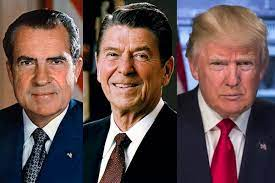
But at his core, Trump is a pacifist. He does not want America involved in any war. He follows in the tradition of two prior pacifists, Nixon and Reagan, both of whom described the American strategy as having the biggest, baddest, meanest military the world has ever seen--and then never using it. "Peace Through Strength" is how previous generations (and Sou Mi) put it. It's Trump's strategy to a tee.

So the debate is between "The War Party," represented by Kamala, Liz Cheney, the journalists at The Bulwark, the CIA, and most college faculty. And "the Peace Party," championed by Trump, Tulsi Gabbard, journalists at ZeroHedge, and (apparently) most of America's working class.

I'm not sure which side Sou Mi is on: is she pro-War or pro-Peace? I don't think she knows, so befuddled is she by all those imaginary "imperialists" floating around in her head. I also don't really know what side I'm on--I can see virtues in both points of view. But I'll be voting for Trump.

So why now? Why is this choice presented to the American public in this election? Sou Mi has an answer (my emphasis).

Harris’s proposals... come amidst the growing tensions of an empire in decline, especially amidst the retreat of globalization when the United States, based on the export of manufacturing and exploitation of cheap labor in the global south (and particularly through the restoration of capitalism in China), and debt-fueled consumption, was able to rearticulate a unipolar order behind it.

Sou Mi's view is that, with the "empire in decline," there are two possible responses. One is, in spite of that, to double down and re-establish our weight in the world. This is what Kamala proposes to do. The other is to retreat into a shell and acknowledge defeat--the Trump strategy. Or, instead of War Party and Peace Party, we can think of them as the Recovering America's Greatness Party and the Surrender Party (which weirdly reverses the terminology the parties use to describe themselves).

I dispute that America is an empire in decline. For good reasons during the Cold War, the US served as the world's policeman, and provided the world with a reserve currency by running huge trade deficits. This enabled an unparalleled period of global economic growth, including, most notably, in China (bringing 400 million people out of poverty). Sou Mi ludicrously describes it as an act of "exploitation," which it definitely wasn't. It was, instead, an act of great generosity (albeit extended only to America's allies--and not to miscreants such as Cuba).

The question thus arises, can America continue to be so generous? Trump says no; Kamala responds yes. The problem is that, while America has certainly gotten richer over the past 70 years, the rest of the world has gotten richer faster and caught up. So Sou Mi is partly right: in relative terms, the US has declined, and is therefore no longer able to finance global trade as it once did. While in domestic terms our trade deficit has not yet declined, today as a fraction of total global trade it is too small a percentage to finance global trade.

In finance parlance, this is known as a shortage of eurodollars--and countries that don't have enough eurodollars (eg, Sri Lanka, Bangladesh, South Africa, and on the cusp, China) are no longer able to import basic necessities such as food and fuel.

Whatever Kamala's intentions, she will not be able to reverse this relative decline in eurodollars, and the result will be a crimp in globalization. As there is no other reserve currency on the horizon, despite this shortage the Eurodollar will remain the world's reserve currency for the foreseeable future. The only country that can literally "print" eurodollars is the United States--we're sitting in the catbird seat.

Then there is our role as the global policeman. We guaranteed European borders, allowing European countries to all but defund their militaries. And likewise for Canada, Japan and the Philippines, among others. This, by itself, made people richer. We made the same guarantee to countries in the Middle East, fighting wars over Kuwait.

But being the world's policeman is expensive! And US taxpayers have to pay the bill. Trump has decided we don't need to do that anymore. For example, our efforts to keep the Red Sea open have come to naught--we're using million dollar missiles to shoot down the Houthi's thousand dollar drones, obviously not a sustainable operation. Technology has changed the nature of warfare. 

There's no reason for us to police the Red Sea--that's a job for the Europeans. We no longer have much interest in defending European borders. If Russia invades the Baltic states, we're probably not going to rise to their defense. We're not patrolling the Indian Ocean--India, Japan and China can fight over that one.

More, the Middle East is on its own. We still have an outpost in Qatar, but I predict that's not long for the world--Trump will bring them all home. The US has no dog in any fight over the Persian Gulf--we don't import any of their oil, and we have no reason to defend their sea lanes. That's up to the Europeans, Japanese and Chinese to work out. Good luck!

That's Trump's plan. Kamala says we're still gonna be the world's policeman. That's popular within the intelligence community and in the faculty lounge--but not among many common voters. It's one reason why I think she'll lose the election.

Sou Mi's article is worth reading. Apart from the gratuitous use of the word "imperialism," hers is an intelligent point of view.

Further Reading:

Monday, March 19, 2018

Summary Statement of US Strategic Goals for the Coming Period

I've been doing some reading and thinking about geopolitics,* and I think I can express America's foreign policy goals succinctly and clearly:
  • The Eurasian continent consists of four "empires" and several smaller "kingdoms". The empires are China, Russia, South Asia, and Europe. The kingdoms include Japan, Indonesia, Persia, and Turkey. I don't mean these countries within their current political boundaries, but rather their cultural/strategic spheres. For example, for Russia that means the former Soviet Union. Turkey is the old Ottoman Empire, plus much of Central Asia and Xinjiang. Persia includes parts of Central Asia, Kurdistan, and half of Afghanistan. South Asia is the whole subcontinent, from Kabul to Dhaka to Columbo, and maybe also Tibet. Only for China do current borders roughly correspond to empire.
  • None of these empires constitutes an essential threat to the United States in their current form. We can defend against any of them individually.
  • The danger comes if one of these empires makes an alliance with the others (or conquers them). Our vital strategic interest is to prevent that from happening. Therefore, for example, we defended Stalin against Hitler, certainly not for moral reasons, but the combination of Europe and Russia potentially augured an entity that would be a vital threat to the United States. So we helped preserve the Soviet Union.
  • The situation is more complicated because Russia is in terminal demographic decline and will cease to be an empire within a generation or two. Its geographic space will be fought over by Europe, Turkey, China, Japan, and Persia. The US vital interest is that none of these kingdoms should win too big a slice.
So this makes US foreign policy spectacularly clear. In the immediate term it has four major goals:
  1. Retain naval hegemony over the South China Sea. This prevents Chinese aggression/alliance with India, and vice versa. Plus it allows us to trade with SE Asia.
  2. Retain control over Afghanistan, which borders several of the above empires and kingdoms: Persia, South Asia, China, Turkey. Indeed, Afghanistan is probably the most strategic piece of ground on the planet. We don't really care what their internal government is, but we insist that none of its neighbors win control over the place. We're gonna have troops in Afghanistan for decades to come.
  3. Harass terrorist groups sufficiently to deny them control over any territory, and so they never acquire any substantial military capability.
  4. Prevent further nuclear proliferation, most immediately in North Korea.
This has some interesting implications for current conflict zones. Consider Syria.
  • One goal in Syria and Iraq is to deny Iran control over the Fertile Crescent and the Levant. Toward this end Turkey, the Syrian/Sunni rebels, and Israel are our allies.
  • Another goal is to prevent the rise of ISIS, al-Qaeda, or any other terrorist organization that potentially threatens the US. Our allies here are the Kurds and the Assad regime.
  • A third goal is to prevent Turkey and Sunni rebels from destroying Kurdish and Alawite populations. Our allies here are Assad and Iran.
  • A fourth goal is to prevent the mass slaughter and ethnic cleansing of Syria's Sunni population, many of whom have become refugees in Europe. Our enemies here are Assad and Russia. The latter is using this as a lever to destabilize NATO and the EU.
  • The Kurds are a people with divided loyalties. On the one hand they speak a Persian language, unrelated to either Arabic or Turkish (apart from some loan words). On the other hand, they are Sunni and at odds with the Shi'a theocracy in Tehran. Should Iran ever have a secular government then likely the Kurds would become Iranian allies. This is why the Turks are so terribly afraid of them and try very hard to suppress their language.
So it's a very complex battlefield, contrary to what Jeff Mackler, writing in Socialist Action maintains. He posits a mythical creature called "American Imperialism" which for some bizarre and unexplained reason wants to occupy Syria. Thus Mr. Mackler supports the Assad regime, who supposedly represent the progressive future of the human race. For him it's a case of white hats vs. black hats, with Americans wearing black. 

His support for Assad is shameful--sort of like supporting Pol Pot (which my Trotskyist friends also did). But no matter--it's just pseudo-revolutionary grandstanding. By taking a fake radical position, no matter how stupid and inconsequential, Socialist Action burnishes its credential on the American Left.

Nobody should take them seriously.

*Bibliography

Peter Zeihan, The Accidental Superpower (reviewed here)
Peter Zeihan, The Absent Superpower (reviewed here)

Friday, January 26, 2018

Book Review: Gorbachev

"Gorbachev is hard to understand." So said the man himself, characteristically using the third person, as quoted in William Taubman's excellent biography, published in 2017. And true enough: understanding Gorbachev means knowing the man, his time, his country and his historical circumstances. Was the collapse of the Soviet Union historically inevitable? Or was it the fault (or credit) of Gorbachev? Or did Gorbachev simply hasten what would have happened anyway, albeit perhaps not for a couple of decades?

However hard it is to understand Gorbachev, it is very easy to like him. Born in 1931 in Russia's Stavropol region, he grew up in a peasant household during times of famine, purges and war, all of which touched his family. For all of that he still managed to have a happy childhood, close to both his parents (esp. his father) and grandparents. Ambitious at a young age, along with his father he served as a combine driver harvesting 8,888 centners of grain, earning him the Order of the Red Labor Banner in 1948, one of the USSR's highest medals.

So young Mikhail Sergeyevich grew into a man: garrulous, confident, friendly, loyal, and extraordinarily well-read, especially considering his semi-literate family.

That, along with native intelligence and a prodigious work ethic, earned him a place at Moscow State University (MGU)--the Harvard of Russia, both then and now. There he studied law (in a country that didn't really have any), and met the love of his life, Raisa Maximovna Titorenko. She, also brilliant, studied philosophy. They were married from 1952 until her death in 1999.

Following university in 1955 Gorbachev was sent back to Stavropol, a posting neither he nor his wife initially wanted. He began his career as a minor functionary with Komsomol, cashing in not only on his MGU credential, but also the Red Labor Banner. In 1969 he was chosen as general secretary of the Stavropol region, a job he held until 1978.

Such a rise required much ass-kissing, and yet somehow Gorbachev never lost his original idealism. He worked hard to make Stavropol a better place, and it began with agriculture. That mainstay of the local economy suffered from notoriously low productivity. Supposedly new machinery arrived broken, other inputs arrived late or not at all, and what was harvested couldn't be properly stored or transported. Most seriously, the peasants were not motivated to work on the kolkhaz (collective farm), from which they derived little benefit.

Gorbachev understood that the extreme centralization of all decisions in Moscow was the leading problem. He railed against that, trying to earn as much autonomy for his people as he could. And in whatever small measure he could affect the outcome he tried, though mostly to no avail. His efforts did succeed in raising his profile in Moscow.

At least as important to his future was that Yuri Andropov served as his mentor, not least because he shared his disciple's idealism. Andropov, also from Stavropol, later served as Brezhnev's successor as USSR General Secretary. In 1978 Gorbachev was appointed Central Committee secretary in charge of agriculture. Such an important portfolio meant he could return to Moscow and join the Politburo.

An important portfolio--yes--but also known as a graveyard for political careers. For improving the abysmal state of Soviet agriculture was nigh an impossible task, failure for which redounded to the secretary. Gorbachev, despite dramatic effort and frenetic activity, failed as much as any of his predecessors.

Brezhnev, long since senile, finally died in 1982. He was succeeded by an already ill Andropov, who in turn left the job to the similarly decrepit Konstantin Chernenko, who passed in March, 1985. His logical successor was Andrei Gromyko, already 74 years old, a dour apparatchik and longtime foreign minister.

In a typical display of tactical genius, Gorbachev bought off Gromyko by promoting him to the largely honorary post of Chairman of the Presidium of the Supreme Soviet. And so the younger man became General Secretary by unanimous vote of both the Politburo and the Central Committee.

For the first three years or so of his reign, Gorbachev had the full support of the Politburo. Everybody knew that the Soviet economy was collapsing, that the war in Afghanistan had to end, and that the Cold War with the US couldn't continue. The country was bankrupt. Even without Gorbachev the status quo was no longer viable.

But Gorbachev was different. Unlike his predecessors, he loved the public limelight, and thoroughly enjoyed street walkabouts among everyday people. And he could talk--too much actually. Unlike Brezhnev, who in rare public appearances read from a script, stumbling and mispronouncing words, Gorbachev spoke expertly and extemporaneously. That led to a joke:
Gorbachev is much worse than Brezhnev. He doesn't even know how to read.
Soon came the two words that would define the rest of Gorbachev's life: glasnost and perestroika, meaning, respectively, openness and restructuring.

Glasnost was relatively easy, albeit painful. The immediate purpose was to make economic statistics transparent and public--you can't fix a problem you can't see. But what happened was the wholesale revelation of Stalin's crimes. This was very painful, especially to the older generation who venerated the old man. And especially to the elderly members of the Politburo who took the whole thing as an assault on Communism. It was at this point the first cracks in Politburo began to appear. Yegor Ligachev (1920 - ), initially a staunch Gorbachev ally, gradually turned against him.

Perestroika, obviously necessary, was much harder to accomplish. Gorbachev got off on the wrong foot trying to improve productivity by taxing vodka--that went over like a lead balloon. While he understood that decentralization was crucial, actually doing that meant firing thousands of bureaucrats, all of whom fought desperately for their jobs.

In the end perestroika was no more successful than Gorbachev's initial efforts to reform agriculture. The Soviet economy went from bad to worse, and Gorbachev's popularity went down with it.

Only in foreign affairs was our man reasonably successful. He pulled out of Afghanistan. He had very good relations with Margaret Thatcher, Helmut Kohl, and especially Francois Mitterand. He loved the accolades he got from Western audiences, which he no longer received at home.

By the end perestroika had changed its meaning. It was obviously no longer possible to restructure the economy within the Communist system--perestroika had gradually morphed into counter-revolution (my term). I think Gorbachev should have accepted the 500-day program, which would have intelligently privatized the economy (unlike what Yeltsin did a couple of years later).

From 1985 to 1988 Gorbachev was mostly in control of the situation. Beginning in 1989 the wheels started to come off the bus, and by 1990 the master tactician could no longer keep up with events. In 1991 came the reactionary (and completely incompetent) coup, after which Gorbachev essentially gave up, ceding the limelight to Boris Yeltsin.

Gorbachev is an honorable man. I thought so then, and I think more so now after reading Taubman's book. He refused to engage in violence. He was not personally corrupt. He refused to fire people--partly for Machiavellian reasons (keep your friends close, and your enemies closer), but also because he felt sorry for people. At the end this strategy no longer worked.

He may not have been responsible for the demise of the USSR--that probably would have happened anyway, if not in 1991 then only a few years later. But that it happened peacefully without brutal ethnic conflict or civil war--that I think is largely due to Gorbachev's honor and moral sense.

And for that we can all be very grateful. He is a good and important man.

Further Reading:

Saturday, November 4, 2017

100 Years After October Revolution

Three articles have recently appeared celebrating the centennial of the 1917 Russian Revolution. Socialist Viewpoint publishes a piece by Chris Kinder, The North Star highlights an article by Roger Silverman, and finally, Socialist Action posts a feature written by their national leader, Jeff Mackler. Mr. Mackler promises a second installment which I fear may not appear for several more weeks.

All three articles cover pretty much the same territory, which we can summarize with three questions:
  1. What was the significance of the Russian Revolution in 1917?
  2. How can the success or failure of the Revolution be assessed?
  3. What is the relevance of 1917 to our present day?
Significance

All three authors hold the Russian Revolution in very high regard. Chris Kinder, in his opening paragraph, phrases it in utopian terms.
Long disparaged and denounced as it is, the Russian Revolution of 1917 still demands our attention today. No event in history was quite like the Russian Revolution, because no other event before or since has attempted to change the motive force of history in the fundamental way that this event did. By forming the world’s first and only lasting (if only for a few years) workers’ state, this revolution alone offered the promise of a world without the endless class conflict that defined all previous history: a world based on genuine human cooperation; free of exploitation, war, racism, sexism and national, ethnic and religious oppression. The promise of the Russian Revolution embodied the true goals of the vast majority of humanity then, and yes, of humanity today. The fact that this revolution soon was unraveled, betrayed and eventually destroyed only makes the lessons it holds for us today more important to understand.
Mr. Silverman perceives the Revolution as a specter that still haunts the globe.
November 7th, 2017 marks the centenary of an event whose impact still today reverberates throughout the world. The Russian revolution remains a constant spectre at the feast of the rich, its shadow falling across all subsequent history. Since its lessons lie buried in a century of sludge by all those determined to malign its meaning, it is the duty of socialists to unearth them and bring them back to light.
Mr. Mackler credits the Bolshevik Party.
To this day, 100 years after Lenin’s Bolshevik Party led the world’s first socialist revolution, no party has matched its record of social, political, theoretical, organizational, military, cultural, and moral contributions to the advancement of the interests of the working-class masses.
He sees Socialist Action as following in the Bolshevik's footsteps (though he's too modest to suggest that he is himself the reincarnation of Lenin).

Assessment

Trotskyists have a problem. Unlike Communist parties, they are not willing to sweep the Stalinist crimes under the rug. They freely admit to the purges and mass murders of the 1930s, though those events are not explicitly mentioned in any of the articles. And contrary to Conservative critics (like me) they are even more adamantly insistent that the Revolution was ultimately a success. After all, why celebrate it otherwise. It is a high wire act to rescue something of enduring value from an event that otherwise appears disastrous.

Mr. Silverman is the most explicit in tabulating accomplishments, citing economic data.
It is worth remembering that in earlier days, for all its devastating burdens, the planned economy had boasted miracles of economic transformation. To take a measure of what was then achieved, in the fifty years starting from 1913 (the highest point of the Russian pre-revolutionary economy), Russia’s share of total world industrial output had soared from 3% to 20%, and total industrial output had risen more than 52 times over. (The corresponding figure for the USA was less than six times.) In the same period, industrial productivity of labour had risen by 1,310%, compared to 332% in the USA, and steel production from 4.3 million tons in 1928 (at the start of the first Five Year Plan) to 100 million tons. Life expectancy had more than doubled and child mortality dropped nine times. Soviet Russia in its heyday produced more scientists, technicians and engineers every year than the rest of the world put together.
This paragraph illustrates a fundamental problem with Marxist economics, which renders their comparisons irrelevant. That's because they weigh measures of what workers produce much higher than what consumers buy. Producing something (e.g., refrigerators that don't work or cars that break down within 5000 miles or warehouses full of rotting produce) is not important if people don't want or need to buy it. Increasing industrial output by 52 times, or even by a million times, has no value if it serves no need for consumers, i.e., people. That's why sales data is more important than production data.

Mr. Kinder recounts some (in his view) admirable Bolshevik policies without commenting on how successful they were. The most radical was the Decree on Land, which forbade landlords from collecting rent or evicting tenants. He tells in loving detail of the political intrigue this dramatic move caused, though nowhere does he say anything about the economic outcome, which we know was awful.

Mr. Mackler also comments on land reform, writing,
Aside from revolutionary Cuba, no nation since then has implemented a land reform-distribution of that scope. Indeed, today in Latin America every so-called revolutionary or “popular” regime, from Venezuela to Bolivia, Ecuador and Uruguay to Nicaragua and Argentina, has failed to accomplish even a modest land reform. To do so would entail a break with the capitalist system of private property that none of the above dared to contemplate.
Beyond Cuba, he fails to consider Zimbabwe, which implemented a land reform at least as catastrophic as the Soviets. And then also China, unless he is revisiting the existence of the Chinese Revolution. Beyond which it beggars imagination to think that Cuba has an effective agricultural industry.

The problem with transferring all property rights to the poorest citizens is that they, almost by definition, lack the capital (both human & financial) and the access to markets to be meaningful producers. If the goal is to improve agricultural output, this strategy will inevitably fail, as it always has.

Then Mr. Kinder talks about Soviet housing policy. The paragraph is long and hard to excerpt, but here goes.
However, to judge by the numerous critiques of Soviet housing that emerged in modern times, one would think that problems such as these were the whole story, as they repeat endless horror stories about inadequate housing in the USSR. Yet, how many homeless people were there in the Soviet Union?....Russians find it odd that Americans call themselves ‘homeowners’ from the day they close on a mortgage loan. For Russians, ownership only begins after all debts are paid off.” How true that was for millions of so-called “homeowners” in the U.S. who lost their homes in the mortgage fraud-induced crash of 2008!
There was no homelessness in the Soviet Union because it was illegal to be homeless. The alternative was internment in a mental hospital (or worse). And surely Mr. Kinder will acknowledge that almost all Americans had housing far better than all but the Soviet's nomenklatura.

Relevance

None of our correspondents are very specific about the relevance of Russia's revolution on today's world, beyond claiming that it's earthshaking and exemplary.

We've quoted Mr. Kinder at the top of this post. Presumably Mr. Mackler will have something to say in his next installment. That leaves Mr. Silverman, who simply asserts that it continues to be important.
And now more than ever, another world is necessary. In every continent today, a new generation is waking up to the reality that the only future it faces under capitalism is one of poverty, homelessness, hopelessness, discrimination, environmental destruction and war. Millions of people are in revolt, casting around for alternatives, sometimes seduced by false demagogues, but increasingly determined to find a road to change. Those commentators who used to scoff at the idea of revolution are today falling silent. In a recent Greek opinion poll, 33% called for “revolution”. And last year in the USA, 54% of respondents voted yes to the idea of a “political revolution to redistribute money from the wealthiest Americans”. That included 68% of Afro-Americans, 65% of Hispanics, and 68% of 18-29 year-olds.
It is time to rescue the Russian revolution from the history books and return it to its rightful place as a guide to action.
I think if you'd asked those poll respondents "Would you like to live in country like the Soviet Union?" I suspect the answers would have been far different.

My view is that the Russian Revolution has faded into history and has nearly no relevance for the modern world outside of Russia. Within Russia, the Revolution was a cataclysmic event that destroyed their country, culture, and peoples, and from which they will never recover.

Further Reading:

Sunday, June 22, 2014

Book Review: Lih's Biography of Lenin

I just finished reading Lars Lih's short biography of Lenin. I'm ashamed to admit that it is the first complete biography of Lenin I've ever read. Mr. Lih's book is well-written and nicely researched. I understand that Mr. Lih has an atypical and tendentious view of Lenin. Indeed, he may have tried too hard to fit the facts into his storyline, though I certainly can't judge that. It all sounds a little too pat.

Born in 1870, Vladimir Ilich Ulyanov morphed into V. I. Lenin only after his death. In fleeing from the tsar in 1900 he borrowed a passport from a man named "Lenin," which our hero turned into the pseudonym, N. Lenin. Legend has it that N stood for Nikolai. He acquired his birth initials only post mortem.

Three people had a profound effect on Lenin's life. The first was his father, Ilya, a teacher who became an organizer of village schools to educate the peasants. This the tsar viewed as subversive.

Lenin's elder brother, Alexander, was involved in a failed plot to assassinate the tsar, for which he was hanged. As much as anything, Lenin was motivated by revenge for his brother's death. More importantly, he resolved not to make his brother's mistake. He disavowed terrorism as a revolutionary method, and indeed, mostly disowned violence.

Finally, Lenin had a life-long, love/hate relationship with Karl Kautsky, the great popularizer and propagandist of Marxism, and a founder of the German Social-Democratic Party. It was pure love until the outbreak of the Great War in 1914, after which it turned into hatred as Kautsky supported Germany's war efforts. Lenin remained resolutely internationalist.

The Leninist perspective was already sketched out in 1894. Mr. Lih calls it the heroic scenario, which Lenin laid out in one, long, banner sentence in an illegal publication entitled Friends of the People. I'll describe it in my own words here:

The beneficiaries of Lenin's heroism were to be the narod, perhaps best translated as the German Volk. The English word, people, does not convey the spiritual significance, though perhaps if you substitute in the American People as politicians do, you'll get closer. Mr. Lih uses the Russian term exclusively.

This Leninist emphasis on das Volk is ignored by my Trotskyist friends, perhaps in part because it doesn't translate easily into English. But more, it reveals the uncomfortable relationship between Leninism and fascism. While it's an overstatement to equate them, there is no doubt that Lenin and Mussolini were political cousins.

Lenin opposed the Russian entry into the Great War, not because he opposed Russian nationalism, but indeed the opposite. He thought the Russian bourgeoisie were betraying the Russian narod.

The agents of the heroic scenario were the Russian proletariat. It was the workers who actually had the power to overthrow capitalism, a power the peasants did not have. Their concentration in the big cities, along with their thumb on the means of production gave them unexcelled political leverage.

The implementation of the heroic scenario depended on the Leninist Party, though of course Lenin didn't know it by that name. The term he used were the praktiki, who were members of the Social-Democratic underground. These class-conscious workers were the communications link between workers in different cities and factories, and also with a class of intellectuals (including Lenin) who lived abroad and could communicate freely. Lenin's paper, Iskra, that he edited up to the 1905 revolution, was smuggled into Russia, and provided news to praktiki across Russia about what they were all doing.

The first order of business in the heroic scenario was to overthrow the tsar and establish a bourgeois democracy. Then it would no longer be necessary to operate underground, and the praktiki could organize for socialism directly. In this first step the peasants would be close allies. The second step--the overthrow of the bourgeoisie, would split the kulaks from the rest of the peasants, and impose a greater responsibility on the proletariat. After that the narod would all live happily ever after.

So what could go wrong? Surprisingly little, actually. Lenin's durable support from the praktiki meant he could not be dismissed from the emigre political scene, this despite his rabid sectarianism. Especially after 1914 his rhetoric against fellow emigres as opportunists waxed vitriolic. During a conference in Bern, he led a something known as the Left Zimmerwald Opposition, a short-lived organization that could rival the Spartacist League.

Lenin assumed that there would be an extended time between the bourgeois revolution and the subsequent proletarian, socialist revolution. When he returned to Russia in March, 1917, he realized this would not be the case. He seized the opportunity to take state power during the infamous October revolution. Mr. Lih devotes very little space to the October events, probably because they've been covered in great detail elsewhere.

And this is where the heroic scenario ends. Lenin had no blueprint for what would happen after the socialist revolution. He was like the dog who caught the car. He simply assumed that socialism was a superior form of economic organization than capitalism. Today, of course, we know that is not true, but Lenin can probably be excused for not realizing that. Accordingly, especially during the period of war communism (1918-1919), Lenin rather uncharacteristically resorts to force. During that time he thought that simply liquidating the class enemy would be sufficient to solve all problems--since, after all, the class enemy was probably the only problem.

But by 1920 it was obvious even to Lenin that murdering his way out of economic difficulty was not going to work. Of course he could never admit to either himself or anybody else that socialism failed. Still, some backtracking seemed necessary. Instead of liquidating the kulaks, he tried to engage them in production. And instead of pure socialism, he turned to the New Economic Policy, subsequently imitated by socialist countries from Romania to Cuba to Venezuela.

Lenin's political career ended in 1923 with a stroke, and he died in 1924. Trotsky's name appears in Lih's book, but not prominently. Trotsky was late to the Bolshevik Party, and thus not an important part of Lenin's life. He was probably more important to the survival of the revolutionary state. Stalin's name also appears, and Lih reports that Lenin consulted closely with Stalin in the writing of his Last Testament. Stalin, of course, did not share Lenin's distaste for violence.

So what of Lenin's legacy? His success depended crucially on his longstanding connection to the praktiki, who eventually became his foot soldiers. In this he had an edge over the intellectual emigres who had lost connection with Russia. Further, Lenin's attitude toward open political work and underground organizations meant that the praktiki were still on the ground in October, 1917, rather than cooling their heels in jail or in Siberia. Similarly, his opposition to terrorism served him in good stead.

Beyond that, Lenin's success looks to be pure luck. His small army of praktiki succeeded only because the Russian state was devastated by World War. Much to Lenin's surprise and dismay, similar organizations were not successful in western Europe. Indeed, Lenin's success has not been duplicated anywhere else in the world. In no place has a small, vanguard praktiki party taken state power. So it seems to be a once-off deal unique to Russian history.

The Lenin Mr. Lih describes was a very smart man who single-mindedly devoted his entire life to his heroic scenario. His success depended on that determination, along with a huge amount of luck. Obviously, Lenin played a crucial role in 20th Century Russian history. But I think his significance for the rest of the world is minor. His contemporary, Teddy Roosevelt, is probably of comparable importance. Lenin's lessons for world politics, never important, have faded into irrelevance.

I agree with Louis Proyect's conclusion, summarized by the title of his article, Goodbye Lenin.

Further Reading:


Saturday, June 14, 2014

What Would Lenin Do?

Louis Proyect writes a wonderful article under the title Goodbye Lenin, appearing Counterpunch. He responds to friendly fire from our former comrade, Paul Le Blanc (not to be confused with the president of the University of Southern New Hampshire). Mr. Le Blanc was a member of the Socialist Workers Party (US SWP) when I joined, and has subsequently cycled his way through to the International Socialist Organization (ISO), his home since 2009.

Mr. Proyect's article is the latest volley in an on-going discussion from the consequences of the British SWP's collapse in a sex and rape scandal. I have not followed that at all, but apparently it has resulted in a serious leadership crisis. That larger issue was addressed by a prominent Marxist theorist, Alex Callinicos, in an article entitled Is Leninism Finished?He maintains that whatever the specific fate of the British SWP, the truth remains that a Leninist vanguard Party is necessary to lead the working class in revolution.

Mr. Proyect responded with an answer to that question: Leninism is Finished, contending that the concept of democratic centralism is no longer helpful. He argues that the Leftist net must be cast wide, and that ideological purity is probably not the most important thing. Otherwise one ends up as a small, sectarian group, such as today's US SWP. His argument is similar to the one I make here.

Mr. Le Blanc picks up his cudgel in a piece entitled Leninism is Unfinished, where he tries to split the difference. Democratic centralism is still important, he maintains, but he thinks the modern grouplets purporting to be Leninist don't understand the concept. Lenin meant it in a much weaker sense, though how weak is a matter of dispute.

Here is how I summarize the three points of view:

Mr. Callinicos: Democratic centralism means vigorous, internal discussion of program and policy, followed by unity of speech and action presented to the outside world. That's the Trotskyism I grew up with.

Mr. Proyect: Democratic centralism means a united voice in parliament.
All discipline meant [according to Lenin--ed] was a deputy voting according to instructions from the party’s central committee, etc. For example, if Alex Callinicos was elected to Parliament and instructed to vote against funding the war in Iraq, and then voted for funding, the party would be entitled to expel him.
Outside of parliament, freedom of speech and action (within the "principles of the Party") are permitted.

Mr. Le Blanc defines democratic centralism succinctly: Freedom of discussion; Unity of action.

So let's consider an example. Back in the 1980s Nat Weinstein--then a member of Socialist Action (SA)--wanted to run his own newspaper. There were no important programmatic differences between SA and Weinstein and his friends, but nevertheless this perfectly simple and reasonable desire led to a split. And given the traditional conception of the "revolutionary press," it had to. The Party can't have two, independently edited newspapers.

Mr. Callinicos will agree with SA's decision to expel the Weinstein grouplet.

Mr. Proyect will probably agree with me and suggest that there's nothing wrong with Mr. Weinstein publishing his own newspaper under the SA umbrella. There is precedent for that, albeit not Trotskyist. The Daily Worker and People's World were both separately edited publications of the US Communist Party, with slightly different points of view. SA, of course, was too conservative to even consider the possibility.

I can't predict Mr. Le Blanc's opinion. Is publishing your own newspaper disunity of action, or freedom of discussion?

The last word, so far, belongs to Mr. Proyect in Goodbye Lenin. I can't do justice to his argument in the space here, nor indeed to any of the arguments. Rather than attempting any kind of summary, let me pick out some items that caught my fancy. I'll add that all three of my correspondents are very good writers, and if you're at all interested in debate on Marxist arcana, this is a good way to get there.

  • Mr. Proyect repudiates the charge of "Zinovievism," supposedly leveled against him by Mr. Le Blanc. I'll let you figure out what that means for yourself--I did promise you Marxist arcana.
  • Mr. Proyect indicates that the Internet changes everything, or at least a whole lot. Mr. Le Blanc appears not to like the Internet very much--witness the fact that his books are not available on Kindle. That means I'll never read them.
  • Mr. Proyect touts the work of Lars Lih, an author whom Mr. Le Blanc seemingly does not think so highly of. The dispute may arise because Mr. Lih is an independent scholar, and not part of the academic priesthood to which Mr. Le Blanc belongs. Or it may be that Mr. Lih releases his books on Kindle. Indeed, I have downloaded his blessedly short Lenin biography, and am finding it quite enjoyable.
So I basically agree with Mr. Proyect--Leninism is dead. Misters Callinicos and Le Blanc are members of what some have called the Dead Russians Society. It's an apt name. As I read Mr. Lih, I am struck by how different Russia a century ago is from the modern world. Not only is there an Internet today (and therefore no "revolutionary press" worthy of the name), but there isn't even a proletariat. The working class of Lenin's day has long since been replaced by machines and robots. It's no longer sensible to speak of an intelligentsia--anybody who wants to read has access to all the information they could ever want.

Mr. Proyect is certainly correct that the Leninist grouplets of the sort I cover will remain completely irrelevant. That includes both versions of the SWP, along with Mr. Le Blanc's ISO, along with whatever variant of SA you care to imagine.

For all that, there is an air of unreality the pervades all the articles we've discussed. Mr. Callinicos spends most of his pixels on the evils of "neoliberalism." He demonstrates a complete lack of understanding of how the modern economy works, nor the remotest comprehension of how to solve our serious problems. If this be the best Marxist theory can offer, then they've got worse problems than Leninism.

Mr. Proyect shares this view of the world, as demonstrated by his alternative to the Leninist project. He puts forward the Greek party SYRIZA as a role model. Now I think SYRIZA is mostly a group of government employees, and since the Greek government employs a very large proportion of the workforce, this is a sizable organization. The problem with these people is that they are totally unproductive. Every member of SYRIZA could go on strike and nobody would even notice. Rather than the proletariat, they represent the parasite, lumpen class.

SYRIZA believes that there is some huge stash of cash hidden somewhere, and if they just throw a big enough temper tantrum then the bank vaults will be opened an all problems will be solved. Of course it's delusional--nobody with any money remains in Greece. Worse, they conflate currency with money with wealth--all of which are completely different things. Currency is easily redistributed, but money less so. Wealth is almost impossible to redistribute since it is almost always intimately tied to the abilities of the wealth owner.

In Zimbabwe they liberated the white-owned farms that then subsequently fell into ruin. Because not only do you need land to run a farm, you also need expertise, access to capital, and access to markets. The Mugabe thieves had none of that--the wealth was impossible to capture. A similar story is playing out in Venezuela--by expropriating the oil industry the government is destroying it. Within the next decade (barring dramatic political change) Venezuela will not be an oil exporter, and for the same reason Zimbabwe isn't a food exporter.

Leninism won't get you to the socialist heaven of which Misters Callinicos, Le Blanc, and Proyect dream. But nothing else will either. Socialism is impossible.

Further Reading:

Saturday, March 15, 2014

The Ukraine & The Other Ukraine

The Militant's John Studer reports on the circumstances in Ukraine in both the March 17th and March 24th issues. Regarding the demonstrations in Maidan Square leading up to the overthrow of Viktor Yanukovych, he writes
Thousands remain mobilized in Independence Square in central Kiev. They are determined to place their stamp on political developments following the overthrow of Moscow-backed Ukrainian President Viktor Yanukovych, who fled Feb. 22. 
Though you wouldn’t know it from the bourgeois press, tens of thousands have marched across Ukraine — from Kiev in the west to Odessa in the south and Dnipropetrovsk in the east — demanding that Russia withdraw from their country. The propertied rulers not only in Moscow, but also its rivals from Washington and Berlin, all fear the popular struggle for political space and independence.
These days Vladimir Putin represents the Russian capitalist class, a far cry from the early days of the post-Soviet Russian state, when the former Soviets had supposedly defeated the US in the cold war. Today The Militant calls for an anti-Russian, Workers' and Farmers' government in Kiev, and it characterizes the demonstrators as closet Communists. Their slogan is Russia Out Of Crimea.

Jeff Mackler reports on Ukraine for Socialist Action (SA), and he must have been standing on the other side of Square or something. For he sees something completely different.
At the recent Kiev “mass mobilizations” of 250,000 that drove Ukrainian President Viktor Yanukovych out of the country to seek refuge in Russia, the best organized forces were those of the fascist, anti-Semitic, hyper-nationalist groupings—most prominently, the Svoboda (“Freedom”) Party, formerly the Social-National Party, which traces its ideological roots to the pro-Nazi Ukrainian movements of World War II. 
These armed, club-wielding, and often Molotov-cocktail bomb-throwing beasts had been let loose by the rump Fatherland Party “opposition” Ukrainian parliamentary oligarchs. And this was accomplished with the complicity, if not overt support, of U.S. officials, who likely seized on the charge (now highly suspect) that Yanukovych had employed snipers to attack and murder 89 demonstrators and wound 100 others on Feb. 20 as the perfect moment to shift the debate over a European Union vs. Russian “trade agreement” toward a violent mobilization for Yanukovych’s removal.
Gotta love the scare quotes around "mass mobilizations," as if 250,000 demonstrators were chopped liver. Far from being advocates of a Workers' & Farmers' government, and not even lobbying for more political space (in The Militant's precious phrase), Mackler sees closet fascists instead of communists. Same demonstration--completely different class character.

So what gives? SA might argue that the evil cultist, Jack Barnes, is betraying the working class yet again by misleading his members about the true nature of the rebellion. And bizarrely, such an argument makes a little sense. For despite pro forma protestations against the US government, The Militant seems surprisingly sympathetic to US foreign policy. Mr. Studer writes without further comment,
The Defense Department announced March 5 that Washington is stepping up air patrols over Estonia, Lithuania and Latvia. 
Putin’s bet is that Obama — who has proposed deep cuts in the U.S. war budget and adopted a passive stance toward the Syrian government to the advantage of Moscow and its ally President Bashar al-Assad — will resist countering Russia’s moves.
He sounds like a neo-conservative, but I think it's merely a case of the enemy of my enemy is my friend.

So Misters Studer and Mackler look at the same people on the same square on the same day and come to completely opposite conclusions. Both gentlemen are roughly my age, and come from the same political background, associated with Trotskyism their entire adult lives.

I think there is no mystery. The politics in Ukraine is completely dysfunctional. They have two parties, to be sure, but if there ever were a Tweedledum and Tweedledee, they live in Ukraine. One party (the one Mr. Studer saw) are a bunch of fascist Commies. The other party (observed by Mr. Mackler) are instead commie Fascists. Hitler and Stalin, or is it Stalin and Hitler? These are the heritage of Ukrainian politics, and Misters Studer and Mackler can be forgiven for getting them mixed up. I couldn't tell the difference myself.

Personally, I support the free-market liberal demonstrators--all half dozen of them.

Tweedledum and Tweedledee agree on at least three things, among all the other things that they also agree on.

  1. The massive and extraordinarily blatant corruption of the Yanukovych regime was unacceptable.
  2. Any new regime has to support Tweedledum instead of Tweedledee, or vice versa.
  3. The Jews are very, very bad people (probably because the half-dozen still left in the country are free-market liberals).

Unfortunately for -dum and -dee, Ukraine is in a very strategic location. That gets the Great Powers involved, each backing one of the Tweedles. The US is supporting the fascist Commies because they oppose Russia and instead want a free lunch from the European Union. And Russia backs the commie Fascists because they want their free lunch from Russia. I hate to break the news to Studer & Mackler, but it's no more complicated than that.

So it is now Saturday night, just before the "referendum" on the future of Crimea. I offer a few predictions, the truth of which should become evident within the next few weeks.

  1. Losing Crimea is an existential threat to Russia. Absent a puppet government in Kiev, Russia needs to reassert its direct control over the peninsula. The Militant can whine and moan about the aggrieved Tatars all it wants, and Mr. Obama can threaten sanctions or more, but Russian control of Crimea is irreversible short of nuclear war. Crimea is to Russia what the Panama Canal is to the United States.
  2. Russia regards Ukraine as a province of Russia. Indeed, the original Russian empire was founded in Kiev. So Russia will insist on at least a friendly regime in Ukraine, but it will not pay any price. So threats of sanctions and military maneuvers will dissuade Moscow from invading. Ukraine is to Russia what Taiwan is to China. Like China, Russia can be patient, and I predict there will be no significant Russian invasion of the Ukrainian mainland.
  3. The flash point is the Baltic states, especially Estonia. That country is a member of NATO, but nearly 50% of its population is Russian. If Russian irredentism is kindled, this is where war happens first. But I don't predict that happening.
  4. I predict that the passengers of MH370 will be found alive. (Yeah, that's off topic, but who cares.)

And what's the longer term future for Russia and Ukraine? I have no clue, but I doubt it will be anything good.

Further Reading: