Showing posts with label Economics. Show all posts

Wednesday, June 17, 2026

Bonnie Weinstein Doesn't Understand Economics
(and neither does the New York Times)


Cartoon posted by Zohran Mamdani in 2020

This post is about the lead article in Socialist Viewpoint by Bonnie Weinstein entitled Guns vs. Butter—It’s Our Choice. But before I get there I need to quickly explain the nine-month gap since my last blog post. 

[The short answer is cancer. The good news is that I am now completely cancer-free. I'm no longer getting chemo or immunotherapy or radiation. It's been a long road to get here, involving surgery, chemo, occupational- and physical- therapy. Because of the cancer I have lost the use of my thumb and two fingers on my right hand, meaning that I am no longer the fast touch typist that I used to be. Thanks to all that therapy I have recovered enough that I can type at about half speed. And that's fast enough--though when it comes to typing I'm no match for any of my Trotskyist friends except--perhaps--Jack Barnes.]

Whether measured by typing speed or quality writing, Comrade Weinstein is in every respect my equal or better. But she knows nothing about economics--and apparently neither does the New York Times. She writes:

A March 2, 2026, New York Times article by Katie Benner and Steven Rich, titled, “Five Takeaways on America’s Boom in Billionaires” included these facts:
  • "Supercharged by Trump-era tax cuts and other policies that favor the rich, America’s wealthy minority has more power over the country than at any time in the last century.
  • The richest Americans saw their net worth soar by 120 percent from 2017 to 2025
  • The top one percent of American households, which have a minimum net worth of $11.1 million, now collectively own about $25.6 trillion worth of stocks and mutual funds, the same amount as the remaining 99 percent of the country, according to the Federal Reserve.
  • Of the $25.6 trillion worth of stock owned by the one percent, more than half is in the hands of the top 0.1 percent.”
  • And as for corporations, “Typically, fewer than one percent of corporations now account for more than 90 percent of corporate profits.”
I don't argue with her data, and unlike her fellow Trotskyists she actually cites her sources!

Ms. Weinstein's third bullet tells us that the top 1% own roughly half of all stocks and mutual funds. Most of the other half is owned by the upper middle class--or approximately the top 20%. They can be loosely defined as households that have a net worth of more than $1 million in assets, not including their primary residence. These are mostly people either retired or near retirement, who have spent their working lives paying into their 401K accounts. Some are younger who have well-paying jobs, while fewer are people of all ages who live very frugally and save most of what they earn, regardless of income.

Comrade Bonnie's statement--that the top 1% own half of all publicly traded assets in this country--is true. What she fails to point out is that the vast majority of assets are not publicly traded, ie, don't show up on any stock exchange. Walk down any busy street in Manhattan, and almost all of the restaurants you see are small businesses--where Mom does the cooking and Pop manages the front of the house. Yes, busy places hire employees--Mom & Pop can't do all the work themselves--but they're a long way from being listed on Nasdaq.

Only a small fraction of US companies are traded on exchanges. According to ChatGPT (for this and all subsequent data) the total market capitalization of publicly traded corporations in 2025 was between $60 - 65 trillion--of which half is owned by the top 1%. The price/earnings ratio for all public companies is about 21, meaning that companies are typically valued at 21 times earnings. That corresponds to about a 5% return on investment.

GDP is the measure of how much a society consumes in one year--ie, it is the total profit for the entire economy--which was about $31 trillion in 2025. Using the same PE ratio as for publicly traded companies, then the total capitalization of the economy as a whole will be 21 x $31 trillion, or $651 trillion! The fraction of that owned by the top 1% is ($25.6 trillion/$651 trillion) equals a bit under 4%. 

That's certainly a low estimate since the top 1% own many assets that aren't publicly traded, such as their homes and vacation homes, private jets, private businesses (such as, until very recently, SpaceX), etc. So increase the proportion to perhaps 10% or 15% of the economy that is owned by the top 1%. 

Being a Marxist, Ms. Weinstein is likely under the illusion that GDP measures total production in a given year. This is not correct: GDP is a measure of total consumption in a given year. Only final sales to the consumer count--eg, when a consumer buys a new car, that adds to GDP, but the sale of auto parts to the assembly plant does not contribute to GDP. When the cash register rings for the final sale to the individual customer is GDP incremented.

In addition to consumption, investment also adds to GDP. Investment refers to the building or purchasing of new plant and equipment--and should not be confused with the common use of the word, as in investing in the stock market. The latter involves no new plant or equipment, but is merely trading assets with other people. Marx accurately termed money saved in the stock market as fictitious capital, ie, it does not imply any real increase in production.

So it is surely weird that Comrade Bonnie measures the wealth of the billionaire class by citing the value of their fictitious wealth. And the term fits, since Elon Musk's net worth can fluctuate by billions of dollars per day depending on how the stock market does--it's hard to get more fictitious than that. So claiming that Elon is obscenely wealthy due to his huge stash of fictitious money seems ill-placed.

Since GDP is based on consumption, a much better comparison is to measure the Musk family's consumption compared to the rest of ours. And by that measure as well, Mr. Musk is wealthy, but nowhere near as obscenely so as his fictitious wealth might suggest. 

He likely doesn't eat any more than other citizens, though perhaps he consumes more expensive ingredients. Let's hypothetically double his food budget.

Mr. Musk lives in a mighty fine house--for which a top-of-line model sells for about $25 million. Perhaps he owns 2 or 3 or 10 such houses, but he can only live in one at a time. Let's say he has a primary residence and also a vacation home, for a total value of $50 million--the remainder are best described as a store of savings. The imputed rent for real estate of that value is about $2.5 million annually. Likewise for vehicles--he may own a whole warehouse full of expensive cars, but he can only drive one at a time. Suppose he buys one $500,000 car every year for his own use. More, he travels on his own private jet, but most of this travel is a business expense. Nevertheless, suppose he splurges on vacations to the tune of $2 million annually. Etc.


No matter how you slice or dice it, it is impossible to imagine Mr. Musk spends more than $50 million annually on personal consumption--ie, his share of annual GDP. If the median family consumes roughly $62,000/annually, then Elon consumes about 800x more than the average American family. That's his drain on the American economy. The remainder of his wealth--fictitious or otherwise--is used to build products for other consumers.


So yes, Mr. Musk is a rich man, though he doesn't look at all like the rich guy in the cartoon. He doesn't behave like the cartoon guy either. The point is that Comrade Bonnie has absolutely no clue how American capitalism actually works.

Further Reading:

Thursday, May 29, 2025

Marxist Economics


Source

Michael Roberts, a formidable Marxist economist, is interviewed by Left Voice's Jason Koslowski in a post entitled Is a Major Slump on the Way? He is asked some basic questions about the tenets of Marxist economics, which makes for a useful read.

The first question asks about the labor theory of value, and why it is important today. Mr. Roberts responds:

Mainstream theories deny that the value/price of commodities is due to human labour.  Instead, some argue that the value or price of a commodity depends on the individual demand for it, its degree of utility. You might pay $1 for an ice cream but somebody else might pay $2, depending on the ‘marginal utility’ of an ice cream to each person. So the price is dependent on the desire of each individual, averaged in some way.  

This is nonsense; first, because how can you add up each individual’s desire for an ice cream to reach its average value?  Second, the question that is not answered is: why does an ice cream cost only $1-2 while a motor vehicle is priced at $30,000?  What decides that is the cost of producing each in terms of the labour time involved, not the individual demand for cars over ice creams.

You can count me among the "mainstream economists" here, who believe that it's consumers who assign values to products. A consumer will spend $30,000 on a car only if a car is worth that much money to her--and preferable to spending the same money on a fancy vacation or for the down payment on a house. Her calculation of value has nothing to do with what the workers think their time is worth.

Mr. Roberts asks how the capitalist can determine that "average value" for an ice cream cone? He can't, of course, but what he can do is find the revenue maximizing price. If the price is higher than that, then too few people will buy ice cream. If the price is lower, then he's just leaving money sitting on the table. There is a price--known as the market price--that maximizes revenue. In theory that happens to be where the red and green curves in the above diagram intersect. Prices convey information about how much consumers want a given product. It is consumers who set prices--not the capitalist or the workers.

Though Mr. Roberts isn't entirely wrong--he asks why a car can't be sold of one or two dollars, like an ice cream cone. This is, of course, because the cost of production--including labor--is much higher to produce a car than it is to produce an ice cream cone. So the price of a car must be higher than the cost of production, including labor. If consumers aren't willing to pay at least that much, then no cars will be produced. Neither capitalists nor workers will be willing to manufacture cars that can only fetch a couple bucks in the marketplace. Or, put another way, the price has to clear the market.

Of course some consumers are willing to pay much more than the market price. Only cheap cars will sell for $30K--these days one can easily find cars that are priced well over $100K! It seems that enough people are willing to spend that kind of money on a car. The production costs to make expensive cars are not that much higher than for the cheap, commodity cars, and so the luxury brands are very profitable for the capitalist. Not because the workers are exploited, but only because some consumers value brand, fashion, fancy electronics and leather seats more than most. In other words, automakers discriminate and they find customers who are willing to pay well above the market price for their cars.

It's the same with airline tickets. Basic economy tickets are a commodity product and are sold as cheaply as the cost of production allows. I use the word commodity here in the narrow sense, meaning products that compete primarily on price. But business class and first class seats sell for a lot more, and substantially add to the airline's profit margin. Unlike what Mr. Roberts implicitly claims, branded and/or luxury products are not commodities and are sold at (often substantially) higher prices. This is only because consumers are willing to pay for them, even if the additional labor cost is negligible.

Quoting again from Mr. Roberts:

Value in things and services produced as commodities for sale by capitalists has a dual basis: 1) it must be useful to somebody so that it will be bought, i.e. it has a “use-value”; but 2) it must be sold for money, i.e. it has exchange value. The great discovery by Marx was to show that the value or wages paid to workers for their labour time is less than the value of the goods or services sold by the capitalist.  The worker works eight hours in a day but gets paid the equivalent of just four hours labour time.  The capitalist appropriates the remaining four hours on the sale of the product. This is “surplus value” free to the capitalist.

What he calls "use-value" is, in fact, the value that the consumer puts on the product. Some consumers are willing to pay more and others less. Capitalists try to get consumers to pay more by upselling them to, say, business class. Consumers try to pay less by shopping around for sales and/or discounts. At the end of the day, the so-called "exchange value," aka price, is the result of bargaining between the consumer and the capitalist. This negotiation has nothing to do with the cost of labor.

Mr. Roberts posits yet a third value--determined by neither what the consumer wants nor by what the negotiated price eventually is. It is instead a spiritual quantity that Mr. Roberts calls "surplus value." I call it spiritual because there is no way this quantity can be measured--Mr. Roberts' offers the imaginary approximation that it accounts for 50% of the "exchange value" price. It is this spiritual, "surplus value" that is supposedly being stolen from the worker and pocketed by the capitalist as profit.

Wages are also the result of market competition. The capitalist needs to pay enough to convince the employee to come to work--and also not to work for another firm. The worker wants not only more money, but also benefits and leisure time. None of this has anything to do with what consumers are willing to pay.

Finally, Mr. Roberts completely misunderstands the role of "profit." There are two ways to measure profit: one as a fraction of all operating expenses, ie, operating profit. This is the measure that Marxists use (though they have a very weird and completely impractical way of estimating it). They posit a "law of economics" that global operating profits are declining. There is no empirical way to test this result.

While it is true that the operating profit has to be positive in order for there to be any profit of any kind, it doesn't have to be big. Walmart, for example, sets its operating profit to be 3%--if it's higher they lower prices; if it's lower, they eventually close the store. While low operating profits may be bad for the capitalist, the trend is excellent for consumers, since it means lower prices overall. Thus what Marxists interpret as being bad for the economy is actually good--assuming the trend of declining profits exists at all.

The way capitalists calculate "profit" is completely different: they calculate it as earnings per share, usually expressed in reciprocal form as the price/earnings ratio (PE ratio). Thus the relevant measure doesn't depend on operating profit at all (as long as it's positive), but instead as a percent of the total market capitalization of the company. By this measure there can never be any systematic decline in profits, since if operating profits go down, then share prices will go down in proportion.

The successful capitalist combines various resources--labor, capital, natural resources, expertise--into a company that creates something new that is of greater value to consumers than the constituent parts. Creating value for consumers is known as creating social utility, ie, making us all richer. Modern America is vastly richer than 18th Century Britain because capitalists, by imaginative recombinations of resources have been able to generate huge amounts of social utility.

The Marxists have economics all wrong--but if you want a concise and clear exposition of Marxist economics, then Michael Roberts is a good place to start.

Further Reading:


Wednesday, April 2, 2025

Tariffs!

AI generated cartoon representing tariffs

The article is by Jason Koslowski, and it appears in Left Voice under the title Notes from a Wall Street Sewer: Tariff Edition. Mr. Koslowski identifies himself as "a contingent college teacher and union organizer who lives in Philadelphia." In other words, he works for peanuts, having to share his salary with the zillion other PhDs out there seeking a career in academia.

I assume he teaches English given the quality of writing, which is good. 

He gets the most important fact correct: Tariffs are "a tax on imported things." The reason for tariffs is supposedly to make foreign goods more expensive for American consumers, and thereby encouraging us to buy domestically. Or, alternatively, to incentivize the producer to manufacture their products in the US. In principle, tariffs should lower the trade deficit.

He remarks, correctly, that this usually doesn't work, writing "...this plan did not work in 2016. Also, pretty much every expert everywhere says it’s not going to work this time."

I don't blame Mr. Koslowski for taking Trump's justification for tariffs at face value. But in this case I think he's mistaken. I think Trump understands that tariffs won't likely reduce the trade deficit. What he really wants to do is raise taxes. And tariffs, especially disguised as repatriating factories to the US, is a politically acceptable way to raise taxes.

In other words, tariffs are--first and foremost--a tax increase. That's entirely the point. The uncertainty arises when one asks Who is gonna pay the taxes? This turns out not to be an easy question to answer.

The obvious answer, which both our contingent college teacher and "experts" suggest isn't likely, is that American consumers will pay the taxes. But here's the rub: when confronted with a tax increase, people adjust their behavior to avoid paying the taxes. American consumers are no exception: they can substitute the foreign products with American products, or they can decide they don't need as much of the tariffed goods after all. Eg, if Mexican avocados are tariffed, then perhaps our affection for guacamole will be lessened. This option, if it happens, would reduce the trade deficit.

Or it could happen that the foreign producers desperately need the revenue, and so they reduce their prices sufficiently to maintain market share. I think Chinese manufacturers may fall into this category--the Chinese need the US dollar reserve currency in order to buy food and oil from abroad, regardless of whether they end up taking a loss in Yuan terms. This is called mercantilism. In this case it is Chinese producers (both workers & capitalists) who pay the tax. There will be no net decrease in the trade deficit.

A third option is that--because, eg, Americans by fewer Canadian products--that Canadians just simply don't have enough money to buy American products. The result is that the Canadian dollar will decline in value compared to the US dollar. This is good for the Canadian manufacturer because of the favorable exchange rate their products sold in the US are no more expensive than they were before the tariffs were imposed. But Canadian consumers are still worse off--they still won't be able to afford that vacation in Florida. In this case there might be an increase in the trade deficit (Canadians sell just as much, but buy less), and it is the Canadian consumer who ends up paying the tax.

Finally, it's possible that Walmart generates sufficiently high margin on, eg, Mexican avocados that they can just pay the tariff as extra overhead. In this case the Walmart shareholder (and eventually, employees) are paying the tariff tax. This will also have no effect on the trade deficit.

None of these options are mutually exclusive, and it's likely that they will all apply to some degree. Of this we can be certain: every option reduces trade and therefore reduces wealth. As such tariffs are bad for the economy. But that's true for any tax increase--all taxes are bad for the economy. The only advantage of tariffs is that they're politically more palatable.

Of course it gets even more complicated. Mr. Koslowski mentions that other countries will levy retaliatory tariffs, ie, raising taxes even more! And it spirals down from there. But I think this problem is somewhat limited because: 1) the US runs a large trade deficit with the rest of the world, so other countries need to sell to the US a lot more than the US needs to buy from them. So the US will win this kind of war. And 2) the US depends less on foreign trade than almost any country on earth, so it's relatively immune from retaliatory tariffs.

In short, apart from being a tax increase, the effects of tariffs are near impossible to forecast. There are just too many options, followed by options in response to prior options, to know how this is gonna proceed. Anybody who predicts a supply shortage/inflation/higher price for Americans/a recession, or any other disaster may be right, but they're most likely wrong. I predict that Trump's tariffs won't have a huge effect on the American economy. People will respond by minimizing their tax bill, and eventually not much tax will actually be collected.

Mr. Koslowski damages his credibility with his cartoon-like description of the US economy. He writes

I think we should see the tariffs as part of a magic trick Trump is trying to pull off. That trick is to hold together an unstable — that’s the key word — class alliance. To get elected, he had to win over very different sections of the different classes in society. 

First sector of this support: large chunks of the ruling class, the “big bourgeoisie,” the very rich, majority shareholders and big CEOs of big companies. ...

He won a lot of them over. Trump’s selling his party as the most pro-business of the two parties. (Elections are lovers’ quarrels between segments of our masters.) He’s offering massive tax breaks for the rich, again. He’s deregulating the economy, he’s slashing protections on the environment — all this is great for profits.

One part of his appeal to the ruling rich: break the backs of the workers. 

His premise is that there is a fight-to-the-death between bosses and workers. I've discussed this in many previous blog posts, and it's not true. While they have some things to fight over, for the most part bosses and workers have a common purpose: sell as much to consumers as possible.

He asserts that the "big bourgeoisie" have a common interest--namely they're for tariffs. Many of them (in industries like agriculture, auto manufacturing, retailers, etc.) are very much against tariffs. Others (such as tech firms) don't care because they don't export material goods. I don't think there are many big businesses who actually think tariffs work in their favor.

The biggest supporters of tariffs are in fact the unions. Many union members were present at Trump's "Liberation Day" announcement. UAW head Shawn Fain is a strong supporter. And no wonder--tariffs allow unionized workers to collect a rent on top of the market wage--eg, a salary increase roughly equal to the tariff.

Mr. Koslowski's only evidence that Trump is anti-worker is "...he's attacking the National Labor Relations Board." This is small potatoes--the NLRB plays a bit role in the American economy. Indeed, the whole idea of collective bargaining is so last century--supply chains and consumer choices are too diffuse for a strike against any one company to have much significance. Much more impactful are unions as lobbying and political organizations, and it is in precisely that role that Trump is trying to reach out to them. A new tariff will strengthen the union far more than any collective bargaining agreement.

Personally, I'm on the side of Mr. Koslowski's cartoonish bourgeoisie: I think tariffs are on net a bad thing for the economy. They're a tax increase. But politically they make a lot of sense, and for Donald Trump they look to be a winning issue.

Further Reading:


Friday, October 11, 2024

Kamala vs. Trump: The Decline of America?


Left Voice
 author Sou Mi (who I think is female; apologies if I have that wrong) has written a think piece entitled Kamala Harris Wants to Revive an Empire in Decline. It's a well-written, worthwhile read that in my view is wrong in important ways. 

The confusion starts at the top. This is the "hook" paragraph--that's supposed to tempt you into reading the rest of the article.

As November pulls closer and the specter of another Trump presidency looms large, Harris is trying to present a different project for the future: one based in restoring a “rules based order” where the rules are fundamentally set by U.S. imperialism.

Only the last word grates--"imperialism" is a meaningless word that adds nothing to the paragraph. The paragraph would be better if she just omitted it, eg, rules are fundamentally set by the U.S. 

"Imperialism" occurs 22 times in the article, and all such mentions should be deleted, either as I illustrated above, or by substituting real institutions like "US foreign policy." Because foreign policy at least comes with an address (Foggy Bottom) and has somebody in charge (Antony Blinken). Unlike "imperialism," which is at best a vague conspiracy theory.

Otherwise she is quite correct--that Trump and Harris represent a decision point for American foreign policy. This observation is not original to her--it's been widely discussed in the mainstream media.

She paints the choice between the two this way. She says Harris

...has not only positioned herself as the heir to an administration that put diplomacy back on the table, but also presented a vision for the future: one based in the realization of an American leadership that will restore a “rules based order” through both diplomacy and might, and where the rules are fundamentally set by the U.S. imperialism.

This seems true. Kamala aspires to take us back to the good ol' days when America ruled the waves, owned the foreign exchange medium, and guaranteed world peace. 

Sou Mi accurately summarizes Trump's position, which I'll describe in my own words. Labelled "America First," it suggests that the US should withdraw from global affairs, mind it's own business, and as far as the rest of the world is concerned, let the devil take the hindmost. When the enemy gets within 12 miles of our shores, then and only then will the world's greatest superpower be roused to action.

I exaggerate slightly. Trump is not quite as hands off as I've described, but only because he's forced to compromise with reality. The US really does have trade relations with other countries that need to be protected, notably with Mexico and Canada, but also with Europe and S.E. Asia. Those trade routes will require US policing. And more, the US has cultural and religious allegiances beyond our shores, eg, Israel, which even though it is of no strategic value whatsoever, we are bound to protect. (It does have economic value.)

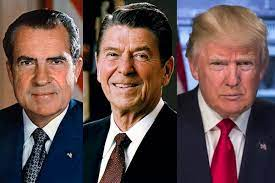
But at his core, Trump is a pacifist. He does not want America involved in any war. He follows in the tradition of two prior pacifists, Nixon and Reagan, both of whom described the American strategy as having the biggest, baddest, meanest military the world has ever seen--and then never using it. "Peace Through Strength" is how previous generations (and Sou Mi) put it. It's Trump's strategy to a tee.

So the debate is between "The War Party," represented by Kamala, Liz Cheney, the journalists at The Bulwark, the CIA, and most college faculty. And "the Peace Party," championed by Trump, Tulsi Gabbard, journalists at ZeroHedge, and (apparently) most of America's working class.

I'm not sure which side Sou Mi is on: is she pro-War or pro-Peace? I don't think she knows, so befuddled is she by all those imaginary "imperialists" floating around in her head. I also don't really know what side I'm on--I can see virtues in both points of view. But I'll be voting for Trump.

So why now? Why is this choice presented to the American public in this election? Sou Mi has an answer (my emphasis).

Harris’s proposals... come amidst the growing tensions of an empire in decline, especially amidst the retreat of globalization when the United States, based on the export of manufacturing and exploitation of cheap labor in the global south (and particularly through the restoration of capitalism in China), and debt-fueled consumption, was able to rearticulate a unipolar order behind it.

Sou Mi's view is that, with the "empire in decline," there are two possible responses. One is, in spite of that, to double down and re-establish our weight in the world. This is what Kamala proposes to do. The other is to retreat into a shell and acknowledge defeat--the Trump strategy. Or, instead of War Party and Peace Party, we can think of them as the Recovering America's Greatness Party and the Surrender Party (which weirdly reverses the terminology the parties use to describe themselves).

I dispute that America is an empire in decline. For good reasons during the Cold War, the US served as the world's policeman, and provided the world with a reserve currency by running huge trade deficits. This enabled an unparalleled period of global economic growth, including, most notably, in China (bringing 400 million people out of poverty). Sou Mi ludicrously describes it as an act of "exploitation," which it definitely wasn't. It was, instead, an act of great generosity (albeit extended only to America's allies--and not to miscreants such as Cuba).

The question thus arises, can America continue to be so generous? Trump says no; Kamala responds yes. The problem is that, while America has certainly gotten richer over the past 70 years, the rest of the world has gotten richer faster and caught up. So Sou Mi is partly right: in relative terms, the US has declined, and is therefore no longer able to finance global trade as it once did. While in domestic terms our trade deficit has not yet declined, today as a fraction of total global trade it is too small a percentage to finance global trade.

In finance parlance, this is known as a shortage of eurodollars--and countries that don't have enough eurodollars (eg, Sri Lanka, Bangladesh, South Africa, and on the cusp, China) are no longer able to import basic necessities such as food and fuel.

Whatever Kamala's intentions, she will not be able to reverse this relative decline in eurodollars, and the result will be a crimp in globalization. As there is no other reserve currency on the horizon, despite this shortage the Eurodollar will remain the world's reserve currency for the foreseeable future. The only country that can literally "print" eurodollars is the United States--we're sitting in the catbird seat.

Then there is our role as the global policeman. We guaranteed European borders, allowing European countries to all but defund their militaries. And likewise for Canada, Japan and the Philippines, among others. This, by itself, made people richer. We made the same guarantee to countries in the Middle East, fighting wars over Kuwait.

But being the world's policeman is expensive! And US taxpayers have to pay the bill. Trump has decided we don't need to do that anymore. For example, our efforts to keep the Red Sea open have come to naught--we're using million dollar missiles to shoot down the Houthi's thousand dollar drones, obviously not a sustainable operation. Technology has changed the nature of warfare. 

There's no reason for us to police the Red Sea--that's a job for the Europeans. We no longer have much interest in defending European borders. If Russia invades the Baltic states, we're probably not going to rise to their defense. We're not patrolling the Indian Ocean--India, Japan and China can fight over that one.

More, the Middle East is on its own. We still have an outpost in Qatar, but I predict that's not long for the world--Trump will bring them all home. The US has no dog in any fight over the Persian Gulf--we don't import any of their oil, and we have no reason to defend their sea lanes. That's up to the Europeans, Japanese and Chinese to work out. Good luck!

That's Trump's plan. Kamala says we're still gonna be the world's policeman. That's popular within the intelligence community and in the faculty lounge--but not among many common voters. It's one reason why I think she'll lose the election.

Sou Mi's article is worth reading. Apart from the gratuitous use of the word "imperialism," hers is an intelligent point of view.

Further Reading:

Tuesday, August 27, 2024

Left Voice Demands 5 Things of UAW's Shawn Fain

UAW president Shawn Fain (Source)

Left Voice author James Dennis Hoff demonstrates his astonishing misunderstanding of the labor movement in an article entitled Five Things Shawn Fain and the UAW Could Do Instead of Campaigning for Harris and Walz. The author, a professor of English at City University of New York campus, seemingly has never met a workplace he didn't want to shut down, including his own employer. Had he succeeded in that misguided effort, 40,000 people would have been out of work and without paychecks for an indefinite (probably long) period.

The primary reason for his misunderstanding is Marxism, which on the subject of labor/company relations is completely wrong. In the Marxist world view, the sole goal of labor is to confiscate the capitalist's profit. Marxists see the very existence of profit as a great injustice. Of course they're wrong--capital will have to win a return no matter who owns the means of production. Profit can never be eliminated and the efforts to do so have all led to destruction. See, eg, Cuba, Venezuela, and the former Soviet Union.

But that's not the primary error we examine here. There are two ways to judge a company's success: one can measure total revenue, and/or one can measure total profit, which is some fraction of that revenue. Marxists somehow seem to forget about the revenue part. But it is revenue that is split between wages and profit, and without revenue neither the worker nor the capitalist will make any money.

For example, Walmart's net revenue for the year ending June 30th was $648 billion. The net profit was about $16.3 billion, or 2.34% of revenue. The remaining revenue went employee salaries, rents, utilities, etc. The workers can legitimately fight over Walmart's profit. If they got all of it they'd get a 2.34% raise (after which the company would promptly go bankrupt).

But the elephant in the room--the fact that Professor Hoff studiously ignores--is revenue. Increases in revenue--even small ones--will have a much larger effect on workers' well-being than chipping away at the profit margin. After all, the workers get the lion's share of that revenue.

So the workers and their bosses have one big task in common--maximizing revenue. This is very complicated problem, for it depends on the mix of products sold (keeping the optimal mix of products in stock), then pricing them at a level that optimizes revenue, and finally ensuring that the products are displayed attractively and can be purchased by consumers with minimal inconvenience. A given Walmart Super Center will carry approximately 120,000 stock-keeping units, each of which has to carried in proper quantity and priced optimally.

Both workers and capitalists have a strong interest in maximizing revenue. The capitalists certainly understand that--their profit is a fraction of total revenue. And workers understand that--the security of their employment along with the size of their wages ultimately depends on revenue. The union understands it most of all--the dollar value of union dues collected will depend only on revenue.

Which is why workers are not particularly interested in going on strike. Strikes do not enhance revenue. They hurt the company and union alike. Note that the recent UAW strike was structured in a way that minimized revenue losses.

But Marxists don't get it at all. They think it's all about quibbling over profit. Profit is a sideshow for the workers--it's the revenue that really counts. When it comes to revenue, the workers, the company and the union are all on the same side. Consumers are on the opposite side.

In that light, let's now consider Professor Hoff's five demands on Shawn Fain's union.

1: Build the Fight Against the Far Right

"It is a fool’s errand to believe that we can defeat the nationalist, misogynist, xenophobic, racist, and anti-queer politics of the Far Right by voting," says Professor Hoff. He is correct; it's likely that the "far right" is gonna win the election. Win or lose, any party that can get 70 million+ votes in an election can't really be called "far" or "extremist." They are, in fact, rather mainstream.

Then I'm not sure why you'd want to defeat the "far right." UAW workers manufacture a lot of pickup trucks. Who buys them? Does Professor Hoff own a pickup truck? Almost certainly not because he lives in New York City. The consumers who buy pickup trucks live in suburbs, exurbs and small-towns across America. They live in Trump Country. Indeed, I'll bet a lot more Trump voters own pickup trucks than voters in blue states. Why should the UAW leader purposely diss the majority of his customers? Picking a fight with Trump's voters is definitely not a way to maximize revenue. 

When it comes to maximizing revenue, staying out of politics altogether seems like the best bet.

2: Take the Struggle for a Free Palestine into the Workplaces

Surely you're joking, Professor Hoff? How can slaughtering the world's Jewry increase revenue? Even if you think Hamas doesn't intend to kill everybody, I still don't see how siding with a bunch of murderous, nihilist thugs helps make American workers richer. Siding with Israel also probably won't help any. So just stay out of it, which seems to be what Shawn Fain is doing as best he can. He's right.

3: Take Seriously the Fight for a 32-Hour Work Week and Other Progressive Demands 

You can take it as seriously as you want, but please remember that the company is already maximizing revenue. A 32 hour work week (with 40 hours pay) is a nice idea, but it's not something that's affordable on a 3% profit margin. Prices would have to go up--by a lot. Such a rise in prices will lower revenue, not raise it. The workers (and the company and consumers) will ultimately come out losers. This is a demand--from the textbook on Free Lunch Economics--that only an English PhD ignoramus could love.

4: Bring Back the Political Strike and Dismantle Taft-Hartley

As said, Professor Hoff has never seen a workplace he didn't want to shut down. And they should shut down for totally frivolous reasons. Eg,

But why shouldn’t nurses and teachers, for instance, be able to go on strike to support their brothers and sisters who drive the buses and trains, and why shouldn’t working people be able to strike collectively to demand basic human rights like access to healthcare, higher education, child care, and pensions?

Most teachers (and most nurses through Medicare & Medicaid) are public employees and get paid at the expense of other workers. It's workers, after all, who pay the majority of taxes that covers their salaries. As the professor admits, a solidarity strike by teachers serves only to stuff teachers' own pockets, especially his demand for more higher education funding. We have way more higher education in this country than we need, and I don't see why the average UAW member should be forced to pay for it. They each already pay thousands of dollars in taxes to support the professors' unions.

5. Break from the Two Parties of Capital and Build a Class Independent Union Movement

Spitting into the wind, Professor Hoff writes,

But more than anything else, the first and most important step that the UAW and every union in the country could take right now to strengthen its membership and prepare for the struggles ahead is to finally break with the two parties of capital once and for all.

Our Trotskyist friends and their predecessors have been demanding this ever since the publication of the Communist Manifesto in 1846. In America it's never happened, and that's because the Marxist model of capitalists and workers permanently locked in a zero-sum fight for profits is just plain wrong.  Workers know that. Workers (real ones--not fake ones like professors) understand that it's revenue that butters their bread, and they're not gonna do anything to stop the flow.

That's why Left Voice only numbers about 50 comrades, and not 50 million.


Further Reading:

Saturday, August 17, 2024

Left Voice on the Economic Crisis

Graph of a crisis happening somewhere (Source)

Kudos to Left Voice author Jason Koslowski for a serious attempt to understand the modern economy, in an article entitled The Economics of Lesser Evilism. But Mr. Koslowski (who self-identifies as "a contingent college teacher and union organizer who lives in Philadelphia") suffers from two serious handicaps in his efforts: 1) he's a Marxist, which means he doesn't understand economics; and 2) he thinks everything is always and everywhere in a crisis.

For all that, Mr. Koslowski writes this paragraph:

Marx writes in Capital that in capitalism, the rate of profit — the rate of return on capitalist investment — tends to fall. That’s because profit only comes from human labor. Capitalists, though — in their endless competition with each other — try to ramp up the productivity of labor. That makes it cheaper to produce a commodity, and can temporarily ramp up profits too, while also reducing the amount of labor needed for production. That’s the problem: capitalism tends to rely more and more on labor-saving techniques and technology, but relatively less on human labor. But as competition drives other firms to adopt that same approach, the rate of profit tends to take a hit; the amount of profit-producing human labor relatively decreases.

This is a model of clarity and concision that is rare in Leftist writing, and which shows that our friend has some talent as a journalist.

Despite that, it's wrong--but let's blame Karl Marx rather than Mr. Koslowski. It's worth taking the paragraph apart.

The first sentence does represent confusion on the part of Mr. Koslowski. He confuses the rate of profit with the rate of return on investment. These are two different things. The "rate of profit" stands for operating profit--aka earnings. That is the percent of total sales revenue that can be counted as profit, which is what Marx meant by the word. Walmart, for example, famously sets this number to 3%. If operating profits rise above that then they lower prices. If they irredeemably fall below that, then they close the store. Thus Walmart--almost definitionally--can never experience a declining rate of profit. It's always 3%.

The rate of return on investment is something completely different: that depends on the stock price. It is calculated by the price/earnings (PE) ratio, namely the price of a share of Walmart stock divided by the (recent or projected) earnings (or profit) per share. Again, using Walmart as an example, the current price of the stock is about $73/share, while the earnings per share for the past year was $1.92. This yields a PE ratio of about 38--roughly typical for an S&P 500 company.

The rate of return on investment (the PE ratio) depends on many things: the marginal rate of return (aka profit), the stock price, current interest rates, and investors' assessment of the company's future. That number can never systematically decline--since if operating margins go down then the stock price will also go down. (Marx has a completely weird way of calculating capital that had nothing to do with the stock price. Nobody today knows how to do the Marxist calculation--not even Michael Roberts.)

The next sentence is also wrong. Profit does NOT come only from human labor, though that is certainly part of it. It's the consumer who sets the value of goods and services--not labor or any other cost of production.

For example, in my old age I prefer to fly business class, which means I'm paying 3x or 4x more than those in basic economy. Most people aren't willing to spend that much money on a plane ticket--and I can do it only because I don't fly all that often. Let's use my most recent trip as an example: RT from Newark to Chicago, my ticket cost $734. By comparison a basic economy seat costs $150 (though the real cost is higher coz they nickel and dime you for everything).

The following statements are true:

  • The airline earns a profit on the basic economy seat--probably the margin is similar to Walmart's. Basic economy travel is a commodity, and prices go down as airlines become more efficient. Say the profit margin is 5%.
  • My business class seat takes up about twice the space of a basic economy seat. So the business class cabin (which had 16 seats) could have fit 32 people if sold as economy seats. So effectively it costs the airline twice as much to fly me to Chicago than it does the economy passenger.
  • More, the airline has to hire an additional flight attendant to take care of us business class folks. And we got "free" drinks. For a longer flight we would've gotten "free" and higher quality meals, but my flight was too short for meal service.
  • I don't have to pay any baggage fees.
  • All sixteen seats in the business cabin were occupied. That's 16 people who paid something like $700 for a RT ticket.
So an educated guess is that it costs the airline 3x more to fly me to Chicago than a basic economy passenger. Yet the price is 5x higher, or if you account for the nickels and dimes, perhaps only 4x higher. But that's an extra $150 that the airline can book as pure profit--in addition to the 5% they get from all the other seats.

That extra profit comes only because I'm willing to pay for it! And apparently 15 other people made the same choice. When considering my alternatives in making the reservation, I didn't take the cost of labor into account at all. All I considered was the relative value I got from spending an extra $500. What else would I have rather spent $500 on? Nothing, apparently, because I spent it on business class airfare.

The airline priced business class at a level that maximized their revenue. If they charged more, they wouldn't have filled all 16 seats. If they charged less they would have just left money sitting on the table. The cost of labor doesn't enter into their calculation either.

So the labor theory of value is wrong--except for commodities. And on this Mr. Koslowski is correct. The cost of labor (or, more accurately, the total cost of production) does determine the price of a commodity--that's the very definition of a commodity. An alternative definition is that commodities compete only on price--nothing else. Basic economy airfares are a commodity, which is why they cost almost the same independently of airline. Business class airfares are not commodities, which is why they vary widely in price depending on the airline. (Business class travel to East Asia varies from about $3500 to almost $10,000. You choose your comfort level accordingly.)

Mr. Koslowski's last few sentences are mostly correct. To increase their profits companies automate their processes (substituting capital for labor) and thereby lower their costs. But competition forces them to lower their prices, and so there is a declining rate of profit. (Again, this holds true only for commodity products.) But this is a good thing--because it lowers prices. Consumers are better off, and our standard of living improves. Indeed, the major beneficiary of capitalism is and always has been the consumer, which is why our standard of living has risen dramatically since the dawn of the industrial revolution.

Mr. Koslowski thinks the current economy is in a "crisis."

Both campaigns are pitched to win support, and money, from the ruling class. They are offering competing visions of how to return the economy to “normal” after the emergency of the pandemic crisis.

But “normal” is a crisis. The campaigns are funded by a ruling class trapped inside a global economy that’s struggled to grow and return profits for decades. That class’s hunt for profits, amid deep, decades-old contradictions of capitalism, keeps on fueling the danger of financial crisis — the recent market plunge is a sign of that danger — and ever-sharper imperialist conflicts. ... That’s the “order” Trump and Harris want to preserve.

Of course there always is a danger of a financial crisis--that's been true since ancient times. Even socialist heaven-states like Cuba, Venezuela and North Korea experience financial crises. So there is nothing capitalists or socialists or anybody can do about that. Other words here--imperialist, contradictions--are just meaningless Trotsky-talk, aka gobbledygook.

But the fact is We are not in a crisis! The long-predicted recession has still not happened. The financial markets have their ups and downs--Mr. Koslowski's article was written on a down day--but there don't seem to be too many bubbles there. Of course there are problems--inflation, housing--but that's all within the normal warp and woof of everyday events.

I will posit (and what follows is not original to me) that we're in stagnation--the complete opposite of crisis. Few people are getting laid off. Few people are hiring. Few people are quitting. The job market is pretty much frozen solid. That wasn't true last year--then there was a serious labor shortage. But in the interim we've admitted millions of new immigrants--quasi-Americans--who have eliminated the shortage (apart from some skilled labor categories).

It's because of quasi-Americans that inflation has gone down. It's because of quasi-Americans that unemployment has begun to tick upwards. Whatever new jobs have been created over the past year, it's quasi-Americans that have filled them. (Most of those new jobs have been in healthcare--disproportionately as home healthcare aides.)

There is no crisis--at least not today. There is no economic crisis. There is no climate crisis. There is no education crisis. There is no democracy crisis. There just isn't any crisis. I know that's a deep disappointment to our Trotskyist friends who are always and everywhere predicting a crisis here and a crisis there and a crisis everywhere.

But they're wrong. At least for now.

Further Reading:

Tuesday, February 13, 2024

Cheapskate Consumers in China

The Mall of America, suburban Minneapolis, sells a lot of stuff from China (source)

Roy Landersen, writing for The Militant (published by the Socialist Workers Party--SWP), contributes an article entitled China’s capitalist rulers’ deepening crises visit disaster on working people. Even though he gets China mostly right, he still misunderstands some basic economics. His lede paragraph is here (emphasis mine).

For decades China’s rulers have relied on expanding capitalist methods to grow their economy, and repression to keep working people in check. But their course today is producing falling exports, rising local government debt and a property market meltdown, exemplified by the collapse of Evergrande, once the world’s most profitable property developer.

What he describes here isn't really capitalism, but rather fascism. While under socialism all economic activity is run directly by the state, in fascism, it is run only indirectly by the state. The government allows private enterprise, but forcibly subordinates it to the political needs of the state. Mr. Landersen denotes this by the euphemism "capitalist methods," which is distinct from capitalism because economic profitability is not the primary concern. Instead enterprises must serve the state first and foremost.

Another name for this might be mercantilism. Either way, it is unfair to blame China's problems on capitalism. Instead, it's the fascist-like CCP that poisons the mix.

The last clause of the quoted paragraph is wrong. It seems that Evergrande was never profitable--the company has been accused of systematically inflating revenue. Apparently they've been running a big Ponzi scheme--with CCP connivance, of course. There were never any profits--only fraud.

In a transparent effort to blame mythical, foreign imperialists, Mr. Landersen writes,

A Hong Kong court ruled Jan. 29 that Evergrande, with its gigantic $300 billion debt, be liquidated, setting up a tug-of-war over its assets between Beijing and imperialist lenders who are owed billions. Bosses at the company stopped paying creditors two years ago.

Google AI (now called Gemini) reports that 

While Evergrande's total debt was massive at $340 billion, its reliance on foreign loans was relatively small. Here's a breakdown:

  • Total debt: $340 billion
  • Foreign debt: $25.4 billion
  • Percentage of foreign debt: ~7.5%

The so-called "imperialist" lenders are only out $25 billion, which is small change. I don't know what an "imperialist" lender is--foreign lender is a better description. I'll suggest almost all of them are from Hong Kong. Is Hong Kong "imperialist"? The epithet is completely meaningless.

Mr. Landersen recites a litany of problems Chinese "workers" face, which I'll summarize in bullet points.

  • Evergrande "took billions in down payments for houses that were never built, and its collapse left countless numbers of construction workers with unpaid wages." As said, it was all a big Ponzi scheme.
  • "In industry, bosses’ profits fell 2.3% last year, after a 4% fall the year before." So it's not just workers who suffered.
  • "High unemployment among Chinese university graduates — one in five without a job..."
  • "Despite government inducements to have children, including tax breaks, cheap housing and cash payments, the birth rate fell in 2023 for the seventh straight year." China looks to be in an irrecoverable demographic downward spiral. There's probably no way of undoing that now.
  • "Foreign capitalists are shifting manufacturing from China to countries like Vietnam where bosses pay workers less."
  • "Chinese President Xi Jingping’s signature project, the Belt and Road Initiative, is losing steam. ... [G]overnments that have borrowed from Beijing are defaulting on loans."
  • "For years, Beijing has detained millions of Uighurs, a Turkic-speaking Muslim minority, in 'reeducation camps' across Xinjiang province."
  • "Demonstrations by workers have grown recently in China’s export-oriented manufacturing industries where demand has fallen. More than 1,700 strikes took place last year, double the number in 2022. They are protesting unpaid wages and benefits, as well as mass layoffs or forced relocations."
Mr. Landersen tells the truth--every statement in these bullet points is true. Intentionally or otherwise, he puts paid to the notion that China is some rising power about to displace the United States. There is no way that is gonna happen. Quite the contrary, China will increasingly have difficulty importing enough food and fuel to meet its needs.

It is, in the end, all a question of supply and demand. 

Marxists only talk about the supply--e.g., the governments in Cuba (sugar), North Korea (food) and the former Soviet Union (steel) all bragged about their levels of production. After all, in their view, the key to economic progress is to increase production because that's the only thing that adds value to an economy.

But it's not true. The real measure of economic progress is the rate of consumption, typically measured as sales volume. Because if consumers can't afford or find use for your product, its manufacture is a waste of resources. It's increased consumption that actually raises a country's standard of living.

This is why the plight of workers--how they're oppressed, deprived, etc.--is mostly irrelevant (as long as they're free and paid market rate wages). The real test of well-being is what those workers--acting as consumers--can buy. In Cuba they can't buy tiddlywinks. In China--even after all the progress of recent decades--most consumers are too poor to buy very much.

Americans, by contrast, are excellent consumers! Indeed, we're the best consumers on the planet. Almost every country on earth tries hard to sell into the American market--because that's where the consumers are. American consumers are the people who have made the world's economy go round.

In particular, modern China has never been able to consume its own production. It has always had to find consumers abroad--mostly by exporting to America.

Unfortunately, America is now tapped out. We're too far in debt to keep accepting new exports from other countries. Our ability to consume everything the world produces is no longer feasible. Other countries are going to have to develop their own consumer markets.

China has not done that. Not even close. A housing Ponzi scheme destroys consumption. A lack of babies results in a lack of consumers--the best consumers are families with children. Not having a good old-age pension system, or something like Medicare for old people, forces people to save more than they likely need for old age. And reduces consumption. China's "iron rice bowl" has rusted out.

So I think China is screwed. Mr. Landersen wants to blame capitalism, but he really should blame the Chinese Communist Party. The CCP, like most Marxists, has always emphasized production over consumption--and now they're in a pickle of their own making.

Mr. Landersen will, of course, champion the Cuban consumer, who earns something like $50/month. How much can you consume on that income? It's pathetic, and that's why Cuba is so poor.

Further Reading:

Saturday, October 7, 2023

The Professors' Congress: The International Situation

(This post is much too long. That's because Left Voice has interesting stuff to say.)

Washington as Statesman at the Constitutional Convention. Junius Brutus Stearns (1856). Virginia Museum of Fine Arts, 50.2.1. https://www.vmfa.museum/piction/6027262-8052859/

My friends over at Left Voice held their first Congress in New York City from July 14th - 16th. 

More than 50 comrades gathered in Manhattan. The largest group came from New York, where Left Voice was founded about eight years ago. A second nucleus was from Detroit .... Further members joined from Philadelphia, Los Angeles, El Paso, and other parts of the United States. Guests from our sister groups in the Trotskyist Fraction tuned in from Mexico City, Caracas, Buenos Aires, São Paulo, Barcelona, Paris, Berlin, Munich, and other cities around the world.

The discussion centered around six documents, of which I so far have read only one: Notes on the International Situation (abbreviated here as Notes). This post is a review of that document--and I'll suggest mine is the only commentary on the piece from anybody outside their small grouplet.

Left Voice (LV) is the publication of a group of NYC college professors, grad students and hangers-on, who are now attempting to form a full-fledged, Leninist Party, building on the early heritage of the original Trotskyist movement in the United States, the Socialist Workers Party (SWP). As the above quoted paragraph makes clear, this core is a very small group of people and they have a very long way to go before they take state power.

Part of that effort means joining the Trotskyist Fourth International (FI), founded by Trotsky himself back in 1938. As with all other Trotskyist grouplets in this country, Left Voice isn't happy with the leadership of the FI, so our professor friends have initiated the Fourth International-Trotskyist Fraction (FT) in an effort to get them back on the straight and narrow. As I commented elsewhere, "the professors are all busy trying to out-Trotsky each other, which is why one needs a Trotskyist Faction inside a Trotskyist International."

Professorial fingerprints are found all over Notes, many of them good. The document is well written, analytical, mostly factual (as far as I can tell), typo-free, and--above all--long. It's 34 pages in pdf format. Trotskyist grouplets in the US collectively produce manifestos on this scale approximately once a month or so. I most recently reviewed Socialist Action's Political Report (authored by Jeff Mackler) last March. Notes is a better version of roughly the same thing, and if you're interested in Trotskyist esoterica it's worth reading.

I'm not going to go through it line by line--that'd take way too much time. Instead, let me address specific issues:

  1. Economics
  2. "Imperialism" and Ukraine
  3. Hegemony
  4. China
Economics

Notes, as is true of all Trotskyist manifestos, makes passing mention of economics, throwing words and concepts around like they actually mean something. These include the declining rate of profit, the crisis of accumulation (which looks like it's not happening), and most importantly, the class struggle.
Looking at the overall situation today, where there has been a volatile panorama of geopolitical crises, renewed instability in the economy, and a developing dynamic toward class struggle. As a result of the war in Ukraine, capitalist equilibrium is under “significant impairment.” ... This implies that as revolutionaries, we have to prepare ourselves for new forms of class struggle, more radical than what we have seen in recent times.

It seems they agree with their comrades in the SWP, whose most recent political report was entitled The Low Point of Labor Resistance is Behind Us, which I reviewed last February. Both grouplets maintain that because of this crisis and that crisis and the other crisis, the class struggle is intensifying and revolution is a-brewing. I've been around politics for over half a century, i.e., long enough to know that's not likely. 

As an example, they point to the Yellow Vest movement in France--which has violently resisted President Macron's (very reasonable) pension reforms--as something wholly new and significant. They forget that the French have a long history of throwing rocks and bottles at each other, as memorialized by Charles de Gaulle's famous quote: "how can anyone govern a nation that has two hundred and forty-six different kinds of cheese?"

In a word, their mention of Marxist verities are merely pro forma and have no measurable relation to actual world events.

"Imperialism" and Ukraine

"Imperialism" is in scare quotes because I don't believe it exists in any way that Marxists think it does. Notes, at least, tries to explain what "imperialism" means by quoting sacred scripture, namely from Lenin's booklet, Imperialism: The Highest Stage of Capitalism

in which the dominance of monopolies and finance capital is established; in which the export of capital has acquired pronounced importance; in which the division of the world among the international trusts has begun, in which the division of all territories of the globe among the biggest capitalist powers has been completed.

This word salad, dating from 1916, does NOT describe today's United States or any part of the world economy. The US has no large monopolies, nobody controls the stock or bond markets, there are no international trusts, and the world has not been divided amongst capitalist powers.

Notes uses the word "imperialism" like religious texts refer to the Holy Ghost. If you already believe in it, you'll see it everywhere, but for the non-believer it's unconvincing. Our professor friends have definitely got religion: the word fragment imperial- occurs 87 times in the document!

That notwithstanding, the professors seem to forget their own definition in the rest of the text. It is important to them that they define the "imperialist" quality of the one-time workers' states, Russia and China.

About Russia they write (italics in original):

Thus, Russia emerges with contradictory characteristics as a capitalist state that’s far from sharing imperialist characteristics economically but has some trace of imperialist characteristics at the level of its military. Despite not being a great power, it is a regional power with limited international influence, such as its role in the Syrian conflict.

It's a pity they can't quantify this for us. Is Russia 16% imperialist? Or is that to much to be a "trace"? They invoke Russia's military here as making it more "imperialist," but nowhere in Lenin's book is military size a factor. After all, I think Lenin would class Switzerland as imperialist, despite it not even having a navy.

Notes' description of Chinese imperialism is even weirder.

In the case of China, the growing confrontation is linked to the country’s imperialist ambitions — continuing the CCP policy that restored capitalism in China. Capitalist restoration in China was carried out under the auspices of international financial capital, particularly that of the United States (we expand on this process in the second part of this document). However, due to the specific importance that China’s economy has acquired after the process of capitalist restoration, the Chinese bourgeoisie increasingly needs to project Chinese capitalism in imperialist terms. As the FT, we’ve been developing our characterization of China and its imperialist traits which have strengthened in recent years. Though China is not yet imperialist and U.S. imperialism still maintains an important level of hegemony over the world order, the possibility of any kind of “succession” of U.S. hegemony will not be peaceful or evolutionary — as the proxy war in Ukraine and growing tensions in Taiwan show. 

So China is not yet imperialist (presumably that's 0%), but its imperialist traits have strengthened (presumably some number greater than zero--may I suggest 43%?) I am glad that our professor friends are closely monitoring China's descent into "imperialism," but I do wonder by what Leninist standards they are reevaluating the situation.

Of course this is all nonsense, but it's consequential nonsense. For Notes' take on Ukraine depends very much on how "imperialist" Russia is. Notes defines a term known as Campism, which is an error engaged by some Trotskyist grouplets. While some grouplets openly support Ukraine in a war of liberation (e.g., our friends in the SWP), others see the Ukraine war as a proxy fight between two imperialist powers, ie, between the US and Russia. Campists believe one should side with Russia, either because Russia isn't imperialist at all and the war results from NATO aggression. Or because Russia is only slightly imperialist and thus represents a lesser evil. The most important thing is to defeat US imperialism. Jeff Mackler at Socialist Action is a good example of that latter form of campism.

So Notes refuses to support Ukraine (they deny it's a war of liberation), but on the other hand they won't kowtow to Russian "imperialism", of whatever trace quantity. Thus they have come up with their own unique slogan (italics in original):

Not NATO, not Putin, and not the Zelenskyy regime

This is very unclear, expressed as it is as three negatives. It becomes marginally clearer if one rephrases it in positive terms. I come up with

For the Tooth Fairy, For free unicorns, and for a Trotskyist regime

OK--maybe that doesn't clarify very much. But that's the best you're gonna get out our professor friends' endless analysis of "imperialism".

Hegemony

After "imperialism," hegemony must be professors' second favorite word. The word fragment hegemon- occurs 36 times. They make three claims:

  1. That US global hegemony is still intact...
  2. but the US is in long-term secular decline, while...
  3. China is the leading contender to rival/displace the US as a global hegemon.
Unlike "imperialism", these statements are arguably true, and Notes makes as strong a case as can be made. I don't disagree much with the facts they present, but I think they're leaving out much important context.

There is no question that the US is still the world's leading hegemon. Our defense budget is larger than the rest of the world put together, and four times bigger than China's. We have by a big margin the strongest navy in the world. Don't let China's large-scale construction of new ships fool you--our navy is vastly superior. The US is the only power that can patrol global sea lanes, including the Straits of Malacca, Hormuz, and Gibralter, along with the Panama and Suez canals. Flows of energy from the Middle East to either Europe or China and Japan depend crucially on the US navy for protection. By withdrawing its navy, the US could deprive Japan and (especially) China of necessary oil and food imports.

The US remains the world's economic hegemon as well. The US dollar is still the world's reserve currency--well, actually that's not true. It's never been true. The world's reserve currency has been the so-called Eurodollar since at least the early 1960s. Notes misstates the situation here:
The 1944 Bretton-Woods agreement established the dollar as the dominant currency of the world, and the Marshall Plan laid the groundwork for economic penetration in Europe in the name of post-war economic reconstruction. These gave the U.S. significant economic and political hegemony in the capitalist world order.

In fact, Bretton-Woods collapsed within a few years of being signed, and Nixon finally admitted as much when he took the US off the gold standard in 1971. The Eurodollar system grew out of the resulting chaos. It was not planned or designed by anybody--it just gradually evolved beginning in the late 1940s, and by 1960 or so it was well entrenched. My post on the Eurodollar explains it as clearly as I know how (the topic is extremely complicated!).

The Eurodollar system has worked spectacularly well for at least 60 years (much better than Bretton-Woods ever could have), but it is beginning to fray around the edges. And that brings us to America's supposed decline.

Of course the US had to decline in relative terms. This report dates from 2016 and is so a bit dated, but it states that in 1960 US GDP was 40% of the world's economy, while in 2016 it was only 22%. This was certainly not because our country was getting poorer (it wasn't), but because the rest of the world was getting richer faster.

Without going into details (see the above linked post), the Eurodollar system works because the US has run large and consistent trade deficits every year since 1974. Those deficits are what finance global trade. Because of the growth of the global economy, relative to global GDP our trade deficit has been shrinking. This means there is a shortage of Eurodollars (one reason why domestic interest rates are rising) and some countries (e.g., Sri Lanka) no longer have a sufficient quantity to import essential supplies. Other countries are setting up bilateral agreements to trade in their own currencies, e.g., between China and Russia, so they don't have to use the Eurodollar. These agreements may solve a short term problem, but at bottom they are not much more than barter exchange and are not durable.

No other world currency (or currency union) is running a large enough trade deficit to finance global trade. Hence, despite the shortage of Eurodollars, there is nothing on the horizon to replace it. This is terrible news for global trade and puts a severe crimp on the globalization phenomenon. But it's great for American consumers as foreigners desperately compete to sell goods into the American market so as to accumulate Eurodollars.

It gets worse because political sentiment (headed by Trump) is increasingly against permanent trade deficits, since the cost of supporting the Eurodollar is the decimation of our own, domestic manufacturing capability. Hence the latter day imposition of tariff barriers and industrial policies.

So while I acknowledge that Notes is right about America's decline, the context is missing. America may be declining by some accounting measures, but we're waaay better off than any other country in the world. We'll be the last man left standing.

China

If "imperialism" and "hegemon" are our professor friends' favorite words, then there is another important term completely missing from their document: demographics. China, Japan, S. Korea, Russia, much of Europe, and even the Middle East and Latin America are in some stage of demographic decline.

Before we get to China, here's another paragraph about Russia and Ukraine. Russian demography augers the end of Russian civilization--it's child-bearing age population has declined beyond the point of no return. Thus the Ukraine war is the last war Russia will ever fight. After this it will never again have the manpower or the industrial base to field another army. Dead Russian soldiers and destroyed Russian tanks will never be replaced. The strategic goal of the United States is to destroy the Russian military once and for all. To that end, the longer the Ukraine war goes on, the more Russia suffers irrecoverable losses, and it will eventually be taken off the global stage as even a regional power. Thus the US strategy is for the war to go on for a very long time, or, as it is often phrased, to fight to the death of the last Ukrainian.

Like Russia, China, too, is in demographic collapse. Even the Chinese government (sort of) admits this. The United Nations--using Chinese government statistics--reports that as of April, 2023, India surpassed China as the most populous country on earth.

But as is true in so many cases, Chinese statistics are misleading. It is increasingly clear that China has been exaggerating its demographics for some time now. Peter Zeihan, an expert on Chinese demography, says that China lost the population crown to India about ten years ago--not this year. By his measures, China's real population is smaller than the official figures by about 100 million people. Worse, all those missing people are under 45 years old. See the Mr. Zeihan's charts here.

By contrast, Notes ignores demographics altogether. They write (as part of a longer discussion)

China, with its pursuit of new markets for its own bourgeoisie, follows the same economic and political tactics in the Global South that imperialists have done previously. It has also established itself as a major trading ally for advanced economies like Germany , and through brokering new alliances and treaties, it is firmly trying to prove itself as a contender to lead the capitalist world order. Especially as the tendencies toward a new bloc around China increase, they threaten further and greater confrontations, militarism, and conflict.

This is wrong on so many levels. First, the Belt & Road project is collapsing into stinking mountain of defaulted loans and unfinished projects. Second, China is no longer the world's cheapest manufacturer--that crown has been ceded to North America, ie, the US-Mexico combination. Third, China is in dire financial straits, desperately short of Eurodollars, and increasingly unable to fund its purchases of necessary raw materials. While China was Germany's key customer (Germany supplied the machine tools for China's manufacturing plant), the demise of China as an industrial powerhouse has put Germany into a severe recession.

And finally, not only is China's total population declining, but its working-age population is declining even faster. There is no way that China can grow its economy with a shrinking population. Mr. Zeihan predicts that the current Chinese government will collapse within this decade, and that the country's survival as a unified state is in jeopardy. Perhaps he exaggerates--but even if he's mistaken about the timeline, the notion that China will ever compete with the USA for "hegemony" is simply wrong.

That doesn't mean they couldn't try to invade Taiwan (though I doubt they will. They'd lose).

Conclusion

I have spent a long time reading Notes and composing what I hope is a considered critique. I wonder why I do this? Left Voice, like all Trotskyist grouplets, is far too small to have any influence on American or global politics. The authors of Notes are too committed to Marxist theory and are too ideologically blinkered in their perspective in order to see straight. Put another way, they don't seem to read anything beyond what they themselves have written.

That said, I do hope the authors--whom I've teasingly mocked as "professors"--will read what I write. First, I've spent a lot of time on it and it would be a shame if they didn't. Second, I think this will be the only commentary on their work that comes from outside their grouplet--and they should be flattered. And finally, I do think the ideas--both those in Notes and in my response--are worth discussing and considering.

Nothing here will change anybody's mind. Still, I don't believe I've wasted my time.

Further Reading: