Showing posts with label Employment. Show all posts

Tuesday, January 7, 2025

CUNY PSC Can't Help HEOs

(Source)

The Defense Department surely wins the contest for having the most acronyms, but a close second must be awarded to higher education. Even I--after 40 years in the business--am still encountering mysterious letter combinations. Today's set comes from a collection of essays entitled Voices From CUNY: Why We’re Voting No on the PSC’s Proposed Contract. The teaser paragraph reads

Workers from eight CUNY colleges speak out against their union’s proposed contract, which includes: inadequate raises for many job titles, workload increases and givebacks on job security for adjunct faculty, and no remote work protections for staff.

CUNY, as most of you likely know, stands for The City University of New York, a collection of 25 campuses from community colleges to graduate schools that purport to serve the citizens of that city. It is New York State's second largest system of public higher education, behind only SUNY (State University of New York), which includes 64 campuses outside the City, with similar scope. I worked for SUNY for most of my career.

Most readers are likely less familiar with PSC, denoting the Professional Staff Congress, which is the teachers' union representing professors and staff. These days that includes everybody from graduate assistants to full professors, along with many staff members. The union tries to capture dues from as many people as possible, even though their benefit in belonging to a union is negligible.

Among those staff members is an acronym I'd never encountered before: HEO. I asked Google AI for assistance.

At CUNY, an "HEO" stands for "Higher Education Officer," referring to a series of non-teaching administrative staff positions within the university, encompassing various administrative roles across different CUNY campuses; essentially, it signifies a professional working in a mid-level administrative role at the university.

I'm still not clear what this means--perhaps it's analogous to the classified services employees at SUNY, eg, secretaries and lower-level administrators. At SUNY those folks have a separate union.

None of the contributors to Voices from CUNY are HEOs, so it's left to Professor James Dennis Hoff to make their case.

The proposed contract also does nothing to secure remote work options for our HEO colleagues. This was the biggest demand for HEOs this contract round, and no progress was made on this question at all. This means that CUNY can end or limit remote work for HEOs anytime it feels like it.

Which is weird. The reason for a physical campus is ostensibly to provide students with one-on-one, in-person instruction. So allowing the HEOs to work from home seems counterproductive. I do know that the secretaries at SUNY are often the front face of the department, welcoming students and answering questions. Or perhaps Professor Hoff thinks that CUNY should move entirely on-line and dispense with in-person classes altogether? In which case everybody could work from home.

Meanwhile, the adjunct faculty are whining to high heaven. A contributor named Kamran writes,

I’m an adjunct at Lehman, and I’m poor, and I hate it. And if this contract goes through, in 2027, I will still be poor, and I will still hate it. $7K was the minimum I think we deserved — 10 years ago. In 2027, it won’t be enough. I will be enthusiastically voting no.

The $7K is payment for a three-credit-hour class, and admittedly it's slim pickings. 
Though at SUNY most adjuncts teach two classes per semester for two semesters per year (and maybe also in the summer)--which then comes to $28,000 per year. Still not much. As Tatiana Cozzarelli, an "adjunct lecturer," writes

Over the summer, I had a dream that we had gotten a contract at CUNY. ... But when I woke up, the reality was so different: I had 30 dollars in my bank account and was borrowing money from friends in order to make ends meet. I needed emergency dental surgery and I had to make a gofundme to pay for it. I’m not the only one. I know adjuncts who are on food stamps, especially over the summer. While CUNY President Felix Matos Rodriguez makes nearly $800,000 a year, adjunct professors just cannot make ends meet.

I have no idea if Mr. Rodriguez is over- or under-paid. But if you take his salary and share it among CUNY's 40,000 full- and part-time employees, the annual raise per employee is about $20. Not enough to get anybody off food stamps. Mr. Rodriguez's salary is--in budget terms--irrelevant.

Ms. Cozzarelli, who identifies as "...a former middle school teacher and current Urban Education PhD student at CUNY," needs to go find another job. Her salary reflects the value of her PhD, which is probably closer to zero. Almost anything she could do, eg, drive an Uber, would pay more and be a greater contribution to society than what she is doing now.

Professor Hoff, who is a member of the union's Delegate Assembly (an elected leadership body), contributes this:

[T]his memorandum of agreement is a pay cut, plain and simple. The proposed across the board wage increases for the life of the contract will equal only 2.82 percent per year. This comes after historic levels of inflation close to twenty percent since 2021. The proposed retroactive wages will do little to make up for that loss and probably will not even keep pace with inflation going forward. Even in the best-case scenario, this contract will actually bake in a nine percent pay cut across the board for all PSC-CUNY members. This comes on top of the lost value that our salaries have suffered since the New Caucus took power in 1999.

In other words, the union got peanuts--despite collecting union dues from Ms. Cozzarelli and her ilk. She's wasting what little money she has. But one has to wonder at the perfidy of the "New Caucus," which agreed to this contract. Why did they do that when it's obviously so bad?

I can think of a number of reasons:

  1. Declining enrollments
  2. Declining revenues from state and city governments
  3. The necessity to keep all the adjuncts and HEOs employed, despite fewer students
  4. An inability to continue deferring maintenance.
Etc. In other words, the New Caucus has to face reality. There is no plausible universe in which CUNY has enough money to make everybody happy. 

I think the contributors to Voices from CUNY are all members of what I call the Shutdown Caucus, of which Dr. Hoff is a leading spokesman. These people--who have never seen a strike they didn't like--think every workplace in America should be shut down until the bourgeoisie cough up their horde of gold coins. In particular, they think CUNY should be shut down with all 40,000 employees going unpaid while on strike. The analogy they present are the strikes at Starbucks, Amazon, the auto workers and at Boeing.

What they don't mention is that workers at Starbucks and Amazon, etc., actually do something useful--and for their labor they get paid by their customers. CUNY employees--ie, the professors, HEOs and adjuncts like Ms. Cozzarelli--don't do anything useful. They're effectively on the public dole--and if they went on strike nobody would even care.

They have no customers. Nobody voluntarily pays money to CUNY. Their entire budget is extorted through taxes on pain of imprisonment.

So please--go on strike. Save us all a dime.

Further Reading:


Monday, August 7, 2023

Three Militant Articles on the Economy

While energy prices have gone down, most items working people depend on are still rising today.
(Source: Bureau of Labor Statistics; Caption: The Militant)

All three articles are from the August 7th issue of The Militant (published by the Socialist Workers Party, SWP). and two of them are only indirectly about the economy. The first piece is entitled Why do liberals claim that US capitalism is on the upswing?  and is authored by The Militant's economics correspondent, Brian Williams. The second, by Seth Galinsky, is headlined Teamsters union says tentative agreement reached with UPS. Finally, there is an editorial under the banner Cuba’s socialist revolution points way forward for working people.

Mr. Williams gets it mostly right--but tells only one side of the story. He agrees with Republican partisans that the economy is going to hell in a handbasket, with this lede (links mine)

If you go by what the liberal big-business media are saying, the economy is on the verge of a boom, with prices dropping and fears of a wrenching recession fading away. Among a plethora of articles pushing this view include: “Everything’s coming up soft landing,” by New York Times economic whiz Paul Krugman, and “US economy shifts into disinflation mode,” by Reuters.

Not true, claims Mr. Williams, and he cites the above chart as evidence, saying 

But this doesn’t mean that prices of goods essential for working people don’t continue to bite us. Rents rose by 8.3% over the past year. Prices for grocery items workers need kept going up — cereals, up 16%; jelly and jam, up 17.5%; mayonnaise, 23%; applesauce, 22%, for example.

Some of the steepest rises were for the cost of insuring a vehicle, up 17% in June. And the cost of keeping your car running rose 12.7% from a year earlier.

He's right in holding Mr. Krugman to account, who claims that fuel, food and rent can be ignored in any meaningful measure of inflation.

There are plenty of voices in the media who, like Mr. Williams, argue that we're heading for a recession. Indeed, the whole Republican party makes that claim, for obvious electoral reasons. The popular website Zerohedge.com makes that case in spades. And they might be right.

On the other hand, it may be no recession is on the near horizon. A popular meme today is, instead of a "soft-landing", there will be "no-landing", that is the economy will continue to grow at a rate proportional to population growth and new technology, i.e., 1 - 2%. But the cost will be continued inflation at or above 3%. My opinion (today; I change my mind every week or so) is this is the most likely outcome, though I'll hazard inflation will be more like 5%.

Mr. Williams makes a huge error, for which we can fault Marxism to which he is beholden. He writes,

Bosses and government spokespeople claim that the biggest problem with inflation is it impels workers to fight for higher wages, leading to what they claim is a “wage-price spiral.” This just isn’t true. When workers organize and use unions to fight and win higher wages, it just means profits go down. Profits are what the bosses steal from the fruits of our labor.

Marxism claims that capital should cost nothing. This will never be true, no matter who owns it. The statement that higher wages always come out of profits is also usually wrong. Most often higher wages result in higher prices, just as the "bosses" claim.

He goes on to say that "...workers’ real wages are currently 3.2% lower than in December 2020." Perhaps this is true--there are uncertainties in measurement that make it debatable. But more important, there have been pandemic-driven changes in the economy that confound any simple comparison. For example, consumer preferences have changed from goods (which manufacture pays relatively high wages) to services (which pay relatively low wages). This will result in lower overall wages, but not because of inflation.

More, Mr. Galinsky, writing about the UPS settlement with the Teamsters Union, writes

According to the Teamsters’ press release, all current full- and part-time UPS workers will get a $7.50 per hour wage increase over the life of the contract, starting with $2.75 more this year. That comes to about an average of 6.5% a year.

Six and one half percent is well over the rate of inflation. Unions do best when there is a labor shortage, forcing all companies to pay more for labor, whether they're unionized or not. Walmart, Amazon and Starbucks have all raised their wages recently. No union is required to get a hefty raise.

I think The Militant fundamentally misunderstands the union movement. Unionists are not revolutionaries in the making. They're certainly not communists. Any union member will understand that a company has to make a profit in order to stay in business (see, e.g., here). The last thing they want is for the company to go bankrupt, as is happening with Yellow Freight, putting nearly 30,000 teamsters out of a job. At their core, unions are pro-company and pro-capitalist. They resent organizations like the SWP, who see unions merely as a tool to help the vanguard party take state power. See, e.g., the Labor Notes movement.

Finally, the editors reprint an excerpt from Castro's speech titled History will absolve me. This speech was delivered in 1953,  It is an agenda for the "revolution," which at that point was still in the future. It is entirely appropriate to compare Castro's promises with the outcome today. What follows are some quotes (taken from the excerpt of the speech published by the editors), with my comments in red (which are so obvious they're hardly necessary).

  • When we talk about the people, in terms of struggle, we mean the 600,000 Cubans without work, who want to earn their daily bread honestly without having to emigrate from their homeland in search of a job. Since the "revolution" millions of people have fled the island in search of jobs and a better life, with more arriving in the US every day. 1.2 million Cuban-Americans live in Miami alone.
  • The 500,000 farmworkers who live in miserable huts, who work four months of the year and starve the rest, sharing their poverty with their children; who don’t have an inch of land to till and whose lives would move any heart not made of stone. Nothing has changed here. Farmworkers still live in miserable huts, still don't own any land, and still lack enough food to live well on.
  • The 400,000 industrial workers and laborers whose retirement funds have been embezzled; whose gains won in the past are being taken away; whose homes are hellish shacks that resemble the worst barracks; whose wages pass from the hands of the boss to those of the moneylender; whose future is a cut in pay and loss of a job; whose life is endless toil; whose only rest is the grave. Today industrial workers and laborers have no retirement funds, and their salaries are less than $100/month. A UPS employee earns that much in under five hours.
  • The 20,000 small merchants, crushed by debt, ruined by the crisis, and dealt the final blow by a plague of thieving, venal officials. Today small merchants are crushed by even more venal officials, and are not allowed to run even the smallest businesses without bureaucratic oversight and corruption.
  • The 10,000 young professionals: doctors, engineers, lawyers, veterinarians, school teachers, dentists, pharmacists, journalists, painters, sculptors, and others who leave school with a degree, looking for a way to fight, full of hope, only to find themselves at a dead end with all doors closed and deaf to their pleas and outrage. With all doors closed to them in Cuba, these are the people who have fled to Miami and have turned that city into the financial and cultural capital of Latin America.
Not only will history not absolve him, it will condemn him! It is obvious that by the standards of its own promises, the "revolution" has been an abject failure. The SWP and The Militant are strong supporters of the Cuban, so-called "revolution. By reprinting this, The Militant's editors show just how clueless they really are. This is just face-plant stupid.

Further Reading:


Saturday, July 29, 2023

Unions and Work From Home

Newly elected CWA President Claude Cummings, the union’s first African-American president.
(Picture & caption source)

I owe my friends at Solidarity some love--I've been ignoring them too long. And they deserve it by reposting a piece by Steve Early entitled Bosses, Union Officials, Rank-&-Filers Debate Work from Home. Mr. Early is a longtime activist in the Communication Workers of America (CWA) union, specifically its Newsguild affiliate which organizes newspaper employees. It's obvious that Mr. Early is a reporter: he writes well, and he definitely knows his facts! Mr. Early reports on a topic nobody else on my beat has mentioned: Work From Home (WFH).

According to demographer Wendell Cox, within all US metro areas with at least one million population, 21.9% of employees worked from home in 2021, while only 3.8% rode mass transit. At very least, the era of so-called "mass transit" appears to be over.

A recent WSJ article, dated July 11th, leads with this:

Office attendance is slumping again and bosses have a warning: We are a worse company when you stay home. 

In buildings across 10 major U.S. cities, office occupancy has fallen back below 50% for the past three weeks, according to Kastle Systems, which tracks security swipes into offices. The drop comes despite new return-to-office mandates that affect more than 600,000 workers and counting.

The bosses cite multiple reasons for wanting their employees back in the office. First, they suspect they're slacking off. Then there is less room for creative conversations and serendipitous discoveries. And finally it's hard to on-board new employees or discover the likeliest candidates for promotion if you never meet them in person.

Also cited is the damage it does to downtowns:

“Everything from daycare to public transportation, toll roads, fuel and fuel taxes, auto purchases and maintenance, dry cleaners, nail spas, restaurants, clothiers, hair stylists, dog walkers, nannies and office leases suffer when people work from home,” said Dean Porter of Houston. “Mayors and governors and too many managers want people back commuting.”

Workers who do a good portion of their job remotely contend they aren’t obligated to prop up the office, or an office-centric economy.

“It is not my responsibility to save downtown by going back to the office,” said Merrik Wright of Miami. “The average worker should not be in charge of something that just costs us time and money.” 

Conversely, employees really like working from home, not only because it saves commuting time and expense. It permits a more flexible schedule, within which they can balance childcare and other responsibilities. They hate the "open-office" layout, which inhibits work. And they claim--with some data to back them up--that they're at least as productive at home as in the office.

On the downside, employees miss social contact with workmates, and they're also required to absorb the expense of setting up a home office.

If the bosses and their employees are struggling with WFH, then so too is the CWA. In a recent election for union president, the two candidates in the run-off disagreed on precisely that issue. The winner, newly elected president Claude Cummings, is a fan, arguing 

... that CWA would not be well-positioned to help more white-collar workers win bargaining rights and contract language on WFH if top union officials opposed remote work options."

Mr. Cummings had support.

According to Local 7250 President Kieran Knutson, his fellow customer service reps in Minneapolis had discovered that remote work “was safer, saved them money on commuting and childcare, gave them more time for rest and with their families and more control of their work space.”

That’s why Knutson and leaders of other AT&T locals launched a grassroots campaign aimed at keeping Work from Home (WFH) as an option at AT&T, the most heavily unionized telecom company.

The response from the union leadership was lukewarm, at best. Indeed, Mr. Cummings' opponent was CWA Vice-President Ed Mooney. His stated reason for opposing WFH doesn't make too much sense.

... WFH has put “the companies in the driver’s seat because they are aware our members like it so much.”

But Mr. Early delves deeper, and Mr. Mooney's objection is more reasonable.

Mooney defended his role in negotiations with Verizon over WFH last year. During those talks, other CWA bargaining committee members like Local 1400 President Don Trementozzi had to overcome Mooney’s initial opposition—voiced during union caucuses — to extending remote work opportunities for Verizon customer service reps.

Then and now, Mooney’s questioning of WFH resonated not only with east coast Verizon locals, dominated by technicians, but also some rank-and-file radicals who belong to those locals. Echoing Mooney’s concerns, one long-time activist and fellow Labor Notes supporter told me that WFH “takes away our bargaining power, leaves people more atomized, and gives management too much control.”

And that's just it. The union depends on the office just as much as the bosses do. The bosses want to instill a company culture; the union wants to foster solidarity. Both of those are threatened by WFH, and hence the resistance from union officialdom despite the rank and file pressure.

Put in my own words: How do you organize a strike in a WFH shop? Holding a picket line in front of a largely abandoned office building doesn't look effective. Do you picket everybody's front porch? And how do you rat out the people who cross the picket line simply by logging in from their home office?

Mr. Early himself admits to being an early WFH skeptic.

Three decades ago, I was similarly ambivalent. As a national union rep between 1980 and 2007, I had much first-hand familiarity with the workplace culture of telephone company service reps and the different (and more blue-collar) world of inside and outside “plant technicians.” ... Most cable guys loved being able to take their trucks home at night and go directly to customers’ homes the next morning. Union-minded telephone techs wanted their co-workers to report to a central location every day, so they would have more regular contact with shop stewards.

After I helped a group of 1,500 customer service reps in New England get a first contract in the mid-1990s, it wasn’t long before the company now known as Verizon wanted to do a “trial” of work from home. One reason for our resistance to that proposal was the fear that collective action in newly organized call centers would be more difficult, if everyone was isolated at home and not working under the same roof.

But he's since come around--for which he credits new technology.

The availability of now well-tested new tools for communication, coordination, and membership participation — that were not available back then — has convinced me that greater union flexibility on this issue is absolutely essential. ...

According to [Don] Trementozzi, rank-and-file participation in his local actually increased during the pandemic. Because bargaining sessions, committee meetings and general membership gatherings were conducted via Zoom, they attracted people who would not have attended in person, after working all day or all week in their previous work locations.

The union argument against WFH is exactly the same as the bosses. And like the bosses' employees, Mr. Early is arguing that company culture/union solidarity is just as well transmitted during Zoom meetings. Count me just a little bit skeptical. But both the bosses and the union have to deal with huge employee resistance to being marched back into the office--and Mr. Early has given up the fight and chosen to side with the employees. I don't blame him, but I'm not sure how well that will serve the union.

The fact is that the interests of the union (in this case building solidarity) and the interests of the workers (who overwhelmingly like WFH) often diverge. There are many other examples, e.g., gig workers generally prefer their gig status to being full-time, unionized employees. I commented on how hotel workers have interests that don't correspond to their union here.

All that said, Steve Early is a good writer and an honest reporter who really knows something about his topic. He takes on a serious issue with important economic ramifications. His piece is well worth reading.

Further Reading:


Saturday, February 18, 2023

Tech Workers vs. Google

Left Voice author Rose Lemlich pens a piece entitled Tech Layoffs Are About Punishing Workers and Driving Down Wages that is a breath of fresh air compared to what the magazine usually covers. It's actually about the real economy, as opposed to the mostly inconsequential travails of academics, or the generally irrelevant concerns of the 0.1% of the population that is legitimately trans. Beyond which Ms. Lemlich is a talented writer--a trait she shares with many of her colleagues.

That said, her understanding of how capitalism really works is abysmal. She really does need to learn some basic economics--even if it's only the Marxist sort. The very title of her article represents a misconception--that tech firms are all in cahoots to drive down wages and "punish" workers. The former is impossible. The firms are in competition with each other to hire the best workers, and thus compete to offer the highest wages possible. That's why Silicon Valley tech workers typically earn well into the six figures. The latter is ridiculous. Why would any firm want to "punish" its own employees? That's hardly a strategy to improve morale or increase productivity.

Ms. Lemlich quotes a Twitter person (@CubicleApril):

Pretty incredible that Google is trying to get away with blaming macroeconomic conditions for their layoffs, when over the last year they’ve spend 57.36B on stock buybacks.

That’s enough to support the 12,000 laid off engineers at their median engineer compensation for 23 years.

It is Ms. Lemlich's opinion that the $57.36B would be better invested in featherbedding Google's workforce rather than "wasted" on stock buybacks. She's wrong on several counts.

To begin, she misunderstands who the owners of Google are. She writes,

This is because capitalism is not altruistic: major shareholders don’t buy shares because they want to invest in these companies’ visions or provide startup capital for them to become more productive. They buy shares because they believe those shares will be worth more money in the future; this is their only pursuit as capitalists; it is the only way they make money.

Of course this is true--capitalists want to make money. But so do workers--otherwise why go out on the picket line demanding more wages and bennies. And how many workers will remain long at a particular job when a neighboring employer is offering a 10% higher salary? Like workers, capitalists are people, too.

But then her image of the capitalist is wrong--she obviously imagines some Monopoly game banker in a top hat who uses money for nothing more than wallowing around in a pool of gold coins. But that's wrong. According to Investopedia

The top individual insider shareholders of Google are Larry Page, Sergey Brin, and Sundar Pichai, and the top institutional shareholders are Vanguard Group Inc., BlackRock Inc. (BLK), T. Rowe Price Associates Inc., and FMR LLC.

Misters Page and Brin each own about 3% of the company. Mr. Pichai owns 0.1% of outstanding shares. Ownership by the institutional owners (Vanguard, Blackrock, & T. Rowe Price) is more complicated, but looks to be between 4% to 7% each. Total institutional ownership of Google stands at 78.4%.

The point here is institutions serve mostly pension funds and individual savers like you and me. Anybody who owns either a mutual fund or an ETF likely has money invested in one or more of those institutions. Pension funds obviously need to maximize returns on their investments--they're greedy like everybody else. But they're not the greedy capitalists of Ms. Lemlich's overheated imagination.

More, Ms. Lemlich apparently believes stock buybacks are just an exercise in frivolity--merely used for buying fancy yachts or custom lattes. 

Stock buybacks reduce the number of shares in circulation, making them rarer and more valuable. Buying back stock does nothing to boost the productivity of a company, and it does nothing for the social good. The cost of these stock buybacks alone would’ve paid the salaries of every laid-off worker for decades. The executives are just using rising inflation and expectations of a recession as a propaganda tool to justify their greed.

She is correct that Google buying back stock does nothing to boost the productivity of Google. Stock buybacks are instead a way of returning money to shareholders. It is an admission that Google is no longer worth the investment. Indeed, Ms. Lemlich quotes an article in Business Insider that claims as much (links omitted).

But while Pichai, who made $280 million in compensation in 2019, said he took "full responsibility for the decisions that led us here," he failed to elucidate those choices. He didn't mention that during his time at the helm Google has been hit with billions of dollars' worth of antitrust fines, been left in the dust by OpenAI's ChatGPT despite "pivoting the company to be AI-first," and seen its core search product get steadily worse.

If Mr. Pichai really is that bad a CEO, then reallocating money away from Google is indeed a good strategy. It's an argument for more stock buybacks rather than fewer.

I can't judge the quality of Mr. Pichai's leadership. But I will say that Google has cornered the online advertising market and is unlikely to increase its market share. It is, therefore, no longer a growth company in the way it has been over the past few decades. So hiring on the expectations of future growth such as before the pandemic were likely not warranted. It is much better that the extra capital be reinvested elsewhere.

There are two ways that capital can be reinvested. One is that Google itself reinvest the capital in its own businesses--this is what Ms. Lemlich suggests should happen. Or the money can be returned to shareholders so they can individually decide where to reinvest it. The first option suggests that Mr. Pichai knows best where to reinvest all capital and never makes mistakes. The second option suggests that shareholders will, on average, make better investment decisions than Mr. Pichai.

Of course "reinvesting capital" is a rather bloodless way of saying that social resources generally should be reinvested. In particular, if Google is maxed out, then not only capital, but also labor should be reallocated to where it provides the most social utility. And that's what is happening: if talented people are being laid off from Google, they will in short order be hired by other companies that need both the investment and labor from talented employees. This is to the benefit of all concerned, especially including consumers.

Here is Ms. Lemlich's closing sentence:

Tech workers — because of their high wages, key place in the economy, and (until now slightly more certain) job security — are in a unique position to organize with workers in other sectors and coordinate actions in solidarity around issues facing the entire class in the face of a recession.

I'm not so certain. The whole tech industry--labor and capital alike--is now threatened by so-called artificial intelligence (AI), such as ChatGPT and its successors. These tools can now write programs better than most human beings, and do so a whole lot cheaper with a whole lot less capital. Tech jobs the world over are now at risk, the current holders of which will likely have to seek out new careers rather than just new jobs.

Further Reading:

Sunday, August 7, 2022

Labor Notes 2022: Starbucks

The inspiration for this post comes from Left Voice (LV) with an article entitled Labor Notes 2022: Which Way Forward for the Movement?. It was written by a team of Left Voice journalists who attended the Labor Notes 2022 conference, held in Chicago June 17th-19th. 

The article led me to the Labor Notes webpage, and specifically the page reporting on the conference, which contains numerous videos of the proceedings. Most interesting to me was the panel discussion by people who organized the first Starbucks union--I listened to about an hour of the 95 minute video.

The LV journalists describe the conference this way:

It is in [today's] context that the biggest Labor Notes conference ever began today in Chicago. More than 4,000 workers, unionists, activists, labor journalists, and scholars are coming together to debate the strategies and tactics for taking the labor movement forward.

I'm don't think this is entirely accurate--at least based on the portions of the plenary sessions that I watched. Very little debate of "strategies and tactics" took place. Instead there was music, poetry, chanting and inspirational speeches. It had more the feeling of religious revival than any kind of serious discussion. Like a revival, the purpose was group solidarity, a sense of belonging, and a sense of purpose. In this it very much succeeded.

The breakout sessions were more substantive, but even there the word "debate" doesn't really fit. Sharing is a better descriptor. The Starbucks breakout (which is the only one I listened to at length) was show and tell from start to finish. The LV authors report that "...the socialist Left is banned from even handing out pamphlets or newspapers at the event, ..." suggests that debate was never on the agenda.

So here are my impressions of the Starbucks union organizers.

But for one older gentleman (who looked to be about 50, and who was the only person I saw wearing a wedding ring) the others were in their 20s or early 30s. One lady informed us of her pronoun, but the others all looked very normal and heterosexual. The youngest was a lady who started at Starbucks at age 17 and got fired--she is likely now about 20, or perhaps not even that old.

These people LOVE Starbucks. They refer to each other by the corporate lingo, i.e., as "partners." It seems like they buy the Starbucks' Mission and Values statements lock, stock and barrel. They like their customers, they're proud of where they work, and one bragged about the fancy drinks he'd learned to make. It's all very endearing.

Starbucks apparently has a serious management problem. The partners complained that their stores had cycled through a sequence of unsuccessful managers--as many as four or five in a year. This made it difficult for them to do their jobs, and more importantly, impossible to live the Starbucks Dream.

I have criticized unions for adding an extra layer of management to a business, and thereby adding to expenses without improving the customer's experience. But in this case that appears less true. These partners seem more interested in competent management than anything else, and if the company can't provide it they'll try to do it themselves. It won't work, but one can't blame them for trying.

If there's an enemy, it's nobody in the store, but district managers are frequently blamed, and probably with some justification.

I think these partners love Starbucks too much! They regard the company as a family, and as such it's supposed to take care of personal problems. For example, the very young lady mentioned above got fired because she had medical issues and also wanted time off to go to school. The company agreed to keep her on, but demanded that she demote herself and take a pay cut. For a company this is a very reasonable request. But it's not something that a family would insist upon--their favors are dispensed unconditionally. The woman's irresolvable dispute with Starbucks was that they refused to treat her like family member.

In a nutshell, these partners expect way too much from Starbucks. It's not just a workplace, but it's a way of life, a cause, a home, a place that's supposed to love you. To be fair, the Mission and Values seem to promise as much, but in fact there is no way a customer-driven company can meet those expectations from its employees.

It seems to me (and this is very speculative) that the union organizers have no personal life outside of Starbucks. They're not married (apart from the old guy), they have no children, and perhaps they're estranged from their parents. They're not members of a church or involved in other extracurricular that would give their lives meaning beyond the workplace.

The union is not being organized because of low salaries or poor working conditions (though too much overtime was a complaint). Instead the union is needed because the partners aren't getting enough love. They want to be loved and appreciated. And the messenger of that love should, by all rights, be the store manager--who because of the high turnover rate is effectively not there.

What the world needs now is love, sweet love
It's the only thing that there's just too little of
What the world needs now is love, sweet love
No not just for some, but for everyone

Failing that, let's all go on strike.

Which brings us back to the article in LV. They write (links omitted)

While labor unions and other organizations of working people have enormous power to fight both the exploitation and oppression of capitalism, the state is always seeking to co-opt, limit, and control that power. And the Democratic Party is one of the main weapons of the ruling class in this process. Unfortunately, both the traditional bureaucracy and the so-called independent unions have ties to the establishment or progressive wings of the Democratic Party. Our union leaders use our dues to campaign for and support Democratic politicians and almost never consult us, except in the most obligatory ways, when endorsing candidates. And those candidates, even when they claim to care about working people, always support U.S. capitalism and almost always endorse war and imperialism abroad.

In light of the video of Starbucks union organizers telling their story in their own words--this seems all fantastically irrelevant. The partners aren't worried about the "exploitation and oppression of capitalism." Quite the contrary--they want to work at Starbucks for a long time, and the last thing they want is for the stores to close and/or the company to go bankrupt. They're definitely not revolutionaries!

The partners don't care about the class nature of the Democratic Party. Most of them are probably Democrats themselves, and in any case it doesn't make a dime's worth of difference.

The LV authors fret about "imperialism." It's a meaningless term, and it has zero relevance to anything that happens at Starbucks. 

In a word, Left Voice lives on a completely different planet from the partners at Starbucks. The latter are sane and honest people who work hard and towards whom I have considerable sympathy. The former are a bunch of overpaid, petty bourgeois college professors.

PS--When I was their age I was a member of and 100% committed to the Socialist Workers Party. That was far less constructive than our partners' 100% reliance on Starbucks for their life's meaning. But I'd advise them (based on my experience) to get a life--that is, do something important that's not part of Starbucks. The best is to get married and have children--nobody will ever love you more than your children. And hopefully you'll eventually have some grandchildren. Failing that, join a church, or a bowling league, or a Friday night poker club. Do something that gives your life structure and meaning that doesn't depend on Starbucks.

Further Reading:


Saturday, May 1, 2021

Amazon Defeats the Union

The Retail, Wholesale and Department Store Union (RWDSU) tried to organize the Amazon warehouse workers in Bessemer, Alabama, and they failed. The vote was 1798 against and 738 for the union, from a total of 5698 workers.

I get my information from several articles at Left Voice (LV - here, here and here), from Socialist Resurgence (SR - pdf, see p. 4), from Vice (here) and from the Wall Street Journal (WSJ - here and here).

My correspondents give several reasons for the loss. First, they claim that Amazon cheated. There was an "illegal" USPS mailbox set up at the employees' front door to make it easier for them to mail in their ballots--but gave the impression that the company would check the ballots. Employees were required to attend meetings where the union was denigrated. The size of the bargaining unit was inflated to include supervisors and managers, and workers were subject to a barrage of text messages. The WSJ partially disputes some of these points, and I doubt--even if true--that any of this could have swung the election to such an overwhelming extent. If the workers really wanted a union, none of these tactics would've mattered.

Second, the loss is blamed on "business unionism." That is, the union tried to organize from the top down, and failed to do the grass roots work necessary to sway the vote. LV's reporter, Tatiana Cozzarelli, relates that, as a reporter, she found it nearly impossible to interview actual Amazon workers. They weren't involved in organizing activity at all. The union dismissed this, saying that they were keeping them under wraps to prevent retaliation. But to me (and apparently also to Ms. Cozzarelli) it was because the workers just weren't interested. The lopsided vote, along with the large number of non-voters, bears out this hypothesis.

Finally, the WSJ suggests that workers didn't think the union could do anything for them. They already get, as starting wages, $15/hour, which in Alabama is pretty good scratch. Amazon recently announced that, while keeping starting salaries the same, it was raising wages nationwide of many employees by as much as $3/hour. The workers didn't believe a union could improve on that, and then would take a cut off the top for union dues.

Amazon has a reputation (probably never entirely fair) of treating its employees like disposable commodities--as casual labor. If somebody quits, a new worker could replace them easily enough. But this is no longer true, for two reasons.

  • There is a labor shortage in this country. Demand for labor is strong as we recover from the pandemic, and the supply of workers is diminishing for demographic reasons.
  • Amazon is automating its warehouses. This means that it needs fewer employees, but they require higher skills. They need to work well around complicated and potentially dangerous machinery.

The result is Amazon has to pay higher wages, it has to provide some kind of career track, and it has to cover medical and retirement benefits. It's doing all those things. This is no longer a job for casual labor. Amazon can and will raise wages as much as needed to make sure it has the labor force it needs. If wage increases are what workers are after, they don't need a union--and the workers knows that.

So instead of promising wage increases, the union offered better working conditions. LV guest contributor Michael Goldfield describes it as "dignity."

And, there were not clear sets of public demands the union put forward, just dignity, etc. They should have said, if the union is certified, we will ask for $20 or so per hour, union safety and health committees, longer and more frequent breaks and lunch periods, less monitoring by computers and supervisors, no discussion of output and breaks without a union steward present, etc., demands that could have been developed at public meetings of workers, not to put in stone the examples that I have given.

Unfortunately, this dignity thing is expensive! And not just that--it destroys Amazon's entire business model. The company can't run a business paying employees to take longer breaks, extended lunch periods, and endless discussions with shop stewards.

But the real clinker is the "monitoring by computers and supervisors." Amazon has invested millions in equipment--robots if you will--and it's the robots who drive the speed of work. The investment is wasted if the employees purposely slow down the line. From the company's point of view this is complete non-starter. If the workers can't work, then Amazon will just pick up its robots and move them some place else.

The bargain is: you (worker) promise to arrive on time, every day, and to work as hard as you can during your shift. In return, we (Amazon) will pay you as much as you need to make that happen. For all that, Amazon is doing its best to improve working conditions within the constraint of running an efficient shop, e.g., by rotating workers from job to job to reduce repetitive motion problems.

What the union really asked for was the right to sabotage Amazon's business. The workers, by overwhelming margin, understood that for what it was, and rejected it. Because they realized that a secure future with a solid paycheck, health and retirement benefits will not be forthcoming if the business is destroyed.

This illustrates an important point: the incentives for the union differ from those of the employees. The workers benefit from higher pay and benefits, and reasonable attention to working conditions. 

The union, meanwhile, benefits most by increasing the total number of employees--for union dues increase more by employee number than by salary level. That's why they want to gum up the works as much as possible, for by minimizing worker productivity they maximize headcount. Apparently Amazon employees saw through this scam, too, and understood that their long-term future is not well served by sabotage.

I think the traditional union with contractual bargaining rights is a dead letter. It's very expensive, it leads to an unaccountable bureaucracy, and has incentives that don't correspond to the employees'. A strike to form a union benefited first and foremost the RDSWU--and that's why Ms. Cozzarelli couldn't find many workers involved in the effort.

More successful will be an informal employees' association, similar to what the West Virginia teachers had when they won their strike. An association travels light--it doesn't suffer under the legal and bureaucratic constraints of a legal union, it needs little or no staffing, doesn't need to pay dues to an "international," and is under no contractual or legal constraints.

My Trotskyist friends might call this suggestion-box unionism. And they'd be right in those cases where labor-management relations are good. But if there's any conflict, an association could make life very difficult for their employer. Recall that the West Virginia teachers' association actually called a strike--despite not being a union. Note that Amazon has a reputation for treating workers poorly--no union is necessary to make that case if the charge is true. The company would be forced to respond--as it is currently doing.

By voting down the RDSWU, the workers at Amazon's Bessemer warehouse showed they are much smarter than the college professors and grad students who write for Left Voice and Socialist Resurgence give them credit for.

Further Reading:

Monday, January 25, 2021

Software Eats The World!

Michael Roberts, in a wonderful article republished in Left Voice, describes the current economy as clearly and as accurately as anybody. There is almost nothing he says that I disagree with. It's what he doesn't say that raises issues.

Weirdly, I'm actually more pessimistic about the economy than he is. Usually it's Marxists who predict capitalism's imminent demise--but now I'm in the strange position of seeing more problems than he.

His description of the current economy is spot-on. I'll condense Mr. Roberts' argument to bullet points.

  • "US economic activity is still some 20-25% below where it was this time last year."
  • "Overall, the US economy has shrunk by about 4-5% in 2020.  That is the largest contraction since the early 1930s – or 90 years ago!"
  • "All the evidence suggests that there has been permanent ‘scarring’ to the economy in employment, investment and incomes."
  • "Instead, there is what I have called a ‘reverse square root’ recovery where output falls but then does not recover to the same trajectory of economic growth that was there before. That output is lost forever, as the forecast for the US from Oxford Economics below shows."
(Source)

Mr. Roberts then describes the government response to this situation. I don't disagree with him, but I'd like to put it in a different context.

There are two components to the so-called "stimulus," which for shorthand I'll refer to (imprecisely) as fiscal stimulus and monetary stimulus.  Fiscal stimulus refers to payments made by the government directly to households and businesses. The money comes from government borrowing. That would include the CARES package, the $1200 checks we all got a few months ago, and the $600 checks we got a couple weeks ago. This is actual money put into the real economy, and should by all rights be inflationary.

Monetary stimulus, meanwhile, are actions taken by the Fed, most notably quantitative easing (QE), also misleadingly known as "printing money."

Jeffrey Snider (paywalled) describes the Fed as operating a warehouse, and as long as money stays within the warehouse, there is little effect on the real economy outside. The Fed prints money inside the warehouse, but unless the cash escapes into the wider economy, it doesn't really do anything. QE means the Fed is buying T-bills (and other assets) from banks (and now corporations). These assets are considered cash equivalents, i.e., nearly as good as money, and they are removed from the economy and sucked into the Fed's vaults inside the warehouse. Meanwhile, freshly-printed money is simply moved from one side of the warehouse to the other side--it never leaves!

The result--since cash equivalent assets are sucked into the warehouse and no cash is let out--is QE is disinflationary! Indeed, in the long history of quantitative easing, no inflation has ever ensued.

Essentially, in terms of inflation, QE undoes what the fiscal stimulus is supposed to accomplish--namely to create inflation. While QE removes assets, fiscal stimulus injects cash--and there is no net inflation. But there is now more cash and there isn't very much to buy with it (restaurants aren't open; planes aren't flying), so it goes back into assets. Mr. Roberts describes it this way.
Indeed, what has happened to all these credit injections is that they have been used by banks and big businesses to speculate in the stock and bond markets rather than to pay wages, preserve jobs or raise investment.  After the initial panic of the pandemic in March, the US stock market has gone on an unparalleled binge.

It is now at all-time highs and, relative to earnings and productive assets, is at extreme levels.  Yet with more Fed support to come, financial markets may well go rolling on up for a while longer.  So all monetary policy has done is to keep businesses on life support, while boosting the wealth of the very rich.

I'd take slight issue with the last phrase. It's not just the "very rich" who have benefited (though they certainly have), but it's anybody able to invest in assets. That includes the upper middle class--perhaps the top 10-15% of the population. People with 401Ks, owners of real estate, buyers of fancy collectables, and even bitcoin hoarders have benefited. Investable assets have all gone up.

It's a gigantic merry-go-round, spinning faster and faster, that nobody wants to be riding. If the Fed stops QE we'll end up with hyperinflation, which would be much worse than the problems we've got. And if they stop fiscal stimulus, the result will be bottomless deflation which, given the huge global debt overhang would rapidly lead to the biggest credit crunch the world has ever seen. So we're stuck.

Put aside the merry-go-round--which is just forestalling disaster. What really is the big problem that starts the merry-go-round spinning to begin with?

The big problem is deflation--the secular cost of everything is going down. The world is getting cheaper. That sounds wonderful--life on $2/day is sweet. But there are winners and losers in a deflationary world. The big losers are people in debt, since deflation causes real interest rates to go up. That's why we need all the fiscal stimulus--to make sure people can make their mortgage payments. It's hard to live on $2/day when the rent is $1500/month.

(Above I suggested a future problem might be hyperinflation. How can hyperinflation and deflation coexist at the same time? Hyperinflation is a problem with the dollar--too many of them chasing too few goods. The deflation I'm talking about is a much deeper problem, and it is that the costs of goods and services are decreasing in real terms, i.e., independent of whatever unreliable currency unit you choose to measure them with.)

The causes of deflation are much discussed. A big reason is demographics--global population growth is slowing, and in many big economies it is now shrinking. Because baby boomers are aging into retirement, the labor force is shrinking even faster than the population. The result is less demand for everything--food, oil, copper, etc., and accordingly, lower prices.

A second reason is automation--the examples are legion and are now part of everyday life. Just one to illustrate: in the old days a human cashier would ring up your groceries, and then make change for a $20 bill. Today I use the self-checkout (beep, beep, beep) and pay with a debit card (no change required). They still do have a few cashiers at Walmart for old folks who haven't caught on yet.

But we ain't seen nothing yet! Because now we're embarking on the second half of the chessboard. I first encountered that analogy in a book entitled The Second Machine Age (my review here). The analogy refers to the ancient king, proposing as a settlement for some debt, suggesting that his rival put a grain of wheat on a chessboard square. And a month later two grains of wheat on the second square, and then four on the third square, and then, on subsequent squares, 8, 16, 32, 64... By the time you get to the 32nd square, the king is due 4,294,967,296 grains of wheat--still maybe doable. But when you go beyond that, to the 33rd square and more, pretty soon his rival will owe more grains of wheat than there are stars in the universe!

Moore's Law is like that--computer power doubles roughly every 18 months. (While Moore's Law in the narrow sense seems to have reached its physical limits, progress in software and bandwidth continues the effect.) For example: college professors smugly note that Zoom meetings are no competition for the live classroom--and true enough. But 18 months from now, Zoom (or whatever replaces it) will be twice as good. And in 36 months it will be four times as good--so good, in fact, that nobody will ever want to sit in a classroom again (at least not for getting an education).

Community colleges and grad schools are already headed for extinction, replaced by Zoom and YouTube. Four-year colleges are not far behind--the notion that one has to sit in a classroom to get educated is doomed. And with that realization, everything else about colleges collapses: degree programs disintegrate, tuition plunges, campuses sit empty. Everything gets sucked up into the ether.

The ultimate software is artificial intelligence, which is advancing very rapidly. Consider another example: drug discovery. Today, a clinical trial consists of a single drug tested against a single disease. That's all the human brain can process at one time. But given enough data, AI can measure a single drug against all diseases, or for that matter all drugs and nutrients against all diseases, all overlayed on variations in the human genome. In other words, drug discovery becomes vastly more efficient--think about all the scientists who are about to get unemployed.

So here's the rub--where deflation is biting most hard. The real wages of the bottom half of our society are going down (h/t Jeff Booth--paywalled). They're competing against software, and in the end software is vastly cheaper. Software will win--it's eating the world. This is a disaster--society can't survive when half the population--professors, retail clerks, insurance agents, factory workers--are being reduced to poverty. The merry-go-round exists to forestall this cataclysmic event. 

The Fed--which is neither evil nor stupid--is working all out to prevent disaster. But it's got the wrong toolbox--using tools that were invented before software was ever a thing. All it can do is spin the merry-go-round ever faster until the whole thing falls apart.

It's not the fault of the bourgeoisie--who will also eventually lose out to software. Their current increase in wealth comes from the Fed whose merry-go-round pumps money into assets. But when the spinning stops the markets will crash, and only owners of software assets (e.g., bitcoin) will come out on top.

It's not the fault of the Democrats--who are working hard to completely miss the boat, arguing about who is more woke and who deserves promotion in the English department.

It's not the fault of the Republicans--who think if we just cut the budget all our problems will be solved. Nope.

Our Marxist friends have no solution. The proletariat can't stop the march of software anymore than the bourgeoisie. Fretting over the precise nature of the "vanguard party" is a spectacular waste of time.

The only winners will (eventually) be consumers, which ultimately is all of us. We'll all be able to live comfortably on $2 per day.

Further Reading:

Friday, December 18, 2020

Trickle-Up Economics

Michael Roberts says nothing but the truth. Comparing our current pandemic-recession with that of 2009, he writes,
But so far, [unlike in 2009--ed] there has not been a ‘financial shock’.  On the contrary, the stock and bond markets of the major countries are at record highs.  The reason is clear.  The response of the key national monetary institutions and governments was to inject trillions of money/credit into their economies to bolster up the banks, major companies and smaller ones; as well as pay checks for millions of unemployed and/or laid off workers.  The size of this ‘largesse’, financed by the ‘printing’ of money by central banks, is unprecedented in the history of modern capitalism.

With massive money-printing one would expect inflation, perhaps even hyperinflation. And there has been considerable food inflation, likely due to a severe food shortage in China.


Cost of food in the United States increased 3.70 percent in November of 2020 over the same month in the previous year. source: U.S. Bureau of Labor Statistics (Source)

On the other hand, energy prices have declined sharply, and other prices have trended down. The net result is inflation for 2020 is near a record low--despite the Fed's desire to hit a 2.0% inflation rate.

(Source)

So what happened? All those trillions of dollars in stimulus and bail-outs had to go somewhere! They obviously didn't get spent. Some of the money is sitting uselessly in the Fed's vaults, and much more of it is tied up in assets. As Mr. Roberts points out, there's no problem with liquidity--we're drowning in it.

In short, while the quantity of money has increased dramatically, the velocity of money (the rate at which money changes hands) went through the floor.

(Source)

Still, it's all a little weird. Lots of money has been printed, but it's all been "sterilized", that is somehow taken out of circulation. But here's the catch: many people were forced out of the labor force in March, 2020, as shown below. While there has been some recovery, as of last month there were nearly 10 million fewer employed people than there were a year ago. That inevitably means that fewer goods and services are being produced today than were produced in 2019.

Statistic: Monthly employment level of the United States from November 2019 to November 2020 (in millions, seasonally adjusted) | Statista
(Find more statistics at Statista)

It's easy to identify the missing product: restaurant service has been severely curtailed if not shut down entirely, airlines are flying a small fraction of last year's customers, hotels are empty or closed, theaters have gone dark. It's now very difficult to spend money on any of those items.

So not only is there way more money being printed, but there is less stuff to spend it on than we used to have. If this isn't a recipe for massive inflation, then what is? But all we've got is crickets.

There are three kinds of inflation. One measures the cost of consumer items, often reported as the Consumer Price Index (CPI), shown above. Despite all the liquidity, consumer prices ain't budging. Why not? Likely because automation and globalization have made manufactures cheaper. As I believe Raoul Pal put it, a Domino's Pizza made by robots isn't going to cost more. Or, another example, today's cars contain fewer parts put together by fewer workers built from globalized supply chains. There's no way cars are going up in price (unless they also go up in quality, e.g., from an econobox to an SUV).

The second kind of inflation is commodity inflation. I refer here to the industrial sort, not the scarce stuff such as gold. And at least some commodity prices are going up! I've already mentioned the price of food. Copper prices (often referred to as King Copper, since it's often indicative of the health of the industrial economy) are also up dramatically.

Copper price ($/lb), 2019-20

Industrial metal prices have gone up this year, though not as much as copper.

So that's a partial solution to our problem--there is inflation in commodities--certainly in food and industrial metals. So Mr. Pal's "Domino's Pizza" example isn't entirely apt--while the assembly and delivery of the pizza now costs less, the raw materials surely cost more today than they did a year ago.

The third kind of inflation is that of scarce commodities. These are items they're not making any more of, or at least not a whole lot more. Gold is the premier example--gold mines add only 2% annually to the existing supply, and the price has gone up nearly 22% in 2020. Silver has done even better, rising 37% so far this year.

The stock market is also a scarce commodity.
Between the lack of IPO activity, the pickup of M&A, and buybacks, the U.S. equity world is becoming smaller and smaller, and this could be one of many reasons why active managers are lagging behind their indexes.

The number of stocks available is about half of what one could buy in 1997. So needless to say, the price of shares gets bid up, and all the more so when the Fed is printing money. The S&P 500 is up 65% from its low last March, despite the fact that corporate earnings are expected are expected to decline by nearly 14% in 2020. People are buying stocks because they have no place else to put their money.

All kinds of scarce commodities are getting more expensive: real estate (esp. luxury), fancy/antique cars, famous art, one-of-a-kind baseball cards, and indeed, collectables of all kinds. The most famous scare commodity today is bitcoin, which nearly tripled in price in 2020.

I'll suggest that inflation in scarce commodities has been dramatic, and is where most of the excess money is flowing. This is great for those households with investable assets, i.e., the those in the top 10% of the wealth distribution. It doesn't really help anybody else.

In light of this, what are the appropriate goals of fiscal/monetary policy?

First and most important, those ten million unemployed people need to get back to work. This is not just for their own benefit, but if we can't increase production then the economy has to shrink--no amount of money-printing can change that outcome. This will be bad not just for the unemployed, but for everybody. So getting them back to work in productive jobs (i.e., not government-funded, make-work jobs) is crucial.

Second, financial and (most) corporate accounts are liquid. Accordingly, lending money to money center banks is not helpful, and neither is lending money to most corporations.

Third, many institutions are not illiquid, but rather insolvent. This means that they're not just short on cash, but instead their entire business model is broken. Indeed, what we face in this country is not a liquidity crisis, but rather an insolvency crisis. Insolvent organizations must be allowed to go bankrupt, however painful that is in the short term.

For example, the airlines are likely insolvent. Their business model--flying business people around from meeting to meeting--has been permanently disrupted by Zoom software. So at least one or more of the big three airlines probably has to go out of business. Neither the Fed nor Congress should bail them out.

Likewise, the states of Illinois and New Jersey (among others) are bankrupt. They need to fail--i.e., default on their obligations. The bondholders should take a big haircut, along with other state creditors such as pensioners (for whom an expansion of the welfare state will likely be necessary). Once the debts are wiped clean (bankruptcy does that) then the states can be reorganized along fiscally responsible lines.

Politically and legally, state bankruptcies will be really hard to pull off. But under no circumstances should they be bailed out.

Finally, it is my hope that the ten million unemployed are not insolvent, but merely illiquid. In other words, I'm suggesting that they can all be reemployed over the next year, and that there will be no increase long term unemployment. They need a bridge loan--aka bailout--to tide them over in the meantime. This means a longer extension of unemployment benefits, albeit at a level that doesn't keep them from seeking employment.

Think of it this way. Because of the bailout, our friendly waitress can pay her rent. Which means the landlord can pay his mortgage. Which means the bank can pay its depositors who want to withdraw money. Which means the financial system remains both liquid and solvent. Eventually the waitress--because she's solvent--will be reemployed productively, making us all richer.

It's called trickle-up economics.

So beyond extended unemployment benefits (and something comparable for small businesses), I'm against any other bailouts. Nothing for the banks. Nothing for the corporations. Nothing for the bondholders. Nothing for the corruptocrats running states like Illinois. These bailouts--unlike that awarded the waitress--will do nothing but inflate asset prices and make bitcoin investors rich.

Further Reading:

Tuesday, July 14, 2020

Robots and AI

Andy Barns, over at Socialist Resurgence, does us a good turn with an article entitled Robots can help humanity, but rarely under capitalism. He's among the few of my Trotskyist friends to comment on technology at all.

Unfortunately, his Marxist premises lead him astray. The opening lede:
Humans are making rapid strides in robotics and artificial intelligence (AI). Both have the potential to reduce working hours, make jobs safer, increase energy efficiency, etc. But there are many potential problems—chief among them being unemployment and the use of AI to control human destiny in ways we may not want.
He's forgotten one huge beneficiary: the consumer. Automation lowers prices which raises the standard of living for all consumers. An economic analysis that doesn't account for the cost of consumption is woefully incomplete.

The relevant word is productivity. As Mr. Barns notes, new technology raises productivity--i.e., the amount that can be produced by person-hour of work. The higher the productivity, the higher our standard of living. It is only by increases in productivity that our standard of living improves at all.

Mr. Barns assumes that all productivity improvements go straight to capitalist's back pocket in the form of profits. His example illustrates the point.
For example, a single industrial forklift can perform the same amount of work with one laborer that once took 20 or more laborers in the same time. Time is how labor is measured under capitalism and how the majority of workers are paid. If one worker can be as efficient as 20 used to be, then that will be more profitable, and thus, capitalists will gravitate towards technological development....
In our forklift example, the displacement of 19 workers means the one now has to do the same work as 20, whereas the 19 others now have no work. The total workload could be reduced for all persons while still offering meaningful employment to all. Again hypothetically, the forklift should reduce a 10-hour day of labor for 20 persons, into a three-hour day for 20 persons.
In this hypothetical, rather than the capitalists capturing all the benefits of new technology, instead the workers would. The price for consumers would remain constant, and thus our standard of living is not improved. Even the workers don't really benefit--their pay is capped because they are forced to work fewer hours.

The real world doesn't look like that. In a competitive marketplace all manufacturers will have to lower their prices to compete. While the remaining forklift drivers will get paid more than the original laborers (because of higher skill level), the total wages paid by capitalists will go down. The proceeds will not go to the capitalist, but instead to consumers as a result of lower prices.

Even a monopolist will lower prices in response to improved technology--just not as much. To maximize total revenue the monopolist will lower prices until the increase in the number of customers (more money) compensates for the reduced price (less money).

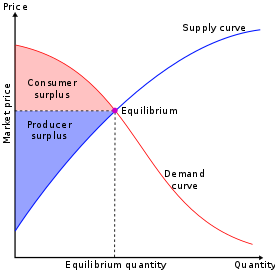
Consider this diagram taken from Wikipedia.
Graph illustrating consumer (red) and producer (blue) surpluses on a supply and demand chart
(Source)
The producer surplus represents the price over the cost of production--and that amount is what is fought over by worker and capitalist. The consumer surplus represents savings by consumers, giving them more money to spend elsewhere.

The effect of new technology is to lower the cost of production. The supply curve will move down, and the point labeled equilibrium will move down and right along the demand curve. The producer surplus will likely (not necessarily) shrink, reducing benefits to capitalists and workers alike. But the consumer surplus will necessarily increase, effectively raising consumers' standard of living.

Since we're all consumers, we're all better off if technology makes things cheaper. Marxists (including Mr. Barns) somehow don't understand this.

Mr. Barns realizes that not all the former laborers will be unemployed. He writes,
While there is a certain truth to the notion that technological development creates more jobs, since new industries (or branches of industry) offer new labor needs, the interim between employment and re-employment in a capitalist system is dehumanizing. All human needs are marketized under capitalism, and if you don’t have the money then you are going to starve (or otherwise be deprived of needs like housing, health care, entertainment, a car to get to work, etc). Meanwhile, the unemployed part of the population serves as a pressure on employed workers to accept lower standards of work and compensation. Unless there is a revolution, the same cycle of needless unemployment will repeat itself.
I don't think he realizes that new technology always creates new jobs, and for two reasons. First is supporting the new technology: forklift repair and maintenance, fuel, forklift manufacturing. But this isn't most important. More crucial is that consumers have a whole lot of money left over that they'll want to spend elsewhere: movies, video games, restaurant meals, personal grooming, travel, etc. Eyebrow plucking is now a job description! Who would've thunk?

Which brings us to Mr. Barns' important point--that the job market is dehumanizing. Of course he's right--and it is inevitably so. People will only pay for goods and services they want, for which they won't pay a penny more than they have to. Some people (not me) want to have their eyebrows plucked (God knows why), and that leads to (what I think is) a dehumanizing profession. Though better than being unemployed.

Consider Mr. Barns' alternative: all job categories are frozen in stone. Any improvement in productivity has to be taken as a reduction in working hours. Nobody is ever allowed to earn any more money. Capital allocations are made politically (i.e., by the mob), rather than by maximizing benefit to consumers (i.e., the same as maximizing profits). This is a recipe for poverty, as experienced in the former Soviet Union and Maoist China, and in Cuba today. I'd rather live in our "dehumanizing" world.

Indeed, contra Mr. Barns, our problem is not too much productivity, but rather too little. Productivity growth has slowed considerably since the mid 1970s, and nobody really knows why. The result is our standard of living is not growing, and the world is becoming a much more zero-sum game. See books/podcasts by Robert Gordon, Tyler Cowen, and Peter Thiel, among others.

Mr. Barns (uniquely among Trotskyists) discusses artificial intelligence (AI). Today AI is simply a tool--one that makes the robot cheaper and more efficient. I think Mr. Barns' concern over advertising is misplaced. For example, how much money would Trump have to spend in advertising before Mr. Barns would vote for him? Billions? Trillions? A whole lot, for sure. That shows how much good advertising does--humans are ornery and they make their own decisions. (See George Gilder's book Life After Google, my review here).

There is much discussion about AI as an existential threat to humanity--i.e., killer robots who will do us in. Nick Bostrom and Gwern write about this. I have not followed this literature at all, and somehow can't take it seriously--sort of like climate change.

Mr. Barns writes about commuting and mass transit. It's interesting stuff, but it will have to wait for another post.

Further Reading: