Showing posts with label China. Show all posts

Friday, October 11, 2024

Kamala vs. Trump: The Decline of America?


Left Voice
 author Sou Mi (who I think is female; apologies if I have that wrong) has written a think piece entitled Kamala Harris Wants to Revive an Empire in Decline. It's a well-written, worthwhile read that in my view is wrong in important ways. 

The confusion starts at the top. This is the "hook" paragraph--that's supposed to tempt you into reading the rest of the article.

As November pulls closer and the specter of another Trump presidency looms large, Harris is trying to present a different project for the future: one based in restoring a “rules based order” where the rules are fundamentally set by U.S. imperialism.

Only the last word grates--"imperialism" is a meaningless word that adds nothing to the paragraph. The paragraph would be better if she just omitted it, eg, rules are fundamentally set by the U.S. 

"Imperialism" occurs 22 times in the article, and all such mentions should be deleted, either as I illustrated above, or by substituting real institutions like "US foreign policy." Because foreign policy at least comes with an address (Foggy Bottom) and has somebody in charge (Antony Blinken). Unlike "imperialism," which is at best a vague conspiracy theory.

Otherwise she is quite correct--that Trump and Harris represent a decision point for American foreign policy. This observation is not original to her--it's been widely discussed in the mainstream media.

She paints the choice between the two this way. She says Harris

...has not only positioned herself as the heir to an administration that put diplomacy back on the table, but also presented a vision for the future: one based in the realization of an American leadership that will restore a “rules based order” through both diplomacy and might, and where the rules are fundamentally set by the U.S. imperialism.

This seems true. Kamala aspires to take us back to the good ol' days when America ruled the waves, owned the foreign exchange medium, and guaranteed world peace. 

Sou Mi accurately summarizes Trump's position, which I'll describe in my own words. Labelled "America First," it suggests that the US should withdraw from global affairs, mind it's own business, and as far as the rest of the world is concerned, let the devil take the hindmost. When the enemy gets within 12 miles of our shores, then and only then will the world's greatest superpower be roused to action.

I exaggerate slightly. Trump is not quite as hands off as I've described, but only because he's forced to compromise with reality. The US really does have trade relations with other countries that need to be protected, notably with Mexico and Canada, but also with Europe and S.E. Asia. Those trade routes will require US policing. And more, the US has cultural and religious allegiances beyond our shores, eg, Israel, which even though it is of no strategic value whatsoever, we are bound to protect. (It does have economic value.)

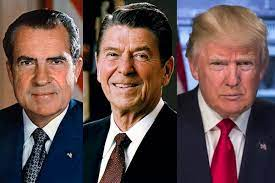
But at his core, Trump is a pacifist. He does not want America involved in any war. He follows in the tradition of two prior pacifists, Nixon and Reagan, both of whom described the American strategy as having the biggest, baddest, meanest military the world has ever seen--and then never using it. "Peace Through Strength" is how previous generations (and Sou Mi) put it. It's Trump's strategy to a tee.

So the debate is between "The War Party," represented by Kamala, Liz Cheney, the journalists at The Bulwark, the CIA, and most college faculty. And "the Peace Party," championed by Trump, Tulsi Gabbard, journalists at ZeroHedge, and (apparently) most of America's working class.

I'm not sure which side Sou Mi is on: is she pro-War or pro-Peace? I don't think she knows, so befuddled is she by all those imaginary "imperialists" floating around in her head. I also don't really know what side I'm on--I can see virtues in both points of view. But I'll be voting for Trump.

So why now? Why is this choice presented to the American public in this election? Sou Mi has an answer (my emphasis).

Harris’s proposals... come amidst the growing tensions of an empire in decline, especially amidst the retreat of globalization when the United States, based on the export of manufacturing and exploitation of cheap labor in the global south (and particularly through the restoration of capitalism in China), and debt-fueled consumption, was able to rearticulate a unipolar order behind it.

Sou Mi's view is that, with the "empire in decline," there are two possible responses. One is, in spite of that, to double down and re-establish our weight in the world. This is what Kamala proposes to do. The other is to retreat into a shell and acknowledge defeat--the Trump strategy. Or, instead of War Party and Peace Party, we can think of them as the Recovering America's Greatness Party and the Surrender Party (which weirdly reverses the terminology the parties use to describe themselves).

I dispute that America is an empire in decline. For good reasons during the Cold War, the US served as the world's policeman, and provided the world with a reserve currency by running huge trade deficits. This enabled an unparalleled period of global economic growth, including, most notably, in China (bringing 400 million people out of poverty). Sou Mi ludicrously describes it as an act of "exploitation," which it definitely wasn't. It was, instead, an act of great generosity (albeit extended only to America's allies--and not to miscreants such as Cuba).

The question thus arises, can America continue to be so generous? Trump says no; Kamala responds yes. The problem is that, while America has certainly gotten richer over the past 70 years, the rest of the world has gotten richer faster and caught up. So Sou Mi is partly right: in relative terms, the US has declined, and is therefore no longer able to finance global trade as it once did. While in domestic terms our trade deficit has not yet declined, today as a fraction of total global trade it is too small a percentage to finance global trade.

In finance parlance, this is known as a shortage of eurodollars--and countries that don't have enough eurodollars (eg, Sri Lanka, Bangladesh, South Africa, and on the cusp, China) are no longer able to import basic necessities such as food and fuel.

Whatever Kamala's intentions, she will not be able to reverse this relative decline in eurodollars, and the result will be a crimp in globalization. As there is no other reserve currency on the horizon, despite this shortage the Eurodollar will remain the world's reserve currency for the foreseeable future. The only country that can literally "print" eurodollars is the United States--we're sitting in the catbird seat.

Then there is our role as the global policeman. We guaranteed European borders, allowing European countries to all but defund their militaries. And likewise for Canada, Japan and the Philippines, among others. This, by itself, made people richer. We made the same guarantee to countries in the Middle East, fighting wars over Kuwait.

But being the world's policeman is expensive! And US taxpayers have to pay the bill. Trump has decided we don't need to do that anymore. For example, our efforts to keep the Red Sea open have come to naught--we're using million dollar missiles to shoot down the Houthi's thousand dollar drones, obviously not a sustainable operation. Technology has changed the nature of warfare. 

There's no reason for us to police the Red Sea--that's a job for the Europeans. We no longer have much interest in defending European borders. If Russia invades the Baltic states, we're probably not going to rise to their defense. We're not patrolling the Indian Ocean--India, Japan and China can fight over that one.

More, the Middle East is on its own. We still have an outpost in Qatar, but I predict that's not long for the world--Trump will bring them all home. The US has no dog in any fight over the Persian Gulf--we don't import any of their oil, and we have no reason to defend their sea lanes. That's up to the Europeans, Japanese and Chinese to work out. Good luck!

That's Trump's plan. Kamala says we're still gonna be the world's policeman. That's popular within the intelligence community and in the faculty lounge--but not among many common voters. It's one reason why I think she'll lose the election.

Sou Mi's article is worth reading. Apart from the gratuitous use of the word "imperialism," hers is an intelligent point of view.

Further Reading:

Tuesday, February 13, 2024

Cheapskate Consumers in China

The Mall of America, suburban Minneapolis, sells a lot of stuff from China (source)

Roy Landersen, writing for The Militant (published by the Socialist Workers Party--SWP), contributes an article entitled China’s capitalist rulers’ deepening crises visit disaster on working people. Even though he gets China mostly right, he still misunderstands some basic economics. His lede paragraph is here (emphasis mine).

For decades China’s rulers have relied on expanding capitalist methods to grow their economy, and repression to keep working people in check. But their course today is producing falling exports, rising local government debt and a property market meltdown, exemplified by the collapse of Evergrande, once the world’s most profitable property developer.

What he describes here isn't really capitalism, but rather fascism. While under socialism all economic activity is run directly by the state, in fascism, it is run only indirectly by the state. The government allows private enterprise, but forcibly subordinates it to the political needs of the state. Mr. Landersen denotes this by the euphemism "capitalist methods," which is distinct from capitalism because economic profitability is not the primary concern. Instead enterprises must serve the state first and foremost.

Another name for this might be mercantilism. Either way, it is unfair to blame China's problems on capitalism. Instead, it's the fascist-like CCP that poisons the mix.

The last clause of the quoted paragraph is wrong. It seems that Evergrande was never profitable--the company has been accused of systematically inflating revenue. Apparently they've been running a big Ponzi scheme--with CCP connivance, of course. There were never any profits--only fraud.

In a transparent effort to blame mythical, foreign imperialists, Mr. Landersen writes,

A Hong Kong court ruled Jan. 29 that Evergrande, with its gigantic $300 billion debt, be liquidated, setting up a tug-of-war over its assets between Beijing and imperialist lenders who are owed billions. Bosses at the company stopped paying creditors two years ago.

Google AI (now called Gemini) reports that 

While Evergrande's total debt was massive at $340 billion, its reliance on foreign loans was relatively small. Here's a breakdown:

  • Total debt: $340 billion
  • Foreign debt: $25.4 billion
  • Percentage of foreign debt: ~7.5%

The so-called "imperialist" lenders are only out $25 billion, which is small change. I don't know what an "imperialist" lender is--foreign lender is a better description. I'll suggest almost all of them are from Hong Kong. Is Hong Kong "imperialist"? The epithet is completely meaningless.

Mr. Landersen recites a litany of problems Chinese "workers" face, which I'll summarize in bullet points.

  • Evergrande "took billions in down payments for houses that were never built, and its collapse left countless numbers of construction workers with unpaid wages." As said, it was all a big Ponzi scheme.
  • "In industry, bosses’ profits fell 2.3% last year, after a 4% fall the year before." So it's not just workers who suffered.
  • "High unemployment among Chinese university graduates — one in five without a job..."
  • "Despite government inducements to have children, including tax breaks, cheap housing and cash payments, the birth rate fell in 2023 for the seventh straight year." China looks to be in an irrecoverable demographic downward spiral. There's probably no way of undoing that now.
  • "Foreign capitalists are shifting manufacturing from China to countries like Vietnam where bosses pay workers less."
  • "Chinese President Xi Jingping’s signature project, the Belt and Road Initiative, is losing steam. ... [G]overnments that have borrowed from Beijing are defaulting on loans."
  • "For years, Beijing has detained millions of Uighurs, a Turkic-speaking Muslim minority, in 'reeducation camps' across Xinjiang province."
  • "Demonstrations by workers have grown recently in China’s export-oriented manufacturing industries where demand has fallen. More than 1,700 strikes took place last year, double the number in 2022. They are protesting unpaid wages and benefits, as well as mass layoffs or forced relocations."
Mr. Landersen tells the truth--every statement in these bullet points is true. Intentionally or otherwise, he puts paid to the notion that China is some rising power about to displace the United States. There is no way that is gonna happen. Quite the contrary, China will increasingly have difficulty importing enough food and fuel to meet its needs.

It is, in the end, all a question of supply and demand. 

Marxists only talk about the supply--e.g., the governments in Cuba (sugar), North Korea (food) and the former Soviet Union (steel) all bragged about their levels of production. After all, in their view, the key to economic progress is to increase production because that's the only thing that adds value to an economy.

But it's not true. The real measure of economic progress is the rate of consumption, typically measured as sales volume. Because if consumers can't afford or find use for your product, its manufacture is a waste of resources. It's increased consumption that actually raises a country's standard of living.

This is why the plight of workers--how they're oppressed, deprived, etc.--is mostly irrelevant (as long as they're free and paid market rate wages). The real test of well-being is what those workers--acting as consumers--can buy. In Cuba they can't buy tiddlywinks. In China--even after all the progress of recent decades--most consumers are too poor to buy very much.

Americans, by contrast, are excellent consumers! Indeed, we're the best consumers on the planet. Almost every country on earth tries hard to sell into the American market--because that's where the consumers are. American consumers are the people who have made the world's economy go round.

In particular, modern China has never been able to consume its own production. It has always had to find consumers abroad--mostly by exporting to America.

Unfortunately, America is now tapped out. We're too far in debt to keep accepting new exports from other countries. Our ability to consume everything the world produces is no longer feasible. Other countries are going to have to develop their own consumer markets.

China has not done that. Not even close. A housing Ponzi scheme destroys consumption. A lack of babies results in a lack of consumers--the best consumers are families with children. Not having a good old-age pension system, or something like Medicare for old people, forces people to save more than they likely need for old age. And reduces consumption. China's "iron rice bowl" has rusted out.

So I think China is screwed. Mr. Landersen wants to blame capitalism, but he really should blame the Chinese Communist Party. The CCP, like most Marxists, has always emphasized production over consumption--and now they're in a pickle of their own making.

Mr. Landersen will, of course, champion the Cuban consumer, who earns something like $50/month. How much can you consume on that income? It's pathetic, and that's why Cuba is so poor.

Further Reading:

Saturday, October 7, 2023

The Professors' Congress: The International Situation

(This post is much too long. That's because Left Voice has interesting stuff to say.)

Washington as Statesman at the Constitutional Convention. Junius Brutus Stearns (1856). Virginia Museum of Fine Arts, 50.2.1. https://www.vmfa.museum/piction/6027262-8052859/

My friends over at Left Voice held their first Congress in New York City from July 14th - 16th. 

More than 50 comrades gathered in Manhattan. The largest group came from New York, where Left Voice was founded about eight years ago. A second nucleus was from Detroit .... Further members joined from Philadelphia, Los Angeles, El Paso, and other parts of the United States. Guests from our sister groups in the Trotskyist Fraction tuned in from Mexico City, Caracas, Buenos Aires, São Paulo, Barcelona, Paris, Berlin, Munich, and other cities around the world.

The discussion centered around six documents, of which I so far have read only one: Notes on the International Situation (abbreviated here as Notes). This post is a review of that document--and I'll suggest mine is the only commentary on the piece from anybody outside their small grouplet.

Left Voice (LV) is the publication of a group of NYC college professors, grad students and hangers-on, who are now attempting to form a full-fledged, Leninist Party, building on the early heritage of the original Trotskyist movement in the United States, the Socialist Workers Party (SWP). As the above quoted paragraph makes clear, this core is a very small group of people and they have a very long way to go before they take state power.

Part of that effort means joining the Trotskyist Fourth International (FI), founded by Trotsky himself back in 1938. As with all other Trotskyist grouplets in this country, Left Voice isn't happy with the leadership of the FI, so our professor friends have initiated the Fourth International-Trotskyist Fraction (FT) in an effort to get them back on the straight and narrow. As I commented elsewhere, "the professors are all busy trying to out-Trotsky each other, which is why one needs a Trotskyist Faction inside a Trotskyist International."

Professorial fingerprints are found all over Notes, many of them good. The document is well written, analytical, mostly factual (as far as I can tell), typo-free, and--above all--long. It's 34 pages in pdf format. Trotskyist grouplets in the US collectively produce manifestos on this scale approximately once a month or so. I most recently reviewed Socialist Action's Political Report (authored by Jeff Mackler) last March. Notes is a better version of roughly the same thing, and if you're interested in Trotskyist esoterica it's worth reading.

I'm not going to go through it line by line--that'd take way too much time. Instead, let me address specific issues:

  1. Economics
  2. "Imperialism" and Ukraine
  3. Hegemony
  4. China
Economics

Notes, as is true of all Trotskyist manifestos, makes passing mention of economics, throwing words and concepts around like they actually mean something. These include the declining rate of profit, the crisis of accumulation (which looks like it's not happening), and most importantly, the class struggle.
Looking at the overall situation today, where there has been a volatile panorama of geopolitical crises, renewed instability in the economy, and a developing dynamic toward class struggle. As a result of the war in Ukraine, capitalist equilibrium is under “significant impairment.” ... This implies that as revolutionaries, we have to prepare ourselves for new forms of class struggle, more radical than what we have seen in recent times.

It seems they agree with their comrades in the SWP, whose most recent political report was entitled The Low Point of Labor Resistance is Behind Us, which I reviewed last February. Both grouplets maintain that because of this crisis and that crisis and the other crisis, the class struggle is intensifying and revolution is a-brewing. I've been around politics for over half a century, i.e., long enough to know that's not likely. 

As an example, they point to the Yellow Vest movement in France--which has violently resisted President Macron's (very reasonable) pension reforms--as something wholly new and significant. They forget that the French have a long history of throwing rocks and bottles at each other, as memorialized by Charles de Gaulle's famous quote: "how can anyone govern a nation that has two hundred and forty-six different kinds of cheese?"

In a word, their mention of Marxist verities are merely pro forma and have no measurable relation to actual world events.

"Imperialism" and Ukraine

"Imperialism" is in scare quotes because I don't believe it exists in any way that Marxists think it does. Notes, at least, tries to explain what "imperialism" means by quoting sacred scripture, namely from Lenin's booklet, Imperialism: The Highest Stage of Capitalism, 

in which the dominance of monopolies and finance capital is established; in which the export of capital has acquired pronounced importance; in which the division of the world among the international trusts has begun, in which the division of all territories of the globe among the biggest capitalist powers has been completed.

This word salad, dating from 1916, does NOT describe today's United States or any part of the world economy. The US has no large monopolies, nobody controls the stock or bond markets, there are no international trusts, and the world has not been divided amongst capitalist powers.

Notes uses the word "imperialism" like religious texts refer to the Holy Ghost. If you already believe in it, you'll see it everywhere, but for the non-believer it's unconvincing. Our professor friends have definitely got religion: the word fragment imperial- occurs 87 times in the document!

That notwithstanding, the professors seem to forget their own definition in the rest of the text. It is important to them that they define the "imperialist" quality of the one-time workers' states, Russia and China.

About Russia they write (italics in original):

Thus, Russia emerges with contradictory characteristics as a capitalist state that’s far from sharing imperialist characteristics economically but has some trace of imperialist characteristics at the level of its military. Despite not being a great power, it is a regional power with limited international influence, such as its role in the Syrian conflict.

It's a pity they can't quantify this for us. Is Russia 16% imperialist? Or is that to much to be a "trace"? They invoke Russia's military here as making it more "imperialist," but nowhere in Lenin's book is military size a factor. After all, I think Lenin would class Switzerland as imperialist, despite it not even having a navy.

Notes' description of Chinese imperialism is even weirder.

In the case of China, the growing confrontation is linked to the country’s imperialist ambitions — continuing the CCP policy that restored capitalism in China. Capitalist restoration in China was carried out under the auspices of international financial capital, particularly that of the United States (we expand on this process in the second part of this document). However, due to the specific importance that China’s economy has acquired after the process of capitalist restoration, the Chinese bourgeoisie increasingly needs to project Chinese capitalism in imperialist terms. As the FT, we’ve been developing our characterization of China and its imperialist traits which have strengthened in recent years. Though China is not yet imperialist and U.S. imperialism still maintains an important level of hegemony over the world order, the possibility of any kind of “succession” of U.S. hegemony will not be peaceful or evolutionary — as the proxy war in Ukraine and growing tensions in Taiwan show. 

So China is not yet imperialist (presumably that's 0%), but its imperialist traits have strengthened (presumably some number greater than zero--may I suggest 43%?) I am glad that our professor friends are closely monitoring China's descent into "imperialism," but I do wonder by what Leninist standards they are reevaluating the situation.

Of course this is all nonsense, but it's consequential nonsense. For Notes' take on Ukraine depends very much on how "imperialist" Russia is. Notes defines a term known as Campism, which is an error engaged by some Trotskyist grouplets. While some grouplets openly support Ukraine in a war of liberation (e.g., our friends in the SWP), others see the Ukraine war as a proxy fight between two imperialist powers, ie, between the US and Russia. Campists believe one should side with Russia, either because Russia isn't imperialist at all and the war results from NATO aggression. Or because Russia is only slightly imperialist and thus represents a lesser evil. The most important thing is to defeat US imperialism. Jeff Mackler at Socialist Action is a good example of that latter form of campism.

So Notes refuses to support Ukraine (they deny it's a war of liberation), but on the other hand they won't kowtow to Russian "imperialism", of whatever trace quantity. Thus they have come up with their own unique slogan (italics in original):

Not NATO, not Putin, and not the Zelenskyy regime

This is very unclear, expressed as it is as three negatives. It becomes marginally clearer if one rephrases it in positive terms. I come up with

For the Tooth Fairy, For free unicorns, and for a Trotskyist regime

OK--maybe that doesn't clarify very much. But that's the best you're gonna get out our professor friends' endless analysis of "imperialism".

Hegemony

After "imperialism," hegemony must be professors' second favorite word. The word fragment hegemon- occurs 36 times. They make three claims:

  1. That US global hegemony is still intact...
  2. but the US is in long-term secular decline, while...
  3. China is the leading contender to rival/displace the US as a global hegemon.
Unlike "imperialism", these statements are arguably true, and Notes makes as strong a case as can be made. I don't disagree much with the facts they present, but I think they're leaving out much important context.

There is no question that the US is still the world's leading hegemon. Our defense budget is larger than the rest of the world put together, and four times bigger than China's. We have by a big margin the strongest navy in the world. Don't let China's large-scale construction of new ships fool you--our navy is vastly superior. The US is the only power that can patrol global sea lanes, including the Straits of Malacca, Hormuz, and Gibralter, along with the Panama and Suez canals. Flows of energy from the Middle East to either Europe or China and Japan depend crucially on the US navy for protection. By withdrawing its navy, the US could deprive Japan and (especially) China of necessary oil and food imports.

The US remains the world's economic hegemon as well. The US dollar is still the world's reserve currency--well, actually that's not true. It's never been true. The world's reserve currency has been the so-called Eurodollar since at least the early 1960s. Notes misstates the situation here:
The 1944 Bretton-Woods agreement established the dollar as the dominant currency of the world, and the Marshall Plan laid the groundwork for economic penetration in Europe in the name of post-war economic reconstruction. These gave the U.S. significant economic and political hegemony in the capitalist world order.

In fact, Bretton-Woods collapsed within a few years of being signed, and Nixon finally admitted as much when he took the US off the gold standard in 1971. The Eurodollar system grew out of the resulting chaos. It was not planned or designed by anybody--it just gradually evolved beginning in the late 1940s, and by 1960 or so it was well entrenched. My post on the Eurodollar explains it as clearly as I know how (the topic is extremely complicated!).

The Eurodollar system has worked spectacularly well for at least 60 years (much better than Bretton-Woods ever could have), but it is beginning to fray around the edges. And that brings us to America's supposed decline.

Of course the US had to decline in relative terms. This report dates from 2016 and is so a bit dated, but it states that in 1960 US GDP was 40% of the world's economy, while in 2016 it was only 22%. This was certainly not because our country was getting poorer (it wasn't), but because the rest of the world was getting richer faster.

Without going into details (see the above linked post), the Eurodollar system works because the US has run large and consistent trade deficits every year since 1974. Those deficits are what finance global trade. Because of the growth of the global economy, relative to global GDP our trade deficit has been shrinking. This means there is a shortage of Eurodollars (one reason why domestic interest rates are rising) and some countries (e.g., Sri Lanka) no longer have a sufficient quantity to import essential supplies. Other countries are setting up bilateral agreements to trade in their own currencies, e.g., between China and Russia, so they don't have to use the Eurodollar. These agreements may solve a short term problem, but at bottom they are not much more than barter exchange and are not durable.

No other world currency (or currency union) is running a large enough trade deficit to finance global trade. Hence, despite the shortage of Eurodollars, there is nothing on the horizon to replace it. This is terrible news for global trade and puts a severe crimp on the globalization phenomenon. But it's great for American consumers as foreigners desperately compete to sell goods into the American market so as to accumulate Eurodollars.

It gets worse because political sentiment (headed by Trump) is increasingly against permanent trade deficits, since the cost of supporting the Eurodollar is the decimation of our own, domestic manufacturing capability. Hence the latter day imposition of tariff barriers and industrial policies.

So while I acknowledge that Notes is right about America's decline, the context is missing. America may be declining by some accounting measures, but we're waaay better off than any other country in the world. We'll be the last man left standing.

China

If "imperialism" and "hegemon" are our professor friends' favorite words, then there is another important term completely missing from their document: demographics. China, Japan, S. Korea, Russia, much of Europe, and even the Middle East and Latin America are in some stage of demographic decline.

Before we get to China, here's another paragraph about Russia and Ukraine. Russian demography augers the end of Russian civilization--it's child-bearing age population has declined beyond the point of no return. Thus the Ukraine war is the last war Russia will ever fight. After this it will never again have the manpower or the industrial base to field another army. Dead Russian soldiers and destroyed Russian tanks will never be replaced. The strategic goal of the United States is to destroy the Russian military once and for all. To that end, the longer the Ukraine war goes on, the more Russia suffers irrecoverable losses, and it will eventually be taken off the global stage as even a regional power. Thus the US strategy is for the war to go on for a very long time, or, as it is often phrased, to fight to the death of the last Ukrainian.

Like Russia, China, too, is in demographic collapse. Even the Chinese government (sort of) admits this. The United Nations--using Chinese government statistics--reports that as of April, 2023, India surpassed China as the most populous country on earth.

But as is true in so many cases, Chinese statistics are misleading. It is increasingly clear that China has been exaggerating its demographics for some time now. Peter Zeihan, an expert on Chinese demography, says that China lost the population crown to India about ten years ago--not this year. By his measures, China's real population is smaller than the official figures by about 100 million people. Worse, all those missing people are under 45 years old. See the Mr. Zeihan's charts here.

By contrast, Notes ignores demographics altogether. They write (as part of a longer discussion)

China, with its pursuit of new markets for its own bourgeoisie, follows the same economic and political tactics in the Global South that imperialists have done previously. It has also established itself as a major trading ally for advanced economies like Germany , and through brokering new alliances and treaties, it is firmly trying to prove itself as a contender to lead the capitalist world order. Especially as the tendencies toward a new bloc around China increase, they threaten further and greater confrontations, militarism, and conflict.

This is wrong on so many levels. First, the Belt & Road project is collapsing into stinking mountain of defaulted loans and unfinished projects. Second, China is no longer the world's cheapest manufacturer--that crown has been ceded to North America, ie, the US-Mexico combination. Third, China is in dire financial straits, desperately short of Eurodollars, and increasingly unable to fund its purchases of necessary raw materials. While China was Germany's key customer (Germany supplied the machine tools for China's manufacturing plant), the demise of China as an industrial powerhouse has put Germany into a severe recession.

And finally, not only is China's total population declining, but its working-age population is declining even faster. There is no way that China can grow its economy with a shrinking population. Mr. Zeihan predicts that the current Chinese government will collapse within this decade, and that the country's survival as a unified state is in jeopardy. Perhaps he exaggerates--but even if he's mistaken about the timeline, the notion that China will ever compete with the USA for "hegemony" is simply wrong.

That doesn't mean they couldn't try to invade Taiwan (though I doubt they will. They'd lose).

Conclusion

I have spent a long time reading Notes and composing what I hope is a considered critique. I wonder why I do this? Left Voice, like all Trotskyist grouplets, is far too small to have any influence on American or global politics. The authors of Notes are too committed to Marxist theory and are too ideologically blinkered in their perspective in order to see straight. Put another way, they don't seem to read anything beyond what they themselves have written.

That said, I do hope the authors--whom I've teasingly mocked as "professors"--will read what I write. First, I've spent a lot of time on it and it would be a shame if they didn't. Second, I think this will be the only commentary on their work that comes from outside their grouplet--and they should be flattered. And finally, I do think the ideas--both those in Notes and in my response--are worth discussing and considering.

Nothing here will change anybody's mind. Still, I don't believe I've wasted my time.

Further Reading:
Tuesday, October 11, 2022

Brian Williams, Inflation and China

Thousands protest ruinous inflation in Prague, Czech Republic, Sept. 28, one of several actions around the world demanding relief from the crushing impact of unfolding capitalist crisis.
Source: Reuters/David W Cerny; Caption: The Militant

I typically commend my friend and former comrade Brian Williams for his economics coverage. He's among the very few on my Beat who actually knows something about the subject and who makes some effort to report it honestly. But I gotta say, his latest article, published in The Militant and entitled Soaring prices wreak havoc on working people worldwide, disappoints. It's not really about economics, and instead it's boilerplate propaganda that's not worth reading. That said, it's a slow week in Trotsky-Land and so here we are.

Trotskyists--and Mr. Williams is no exception--are against inflation. In this they agree with 99.5% of the global public, which makes them boringly mainstream. He writes,

Rising prices are wreaking havoc with the lives of working people and our families worldwide. Inflation reduces the value of our wages as we confront higher costs for food, fuel, housing and other essentials, and rising debts. ...

Sizable protests against these assaults have been held in many countries. In France thousands joined protests in dozens of cities Sept. 29 during a one-day walkout called by the CGT union federation. They denounced rising food prices and moves by French President Emmanuel Macron to raise the retirement age from 62 to 64 or 65. “Increase our salaries, not the age of retirement,” Metro conductor Ludovic Le Ny, told the Wall Street Journal in Paris.

Demonstrating against inflation is rather like demonstrating against earthquakes--it's under no one's control. Inflation arises when the supply of money exceeds the demand for money, which means the value of money goes down (i.e., things cost more). The supply of money is imperfectly regulated by central banks (in the US the Federal Reserve Bank), but even they can't control it with any precision. The demand for money depends on no central authority, but rather on collective consumer behavior. Nobody can control that, not even the Marxist despots in Cuba, Venezuela, North Korea or China.

So it's not clear to me what the protesters pictured above expect to accomplish. They're wasting their time.

What astonishes me is that Mr. Williams thinks our primary problem is inflation. Trotskyists--of all people--surely should be able to identify the root of our difficulty: our standard of living is declining. Inflation is not causing this, but does result in part from efforts by governments to make people feel richer by giving them extra money. In the US this has come in the form of "stimulus checks" and "student loan forgiveness." But extra money doesn't make people richer--it just raises prices.

Why is our standard of living going down?

There is one big reason and several smaller contributing reasons. Let's consider the small stuff first.

The Ukraine war and accompanying sanctions on Russia have taken a big chunk of global energy supply off the market. This has a dramatic effect on Europe--and will definitely lower their standard of living until the supply can somehow be replaced.

Likewise, the war has reduced global food production and distribution. Together, Russia and Ukraine were the world's leading wheat exporters. This hugely disrupts the food supply in the Middle East and will likely lead to famine. Egypt--which now grows cotton as a successful cash crop--will have to abandon that to grow its own food. Egyptians will be getting a lot poorer.

The US has a serious labor shortage, caused by the retirement of the baby boomers, sharply declining birth rates and declining immigration, and increased social dysfunction such as drug abuse. The result is increased wages and stronger unions (arguably good things), but also serious shortages of healthcare workers, airline personnel, and skilled trades. Many small businesses are being forced to close.

Mr. Williams obviously doesn't understand this. He writes

A large number of newly created jobs are at low pay, forcing an increasing number of workers to take on a second or even a third job to make ends meet. At the same time, bosses are hiring part-time workers with few if any benefits, and pushing speedup, as part of their drive to defend their profits and to weaken our unions.

This is not true. Starting wages for low-skilled labor is now over $20/hour in many parts of the country. Companies like Starbucks are belatedly realizing that they're going to have to treat their employees a whole lot better.

But the big problem--the one that Mr. Williams barely mentions--is the demise of China. George Friedman explains it very clearly. While I believe this video was recorded some years ago as a prediction, it is a prediction that is now coming true.

China is bankrupt. Twenty percent of the world's productive economy is now going out of business.

The ramifications are global--and huge.

  • The US used to import lots of stuff from China. That's not happening any more--our manufacturing is being repatriated. (A huge new chip manufacturing facility is opening near Albany, NY). It will take some years for our supply chain to readjust, and there will be an additional strain on our labor supply, but within five years Americans won't even know that China is missing.
  • While the US was China's biggest customer (by far), Germany was China's biggest supplier. To manufacture all that stuff, China needed machines and machine tools--most of which were imported from Germany. That market has disappeared--China ain't importing nothing. For the first time in decades Germany is running a trade deficit. The German standard of living is declining not just because of energy, but because there is no market for their products. Basically, Germany (and the EU) is screwed.
  • Many Third World countries are in the same boat as Germany. Mr. Williams mentions South Africa. South Africa's leading exports are gold, platinum, cars, iron products, coal, manganese, diamonds. Diamonds may be a girl's best friend, but a lot of those girls live in China--and they're not buying diamonds any more. Gold is also a luxury product for which the Chinese market no longer exists. I'll suggest that (apart from cars) the other items on the export list were headed to China. Indeed, China was South Africa's largest export market--and it's gone. South Africa is just as screwed as Germany--there is no ready substitute market for its exports.
So Mr. Williams tells us about irrelevant demonstrations against a mostly irrelevant problem--namely inflation. I don't know who those poor souls in Prague should be demonstrating against, but maybe Chairman Xi is the place to start. Not that it would do any good--China is still bankrupt.

Further Reading:

Monday, October 18, 2021

The China Beat

This post is in response to three recent articles from the Trotskyist press--one by Jeff Mackler, another by Michael Roberts, and a short piece by Roy Landersen.

Mr. Mackler's piece is entitled The Myth of a New “Cold War” Between the U.S. and China/Russia. He's addicted to the word imperialism--the word fragment imperial- shows up 28 times in the article. This despite the fact that he has no clue what the word means. He's not alone--nobody else knows what it means either.

What I think he thinks it means is something like unequal exchange. That is, on the one hand US capitalists will exploit Chinese workers who manufacture cheap products for American consumers by paying them "near slave wages." On the other hand, the US will export expensive, overpriced products back to China. Thus the capitalist realizes excess profits on both legs of the round trip. The problem is it doesn't work that way. Why would China volunteer their citizens for slavery? And why would they agree to buy overpriced products when the same can be had for cheaper from other countries?

Mr. Mackler actually admits that the imperialism model doesn't fit. He writes,

In the 20 years since China was admitted to the WTO, China went from operating as one of the world’s lowest technology nations to today, when Chinese technology rivals or exceeds almost all other nations on earth. In the past 20-plus years China was transformed from providing “internal migrant” teenage girls from the countryside, producing garments in prison-like foreign-owned dormitory factories at six cents per hour and seven days a week, to a nation with some of the most modern Chinese-owned factories in the world, producing world-class industrial tools and machinery and state-of-the-art 5G (fifth generation) electronics and telecommunication products.

So--in a mere 20 years those migrant slave girls went from being ruthlessly exploited to becoming middle class citizens of an increasingly wealthy country. There is still a lot of poverty in China, but the collaboration between Walmart, on the one hand, and Chinese entrepreneurs on the other has lifted 400,000,000 people into the global middle class--an achievement unprecedented in human history. Mr. Mackler needs to explain how "imperialism" wrought such a change, and if so, then why is "imperialism" such a bad thing?

It's not like American consumers suffered. Walmart reduced prices across the board, sharply lowering the cost of living, especially in rural areas. More, Walmart kept its operating margins at 3%, thereby passing nearly all the benefits of the China trade on to American consumers. Sam Walton only got a small slice.

The problem with Mr. Mackler's version of Marxism is that he sees trade as being a zero-sum game. He thinks anybody who trades with the USA is getting ripped off. Other people postulate the reverse: the US is getting ripped off by foreigners selling cheap products to Americans (I put Barry Sheppard into this category here). Though Mr. Mackler is inconsistent: he also believes Cuba's suffering is due to the US trade embargo, i.e., Cuba can't trade with the US.

There are social and geopolitical reasons why the US needs to curtail its trade with China--but we will pay an economic price by doing so.

Michael Roberts' article, entitled China at a turning point?, is much better--not least because the word imperialism isn't mentioned even once. More, Mr. Roberts actually knows something and is careful about terminology--nothing he says can be dismissed out of hand.

The article is inspired by the collapse of the giant real estate developer, Evergrande. I think Mr. Roberts' analysis of the near-term consequences is accurate. It is not a financial collapse on the order of Lehman Brothers, nor will it bankrupt the entire Chinese economy. But it will lower the standard of living by a misallocation of resources. Mr. Roberts suggests that China is creating "zombie companies" such as exist in many capitalist countries. He writes,

The real problem is that in the last ten years (and even before) the Chinese leaders have allowed a massive expansion of unproductive and speculative investment by the capitalist sector of the economy.  In the drive to build enough houses and infrastructure for the sharply rising urban population, the central and local governments left the job to private developers.  Instead of building houses for rent, they opted for the ‘free market’ solution of private developers building for sale.  Evergrande-like development in China wasn’t just capitalism doing its thing. It was capitalism facilitated by government officials for their own purposes. Beijing wanted houses and local officials wanted revenue. The housing projects helped deliver both. The result was a huge rise in house prices in the major cities and a massive expansion of debt.  Indeed, the real estate sector has now reached over 20% of China’s GDP. 

I think this diagnosis is largely correct, except I wouldn't blame the free market, but instead government intervention in the market. "Beijing wanted houses and local officials wanted revenue" has nothing to do with free market capitalism.

The Chinese problem is in a sense the opposite of that of the USA. In our country we subsidize housing demand: Section 8 vouchers, eviction moratoria, generous tax benefits, subsidized mortgages, concerted government efforts to extend home sales to poor people, etc. At the same time, housing supply is sharply limited, mostly by local zoning and environmental regulations. Many Greenies want to ban single family housing altogether. The result, of course, is sharply higher housing costs as subsidized demand outstrips constrained supply.

In China it's the other way round. Both the local and national governments want more houses--and boy, have they built houses! Whole ghost cities full of them. Supply is hugely subsidized, leading to falling prices. But the government can't have falling prices since that would destroy middle class savings. The result is a bankrupt Evergrande that is building houses that nobody really wants to pay for anymore.

My take on this is government regulation--on either the demand side or the supply side--screws things up. It's not capitalism anymore, but rather government cronyism, which eventually morphs into fascism/socialism.

Mr. Roberts' solution is to prohibit consumers from buying what they want. In the US consumers by a large majority want to live in single family homes in the suburbs. Chinese consumers want to own their own apartment and drive a car. But Mr. Roberts and his fellow socialists are against that--they think they know what the people want more than the people themselves. His penultimate paragraph makes precisely that point.

What is needed is not a further expansion of consumer sectors by opening them up to ‘free markets’, but instead state-led investment into technology to boost productivity growth.  And that state sector investment can be directed towards environmental goals and away from uncontrolled expansion in carbon-emitting fossil fuel industries.  As Richard Smith has put it: “The Chinese don’t need a higher standard of living based on endless consumerism. They need a better mode of life: clean unpolluted air, water and soil, safe and nutritious food, comprehensive public health care, safe, quality housing, a public transportation system centred on urban bicycles and public transit instead of cars and ring roads.” Rising personal consumption and wage growth will follow such investment, as it always does.

Somehow I doubt Chinese consumers prefer to ride around on bicycles instead of owning a car.

Mr. Landersen, writing for The Militant, pens a piece entitled Embracing Mao, Chinese rulers continue assault on working people. The premise is much the same as Mr. Mackler's--Chinese workers were exploited and oppressed by their Stalinist masters (which makes me wonder why The Militant offered the Maoists critical support for all those years). That oppression continues near unabated to this very day--the dramatic rise in China's material well-being is barely mentioned.

China's travails are contrasted with Cuba's virtues:

This is the opposite of the working-class trajectory of the Marxist leadership of Cuba’s socialist revolution. Under Fidel Castro and the July 26 Movement, workers and farmers were led to take political power into their own hands and to take on ever-greater control over all aspects of economic and social life, transforming themselves in the process. Working people became conscious actors in history, extending their hand to anti-imperialist struggles around the world.

Yet China has manifestly been more successful than Cuba! Cities like Shanghai and Beijing look a lot more like New York than Havana. There are good restaurants, excellent public transportation, and nice stores. As mentioned China has a sizeable middle class.

None of that exists in Cuba. Smart and ambitious Cubans have all been exiled. Those still living in Cuba are hungry, live in housing so dilapidated that they're functionally homeless, and survive without electricity for much of the day.

China has a lot of problems--but there is no way that Cuba compares favorably with China.

Further Reading:

Sunday, March 21, 2021

Keith Leslie's International Report

Socialist Resurgence (SR) held a convention meeting on March 13th, and issued the usual, Trotskyist-style reports: a Political Report by Erwin Freed, and an International Report by Keith Leslie. The topic for this post is the latter.

Readers may recall Mr. Leslie from our discussion of the long and excellent monograph he wrote while he was still a member of Socialist Action, entitled China: A New Imperial Power (pdf). In those days he was known as "Comrade Keith," and while I credited him with considerable erudition, I faulted him for putting too much weight on the word imperialism--a mostly meaningless term.

Unfortunately, the same error leads him astray in the International Report. He is so convinced that the US is an "imperialist" power, and that China aspires to be an "imperialist" power that he completely misses the historical dynamic. So let's just ignore the word imperialism and try to make sense of things as they really are.

Here's a key graf:
The election of Joe Biden heralds a new effort by U.S. imperialism to halt or reverse the phenomenon of its declining global power. The Trump administration sought to reinvigorate U.S. standing through brash unilateralism, disruption of existing agreements, and trade wars waged on every front, including against both traditional allies and opponents in Europe and Asia. Meanwhile, it suffered a series of embarrassing reversals such as the failure of a U.S.-backed coup effort in Venezuela, a partial withdrawal of military forces from Syria, which provoked wide backlash in bourgeois circles, and a negotiated truce in the trade war with China.

The first sentence is partly true. Following WWII the US contributed about 50% of gdp; today the value is a bit over 25%. But this is only relative decline--in absolute terms the US economy has grown like gangbusters. It's just that the global economy has grown faster because it started from a much lower base. In particular, China went from zero to hero once it got over the whole Revolution-Mao-Tse-Tung-mass-murder thing.

The Trump administration, far from trying to "reinvigorate U.S. standing" intended precisely the opposite. His goal was isolationism--and for good reason. To wit:

  1. The US depends less on foreign trade than any country on earth (for which data exists) besides Afghanistan and Sudan. Our total trade (imports plus exports) amount to only 26% of gdp. Even Cuba (at 27%) relies more on foreign trade than we do. By comparison, China is at 36%, Canada at 65%, and Germany at 88%. (The leader is Luxembourg at 382%, but for obvious reasons small countries have a greater dependence on foreign trade than big ones.)
  2. Yet, despite our relative self-sufficiency, we have been financing global foreign trade through the Eurodollar system. This is known colloquially as "the dollar is the reserve currency." 
  3. Owning the reserve currency has some big advantages (we can unilaterally sanction anybody we want), but it comes with a huge disadvantage--we have to run permanent and large trade deficits. That's because everybody else needs dollars in order to finance their trade, and the only way they can get dollars is to sell into the US market. Thus our imports are nearly unlimited, while our exports are capped because our trading partners are hoarding dollars to use as a global currency.
When the US contributed 50% of global gdp, financing the reserve currency was a tolerable expense, and the advantages outweighed the cost. But now the shoe is on the other foot--especially since the US is nearly self-sufficient, and including Canada and Mexico almost entirely self-sufficient. Trump decided (rightly in my opinion) to stop financing global trade, and as a corollary to repatriate manufacturing back to the United States (so we don't have to import the products). Hence all the tariffs on everybody.

If we're gonna withdraw from foreign trade, then there's no reason for us to be the world's policeman. Thanks to fracking, we no longer have much interest in the Persian Gulf--the US Navy has largely withdrawn from that venue. Likewise neither the Indian Ocean nor the Mediterranean are of much concern for us. There's no reason for us to have troops in either Afghanistan or Syria--or for that matter in Germany or the Korean peninsula. Trump--left to his own devices--would have withdrawn US troops from all those locales. Beyond North America and the Caribbean, only the North Atlantic, the North Pacific, and the South China Sea remain important trading routes for us.

Put bluntly, the United States has not been acting like an "imperialist" nation. Quite the opposite. Mr. Leslie is pounding square pegs into round holes.

Now let's look at it from China's perspective. (My view is heavily influenced by Peter Zeihan, whose books I reviewed here, here, and here.)

This is what Mr. Leslie has to say:

For its part, China is facing a new series of obstacles to its investments abroad. A number of stops along the Belt and Road Initiative have run into serious issues, with infrastructure falling behind schedule, large debt loads piling up, economic returns underachieving expectations, and a few messy defaults in progress. These experiences reflect the relatively poor investment locations that China has had access to as a newly emerging power. As Chinese capital licks its wounds from this first round of setbacks, it seems likely that the BRI will not succeed, at least in the immediate future, at shaping global economic and trade flows as hoped. China will be forced to increasingly compete with other powers to access more stable investment locations, or intensify its international political and military presence to better secure its existing ones.

Everything he says is very true--I don't disagree with a word of it. But he misses the elephant in the room, and that is--unlike the USA--China is NOT self-sufficient.

  • China can't feed itself. According to Mr. Zeihan, their productivity per acre is declining because of a move toward mechanized farming. Recently they've had some bad luck--a major swine flu epidemic, and serious flooding in the Yangtze river basin. China has to buy food on the open market--and for this they need dollars. Mr. Zeihan suggests they're on the verge of famine. China has begun an anti food-waste campaign.
  • China depends on foreign energy--especially from the Persian Gulf. While China possesses huge reserves of shale gas, the American fracking method won't work in their geology. So for the moment they have to import most of their energy--and for that they need dollars.
The bottom line is that China urgently needs dollars--and just at a time when the US is no longer providing them. They're trying to turn the RMB into a reserve currency, but this has failed--less than 2% of global trade is settled in RMB. More--China does not run huge trade deficits and has no intention of doing so--so there aren't enough RMB in global circulation to work as a reserve. No major food exporter--the US, Canada, Argentina, Brazil, Europe--is willing to accept RMB as payment.

So Mr. Leslie completely misreads the situation. Far from seeking to be an "imperialist" power (whatever that means), the country is desperately trying to keep the wolf from the door. Mr. Zeihan thinks they won't succeed--and I'm increasingly inclined to agree with him.

Conventional Wisdom has it that tariffs are a tax on consumers--prices will go up to reflect the cost of the tariff. But in the case of China this has proven false. They are so desperate for dollars that they're not willing to raise prices and so lose market share. They're simply eating the losses so that they can procure enough dollars to feed themselves.

The situation is that serious.

Further Reading:

Tuesday, April 21, 2020

Book Review: Disunited Nations

I have a love/hate relationship with Peter Zeihan's new book, Disunited Nations: The Scramble for Power in a Disunited World.

Let's start with the bad news first.

Apart from editorial asides by the author, the book has no footnotes. The bibliography only includes five titles. There is no reference to historical models of geopolitics. Facts are offered without citations. Now I'm not a great fan of scholarship--academic monographs are not just boring, but useless. Reading through a forest of footnotes is tedious.

But without any context I have no way to know how trustworthy Mr. Zeihan's sources are. Is he just cherry-picking factoids to fit his story? Is he really such a genius that he can develop a whole geopolitical theory de novo out of thin air?

Is the man a serious thinker?--or merely a huckster trolling for consulting dollars? Yes, and yes.

I loved this book!

For clarity and concision it is unmatched. He tells a simple (too simple by half) story of the globe's future for the next generation. Story is the operative word--the book reads like a well-plotted novel. That makes me suspicious (is life really that straightforward?), but it's very readable. I think he's wrong in big ways, as I'll explain below. But the basic story seems true enough.

It goes like this:

After WWII, the Soviet Union, despite its intrinsic weaknesses, represented an existential threat to the United States. Our ingenious counter was to mobilize the world to our side. This was not done by brute force, nor by appeal to humanitarian principles. For the most part we bribed other countries to be our allies. The bribe consisted of three parts:
  1. The US will guarantee your current borders. You do not need to defend yourself against your neighbors.
  2. The US will guarantee your trade routes. Our navy will patrol the world and keep the seas free of pirates and military foes. Not merely was transit through the Panama and Suez canals open to all, but also through the Malacca, Hormuz, and even the Bosporus Straits.
  3. The US market was open to your produce nearly without restriction. Whether German cars, Japanese electronics, Bengali textiles, or Chinese toys--anybody could sell anything in the USA tariff-free.
It worked like a charm. Apart from the US and the Soviet Union, military spending decreased around the globe. The NATO allies, for example, couldn't rouse themselves to even spend 2% of their GDP on defense. Piracy and privateering on the high seas, along with toll-collecting at choke points disappeared. Countries as diverse as Germany, South Korea and China got rich selling into US market.

The world got rich, including the United States. Mr. Zeihan refers to this era--from 1945 to nearly the present day--as the post-war Order. But now the Order is breaking down, again for three reasons.
  1. The Soviet Union is no more. The empire collapsed in 1991, and the successor state, Russia, is itself in terminal, demographic decline (so claims Zeihan).
  2. Fracking changes everything. North America is now energy independent, and indeed, we're a net energy exporter. The result is we have little cause to police the Middle East anymore, and certainly not the Persian Gulf or the Straits of Hormuz.
  3. While in 1950 the US produced about 50% of global gdp, today the number is only 25%. That's certainly not because the US is poorer, but rather because the Order hugely increased wealth globally. Thus we can no longer serve as a market of last resort, nor can we cover the world's defense costs.
As said, it's too simple by half. While the Soviets inspired NATO, it seems unlikely that they were the only reason for the Order. Surely American business understood the virtue of global markets, even in 1945. There were strong economic reasons for the Order. Accordingly, the collapse of the Soviets did not presage the imminent demise of the Order--it's hung on for nigh 30 years--again for its economic benefits.

Mr. Zeihan's tale leaves out some important trends. New technology spread around the world--the rise in global wealth is as much due to that as the American policeman. The Order’s decline may be due to a sharp drop in global productivity beginning in the mid '70s as much as anything else. Indeed, Mr. Zeihan’s story depends too heavily on geography and demographics--important topics to be sure, but not necessarily more important than technology, history, culture, or even genetics.

Still, I think he's mostly right, and the Order's inevitable demise may lead to the consequences he foretells. I think he's right about China. I think he's wrong about Germany.

China has five existential problems, and while it might survive one or two of them, solving all five of them simultaneously is impossible. The Chinese economy will crash, and Zeihan predicts the country will not survive as a unitary state. The five issues are:

  1. While Americans do farming, the Chinese do gardening. This is because they had a surplus of agricultural labor, and gardening is more productive per acre than farming. By shipping labor off to the cities, China was forced into mechanized farming, which hasn't worked too well. Despite the huge capital investment, agricultural productivity has not grown proportionately. Mr. Zeihan predicts famine in China's near future.
  2. China has over-invested in housing. Housing is the primary investment tool for middle-class Chinese, including many second- and vacation- homes, similar to what the stock market is in the US. By building too many houses, there will inevitably be a crash in prices, wiping out the wealth of much of the population.
  3. Chinese demography is terrible. Unlike the US (with our large Millennial Generation), Chinese baby boomers were limited to one child each. Thus China is older than the United States, and it's labor force is actually shrinking. It's very difficult to grow an economy when your labor force is shrinking and the bulk of your population is retiring.
  4. China has insufficient natural resources. It produces very little of its own energy, importing most from the Persian Gulf (to which, absent the US Navy, access is not guaranteed). It can't produce enough food to feed itself, and also must import the fertilizers and other inputs for its agriculture. Given the shortage of labor, the reversion to labor-intensive gardening looks unlikely. 
  5. China is too big to be an export power. Economic success depends on a sharp increase in domestic consumption. But consumers are in the ages 30-50 demographic, i.e., the generation that doesn't exist in sufficient numbers in China. And they're not having any children, either. The result is Chinese consumption is purchased only by government debt, i.e., the government buying all kinds of products that citizens can no longer consume. Every financial institution in the country is insolvent. It will end badly.
Moral: Don't invest money in China!

Now for Germany: Mr. Zeihan takes the Marxist saw too literally: history repeats itself, first as tragedy, and then as farce. The "Germans" invaded Russia first in 1914, and then again in 1940. Contrary to Marx, Mr. Zeihan thinks they'll do it a third time. I believe he's ignoring history.

There were three "German" empires (Reich). The First Reich was under Charlemagne, founded in the Eighth Century, and that really was a German empire (without scare quotes). The capital was in Aachen, in the Rhineland. The Second Reich was founded by Bismarck in 1871, with it's capital in Berlin. But it wasn't really a German Empire, but rather a Prussian one.

The Prussians are originally a Baltic people--Old Prussian, spoken until the 18th Century, is related to Lithuanian. Ancestral Prussians lived in what became known as East Prussia, today parts of Lithuania and northeast Poland. They were first conquered by one of Charlemagne's heirs, and took to German language and culture with some enthusiasm. But they are not ethnic Germans--neither then nor now. They're Prussian. Mr. Zeihan seems to think they're just another species of "German."

Bismarck was very aware of this--his goal was a Prussian empire, not a German one. Indeed, he wanted the Kaiser to be dubbed the Emperor of the Germans rather than the German Emperor (it is only by accident that he didn't get his wish). He treated Germany proper (the Rhineland, Baden-Wurttemburg, Bavaria and Austria, along with Alsace and Lorraine--i.e., Catholic or Roman Germany) as colonies to be exploited. (This was especially true in Alsace and Lorraine.)

And even though Hitler was an ethnic German, the Third Reich was also a Prussian empire, not a German one. It's the Prussians who had an issue with Russia. The Drang nach Osten was never a German emotion, but solely a Prussian one.

In the meantime, Prussia has been completely destroyed. They've been ethnically cleansed from their native homeland. Today they live mostly in the former East Germany--a geography that has long been a Prussian satrapy. Berlin is the capital of Prussia, not Germany.

The Germans, properly understood, have no cause to pick a fight with Russia. And I doubt the Prussians have the resources to even think about it. More likely is Germany will re-divide into two states along the former iron curtain: proper Germany to the West, and a rump Prussia in the East.

I don't think Mr. Zeihan's story about Germany makes much sense, for this and other reasons. But his book is a lot of fun and well worth reading.

Further Reading:

Friday, December 27, 2019

Book Review: Capitalism Alone

Late Capitalism Sucks!

That's a not very accurate summary of Branko Milanovic's short, dense book Capitalism Alone: The Future of the System That Rules the World.

To begin, Mr. Milanovic will disagree with the adjective. There's nothing "late" about capitalism, for it is nowhere near extinction. Indeed, arguably it is just coming into its own. All its competitors have been vanquished. Socialism--whatever its theoretical and occasional popular appeal--simply cannot provide a quality standard of living for most people. The end of capitalism, should it ever come about, will not auger a brighter future, but instead the end of civilization. Think Venezuela.

Mr. Milanovic puts great stock on Gini coefficients--numbers that measure the degree of inequality in a society--with zero representing perfect equality of income and/or wealth, and one hundred (perfect inequality) implying that a single person has all the income/wealth, while everybody else has nothing. South Africa has the world's highest Gini value (63.0). The USA comes in at 41.5. The Nordic countries are at the low end, ranging from 26 to 29 (data from Wikipedia).

Mr. Milanovic includes a chart of global Gini coefficients from 1820 to the present. With slight fluctuations inequality has increased from 55 in 1820 to about 75 just after World War II. Mr. Milanovic attributes this to rapid industrialization in the West, coupled with stagnation in the East. Since the war, however, the global Gini has declined, and quite significantly since 2000, mostly because of dramatically higher incomes in China. As of 2018 it stands at about 65.

The first half of the book fairly bristles with Gini coefficients. I never thought them very important--to me the value of capitalism is rising absolute incomes, and not significantly diminished by income inequality. There is no doubt that absolute incomes for most of the world's people have increased dramatically over the past few decades, so enough said. Who cares if Warren Buffett is rich.

But Mr. Milanovic partially changes my mind. No doubt it is true that absolute incomes go up--and that's the true value of capitalism--that's why we want to keep it. But the risk to capitalism stems from a lingering sense of unfairness. The suckiness derives not from the wealth that it obviously generates, but instead from its unequal distribution.

So the question then becomes how to lower Gini coefficients. The book offers no good suggestions, and puts paid to commonly proposed solutions. For example, social democracy only works when there is sufficient solidarity such that all members of society are willing to contribute to a common pool. That breaks down if the rich, young, or healthy refuse to pay for public insurance, or if one ethnic group resents payments to another. Globalization weakens social democracy because labor and capital are separated--capital comes from country A, labor is performed in country B, while the consumer lives in country C.

Mr. Milanovic cites the philosopher Nikolai Berdyaev who distinguished two models for history: Athens vs. Jerusalem. In the Athenian model, history is just repeated variations, or perhaps only random chance. There is no larger progression. The Jerusalem model, on the other hand, sees progress in history--perhaps even a teleological purpose.

Within the Jerusalem framework, Mr. Milanovic describes two possible models of progress. One is the Whiggish view that capitalism will simply get better and better, and we'll all get richer and richer. Francis Fukuyama's excellent little book, The End of History and the Last Man, is among the best examples of this genre. Modern journalists often reflect the view with statements like "no two countries which both have a McDonald's franchise will ever go to war," or, perhaps, the ubiquitous, pre-Trump assumption that China would eventually take its place in the law-abiding, international community.

The Trump phenomenon puts paid to any simplistic Whig view. More importantly, Whiggery was ruined by 1914. That cataclysmic collapse of the capitalist world order should never have happened.

Opposing the Whigs are the Marxists, for whom capitalism is merely a steppingstone on the way to socialism or communism. For them, capitalism is beset with irresolvable crises and contradictions that will eventually lead to its downfall. Marxists have no difficulty explaining 1914.

The problem for them, however, comes in 1989, when the workers' states in Russia and Eastern Europe moved backwards--from some form of socialism to capitalism. The transition was most dramatic in China where Deng Xiao Ping led a dramatic counter-revolution. Marxism can't explain that, and it is a problem that my Trotskyist friends struggle with to this very day.

I'm not sure if Mr. Milanovic gives a satisfying account for 1914, but he's got 1989 down pat. He agrees that various communist parties led successful revolutions in Russia, China, Vietnam, etc. These accomplished two important things: they abolished feudalism, and they threw out the colonial powers. But after that the Communists were like the dog that caught the car: they had no idea what to do with their success. But they'd cleared the way for the development of true capitalism in their countries--and that is what happened in every case.

So Mr. Milanovic puts the Bolshevik revolutions not as a step toward a post-capitalist world, but rather as laying the groundwork for a thriving, capitalist economy. The most successful revolution--which tore up feudalism root and branch--was in China, and is today the most successful capitalist country in the developing world. Compare, e.g., to India, where feudalism was only partially removed, and where capitalism remains stunted.

Mr. Milanovic offers another dichotomy--that between liberal, democratic capitalism and political capitalism. In the former, while the state remains a servant of the bourgeoisie, it retains an independent existence. The state serves as the guarantor of fairness, and hence ensures the survival of the capitalism itself. Liberal democratic societies have a rule of law, a free press, an independent judiciary, and democratic institutions--along with a fixation on Gini coefficients. Governance is messy, inefficient, and occasionally completely dysfunctional, but the theory goes that long-term, liberal democratic capitalism is the best possible outcome.

In political capitalism, on the other hand, capitalism survives only at the sufferance of the state or the Party. The social contract is that the Party will ensure an ever improving standard of living as long as all political power remains with the Party. China is the archetype for this system, but other examples are Russia, Vietnam, and Singapore. Political capitalism sounds to me a whole lot like fascism.

Political capitalism is vastly more efficient than its liberal neighbors, but it is much more brittle. It's not clear if China can survive a serious recession. Because the very goal is to serve the Party, there is no rule of law, corruption is endemic, and human rights are honored only in the breach. (Singapore looks to be an exception.)

Indeed, corruption is feature rather than a bug--it's how the Party bureaucrats cash in on the wealth created by the bourgeoisie. But they can't engage in too much conspicuous consumption at home--that's why much of their wealth has to be stashed abroad. Hence the houses in Vancouver and New York, the yachts in Miami and Brisbane, and the children attending Harvard and Stanford. Seen in this light, Hong Kong is more important to the Chinese Communist Party than they let on--it is the window by which they can launder their money and get it out of the country. The US threat to withdraw Hong Kong's special financial status is a direct threat to the Party.

There are a lot of ideas in this book--I've barely scratched the surface. I've read parts of it twice and yet am still missing bits. I need to read the whole thing again. As said, it's a very dense book, but it definitely rewards the effort.

Further Reading:


NOTE: Because of some health issues, blogging is likely going to be on the light side for the next few months.


Thursday, November 7, 2019

Comrade Keith L. Writes About China

Comrade Keith L., then part of Socialist Action (SA), contributed a monograph entitled China: A New Imperial Power (pdf) to the 2016 pre-convention discussion bulletin. It is now among the founding documents of the new Socialist Resurgence group.

It's 83 pages long! And I read all of it, not because I had to, but because it really is fascinating. It is chock full of facts and statistics about the Chinese economy, along with interesting figures and maps. Comrade Keith is a good writer, and--at least if you like statistics--it's an enjoyable read. It is exhaustively researched, and while I can't vouch for total accuracy, what data I did double-check survived the experience. Comrade Keith definitely knows his China!

Were he an academic, this is a monograph that could earn him tenure. It's a pity that he writes for such a small, insignificant audience. (Like I should talk--what with my obsession over small, Trotskyist grouplets!)

While the piece can and should be profitably read just to learn about China, Comrade Keith has a larger agenda. He wants to demonstrate to his comrades that China is an "imperialist" power. For me this raises two problems. First, I don't think the word "imperialism" actually means anything. And second, if it does mean what you might think it means, then it's obvious that China is "imperialist," and no 83 page argument is necessary.

To define imperialism, Keith goes back to the original source, namely Lenin's 1916 work, Imperialism: the Highest Stage of Capitalism. It's a five-point test: 1) monopolies play a decisive role in economic life; 2) the creation of "finance capital" and a financial oligarchy; 3) the export of of capital, in addition to the export of commodities; 4) the formation of international monopolist capitalist associations; and 5) the territorial division of the world into capitalist spheres of influence.

By this definition not even the United States is imperialist, failing to one degree or another on all five counts, most notably on the formation of monopolies. There is no major industry in the US that is dominated by a monopolist.

Consider, for example, Amazon, which is certainly a big company (on some days the world's biggest company by market cap). But it isn't a monopoly in any of its businesses. The retail trade is so competitive that Amazon can barely break even--basically no profit at all. Its cloud computing service, AWS, is profitable, but has to compete aggressively against Microsoft, IBM, Google, and recently, Apple. Amazon Prime is in entertainment, competing against Netflix, Hulu, HBO, Disney, and now Apple wants to enter that market, too. Whatever else Amazon is, it's not a monopoly.

Comrade Keith conflates "monopoly" with "big." He writes,
One useful measurement for determining the presence of monopoly companies is the Fortune 500 Global list, which lists the 500 largest companies in the world by revenue. How then, do China and other leading imperial powers compare on this metric?
After which he presents data in Figure 3 (p. 19) showing that China had 109 companies in the global Fortune 500 in 2017. Which only proves that China has big companies (like Amazon), not that they're monopolies. "Big" and "monopoly" are not the same thing. (China may have monopolies. I don't know, and Keith never makes the case.)

Similarly, the US has no "financial oligarchy." I assume that means a group of people who could, for example, set interest rates above the market rate. But it's obvious that no US financial institution can set interest rates--probably not even the Federal Reserve. The fluidity of the system is surely one reason why interest rates remain near all time lows (much to the chagrin of any incipient "oligarchy").

If not even the US is "imperialist," then why does Comrade Keith spend 83 pages trying to convince us that "imperialist" is something more than an epithet? The reason lies deep in the DNA of Marxism--Trotskyists need to explain why successful revolutions in the USSR, China, and elsewhere backslid to restore capitalist social relations. And further, this happened gradually without any violent counter-revolution. Now--only 28 years after the collapse of the Soviet Union--Socialist Action and Socialist Resurgence have finally come to terms with this course of events that wasn't supposed to happen.

Per Lenin, an "imperialist" country has to export capital, and China has been doing that at scale. China has accumulated, as of 2016, nearly $1.4 trillion in foreign direct investment, i.e., direct investment by China into businesses in other countries, ranking the country fifth in the world. (See Figure 8 on p. 25.)

China has been investing heavily in African ports, railroads and mining ventures, which makes sense since China is a natural-resource-poor country. In return for importing raw materials, China exported high-end manufactured products. Accordingly, China had a $38 billion trade surplus with Sub-Saharan Africa in 2015 (Figure 12 on p. 38).

They don't treat their African workers well. Comrade Keith quotes one of his sources (p. 32) at length, including this excerpt.
Chinese employers tend to be amongst the lowest paying in Africa when compared with other companies in the same sector. In Zambia, for example, the Chinese copper mine paid its workers 30% less than other copper mines in the country. In general, Chinese companies do not grant African workers any meaningful benefits and in some instances ignore even those that are prescribed by law. Wages above the national average were only found at those Chinese companies with a strong trade union presence. Chinese staff members enjoy significantly higher wages and more benefits than their African counterparts.
So here is my question--and I don't know the answer. What fraction of Chinese loans to a country like Zambia are denominated in RMB (the Chinese currency)? Obviously a lot of it is: Chinese employees on African work sites are likely paid in RMB, as are the costs of materials imported from China. The cost of consumer products sent to Africa are also probably denominated in RMB. On the other hand, salaries, rents and bribes paid to African employees, landlords and politicians must be paid in a hard currency. Which is surely one reason why China is so chintzy on the wages and working conditions.

The point is that RMB debt is funny-money. There is no transparency: China can simply write off RMB debts, or print money to pay for them, or just shoot people who complain about not getting paid back. As a mercantilist economy they don't care about making a profit. They only care about earning hard currency (USD) from the export of manufactured products, net of hard currency expenses spent in Africa acquiring the raw materials. Spending funny-money for those resources is not a problem (though there is a cost in Chinese living standards).

So Tanzania and Zambia, etc., may not be getting such a raw deal. Their actual dollar debt is probably much smaller than what the headline number suggests. The funny-money default will only count against them with respect to China--the rest of the world will ignore it and their credit rating will be unaffected.

Comrade Keith devotes considerable attention to the size and state of the Chinese military, detailing technical advances in the land, air and sea forces. China's annual defense spending is approximately one fourth that of the US--still a hefty sum. The country built its first foreign military base in Djibouti, along with a chain of ports (in Burma, Pakistan and Tanzania, among others) that could easily become military bases. Collectively these are part of the One Belt, One Road system.

Keith suggests that military force could be used to enforce debt repayment from countries like Zambia. This is not likely--not even the US would try to use military force just to enforce debts. The problem with roads, power plants, and mining infrastructure is they can't be repossessed. If Zambia can't repay, then China is plum out of luck. Unlike the US, they have no control over the international banking system.

I think Keith exaggerates China's current military strength. Yes--they are a force to be reckoned with in the South China Sea. But they do not have a blue water navy, and are nowhere close to acquiring one. Their geography--a continental country separated from the larger ocean by island archipelagos, mitigates against it. In the Indian Ocean they are no match for the Indian navy, and they have no power necessary to keep the Straits of Hormuz open should the US decide not to do that for them. I base my opinion on Peter Zeihan's books.

As mentioned, Comrade Keith describes at great length the miserable way that Chinese companies treat their African workforce. I have no cause to disbelieve him--and this alone is reason to read his article. China's foul behavior is attributed to "imperialism" (my emphasis).
The analysis of Tanzania, Namibia, and Ethiopia, as well as several integrated pieces of broader, continental-level analysis, attempt to show the broad trends, categories of interest, and serve as representative examples of Chinese imperialism in Africa. Broadly, it might be said that these primary interests fall into natural resource extraction, exporting of manufactured goods, capital export through infrastructure construction, offshoring of labor-intensive manufacturing, and utilizing Africa’s strategic position both in facilitating trade to and from Europe and in controlling the Indian Ocean. (p. 43)
I think the word "imperialism" adds nothing to this paragraph. The problem isn't "Chinese imperialism," but instead it's just China. China is a big country, humiliated in the 19th Century, that views itself as the Middle Kingdom, and as the world's leading and most important society. It's a very inward-looking, xenophobic culture, and no wonder they treat Africans with complete disrespect, if not contempt.

So the first couple of pages of Comrade Keith's opus are all about "imperialism." But after that you can just ignore the word. Then it's a rollicking good read, You will learn a whole lot about China. Highly recommended!

Further Reading: