Tuesday, January 5, 2021

Book Review: The Future of Higher Education

Because the topic is so close to my heart, this post is very long.

The book, Sustainable, Resilient, Free: The Future of Higher Education,  by John Warner, is a joy to read. Mr. Warner, an untenured affiliate professor of English at the College of Charleston, can definitely practice what he teaches--he knows how to write. Whatever else you think about this book, you won't be bored.

I thank Mr. Warner for agreeing to send me a review copy. His generosity is not the important part, but rather the attitude his gift implies. For he knows that I will be critical of his thesis (as indeed I am), yet still thought I should read it. I call this charity in the sense that Abraham Lincoln meant it: with malice toward none, with charity for all. 

That is, I doubt Mr. Warner expects me to agree with him, but perhaps he does hope that I will understand him. It's not that we should bury our differences in some kumbaya moment--our disagreements are too profound for that. It's likely there will never be a meeting of the minds. But if we can understand each other, give credit to each other for acting in good faith, and engage in civil discourse--then surely the world is a better place and our democracy that much stronger. (This blog is founded on the principle of civil discourse.)

Right-wing though I may be, I can't stand Sean Hannity and Laura Ingraham--or Rachel Maddow and much of the PBS News Hour. Those are all propaganda shows, and I have no use for propaganda.

Mr. Warner's book is not propaganda, but he does fall down a bit in the charity department. In the first chapter he calls Republicans "evil", and accuses us of "sabotage." Mocking Betsy DeVos is given as an example of how "someone has benefited from their college education." This is not charitable language, and fortunately it's not typical of the book as a whole.

The major thesis of the book is that nearly all public higher education expenses should be borne by the federal government, and no tuition should be paid by students. There are at least two problems with this:

  1. The federal government is (by definition) a political animal, and with every change in administration the goals set for higher ed will change. Remember that Republicans will be in power approximately half the time--for every Arne Duncan there will follow a Betsy DeVos. Is putting all your eggs in that one basket really a sustainable way to run higher ed? Probably not.
  2. As Mr. Warner repeatedly points out, students need to be in charge of their own education. That means at very least they must have a right to exit--that is, when they leave they can take their money with them. If they put no money on the table, they ultimately lose any authority to change anything. They will always be at the mercy of Betsy and Arne in the Education Department.
Case in point: the feds already allocate substantial funds to higher ed (both public and private) and use the accruing authority to regulate students' romantic relationships down to the most intimate details. There is a case for colleges acting in loco parentis, but to defer this responsibility to Betsy and Arne strikes me as a path toward totalitarianism. The solution is to reduce federal investment in higher ed, and thereby minimize their power.

Germany is a cautionary tale. German universities are tuition-free (and prior to 2014 they charged only nominal tuition)--and they're terrible. It takes the typical student nearly a decade to complete their education, the classrooms are massively overcrowded, grades are assigned exclusively by final exams, and the faculty are completely unaccountable to anybody (they can't even be fired for financial exigency). Entrance criteria rely overwhelmingly on a nationwide test, and admitted students are assigned by the government to any university in the country. Is this the model Mr. Warner wishes to emulate?

Another wonderful example of "free education" is K-12 in this country, where, apart from a few charter schools, students have lost the right to exit. It's a complete disaster. Indeed, the more money spent per student, the worse it gets. Why does Mr. Warner think federalizing higher ed will somehow have a different outcome?

According to Statista, in 2017 the US spent 2.6% of GDP on higher education, second on a list of 42 countries (including, I believe, all OECD countries) behind only Chile (2.7%). (The complete list is behind a registration wall.) Of that fraction, 1.7% of GDP was spent at private institutions (I suspect largely on their research mission), while 0.9% was spent at public institutions. By comparison, Germany spent a mere 0.2% on private schools, but 1% on public schools.

Perhaps Mr. Warner can tell us: What fraction of GDP is optimally spent on higher education? Who should make that decision? And who is going to be accountable for the results? His book doesn't say. I think students should have a significant voice in these decisions, and that means they have to put money on the table and be able to vote with their feet.

Mr. Warner's major complaint about the current system is it forces colleges to compete against each other. In his opinion this is bad--and he does have a point. On first pass, competition reduces to simple-minded comparisons, such as the execrable US News and World Report rankings--that are apropos nothing in particular. But that's only on first pass--anybody who's serious about going to college will be looking under the hood. Think about the campus tours, the open houses, the relentless efforts of admissions offices to generate people to fill the seats. None of that would happen if students weren't concerned about more than magazine ratings.

Here's some news for you, Mr. Warner: prospective students know more about your college than either Mr. Duncan or Ms. DeVos. Please let students decide where to spend their money and time--not some corruptocrat up in Washington. It's the job of your institution--from the admissions office on down--to provide them with as much information as possible. And precisely because they are paying you, it is also your responsibility to live up to whatever promises you make to them. Your advertising can't be bullshit.

Which means Mr. Warner presents a false dichotomy. He quotes Carol Christ, chancellor at UC Berkeley: 
Colleges and universities are fundamentally in the business of enrolling students for tuition dollars.
And of course that's true, but it's only half the truth. For in order to enroll students, the institution must deliver a good product--otherwise no students will enroll. Without money one can't provide a good education, and without providing a good education, one can't possibly earn the money. Does Mr. Warner work for his paycheck? Or does the paycheck enable him to do his work? The answer is both--so when he claims that competition detracts from the goal of a good education, he's just plain wrong. It's possible--indeed, essential--to do good teaching and earn tuition dollars at the same time.

Mr. Warner's plan will require only a minor modification to Ms. Christ's statement:
Colleges and universities are fundamentally in the business of enrolling students for tax dollars.

In other words, students will lose their vote. 

Mr. Warner rightly notes that the magazine rankings are a zero-sum game--for every college that moves up a notch, another must move down. It is then ironic that he champions social mobility as a goal for higher education. He writes
Data compiled by Harvard economist Raj Chetty shows that colleges are largely stratified by socioeconomic class in terms of students they admit. Only a few institutions in the country achieve a high "mobility rate," moving students from the bottom 40 percent of income to the top 40 percent.

And perhaps it's good--to move students into the top 40%. But of course it is mathematically impossible to move 80% of students into the top 40%--by definition only 40% of students can be in the top 40%. That means that for every student that moves up, another must move down. So just like the magazine rankings, social mobility is a zero-sum game. It is ironic that Mr. Warner is imposing on students precisely the zero-sum game from which he wants to hold colleges exempt.

Who are these downwardly mobile? Consider the seven rich kids--white, college graduates, well-travelled, progeny of upper-middle-class parents, ranging in age from 20 to 30--who are members of the New Afrikan Black Panther Party [transgressive "k" in original] and got themselves arrested for rioting and smashing store windows during the recent "George Floyd" protests.

Why did they do that? I don't know, but here's an educated guess: elite educations and wealthy parents notwithstanding, these folks have only menial and/or low wage jobs to look forward to. Their futures look bleak, an upper-middle-class lifestyle is increasingly out of reach. In other words, college didn't prepare them for anything--they're on the downhill slide, and they know it. Of course they're pissed.

Social mobility is great for the folks moving up, and traumatic for those on the other side. There is no net benefit to society as a whole. Increasing social mobility should not be a goal for either the government or the university, and it is no reason to federalize higher education.

Unlike social status, wealth is not a zero-sum game. A rising economic tide lifts all boats--rich and poor alike. The goal is to lift the boat, not merely to rearrange the deck chairs. Taking money from the rich and giving to the poor works only if it also grows the size of the pie. In most real cases, however, it actually shrinks the pie and on average makes everybody poorer. For example, forgiving student loans will have precisely that effect: it is a benefit to rich people attending medical school, paid for mostly by people who never went to college. The primary beneficiaries will be unproductive rent collectors, namely the med school cartel.

Speaking of rent collecting, tenure is a lifelong pass to collect rents paid for by 19 year-olds. By "rent," I mean an income stream that depends only on a person's position or status, and not on their labor or ability. (Rent in the real estate sense doesn't mean the same thing.) A bribe paid to a bureaucrat is a form of rent. Licensing enables rent collection--people with licenses can charge extra for their services despite not doing any more work than people without licenses. (Milton Friedman argued convincingly that all occupational licenses should be abolished except for nurses.)

Rents are a dead-weight loss to the economy--and certainly that's true for tenured professors. "I just got tenure" is a synonym for "screw students."

Contingent faculty receive no rents, and therefore are likely paid at the market rate. Mr. Warner has a long chapter explaining how he wants to lower salaries for tenured faculty (i.e., deprive them of their rent), and raise the salaries of adjuncts. The former is not likely (no way are the tenured gonna give up their rents), and the latter is not desirable. What Mr. Warner is really suggesting is that adjuncts should also be entitled to rents.

Suppose adjuncts are paid at the market rate. Then the reason salaries are so low for contingent English faculty is because of competition from the gazillion English PhDs out there looking for any kind of professional employment. The benefit to students is maximized when as many of them are hired as possible--and the market rate does that. Paying below market will cause fewer adjuncts to seek positions, harming students. Paying above market will, because of financial constraints, reduce the number of adjuncts that colleges can afford. So the market rate maximizes the number of adjuncts--which is certainly good for students, and probably on net best for adjuncts as well. Mr. Warner's rent collection scheme means there will be more unemployed English PhDs--imagine the misery of those folks as they glide down the status escalator.

What is the purpose of going to college? According to Mr. Warner, it is most importantly a certain je ne sais quoi--an ill-defined, vaguely religious mission of self-discovery and enlightenment, the value of which will only become apparent years after completion. This, along with "critical thinking skills" (whatever those are--don't get me started) is what justifies taxpayer support for higher education.

I think if you ask students why they go to college, you'll likely get some list like this: career preparation, finding a spouse, partying, making life-long friends, having sex, discovering new things, getting drunk, playing sports, joining a fraternity/sorority, smoking weed...  Those are mostly good reasons, though few of them have much to do with academics. I don't know what on that list maps onto Mr. Warner's je ne sais quoi, nor do I see anything that justifies a huge government subsidy--except maybe it gets the kids off the street for a few years.

For adults returning to school, the list shrinks almost exclusively to career preparation.

Mr. Warner makes two implicit assumptions that I think are incorrect. First, he seems to believe that there is a shortage of educational opportunity in this country. I strongly disagree. In my view we are already hugely over-invested in higher ed, much of what we spend on it is wasted, and the economy will do better if we redirect resources elsewhere. The last thing this country needs is more seat-time in college classrooms.

We're really scraping the bottom of the barrel. Mr. Warner writes about a survey conducted during the pandemic disruption, which found that
44 percent of two-year college students and 38 percent of four-year college students experienced food insecurity. Eleven percent of two-year students and 15 percent of four-year students lacked a stable place to live.

Admittedly, the pandemic is an extraordinary time which has greatly exacerbated these statistics--and perhaps some short term response is in order. But even before the pandemic, SUNY campuses (my employer before I retired) had made food pantries and housing solutions a priority.

I'm not against feeding the hungry or housing the homeless, but this is NOT a responsibility for higher ed. Our job is to educate all qualified students--qualified being a term Mr. Warner uses. Somebody whose life is in such disarray as to be homeless and/or hungry has urgent problems that preclude them from being qualified. By enrolling them, colleges are artificially inflating their enrollments and therefore receiving more subsidies--it's a grossly unethical tax-grab.

Mr. Warner writes that 

Another reason why elite private institutions are irrelevant in terms of reshaping the higher education ecosystem as an engine for broad-based prosperity is that these schools overwhelmingly serve students who are already prosperous. The Raj Chetty data on economic mobility reveals that the median annual family income for students at Ivy League institutions is between $150,000 and $200,000. Two thirds of their students come from the top 20 percent in terms of income. While graduates of Ivy League colleges who started in the bottom 20 percent income bracket have a better than even chance of moving up to the top 20 percent bracket, fewer than 4  percent of Ivy League students come from the bottom 20 percent to begin with.

This means that fewer than 900 individuals per year are put on track to move from the bottom to the top of the income ladder by graduating from an Ivy League institution. 

Elite colleges (including the Ivy League) may not be leaders in social mobility, but they definitely excel in overall wealth creation. Bill Gates, Mark Zuckerberg, the Google Guys, and many more attended elite schools. Eight of the nine sitting supreme court justices attended law school at either Harvard or Yale--Amy Coney Barrett (Notre Dame) being the lone outlier. Bill Clinton got his law degree from Yale, Barack Obama is J.D., Harvard. Donald Trump graduated from Penn. George Bush must've read a book or two while studying at Yale, and eventually completing an MBA from Harvard Business School. Odds are that the corruptocrat who works for Betsy and Arne is an Ivy Leaguer.

For better or worse, these people are key for "broad-based prosperity." People in the top few percent of  the IQ distribution, regardless of where they went to college, are responsible for the overwhelming majority of new science, technology, and social/political movements. Without them we'd all be as poor as church mice. 

Apples usually don't fall far from the tree. Children born into the top quintile are more likely to be: smart, healthy, beautiful, do well in school, come from intact families, excel at standardized exams, attend church, compete in science fair projects, and marry other people from the top quintile.

Children born into the bottom quintile are more likely to: fail in school, be unhealthy and perhaps obese, have substance abuse issues, come from single parent households, suffer from homelessness and hunger, get involved in crime, watch too much TV, and never get married. None of these problems will be fixed by going to college.

Seen this way, it is quite astonishing that Ivy League institutions can find 900 qualified students per year from the bottom 20%. They must work really hard at this--and even though I'm not necessarily a fan of social mobility, the fact that so many kids can be pulled out of poverty into the elite is inspiring. We should celebrate this, not deride it as a lack of educational opportunity. It is precisely not that.

Mr. Warner's second implicit assumption is that the interests of faculty and students largely coincide--that faculty invariably have students' welfare at heart. I don't blame him for thinking that way, for until I entered the administration I would've agreed with him.

I call it the lowest common denominator effect.

I used to teach general chemistry, a task I shared with three or four other people in my department. We agonized over textbooks, teaching methods, exams, etc. We worked hard to do right by our students, and I can say without hesitation that everybody on that team cared deeply for our pupils. Likewise, Mr. Warner and his colleagues are similarly passionate about English composition--and I'm sure they work just as hard.

But were Mr. Warner to ask me what textbook he should use, I'd have no clue. Similarly, I don't even really know what their pedagogical objective is: is it how to follow the MLA style manual? Or how to write a coherent paragraph? Or how to construct a grammatically correct sentence? Or merely an opportunity to get students to express ideas on paper, regardless of skillset? Even given the objective, I'd have no idea how to execute it in practice. Meanwhile, Mr. Warner is expert on all those issues--even though he probably couldn't do a simple titration if I put the equipment in front of him.

As a former dean of science & engineering, I was shocked to learn how differently the math department thought about instruction than did the chemistry faculty. Meanwhile, the geologists are fixated on problems posed by long camping trips, e.g., to the Grand Canyon, that our English colleagues might think of as junkets. I had some interaction with the fine arts faculty, and honestly, they live on a completely different planet.

Each of those faculties care deeply about what they do and work very hard at it. On that level, student interest and faculty interest largely correspond (though even there not completely). But when the professors get together--say at a general faculty meeting or as part of a union--what do they talk about?

How are we all gonna keep our jobs? Are we really gonna get the promised 2% raise this year? What constitutes a full time teaching load? Why do I have to work so hard? This is the lowest common denominator--it's the only stuff we're all concerned about.

It has nothing to do with students or teaching. The more faculty there are in a room, the less important the topics of discussion become. It justifies the old saw: nothing is less important than the agenda of a general faculty meeting.

Let me cite one especially egregious example. The college's general education (GE) requirements are subject to review and revision every ten years or so, and this is the responsibility of the faculty as a whole. The whole thing is a travesty, because the GE program is designed specifically to satisfy the lowest common denominator demands of the faculty. While lots of suggestions come forth that might actually benefit students, what comes out at the end is a turd.

Many years ago the college instituted a foreign language requirement--students were all obligated to take two years (four semesters) of foreign language instruction. Perhaps that made sense thirty years ago, but it's crazy today. Now we have cheap software (e.g., Rosetta Stone), cheap airfares (less than the cost of tuition), and Google Translate (for the incorrigibles who refuse to learn a language). Plus English is far and away the world's second language--it is surely the international language of tourism.

So while I think foreign languages are important, college classroom instruction in a language is no longer very useful--especially since students are rarely fluent even after four semesters (my impression is that many can't speak it at all). So the requirement really should be abolished!

I was not alone in my opinion, but doing that required laying off the folks who teach the classes, and this the lowest common denominator faculty refused to do. Admittedly, the language teachers would have had a very hard time finding another job (which says something about the importance of said instruction), and the proper solution is hard-hearted. So the language requirement persists to this very day--students' best interest be damned. They're still forced to waste their tuition money, and worse, their time. (My motto as dean became Never waste a student's time.)

As individuals, faculty are generous, idealistic, hardworking people. Collectively they're a bunch of selfish jerks. I learned that as dean, and my goal in that job was to push back against lowest common denominator policies. Needless to say, I wasn't very successful.

I could go on about Mr. Warner's book, but I won't. Let me close on a happier note.

For as much as I disagree with his book, I deeply admire him as a person. First, unlike us tenured sorts, he's earned an honest living, surviving only because he's very good at his job.

Second, his dedication is amazing. He could surely have chosen a higher-paying career, and yet he loves to teach. The world needs more people like that. If I were dean, I'd hire him in a heartbeat!

Finally, he really is a good writer. For as much as I wanted to throw my shoe through the TV set, I happily kept reading his book. It's very clear, passionate, occasionally funny, brutally honest--and completely wrong.

But read it anyway. It's worth your time. I went with the Kindle edition, which worked fine. As you'd expect from Mr. Warner, I didn't find a single typo.


Further Reading:

Friday, December 18, 2020

Trickle-Up Economics

Michael Roberts says nothing but the truth. Comparing our current pandemic-recession with that of 2009, he writes,
But so far, [unlike in 2009--ed] there has not been a ‘financial shock’.  On the contrary, the stock and bond markets of the major countries are at record highs.  The reason is clear.  The response of the key national monetary institutions and governments was to inject trillions of money/credit into their economies to bolster up the banks, major companies and smaller ones; as well as pay checks for millions of unemployed and/or laid off workers.  The size of this ‘largesse’, financed by the ‘printing’ of money by central banks, is unprecedented in the history of modern capitalism.

With massive money-printing one would expect inflation, perhaps even hyperinflation. And there has been considerable food inflation, likely due to a severe food shortage in China.


Cost of food in the United States increased 3.70 percent in November of 2020 over the same month in the previous year. source: U.S. Bureau of Labor Statistics (Source)

On the other hand, energy prices have declined sharply, and other prices have trended down. The net result is inflation for 2020 is near a record low--despite the Fed's desire to hit a 2.0% inflation rate.

(Source)

So what happened? All those trillions of dollars in stimulus and bail-outs had to go somewhere! They obviously didn't get spent. Some of the money is sitting uselessly in the Fed's vaults, and much more of it is tied up in assets. As Mr. Roberts points out, there's no problem with liquidity--we're drowning in it.

In short, while the quantity of money has increased dramatically, the velocity of money (the rate at which money changes hands) went through the floor.

(Source)

Still, it's all a little weird. Lots of money has been printed, but it's all been "sterilized", that is somehow taken out of circulation. But here's the catch: many people were forced out of the labor force in March, 2020, as shown below. While there has been some recovery, as of last month there were nearly 10 million fewer employed people than there were a year ago. That inevitably means that fewer goods and services are being produced today than were produced in 2019.

Statistic: Monthly employment level of the United States from November 2019 to November 2020 (in millions, seasonally adjusted) | Statista
(Find more statistics at Statista)

It's easy to identify the missing product: restaurant service has been severely curtailed if not shut down entirely, airlines are flying a small fraction of last year's customers, hotels are empty or closed, theaters have gone dark. It's now very difficult to spend money on any of those items.

So not only is there way more money being printed, but there is less stuff to spend it on than we used to have. If this isn't a recipe for massive inflation, then what is? But all we've got is crickets.

There are three kinds of inflation. One measures the cost of consumer items, often reported as the Consumer Price Index (CPI), shown above. Despite all the liquidity, consumer prices ain't budging. Why not? Likely because automation and globalization have made manufactures cheaper. As I believe Raoul Pal put it, a Domino's Pizza made by robots isn't going to cost more. Or, another example, today's cars contain fewer parts put together by fewer workers built from globalized supply chains. There's no way cars are going up in price (unless they also go up in quality, e.g., from an econobox to an SUV).

The second kind of inflation is commodity inflation. I refer here to the industrial sort, not the scarce stuff such as gold. And at least some commodity prices are going up! I've already mentioned the price of food. Copper prices (often referred to as King Copper, since it's often indicative of the health of the industrial economy) are also up dramatically.

Copper price ($/lb), 2019-20

Industrial metal prices have gone up this year, though not as much as copper.

So that's a partial solution to our problem--there is inflation in commodities--certainly in food and industrial metals. So Mr. Pal's "Domino's Pizza" example isn't entirely apt--while the assembly and delivery of the pizza now costs less, the raw materials surely cost more today than they did a year ago.

The third kind of inflation is that of scarce commodities. These are items they're not making any more of, or at least not a whole lot more. Gold is the premier example--gold mines add only 2% annually to the existing supply, and the price has gone up nearly 22% in 2020. Silver has done even better, rising 37% so far this year.

The stock market is also a scarce commodity.
Between the lack of IPO activity, the pickup of M&A, and buybacks, the U.S. equity world is becoming smaller and smaller, and this could be one of many reasons why active managers are lagging behind their indexes.

The number of stocks available is about half of what one could buy in 1997. So needless to say, the price of shares gets bid up, and all the more so when the Fed is printing money. The S&P 500 is up 65% from its low last March, despite the fact that corporate earnings are expected are expected to decline by nearly 14% in 2020. People are buying stocks because they have no place else to put their money.

All kinds of scarce commodities are getting more expensive: real estate (esp. luxury), fancy/antique cars, famous art, one-of-a-kind baseball cards, and indeed, collectables of all kinds. The most famous scare commodity today is bitcoin, which nearly tripled in price in 2020.

I'll suggest that inflation in scarce commodities has been dramatic, and is where most of the excess money is flowing. This is great for those households with investable assets, i.e., the those in the top 10% of the wealth distribution. It doesn't really help anybody else.

In light of this, what are the appropriate goals of fiscal/monetary policy?

First and most important, those ten million unemployed people need to get back to work. This is not just for their own benefit, but if we can't increase production then the economy has to shrink--no amount of money-printing can change that outcome. This will be bad not just for the unemployed, but for everybody. So getting them back to work in productive jobs (i.e., not government-funded, make-work jobs) is crucial.

Second, financial and (most) corporate accounts are liquid. Accordingly, lending money to money center banks is not helpful, and neither is lending money to most corporations.

Third, many institutions are not illiquid, but rather insolvent. This means that they're not just short on cash, but instead their entire business model is broken. Indeed, what we face in this country is not a liquidity crisis, but rather an insolvency crisis. Insolvent organizations must be allowed to go bankrupt, however painful that is in the short term.

For example, the airlines are likely insolvent. Their business model--flying business people around from meeting to meeting--has been permanently disrupted by Zoom software. So at least one or more of the big three airlines probably has to go out of business. Neither the Fed nor Congress should bail them out.

Likewise, the states of Illinois and New Jersey (among others) are bankrupt. They need to fail--i.e., default on their obligations. The bondholders should take a big haircut, along with other state creditors such as pensioners (for whom an expansion of the welfare state will likely be necessary). Once the debts are wiped clean (bankruptcy does that) then the states can be reorganized along fiscally responsible lines.

Politically and legally, state bankruptcies will be really hard to pull off. But under no circumstances should they be bailed out.

Finally, it is my hope that the ten million unemployed are not insolvent, but merely illiquid. In other words, I'm suggesting that they can all be reemployed over the next year, and that there will be no increase long term unemployment. They need a bridge loan--aka bailout--to tide them over in the meantime. This means a longer extension of unemployment benefits, albeit at a level that doesn't keep them from seeking employment.

Think of it this way. Because of the bailout, our friendly waitress can pay her rent. Which means the landlord can pay his mortgage. Which means the bank can pay its depositors who want to withdraw money. Which means the financial system remains both liquid and solvent. Eventually the waitress--because she's solvent--will be reemployed productively, making us all richer.

It's called trickle-up economics.

So beyond extended unemployment benefits (and something comparable for small businesses), I'm against any other bailouts. Nothing for the banks. Nothing for the corporations. Nothing for the bondholders. Nothing for the corruptocrats running states like Illinois. These bailouts--unlike that awarded the waitress--will do nothing but inflate asset prices and make bitcoin investors rich.

Further Reading:

Thursday, December 3, 2020

What is Trotskyism?

A commenter writes "Do you have a blog post that explains Trotskyism? I just want to read it, if you have one."

The answer was No, I don't. I actually never even thought to write one--I guess I figured that Trotskyists themselves should do the honors. Yes, there are books one can read (e.g., here and here, both by James P. Cannon). There are also the About Us tabs (e.g., here, here, here and here) on various webpages that give information about the individual grouplets. But I know of no reasonably objective, blog-length description of Trotskyism generally. So here goes.

                                                                                                                    Continue Reading --->

Sunday, November 29, 2020

Elections 2020: Socialist Action and SWP

There's something fishy in Mackler-land.

On November 3rd--election eve--Jeff Mackler, Socialist Action's (SA) failed presidential candidate, hosted a Youtube roundtable to discuss the returns as they came in. The comrade-panelists were Lisa Lunenburg (from Minneapolis); Barry Weisleder (Toronto); Marty Goodman (New York); Nicholas Brannon; Gary B (Oregon); John Pottinger (Chicago); and Ann Montague (VP Candidate). That's six white males and two white females, which is likely representative of SA's demographics.

Since November 3rd--26 days ago as of this writing--there has been nothing posted on the SA website. Crickets! What's going on? I suggest four possibilities.

  1. Comrade Jeff is just too tired after his arduous campaigning. After all, sitting in an easy chair in front of a webcam for a few hours/week is just exhausting. He needs a rest.
  2. With Thanksgiving and Christmas coming on, comrades need some time to prepare for the holidays.
  3. There is another split brewing in SA...and indeed, perhaps the organization will cease to exist.
  4. Or (my preference), Mr. Mackler is being deposed as National Secretary because of old age and gross incompetence. After all, if there were ever a more humiliating presidential campaign I've never heard of it.
Anyway, we'll likely find out within the next week or two.

The video is two hours long, and I did not listen to all of it. I probably invested 45 minutes or so this afternoon (11/28) , and I made sure I sampled each of the speakers. I do not have a transcript, any "quotes" here are from memory and likely not strictly accurate. I'm not listening to it again--it really is very boring. Since it went online it has received 135 views, at least three of which were from me. The most commonly used word was "uh", followed closely by "um."

Mr. Mackler opened by touting the success of his campaign, claiming even to have gotten a vote from Idaho! Of course he dismissed both Trump and Biden as being bourgeois candidates neither of whom represents the working class. But he claimed to defend the right to a fair election, somehow blaming only Republicans for any unfairness. In retrospect, it appears that if there was any cheating it came overwhelmingly from Democrats.

He repeated the ridiculous assertion that "between 15 million and 26 million people" showed up for the George Floyd protests. Not even his fellow panelists lent their support to that statement.

Mr. Mackler doesn't believe in bourgeois elections, for when and if he ever wins one then all future elections will be abolished. The People will have spoken once and for all time. So his concern that the election be fair is pure hypocrisy.

Many speakers (maybe even all of them) went through the litany of who SA supposedly supports: Black, Latino, Native Americans, GLTBQAI, Trans, etc. In other words, all the BIPOCs, as current lingo will have it, despite the fact that nobody in SA shares that identity. This, of course, is precisely the same audience desired by AOC and the progressive wing of the Democratic Party, and also the Green Party under Howie Hawkins' banner. 

Is it any surprise that the program of Socialist Action is exactly the same as that of Democratic Party progressives? Of course it is--straight down the line: Green New Deal, Medicare for All, End Systemic Racism, Tax the Rich, $15 minimum wage, No New Wars, Down With Israel, etc. The only difference between SA's program and the Democratic Party Left's program is that Mackler claims he doesn't like Democrats. But I don't believe him--because he campaigned for the Democratic Party program the entire time.

So they oughta be happy that 75,000,000 people voted for the Dems, which more than makes up for the piddling 135 who watched snippets of Mr. Mackler's video. After all, why vote for Boring Jeff when you can vote for the real thing, i.e., Stupid Joe Biden.

Because Jeff Mackler, AOC, Kamala Harris, Bob Avakian and the whole disreputable gang do not stand for the Working Class. They instead represent an unholy alliance between the top 10% (academia, the media, Hollywood, "experts", climate gurus, etc.) and the Lumpen Proletariat (teachers' union hacks, civil servants, NGOs, social workers, grad students, folks up to their eyeballs in student loan debt).

The real champion of the Working Class in this election was none other than Donald J. Trump. Needless to say, the ruling elite has worked overtime to steal the election from him. And even though I am personally petty bourgeois from my split ends down to my toenail fungus, at least I'm smart enough to know where the class line is.

I don't vote for Democrats--not even those that gussy themselves up as "revolutionaries."

The Socialist Workers Party (SWP) understands at least some of this. An article by Terry Evans (probably written around Nov. 13th) puts it this way:

The Democrats, middle-class left and some “Never Trump” Republicans complain Trump’s refusal to concede is a threat to democracy. Groups like ShutDownDC threaten to do whatever it takes “to force Trump from office.”

Their threats are dangerous for the working class. There is enough time to resolve the election result and hear the legal challenges before Inauguration Day in January. Working-class parties like the Socialist Workers Party are more than familiar with Democrats and Republicans rigging ballot rights.

The real target of the liberals and middle-class radicals is the working class. They are astounded their pollsters got the election so wrong. They say the 71 million people who voted for Trump means that working people are becoming more right wing and racist.

This isn’t true. Millions of workers are looking for ways to fight against the capitalist crisis today. Hundreds of thousands joined protests against police brutality in cities, towns and rural areas across the country in early summer.

Fine, as far as it goes. But they then go wrong in two ways:

  1. They believe Trump is a false prophet--that he's just faking it as a friend of the working man. I think they're stuck in a time warp and don't really understand how class politics works today.
  2. Like SA, despite their solidarity with Trump voters, they still subscribe to the Democratic platform: things like Health Care for All and Amnesty for All Undocumented Immigrants, i.e., appeals to the Lumpen Proletariat. Though, to give them credit, they don't sign on to the climate change nonsense, nor are they rabidly antisemitic.
To my knowledge, the above quoted article by Mr. Evans is the only journalistic piece the SWP has published about the election. Weirdly, it makes no mention of the Kennedy/Jarrett campaign, on which they expended considerable effort. Is that to be tossed down the memory hole so quickly? Seems like a lot of work for nothing.

Further, they worked hard to get on the ballot in at least a few states. As I pointed out here, it's weird that they didn't mention that at all in their final election push. And now they really should say how many votes they got--for if they're on the ballot those votes were all machine tabulated and should be readily available.

Why have they deep-sixed the petition drives to get on the ballot? I can think of several possible reasons.
  1. It's just an oversight. In which case getting on the ballot just wasn't that important in the first place. Why then did they bother?
  2. Their vote totals are humiliating. But surely it can't be worse than Mr. Mackler's 135 views. I understand that people who vote for minor parties at the bottom of the ballot often don't know who they're voting for--it's just a joke or a protest, or perhaps a mistake. But some of those votes are real, and they should be championed.
  3. The Party, despite their efforts, didn't actually succeed in getting on the ballot anywhere. Now that would really be humiliating!
Anyway, here is the election outcome in a nutshell:
  • the Working Class lost.
  • the highly educated elite (aka, the swamp) won.
  • The SWP was not effective.
  • The most pathetic loser of all time is Jeff Mackler, who needs to get out of politics.

Further Reading:

Tuesday, November 17, 2020

Austerity Comes to Campus

This post derives from two articles in Left Voice: one authored by Scott Cooper, and entitled What's Next: Stimulus or Austerity?  The second, by Olivia Wood, is New York Postpones Raises for Public Employees; CUNY Workers Push for a Strike. As Left Voice's core is a collective of New York City college professors, they know their subject matter, and as a retired professor myself the topic is of considerable interest. The integrity and competence of both authors is beyond question and the articles are worth your time. 

Here is Mr. Cooper's lede idea:

The cuts are everywhere, thanks mostly to plunging tax revenues. States rely on taxes to fund their budgets that come, overwhelmingly, from two sources: income taxes, which don’t get paid if people don’t have jobs; and sales taxes, which are not forthcoming if people have little or no money to spend. …

His solution is to tax the rich, and he documents in some detail how the rich are frequently taxed at a lower rate than the middle class.

Unless it prints new money, federal government funds — and those of state and local governments, for that matter — are overwhelmingly what has been collected from the vast majority of people, the working class. As New York Times columnist David Leonhardt has pointed out by the numbers, the wealthiest pay taxes at much lower rates than the rest of us. And we don’t enjoy any of the numerous loopholes that have been established to help them get away with paying less and less and sometimes even zero.

And true enough, and in fact it's even worse than Mr. Cooper imagines. The very poor, i.e., those receiving welfare benefits, are often taxed at rates exceeding 100% (e.g., they lose food stamp benefits if they're $1 above the cutoff). There is obviously something wrong with welfare, leading many to propose getting rid of all the individual benefits entirely and replacing them with a negative income tax or a universal basic income.

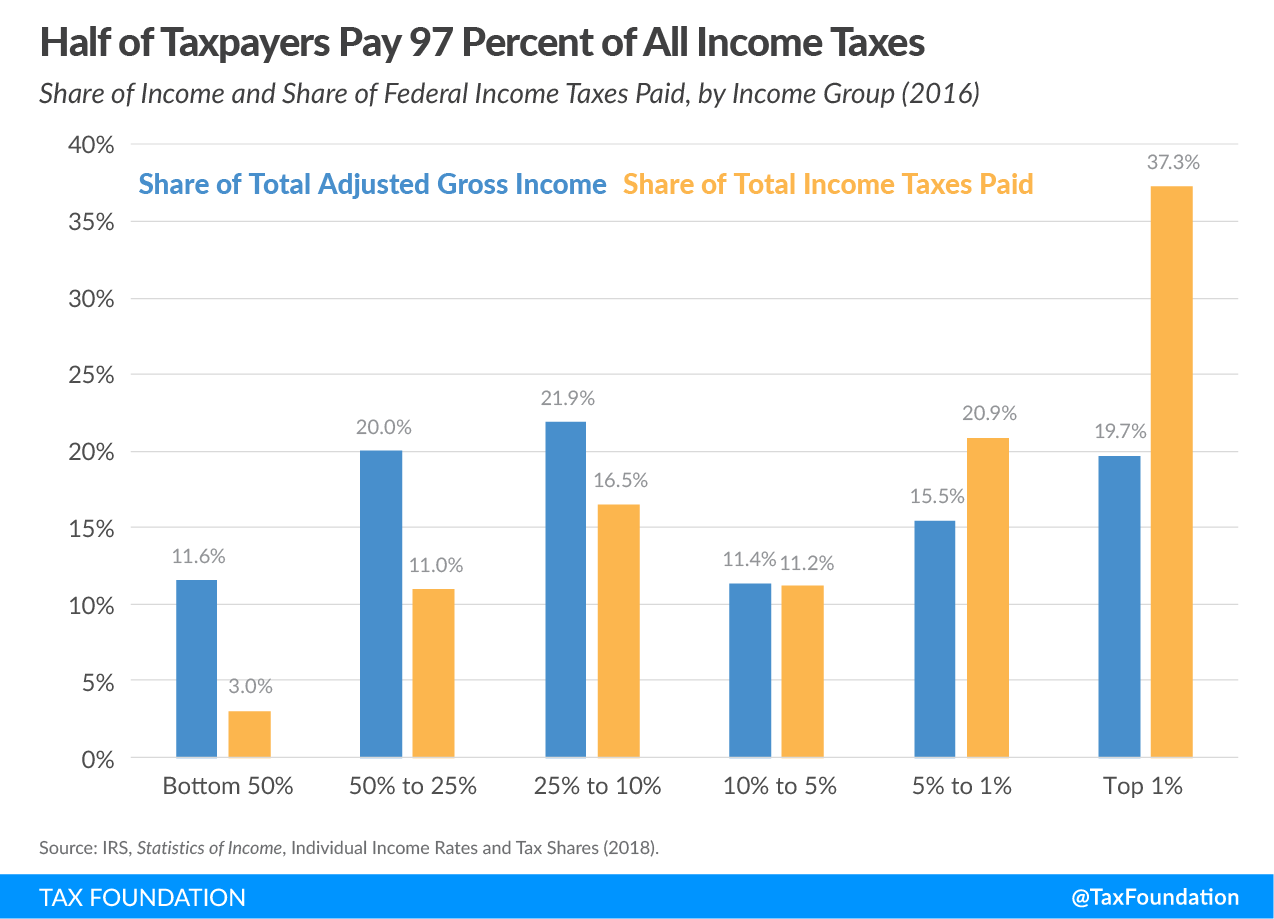
But at the end of the day, it's all irrelevant. Because the big issue isn't the rate at which income is taxed, but rather the total amount received in taxes. And by this measure income taxes are highly progressive, as this chart shows.

Source

That's for federal taxes, nearly 70% of which are paid by the top 10% income earners. Relevant here are New York State and City income taxes, which are even more progressive than the Feds. As shown below, over 50% of New York state tax receipts come from the top 1%, and nearly 80% comes from the top 10%.

Source

Of course income taxes are not the whole story. There are payroll taxes, overwhelmingly paid by the middle class, for whom the primary beneficiaries are also the middle class. This does not seem unfair. Then there are sales and property taxes, which are undoubtedly regressive.

In light of this, raising taxes on the rich doesn't make too much sense. If they're already paying 70% of the tax haul, government is already dependent on the whims of only a few people. These people are the most mobile folks on the planet, and can easily move out of state or even out of the country. Indeed, the NY Post reports that nearly 300,000 people fled the state in the eight months ending Oct. 31st. These are upper income folks who are taking a big slice of AGI with them.

I'll suggest that tax rates are already adjusted to maximize revenue. Adjust the rates either up or down, and actual tax receipts will decline--the former because rich people can move, and the latter because you're just leaving money on the table.

If Mr. Cooper is worried about the revenue stream, Ms. Wood cares more about how the money should be spent. The meat of her argument is summarized in the last paragraph.

New York City, New York State, and CUNY have all been looking to Washington for some kind of relief. They say these cuts and budget shortfalls are temporary, and federal funds from a Biden administration will save us. But workers should not hold our breath. Instead, we must organize, within our unions, across unions, and with the un-unionized, to demand relief that benefits the workers, not the governments and the capitalists. This includes preparing our unions to take citywide strike actions to fight the wave of further austerity that is sure to come.

Are the budget shortfalls temporary? Probably not, and for several reasons. First, as said above taxpayers are leaving the state and taking their AGI with them. Second, and more important, the economy is recovering, but to a different economy.

“We’re recovering, but to a different economy,” [Fed chair Jerome] Powell said during a virtual panel discussion at the European Central Bank’s Forum on Central Banking.

The pandemic has accelerated existing trends in the economy and society, including the increasing use of technology, telework and automation, he said. This will have lasting effects on how people live and work. 

So what are the effects on higher education? I can count a few.

  • More students are learning online. Some of them will prefer it and will not go back to the classroom. Online education got a permanent boost.
  • Students expect online education to be cheaper and are less willing to pay high tuition. Beyond which, online students have no need for dorm rooms, cafeteria food or athletic facilities--all of which are major revenue sources for colleges.
  • Working from home reduces the need for office space, managers, and overhead. Ultimately, it reduces the benefits of a college degree. For that and other reasons, including automation, the demand for college grads likely decreases over time.
  • Likewise, working from home expands the labor pool available to the employer. Their candidates can live in Topeka as easily as in Manhattan. Wages will accordingly trend lower.
  • Not pandemic related, but still important, is the demographic cliff--the cohort of high school grads will be much smaller in coming years.
Bottom line: fewer kids will go to college, fewer of them will attend a residential college, and those kids will all be spending less money at college.

So what's Ms. Wood's suggested solution?

This week, rank and file organizers at CUNY are bringing a Cross-Campus Resolution for a Strike Authorization Campaign and Vote to the floor of the PSC’s Delegate Assembly.

Who are they going to strike against? Surely not against the CUNY administration, because at the end of the day they don't control the purse strings. And also not against the state or city government--for not only can they not control the purse strings, but they've got all kinds of other social services they need to fund.

The faculty probably intend to strike against the millionaires and billionaires, who generally don't give a rat's patoot about CUNY. Why should they? Certainly the ones who have already left town have washed their hands of the whole problem.

So ultimately our faculty friends are striking against their own students--the ones who are at least paying a fraction of the bills. This seems perverse--and deeply counterproductive.

The whole higher education edifice is overbuilt and needs to shrink. We need fewer colleges, fewer professors, and a whole lot fewer grad students. One hopes it can happen gradually so that people could adjust their lives over time. But the world is never like that. As Hemingway put it

“How did you go bankrupt?" 

"Two ways. Gradually, then suddenly.”

 Further Reading:

Monday, November 9, 2020

Down the Cuba Rabbit-Hole with Mary-Alice Waters

Last week I wrote about The Militant's (published by the Socialist Workers Party--SWP) retraction of an article by Steve Warshell. My lede paragraph:

The Militant concocts more fake controversy with this post:

This week’s print edition of the Militant includes an article “Would a Joe Biden White House Be Better for Cuba?” It has been withdrawn from the online edition. It does not reflect the opinion of the Militant or the Socialist Workers Party. 

Next week’s issue of the Militant will feature an editorial correcting that article.

This week's editorial--actually a long article by Mary-Alice Waters--appears in the current issue under the title Defending the Cuban Revolution, strengthening US working people. The supposedly offensive article by Mr. Warshell (Would a Joe Biden White House be better for Cuba?) is included at the same link (scroll down). If you really want to go down this rabbit hole, I suggest you read Mr. Warshell's piece before engaging with Ms. Waters, though this is one of those cases where I've done the reading so you don't have to.

Ms. Waters' piece is just plain incoherent. In an effort to understand it I've tried to outline it. The idea is that major points have a lede paragraph, and each paragraph has a topic sentence. Let's see how far those high school English class principles carry us.

For example, she says,

The second major problem with the article “Would a Joe Biden White House Be Better for Cuba?” is its opening sentences. “A number of groups here and around the country that consider themselves ‘friends of Cuba’ are promoting Joe Biden’s bid for the presidency as a way to relieve the effects of over 60 years of Washington’s economic and political attacks. …

The journalistically unacceptable anonymity of the phrase “a number of groups” is plenty reason enough to reject such a lead sentence in a working-class newspaper. But why is it a problem that some friends of Cuba are urging a vote for Joe Biden? Or Donald Trump? Is it a problem that the Socialist Workers Party advocates and organizes everyone we can to support the SWP ticket of Alyson Kennedy and Malcolm Jarrett?

The major criticism seems picayune--that Mr. Warshell omits a listing of the offending groups. Of course The Militant does this all the time, often referring to middle class organizations that cross the class line--without listing them individually.

But beyond that, she claims that Mr. Warshell misunderstands the principles behind a united front, where working class groups come together around narrow issues upon which they agree. He writes

These groups are organizing car caravans here, peddling the myth that Democratic administrations — and in particular Barack Obama’s — “have been better” for relations between Washington and Havana, especially better than Donald Trump’s.

Perhaps Mr. Warshell is unclear here, but my impression is the car caravans are not organized to defend Cuba, but rather to promote Joe Biden. In which case this isn't a united front at all. But even if the stated purpose of the caravans were the defense of the Cuban "Revolution," since when is the Party supposed to remain silent about other issues of disagreement not involved in the united front? For example, we never hid our criticism of liberal Democrats despite marching with them in antiwar demonstrations.

But getting back to high school English, note the first phrase in Ms. Waters' above quote: the second major problem. Which begs the question: What is the first major problem? As best I can figure (and it's really unclear), it's this:

The problems begin with the headline itself. It poses a question the article never addresses. Moreover, it is a question that can’t be answered. What is there to say except, “If Joe Biden becomes the next president of the United States, we’ll see.”

Huh? Wouldn't this be solved by rephrasing Mr. Warshell's headline If Joe Biden became president, would that be better for Cuba? This seems like a really minor point. 

The supposed first issue subdivides into two, numbered components. 

First, whether Biden or Donald Trump is installed in the White House on Jan. 20, 2021, the revolutionary leadership of Cuba will continue on the course they’ve followed from 1959 to today, through 12 U.S. administrations. ...

Second, for our part, irrespective of who occupies the White House for the next four years, the Socialist Workers Party too will continue on the course we have followed from 1959 to today. 

She simply restates what we already know, namely that neither the Cuban government nor the SWP will change fundamental positions, regardless of the election outcome. There is nothing in Mr. Warshell's article to suggest otherwise. And neither has anything to do with the supposedly misguided headline--it's a non sequitur.

Then we get to the second major problem discussed above, not to be confused with the aforementioned "second" sub-point. (And if you're confused, so am I.) I think Ms. Waters just flunked English Comp.

But now we strike gold with {emphasis mine}

There’s a third way in which the article “Would a Joe Biden White House Be Better for Cuba?” did not express the editorial line of the Militant or the positions of the Socialist Workers Party. That is the way in which it presented the differences between executive actions taken by the Barack Obama administration during its second term versus measures imposed by the Trump administration. The latter have included cutting back travel rights in both directions and depriving Cuba of necessities such as oil, access to the international financial system, and remittances from family members living abroad. 

Here I'm indebted to commenter Eldee Stephens who intuited the true reason for the retraction without chasing down any rabbits. The reason is that life for the Cuban government (and probably also the Cuban people) will be easier under a less stringent sanctions regime, i.e., under a Biden administration.

After much throat-clearing Ms. Waters admits as much.

If a Biden administration were to reverse the direction of some of Washington’s current policies, it would open some breathing room for Cuban working people and their government to more easily deal with the challenges they face. If the boot on their neck pressed less tightly, they would be quite capable of doing that. … 

For these reasons, it’s probably safe to say that a majority of Cuban working people and their leadership are hoping for a Biden electoral victory. Does that mean it’s in the interests of U.S. working people to give political support to a capitalist party and its candidates?

That question was neither asked nor answered in the article “Would a Joe Biden White House Be Better for Cuba?” But for class-conscious workers in the U.S., that’s the most important question. And the answer is an unequivocal “No.”

So she admits that there is a difference between the two bourgeois candidates--a distinction that the Cubans are very much aware of. This is very unTrotskyist of her--Trotskyists (like Mr. Warshell) assert there is no essential difference between Republicans and Democrats--any contrary answer is reformist. But since the SWP wants to remain on good terms with the Cuban leadership, high principle has to yield to Cuba's immediate self-interest.

Regarding the question Does that mean it’s in the interests of U.S. working people to give political support to a capitalist party and its candidates?, Mr. Warshell answers it unambiguously in his final paragraph:

The fact is the only campaign for president that offers solidarity with the Cuban people and their revolution is the Socialist Workers Party campaign of Alyson Kennedy. Not only does the SWP call for an end to Washington’s economic assaults against Cuba and for the U.S. rulers to get out of Guantánamo, Kennedy points to Cuba’s socialist revolution as an example for workers and farmers in the U.S. to follow.

So here we are--at the bottom of the rabbit hole. And there ain't even a rabbit down here! 

Further Reading:

Monday, November 2, 2020

Pre-Election Mockery

The Militant (published by the Socialist Workers Party--SWP) concocts more fake controversy with this post:

This week’s print edition of the Militant includes an article “Would a Joe Biden White House Be Better for Cuba?” It has been withdrawn from the online edition. It does not reflect the opinion of the Militant or the Socialist Workers Party. 

Next week’s issue of the Militant will feature an editorial correcting that article.

They did that last July--that is, retracted an article by Emma Johnson published in the prior week's Militant. I read both the offending article and the retraction, and even after all that I couldn't discern the reasons for the retraction. I concluded:

So I count Ms. Johnson not guilty. Her article is actually a clearer statement of what I (sort of) understand to be The Militant's true position. She does not deserve her walk of shame.

So why does The Militant retract an article that doesn't need to be retracted? This is like Tweedledum retracting a piece written by Tweedledee. It makes no sense.

So why the unnecessary retraction? My answer was "It's just clickbait."

So here we go again, except now we have to wait a week to supposedly find out the reason for the retraction. Fortunately for us, the print edition of The Militant is posted in pdf format here. The offending article is by John Warshell and can be found on page six. So it's kind of a game--can I figure out why it's been retracted without being told?

The answer is: No, I can't! For the life of me I have no clue where the author has gone wrong. Mr. Warshell was in the movement when I joined, so he's been a member for at least 50 years now. That he's suddenly succumbed to petty bourgeois wrong-think strikes me as astonishing. The article is total Trotskyist boilerplate--there's nothing in it any Trotskyist of any denomination could find offensive.

Yet I've fallen for the trick again. I will likely write a post about the retraction, and that of an article I should otherwise ignore. I guess I'm just a sucker for clickbait.

Help me out here, folks. Can any of you find the "error" in Mr. Warshell's piece? You have until next Saturday to let us know.

----

The ever-incompetent presidential candidate Jeff Mackler strikes again. As readers of this blog know, Mr. Mackler's original running mate was Heather Bradford. After declaring her candidacy in May, 2019, Ms. Bradford was part of the group that split from Socialist Action to form the new Socialist Resurgence grouplet. That happened in October, 2019, which means that Ms. Bradford had five months to campaign with the team before becoming a non-person. 

Her short-lived campaign for veep earned her exactly three (3) mentions on the Socialist Action website. That was a really aggressive, busy campaign schedule! (sarcasm).

Anyway, since October, 2019, Mr. Mackler has campaigned alone, sitting in his basement pontificating via boring Youtube videos watched (or at least clicked on) by dozens of people. But somehow, miraculously, on October 22nd, 2020, a new running mate has suddenly materialized--her name is Ann Montague.

Ann Montague and Jeff Mackler (source)

This is two weeks before the election, obviously too late to get any changes to ballot status. Oh--I forgot--Socialist Action has made exactly zero effort to get on any ballot. So all they'll need to do is modify their campaign literature--the 50 or so copies they've printed up. They'll have to cross out the name "Heather Bradford" and hand-write in "Ann Montague". A couple of comrades working all night should be able to get this done.

I have nothing against Trotskyists running presidential campaigns, no matter how quixotic they may be. But back in the day we took pride in at least being professional about it. If I were in Socialist Action, or for that matter in any denomination, I'd be totally ashamed. This is truly pathetic.

----

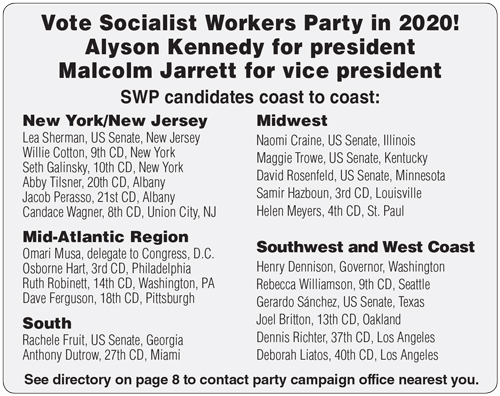
Getting back to The Militant, the SWP campaign of Alyson Kennedy and Malcolm Jarrett at least meets the professionalism standard. In the issue just before the election, at least three front page articles are directly about the election. Ms. Kennedy and Mr. Jarrett have actually been out campaigning and have gone on tour.

But here is something weird. Back in August The Militant published this statement:

Join the fight to put the Socialist Workers Party 2020 presidential campaign on the ballot everywhere we can! Teams of campaigners are fanning out across Washington state, Tennessee, New Jersey and Minnesota. With backing from working people, the party has already won ballot status in Colorado and Vermont, and is filing in Louisiana Aug. 7. The party’s goal is to be on the ballot in as many states as possible, as we have done every four years since 1948.

So I don't understand why the final list of candidates (published the week of the election) does not indicate ballot status. What's the point of getting on the ballot if you don't tell your readers (and potential voters) about it?

(Source)

If they're on the ballot, one would expect that Kennedy/Jarrett will get thousands of votes--some by accident, more as a random protest against Biden/Trump, and a few intentional. No matter how they come, votes are an accomplishment for the Party. I don't know why they keep their ballot status under wraps.

Anyway I'd like to know how many votes they get.

And even more important, the world wants to know if Boring Jeff Mackler can get more than two dozen votes. I doubt he will. We'll likely never find out because nobody has the time to go looking for the kooks who bothered to write in the name of the most ridiculous candidate ever in American history.

Further Reading: