Tuesday, January 24, 2023

Brief Comments on SWP Convention

From the article entitled The Low Point of Labor Resistance Is Behind Us, by Mary-Alice Waters, we learn that

The heart of the book, from which the title is taken, is the political resolution adopted December 12, 2022, by the 49th Constitutional Convention of the Socialist Workers Party. It sets forth the course of action that has guided the party’s work and will continue to do so — the course necessary today to forge mass proletarian parties and an international communist movement able to lead the struggle to end capitalist rule.

I have ordered said book--just published--and am told by the USPS that it will arrive on Jan 30th. I will comment substantively on the political content of the report after I've read it. Parenthetically, Pathfinder is a very professional organization. Ordering was a snap. My only complaint was that shipping charges were very high. (I usually buy my books used on Amazon, or better yet, on Kindle.)

Regards specifics, we don't know where the convention was held (I suggest it was a Zoom meeting), how long it lasted (perhaps over a weekend; 12/12 was a Monday), or how many people were present. It was clearly for members only (true Worker-Bolsheviks). The size of the Party is likely between 100 and 120. Given that conventions are delegated (in my time it was one delegate per five comrades), likely 30-odd people had speaking privileges. The remaining 90 or so comrades could listen in. A Zoom call (or slightly more sophisticated software) would work fine.

I'm very disappointed that there is no hint of a change in leadership. The octogenarian troika will not be able "to forge mass proletarian parties and an international communist movement able to lead the struggle to end capitalist rule." Even worse, the Party is very (small-c) conservative, and has reverted to an ancient, timeworn version of Trotskyism. It will not attract a younger generation. I'll likely have more to say about this after reading the book.

I wish they'd also publish the Organizational Report. I'd like to know how the Party intends to change its tactics. (I suspect there will be no changes.)

Commenter Andrew Chebuhar helpfully links to two Youtube videos starring SWP comrades (Koppel and Britton, plus his own comment here). They're too long for me to listen to them all, but I did partake of the talk by Joel Britton (beginning at 13:47). I recall Comrade Britton as speaking very deliberately, and the intervening 50 years hasn't speeded him up any. But his remarks are brief and his point is clear, so it's worth listening to. But I can read 20x faster than he can talk, so I'll just wait for the book.

The SWP looks doomed. I'll probably die before they do, but it will be a close-run thing.

Further Reading:


Sunday, January 22, 2023

Academic Workers on the Rampage

Photo: JULIETTE HUY, Voice of OC, via Left Voice
NYC's Homeless Go On Strike
Refuse to sleep on subways until demands are met

It's an impossible headline--the lumpen proletariat can't go on strike. That's because they perform no useful labor and create no value. Instead, what they do is deprive others of their comfort. Honest citizens will be overjoyed if the homeless refrained from sleeping on subways.

But what about the lumpen intelligentsia, i.e. people who work for our academic institutions? These are folks who think they work hard, but they produce little or nothing of value and receive in return what amounts to a welfare check. Wouldn't the rest of us be better off if they all went on strike?

Olivia Wood, a journalist at Left Voice, reports on that issue in an article entitled The Higher Ed Labor Movement Runs Full Speed Ahead into 2023.

Ms. Wood, a PhD student in English Composition and also a lecturer, inadvertently tells us in one very long, run-on sentence what she thinks about all day.

While higher education is not the most strategically placed sector of the labor movement (like logistics or transportation), these struggles do take on extra weight in the context of the student debt crisis, public divestment from education, and right-wing attacks on “critical race theory” (by which they mean any discussion of racism), queer people in general and trans people more specifically (including teaching about these topics), and all forms of “wokeness” (defined in Florida as any acknowledgement of systemic oppression).

Her first clause ("...not the most strategically placed...") is absolutely correct. Unlike truck drivers, if college professors the world over all went on strike, by the end of the first semester nobody would miss them at all. The bright students can learn on-line, and the really bright students can teach themselves. As for the others, there are lots of folks out there who could substitute in for the professoriate (scabs, if you will), and would be happy to do so. A strike by the professoriate is about as feasible as a strike by homeless people.

The second clause ("...debt...divestment...") is a whine for more money. The student debt crisis is wholly the fault of the higher education establishment. Per the Education Data Initiative (Hanson, Melanie. “College Tuition Inflation Rate” EducationData.org, August 10, 2022),

  • College tuition inflation averaged 4.63% annually from 2010 to 2020.
  • The cost of tuition at public 4-year institutions increased 31.4% from 2010 to 2020.
  • After adjusting for currency inflation, college tuition has increased 747.8% since 1963.
  • The most extreme decade for tuition inflation was the 1980s, when tuition prices increased 121.4%.

This results from the collective greed of the entire academic establishment--faculty, staff and administrators alike. It is recently augmented by colleges now turning themselves into full-service social welfare institutions, increasingly responsible not just for education, but also for food and housing insecurity and student mental health.

Finally, the last clause ("...critical race theory...queer...trans...wokeness...") is a guide to what she wants to "teach." This is straight-up propaganda and has no relationship to actual teaching. A teacher maintains scholarly distance and is not trying to proselytize students. It's an attempt to indoctrinate students into a very particular world view that champions infertility, poverty and self-pity. There is nothing here of value to anybody trying to raise children, establish a career, save for a successful retirement, and hopefully have some money left over to leave to one's grandchildren.

There is no reason for taxpayers to subsidize this, and even less reason for students to pay exorbitant tuition or go into debt over it.

She considers two strikes in detail: at the University of California system where 

The striking scholars included teaching assistants, researchers, tutors and other graduate student instructors at all 10 UC campuses and the Lawrence Berkeley National Laboratory.

And at The New School, where

The sizable walkout had left the school at a near standstill. Classes were canceled because nearly 90 percent of the faculty is made up of untenured adjunct professors and lecturers. The school had also been facing a lawsuit from irate parents, who had threatened to withhold payment or force their children to transfer to other institutions. 

Both strikes were settled before Christmas.

Ms. Wood never really tells us who the strikers were striking against. The closest she comes is the word "management," which I suppose is a synonym for "the administration." The problem is that the administration is on the same side as the "workers." Nobody in the administration is against giving everybody raises--5%, 10%, 200%--it doesn't matter. Administrators favor them all.

The problem is not the administrators' will--it's their lack of money. Beyond their own salaries (often quite meager, eg, for assistant directors), they have no resources to contribute to the cause. For them, therefore, it's a zero-sum game. The more money they give to one group (eg, English adjuncts), the less money they'll have for another group (eg, childcare workers).

Extra money only comes from off-campus. There are three major sources:

  • Tuition: As noted, tuition has already gone up way more than inflation. Asking students to pay more tuition in today's environment is a non-starter. Colleges have already priced themselves out of the market. It's ironic that the people striking for more money are many of the same people who will have to pay higher tuition.
  • Taxpayers: Most tax dollars at the state level are already paid out as charity: Medicaid, housing allowances, prisons, hospitals, mental institutions, public schools, etc. These expenditures--while arguably necessary at some level--produce no new wealth for society. In economic terms they're a dead-weight loss. Higher ed used to justify itself that they prepared students for life and for the workplace. But Ms. Wood's list of priorities puts a lie to that. It seems higher ed is a waste of money.
  • Philanthropy: Private colleges, especially elite ones, depend on philanthropy. It's not clear to me why anybody will want to contribute to Ms. Wood's list of sorry causes.
Then there is this:
At The New School, part time faculty (UAW Local 7902) voted down management’s “last, best, final offer” and eventually won their contract shortly after students began an occupation of the main academic building, students’ parents began a lawsuit against the university, and full-time faculty demanded the university rescind its plan to begin docking pay and benefits.

The relevant clause is "...students' parents began a lawsuit against the university...". To what end? Did they demand the university end the strike and volunteer to pay the additional tuition? Or did they demand the opposite: that the university defeat the strike and not raise tuition? It's odd that Ms. Wood doesn't tell us.

Students at fancy schools like the University of California and The New School aspire to join the elite. Some of them will succeed, and themselves become tenured professors at elite institutions, or rise to leading roles in business, government, or media. Others (like me) will get tenure, but only at Podunk State. Many will only get jobs at adjuncts--but that assumes that colleges have enough money to hire adjuncts at the inflated salaries.

There is a word for this: elite overproduction. We're producing way too many elite aspirants than there are elite jobs. And with the skills being taught by Ms. Wood, no other jobs will be available to them.

 Further Reading:

Sunday, January 8, 2023

The Mysterious Case of the Missing Convention

The much touted (at least on this blog) Socialist Workers Party (SWP) Convention supposedly scheduled for this past December has yet to be reported on in The Militant. What gives?

Of course I don't know. I'm sure my former friends and comrades are laughing at me as I employ my best Kremlinological skills to divine an answer--when to them it must seem so obvious. My shame is magnified because I'm not a reporter--all I know is what I read in the newspapers, though now between the lines.

Some possibilities come to mind:

1)    The convention never happened. It was announced once:

The SWP will hold a December convention, Barnes said. Based on discussion by the membership of material prepared by the party leadership, branches will choose delegates to debate and decide the party’s course and next steps, and to elect a National Committee.

As far as I know there was no further public mention of said convention. So perhaps they changed their mind and decided not to hold it?

Evidence against this option: The Militant took a weird two-week break in early December, 2022. Their last issue of the year was dated Dec. 12th, while the next issue was dated Jan. 2nd, 2023. Recall that issues are post-dated 11 days after publication, so the corresponding print dates are Dec. 1 and Dec. 22, 2022. In other words, they worked over the holidays while supposedly holding a convention in early December. By comparison, in 2021 The Militant published all four issues in December.

If the convention never happened, then why the strange publication schedule?

2)    The convention was so routine and so boring that there is no point in even reporting on it. I don't believe that. John Studer and Terry Evans can turn out boilerplate in about five minutes--all they'd have to do is cut and paste from prior conference reports.

3)    In a comment I made the off-hand suggestion that there may have been a split. To which commenter John B replied 

A normal organization might be due for a split, but I think Jack's slack-jawed followers are too tired and worn out for that. 

He's certainly right that a split is very unlikely, but I'd dispute the cause as "tired and worn out." I think it's because comrades are way too much emotionally invested in the movement--they've been in it for 50 years--and they're not gonna abandon it for what is, in the end, some relatively trivial theological dispute.

4)    The topics under debate were not resolved during the December conclave, and so a follow-up meeting is occurring now, as I write this. The Militant is currently on another publishing pause: the Jan. 16 issue was posted online yesterday, the Jan. 23 issue will be skipped, and the next edition will be dated Jan. 30. For reference, the missed issue would have been mailed Jan 12, which means they could easily be holding a convention right now. Or perhaps it's just a National Committee meeting--which given the small membership is virtually the same thing.

5)    Related to the above, the only topic I can imagine that could engender such discord is a leadership transition. I admit that I'm hoping that's what's going on. The Party cannot long survive with octogenarian leaders, and unless they can replace them with younger people the whole enterprise is toast. (See, e.g., Jeff Mackler.) While I certainly don't share the SWP's politics, I'm still happy the Party is still around (it's completely harmless), and I sincerely hope that it outlives me.

There are some other tea leaves in the mix. First, The Militant is making a big deal about Ilona Gersh's campaign for Chicago mayor. Not only is there the piece I discussed last week, but a longer, subsequent post--with a better picture. (Also, many mentions in other articles.) Her key campaign demand is

The SWP says we need a labor party, based on our unions. A labor party would be an instrument to advance working-class struggles, and point the road for working people to take political power into our own hands and establish a workers and farmers government.

This is odd because it's a demand on the working class--and not the ruling class. It doesn't follow Trotsky's transitional program strategy.

Finally, The Militant announced a change in its editorial staff.

Joining the full-time Militant writing staff is Vivian Sahner, a member of the Socialist Workers Party branch in Northern New Jersey. Sahner was the 2021 SWP candidate for lieutenant governor in New Jersey while part of the party’s national trade union fraction at Walmart.

The editorial staff listed in the Dec. 12th print edition is

Editor: John Studer

Managing Editor: Terry Evans

Editorial volunteers: Róger Calero, Seth Galinsky, Emma Johnson, Martín Koppel, Roy Landersen, Jacob Perasso, Brian Williams. 

The staff listed in the Jan. 16th print edition is

Editor: John Studer

Managing Editor: Terry Evans

Editorial volunteers: Róger Calero, Seth Galinsky, Martín Koppel, Roy Landersen, Jacob Perasso, Vivian Sahner, Brian Williams. 

Ms. Sahner appears to have replaced Emma Johnson, maintaining female representation on the panel at one. I believe "Roy Landersen" is a pseudonym for Brian Williams. "Terry Evans" also looks to be a pseudonym--and I'm suggesting that's also for Brian Williams.

The staff listed on-line differs from either of these. It doesn't appear to have been updated, and doesn't include "Roy Landersen."

If there is any significance to this, it escapes me.

Further Reading:

Thursday, December 29, 2022

Chicago: Ilona Gersh Runs For Mayor


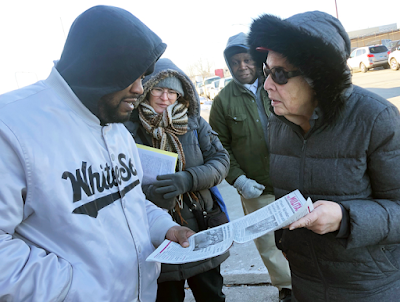
Ilona Gersh, right, Socialist Workers Party candidate for mayor of Chicago, discusses fight of rail workers and the need for solidarity with co-workers at Alpha Baking Company Dec. 18.
(Picture & Caption Source: MILITANT/LISA ROTTACH)

I knew Ilona Gersh very well. She was the organizer of the Chicago Branch when I first moved there back in 1972. For at least a few months I shared an apartment with her and her roommate, Pearl Chertov. It was among the happy times of my life: I had a mission, I had friends, and we had fun.

I recall Ms. Gersh as a very serious but kind hearted person. She rarely smiled. I regarded her as my boss in those days, and I very much respected and admired her. She was totally business-like and competent. I'm not surprised she's still in the Movement.

If good character is required of a Chicago mayor, then Ms. Gersh is more than qualified.

I confess I wouldn't have recognized her from the picture. The sunglasses certainly don't help, and neither does the winter coat. It reminds me of our January days selling Militants at 63rd & Halsted. Then again, she's a lot older than she was back in 1972 and it's been a very long time. She is at least a couple years older than me, which puts her about age 73 or 74. I think she's probably in better physical shape than I am--which means she probably wouldn't recognize me, either.

The sad thing is that she is still working! The article announcing her candidacy (by Naomi Craine) has this lede:

The Socialist Workers Party announced Nov. 29 that it is running Ilona Gersh, a lifelong fighter for the interests of the working class, for mayor of Chicago. Gersh is a bakery worker and member of Bakery, Confectionery, Tobacco Workers and Grain Millers union Local 1.

So I suppose bakery work involves some strenuous physical activity. I doubt I would be capable of doing it today. And surely most bakery workers at her age have retired. At very least she should be living off social security by now, and union bakers must have some kind of pension plan. I think it's very sad that she still has to work to support herself.

Perhaps she is working just so she can participate in the union movement? That would be consistent with her character. In that case it's voluntary and I admire her for still having the stamina to do it.

Or perhaps she's working because she has contributed all her savings over the years to the Party? This looks to be foolish. It's one thing to contribute to the Party if that is such an important part of your life, but to forfeit your retirement savings is taking it too far. She should have put some money aside.

Related to the above, perhaps she doesn't get a pension at all? Pensions are awarded to long-time employees--those who put 20 or 30 years into the job. The Party has a habit of moving comrades about fairly regularly, which means they can't keep a job for any length of time. It may be that Ms. Gersh has only had her current job for only a few years, in which case no pension will be forthcoming.

I suspect she is still working in part because she has no choice. As I say, I think this is very sad.

Ms. Gersh's campaign program can be summed up in a short paragraph (from Ms. Craine's article).

“Working people need to break with the Democrats, Republicans, and all other capitalist parties,” Gersh told the Militant. “We need to build our own party, a labor party, based on our unions, that can organize to fight for our own class interests in face of the economic, social and moral crises of the capitalist system. ..."

That's pretty much it. If you vote for Ilona Gersh you'll get a promise to build an as yet non-existent labor party built on a union movement that represents about 10% of the workforce (most of whom are public employees).

There is nothing about crime, homelessness, the terrible schools, the city and state's crushing debt, or any other issue that confront Chicago voters. What they really need, claims our candidate, is a party that doesn't even exist.

This alleged party does have some programmatic planks, to wit:

“Employment is a central question facing working people in Chicago and beyond,” Gersh said. “We need a union-led fight for jobs, with wages, hours and schedules that mean workers can be with their families and be politically active, rather than be torn apart by the bosses’ drive for profits.

That's weird. The BLS (pdf) reports that the unemployment rate as of October, 2022, in Chicagoland metro was 4.3%. In Cook County it was 4.9%. In the city it is about 5.3%. The national average (Oct., 2022) was 3.4%.

So Chicago is above the national average, but that's because of very high taxes and corrupt government. Still, unemployment is historically low, and wages for low-skilled workers are rising faster than average. Poor employment prospects does not seem like a major campaign issue right now.

“The labor movement needs to fight for a nationwide government-funded public works program, to create jobs and build and produce things that working people need,” the SWP candidate said.

Just what we need--more public employees! Unlike Ms. Gersh (who actually bakes something that people want to buy), most public employees contribute little to our total welfare. The teachers' union, for example, has reduced the public schools to a glorified babysitting service--when they're not pretending to teach over Zoom calls. We have more than enough public employees already, yet Ms. Gersh is calling for more of them.

Finally,

Gersh and her campaign supporters will join in fights in the interests of working people worldwide, including against Moscow’s assault on the independence of the courageous Ukrainian people and the protests by workers and youth in Iran today.

Ms. Gersh is entitled to her opinions on foreign affairs, but this has nothing to do with the City of Chicago, and she has no right to hijack its citizens into supporting her disparate causes, no matter how worthy.

I'll vouch for Ms. Gersh's character, but there is no other reason to vote for her for Mayor in 2023. 

Further Reading:

Tuesday, December 20, 2022

The Harm Reduction Team

Physician Mike Pappas works for a "harm reduction facility" in New York City, and writes a piece for Left Voice entitled Eric Adams Prescribes More Cops and Prisons for New York’s Poor and Oppressed. Who can be against harm reduction? And whose harm are they reducing?

Dr. Pappas' lede (link in original):

Last week, New York Mayor Eric Adams announced his new directive allowing cops to forcibly remove people from public areas and involuntarily detain them for transport to hospitals. The mayor’s guidance expands previous definitions which allowed cops and qualified professionals to involuntarily detain someone if the individual is deemed to be a threat. Now, the new recommendations allow cops to detain people if they deem they are “unable to meet their basic needs.”

My wife and I spent two days in Singapore last month, sightseeing. The most striking feature is that there are no beggars or homeless people on the streets or in the subway. It's the only city in the world that I've been to with that feature. This makes the city much more pleasant for the tourist. It is safe to walk around late at night. One doesn't need to fear pickpockets or muggers. One certainly doesn't have to worry about aggressive panhandlers on the subway.

It's much easier to be a tourist in Singapore than in New York. The no-beggars policy is obviously successful--this site claims that the "city of Singapore is very popular with international travellers. In 2019, it reached the 4th place of the world's most popular cities with 19.76 million tourists." For a city with less than 5.5 million people, this is pretty impressive (and even more impressive if you consider there isn't really very much to see there!).

Of course tourists aren't the only beneficiaries. The city hosts lots of hotels--we stayed in a big one--employing thousands of people. A key draw is the food--there are hundreds of restaurants at competitive prices. (For a delicious cheap-eat, go to the Chinatown Market.) The shopping centers are to die for. A rule of thumb is for every two tourists you need one employee. There are nearly 70,000 hotel rooms in Singapore, which at double occupancy results in 140,000 tourists every day. That means 70,000 people are employed taking care of them.

No wonder Singapore is such a rich country! When it comes to harm reduction, getting the beggars off the streets earns city residents some serious cash!

But Dr. Pappas will undoubtedly ask What happens to the mentally ill? the indigent? the addicted? Fair questions, those. Given the city-state's draconian drug laws, the addicted are probably in jail. The mentally ill are housed in hospitals--or at least some place that pretends to be a hospital. And the indigent are likely provided with subsidized housing--and told to stay there.

Singapore is not a free country. Civil liberties don't carry much weight. A harm reduction method that works there will not work anyplace else in the world--certainly not in messy, rambunctious, lively New York City.

At the same time, what Dr. Pappas calls "harm reduction" doesn't really cut the mustard. His horizon of "harm" extends only as far as the homeless--he wants to make their lives more comfortable. He ignores the welfare of an urban neighborhood when a few dozen homeless people camp out in their park, depriving them of its use. He doesn't see the effects on city life when homeless people shelter in subway stations or on trains. He pretends that mentally ill people pushing people on to subway tracks is not a real problem (only isolated incidences, he'd claim). He forgets that for every shooting in Times Square, there are thousands of potential tourists who decide they'd rather not spend their money on Broadway.

A New York Times article from this past March says that there are about 50,000 homeless people living in shelters. Nevertheless,

While it is difficult to accurately count the number of people living unsheltered, the city’s most recent estimate, conducted in January 2021, tallied about 1,300 people sleeping in subways and about 1,100 on the streets. Many advocates consider the estimate to be an undercount.

Those 2400+ people living rough are doing great harm to the remaining 8.465 million New Yorkers who don't sleep in subway cars or commandeer park benches. They scare tourists, commuters, restaurant patrons, pedestrians, and anybody else who wants to live in a civilized world. Mr. Adams' proposal is a perfectly reasonable effort to get people who for whatever reason can't follow rules of common decency and courtesy off the streets. This looks to be a police function--harm reduction for that small group of people can happen at the facility where the cops drop them off.

I also strongly urge the mayor to arrest turnstile jumpers and panhandlers. These are a small group of uncivilized people who hijack public conveyances for their own selfish purposes. Securing the right of 8.465 million New Yorkers to enjoy public spaces that they pay for constitutes a much greater degree of "harm reduction" than anything Dr. Pappas proposes.

In his headline, Dr. Pappas claims the homeless are "oppressed." This is not true--not even by Marxist standards. "Oppression" happens when surplus value is taken from workers in the form of profit. Homeless people are not workers, and they contribute nothing of value, much less surplus value. Instead they are thieves, stealing public spaces from workers who pay to ride the subway to work every day, and who deserve the quiet enjoyment of their ride.

The homeless, the turnstile jumpers, the squeegee guys--they're not oppressed. Instead, they are the oppressors. One can certainly feel sorry for them at some level, but they have absolutely no right to take over the subway or other public spaces.

Unfortunately, the harm reduction crew, which includes Dr. Pappas, isn't entirely innocent. Here is what it seems they're really interested in.

Workers at OnPoint NYC [a city-funded harm reduction outfit--ed] officially submitted their demand for voluntary union recognition on Thursday, December 8. The workers, who are demanding union recognition with the New England Joint Board of UNITE HERE, are calling their union OnPoint United. They are fighting for a wall-to-wall union, greater job security for employees, better healthcare, and a democratization of the workplace.

The truth will out! The harm reduction folks are more interested in their own bennies than in any serious harm reduction. Indeed, their incentives look to be entirely in the wrong place. The more homeless people there are, the more their services will supposedly be needed, and the more money they'll get. Rather than "harm reduction," their goal appears to be the exact opposite. They benefit most when the homeless population expands.

The vast majority of New Yorkers are civilized people. They deserve to live in a civilized city.

Further Reading:


Tuesday, December 13, 2022

Crypto & Socialist Action

This is now the second post in a week about Socialist Action (SA) and its chief honcho, Jeff Mackler. SA claims to be a "Vanguard Party," i.e., a Party that will lead us all to living happily ever after in a socialist utopia. That claim is belied by the fact that the Party has shrunk to minuscule size--indeed, it's arguable that Mr. Mackler is the very last member--the Vanguard Person. Or perhaps he's the Messiah? Who knows?

In the event, SA has become so small and so irrelevant that it's hardly worth paying them any attention at all. They're not even important within the narrow context of American Trotskyism, which this blog is vowed to cover. And yet here we are.

The reason for the favor is that Mr. Mackler attempts to do something important. He is, as far as I know, the first person on my Beat to actually discuss bitcoin and cryptocurrency. For this he deserves some credit. All the more is the pity that he understands absolutely nothing about the space. He's so ignorant that I have no choice but to make fun of him.

Full disclosure: I bought most of my bitcoin back in 2015, when it was very cheap, and sold all of it by the end of 2021--at a very healthy profit. For the moment I own no bitcoin or any other cryptocurrency. That should make me an expert (and compared to Mr. Mackler I am), but I have to confess that until it went bankrupt I had never heard of FTX! I attribute that (in retrospect) to the fact that I never watch sports, am unaware of how stadiums are named, and don't see any of the ads on those channels.

So now it is my sad duty to correct Mr. Mackler's many errors of fact about bitcoin and crypto. His article is entitled Behind Sam Bankman-Fried’s Cryptocurrency Crash.

Mr. Mackler writes

A competitor, CoinDesk, apparently hacked its financial balance sheet and made it public, revealing grave discrepancies between FTX’s claimed worth and the reality of its investment portfolio. All hell broke lose as investors ran for the hills. In a matter of days most of FTX’s $32 billion evaporated.

CoinDesk was not a competitor, but is instead a news site covering the crypto space. They didn't really "hack" anything, but reporter Ian Allison did some good journalism. Mr. Mackler's bad habit is to never cite his sources. In this case we can correct the error: Mr. Allison's piece is here

Mr. Mackler writes "Cryptocurrency has been largely unregulated; it was only in the IRS’s 2022 tax forms that an item appeared regarding reporting cryptocurrency income." This is not true. Crypto showed up on the 1040 form in 2021, and maybe earlier. The IRS issued guidelines for "digital assets" as early as 2014.

Bitcoin, by construction, is completely decentralized and can't be regulated. This is seen by many people as a feature and not a bug. Indeed, I find it kinda weird that Mr. Mackler supports "bourgeois" regulation. More, the vast majority of bitcoin trading takes place outside the USA, and is obviously not subject to American regulations.

What can be regulated are the on and off ramps--i.e., the process of buying or selling bitcoin for dollars. This is increasingly true in the US. The biggest US exchange, Coinbase, is required to obey all KYC/AML laws (Know your customer/Anti-money laundering). They're also required to submit some information to the IRS. But transactions from one bitcoin wallet to another are impossible to regulate.

Mr. Mackler informs us that

Its touted blockchain technology, powered by tens of thousands of computers, consumed some 0.55 percent of the world’s energy supply. It was said to be impenetrable—free from government oversight and, thus, free from tax obligations. Anonymous crypto speculators, called miners, spent countless hours pouring [sic] over new deals and opportunities. Initially, it was a dreamworld for anti-government-intervention libertarian politicos, who marveled at SBF’s [Samuel Bankman-Fried] gifting NGOs and related altruistic causes millions of dollars.

I'm not sure what the initial "Its" refers to. Is he talking about crypto generally, or is he just referring to bitcoin? I don't think he knows. Crypto coins can be mostly put into two classes: proof-of-work and proof-of-stake. Bitcoin uses a proof-of-work algorithm--and that does consume a lot of energy. Though I'm doubtful it's as high as Mr. Mackler claims--and in any case it's lower now than it was when bitcoin was at its high in 2021. (As usual, Mr. Mackler provides no reference for his data, so it's impossible to check.) Most other coins--notably ethereum--use the proof-of-stake algorithm, which uses much less energy. Both methods have their fans, but you can put me in the bitcoin camp. Mr. Mackler lumps them all together and ends up with confused mush.

The bitcoin network--started in 2009 by "Satoshi Nakamoto"--has proven itself impenetrable. Nobody has hacked it. The on/off ramps have been successfully hacked, and some users have lost their passwords to thieves, but the blockchain itself remains sacrosanct. I'm not sure that's as true with the proof-of-stake coins.

Mr. Mackler clearly does not understand the role of miners. Yes, perhaps some of them are speculators. Few of them are anonymous--bitcoin wallets are only pseudonymous, and once one cracks the pseudonym all trades are a public record. But the main purpose of the miners is to handle transactions. If I send bitcoin to Mr. Mackler (heaven forbid) then it's the miners' job to see that those coins are transferred irreversibly from my wallet to his wallet. That's what they do, and in return they're paid some small amount of newly minted bitcoin. It has nothing to do with "speculation" or "poring over opportunities."

Finally, Mr. Mackler has his history mixed up. The kooky Libertarian influence was strongest shortly after bitcoin was founded--say from 2009 to 2015. Since then bitcoin has entered mainstream consciousness and the ideologues have mostly been sidelined. FTX was founded in 2019--long after bitcoin had matured. Nathaniel Popper wrote a book published in 2015 that I reviewed. Mr. Mackler should read my review (or better yet, the book).

The remainder of Mr. Mackler's piece attempts to show that the whole crypto thing is just a bourgeois plot to destroy the working class, just as what happened during the 2008 financial crisis. I don't have the energy or space to go through it in detail, but it's just as sloppy as his account of crypto. 

He keeps referring to the government's response to the 2008 financial crisis as a "bailout," and then asserts that FTX wasn't "bailed out" because it lacked connections with the "ruling class." Of course it is impossible to "bail out" crypto--a bank is not the same thing as a blockchain. That Mr. Mackler can't tell the difference says something about Mr. Mackler.

In any case, the word "bailout" is inappropriate. The Federal Reserve was simply following Bagehot's law (1873) as best it could, which states that "to avert panic, central banks should lend early and freely (ie without limit), to solvent firms, against good collateral, and at ‘high rates’". In other words, all the Fed did was lend money--it didn't give anybody anything. I believe all or most of that money was paid back--at a high rate of interest. It's impossible to lend money to a blockchain.

In my aforementioned book review, I write

So what do Trotskyists think about bitcoin? I have absolutely no clue. My guess is that few of the papers on my Beat would know the difference between a blockchain and a cement block. If you're stuck in a 19th Century timewarp, then new technology becomes a mystery.

I'll give props to Mr. Mackler for at least trying, but unfortunately he still seems to be at the cement block stage.

PS  Let me link to this excellent post by Scott Alexander.

Further Reading:


Sunday, December 4, 2022

Conventions

There are two conventions of note: one that has already occurred, and another that has yet to happen.

The past convention was Socialist Action's (SA) 20th biennial meeting, implying that the "Party" has been around for forty years now. The Political Report is published on their webpage here. Apart from "November," no information is given about when or where the meeting happened. I suggest the venue was Jeff Mackler's living room--probably large enough to accommodate the dozen or so remaining members of the organization.

Why I bother writing about this is beyond me. Following SA is a waste of time. I have not read the entire Report, but what I have read strongly suggests it was written by Mr. Mackler. Indeed, apart from an occasional web post from his sidekick, Marty Goodman, there is no other literate person remaining in the mini-grouplet.

I also conclude that the whole document is balderdash from start to finish. There is no point in going through it in detail--it's completely illogical. But here are a few random highlights (lowlights) harvested from my brief perusal.

Mr. Mackler begins with the old Marxist chestnut, writing

The imperialists ceaselessly aim to counter what Marx described as the “law of the tendency of the rate of profit to fall.”

There are so many things wrong here: 1) the "imperialists" don't exist, and certainly don't give a shit about any alleged tendency. 2) There is no tendency for the rate of profit to fall. 3) If there were such a tendency it would be a good thing, since it would lower prices for consumers, and finally, 4) Mr. Mackler has no idea what this sentence means (assuming it means anything at all). He can't define profit, or rate of profit, and he has no idea how to measure any alleged tendency. He's an economic ignoramus.

Nevertheless, undaunted (with ignorance being bliss), Mr. Mackler proceeds to blame all the world's problems on mythical imperialists worried about a nonexistent tendency.

I really should have stopped reading here, but I didn't. So let me again mention Mr. Mackler's penchant for just making stuff up. He asserts factoids that can't possibly be true. There are no links in the Report, and no bibliography with references at the end, so there's no way to check Mr. Mackler's supposed "facts." For example, he writes

Today U.S. imperialism, with 1,100 military bases in 110 countries [Recent Congressional reports put the number of countries with ongoing U.S. military operations at 159!] reigns as “the chief cop of the world.” Its overriding objective is the subjugation and exploitation of poor and oppressed people and nations to advance the economic interests of U.S. imperialism.

How can the US have 1,100 military bases? And to what end? This makes no sense and isn't true. He cites "Congressional reports," but provides no reference where to find them. I doubt they exist. It is true that the US has embassies and consulates in most of the world's countries. Each of those embassies has a Marine guard--and I suppose if you count those as a "military base," then you'd generate a number in the couple hundreds. But then all large countries (China, Canada, Russia, etc.) have embassies around the world with attached guard contingents, so in this respect the US is no different.

Mr. Mackler writes

Tragically, comrades in Socialist Action found themselves on opposite sides of a war that today few, if any, consider anything but yet another U.S. imperialist slaughter, a slaughter that took the lives of 500,000 Syrians.

Somehow Mr. Mackler credits all 500,000 deaths in the Syrian civil war to the United States. And then claims near universal agreement that it was "another U.S. imperialist slaughter." This is absurd. Nobody outside of Mr. Mackler's living room believes the US murdered 500,000 people in Syria. To the contrary, the USA has all but kept out of that conflict altogether.

Enough already!

The future convention is that of the Socialist Workers Party (SWP), scheduled for later this month. The current issue of The Militant informs us that it is a three-week issue, implying that the event will happen soon. But for now all I can do for you is speculate.

1) Previous conventions have been advertised in The Militant, inviting people interested in the SWP to attend. No such invites have appeared for this convention. This suggests that some sensitive topics are up for debate. As far as I know, this event has only been mentioned once.

2) There's some weird shit happening in the Party. They're rearranging their longstanding policy on abortion. In the most recent issue they are apparently rethinking their position on Taiwan.

3) The Party seems to be doubling down on its defense of Donald Trump. I confess I can't now find the article I'd like to cite (I'll pull a Jeff Mackler here), but I recall a phrase where they took issue with Trump Not Now voters (as distinguished from the never-Trump people). I'll admit that I'm in the Trump not now camp--he's got way too much baggage and he's caused the GOP to forfeit too many elections. I'm getting tired of losing. I think Trump was a great and transformative president, but it's time for him to retire. In a word, The Militant is more pro-Trump than I am (as hard as that is to believe).

4) I'm hoping there will be a change in the Party's leadership. The trio of octogenarians now leading the Party need to be replaced by younger people. I'll root for my old roommate, Brian Williams (who may also be the mysterious Terry Evans). OK--he's not much younger--but at least he's only a septuagenarian. And he's still active in the Party.

Anyway, we'll see.

Further Reading: