Thursday, May 7, 2020

Trotskyist Ephemera

Today's topic is Trotskyist ephemera--nothing substantial here.

Let's begin with Socialist Action (SA). Because of the virus they are posting a pdf version of their paper online. While the articles are mostly reproduced from the web, some other bits are not. Notably, the print version has a list of locations and phone numbers. In my day we would have called them branches (which typically had 15+ members), but that seems too generous a term. SA has about 60 members spread out among 14 locals implies an average of six comrades per local.

My interest in geography inspires me to copy the list here:

Brunswick, ME; Buffalo, NY; Central New Jersey; Chicago, IL; Detroit, MI; Kansas City, MO; Lexington, KY; Louisville, KY; Minneapolis/St. Paul, MN; New York City, NY; Oregon; Norfolk, VA; Bay Area, CA; North Bay Area, CA

Brunswick and Lexington are unambiguously college towns. Central NJ might mean Rutgers or Princeton. Buffalo and Minneapolis have lots of campuses.  So one concludes that SA is still oriented towards campus.

Is that good news or bad news? If they're attracting students, then it is unambiguously good news--it means the organization is getting younger. But somehow I doubt that. I suspect their membership is mostly among the faculty and staff. Or less optimistically, among the retired faculty and staff. That their leader--Jeff Mackler, a retired teachers' union hack who will turn 80 this year--likely represents the demographic.

Norfolk is weird--I've never seen a Trotskyist branch there. It's mostly a military town, but there are colleges in the area. The other places, e.g., Chicago, Detroit, and New York, are places where any grouplet will want to have a branch.

More generally, membership skews heavily toward the Northeast and Midwest, with the Bay Area, Oregon, and Norfolk being outliers. Most locations are wealthy cities. The Deep South and Texas are not represented. Neither is Los Angeles--a much more proletarian city than San Francisco.

There are some changes in the Socialist Action webpage/newspaper. Distressingly, there is no link to archives--or at least none I could find. You can still search for old articles, but for that you need a specific title. There is no way to look up what was in the paper in, say, May, 2019, or for any time prior to January 30th, 2020. Perhaps this is just a technical oversight to be corrected in a few days. But I fear instead it is an attempt to airbrush Socialist Resurgence out of history. (Recall that SR split from SA in October, 2019, taking about half the membership with them.) This makes it seem like they have something to be ashamed of.

The other novelty is SA is now posting more videos. This sounds like a good idea, and perhaps they'll get the hang of it some day. But right now there are lots of problems.

They've posted a long video entitled Why I Am Running to be President of the USA. It's in interview format with host Kurt Young, who along with Vancouver comrade Yvonne Hanson, asks Mr. Mackler a bunch of very softball, scripted questions.

The good news is that Mr. Mackler has at least changed his shirt. He's wearing a clean and pressed dress shirt with a tie--big improvement there. He's sitting in his Bay Area living room, in front of a fireplace and well-stocked bookshelf. It looks to be a very nice private house--one wonders what money that would fetch on today's market? He confesses to be nearly 80 years old and has likely lived in that house for decades--surely it's paid for by now. The conclusion: Mr. Mackler is probably a millionaire several times over. He's richer than I am!

But that's not the worst of the video. The main flaw is it's an hour and 20 minutes long! Even I, a devout follower of irrelevant grouplets, don't have the stomach for that. I have only sampled it. Then the production quality, while adequate, is not professional. Mr. Mackler--whom I've dubbed Boring Jeff--lives up to the nickname, answering obvious questions in a monotone voice at great length.

Leonid Brezhnev would be proud! Though I gotta say, Mr. Mackler is a lot more articulate than Joe Biden, so there is hope.

Socialist Resurgence (SR) posts a pdf version of Volume 1 Issue 1 of their eponymous quarterly. (Note that the link goes to votesocialistaction.files.wordpress.com. Some divorces are more amicable than others.)

The paper does contain color photographs, some quite dramatic. For some reason there are two multi-column wide pics of Bernie Sanders--even though they're as much against the guy as Mr. Mackler. But photos notwithstanding, the overwhelming impression is a Wall of Text. Three or four columns wide, covering the entire page in small type, is nothing but fine print. It's very uninviting. The front page has exactly one article, continued on page six. Compare that with The Militant, which front page contains five headlines and two photos--it's a much more lively and engaging layout. Of course The Militant has been in business since 1928--and they certainly don't hide their archives.

SR doesn't offer much geographical information, but there is this. Their national office address is a mailbox at a UPS store in--you'd better sit down for this--Stamford, CT! What's going on--are they running a hedge fund on the side? While Stamford itself is not super-wealthy--it's only the 38th richest town in the state, out of 178--it is the largest business and financial center in New York metro second only to Wall Street. The neighboring communities, e.g., Greenwich and New Canaan, are among the wealthiest places in the world.

What a place to headquarter a supposed Vanguard Party! Sheesh!

Apparently SA and SR are engaged in a competition to see who can attract the smallest audience with new videos. Among SR's contributions is a post by Keith Leslie entitled China, from workers state to imperialist power. It's a presentation of his excellent monograph on the same topic. But honestly, Mr. Leslie should stick to his knitting--while he's a superb writer, he sucks as a lecturer. Even Boring Jeff does better.

The video is nearly two hours long. Mr. Leslie looks like a grad student--slovenly dressed and in dire need of a haircut. Grad students (and here I speak from experience) are very low-status individuals, with only a tenuous purchase on the academic ladder (much more tenuous today than in my time). Typically they are people who have nothing better to do with their time, and who are willing to work for what is likely less than minimum wage. When making a video, the last thing you want to do is look like a grad student!

I don't know if Mr. Leslie really is a grad student--I'm just saying he looks like one. SR does have a number of articles bemoaning their plight, so perhaps Mr. Leslie is playing to type. He needs a better stage persona.

My advice to him is stick to writing. He's good at that.

Further Reading:


Monday, April 27, 2020

The Militant & Louis Proyect Argue About the Virus

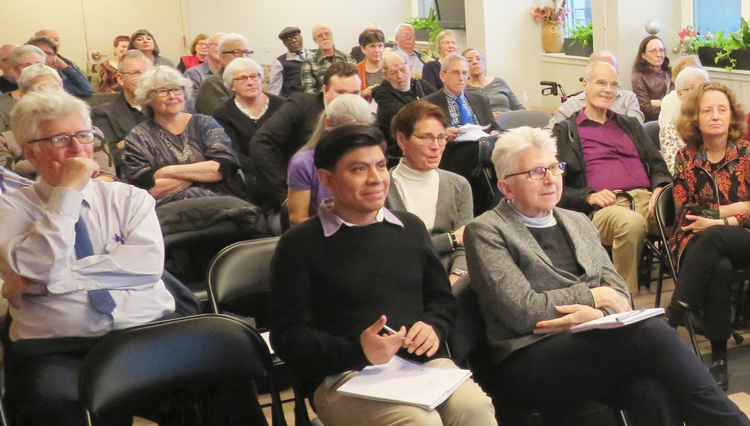
Louis Proyect (h/t commenter John B) suggests a (perhaps literally) fatal flaw in Socialist Workers Party (SWP) strategy and tactics. Consider the picture below, published in an article by Maggie Trowe in the April 6th edition of The Militant.

Audience at March 15th memorial meeting celebrating the life of Larry Quinn (Source: The Militant/Roy Landerson)
Mr. Proyect notes in his lede:
In this photograph, dated March 15, 2020, you will see a group of mostly senior citizens defying the call for social distancing. Who could they be? Rightwing Christian evangelists? Libertarians standing up for liberty? 
Nope. Instead, you are looking at members of the Socialist Workers Party at a memorial meeting for one of their members who died last month. The Militant newspaper reported that more than sixty people were in attendance. That’s probably about half the membership, ...
The meeting was held in Albany, NY on March 15th. In our comrades' defense, New York's Stay-At-Home order was not issued until March 22nd--a week later. Broadway theaters were closed on March 12th. It's hard for me to go back in time and recover how transgressive such a gathering was perceived back then, but Mr. Proyect obviously conflates attitudes on April 10th (when his article was published) with those on March 15th (when the meeting took place). Likewise, the door-to-door canvassing depicted in this article probably did not violate Indiana's stay-at-home order (not sure).

Mr. Proyect exaggerates the kookiness of the SWP--there is no way this meeting can be interpreted as libertarian civil disobedience. Though in retrospect it was foolish--especially for the senior citizen crowd. I'm glad I didn't attend. (Apparently the Party's top leadership--Jack Barnes, Mary-Alice Waters, or Steve Clark--also didn't attend. Make of that what you will.) [Update: Ms. Waters did attend the meeting and is sitting in the second row.]

Weirder is The Militant's vigorous defense of Alcoholics Anonymous (AA) meetings. In the April 13th issue Roger Calero writes
Essential needs like 12-step program meetings — the regular, face-to-face peer gatherings key to recovery for alcoholics and addicts, as well as their spouses and families — have been forced to close by shelter-in-place and lockdown edicts, and bans on even small gatherings, here and elsewhere.
This was almost certainly written after lockdown orders went into effect, so the context is very different from Larry Quinn's memorial.

Mr. Proyect's take is this:
If you want to see an explicit call, however, you can turn to a bizarre Militant article titled “Morality of capitalist rulers reflected in shutdown of AA.” It defended the right of alcoholics to attend weekly meetings even if it cost their lives from COVID-19 rather than cirrhosis of the liver.
Mr. Proyect himself can't decide whether Covid or alcoholism is the greater threat, and his uncertainty somehow renders the SWP "bizarre." But surely it's a fair question--the lockdown inevitably produces some trade-offs. Is it unreasonable to let individuals decide for themselves which risk is greater? Apparently not according to Mr. Proyect--he thinks that Mr. Cuomo should make such decisions for everybody, unilaterally.

To me, the "weird" part is The Militant's uncharacteristic support for a religious movement. In AA's 12 steps, "God" or "higher power" is explicitly mentioned in six of them. Belief in God is core to AA's success. That a supposedly Trotskyist organization is touting such virtues is astonishing.

In our politically polarized society, it's not surprising that people gravitate toward extreme positions. Our Marxist and pseudo-Marxist friends, such as Misters Proyect and Cuomo, take literally Marx's dictum  "from each according to his ability, and to each according to his needs."

Supporters of capitalism--especially Libertarians--will rephrase this.
From each an opportunity to apply his ability toward maximum economic benefit, both for himself and society, and to each according to his wants.
Only the free market allocates and organizes abilities efficiently. No other system works nearly as well--not state capitalism (aka fascism) such as practiced in China, and certainly not socialism, e.g., Cuba or Venezuela.

More important for the discussion here is the second clause--the contrast between needs and wants. Marxists (pseudo and otherwise) claim to know the difference. This leads to the distinction between essential workers and non-essential workers. Mr. Cuomo--acting now very much like a Marxist--believes that essential workers tend to people's needs, while the non-essential sort are only about wants. Misters Proyect and Cuomo claim to be smart enough to tell them apart.

Of course the governor is self-dealing. People who deliver groceries to the upper-middle class (e.g., Cuomo's political base, Mr. Proyect, and me) are deemed essential, while the waitress at the working-class diner is somehow a non-essential luxury. Supposedly waitresses spread disease, but grocery deliverers somehow don't.

To supporters of a free market the distinction is completely nonsensical. The other night on Fox News, Shannon Bream interviewed two small business owners from Atlanta--now legally allowed to reopen. One lady owned a beauty parlor--hair styling, facials, manicures, etc.--the owner herself did eyebrows. For her own safety she chose not to reopen, despite running up a big debt on her credit card.

The other lady owned a cross-fit gym, and armed with blue tape to mark out socially-distanced workstations, along with liberal quantities of sanitizer, she is back in business.

The only thing these two businesses have in common is that some stupid governor deemed them non-essential (as if nobody ever needed a haircut). But they're obviously completely different from each other, and the one-size-fits-all, essential category is silly.

People, including the president, criticized Georgia's Governor Kemp for reopening too soon. That would be a proper criticism if he'd required businesses to reopen. But as the Fox clip shows, both these ladies are very smart and know their businesses. They choose different strategies. The moral is Let Capitalism Reign. Businesses, their employees, and their customers will work out optimal solutions.

The Militant gives a good example of how this happens.
On March 26 an assistant manager at a sizable Walmart in the northern New Jersey area told Tetri Boodhoo that she had to take off the mask she had decided to wear, saying it was against company policy. The boss said she and any other workers not happy with this could take leave without any penalty — and without any pay. 
... After rejecting their demands, the boss consulted with higher-ups and backed down. Many workers — and customers too — considered this a victory. “You see, when we speak out together we can win,”
... Walmart bosses nationally have now reversed their position. They told the press March 31 that they intend to make available “high-quality masks” for any employee who wishes to wear them.
While this is more confrontational than seems necessary, it didn't take long for a meeting of minds between bosses, employees and customers--to the benefit of all concerned. Yet Mr. Proyect puts all his hopes in the supposedly unfailing wisdom of Mr. Cuomo, who thinks the only good business is a closed business.

Just to rant a little bit:

Aren't non-essential workers some vaguely sub-human folks who can't serve people's needs instead of merely their wants? That's what Mr. Cuomo implied when he told "protesters" to get "essential" jobs. So the lady, whose life savings and entire career are invested in the beauty business, should now go and deliver groceries to Mr. Proyect's house?

Or--aren't non-essential workers approximately the same as the deplorables? Admittedly the correspondence isn't exact, but surely close enough. Do people like Mr. Proyect really have it in for the lower middle class?

Perhaps Mr. Proyect is correct? Maybe the SWP isn't Marxist anymore? But at least they know who their customers are. The Militant's masthead proclaims "published in the interests of working people."

Seems right to me.

Further Reading:

Tuesday, April 21, 2020

Book Review: Disunited Nations

I have a love/hate relationship with Peter Zeihan's new book, Disunited Nations: The Scramble for Power in a Disunited World.

Let's start with the bad news first.

Apart from editorial asides by the author, the book has no footnotes. The bibliography only includes five titles. There is no reference to historical models of geopolitics. Facts are offered without citations. Now I'm not a great fan of scholarship--academic monographs are not just boring, but useless. Reading through a forest of footnotes is tedious.

But without any context I have no way to know how trustworthy Mr. Zeihan's sources are. Is he just cherry-picking factoids to fit his story? Is he really such a genius that he can develop a whole geopolitical theory de novo out of thin air?

Is the man a serious thinker?--or merely a huckster trolling for consulting dollars? Yes, and yes.

I loved this book!

For clarity and concision it is unmatched. He tells a simple (too simple by half) story of the globe's future for the next generation. Story is the operative word--the book reads like a well-plotted novel. That makes me suspicious (is life really that straightforward?), but it's very readable. I think he's wrong in big ways, as I'll explain below. But the basic story seems true enough.

It goes like this:

After WWII, the Soviet Union, despite its intrinsic weaknesses, represented an existential threat to the United States. Our ingenious counter was to mobilize the world to our side. This was not done by brute force, nor by appeal to humanitarian principles. For the most part we bribed other countries to be our allies. The bribe consisted of three parts:
  1. The US will guarantee your current borders. You do not need to defend yourself against your neighbors.
  2. The US will guarantee your trade routes. Our navy will patrol the world and keep the seas free of pirates and military foes. Not merely was transit through the Panama and Suez canals open to all, but also through the Malacca, Hormuz, and even the Bosporus Straits.
  3. The US market was open to your produce nearly without restriction. Whether German cars, Japanese electronics, Bengali textiles, or Chinese toys--anybody could sell anything in the USA tariff-free.
It worked like a charm. Apart from the US and the Soviet Union, military spending decreased around the globe. The NATO allies, for example, couldn't rouse themselves to even spend 2% of their GDP on defense. Piracy and privateering on the high seas, along with toll-collecting at choke points disappeared. Countries as diverse as Germany, South Korea and China got rich selling into US market.

The world got rich, including the United States. Mr. Zeihan refers to this era--from 1945 to nearly the present day--as the post-war Order. But now the Order is breaking down, again for three reasons.
  1. The Soviet Union is no more. The empire collapsed in 1991, and the successor state, Russia, is itself in terminal, demographic decline (so claims Zeihan).
  2. Fracking changes everything. North America is now energy independent, and indeed, we're a net energy exporter. The result is we have little cause to police the Middle East anymore, and certainly not the Persian Gulf or the Straits of Hormuz.
  3. While in 1950 the US produced about 50% of global gdp, today the number is only 25%. That's certainly not because the US is poorer, but rather because the Order hugely increased wealth globally. Thus we can no longer serve as a market of last resort, nor can we cover the world's defense costs.
As said, it's too simple by half. While the Soviets inspired NATO, it seems unlikely that they were the only reason for the Order. Surely American business understood the virtue of global markets, even in 1945. There were strong economic reasons for the Order. Accordingly, the collapse of the Soviets did not presage the imminent demise of the Order--it's hung on for nigh 30 years--again for its economic benefits.

Mr. Zeihan's tale leaves out some important trends. New technology spread around the world--the rise in global wealth is as much due to that as the American policeman. The Order’s decline may be due to a sharp drop in global productivity beginning in the mid '70s as much as anything else. Indeed, Mr. Zeihan’s story depends too heavily on geography and demographics--important topics to be sure, but not necessarily more important than technology, history, culture, or even genetics.

Still, I think he's mostly right, and the Order's inevitable demise may lead to the consequences he foretells. I think he's right about China. I think he's wrong about Germany.

China has five existential problems, and while it might survive one or two of them, solving all five of them simultaneously is impossible. The Chinese economy will crash, and Zeihan predicts the country will not survive as a unitary state. The five issues are:

  1. While Americans do farming, the Chinese do gardening. This is because they had a surplus of agricultural labor, and gardening is more productive per acre than farming. By shipping labor off to the cities, China was forced into mechanized farming, which hasn't worked too well. Despite the huge capital investment, agricultural productivity has not grown proportionately. Mr. Zeihan predicts famine in China's near future.
  2. China has over-invested in housing. Housing is the primary investment tool for middle-class Chinese, including many second- and vacation- homes, similar to what the stock market is in the US. By building too many houses, there will inevitably be a crash in prices, wiping out the wealth of much of the population.
  3. Chinese demography is terrible. Unlike the US (with our large Millennial Generation), Chinese baby boomers were limited to one child each. Thus China is older than the United States, and it's labor force is actually shrinking. It's very difficult to grow an economy when your labor force is shrinking and the bulk of your population is retiring.
  4. China has insufficient natural resources. It produces very little of its own energy, importing most from the Persian Gulf (to which, absent the US Navy, access is not guaranteed). It can't produce enough food to feed itself, and also must import the fertilizers and other inputs for its agriculture. Given the shortage of labor, the reversion to labor-intensive gardening looks unlikely. 
  5. China is too big to be an export power. Economic success depends on a sharp increase in domestic consumption. But consumers are in the ages 30-50 demographic, i.e., the generation that doesn't exist in sufficient numbers in China. And they're not having any children, either. The result is Chinese consumption is purchased only by government debt, i.e., the government buying all kinds of products that citizens can no longer consume. Every financial institution in the country is insolvent. It will end badly.
Moral: Don't invest money in China!

Now for Germany: Mr. Zeihan takes the Marxist saw too literally: history repeats itself, first as tragedy, and then as farce. The "Germans" invaded Russia first in 1914, and then again in 1940. Contrary to Marx, Mr. Zeihan thinks they'll do it a third time. I believe he's ignoring history.

There were three "German" empires (Reich). The First Reich was under Charlemagne, founded in the Eighth Century, and that really was a German empire (without scare quotes). The capital was in Aachen, in the Rhineland. The Second Reich was founded by Bismarck in 1871, with it's capital in Berlin. But it wasn't really a German Empire, but rather a Prussian one.

The Prussians are originally a Baltic people--Old Prussian, spoken until the 18th Century, is related to Lithuanian. Ancestral Prussians lived in what became known as East Prussia, today parts of Lithuania and northeast Poland. They were first conquered by one of Charlemagne's heirs, and took to German language and culture with some enthusiasm. But they are not ethnic Germans--neither then nor now. They're Prussian. Mr. Zeihan seems to think they're just another species of "German."

Bismarck was very aware of this--his goal was a Prussian empire, not a German one. Indeed, he wanted the Kaiser to be dubbed the Emperor of the Germans rather than the German Emperor (it is only by accident that he didn't get his wish). He treated Germany proper (the Rhineland, Baden-Wurttemburg, Bavaria and Austria, along with Alsace and Lorraine--i.e., Catholic or Roman Germany) as colonies to be exploited. (This was especially true in Alsace and Lorraine.)

And even though Hitler was an ethnic German, the Third Reich was also a Prussian empire, not a German one. It's the Prussians who had an issue with Russia. The Drang nach Osten was never a German emotion, but solely a Prussian one.

In the meantime, Prussia has been completely destroyed. They've been ethnically cleansed from their native homeland. Today they live mostly in the former East Germany--a geography that has long been a Prussian satrapy. Berlin is the capital of Prussia, not Germany.

The Germans, properly understood, have no cause to pick a fight with Russia. And I doubt the Prussians have the resources to even think about it. More likely is Germany will re-divide into two states along the former iron curtain: proper Germany to the West, and a rump Prussia in the East.

I don't think Mr. Zeihan's story about Germany makes much sense, for this and other reasons. But his book is a lot of fun and well worth reading.

Further Reading:

Wednesday, April 15, 2020

Book Review: Human Diversity

The full title of Charles Murray's recent book is Human Diversity: The Biology of Gender, Race and Class. It's a dense, tightly-reasoned, data-packed, expertly-written tome that will change the world. Or rather, the subject it discusses will change the world.

The major purpose of the book is to bring the educated layman up to date on the science of human genetics. Thanks to spectacular advances since 1980, and especially since the complete mapping of the genome in 2005, it is now possible to shed some serious light on the old nature vs. nurture question. While these results have until now stayed mostly within the specialist, scientific community, it is Mr. Murray's view that before the end of this decade, the consequences of this new knowledge will impact every aspect of our lives.

A short, oversimplified summary of the story goes like this: Back in the old days (before 1980) it was supposed that most human traits were the result of a gene or two, or perhaps maybe half a dozen. In this context we are using the word gene to refer to a bit of DNA that actually codes for a protein. In those days people supposed there were 100,000 or more genes.

This had numerous consequences. First, there was fear of genetically modified babies. If we could just change a specific gene, then we could make children much more intelligent. This possibility was never remotely realistic.

Then people assumed that evolution happened very slowly. Most mutations in actual genes are deleterious--resulting in birth defects or death. Only a very few are beneficial, and even those will need about 2000 generations (40,000 years) to spread from one individual to the entire human population.

Even then, it was understood that the bulk of our DNA was not part of a gene, i.e., didn't code for anything. Folks didn't know what that excess DNA did--it was often called junk DNA. Today we know different. It appears there are only about 20,000 actual genes in the entire genome. By far most DNA is in the non-coding portion. It appears that non-coding DNA regulates gene expression in some complex way.

While mutations in the genes are still usually deleterious, mutations in the non-coding parts of the genome tend to not have much effect. Therefore mutations accumulate there. Many of them spread across the human species: certain mutations that occur in more than 1% of individuals are called single nucleotide polymorphisms, or SNPs (pronounced snips). Wikipedia claims that more than 335 million SNPs have been found in our species, while any given individual will have between four and six million SNPs.

While an individual SNP has little effect, cumulatively the SNPs make a big difference. For example, it is now known that millions of SNPs help determine how tall you will be. With enough data and a big enough computer, one can isolate those SNPs that correlate with height.

So today we understand there isn't a "gene" for height, nor for personality/behavioral traits like intelligence, empathy, honesty, conscientiousness, etc. Yet we know that all these traits are significantly heritable--that is depend on our DNA. But instead of counting genes by the handful, we count SNPs by the thousands. Thus almost all traits (both physical and behavioral) are polygenic, in some cases nearly omnigenic (involving contributions from nearly all your DNA).

It's the SNPs that drive human evolution, and sufficiently fast that evolution can (and does) happen in historical time.

It is possible to count SNPs that enhance a certain trait, such as height or tendency toward schizophrenia. This leads to the polygenic score for that particular trait. Since your SNPs are fixed at birth, one can readily calculate your odds of being schizophrenic later in life. (It will never be 100%--environmental effects alter the odds significantly).

Likewise, there is a polygenic score for IQ. It cannot predict your IQ as an adult--for which the environment contributes about 40% of the variance--but it definitely narrows the field. If your child is born with a high polygenic score for IQ, then it might be worth saving money to send her to Harvard.

There are polygenic scores for things like criminality. The optimist will say that by judicious interventions we can prevent that outcome from occurring. The pessimist will fear that we'll be punishing people in advance of any crime--simply on the basis of their polygenic scores. I think they're both probably right--it is a brave new world coming on.

A second theme in Murray's book is an argument against the socialization theory. This theory--standard groupthink at American colleges--maintains that all differences between genders, races, and classes are merely social constructs, and have no underlying basis in biology. I'll mention that prior to 1980 this was a plausible idea, but since then, and especially since the rise of modern genomics, it becomes completely untenable.

Mr. Murray discusses at length the differences between men and women, who differ by an entire chromosome. There are genetic, physiological and psychometric differences between the sexes, compared to which "socialization" pales into insignificance. That said, it is not a simple switch--there is a continuum between male and female in nearly all traits. Few men have exclusively "male" traits, while few women are exclusively "female."

Murray uses facial features as an example. Consider the kinds of metrics facial recognition software might use: relative length of nose, relative distance between the ears, etc. Suppose there are twenty such metrics. It may be that women have slightly shorter noses (relatively) than men. But the effect is not very large--many women have noses longer than the average man, but most women don't.

So it is with all the other metrics. Women congregate slightly on one side of the spectrum, while men predominate mostly on the other, with a large overlap in the middle. Very few men are "masculine" on all twenty measures, and neither are many women "feminine" on all measures.

And yet it is easy to distinguish male faces from female faces. Even though each effect is small, the accumulated effects are big enough to see the difference. Only in a few cases is it truly ambiguous--I think of Rachel Maddow, for example. Two corollaries: facial recognition software can distinguish between male and female faces most of the time; it takes a skilled artist to draw an obviously female face, since most of the differences are so subtle.

Similarly, racial and ethnic differences show up in polygenic scores. That's how sites like 23&Me work their magic. Those very same polygenic scores imply ethnic differences in disease susceptibilities, physical attributes, and personality traits. Race is not just "skin deep" as the pre-1980 school would have it.

Class differences also depend on polygenic scores.

I'll close with some comments on how I think Murray's book will be received, especially by my former colleagues at Local State College.

First, most of the people who fancy themselves as experts on Race, Class and Gender are committed to the social construct theory and won't change their minds. But science progresses one retirement at a time, and these folks--tenured baby boomers--are not that long for the academic world. I don't think they're being replaced.

Second, those same self-proclaimed experts are typically in English and education departments. They know nothing about statistics. (Yes, I know--education faculty should know some stats, but I don't think they generally do.) One doesn't need a lot of statistics to read Murray's book, but a college-level introduction to the discipline strikes me as a prerequisite. (Sociologists have no excuse here.)

Finally, "Charles Murray" is a dirty word in those quarters. He should have written the book under a pseudonym. As the book has just come out, I can't blame them yet for not having read it, but they won't have read it five years from now, either.

So yes, while it will pass the academy by, I predict there will be a revolution in our understanding of human behavior. I'm not sure it will all be good. Lots of people (e.g., inhabitants of red states) will be classed as vaguely subhuman because of their average polygenic scores, as will many other groups of people.

There are some things this book should never change, concepts of morality, justice, and human worth among them. No polygenic score is an excuse to deny anybody their human rights. As Mr. Murray recently opined, religion becomes more important. Absent some kind of revival, the temptation to equate polygenic scores with human worth becomes irresistible.

You should definitely read Charles Murray's book. But whether you do or not, for better or worse it will definitely change your life.

Further Reading:

Thursday, April 2, 2020

Trotskyists on the Pandemic

My Trotskyist friends have all opined on the coronavirus crisis. And well they should, because finally they have something that might actually rise to the level of a "crisis," unlike all the other mythological "crises" they have previously invented (climate, education, decline in living standards, etc.).

Never let a good crisis go to waste.

Here is a brief review of relevant articles. Let's begin with the Statement By Socialist Resurgence  (SR), which sums up everything wrong with Trotskyist economics.
Slowing down the initial spread of COVID would have meant paying for massive testing campaigns in every country as soon as the virus was identified in China. In itself, this act would have meant large payments for doctors and equipment, not to mention the inevitable slowdowns in production as workers test positive and choose to self-quarantine. A rational response to the virus means workers and their dependents must not engage in productive activity while also being sustained in all of the necessities of life.
Consider the last sentence: workers and dependents must not engage in productive activity. Presumably "workers and dependents" include people employed by grocery stores, pharmacies, delivery services, not to mention farmers, tractor mechanics, grain haulers, meat packers, etc. None of those people can go to work. Yet everybody is gonna get free food? How?

Further, doctors (who presumably are also banned from working) are now supposed to provide "free" healthcare. I assume that means they're supposed to work for free, like they do in Cuba. At very best they'll get paid in little green pieces of paper--with which they'll be able to buy nothing at all because nobody else will be producing anything.

The ridiculous assumption is that the "bourgeoisie" have some huge stash of food held in reserve that they can now personally distribute to the working class. Imagine Bill Gates riding a bicycle delivering pizzas.

This is the free unicorn theory of economics. It makes no sense.

SR can't help but resurrect old eco-wheezes, blaming the virus on: deforestation and forest fires; global trade, especially with more remote areas; industry reaching deep into hitherto untouched forest uncovering disease-ridden animals ready to transmit to humans (a silly thesis); the stock market. Ultimately, they blame civilization--we should all return to some primitive hunter-gatherer existence when everybody was happy and life expectancy was 32 years.

The truth is that Covid-19 originated in a live-animal market in Wuhan. Or, for the more conspiracy-minded, it was caused (probably inadvertently) by an escaped virus from a nearby research lab. None of this has anything to do with forest fires.

James Fortin, in an article in Socialist Action (SA), is absolutely obsessed with Donald J. Trump. In his imagination the spread of the virus was caused by: Trump refusing to implement the Defense Production Act; Trump suggesting that "WE CANNOT LET THE CURE BE WORSE THAN THE PROBLEM ITSELF" (caps in Fortin's original); Trump disobeying his own medical advisers; Trump personally responsible for denying masks and PPE to healthcare workers; Trump originally underestimating the seriousness of the disease; and last but not least, Trump wanting the stock market to go up.

If only Hillary had been elected president! The world would just be so much better!!

Like SR’s piece, an article by Roy Landerson in The Militant concentrates on economic issues, albeit much more intelligently. Mr. Landerson (who I believe is a pseudonym for Brian Williams) is a competent economics reporter. The problem with being competent is that it becomes impossible to issue the radical-sounding but ultimately really stupid demands. Accordingly The Militant comes across as veritably reformist. They're not really--they're just sane.

A key graf:
In the U.S. and around the world, the capitalist rulers are trying to stem the virus tide by shutting down much of the economy and globalized world production and trade, apart from “essential” industries and services. Borders have been closed, lockdowns and curfews imposed in ever more far-reaching fashion. As the social dislocation for hundreds of millions of working people increase, so too will attacks on our rights and political space.
Mr. Landerson's account is much more specific about what has and has not been shut down. Further, he never criticizes the principle behind the closures--namely to prevent the spread of the virus. His final sentence also rings true, albeit he uses weird, SWP language to express it.

Attacks on "our rights and political space" supposedly refers only to the working class, but really it affects everybody--especially academics and journalists. The warning is echoed by many others, including the prominent libertarian, Arnold Kling, who suggests that once governments obtain power, they are reluctant ever to concede it. I'm sympathetic to Mr. Kling's and The Militant's concern.

Mr. Landerson is alone on my list who mentions the other principle reason for economic distress.
An additional external shock, in the midst of this crisis, is the collapse of the crude oil production quotas and price fixing deal between the rulers of Saudi Arabia and Russia. This caused a glut amid falling demand and already plummeting prices. Low prices will hit highly indebted U.S. shale oil producers hard as well as the budgets of governments dependent on oil exports like Venezuela, Nigeria and Iran.
The US used to be a net energy importer, which means that falling oil prices were an unalloyed blessing to our economy. But now we're a net exporter and the shoe is on the other foot. The benefit to the American consumer (which given the lockdown they can't avail themselves of) are outweighed by the collapse in energy sector employment.

The Militant's sober analysis of the crisis leads to a sober list of demands, most of which have already been met by the government.
  • They demand "emergency relief for the working class" and others, such as farmers and shop owners. The $1200 checks issued to each adult meets this request.
  • They ask that the government build emergency hospitals--now being done in New York at the Javits Center and in Central Park, along with a hospital ship. Similar efforts are underway elsewhere.
  • They request "weekly unemployment relief that working people can depend on — not just a one-time check in the mail that falls far short of what is needed." Indeed, unemployment benefits have been juiced by $600/week, and extended to 39 weeks.
  • They want a "government-funded public works program to put millions to work at union-scale wages." In government they call that an "infrastructure bill," and it does look like it's coming. I oppose it because I think it's mostly wasteful pork.
  • Finally, they want "a crash government program to greatly expand the resources to produce a coronavirus vaccine." I think that's happening. The problem with vaccines is they have to be proven both safe and effective, which takes time. No amount of money will make that time any shorter.
Two of the SWP's demands are out of sync with the public's. First, they want emergency and unemployment benefits to be extended to illegal immigrants. This is a political nonstarter. 

And second, they want the Federal government to take over the production and distribution of essential supplies. For some reason they think that the government will be better at logistics than Walmart or Amazon!? The government--which ordered hospitals to use virus tests that didn't work; that couldn't get the Obamacare webpages to work; which allows the military to buy hammers at a thousand dollars each; which can't get the 737-Max plane back in the air--that government is now supposed to be given a monopoly on essential medical supplies.

No thank you!

Finally, let me link to a wonderful article by Louis Proyect. It's not really political, but instead is a beautifully written memoir of what it's like to be a septuagenarian in New York City during a pandemic.

Further Reading:

Tuesday, February 25, 2020

The SWP's 2020 Campaign Platform

The Transitional Program is among the founding documents of modern Trotskyism. Written by Trotsky in 1938, it describes a method by which the revolutionary party can hasten the radicalization of the working class.

The original text is turgid prose--I don't recommend it. But in brief summary, the Party (in this case the Socialist Workers Party--SWP) should put forward seemingly reasonable demands that workers will all agree with, but which are impossible for the ruling class to accommodate. Out Now, referring to American troops in Vietnam, is a classic example. Workers thrilled to the call, demonstrating by the hundreds of thousands against the war, but it was impossible for the US government to precipitously end the war. (Though they came pretty close.)

Trotskyist presidential campaigns are supposedly designed around these so-called transitional demands. Impossible on the one hand; reasonable on the other. The thirteen demands that constitute the SWP's 2020 campaign platform (offered in support of the Alyson Kennedy/Malcolm Jarrett ticket) fail this test. They're completely unreasonable. No doubt the bourgeoisie will be flummoxed--but so will everybody else.

Here is the list:
UNIONS/FOR A LABOR PARTY Support workers’ struggles to organize to defend themselves, to use union power on behalf of ourselves and all working people. Workers need their own party, a labor party. One union for all drivers — taxi, Uber, Lyft, other app-based and car service drivers! Support farmworkers in their fight to organize unions and for safe working conditions.
This is a demand on the working class--not the bourgeoisie, and as such is not transitional. Every Trotskyist grouplet makes the same demand--even the laughable Jeff Mackler. The sentence about drivers is a non sequitur--they're effectively self-employed and can't meaningfully organize.
 AMNESTY FOR ALL UNDOCUMENTED IMMIGRANTS in the US, a life-and-death question for the unions to unite workers and cut across divisions the bosses use to drive down wages. For access to driver’s licenses for all.
Should people who arrive on tourist visas be granted the same amnesty? Or should they get amnesty only after they overstay their visas? Immigration laws don't drive down wages, but instead raise them because they lower competition for jobs. Not clear why they don't demand an end to all driver's licenses--what's the point of issuing them to all? Should 2-year olds be granted driver's licenses if they're undocumented?
JOBS Fight for a federal government-financed public works program to put millions to work at union-scale wages building roads, bridges, hospitals, child care centers, mass transportation and quality affordable housing workers need. Set the minimum wage to allow workers to have a home and support a family.
This paragraph reads like a timewarp from 1932. How is said public works program gonna put millions to work? Most construction projects require very few workers these days. They built a new building on my campus and there probably weren't more than 20 people on the construction site at any one time. And aren't new roads and bridges mostly just pork barrel projects used to siphon money into the pockets of corrupt officials (union and otherwise)? Can The Militant provide even one example of a new road or bridge that is so desperately needed as to warrant such an emergency effort? 
OPPOSE WASHINGTON’S WARS US hands off Iran, Venezuela and Cuba. US troops out of Afghanistan, Korea, the Middle East. End US colonial rule in Puerto Rico.
The US is pulling out of Afghanistan, the Middle East, and (eventually) Korea. We don't have troops in Venezuela or Cuba (apart from the Guantanamo sideshow). And if Puerto Rico wants independence, then please don't let the door hit them on the way out.
CUBA’S REVOLUTION — AN EXAMPLE End the US rulers’ economic war against Cuba; US out of Guantánamo. The Cuban Revolution in 1959 showed it is possible for workers and farmers to transform themselves in struggle, to take political power and uproot capitalist exploitation.
Nobody--not even my comrade-friends--will choose to voluntarily live in Cuba. Those heroic workers and farmers--all they've done is transform themselves into impoverished slaves of the Castro regime.
HEALTH CARE FOR ALL Fight for universal, government-guaranteed cradle-to-grave health care, and retirement income for all.
We already have health care for all. In the worst case it's Medicaid, which is a far sight better than what they get in Cuba. Most Americans have much better health care than that. And apparently my comrade-friends have never heard of social security.
ABORTION Defend women’s right to unrestricted access to family planning services, including the right to safe, secure abortions.
Not clear why the Party takes a position on abortion--how does it further the World Revolution? Do they also support infanticide? What about killing unwanted two-year olds?
ISRAEL & PALESTINE For the recognition of Israel and of a contiguous Palestinian state. For the right of Jews to return to Israel as a refuge in the face of capitalist crisis, Jew-hatred and murderous violence.
I agree with this demand. Whatever else the SWP is, it is not antisemitic. Thank you!
WORKERS CONTROL OVER PRODUCTION The bosses and their government lie to working people about their production costs and profits, while they insist they can’t afford to pay higher wages. Demand they open their books for inspection by workers and consumers. To prevent capitalist collusion and thievery — and their production of shoddy and dangerous goods like the Boeing 737 MAX — workers in their millions will need to fight for control of production, a step towards taking political power and a school for running the economy for ourselves in the interests of all.
The real demand here is for democratic control over business decisions. This will never work because the primary beneficiaries of business are neither workers nor capitalists, but instead consumers. Businesses respond to the marketplace because it is the market that makes consumers happy. It's consumers who demand safe airplanes--not Boeing employees or managers. If Boeing can't deliver then they should go out of business.
“JUSTICE” SYSTEM Fight against police brutality, racist discrimination and the entire capitalist injustice system with its frame-ups, “plea bargains,” onerous bail and outrageous prison sentences, all of which disproportionately hit workers who are Black. For the right to vote for ex-prisoners and all workers behind bars.
So I'm against police brutality, racist discrimination, onerous bail, etc. as much as the next guy. I'm also against high crime. Crime causes poverty, which is the reason some Black communities are poor. Eliminate the crime and everybody gets richer. My neighborhood is mostly Black. Black teenagers play basketball on the street. But there are very few cops around here and nobody is stopped or frisked. That's because there is no crime. My neighbors--whatever their color--are civilized people.
POLITICAL RIGHTS Defend democratic rights — the right to vote, to free speech and assembly and to bear arms, under attack from Democrats and Republicans alike. Stop FBI and other government spying, harassment and disruption.
I know there is a lot of whining and complaining on both sides of the aisle, but I still think that police interference in our democracy is a relatively minor problem.
PRISONER RIGHTS End solitary confinement. End suppression of the Militant, books and newspapers by prison authorities. Abolish the death penalty, an anti-working-class weapon in the hands of the rulers.
I'm sympathetic to this. Prisoners are wards of the state and it is our collective responsibility to take care of them. I think we have not always lived up to the responsibility. I think we should minimize the number of people in prison and in solitary confinement. But some people are just criminals and have to be locked up. I generally oppose the death penalty.
FARMERS — WORKERS ALLIES ON THE LAND To put a halt to farm foreclosures, bankruptcies and skyrocketing rural debt, we demand nationalization of the land. This puts the soil at the service of the farmers who till it, as opposed to control by the banks and landlords. We demand the government guarantee farmers their costs of production, including their living expenses.
Yet another paragraph from 1932. In what parallel universe is The Militant living in? If the government guaranteed costs of production we would end up with huge surpluses of products that consumers don't want to buy. Like everybody else, farmers have to work for the consumer.

Despite the fact that the Kennedy-Jarrett campaign is a professionally run operation (unlike Jeff Mackler's), these demands aren't transitional. They're not even logical. I'm not even clear what the programmatic differences are with the Bernie Sanders campaign.

This blog endorses the reelection of Donald J. Trump for president.

Further Reading:

Note: Due to health issues, blogging may be light for the next few months.

Thursday, February 20, 2020

The Las Vegas Democratic Debate

I don't know if you watched the Dem debate last night, but it was a jolly good show. Unlike the others, nothing boring about it.

I can't believe anybody who watched it will come away thinking that Bloomberg is a good candidate. He got completely eviscerated. Liz Warren, whatever else you may think about her, is very, very smart, and definitely deserves her title as Harvard Law professor. She took Bloomie apart limb from limb, leaving him speechless and flustered. Bernie & Biden got in some good shots as well--Charles Hurt remarks that "it was almost like Mr. Bloomberg joined the stage to give Mr. Biden a hand. I mean, next to Mr. Bloomberg, Mr. Biden came off like a brain surgeon."

Bloomie--visibly embarrassed--slunk off the stage at the end with his tail between his legs, He got very little air-time, and apart from calling Bernie a "communist" (true), he scored no punches. If debates count for anything this should end his campaign. I guess there's another one next week--we'll see if he even shows up.

Money will buy you a seat at the table. But after that a successful candidate has to connect with voters in some personal way. TV ads can never do that. The only candidates this round who have that personal connection are Donald and Bernie. Trump routinely draws crowds of thousands at his rallies, and that is the key to his success. The man is an expert storyteller and entertainer. He also has a compelling political message, which (contrary to rumor) is not far-right, but is instead dead center in the American political spectrum.

Bernie can also draw a crowd--I read that his Las Vegas rally scored 10,000. I don't get the attraction, but it's obviously there. None of the others--not Biden, Buttigieg, Klobuchar or Warren, and certainly not Bloomberg--can pull an audience.

So I think the election comes down to two competing visions for America, represented by Bernie and Trump. The odds strongly favor Trump given that Bernie is too far Left. But Bernie is a wildcard--he could pull off a victory. Some of his more reluctant supporters are suggesting "we should take him seriously, but not literally." That is, don't believe the hyperbole about Medicare for All, because that will never happen. What will happen is a change in the environment in which the current medical system works (or doesn't). I think that will be much for the worse, but it's not the same thing as a revolution.

Compare this with Trump (about whom Salena Zito coined the famous seriously...literally phrase) and his early promise to deport all illegal aliens. He's made no serious effort to do that. Indeed, I think actual deportations were higher under Obama. I don't think Trump was ever serious about that promise.

But Bernie just might believe his own bullshit. In that case his election will destroy the country.

By the way, I don't dislike Bloomberg. In terms of actual policy he's not that bad (apart from wanting to spend a trillion dollars on a mostly imaginary climate problem). His stop & frisk strategy was an anti-crime measure, not something racist, and arguably it worked. For a staunch supporter of gun control it's hard to imagine him doing anything different.

The Democratic Party is disintegrating before our very eyes. I'm not sure what will take it's place, but something will. Old-fashioned social democracy such as existed from Teddy Roosevelt through Obama is dying out--not just in this country but around the world. I suggest that's because since 1975 global economic growth per capita has slowed down, and in that environment people are less willing to pay taxes to support other people's welfare benefits. It's a much less charitable, zero-sum world that we live in today. Until and unless per capita growth can resume its earlier course, the call for ever more generous government bennies will fall on deaf ears.


Further Reading:
Note: Due to health issues, blogging may be light for the next several months.