Sunday, April 16, 2023

Cozzarelli on Chicago's Mayor Race

Chicago Mayor-elect Brandon Johnson
(source)

Tatiana Cozzarelli, one of Left Voice's better and more interesting columnists, writes about the city of Chicago. I moved to Chicago back in 1972 to help build the Socialist Workers Party (SWP) branch there. In subsequent years I drove a cab for five years, and eventually graduated from the University of Chicago. In total I spent 13 years living in or near the City of Chicago, and it is the town to which I am most sentimentally attached. While there, I cast the worst vote I ever cast in my entire life--I voted for Jane Byrne for mayor in 1979!

To atone for my sins, were I still a Chicagoan I would have voted for Paul Vallas, who Ms. Cozzarelli describes as (links omitted)

Vallas was a “law and order” candidate funded by big business and conservative donors, and he was strongly supported by the Chicago police union. He received over $1 million from Trump voters and even spoke at a fundraiser for anti-queer far-right group Awake Illinois. He is the former CEO of Chicago public schools and supports a program of pro-charter privatization, attacking the Chicago public school district and the Chicago Teachers’ Union [CTU--ed].

Among the biggest issues in the election were crime (aka "law and order"), the city's imminent bankruptcy (the chief concern of "big business and conservative donors"), and the total failure of the Chicago Public Schools (CPS). Mr. Vallas, to his credit, at least addressed those concerns. His opponent ignored them.

His opponent and ultimate victor in the race was Brandon Johnson, a very progressive Democrat who Ms. Cozzarelli describes this way:

Johnson is a former public school social studies teacher. He left teaching to become a staff organizer with the CTU and was in that position during the 2012 teachers’ strike. He spoke out against police brutality and anti-Black racism, making speeches in the Black Lives Matter movement. He ran on a progressive platform, promising to invest in affordable housing, public schools, and public transportation — paid for by taxing big corporations.

Police brutality is a problem, but a relatively minor one. Anti-Black racism is mostly not a problem--at least not in the way Ms. Cozzarelli imagines it. Black Lives Matter (BLM) is a fascist organization which never had the depth of support that our friendly journalist supposes. But worst of all, Mr. Johnson wants to tax productive businesses to fund things that don't need to be funded: e.g., housing, schools and transportation.

Nevertheless, Ms. Cozzarelli agrees with Mr. Johnson in every particular. She's against police brutality (who isn't?), she's against anti-Black racism (again, who isn't?), and she's in favor of good things paid for by magic unicorns and the tooth fairy. Put more generally, Ms. Cozzarelli supports the progressive Democrat platform down the line, on everything from excessive Wokery to antisemitism.

So why isn't she a Democrat?

Unlike an elected legislator, the mayor is directly responsible for running the city, including the police and the budget. Winning and taking this position is qualitatively different from taking a legislative position, where a socialist could run on an independent ticket and primarily use the position for protest votes and to advance class struggle.

This is a very profound paragraph! Apparently it's OK for a socialist to be in a legislative body, (e.g., Kshama Sawant in Seattle) who, like Ms. Cozzarelli, is allied with the Democrats 99% of the time. But the minute a Democrat actually wins executive office, then, like Mr. Johnson, they run headlong into reality and discover that compromises have to be made. In other words--unlike a city councilwoman or kibitzing journalist--they can no longer count on the magic unicorns to come through in a pinch.

Ms. Cozzarelli will claim she doesn't believe in magic unicorns. But she uses different verbiage that mean the same things. Here's an excerpt where I have italicized places where words like "unicorn" and "tooth fairy" could be freely substituted.

Refusing to support Democrats does not signify relegating ourselves to the sidelines of class struggle.  We should participate side by side  in every struggle of the working class and oppressed, discussing the need for our own party, for our own program and highlighting the need to fight to end this oppressive system.

So let's consider a serious problem Chicago has: crime. According to Wikipedia, Chicago had 796 murders in 2021. Of those, 398 (50%) were cleared by the police--that is, the police arrested and charged somebody with murder. That means that 50% of all murderers in Chicago got away scot-free! No wonder Mr. Johnson wants to hire more detectives--Ms. Cozzarelli disagrees with that because she's worried about the poor criminals and apparently cares not a whit for the parents whose children were killed. Of course that's a position she can hold only as long as she has no responsibility for anything.

On the day Ms. Cozzarelli's article was posted, Walmart issued a press release announcing the closure of four stores in Chicago, most notably including the one in Chatham at 83rd and Stewart. This is an all-Black neighborhood--the last time I drove through there about 15 years ago it was a tidy, working-class community. The Walmart store likely served 100,000 or more people in that part of town.

While Walmart was too polite to say so, a major reason for the store losing money was shoplifting. The police never arrested the culprits, and if they did the DA wouldn't have charged them. I'm sure Ms. Cozzarelli thinks the shoplifters are all single moms desperately trying to feed their children--but she'd be mistaken in that belief.

To the contrary, shoplifting in Chicago is a criminal enterprise, probably much like this report from New York:

Nearly a third of all shoplifting arrests in New York City last year involved just 327 people, the police said. Collectively, they were arrested and rearrested more than 6,000 times, Police Commissioner Keechant Sewell said. Some engage in shoplifting as a trade, while others are driven by addiction or mental illness; the police did not identify the 327 people in the analysis.

Of course professional shoplifters likely minimize the number of times they're arrested, and they also steal the most valuable items, so despite being only a third of arrests, they probably account for a majority of the expense. So by putting 327 people in jail, more than half of all shoplifting in New York would stop. 

The stats are likely very similar in Chicago. Jailing relatively few individuals would make the difference between a profitable store and an unprofitable, closed store.

Who pays for the shoplifting? It's certainly not the Walton family! Does Ms. Cozzarelli really believe that shareholders will pay for her friends' stealing? No, the people who pay are the minimum wage employees and their comparably poor customers. Whole neighborhoods will now not have a convenient grocery store because Ms. Cozzarelli and her BLM comrades defend wholesale theft.

It's worth noting that the Chatham store was comprehensively looted during the George Floyd/BLM riots. I'm pretty sure that Ms. Cozzarelli didn't participate in the looting, and I doubt she does any shoplifting, either. Somewhere in her character is basic human decency and common sense, which unfortunately she hides behind an army of unicorns and tooth fairies.

Further Reading:


Wednesday, April 5, 2023

Steve Clark's Bizarre Book Bazaar


Steve Clark (MILITANT/ÖGMUNDUR JÓNSSON)


The astonishing thing about the book fair recently held in Erbil in Iraqi Kurdistan, is that Steve Clark attended it. Mr. Clark is a member of the Troika, namely the three-person team that constitutes the leadership of the Socialist Workers Party (SWP). Of those three, he is the junior member, both in age and rank. His seniors are Jack Barnes, the National Secretary of the Party, and Mary-Alice Waters, who is Jack's significant other and head of Pathfinder Press. Comrades Barnes and Waters are both octogenarians. I believe Comrade Clark is a year or two younger than I am, which suggests he's about 70.

Mr. Clark, despite his status, rarely lets his picture be published, which likely explains why he's infrequently seen at public events, and has never run as an SWP candidate for any election. It's weird that he'd travel all the way to Erbil to be photographed sitting in an easy chair like a crown prince, attended to by hijab-clad women. Indeed, the phrase "crown prince" describes him rather well given his youth and status compared to the other two royals. He's the son that comrades Barnes and Waters never had.

Two other adjectives are inspired by the picture: old and frail. In knew Mr. Clark from the Chicago branch back in the early 1970s. He looked old then--the early onset of male-pattern baldness didn't do much for youthful good looks. He rose to the challenge, leveraging his appearance to seem more serious and mature than his fellow comrades. Today he just looks old--much older than 70.

Frail may be an artifact of the photo: being seated and surrounded by much younger, standing people will make anybody look frail. Still, I don't know what Mr. Clark actually does. He writes for The Militant only occasionally. He has no formal responsibility of which I am aware. I suggested in the past that he was in ill-health. Which may be true, but he can't be all that decrepit if he is able to fly from New York to Erbil and back.

I've dubbed Mr. Clark the Sycophant in Chief. If the Party had state power, he'd be the guy in charge of the concentration camps. He behaves the way you'd expect a good crown prince to behave.

Anyway, I think he joined the Movement after I did, and partly because of that bald pate made himself felt right away. He was always behind closed doors in some important meeting or another, or taking an urgent phone call. In those days the Revolution was serious business, and comrade Clark was in the thick of it. It was only a matter of time before fate called and he ascended into heaven the National Office to sit at the right hand of the National Secretary and his wife. I never saw him again except from a distance, as he has decorated the dais of every Oberlin conference since.

The current issue of The Militant has two articles by Ögmundur Jónsson: Book fair reflects class politics in Kurdistan and Iraq, and Socialist Workers Party author speaks on new title at book fair forum. From the former we learn that this is the fourth book fair that Pathfinder Press (the SWP's publishing house) has attended in Erbil. Pathfinder set up a large booth and sold 1200 books over the 11-day event. The organizers of the fair put the attendance at 600,000 people. (By comparison, last year Amazon sold about 330 million print books and an additional 300 million e-books.)

From the latter article we discover that Mr. Clark flew all the way to Erbil to deliver a talk to 50 people at the book fair. He was accompanied not only by Mr. Jónsson (who I believe is based in London), but also by Joe Young, from Toronto. The round trip airfare from New York to Erbil (basic economy) is over $1300 per person. It may be a bit more from Toronto and a bit less from London, but the Party spent the better part of $4000 getting these folks to Erbil. That doesn't include the cost of food and lodging, or the cost of transporting all the Pathfinder books to and from the site. If the trio sold 1200 books at an average price of $10 per, then total revenue comes to around $12K--which also has to cover the cost of printing the books.

Of course this makes no sense. It obviously makes no financial sense, and it doesn't look to make much political sense, either. Why should the third most important man in the Socialist Workers Party fly all the way to Iraq just to give a speech to 50 people? Is the Revolution really that desperate for eyeballs? My former comrades need to explain what they expect the political benefits of this extravagance to be.

Reading between the lines of Mr. Jónsson's article, I doubt his speech was especially well received. While Mr. Jónsson acknowledges the crime committed by Saddam Hussein in Halabja, he writes

Clark noted the importance of holding a book fair in Erbil, a city both in Kurdistan and Iraq. “The U.S. rulers have brought so much devastation to Iraq,” he said, pointing to the killings of hundreds of thousands due to Washington’s wars of 1990-91 and 2003 and the destruction still evident in Baghdad and other cities.

He fails to note that absent the American invasion the Kurds would likely have been wiped out. More, America has protected the Kurds in both Syria and Iraq from Turkish depredations. The Kurds love the Americans--why wouldn't they? I think it probably doesn't matter if you're a Communist or a Nazi or an Islamophobe or even a Jew--if you're an American you'll be warmly welcomed no matter what.

In addition, I think Mr. Clark makes one error of fact--probably minor. He says

“The U.S. rulers continue to assert their domination over Puerto Rico, which is the largest colony in the world today. The Kurdish people are the largest nation without a country, so you have something in common.”

This is not true. The Kurds have a population between 30 and 45 million. The Hakka minority in southern China and Taiwan number around 80 to 120 million people. The Dravidian peoples of southern India and Sri Lanka number around 250 million people. These are just two examples of other peoples who don't have their own country.

Back in the day--early '70s--the Revolution really was serious business. But nobody in today's SWP expects any imminent revolution--it's all put off into the distant future like the second coming of Christ. So it doesn't really matter who leads the SWP anymore. Steve Clark and his fellow royals imagine themselves to be indispensable, forgetting de Gaulle's maxim that "the cemeteries are full of indispensable men."

In the meantime they can play games with comrades' dues and sustainers. Comrade Clark's bizarre trip to Erbil's book bazaar is a case in point.

Further Reading:


Tuesday, March 21, 2023

Michael Roberts & Monetarism

(Source)
Economist Michael Roberts pens a piece posted in Left Voice entitled Monetary Tightening, Inflation and Bank Failures. The article is about all those things, but the subtext is an argument against monetarism--and that is the aspect I wish to address. I think Mr. Roberts gets it wrong.

Monetarism (for our purposes, at least) can be summed up by Milton Friedman's famous dictum,

Inflation is always and everywhere a monetary phenomenon, in the sense that it is and can be produced only by a more rapid increase in the quantity of money than in output.

This is undoubtedly true, but it is frequently misinterpreted by many commentators. Especially on my side of the aisle, it is often claimed that the "Fed" is just "printing money" as fast as it can--one helicopter drop after the other. In fact, the Federal Reserve Bank can't print money--all it can do is add money to bank reserves. Those may eventually leak out into the economy, but such leakage depends not on the Fed, but on the economy's demand for money. 

While the Fed can't print money, the Treasury certainly can. The former is supposed to be politically independent (and to some extent it surely is) and is responsible for so-called monetary policy. The latter--responsible for fiscal policy--is very much beholden to the president and Congress (i.e., inherently political), and isn't allowed to spend anything without legislative authorization. Given that authorization, it can effectively print money.

As Mr. Friedman's suggests, inflation doesn't just depend on how much money is being created (or "printed," if you prefer that term), but also on how much money is needed by the economy. That is, if the supply of money ("printing") is balanced by the demand for money, then there will be no inflation (or deflation). Conversely, if the supply of money exceeds the demand, or the demand for money is less than the supply, then there will be inflation. (The reverse will lead to deflation.)

And this is where I think Mr. Roberts makes his most fundamental mistake: he confuses the supply of money with the supply of goods and services. He writes (link in original),

        And in a recent post, I recounted a long study by Joseph Stiglitz that offered comprehensive data showing that inflation was caused by supply-side shortages not ‘excessive demand.
        Since then, more evidence has appeared backing up the supply story.  One recent paper found that when the economy came out of the COVID pandemic lockdowns and slump there was a shift into buying more goods.  However, producers were unable to deal with this surge.

In the linked post, he compares the "supply story" with the demand story (here referring to the supply and demand of goods and services, not money). In the former, it's because of pandemic-driven snafus in the supply chain that caused price rises, and hence inflation. A variant of the "supply story" is the so-called wage-price spiral. In this case it is the labor supply that's causing the snafu, and the economy responds by raising prices.

Contrary to the supply story, it could be higher demand that's causing inflation. People want to buy more stuff, the stuff is not being produced at sufficient volume, the price of stuff goes up, so people empty out their bank accounts to buy the stuff anyway, even at the inflated prices. That is, inflation is caused because demand has outstripped supply. 

Mr. Roberts does not subscribe to the demand story--he believes that it's supply snafus that have caused inflation. The solution, therefore, is not to curtail demand (e.g., by raising interest rates), but instead to augment supply. In Mr. Stiglitz's opinion this is to be done by more regulation of the market.

I think both analyses are wrong. There is no question but that the pandemic made us poorer. It reduced the supply of a large number of goods and services--driving many businesses out of business altogether. Governments around the world made (in varying degrees) many things illegal, e.g., eating in restaurants, riding on airplanes or cruise ships, working in an office or factory, sending your children to school, etc. Increased poverty was the order of the day.

But poverty does not cause inflation--nor does inflation automatically cause poverty. Inflation is caused by variations in the money supply. Misters Roberts and Stiglitz err in conflating the money supply with supply and demand in the goods economy. They are not the same thing. And we're back at Mr. Friedman's dictum--inflation results when the supply of money (not goods) exceeds the demand for money (not goods).

The Fed purports to moderate the money supply by using two tools: 1) open market transactions to keep overnight interest rates within a certain range; and 2) varying the size of total bank reserves by various tricks including quantitative easing (QE), etc. These are very blunt instruments, and they've gotten blunter with time. The link between overnight interest rates (that the Fed controls) and longer term interest rates (such as your home mortgage) looks to have broken down. The effectiveness of the other tools is dubious at best.

More, there are too many other players in the monetary game besides the Fed. There's the whole shadow banking network (including money market funds) that exists outside of the Fed's direct reach. And then the Eurodollar market (dollars housed outside the US, uncontrolled by the Fed) is huge and clearly has an impact on the domestic money supply. So the Fed is, in significant measure, a paper tiger. 

However little control the Fed has over the money supply, it does regulate and backstop the banking system (see Bagehot's Rule). This job is as important as ever, especially right now.

But even if the Fed can't control the money supply, it is still possible for the Treasury to "print" money. So they don't actually print it, but instead they borrow it. Through its QE programs the Fed dramatically increased the levels of bank reserves. This allows the banks to lend way more money if there is a market for the loans. There was a huge market--between Trump and Biden, the government borrowed $3 trillion for so-called "Covid relief." This had absolutely no effect on the supply of goods--not a single supply snafu was straightened out as a result. But it had a huge impact on the money supply.

Mr. Roberts seems to think this had no effect on inflation. He writes,

...that increased money supply is associated with rising house prices and stock prices – no mention of the prices of goods and services.  And that is the point.  Strong money supply growth and low interest rates up to the point of the pandemic did not lead to rising prices and accelerating inflation in the shops.  Instead, money supply fuelled a credit boom expressed in a boom in real estate and financial assets.

He's right, of course. The immediate effect of the Covid Relief windfall was to increase savings--after all, with pandemic restrictions there were no easy ways to spend the money. So it went into the stock market, high-end real estate, bitcoin and other crypto assets, and collectables. Mr. Roberts doesn't count this as "inflation" because it's not measured by the CPI. But it surely is a way to store money for later use.

And later arrived with the end of the pandemic rules. All that money was pulled out of storage and poured into the goods and services economy. Accordingly, asset prices tumbled, but inflation in goods and services soared--and we're confronted with the inflation problem we have today. Like all inflation, it's caused by too much money chasing too few goods--and it has nothing to do with a wage-price spiral or a supply snafu or some such.

What to do about it? The Fed will have to raise interest rates and engage in quantitative tightening to soak back up the extra cash. But it won't work very well--it is obviously breaking the banking system before it's ending inflation. So I'm not optimistic that inflation will go down anytime soon.

The bottom line is inflation is a function of government deficit spending. When the government spends money faster than the economy is growing, inflation will ensue. Only when the government cuts the deficit will inflation slow down. Cutting the deficit means cutting social security, Medicare, Medicaid, and the defense budget. This is politically and socially impossible.

Have a nice day.

Further Reading:

Thursday, March 2, 2023

Socialist Action's Political Report


Vanguard Man (source)

Socialist Action
 (SA) split from the Socialist Workers Party (SWP) back in 1983. It has been helmed by Jeff Mackler since its founding. He was SA's presidential candidate for both the 2016 and 2020 elections, running failed and unprofessional campaigns on both occasions. The man is 82 or 83 years old. It remains to be seen if he'll be the SA's candidate in 2024.

In 2019 SA underwent a split, with a large number (perhaps even a majority) of its members leaving. Notably, the very talented editor of their newspaper, Michael Schreiber, was among the leavers, as was Mr. Mackler's vice presidential running mate, Heather Bradford. How humiliating!

Some of the splitters went on to form the new and short-lived Socialist Resurgence movement. Other leaders of SA, e.g., Erwin Freed and Ernie Gotta (frequent coauthors), formed the core nucleus.

In 2022, Socialist Resurgence merged with a group called Workers' Voice with the new group assuming the latter name. This was hailed as an historic event, which I described as

The "two historic divisions" represent two versions of the Fourth International (FI): that of the United Secretariat, which purports to be the original FI, and the International Workers' League-Fourth International  (IWL-FI), which claims a mission to "reconstruct" the original FI. (A more useless mission is hard to imagine.)

So Mr. Mackler remains leader of SA's remnant husk, which I suggest is now down to about two dozen members. Since the first of the year their webpage has posted four (4!) articles--three of which are by Jeff Mackler, and one by that old Pol Pot supporter, Barry Sheppard. Apparently, apart from Mr. Mackler, nobody with any literary skills remains in the sect. Going back further in time, besides Mr. Mackler the website contains articles by others cribbed off the web. Only Marty Goodman, an SA comrade, occasionally contributes content.

Nevertheless, the "Party" held a convention last November. Insofar as it wasn't a Zoom meeting, it likely took place in Mr. Mackler's living room. The conclave issued a document: Fighting for the Socialist Future Today: Socialist Action Political Resolution. We're told that "[t]he following resolution was approved by Socialist Action’s 20th National Convention in November 2022." Approved it may have been, but the author is undoubtedly Mr. Mackler himself--so I'll give him credit here and not let him hide behind a Zoom meeting fig leaf.

I've taken to calling Mr. Mackler the "Vanguard Man." Normally, in Trotsky-talk, one speaks of the "Vanguard Party," which organization is the custodian of revolutionary tradition and which aspires to lead us toward a socialist utopia. But SA is so small and so depleted of talent that this awesome responsibility now rests on the shoulders of one octogenarian man: Jeff Mackler. Pity the poor proletariat, whose future hangs on such a thin reed.

Anyway, Mr. Mackler is a good writer, and that's the only reason I keep reading this stuff. But in this case he falls down on the job. There are too many typos, e.g., he writes "...right of return of all disposed Palestinians... ." Disposed is obviously the wrong word; perhaps he means dispossessed or dispersed? Not sure. Compare, e.g., with the SWP Political Report that I recently reviewed, in which I didn't find a single typo. It's not a big deal, but it indicates that the talent stack at SA is too small to support a proofreader.

The report is 15,000 words long, or the same length as the SWP's. I'll confess I skimmed through parts of it--much of it doesn't interest me, though perhaps that says more about me than Mr. Mackler.

The document discusses two big issues and several less important ones. The big issues concern "imperialism," especially the American variety, and then "[t]he global warming climate catastrophe."

Mr. Mackler subscribes to a theory known as campism, which I have dubbed American Brezhnevism. That post explains what that means in more detail, but briefly, campism maintains that the chief villain in the world is something called "American imperialism." We're never told what that is or how that operates, but it is apparently responsible for every war casualty anywhere in the world today. Mr. Mackler, for example, blames "American imperialism" for all the war deaths in Syria, and then also in Ukraine. Nobody else is responsible for anything. 

Because of "American imperialism," it is necessary for Vanguard Man to support any and all opponents of said imperialism, no matter how vile. Thus Mr. Mackler lends support to Assad in Syria,  Putin in Russia, and the Taliban in Afghanistan. This is, of course, exactly the same argument that Barry Sheppard made in supporting Pol Pot and his murderous Khmer Rouge regime in Cambodia--no wonder Mr. Sheppard is an avid contributor to SA's webpage. However evil those regimes are, they're a lesser evil compared to "American imperialism."

To my mind, it's all a giant conspiracy theory. "American imperialism" does not exist in reality and is present only as a figment of Vanguard Man's overheated imagination.

Mr. Mackler is also a leader of the United National Antiwar Coalition (UNAC). Actually, it's not antiwar, but instead pro-war on the other side. They're rooting for Assad, Putin, the Taliban, Kim Jong-un, and China's Xi. Obviously this is not a popular position in the United States, especially since most sane people realize that "American imperialism" doesn't even exist.

Here is something funny. Vanguard Man admits that

With the exception of revolutionary Cuba, a healthy workers state with some inevitable bureaucratic distortions, there are no deformed or degenerated workers’ states in the world today.*

So, but for Cuba, we're all capitalist, imperialist running-dogs these days, the most evil of whom deserve support from those opposed to "American imperialism." But the humor comes from the asterisk, which footnote states,

*Tentative statement pending NC/PC discussion in the class nature of North Korea

As Shakespeare says, "uneasy is the head that wears a crown." Vanguard Man has a weighty decision to make: Is N. Korea a deformed workers' state, or instead only another imperialist, capitalist running-dog? The fate of the global proletariat depends on his answer.

Or not. Vanguard Man will support the Norks over the United States regardless of what their "class character" supposedly is.

I can't let Mr. Mackler's obvious antisemitism pass unremarked. He does say that "Anti-Zionism Is NOT Anti-Semitism." This is true--but the near-converse statement is also true: anti-Semites are always anti-Zionist. Thus anti-Zionism is an unprincipled coalition between those who support a constructive Palestinian nationalism, and those who simply hate the Jews. Vanguard Man is in that latter category because of his "...recognition of the illegitimacy of the racist, Zionist, colonial settler, apartheid state of Israel is today widespread, ..." Nobody but an antisemite could talk about Israel in such angry, vituperative terms. If he really were merely anti-Zionist, he'd use more conciliatory language.

The second big issue is climate change, where he opines:

Here, despite the uncontested facts, the world’s major powers press on to increase fossil fuel production in the face of ever-intensifying killer heat waves, deadly floods and hurricanes, inundation of low lying land masses, drying up and poisoning of major water supplies – all accompanied by unprecedented environmental destruction across the board. Forests are decimated, oceans and rivers are irreversibly polluted, air is poisoned, nature is torn asunder, with no end in sight. 2,000 people died in a single week from the recent heat wave in Spain and Portugal alone! All of the above are the undeniable reality everywhere.

This is just nonsense on stilts. He's cherry-picked random factoids that add up to nothing. He obviously knows nothing about science or scientists. Any legit climate scientist of whatever persuasion will be ashamed to be associated with our Vanguard Man.

I'm not a climate scientist, but I've spent my career as a professor of chemistry with a special interest in thermodynamics. So while I claim no expertise in climate science, I know a hell of a lot more than Vanguard Man. Which isn't hard, because he knows zilch.

The rest of the Report is about topics that are either irrelevant or unimportant: abortion, LGBTQIA+ rights, "Latinx" issues, etc. I don't have time or space, so see the links below if you're interested.

Further Reading:

Saturday, February 18, 2023

Tech Workers vs. Google

Left Voice author Rose Lemlich pens a piece entitled Tech Layoffs Are About Punishing Workers and Driving Down Wages that is a breath of fresh air compared to what the magazine usually covers. It's actually about the real economy, as opposed to the mostly inconsequential travails of academics, or the generally irrelevant concerns of the 0.1% of the population that is legitimately trans. Beyond which Ms. Lemlich is a talented writer--a trait she shares with many of her colleagues.

That said, her understanding of how capitalism really works is abysmal. She really does need to learn some basic economics--even if it's only the Marxist sort. The very title of her article represents a misconception--that tech firms are all in cahoots to drive down wages and "punish" workers. The former is impossible. The firms are in competition with each other to hire the best workers, and thus compete to offer the highest wages possible. That's why Silicon Valley tech workers typically earn well into the six figures. The latter is ridiculous. Why would any firm want to "punish" its own employees? That's hardly a strategy to improve morale or increase productivity.

Ms. Lemlich quotes a Twitter person (@CubicleApril):

Pretty incredible that Google is trying to get away with blaming macroeconomic conditions for their layoffs, when over the last year they’ve spend 57.36B on stock buybacks.

That’s enough to support the 12,000 laid off engineers at their median engineer compensation for 23 years.

It is Ms. Lemlich's opinion that the $57.36B would be better invested in featherbedding Google's workforce rather than "wasted" on stock buybacks. She's wrong on several counts.

To begin, she misunderstands who the owners of Google are. She writes,

This is because capitalism is not altruistic: major shareholders don’t buy shares because they want to invest in these companies’ visions or provide startup capital for them to become more productive. They buy shares because they believe those shares will be worth more money in the future; this is their only pursuit as capitalists; it is the only way they make money.

Of course this is true--capitalists want to make money. But so do workers--otherwise why go out on the picket line demanding more wages and bennies. And how many workers will remain long at a particular job when a neighboring employer is offering a 10% higher salary? Like workers, capitalists are people, too.

But then her image of the capitalist is wrong--she obviously imagines some Monopoly game banker in a top hat who uses money for nothing more than wallowing around in a pool of gold coins. But that's wrong. According to Investopedia

The top individual insider shareholders of Google are Larry Page, Sergey Brin, and Sundar Pichai, and the top institutional shareholders are Vanguard Group Inc., BlackRock Inc. (BLK), T. Rowe Price Associates Inc., and FMR LLC.

Misters Page and Brin each own about 3% of the company. Mr. Pichai owns 0.1% of outstanding shares. Ownership by the institutional owners (Vanguard, Blackrock, & T. Rowe Price) is more complicated, but looks to be between 4% to 7% each. Total institutional ownership of Google stands at 78.4%.

The point here is institutions serve mostly pension funds and individual savers like you and me. Anybody who owns either a mutual fund or an ETF likely has money invested in one or more of those institutions. Pension funds obviously need to maximize returns on their investments--they're greedy like everybody else. But they're not the greedy capitalists of Ms. Lemlich's overheated imagination.

More, Ms. Lemlich apparently believes stock buybacks are just an exercise in frivolity--merely used for buying fancy yachts or custom lattes. 

Stock buybacks reduce the number of shares in circulation, making them rarer and more valuable. Buying back stock does nothing to boost the productivity of a company, and it does nothing for the social good. The cost of these stock buybacks alone would’ve paid the salaries of every laid-off worker for decades. The executives are just using rising inflation and expectations of a recession as a propaganda tool to justify their greed.

She is correct that Google buying back stock does nothing to boost the productivity of Google. Stock buybacks are instead a way of returning money to shareholders. It is an admission that Google is no longer worth the investment. Indeed, Ms. Lemlich quotes an article in Business Insider that claims as much (links omitted).

But while Pichai, who made $280 million in compensation in 2019, said he took "full responsibility for the decisions that led us here," he failed to elucidate those choices. He didn't mention that during his time at the helm Google has been hit with billions of dollars' worth of antitrust fines, been left in the dust by OpenAI's ChatGPT despite "pivoting the company to be AI-first," and seen its core search product get steadily worse.

If Mr. Pichai really is that bad a CEO, then reallocating money away from Google is indeed a good strategy. It's an argument for more stock buybacks rather than fewer.

I can't judge the quality of Mr. Pichai's leadership. But I will say that Google has cornered the online advertising market and is unlikely to increase its market share. It is, therefore, no longer a growth company in the way it has been over the past few decades. So hiring on the expectations of future growth such as before the pandemic were likely not warranted. It is much better that the extra capital be reinvested elsewhere.

There are two ways that capital can be reinvested. One is that Google itself reinvest the capital in its own businesses--this is what Ms. Lemlich suggests should happen. Or the money can be returned to shareholders so they can individually decide where to reinvest it. The first option suggests that Mr. Pichai knows best where to reinvest all capital and never makes mistakes. The second option suggests that shareholders will, on average, make better investment decisions than Mr. Pichai.

Of course "reinvesting capital" is a rather bloodless way of saying that social resources generally should be reinvested. In particular, if Google is maxed out, then not only capital, but also labor should be reallocated to where it provides the most social utility. And that's what is happening: if talented people are being laid off from Google, they will in short order be hired by other companies that need both the investment and labor from talented employees. This is to the benefit of all concerned, especially including consumers.

Here is Ms. Lemlich's closing sentence:

Tech workers — because of their high wages, key place in the economy, and (until now slightly more certain) job security — are in a unique position to organize with workers in other sectors and coordinate actions in solidarity around issues facing the entire class in the face of a recession.

I'm not so certain. The whole tech industry--labor and capital alike--is now threatened by so-called artificial intelligence (AI), such as ChatGPT and its successors. These tools can now write programs better than most human beings, and do so a whole lot cheaper with a whole lot less capital. Tech jobs the world over are now at risk, the current holders of which will likely have to seek out new careers rather than just new jobs.

Further Reading:

Wednesday, February 1, 2023

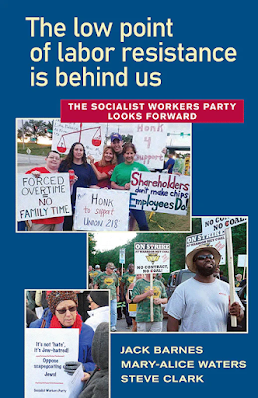
Book Review: The Low Point of Labor Resistance is Behind Us


Authored by Jack Barnes, Mary-Alice Waters and Steve Clark, The low point of labor resistance is behind us is the political report adopted by the 49th Constitutional Convention of the Socialist Workers Party (SWP), held on December 12th, 2022. The authors (whom I've dubbed the "Troika") are the long-time (going on five decades now) leaders of the Party. Comrades Barnes and Waters are over 80, while comrade Clark is about 70.

The premise is that the union movement has reached bottom, and because of economic misery workers are becoming more militant and more likely to organize and rebel. This, if true, will reverse a decades long trend that began in the 1970s.

Except I don't think it's true. Just today, in an editorial, the WSJ writes

Union members made up only 10.1% of the workforce last year, down from 10.3% in 2021, according to data released recently by the Labor Department. For a long time the prototypical union shop hasn’t been a private steel plant but a public school, yet the unionized share of government employees also fell.

Though the annual changes look small, they add up: The workforce in 2012 was 11.3% unionized, and in 2002 it was 13.3%. Organized labor hasn’t been able to stop the trend, despite frantic unionization drives, including many aimed at nontraditional members, such as the university graduate students who march under the United Auto Workers banner. Private workers are 6% unionized, down from 8.6% two decades ago. For public workers, it’s 33.1%, down from 37.3%.

Last week ZeroHedge reported similar statistics, along with this rather depressing gem:

The most unionized occupations are public safety (34.6%) and education (33.7%). The lowest are sales (3.0%) and computer and math jobs (3.3%). 

Bad news for Trotskyists, who don't consider cops to be part of the working class.

The Troika might concede that union membership hasn't yet recovered, but they'd insist that the trajectory has changed. Unions, they'd claim, are becoming more militant and better organized, which will be reflected in the overall statistics soon enough. They provide no data for that belief, but are concentrating their efforts in two unions: the bakery workers (BCTGM) and the rail workers. Among the bakery workers, 160 of them have gone on strike in recent months (120 at Ingredion, 40 at Corn Nuts). Both strikes have been settled. This does not auger a surge in labor activism.

The fact is that unions are increasingly irrelevant. There is a serious labor shortage for workers in blue collar professions, and those employees are getting raises. For example, Walmart recently raised starting salaries across the board from $12 to $14 per hour. That's a near 17% raise, for which no strike was required. They're doing this because they need the workers.

The Report consists of 27 sections, ranging in length from a paragraph to a page or two, organized within four chapters. The whole document (not counting prefatory material or illustrations) is about 60 pages long, or approximately 15,000 words. I read it in about three hours.

The first chapter is entitled Opposing US rulers' assaults on freedoms protected by the Constitution and their use of the political police. It describes in detail the unconstitutional persecution of Donald Trump and so-called "MAGA Republicans" by "the government's political police, first and foremost the FBI." It must be noted that the Party has had its own run-ins with the FBI before, notably the COINTELPRO lawsuit in which the Party won $264,000 in damages. Opposing the FBI is consistent with Party history, as the Report discusses at some length.

More, the Party notes that a majority of blue collar workers voted for Trump in 2016 and in 2020. Trump earned the vote of record numbers of Hispanics and Blacks (though the latter was still a small percentage). Therefore supporting civil rights in this case is in solidarity with the people whom they hope to represent. They cast themselves as being on the side of the "deplorables" and the "bitter clingers."

In their defense, the Report cites Leon Trotsky himself:

"Under conditions of the bourgeois regime, all suppressions of political rights and freedom, no matter whom they are directed against in the beginning, in the end inevitably bear down upon the working class, particularly its most advanced elements."

They are also very clear about who their opponents are.

Democrats, liberals, the "left," and "woke," so-called social justice warriors--not rightist or other reactionary forces--have led the assault against constitutional protections and freedoms in recent decades.

Trotskyists have always opposed the Democratic Party and all it stands for. The Report strongly reiterates that position.

While standing up for civil rights, the Report does not explicitly make clear their opposition to Trump and the Republican Party as agents of the bourgeoisie. Trump's name is mentioned in the Report only in passing, and the Republicans are not mentioned at all. This may lead to some confusion as to whether the Party still is part of the Left. I think they unambiguously are, but the Report would be better if they made that case explicitly.

The second chapter is entitled Capitalism's erosion of the family and the working-class road to women's emancipation. This includes some standard boilerplate:

Central to any communist program is a union-led fight for employment, with wage rates, work schedules, and job conditions necessary for families to live. ...

Jobs, not dependence on welfare programs, open a road forward. ...

Class-conscious workers call for a shorter workweek with no cut in pay, with regular hours.

So they're in favor of full employment, but then, after all that, they come out in favor of a comprehensive welfare program: "What is needed is a floor for all families--an income that's sufficient for workers..." to pay for all the bennies. The standard label for such a policy is universal basic income, and was championed by Andrew Yang in 2020.

The weirdest part of the Report concerns abortion. They claim that (boldface mine)

...we fight for women's right to reproductive and maternal health care, sex education (not gender indoctrination), as well as access to the safest and most reliable contraceptive methods and safe and legal abortion.

There is then a long section on how they supported Roe v Wade back in the 1970s, but have now come to regret that choice. The argument isn't entirely convincing. Summarizing in my own words, Roe v Wade short-circuited a national debate on abortion, depriving the working class of an opportunity to come to a decision on their own.

What the current Supreme Court has done, in the Dobbs v Jackson ruling, is simply return decisions about abortion to people in the individual states. They didn't rule on abortion one way or the other. The Party supports this move, and assumes that abortion will eventually be legal everywhere.

But now comes the truly mysterious part (in section 15; boldface mine):

The Socialist Workers Party unconditionally supports the decriminalization of abortion and joins others in fighting for it.

Decriminalization? Why that instead of legalization, as suggested in the prior quote? There is a difference, I suppose, but we're never told what it is.

A hint might be this:

...our communist program has nothing in common with bourgeois and middle-class forces--whether feminists, or campaigners for population control--who in fact advocate abortion as a means of contraception. We reject the pseudoscientific views of those who deny that the issue of human life, a profound moral question for all working people, is always involved in abortion decisions and procedures.

That second sentence is a bit hard to follow because of the double negative (...reject...deny...). It could be more simply written, but I think the mealy-mouthedness is on purpose.

I interpret the Party's position as pro-natalist, i.e., they want workers to have more babies. I think they're right--I describe myself using that word (and not just for workers). It's hard to square pro-natalism with unequivocal support for birth control and abortion. Therefore they equivocate.

The third chapter is entitled The Cuban socialist revolution and our communist continuity. It's much shorter than the first two, and in my opinion is completely wrong. Indeed, I think the Party's whole international analysis is wrong--I'll refer readers to books by Peter Zeihan for a clearer understanding. I'm going to skip over that here.

The fourth chapter--shortest of all--is Forging a proletarian party and educating its cadre. They claim, with no evidence whatsoever, that

The SWP is forging a proletarian party in the United States--a revolutionary political instrument of the working class, whose purpose, as our constitution asserts...is "to educate and organize the working class in order to establish a workers and farmers government, which will abolish capitalism in the United States and join in the worldwide struggle for socialism."

That's a tall order for a Party of about a hundred souls, with an average age in the 60s. The majority of comrades are at or nearing retirement age. Their current leading spokeswoman is Ilona Gersh, who is in her mid-seventies. The leaders are a pair of octogenarians.

What I am most disappointed with is that the Party has not brought in new, younger leadership. While I don't support the Party's goal of revolution and socialism, I have no fear of that ever happening even in my grandchildren's lifetime. But I'm sentimentally attached to my former comrades, and I want the Party to continue to exist. Having the same leadership for 50 years is not healthy. Presuming that the organization will have a meaningful voice when lead by octogenarians is fanciful.

I don't think Jack Barnes, Mary-Alice Waters, or Steve Clark are serious about the World Revolution. They're just concerned for their own sinecures--and what happens after that let the devil take the hindmost.

I enjoyed reading the Report. It's well written, entertaining, and not too long. The illustrations are silly--they're mostly pictures of people standing around holding placards, such as shown on the front cover. But the book is professionally produced. I didn't find any typos--if there are some in what I've quoted here, they are mine. Apologies in advance.


Further Reading:


Friday, January 27, 2023

ChatGPT and Artificial Intelligence

                                    (2100 words long. I have borrowed many ideas from Arnold Kling's substack.)

I've been doing a lot of thinking and reading about ChatGPT (GPT). For those of you living under a rock, GPT represents a major milestone in so-called artificial intelligence (AI). It's free for public use here, though you will need to register with a legit email address. I urge you to try it.

While GPT is the talk of the town on college campuses these days, its intersection with Trotskyism is minimal. For example, I asked GPT to

Give a brief biography of the SWP's Jack Barnes.

It replied

Jack Barnes is a political figure and a longtime leader of the Socialist Workers Party (SWP) in the United States. He joined the SWP in the 1960s and has been a central leader of the party since the 1970s. Barnes has written extensively on a wide range of political and theoretical topics, and has been a central figure in the SWP's efforts to build a revolutionary socialist movement in the United States. He has also been involved in various international socialist organizations and campaigns. Despite some controversies, Barnes is widely respected within the socialist movement for his commitment to building a revolutionary party and his contributions to socialist theory. 

I learned nothing from this--it's boilerplate bordering on balderdash. I got a better answer when I substituted in "Mary-Alice Waters" for Jack Barnes. I will note that you will likely get a different answer every time you enter a prompt.

Of the blogs on my Beat, the comrades over at Left Voice will probably care the most about GPT. That's because they're mostly college professors or aspire to become so. GPT threatens to upend their business model and their career plans, so I suspect they won't like it. But they most need to take my advice and learn how to use it. Consider this a brief tutorial.

So what is GPT?

Perhaps most important, GPT is not actually "intelligent", artificial or otherwise. It has no consciousness, it isn't creative, and it can only reorganize and spit out what one feeds in to it. It won't, for example, ever replace a journalist's job as it can't interview anybody, or observe what's happening in real time. At the end of the day it's just a large linear algebra processor, in many ways very similar to Google.

So what is different about GPT? I suggest it is analogous to a new graphical user interface (GUI). Point & click is a much easier way to navigate a webpage than typing in text in response to a ">" prompt. Now the point & click computer is not really any more intelligent than the ">" computer (though it probably does have more RAM and a better graphics card), but it really is a whole lot easier to use. Its construction required a whole new way of thinking about software--and so object-oriented programming was born.

A Google search is the analogue to the ">" prompt. You will get a list of links--perhaps thousands of them--and it will be up to you to find the ones most suited for your purpose. Google uses a linear algebra solver based on counting the number of links to any given webpage. So Google scours the web 24/365 to look and see which pages link to what other pages.

On the other hand, if you type a query into GPT (the "point & click" analogue), the computer doesn't do that. Yes, it still has a database of all the world's webpages (or soon will have that database), but it is no longer looking for links. Instead it is searching for words and phrases. Words and phrases that happen more frequently rise to the top, while those of less frequency sink to the bottom. Eg, "the red barn" will occur more often than "the red epistemology," and thus when asked to illustrate "red", GPT will cite "barn" rather than "epistemology." (Example borrowed from somewhere.) It's still a linear algebra machine, but it's now described as a "neural network" and supposedly is "artificial intelligence." Instead, it's just extremely clever software, just as object-oriented was extremely clever software.

But there is an additional twist. GPT can borrow phrases from across the web, and can put them together to make a coherent sentence and paragraph. That is, it has been taught the rules of English grammar, syntax and (to some extent) style. This is natural language processing, and I'm not sure how the computer learns how to do that. But it's not really saying anything original--it is merely piecing together bits of language that it's cribbed off the web.

In the Google world, you got a list of links, hopefully in order of declining relevance. In the GPT world, you get a list of words and phrases put together in paragraph form, constructed by a natural language processor. There is no fundamental difference--GPT isn't any more intelligent than Google and draws from the same dataset. But it organizes the data differently and allows for free form queries, and presents the results in a different format (written paragraphs), just as a GUI alters the input/output of graphical data.

Needless to say, the business most disrupted by GPT is Google, and my impression is that company is now sweating bricks. GPT was designed by OpenAI, which has received $billions in investment from Microsoft, which now proposes to invest billions more. In the search world this gives Microsoft a new killer app--or perhaps it's a Google-killer. Google is responding by accelerating its own investment in AI (an acronym that should be in scare quotes).

So could GPT have written this essay? Right now, No. That's because GPT is, as far as I know, trained only on data current thru 2021. The data I'm drawing from is much more recent than that, so therefore GPT has no access to my sources. But that's a short-term limitation; surely within the next few weeks or months there will be AI that searches the entire web. In that case GPT and I have access to exactly the same information. Or actually, not--for I have only accessed a dozen or so pages, while GPT has looked at billions. GPT knows way more than I do.

So why can't GPT write my essay better than I can? Because my essay reflects my personality just as much as it is about web pages. I come with a prejudice against AI--that is, I don't think it's intelligent, and I doubt it ever will be. Then, as will be apparent later, I have a bias against higher education. These biases (among others) reflect inputs into my essay that GPT will never have access to--and therefore it can't write my essay. It never will be able to. (If I were famous perhaps it could get closer. I can ask GPT to write an essay about inflation in the style of Paul Krugman, and what I'd get will be an imitation of Paul Krugman. Though were I to ask the real Paul Krugman for such an essay, it would likely be very different. But I'm not famous enough for GPT to imitate me.)

It appears that GPT can pass both the Medical Boards and the Bar Exam. Of course a person using Google could also pass those exams, but it would take them a lot longer. By searching for words and phrases rather than links, GPT greatly expedites the search process. It is not because GPT is more intelligent. Nevertheless, GPT is a very important new step in technology--at least as important as the modern graphical user interface. Mr. Kling suggests that GPT is as important as the founding of Netscape in 1994. That sounds about right to me.

If GPT can pass the Boards and the Bar, then it certainly can do a lot of the work that doctors and lawyers now do. Doctors' jobs are likely safer because they have to talk to, look at, and touch their patients. GPT can't do any of that. But once the doctor (or the nurse or PA) has accumulated a list of symptoms, then GPT can probably narrow down the diagnosis pretty quickly, and then also the recommended treatment. While GPT probably won't outright eliminate jobs, it will become an important medical coworker.

Lawyers, on the other hand, are at greater risk. I'll suggest that the work entry level lawyers do today will increasingly be done by GPT. If a legal practice is simply constructing wills and managing estates, I think they may be substantially out of business rather soon. Or at least have many fewer employees.

I read that GPT is an excellent programmer. Mr. Kling suggests that a million Indians, now working in Bangalore writing routine code, will soon be replaced by GPT.

Higher ed is both behind the eight ball and in the catbird seat. If they were smart they'd own GPT. But they're not smart--which is where the eight ball comes in. From lurking on my campus email, it seems the faculty's first response is just to ban the platform and assume all it's good for is cheating. I suspect that will be the go-to opinion of the Left Voice crowd. First, I'm shocked that they think so poorly of their students. Yes, some of them will cheat, but most of them won't. Second, this is a fool's errand--you will never be able to ban GPT. And I don't know why you'd want to (except perhaps on a few specific assignments). GPT will change the way higher ed works in very dramatic ways. I suggest it will make online education much cheaper and more effective. The benefits of a residential college will decline in relative terms. Since GPT will radically change the workplace, it must perforce change what higher ed teaches.

I believe (and have believed for some time now) that educating students in STEM fields is not useful, and I deplore the huge funds that governments and philanthropies are investing in STEM education. Because computers can already do math better than you can. And now GPT can program computers better than you can. GPT can probably do science and engineering better than you can, and learn to design experimental apparatus or an organic synthesis faster and better than any human. Of course there will always be a need for very high-end scientists and engineers--but much less need for the more mediocre sorts educated at smaller, public institutions like where I worked.

College algebra is a nearly useless subject. Calculus is even less useful. Yes, they're beautiful, and people who are interested in those disciplines for their own sake should be encouraged. But to require hundreds of students to take algebra and calculus because they're useful (when they're not) strikes me as not sensible. Calculus probably needs to go the way of Latin.

The careers of the future will not be in STEM. Instead they'll be in the arts and humanities. The scientist and engineer were careers for the 20th Century. Today they're increasingly automated away. The careers of the 21st Century are the artist, musician, storyteller, preacher, counselor, sex worker, nurse, teacher*, comedian, chef, hotelier, etc., along with the all-important skilled trades. Those are where the jobs will be. And those are the jobs that cannot be done any computer, much less GPT.

So how is higher ed in the catbird seat? That's because nobody really knows how to use GPT yet. How does one use the platform effectively? Ethically? How do you cite GPT sources? This is all very unclear, and it seems to me that the best people to work out some answers to those questions might be college faculty. Or, at least, should be if they weren't such ostriches about it. College faculty need to spend a lot of time using GPT, and need to give their students assignments using it, and play around with what "effective and ethical GPT use" actually means. There will certainly be some false starts, but for the most part I think it would be an adventure.


*By "teacher," I don't mean the college professor type who went to grad school and thinks she's smart enough to ban GPT. I mean something like the Bennington College model where the faculty are practicing artists who take a year-long sabbatical from their careers (art, music, theater, creative writing) to mentor young people who want to learn, only to go back to their careers after a year (or two). 

Further Reading: